Let's get real for a minute. Your sales team is probably drowning in admin work instead of actually selling. This isn't just a minor headache; it's a direct hit to your bottom line. Sales process optimization is all about cutting through that noise, fixing the bottlenecks, and freeing up your reps to do what they do best: close deals.
Why Your Sales Process Is Costing You Money
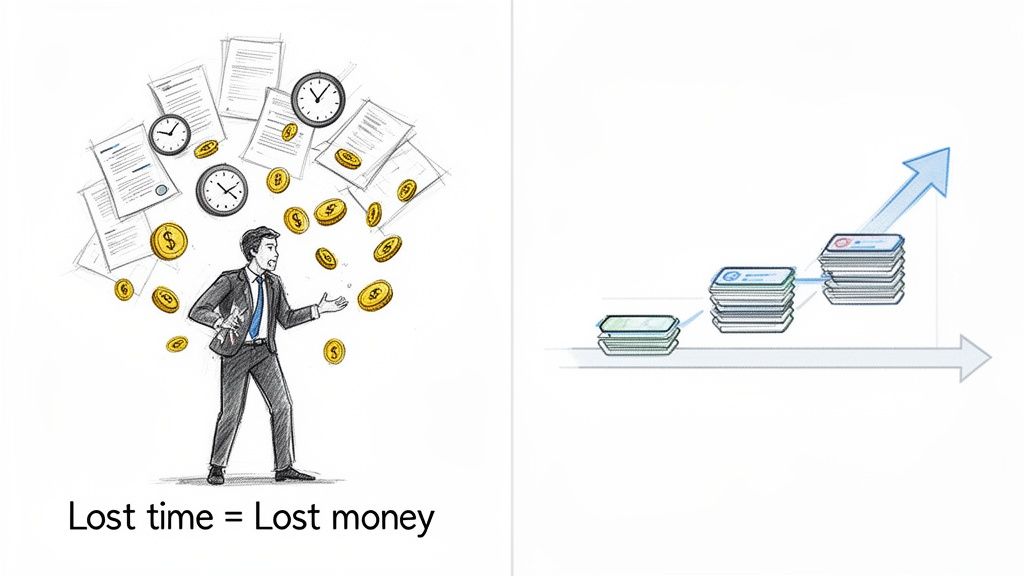
An old, manual sales process is a silent revenue killer, especially for small and medium-sized businesses. It creates friction that drags down deals, burns out your top performers, and lets perfectly good opportunities slip through the cracks. The results are painfully real: stalled deals, missed quotas, and a pipeline that just won’t grow.
The real problem is usually a messy, disconnected system. When your team is juggling spreadsheets, a separate CRM, and a handful of other prospecting tools, they spend more time wrangling data than they do talking to buyers. That chaos leads directly to some very expensive problems.
The Real Cost of Inefficiency
The industry has definitely caught on. The global market for sales process automation software was already valued at US$12.2 billion in 2024 and is on track to hit US$19.5 billion by 2030. That explosive growth is a direct reaction to a pretty shocking statistic: most sales reps spend only 28% of their week actually selling.
Where does the other 72% go? It gets eaten up by administrative work, manual data entry, and other tasks that don't generate a dime of revenue. You can dig into the data yourself in this detailed business report.
When reps are stuck doing manual work, they can't focus on building relationships and closing deals. Sales process optimization isn’t about piling on more tools—it’s about creating a single, intelligent workflow that does the heavy lifting for them.
This shift is a game-changer for any SMB trying to scale. A predictable, automated process turns sales from an unpredictable art into a measurable science. It makes sure every lead gets followed up on, every conversation is logged, and every rep is working from the same playbook.
From Chaos to a Revenue Engine
A messy sales process leaves money on the table. A tight, optimized one builds a repeatable revenue engine. Here’s a quick look at the difference.
Before and After Sales Process Optimization
Challenge in Unoptimized Process | Solution with Optimized Process | Stamina Feature |
|---|---|---|
Reps spend hours on manual data entry | Repetitive tasks are automated | Zara AI SDR & Workflows |
Inconsistent or forgotten follow-ups | Engagement flows ensure every lead is nurtured | Automated Engagement Flows |
Disconnected data across multiple tools | One CRM provides a single source of truth | Unified CRM Pipelines |
High-performing reps get bogged down | Reps focus on selling, not admin work | AI-Powered Sales Engagement |
Pipeline visibility is unclear and fragmented | Real-time analytics show what's working | Centralized Dashboards |
The goal is to move your team from the "before" column to the "after" column. By bringing everything into one platform like Stamina, you replace operational chaos with a system that works for your reps, not against them.
This approach gives your team a real edge by:
Automating Repetitive Tasks: Freeing reps from the soul-crushing work of manual data entry and prospect research.
Ensuring Consistent Follow-Up: Using automated engagement flows so no lead ever feels ignored or forgotten.
Providing a Single Source of Truth: Centralizing all customer data into one CRM for a complete, 360-degree view of your pipeline.
A structured process allows your team to move faster and with more confidence. For a real-world example of this in action, check out how Summit Life Group scaled their entire operation with Stamina. When you turn your sales process into a well-oiled machine, you don’t just boost efficiency—you create a more motivated and successful sales team.
How to Run a Sales Process Audit That Actually Works
You can't fix a sales process you don't really understand. A proper audit isn't about glancing at a few dashboards; it’s a full-on deep dive into every touchpoint, from the first lead interaction to the final signed contract. The whole point is to stop guessing and start using hard data to find the hidden friction that's quietly killing your revenue.
The first step is always mapping out your sales journey as it exists right now—not how you wish it were. This means getting in the trenches with your reps and tracing the actual path a deal takes. For a moment, forget the official playbook and focus on what’s really happening day-to-day.
Uncover the Truth Hidden in Your Data
Before you can make any real improvements to your sales process, you need an honest look at your current performance. This starts with getting all your data into one place so you can see the whole story. A unified CRM like Stamina is built for this, bringing deal stages, sales activities, and communication history together into a single source of truth.
With your data centralized, you can start asking the tough questions that point straight to your biggest bottlenecks. Don't just settle for surface-level metrics. Dig in and find the root cause.
Here’s where I’d start looking:
Deal Velocity: How long does it take for a deal to get from one stage to the next? Where do deals seem to get stuck for weeks on end?
Conversion Rates: What percentage of leads actually move from "Discovery" to "Demo"? A big drop-off at any specific stage is a huge red flag.
Sales Activity: Are your reps spending their time on things that actually close deals? Look at call logs, email volume, and meetings, then compare that activity to your closed-won deals. You’ll quickly see what works and what’s just busywork.
Manual Task Time: Just ask your reps to track how much time they spend on admin work—data entry, prospect research, updating the CRM. The number of hours lost to non-selling tasks might genuinely shock you.
Often, an audit shows that deals don't just stall randomly; they get stuck in the same place for the same reasons. For instance, you might discover that 70% of deals that sit in the "Proposal" stage for more than 14 days are eventually lost. That’s not a coincidence. It's a process problem screaming to be fixed.
An audit isn't about placing blame; it's about finding opportunities. Once you identify where deals get stuck, you've found the most valuable places to focus your efforts.
Visualizing your pipeline is a must for this kind of analysis. A clear, stage-by-stage view instantly shows you where the process is breaking down.
Take this pipeline, for example. It’s immediately clear where deals are piling up.
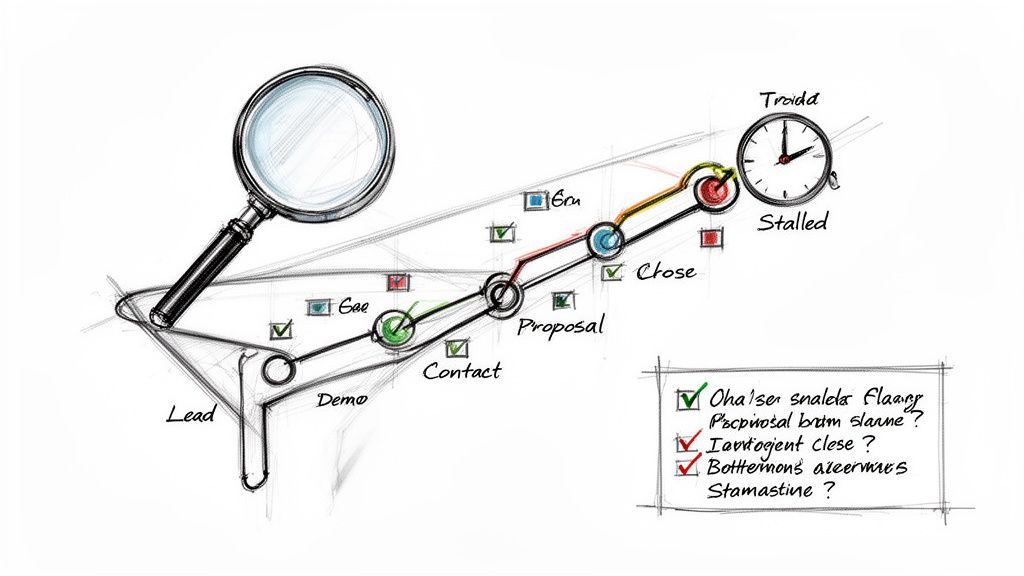
This visual makes it painfully obvious that the "Stalled" stage is a black hole for revenue. That’s where you need to focus your attention first.
Sit Down with Your Team and Ask the Right Questions
Your data tells you what is happening, but only your team can tell you why. After you've spotted the problem areas in your CRM, it's time to talk to your sales reps. They're on the front lines, and they have the real-world insights you’ll never find on a dashboard.
But don't just ask generic questions. You need to structure your conversations to get specific, actionable feedback that reveals the friction they deal with every single day.
Here are some essential questions to ask your sales team:
Lead Follow-Up: What’s our actual process for following up on a new inbound lead? How fast are we on it, and how many times do we try before we give up?
Qualification: How do you decide if a lead is qualified? Is everyone on the team doing it the same way?
Content Gaps: What materials do you wish you had when a prospect asks for a case study or more info?
Handoffs: Where do things get messy when marketing passes a lead to sales (or an SDR to an AE)? Is key info getting lost?
Closing Blockers: What are the top three things that slow down deals in the final stages? Is it always legal review, budget approval, or something else?
The answers will expose the gaps between the process you think you have and the reality your team lives in. For a lot of SMBs, a common discovery is the total lack of a standard workflow for nurturing long-term leads. Reps are often left to invent their own methods, which creates a messy and inconsistent experience for buyers. If you want to build better systems, our guide on how to create a workflow is a great place to start.
When you bring together the hard data from your CRM and the real-world insights from your team, your audit will give you a clear, evidence-based roadmap for optimizing your entire sales process.
Designing Your AI-Powered Sales Framework

Once you’ve audited your current process, you can start designing a modern sales framework. This isn't about small tweaks. It’s about completely rethinking how work gets done by embedding smart automation at the heart of your operations.
The goal is simple: let AI handle the repetitive, time-sucking tasks so your sales reps can focus on what they do best—building relationships and closing deals.
This is where the idea of an AI Sales Development Representative (SDR) becomes a real game-changer. Imagine an SDR that works 24/7, researches thousands of prospects in minutes, and writes hyper-personalized outreach at a scale no human team could ever touch. That’s exactly what tools like Stamina's AI SDR, Zara, were built for.
Automating the Top of the Funnel
The heaviest lift in any sales process is almost always at the very top of the funnel—prospecting, research, and that first contact. This is also where sales process optimization gives you the fastest wins.
Instead of your SDRs burning hours on LinkedIn and company websites, an AI SDR can get it done in seconds.
For instance, you could give an AI SDR a prompt like: "Find 100 marketing VPs at B2B SaaS companies in North America with 50-250 employees who recently posted on LinkedIn about 'demand generation'." Zara won't just find them; she’ll analyze their activity to pinpoint pain points you can use for personalized outreach. This automates the grunt work, freeing your team for more strategic follow-ups.
From Data Points to Personalized Conversations
The real magic of an AI-driven framework is turning raw data into compelling conversations. AI has completely changed what’s possible for sales productivity. The data backs it up, too.
Reps who use AI tools effectively are 3.7 times more likely to hit their quota. Companies that adopt AI-powered CRMs have seen conversion and productivity jump by 10-30%, with 73% of users reporting a major boost. You can discover more insights on AI's impact on sales productivity.
An AI SDR uses all this data to move far beyond generic templates. It can spin up entire email sequences based on a prospect’s industry, title, and recent online behavior.
Here’s a quick look at how you can design an AI-powered workflow:
Define Your Target: Set your Ideal Customer Profile (ICP) in the system, including firmographics like company size and technographics like the software they use.
Set the Trigger: Tell the AI SDR to kick off its research the moment a prospect matching your ICP visits your pricing page or downloads a whitepaper.
Generate the Outreach: The AI drafts a three-step email sequence. The first email might reference their recent activity, the second can share a relevant case study, and the third asks for a meeting.
Launch and Learn: The system deploys the emails, A/B tests subject lines on its own, and tracks engagement to make future outreach even smarter.
This kind of structured approach transforms your top-of-funnel from a manual, inconsistent chore into a predictable, scalable machine. It also ensures that by the time a lead gets to a human rep, they’re already qualified and warmed up. For a closer look at how this works, you can explore the capabilities of an AI SDR like Zara.
Measuring Your AI-Powered Engine
To make sure your new framework is actually working, you need to track the right metrics. An AI-powered sales process should deliver clear improvements in very specific areas. Forget vanity metrics and focus on the KPIs that tie directly to efficiency and revenue.
An AI sales framework isn't about replacing your reps; it's about making them superhuman. By automating the 80% of work that is research and data entry, you free them to excel at the 20% that is building relationships and closing deals.
The table below breaks down the essential KPIs to watch as you implement your AI-powered framework. Monitoring these will give you a clear, data-backed view of your sales process health and the ROI of your automation efforts.
Key Performance Indicators for Sales Process Health
KPI Category | Primary Metric | What It Measures | How to Improve It |
|---|---|---|---|
Top-of-Funnel Efficiency | Meetings Booked by AI SDR | The AI's effectiveness at generating qualified appointments. | Refine outreach prompts and ICP targeting. |
Sales Velocity | Lead-to-Opportunity Conversion Rate | The percentage of leads that become qualified pipeline. | Improve lead scoring and handoff process. |
Rep Productivity | Time Spent on Core Selling Activities | The shift in rep focus from admin tasks to active selling. | Automate more non-selling tasks (e.g., CRM updates). |
Pipeline Health | Average Sales Cycle Length | The time it takes to close a deal from first contact. | Use AI to identify and remove bottlenecks faster. |
Tracking these numbers will tell you exactly where your new process is winning and where you might need to make adjustments. It’s all about continuous, data-driven improvement.
Putting Your New Sales Process Into Action
A brilliant sales framework on paper is worthless if your team doesn't actually follow it. The real test of sales process optimization is turning that shiny new design into a daily reality for your reps.
This is where you shift from strategy to execution. The goal is to make your new process the path of least resistance—so easy and effective that your team wouldn't want to do it any other way.
The key is to build a living, breathing sales playbook that your team will use because it makes their lives easier. This isn't some dusty binder on a shelf; it's a dynamic resource embedded right into their daily workflow. When you build this inside a unified platform like Stamina, your playbook becomes an interactive guide that actively helps reps sell.
Building a Playbook Reps Will Actually Use
An effective playbook does more than just list out sales stages. It gives your reps the exact tools and language they need for every single interaction, which cuts down on guesswork and builds a ton of confidence. It should be the one-stop shop for all your selling resources.
Here’s what this kind of living playbook should have:
Up-to-Date Scripts: Clear, field-tested scripts for that first outreach call, the discovery deep-dive, and the final demo. They're not meant to be read like a robot, but they provide a solid foundation.
Email and SMS Templates: Pre-approved templates for common situations, like following up after a demo or trying to re-engage a cold lead. This ensures a consistent message and saves reps hours of writing time.
Objection-Handling Guides: A list of the most common objections your team hears, along with proven, value-based responses. When a rep gets pushback on price, they should have a confident answer ready to go.
Competitive Battlecards: Equip your team with quick, scannable summaries of your top competitors. You need to highlight their weak spots and your key differentiators so your team is always prepared.
By putting these assets directly inside your CRM and sales engagement platform, you make them available right when they're needed. A rep shouldn't have to click away from their workflow to find the right resource. It has to be right there.
The goal isn't to turn reps into robots. It's to give them a toolkit that handles the repetitive parts of their job, so they can dedicate their brainpower to active listening, strategic thinking, and building genuine relationships with buyers.
This approach flips the script. The playbook stops being a mandate and becomes a valuable asset that directly helps reps hit their targets and, let's be honest, make more money.
Automating Engagement to Drive Consistency
One of the biggest leaks in any sales funnel is inconsistent follow-up. A well-designed process makes sure no lead ever falls through the cracks. Automation is how you make that happen without burning out your team.
We're not talking about your basic email drips here. Modern engagement sequences blend multiple touchpoints across different channels to create a persistent, yet natural, follow-up experience. With a tool like Stamina, you can orchestrate these multi-touch campaigns to run on their own.
For instance, this is what an automated engagement flow for a warm inbound lead might look like inside Stamina.
This visual shows how you can map out a flow that combines emails, social media touches, and internal task reminders into a single, automated sequence. The system drives the process, ensuring every lead gets the right amount of attention at the right time.
Let's walk through a tangible example. Say a warm lead downloads an e-book from your site. Here’s a multi-touch sequence you could run:
Day 1 (Instant): An automated, personalized email goes out from the assigned rep. It references the e-book they downloaded and suggests a quick chat.
Day 2 (Automated Task): The system creates a task for the rep to connect with the prospect on LinkedIn and "like" one of their recent posts. A simple, human touch.
Day 4 (Automated Email): A second email is sent, this time sharing a case study that’s relevant to the prospect's industry.
Day 7 (Automated Task): The system pings the rep with another task, this time to make a phone call.
Day 10 (Automated Email): A final, "break-up" style email is sent to get a response or just close the loop cleanly.
The best part? All of this happens without a single manual trigger from the rep after the initial setup. This is how you guarantee persistent, consistent follow-up at scale. By operationalizing your new framework with a living playbook and automated engagement, you free up your team to focus on the high-value activities that actually close deals.
Measuring Success and Refining Your Process
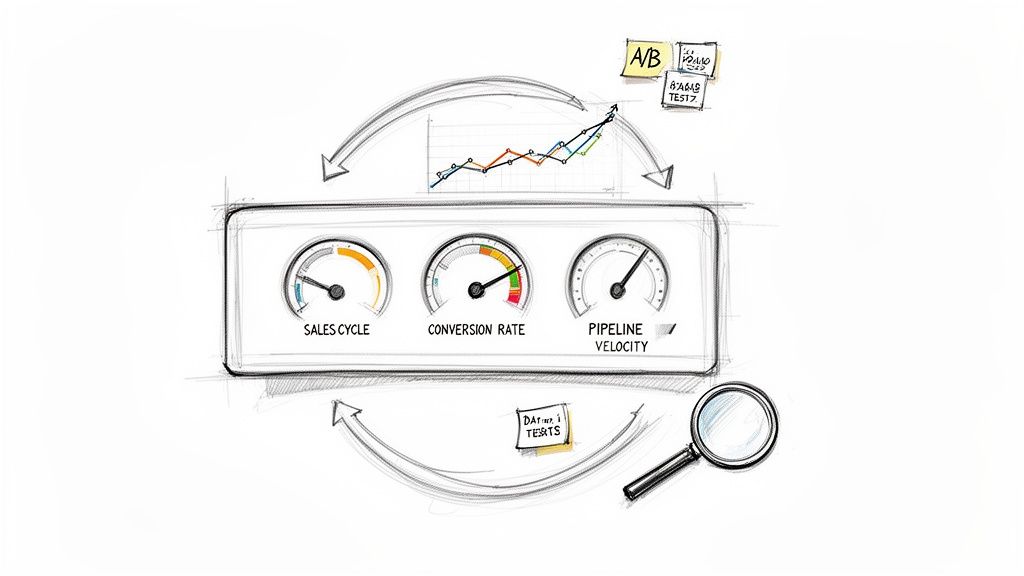
Getting your new sales framework live is a huge win, but it’s not the finish line. Far from it. Real sales process optimization is a living, breathing thing—a constant feedback loop where you measure, test, and tweak. Your market will shift, your buyers will change, and your process needs to evolve right along with them. This is where you turn a good sales engine into a machine that gets smarter every quarter.
This isn’t about hunches or gut feelings. It’s about creating a culture where data calls the shots. The proof is in the numbers: companies that live by their data are 58% more likely to crush their revenue goals. High-performing teams get it—50% of them say conversion rate is their top metric for efficiency. And it's a team sport, with 92% of sales leaders collaborating to keep their processes sharp, as shown in this in-depth report on sales trends.
Build Dashboards That Actually Tell a Story
You can’t fix what you can’t see. Your first move is to build dashboards that give you a real-time, at-a-glance health check on your sales engine. A unified platform like Stamina is a game-changer here, pulling all your data into one spot so you’re not scrambling to connect dots between five different tools.
Your dashboards need to go deeper than just revenue. You want the leading indicators, the metrics that show you the how and why behind your results.
Key Metrics for Your Optimization Dashboard:
Sales Cycle Length: The average time from first touch to a closed deal. If this number starts creeping up, you’ve likely got a new bottleneck somewhere in the process.
Pipeline Velocity: This tracks how fast deals move through your pipeline and how much value is closing daily. It’s a killer metric for measuring your overall sales momentum.
Stage-by-Stage Conversion Rates: Keep an eye on the percentage of deals that move from one stage to the next. A huge drop-off between “Demo” and “Proposal” is a red flag that your demos aren't connecting value to the price tag.
Think of these numbers as your early warning system. They’ll show you where friction is building up long before it torpedoes your quarter.
A/B Test Everything That Matters
Once you have your core metrics, you can start experimenting. A/B testing isn't just for marketing anymore; it’s one of the most powerful tools for refining your sales process. The idea is simple: test one variable at a time and let the data tell you what actually works.
Instead of guessing what reps think is the best approach, you can get definitive answers. Stamina’s sales engagement tools make this dead simple, letting you test different outreach elements and tracking the results automatically.
Here are a few high-impact tests you can run right away:
Email Subject Lines: Try a question-based subject line (“Struggling with lead gen?”) against a benefit-driven one (“A new way to fill your pipeline”).
Outreach Cadences: Pit a 7-step sequence over 14 days against a more aggressive 5-step sequence over 10. Does persistence or urgency get more replies?
Call-to-Action (CTA): Does asking for a “15-minute exploratory call” perform better than a “30-minute demo”?
This testing mindset turns your sales motion into a living laboratory. You’ll uncover surprising insights about what your buyers truly respond to, and you can bake those wins right into your playbook. It also pays to dig into the conversations themselves, and you can learn more about the power of call intelligence to do just that.
Your sales process should never be set in stone. Treat it like a product that you are constantly iterating on based on user feedback—your sales team and your customers.
Foster a Culture of Constant Improvement
Data and tools are great, but the final piece is building a culture where data-driven feedback is not just welcomed but expected. You need a dedicated time and place to talk about what’s working, what’s broken, and how to fix it.
A quarterly process review meeting is the perfect way to do this. It gets sales leadership, top-performing reps, and even marketing in the same room to look at the data and share what they’re seeing on the front lines.
Here’s a simple agenda for running an effective quarterly review:
Look at the Numbers (20 min): Walk through the core dashboard metrics. Where did things improve? Where did they slip?
Celebrate the Wins (10 min): Shine a spotlight on a specific A/B test that killed it or a rep who found a brilliant new way to handle an objection.
Dig into the Bottlenecks (20 min): Zero in on one or two stages where deals are getting stuck. Open the floor for reps to share why they think it’s happening.
Brainstorm & Prioritize (10 min): Based on the discussion, agree on one or two new experiments to run in the next quarter.
This simple, structured meeting makes sure optimization isn’t a one-off project but a continuous, collaborative effort. It also empowers your reps, showing them their feedback directly shapes the process and making them true partners in building a world-class sales engine.
Of course. Here is the rewritten section, crafted to sound completely human-written, following the specific style and tone from your examples.
Your Top Questions About Sales Process Optimization, Answered
Changing up your sales process always kicks up a few questions. You’re moving from comfortable habits to a new system that runs on data, and that’s a big shift. Let’s tackle the most common questions I hear from teams making this move, so you can walk in with clarity and confidence.
This isn't about just checking boxes. It’s about really understanding what makes a new process stick and actually drive revenue for your business.
How Do I Get My Sales Team to Buy In?
Getting your team on board isn’t about a top-down mandate. It’s about showing them what’s in it for them. Let's be honest, most sales reps are coin-operated. Show them how a new process helps them close more deals and make more money, and you’ll have their full attention.
A great way to start is by bringing them into the audit process itself. Let them point out the frustrating bottlenecks they already deal with every day—like mind-numbing manual data entry or hunting for the right sales deck. When they see optimization as a way to free them up to do what they actually enjoy (selling), they’ll become your biggest advocates, not your biggest obstacles.
What Are the Most Important Metrics to Track?
While every business is unique, a few KPIs are non-negotiable for knowing if your sales process is healthy or broken. It’s easy to get lost in vanity metrics, so my advice is to zero in on the numbers that directly tie to revenue and efficiency.
Start with these three:
Sales Cycle Length: How long does it take to get a deal from first contact to closed-won? This is your best indicator of process efficiency.
Lead-to-Opportunity Conversion Rate: What percentage of your leads are actually turning into real, qualified pipeline? This tells you if your top-of-funnel is working.
Pipeline Velocity: How fast are deals moving through your pipeline, and what’s the average value of deals closing each day? This is a powerhouse metric that shows your revenue momentum at a glance.
The goal isn’t just to track numbers; it’s to understand the story they’re telling. If your conversion rate suddenly drops at the proposal stage, for example, that points to a specific problem you can go in and fix.
Focusing on these actionable metrics means you can make decisions based on facts, not just guesses.
How Long Until We See Real Results?
This is the million-dollar question, and the honest answer is: it depends. You can definitely see some quick wins within the first 30-60 days, especially from automating top-of-funnel tasks. For example, using an AI SDR to handle prospecting can immediately free up rep time and pump up your outreach volume.
But seeing a major impact on bigger metrics like your overall sales cycle length or win rates—that takes a bit longer, usually around 3-6 months. It takes time for the team to fully adopt the new process, for longer deals to work their way through the new pipeline stages, and for you to gather enough data to make smart refinements. Be patient and focus on those small, steady improvements.
Ready to stop losing deals to process friction? With Stamina, you can unify your CRM, sales, and marketing into one AI-powered platform. Automate outreach with our AI SDR, build smarter engagement flows, and get the data you need to optimize your entire revenue engine. Start closing more deals with Stamina.

