Instantly.ai Review 2026: Is It Worth It for SMBs?

A deep-dive Instantly.ai review for 2026. We analyze features, deliverability, real costs, and compare it to all-in-one platforms like Stamina for SMBs.

0 - Minute Read

You're probably looking at Instantly.ai because your outbound process has crossed an invisible line. One rep can no longer manage follow-ups in Gmail. One spreadsheet can't keep lead lists clean. One warm domain isn't enough. The quick fixes that worked when outreach was light now create daily friction.

That's usually when Instantly enters the conversation. It has become one of the default names in cold email because it promises scale, warmup, and a cleaner way to run outbound without buying a heavyweight sales platform. For many teams, that's compelling.

But an honest Instantly.ai review can't stop at the homepage pitch or the base plan price. The critical question is whether it works well enough, consistently enough, and cheaply enough once you factor in the rest of the stack around it. If you're still shaping your outbound motion, it also helps to zoom out and compare Instantly with broader effective B2B prospecting strategies and tools so you don't mistake a strong sending tool for a full revenue system.

An Honest Instantly.ai Review for Scaling Your Outreach

Instantly is not typically adopted because of a love for new software. Rather, its adoption occurs when current setups begin to fail in familiar ways. Reps send from too few inboxes. Deliverability slips. Reply management turns messy. Prospect lists live in one tool, sequences in another, and deal updates somewhere else entirely.

Instantly is popular for a reason. It gives outbound teams a fast path to multi-inbox cold email, warmup, and campaign management without a long implementation cycle. That matters when a founder, SDR, or agency operator needs to start sending now, not after a quarter of systems work.

Still, popularity doesn't answer the operational questions that matter later.

The best outbound tools look cheap at the point of purchase and expensive at the point of use.

That's the lens worth using here. Instantly can be a strong specialist. It can also become the center of a fragmented workflow where the hidden work shifts to your team. You still need lead sourcing, compliance review, CRM discipline, campaign analysis, and a process for acting on replies.

This review looks at Instantly the way a sales ops lead would. Not as a shiny outreach app, but as part of a revenue system. The core issue isn't whether it can send cold email. It can. The issue is whether it's the right foundation for a growing SMB that needs clean handoffs between prospecting, outreach, pipeline management, and follow-up.

What Is Instantly.ai and Who Is It Really For

A hand-drawn illustration showing paper airplanes flying into an inbox, with the Instantly.ai brand logo featured prominently.

Instantly.ai is best understood as a specialist outreach platform. Its center of gravity is cold email. Not full-funnel orchestration. Not deep CRM management. Not broad marketing automation. It's built to help teams send outreach at volume and protect inbox placement while doing it.

That specialist focus has worked commercially. Founded in 2021, Instantly.ai rapidly scaled to serve over 20,000 customers, from solopreneurs to global agencies, and holds a 4.9 out of 5-star rating on G2 from over 2,600 reviews, according to Breakcold's Instantly.ai review.

Think specialist tool, not operating system

The easiest analogy is a dragster versus a pickup truck. A dragster is excellent at one thing. Straight-line speed. It's not designed to haul equipment, handle rough roads, or carry a team through everyday work. Instantly is similar. For cold email sending and warmup, it's built for focus.

That's good if your problem is narrow and immediate.

It's less good if your team needs all of these in one place:

  • Pipeline visibility: Reps, managers, and founders all need the same view of lead status, not scattered updates.

  • Marketing handoff: Website leads, nurture flows, outbound targets, and deal activity should connect.

  • Shared customer context: Sales and marketing should work from the same contact history.

Who usually gets the most value

Instantly makes the most sense for a few specific profiles:

  • Solo operators: Founders and freelancers who need outreach live quickly.

  • Agency teams: Operators managing outbound campaigns across multiple client inboxes.

  • Early-stage startups: Teams still testing message-market fit and segment response.

  • Dedicated outbound shops: Teams where email is the primary channel and other systems are already handled elsewhere.

If your revenue motion is mostly “find leads, send cold email, book calls,” Instantly fits cleanly.

Who should be cautious

A more integrated team can outgrow it fast. If your business depends on clean movement between prospecting, marketing nurture, sales activity, and CRM reporting, a point solution creates overhead. Someone has to sync data, reconcile lead status, and keep process gaps from turning into missed follow-ups.

That's the dividing line in this Instantly.ai review. It's not whether the tool is legitimate. It clearly is. It's whether your team needs a specialist or a system.

Core Features A Deep Dive Into Deliverability and Analytics

A digital marketing dashboard showing email campaign performance metrics like deliverability, open rate, click rate, and conversions.

A team can write strong copy, buy clean data, and still miss quota if mailbox placement slips for two weeks. That is the operational reality behind any serious Instantly.ai review. Deliverability is the feature that determines whether the rest of the product matters.

According to ZoomInfo's review of Instantly.ai, Instantly.ai's proprietary Deliverability Network utilizes over 1,000,000 real email accounts to exchange positive engagement signals with user inboxes. It features a 'Slow Ramp' mechanism to prevent spam flags and offers Premium and Private Pool tiers to further boost sender reputation.

That setup addresses a common scaling problem. Outbound teams add inboxes, raise daily send volume, and assume the system will absorb the change. Mailbox providers usually do not. Sudden volume shifts, weak engagement, and uneven sending behavior create reputation issues that show up as lower reply rates before anyone notices a technical problem.

Instantly's warmup system is built to reduce that risk. The large network matters, but the operational value is in how the product helps teams phase volume up with less guesswork. Slow Ramp is one of the more practical controls here because it protects newer inboxes from being pushed too hard too early.

For a lean outbound team, that saves time. For a larger team, it saves cleanup work.

The strongest parts of the deliverability layer are straightforward:

  • Warmup is native: Teams do not need to patch together a separate warmup tool and monitor two systems.

  • Pool options give admins more control: Premium and Private Pool settings help teams treat newer inboxes, older domains, and higher-risk campaigns differently.

  • Inbox placement testing adds a second check: Sending volume is one thing. Seeing whether messages reach the primary inbox is what matters in production.

That last point gets missed often. Sales teams tend to measure success by launches and send counts, while ops teams care about stability over time. The same discipline applies in other channels. Teams that care about SMS and voice deliverability already understand that routing quality, sender trust, and message placement are ongoing operational concerns, not one-time setup items.

Teams comparing point solutions against broader platforms should also look at whether deliverability sits inside the rest of the revenue workflow. Stamina's deliverability product layer is a good example of that design choice. The difference is not just feature coverage. It changes who has to own troubleshooting, how many tools need to stay synced, and how quickly revenue teams can act when performance drops.

Practical rule: Judge deliverability software by how fast your team can detect a problem, isolate the cause, and protect sending reputation before pipeline slows down.

Analytics are useful, but they stay close to the email channel. Instantly gives teams visibility at the account, campaign, and sequence-step level, with reporting built around opens, clicks, replies, and bounces, as covered in EmailTooltester's Instantly review. That is enough for campaign management. It helps reps and ops leads identify weak copy, underperforming inboxes, and steps that should be rewritten or paused.

The limit shows up after the campaign. Instantly can tell you which sequence produced replies. It does not give you the full commercial picture unless you connect it to other systems and keep those connections clean. That is where total cost of ownership starts to rise. A low monthly price looks different once someone on your team has to reconcile contact status, sync CRM fields, and explain why campaign metrics do not match pipeline reporting.

Here is the practical split:

Area

Instantly handles it well

Instantly needs help

Sending infrastructure

Yes

No

Warmup and sender reputation

Yes

No

Sequence performance analysis

Yes

No

Full-funnel attribution

Partial

Yes

Shared CRM context

Partial

Yes

If your team needs a focused cold email engine, Instantly does the core job well. If your team needs one operating system for outbound, reporting, and customer context, these strengths come with extra integration work, extra process debt, and a higher real cost than the base subscription suggests.

The Secret Weapon Website Visitor Identification

A hand-drawn illustration showing a magnifying glass revealing detailed visitor information on a company website.

Most cold email tools help you send better messages. Instantly has one feature that changes who you send to in the first place. That feature is Watchtower, its native website visitor identification capability.

According to TrulyInbox's Instantly review, Instantly's native Website Visitor Identification (Watchtower) resolves anonymous US-based site traffic to business emails and job titles, allowing users to automatically trigger campaigns based on visitor behavior like page views without requiring third-party integrations.

Why this matters more than another sequence feature

This feature moves part of your outbound motion from cold to warm. That distinction matters. A purchased list gives you a static target. A visitor who looked at your pricing page or service page gives you timing and context.

That changes the quality of outreach. Instead of sending a generic first-touch email, a rep can shape messaging around observed interest. The lead still may not know you personally, but the outreach is no longer blind.

A warm signal beats a larger cold list when the rep knows how to use it.

What the workflow looks like

Operationally, the appeal is simple. You install the tracking layer, and Instantly tries to resolve anonymous business traffic into actionable contacts. The useful part isn't only the identification. It's the native routing into campaigns or contact lists.

That removes a lot of glue work.

Without native visitor identification, teams often end up with a setup like this:

  • Tracking tool: Detects company visits

  • Enrichment tool: Tries to find contacts

  • Automation layer: Moves data between systems

  • Outreach platform: Finally sends the email

Watchtower compresses that process inside one product. For teams that care about prospect research quality, this is also a good moment to review broader approaches to intent-driven list building and prospect research tools, because the outreach quality still depends on how well you interpret the signal.

The real limitation

The biggest caveat is fit. This capability is US-based only in the verified material, so it won't carry the same value for every market. Teams selling internationally need to think carefully before treating it as a universal intent engine.

There's also a process discipline issue. Visitor data is only useful when reps respond with context. If the team sends the same canned sequence they use for generic cold outreach, the strategic advantage disappears.

The feature itself is strong. The value comes from how quickly your team turns that signal into relevant outreach.

Pricing and The Hidden Costs of a Point Solution

The sticker price is what pulls many SMBs into Instantly. The total cost of ownership is what should make them slow down.

The verified data here is unusually helpful because it surfaces a gap most reviews skip. According to The Showcase's review of what Swedish B2B teams miss about Instantly.ai, while Instantly's seat cost is low, the total cost for users in regulated markets like Sweden can be much higher due to mandatory add-ons like data enrichment tools ($50–$200/month) and the necessary legal compliance reviews for lawful basis documentation under IMY scrutiny.

The cheap plan is rarely the whole system

This is the central TCO problem with point solutions. The base subscription covers one layer of work. The business still has to fund the rest.

In real use, teams often end up adding:

  • A CRM: Because outreach replies and pipeline tracking can't stay disconnected for long.

  • A data source or enrichment tool: Because list quality decides whether campaigns are viable.

  • Compliance review: Especially in regulated markets where lawful basis, suppression handling, and documentation aren't optional.

  • Ops time: Someone still needs to manage imports, status syncing, exclusions, and campaign hygiene.

The software bill is only one part of the cost. The hidden expense is process coordination.

Compliance is where low-cost narratives break

For regulated markets, this isn't theoretical. It changes the economics of the tool. A team can buy a low-cost seat and still spend far more making the workflow legally usable and commercially safe.

There's another practical cost in smaller markets. Burn the wrong contacts with poor targeting, and you don't just lose one campaign. You can damage sender reputation and account perception for an extended period. In a narrow market, that hurts more because the pool is limited.

If your addressable market is small, every bad send has a larger business cost.

What SMB buyers should actually ask

Before buying Instantly, a practical buyer should answer these questions:

  1. Where will contact data come from? If the answer is “somewhere else,” budget for it.

  2. Where will opportunities be managed? If the answer is “our CRM,” plan the integration and process work.

  3. Who owns compliance review? If nobody owns it, the risk is already in the system.

  4. Who updates lead status across tools? Manual syncing always looks manageable before volume arrives.

For teams comparing alternatives, this is the point where package pricing becomes less important than system design. A lower subscription can still produce a higher operating cost. If you want to pressure-test that idea against a more unified pricing model, compare it with an all-in-one option such as Stamina pricing.

That doesn't make Instantly bad. It makes it narrow. Narrow tools can be excellent. They're just rarely complete.

Instantly.ai vs Stamina An All-in-One Alternative

A common SMB scenario looks like this. Sales buys Instantly to speed up outbound. Marketing keeps running in a separate platform. The CRM lives somewhere else. Lead data comes from another vendor. Within a month, the team has a sending tool that works, but the revenue process is split across four systems and nobody fully owns the handoffs.

That is the actual comparison here.

Instantly is a specialist product. Stamina is an operating system for revenue work. If the team already has clean process, strong CRM hygiene, reliable data sources, and someone managing the stack, Instantly can fit well. If those pieces are still forming, a point solution often adds coordination work faster than it adds usable output.
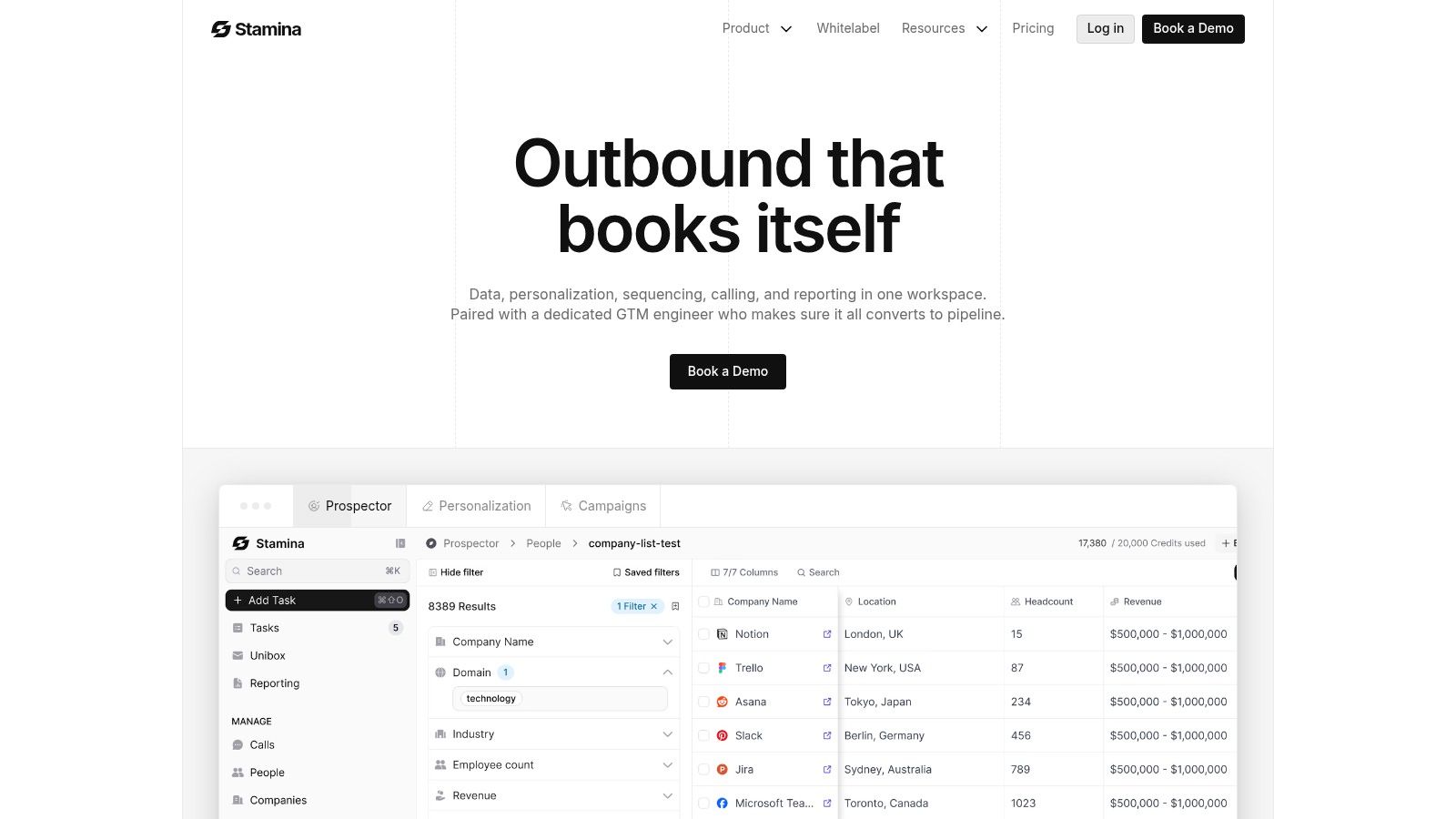
Screenshot from https://stamina.io

Where Instantly wins

Instantly is the better fit when the assignment is narrow and clearly owned. Send cold email at volume. Rotate across inboxes. Manage warmup. Launch sequences quickly. Agencies, SDR teams with an established stack, and operators who already know how to source data and push outcomes back into a CRM can get value fast.

That specialist focus still matters.

There is also a category difference worth calling out. Tools in this segment are often judged on inbox health first and workflow second. Comparisons such as this Lemwarm vs Instantly comparison are useful because they show how much of the market is still centered on deliverability mechanics rather than pipeline management.

Where an all-in-one platform changes the economics

The harder problem for a growing team is not sending email. It is sending the right email, at the right time, with enough account context that reps do not sound interchangeable.

As noted earlier, Instantly's own reporting highlights the value of relevance and concise messaging. The issue is operational. A sending platform can execute outreach, but it usually depends on outside systems for account history, web activity, lead source, deal stage, and prior touchpoints. That means reps or ops people have to assemble context before the sequence goes out, then sync results after replies come in.

An all-in-one platform changes that cost structure. Prospect data, outreach history, pipeline status, and follow-up logic sit in one system, so the team spends less time moving records around and less time checking whether the CRM reflects reality. That is the practical advantage behind an all-in-one business platform model. It reduces tool switching, ownership gaps, and duplicate admin work.

Side-by-side practical difference

Here is the decision in operating terms:

Decision area

Instantly as point solution

Stamina as integrated platform

Outreach execution

Strong for cold email

Built into broader revenue workflow

CRM coordination

Separate system or integration work

Native record and workflow management

Marketing and sales handoff

Depends on process discipline

Shared data and activity history

Personalization inputs

Pulled from external tools and research

Available inside the same system

Reporting

Split across platforms

Tied to campaigns, pipeline, and follow-up in one place

Operational overhead

Rises as the stack expands

Lower if it replaces multiple tools

The table understates one thing. Handoff quality usually decides whether the stack holds up.

In a point-solution setup, marketing captures interest, ops enriches records, sales launches sequences, and someone later updates the CRM. Every extra step creates delay, stale fields, or missed context. In a unified system, the same contact record can move from first touch to opportunity without a rep wondering which tool has the latest version.

That does not make Instantly the wrong choice. It makes it a narrower one. Teams buying a cold email engine should choose it for that reason. Teams trying to simplify revenue operations usually get more long-term value from fewer systems, clearer ownership, and one place to manage the full motion.

Final Verdict Is Instantly.ai Right for You

Instantly earns its reputation. It's a capable cold email platform with strong deliverability infrastructure, a clean specialist focus, and one standout differentiator in website visitor identification. For freelancers, agencies, and outbound-heavy teams that mainly need to send cold email at scale, it's a legitimate choice.

The friction starts when an SMB expects it to be more than that.

This Instantly.ai review comes down to system fit. If your workflow is already built around separate tools for CRM, prospect data, compliance, and reporting, Instantly can slot into that environment as the outreach engine. If your business is still assembling those pieces, Instantly can pull you into a fragmented stack faster than you realize.

The low seat cost is real. So are the hidden costs. Data sourcing. Compliance review. Process coordination. Sync work between platforms. Those don't show up neatly on the pricing page, but your team will still pay for them in software, labor, or missed follow-up quality.

My recommendation is simple:

  • Choose Instantly.ai if cold email is the core motion and your team is comfortable managing a specialist tool inside a broader stack.

  • Look elsewhere if you want one system to connect prospecting, outreach, pipeline, and nurture from the start.

For most growing SMBs, the long-term win usually comes from reducing operational seams, not adding another excellent point solution.

If you're at the stage where outbound, CRM, and marketing need to work as one system, take a look at Stamina. It's built for SMBs that want one revenue platform instead of a stack of disconnected tools, with AI-assisted prospecting, outreach, automation, and CRM in one place.

You're probably looking at Instantly.ai because your outbound process has crossed an invisible line. One rep can no longer manage follow-ups in Gmail. One spreadsheet can't keep lead lists clean. One warm domain isn't enough. The quick fixes that worked when outreach was light now create daily friction.

That's usually when Instantly enters the conversation. It has become one of the default names in cold email because it promises scale, warmup, and a cleaner way to run outbound without buying a heavyweight sales platform. For many teams, that's compelling.

But an honest Instantly.ai review can't stop at the homepage pitch or the base plan price. The critical question is whether it works well enough, consistently enough, and cheaply enough once you factor in the rest of the stack around it. If you're still shaping your outbound motion, it also helps to zoom out and compare Instantly with broader effective B2B prospecting strategies and tools so you don't mistake a strong sending tool for a full revenue system.

An Honest Instantly.ai Review for Scaling Your Outreach

Instantly is not typically adopted because of a love for new software. Rather, its adoption occurs when current setups begin to fail in familiar ways. Reps send from too few inboxes. Deliverability slips. Reply management turns messy. Prospect lists live in one tool, sequences in another, and deal updates somewhere else entirely.

Instantly is popular for a reason. It gives outbound teams a fast path to multi-inbox cold email, warmup, and campaign management without a long implementation cycle. That matters when a founder, SDR, or agency operator needs to start sending now, not after a quarter of systems work.

Still, popularity doesn't answer the operational questions that matter later.

The best outbound tools look cheap at the point of purchase and expensive at the point of use.

That's the lens worth using here. Instantly can be a strong specialist. It can also become the center of a fragmented workflow where the hidden work shifts to your team. You still need lead sourcing, compliance review, CRM discipline, campaign analysis, and a process for acting on replies.

This review looks at Instantly the way a sales ops lead would. Not as a shiny outreach app, but as part of a revenue system. The core issue isn't whether it can send cold email. It can. The issue is whether it's the right foundation for a growing SMB that needs clean handoffs between prospecting, outreach, pipeline management, and follow-up.

What Is Instantly.ai and Who Is It Really For

A hand-drawn illustration showing paper airplanes flying into an inbox, with the Instantly.ai brand logo featured prominently.

Instantly.ai is best understood as a specialist outreach platform. Its center of gravity is cold email. Not full-funnel orchestration. Not deep CRM management. Not broad marketing automation. It's built to help teams send outreach at volume and protect inbox placement while doing it.

That specialist focus has worked commercially. Founded in 2021, Instantly.ai rapidly scaled to serve over 20,000 customers, from solopreneurs to global agencies, and holds a 4.9 out of 5-star rating on G2 from over 2,600 reviews, according to Breakcold's Instantly.ai review.

Think specialist tool, not operating system

The easiest analogy is a dragster versus a pickup truck. A dragster is excellent at one thing. Straight-line speed. It's not designed to haul equipment, handle rough roads, or carry a team through everyday work. Instantly is similar. For cold email sending and warmup, it's built for focus.

That's good if your problem is narrow and immediate.

It's less good if your team needs all of these in one place:

  • Pipeline visibility: Reps, managers, and founders all need the same view of lead status, not scattered updates.

  • Marketing handoff: Website leads, nurture flows, outbound targets, and deal activity should connect.

  • Shared customer context: Sales and marketing should work from the same contact history.

Who usually gets the most value

Instantly makes the most sense for a few specific profiles:

  • Solo operators: Founders and freelancers who need outreach live quickly.

  • Agency teams: Operators managing outbound campaigns across multiple client inboxes.

  • Early-stage startups: Teams still testing message-market fit and segment response.

  • Dedicated outbound shops: Teams where email is the primary channel and other systems are already handled elsewhere.

If your revenue motion is mostly “find leads, send cold email, book calls,” Instantly fits cleanly.

Who should be cautious

A more integrated team can outgrow it fast. If your business depends on clean movement between prospecting, marketing nurture, sales activity, and CRM reporting, a point solution creates overhead. Someone has to sync data, reconcile lead status, and keep process gaps from turning into missed follow-ups.

That's the dividing line in this Instantly.ai review. It's not whether the tool is legitimate. It clearly is. It's whether your team needs a specialist or a system.

Core Features A Deep Dive Into Deliverability and Analytics

A digital marketing dashboard showing email campaign performance metrics like deliverability, open rate, click rate, and conversions.

A team can write strong copy, buy clean data, and still miss quota if mailbox placement slips for two weeks. That is the operational reality behind any serious Instantly.ai review. Deliverability is the feature that determines whether the rest of the product matters.

According to ZoomInfo's review of Instantly.ai, Instantly.ai's proprietary Deliverability Network utilizes over 1,000,000 real email accounts to exchange positive engagement signals with user inboxes. It features a 'Slow Ramp' mechanism to prevent spam flags and offers Premium and Private Pool tiers to further boost sender reputation.

That setup addresses a common scaling problem. Outbound teams add inboxes, raise daily send volume, and assume the system will absorb the change. Mailbox providers usually do not. Sudden volume shifts, weak engagement, and uneven sending behavior create reputation issues that show up as lower reply rates before anyone notices a technical problem.

Instantly's warmup system is built to reduce that risk. The large network matters, but the operational value is in how the product helps teams phase volume up with less guesswork. Slow Ramp is one of the more practical controls here because it protects newer inboxes from being pushed too hard too early.

For a lean outbound team, that saves time. For a larger team, it saves cleanup work.

The strongest parts of the deliverability layer are straightforward:

  • Warmup is native: Teams do not need to patch together a separate warmup tool and monitor two systems.

  • Pool options give admins more control: Premium and Private Pool settings help teams treat newer inboxes, older domains, and higher-risk campaigns differently.

  • Inbox placement testing adds a second check: Sending volume is one thing. Seeing whether messages reach the primary inbox is what matters in production.

That last point gets missed often. Sales teams tend to measure success by launches and send counts, while ops teams care about stability over time. The same discipline applies in other channels. Teams that care about SMS and voice deliverability already understand that routing quality, sender trust, and message placement are ongoing operational concerns, not one-time setup items.

Teams comparing point solutions against broader platforms should also look at whether deliverability sits inside the rest of the revenue workflow. Stamina's deliverability product layer is a good example of that design choice. The difference is not just feature coverage. It changes who has to own troubleshooting, how many tools need to stay synced, and how quickly revenue teams can act when performance drops.

Practical rule: Judge deliverability software by how fast your team can detect a problem, isolate the cause, and protect sending reputation before pipeline slows down.

Analytics are useful, but they stay close to the email channel. Instantly gives teams visibility at the account, campaign, and sequence-step level, with reporting built around opens, clicks, replies, and bounces, as covered in EmailTooltester's Instantly review. That is enough for campaign management. It helps reps and ops leads identify weak copy, underperforming inboxes, and steps that should be rewritten or paused.

The limit shows up after the campaign. Instantly can tell you which sequence produced replies. It does not give you the full commercial picture unless you connect it to other systems and keep those connections clean. That is where total cost of ownership starts to rise. A low monthly price looks different once someone on your team has to reconcile contact status, sync CRM fields, and explain why campaign metrics do not match pipeline reporting.

Here is the practical split:

Area

Instantly handles it well

Instantly needs help

Sending infrastructure

Yes

No

Warmup and sender reputation

Yes

No

Sequence performance analysis

Yes

No

Full-funnel attribution

Partial

Yes

Shared CRM context

Partial

Yes

If your team needs a focused cold email engine, Instantly does the core job well. If your team needs one operating system for outbound, reporting, and customer context, these strengths come with extra integration work, extra process debt, and a higher real cost than the base subscription suggests.

The Secret Weapon Website Visitor Identification

A hand-drawn illustration showing a magnifying glass revealing detailed visitor information on a company website.

Most cold email tools help you send better messages. Instantly has one feature that changes who you send to in the first place. That feature is Watchtower, its native website visitor identification capability.

According to TrulyInbox's Instantly review, Instantly's native Website Visitor Identification (Watchtower) resolves anonymous US-based site traffic to business emails and job titles, allowing users to automatically trigger campaigns based on visitor behavior like page views without requiring third-party integrations.

Why this matters more than another sequence feature

This feature moves part of your outbound motion from cold to warm. That distinction matters. A purchased list gives you a static target. A visitor who looked at your pricing page or service page gives you timing and context.

That changes the quality of outreach. Instead of sending a generic first-touch email, a rep can shape messaging around observed interest. The lead still may not know you personally, but the outreach is no longer blind.

A warm signal beats a larger cold list when the rep knows how to use it.

What the workflow looks like

Operationally, the appeal is simple. You install the tracking layer, and Instantly tries to resolve anonymous business traffic into actionable contacts. The useful part isn't only the identification. It's the native routing into campaigns or contact lists.

That removes a lot of glue work.

Without native visitor identification, teams often end up with a setup like this:

  • Tracking tool: Detects company visits

  • Enrichment tool: Tries to find contacts

  • Automation layer: Moves data between systems

  • Outreach platform: Finally sends the email

Watchtower compresses that process inside one product. For teams that care about prospect research quality, this is also a good moment to review broader approaches to intent-driven list building and prospect research tools, because the outreach quality still depends on how well you interpret the signal.

The real limitation

The biggest caveat is fit. This capability is US-based only in the verified material, so it won't carry the same value for every market. Teams selling internationally need to think carefully before treating it as a universal intent engine.

There's also a process discipline issue. Visitor data is only useful when reps respond with context. If the team sends the same canned sequence they use for generic cold outreach, the strategic advantage disappears.

The feature itself is strong. The value comes from how quickly your team turns that signal into relevant outreach.

Pricing and The Hidden Costs of a Point Solution

The sticker price is what pulls many SMBs into Instantly. The total cost of ownership is what should make them slow down.

The verified data here is unusually helpful because it surfaces a gap most reviews skip. According to The Showcase's review of what Swedish B2B teams miss about Instantly.ai, while Instantly's seat cost is low, the total cost for users in regulated markets like Sweden can be much higher due to mandatory add-ons like data enrichment tools ($50–$200/month) and the necessary legal compliance reviews for lawful basis documentation under IMY scrutiny.

The cheap plan is rarely the whole system

This is the central TCO problem with point solutions. The base subscription covers one layer of work. The business still has to fund the rest.

In real use, teams often end up adding:

  • A CRM: Because outreach replies and pipeline tracking can't stay disconnected for long.

  • A data source or enrichment tool: Because list quality decides whether campaigns are viable.

  • Compliance review: Especially in regulated markets where lawful basis, suppression handling, and documentation aren't optional.

  • Ops time: Someone still needs to manage imports, status syncing, exclusions, and campaign hygiene.

The software bill is only one part of the cost. The hidden expense is process coordination.

Compliance is where low-cost narratives break

For regulated markets, this isn't theoretical. It changes the economics of the tool. A team can buy a low-cost seat and still spend far more making the workflow legally usable and commercially safe.

There's another practical cost in smaller markets. Burn the wrong contacts with poor targeting, and you don't just lose one campaign. You can damage sender reputation and account perception for an extended period. In a narrow market, that hurts more because the pool is limited.

If your addressable market is small, every bad send has a larger business cost.

What SMB buyers should actually ask

Before buying Instantly, a practical buyer should answer these questions:

  1. Where will contact data come from? If the answer is “somewhere else,” budget for it.

  2. Where will opportunities be managed? If the answer is “our CRM,” plan the integration and process work.

  3. Who owns compliance review? If nobody owns it, the risk is already in the system.

  4. Who updates lead status across tools? Manual syncing always looks manageable before volume arrives.

For teams comparing alternatives, this is the point where package pricing becomes less important than system design. A lower subscription can still produce a higher operating cost. If you want to pressure-test that idea against a more unified pricing model, compare it with an all-in-one option such as Stamina pricing.

That doesn't make Instantly bad. It makes it narrow. Narrow tools can be excellent. They're just rarely complete.

Instantly.ai vs Stamina An All-in-One Alternative

A common SMB scenario looks like this. Sales buys Instantly to speed up outbound. Marketing keeps running in a separate platform. The CRM lives somewhere else. Lead data comes from another vendor. Within a month, the team has a sending tool that works, but the revenue process is split across four systems and nobody fully owns the handoffs.

That is the actual comparison here.

Instantly is a specialist product. Stamina is an operating system for revenue work. If the team already has clean process, strong CRM hygiene, reliable data sources, and someone managing the stack, Instantly can fit well. If those pieces are still forming, a point solution often adds coordination work faster than it adds usable output.

Screenshot from https://stamina.io

Where Instantly wins

Instantly is the better fit when the assignment is narrow and clearly owned. Send cold email at volume. Rotate across inboxes. Manage warmup. Launch sequences quickly. Agencies, SDR teams with an established stack, and operators who already know how to source data and push outcomes back into a CRM can get value fast.

That specialist focus still matters.

There is also a category difference worth calling out. Tools in this segment are often judged on inbox health first and workflow second. Comparisons such as this Lemwarm vs Instantly comparison are useful because they show how much of the market is still centered on deliverability mechanics rather than pipeline management.

Where an all-in-one platform changes the economics

The harder problem for a growing team is not sending email. It is sending the right email, at the right time, with enough account context that reps do not sound interchangeable.

As noted earlier, Instantly's own reporting highlights the value of relevance and concise messaging. The issue is operational. A sending platform can execute outreach, but it usually depends on outside systems for account history, web activity, lead source, deal stage, and prior touchpoints. That means reps or ops people have to assemble context before the sequence goes out, then sync results after replies come in.

An all-in-one platform changes that cost structure. Prospect data, outreach history, pipeline status, and follow-up logic sit in one system, so the team spends less time moving records around and less time checking whether the CRM reflects reality. That is the practical advantage behind an all-in-one business platform model. It reduces tool switching, ownership gaps, and duplicate admin work.

Side-by-side practical difference

Here is the decision in operating terms:

Decision area

Instantly as point solution

Stamina as integrated platform

Outreach execution

Strong for cold email

Built into broader revenue workflow

CRM coordination

Separate system or integration work

Native record and workflow management

Marketing and sales handoff

Depends on process discipline

Shared data and activity history

Personalization inputs

Pulled from external tools and research

Available inside the same system

Reporting

Split across platforms

Tied to campaigns, pipeline, and follow-up in one place

Operational overhead

Rises as the stack expands

Lower if it replaces multiple tools

The table understates one thing. Handoff quality usually decides whether the stack holds up.

In a point-solution setup, marketing captures interest, ops enriches records, sales launches sequences, and someone later updates the CRM. Every extra step creates delay, stale fields, or missed context. In a unified system, the same contact record can move from first touch to opportunity without a rep wondering which tool has the latest version.

That does not make Instantly the wrong choice. It makes it a narrower one. Teams buying a cold email engine should choose it for that reason. Teams trying to simplify revenue operations usually get more long-term value from fewer systems, clearer ownership, and one place to manage the full motion.

Final Verdict Is Instantly.ai Right for You

Instantly earns its reputation. It's a capable cold email platform with strong deliverability infrastructure, a clean specialist focus, and one standout differentiator in website visitor identification. For freelancers, agencies, and outbound-heavy teams that mainly need to send cold email at scale, it's a legitimate choice.

The friction starts when an SMB expects it to be more than that.

This Instantly.ai review comes down to system fit. If your workflow is already built around separate tools for CRM, prospect data, compliance, and reporting, Instantly can slot into that environment as the outreach engine. If your business is still assembling those pieces, Instantly can pull you into a fragmented stack faster than you realize.

The low seat cost is real. So are the hidden costs. Data sourcing. Compliance review. Process coordination. Sync work between platforms. Those don't show up neatly on the pricing page, but your team will still pay for them in software, labor, or missed follow-up quality.

My recommendation is simple:

  • Choose Instantly.ai if cold email is the core motion and your team is comfortable managing a specialist tool inside a broader stack.

  • Look elsewhere if you want one system to connect prospecting, outreach, pipeline, and nurture from the start.

For most growing SMBs, the long-term win usually comes from reducing operational seams, not adding another excellent point solution.

If you're at the stage where outbound, CRM, and marketing need to work as one system, take a look at Stamina. It's built for SMBs that want one revenue platform instead of a stack of disconnected tools, with AI-assisted prospecting, outreach, automation, and CRM in one place.

Share this article

Share this article

Send a shareable link to your team or anyone who might find it useful.

Send a shareable link to your team or anyone who might find it useful.

Copy link

Copied

Share directly to

Table of contents

Give Your Business the Stamina it needs to Thrive

PRODUCT

COMPANY

RESOURCES

© 2026 Stamina Software Technologies Inc. All rights reserved.

PRODUCT

COMPANY

RESOURCES

© 2026 Stamina Software Technologies Inc. All rights reserved.

PRODUCT

COMPANY

RESOURCES

© 2026 Stamina Software Technologies Inc. All rights reserved.