

If your tech stack feels like a mess of apps that don’t talk to each other, you’re not imagining things. An all in one business platform fixes this by giving you a single control center for every revenue-focused activity. It creates one source of truth for your business data, bringing your sales, marketing, and customer service efforts under one roof.
Escaping the Chaos of Disconnected Software

For most small and mid-sized businesses (SMBs), just managing the daily tech is a huge drain. You probably use one tool for CRM, another for email marketing, a third for booking meetings, and maybe a fourth for website analytics. This is a classic case of "tool sprawl"—the slow, creeping takeover of your business by dozens of separate apps.
Each new tool starts with good intentions, bought to solve one specific problem. But over time, they create a fragile system that’s a nightmare to manage. It’s like building a car with parts that were never meant to work together. This "software Frankenstein" demands constant manual work just to connect the dots, killing your team's efficiency.
The Problem with Disconnected Systems
When your tools don’t communicate, your teams end up working in silos. Critical customer info gets stuck in one app, making it impossible to see the full picture of a customer's journey. This fragmentation quietly sabotages your growth in several ways.
Incomplete Customer View: Your sales team has no idea which marketing emails a lead just opened. Your marketing team can’t see where a deal is in the pipeline.
Wasted Time and Resources: Your team wastes hours every week manually exporting and importing CSV files between systems. It’s boring, and it’s a recipe for human error.
Poor Decision-Making: Without one source of truth, leaders are stuck making big decisions with incomplete or old data pulled from a dozen different spreadsheets.
This operational drag—the friction caused by data silos and manual work—not only wastes time but also leads to missed sales opportunities and a disjointed customer experience. It’s a hidden cost that slowly eats away at your bottom line.
Finding a Unified Path Forward
The alternative is an all in one business platform. Imagine a single, clean dashboard where every piece of customer data lives. From the first email they opened to the final sale and every interaction after, it's all tracked and managed in one place. This integrated approach turns your technology from a headache into a real strategic advantage.
This guide will show you exactly how a unified platform can bring clarity to your operations. You’ll learn the core benefits, the must-have features, and how to pick the right system for real growth. By the end, you’ll have a clear plan for simplifying your tech and getting back to what you do best: running your business.
The True Cost of Your Fragmented Tech Stack
When you add up your monthly software bills, the total might seem fine. But that number—the visible cost—is just the tip of the iceberg. The real damage from a fragmented tech stack is hidden in the daily friction and lost opportunities that quietly bleed your budget and stall your growth.

Think about this all-too-common scenario: your marketing team runs a killer campaign and sends a fresh batch of leads over to sales. But because their marketing tool doesn’t talk to your CRM, your sales reps are flying blind. They have no idea which emails a prospect opened or what pages they checked out on your site, forcing them to start every single conversation from scratch.
This disconnect causes a painful ripple effect. Your marketing team, lacking a unified view of what actually works, resorts to generic, one-size-fits-all emails that land with a thud. Meanwhile, leadership is stuck trying to make critical decisions by taping together conflicting reports from a dozen different systems—a process that’s both a massive time-waster and dangerously inaccurate.
Quantifying The Friction
This constant, invisible friction has a name: “operational drag.” It’s the force created by disconnected data silos and the endless manual workarounds your team invents just to get through the day. It’s the time spent exporting and importing spreadsheets, the hot leads that fall through the cracks between systems, and the clunky customer experiences that result from a disjointed process.
Every hour an employee spends on manual data entry is an hour they aren't spending talking to customers or figuring out how to grow the business. This drag doesn't just slow you down; it actively costs you money.
The market is already reacting. Demand for a single, streamlined solution is so strong that the all-in-one marketing platform market, valued at $2.56 billion in 2025, is projected to explode to $7.76 billion by 2033. You can dig into more of these market growth trends on Data Insights Market. This trend isn't a fluke; it highlights how urgently SMBs need a better way to operate without juggling a dozen different tools.
From Disconnected Tools to a Unified System
When you put the two approaches side-by-side, the difference between a fragmented setup and an all in one business platform becomes crystal clear. While point solutions might fix one specific problem, they often create a much bigger, system-wide mess of inefficiency. A unified platform, on the other hand, is built to make the whole greater than the sum of its parts.
Let's look at a head-to-head comparison.
Point Solutions vs All In One Platform A Head-to-Head Comparison
Business Area | Point Solutions (The Old Way) | All-in-One Platform (The New Way) |
|---|---|---|
Data & Reporting | Incomplete, siloed data; manual report building | A single source of truth; automated, 360-degree dashboards |
Sales & Marketing | Misaligned teams; inconsistent messaging | Coordinated campaigns; shared customer intelligence |
Customer Experience | Disjointed and impersonal interactions | A seamless, personalized journey across all touchpoints |
Team Efficiency | High manual workload; wasted hours on data entry | Automated workflows; focus on strategic, revenue-driving tasks |
Getting rid of operational drag does more than just save you a few bucks on subscriptions. It unlocks new levels of team efficiency, gets your sales and marketing teams actually collaborating, and gives you the clear, complete data you need to make smart decisions. The business case for unifying your tech isn't just compelling—it's undeniable.
The Core Features of a True All In One Platform
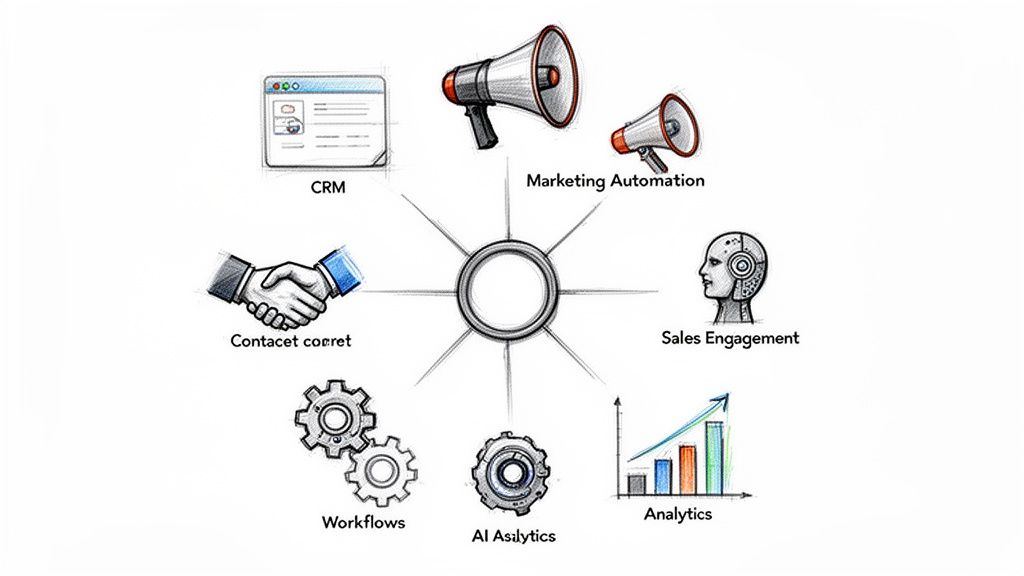
To really get what an all in one business platform does, you have to look past the buzzwords and see how the pieces fit together. These aren't just random features bundled into a subscription. They're interconnected pillars designed to share data and automate work across your entire revenue team. A real unified platform isn't just software—it's the operating system for your go-to-market engine.
Think about a modern car's dashboard. You don’t have separate gauges for speed, fuel, and engine temp, all made by different companies and duct-taped together. You get one clean, integrated display that shows you everything you need to know, instantly. That’s exactly what a true all-in-one platform does for your business.
Let's break down the non-negotiable features that make up a powerful, modern system.
A Unified CRM: The Central Nervous System
At the heart of every great all in one business platform is a Unified Customer Relationship Management (CRM) system. This isn’t just another glorified contact list. It’s the central nervous system that pulls in and organizes every single customer data point. Every interaction, from the first marketing email a lead opened to their latest sales call, all lives in one place.
This single source of truth is what finally kills the data silos that cripple teams using a patchwork of different tools. When your CRM is truly unified with everything else, your sales team can see a lead's full marketing history, and your marketing team knows exactly where a contact is in the sales pipeline. This shared intel is the foundation for creating personalized experiences that actually land. Check out how a flexible CRM can become the core of your business and how it all connects.
A unified CRM makes sure every team member is working from the same playbook. It stops valuable customer insights from getting lost in the shuffle between departments and lets everyone act on the most current, complete information available.
Marketing Automation for Intelligent Nurturing
Once you have that central hub for all your customer data, the next pillar is Marketing Automation. This is what lets you nurture leads and customers at scale without sounding like a robot. Instead of just blasting generic emails to your entire database, you can build smart, automated campaigns based on specific behaviors and data points already sitting in the CRM.
For example, you can set up a workflow that automatically sends a series of targeted educational emails to anyone who downloads a specific ebook. If a lead keeps coming back to your pricing page, the system can instantly alert a sales rep and add that person to a "high-intent" segment for an immediate follow-up. This kind of intelligent nurturing keeps your brand top-of-mind and moves prospects through the funnel way more efficiently.
Sales Engagement Tools for Effective Outreach
While marketing automation warms up your leads, Sales Engagement tools give your sales team the power to act on them. This is where the platform helps reps turn those warm leads into qualified opportunities. Because these tools are built right on top of the CRM data, your sales team gets everything they need in one workspace.
Key sales engagement features usually include:
Multi-step sequencing: Create and automate a series of emails, calls, and social touches to guarantee consistent follow-up.
One-click dialing and call logging: Let reps make calls directly from the CRM, with every activity and note logged automatically.
Email templates and tracking: Give reps access to pre-approved, high-performing email templates and notify them the second a prospect opens an email or clicks a link.
By having these tools inside the same platform, you stop forcing reps to jump between their CRM, their email client, and their dialer. It saves a massive amount of time and ensures every single sales activity is captured in the central customer record.
AI Assistants and Advanced Workflows
The most advanced all in one business platforms now come with Artificial Intelligence (AI) and Advanced Workflows that automate processes across different teams. An AI assistant can act like a tireless sales development rep (SDR), automatically finding ideal customer profiles, researching prospects, and even drafting personalized outreach emails for your team to quickly review and send.
Advanced workflows take this a step further by orchestrating complex plays between departments. Imagine a workflow where a high-value customer submits a support ticket, which automatically triggers a notification to their account manager in the CRM and creates a task for them to personally follow up. That seamless handoff between service, sales, and the CRM is only possible in a truly unified environment.
Integrated Analytics: A 360-Degree View
Finally, the whole system is tied together with Integrated Analytics. Because all your data—marketing, sales, and service—lives in one place, you can finally get a true 360-degree view of your business performance. You can track a customer's entire journey, from the first ad they ever clicked to their total lifetime value, all from a single dashboard.
This unified reporting lets you answer the big-picture questions that are nearly impossible to tackle with a mess of disconnected tools. This is where the market is headed. Fueled by the SaaS boom, worldwide revenue for these platforms is projected to grow at 19.38% annually, hitting a massive $793.10 billion market volume by 2029. You can dive deeper into the latest SaaS statistics to see the trends for yourself. This is the power an all-in-one platform brings to the table.
Swapping out a messy tech stack for a single, integrated system isn't just a cleanup project. It’s a direct move to fatten up your bottom line. An all in one business platform stops being just another line item on your expense report and starts acting like a real investment in efficiency and growth—one with a clear return you can actually see.
The magic happens when you shift from thinking about software bills to focusing on business results. Let's dig into exactly how a unified platform delivers, focusing on three things that really matter: cutting costs, boosting revenue, and making your team more efficient.
Significant Cost Savings
The first and most obvious return comes from cost consolidation. Go ahead and tally up what you’re paying each month for your CRM, email marketing tool, sales dialer, scheduler, and analytics software. For most small businesses, this "software tax" adds up fast, often hitting hundreds or thousands of dollars a month. A single platform subscription almost always costs less than the sum of its parts.
But the savings run deeper than just the monthly fees. You also get to ditch all the "soft costs" that drain your resources:
Less Admin Work: Forget juggling multiple vendor contracts, payments, and renewal dates.
Faster Training: Onboarding a new hire is way simpler when they only need to master one system, not five.
No More Integration Fees: You can stop paying for expensive, clunky connectors just to make your tools pretend to like each other.
When you consolidate your tech, you're not just trimming the software budget. You're getting back all the time and money you used to burn just managing a complicated, broken system.
Accelerated Revenue Growth
Saving money is good, but making more is better. A unified platform is a revenue engine because it finally gets your sales and marketing teams rowing in the same direction. When everyone has a single view of the customer journey, from first click to final sale, they can move faster and make smarter decisions.
This alignment fuels growth in a few concrete ways:
Higher Conversion Rates: When your sales reps can see a lead's entire marketing history—every email opened, every page visited—they can have conversations that are actually relevant. That means more deals close.
Shorter Sales Cycles: Automated nurturing keeps prospects engaged, and instant alerts on high-intent actions (like checking out your pricing page) let reps jump in at the perfect moment. Deals just move faster.
More Customer Lifetime Value: With all your data in one spot, it's way easier to find upsell and cross-sell opportunities. You can turn one-time buyers into loyal customers and move beyond basic dashboards to build ad hoc reports that reveal growth opportunities.
Major Efficiency Gains
Maybe the most underrated ROI driver is the huge jump in team efficiency. When you automate the boring stuff and kill manual data entry, you give your team their most precious resource back: time. Instead of wasting hours exporting spreadsheets, they can actually focus on strategy and talking to customers.
There's a reason the market is shifting so hard toward unification. The global business software and services market is projected to rocket from $721.14 billion in 2026 to an eye-watering $1,523.46 billion by 2034, with cloud platforms leading the way. You can dig into the numbers yourself in this Fortune Business Insights report.
Here’s what this looks like in the real world: A marketing agency I know ditched five separate tools—a CRM, email tool, dialer, reporting app, and lead scraper—for one all-in-one platform. In just three months, they saw a 40% increase in qualified demos and shaved their average sales cycle by 25%. The team was suddenly flying because they weren't fighting their software anymore. That’s the kind of impact that proves the ROI of going all-in-one.
How to Choose the Right All-In-One Platform
Picking an all-in-one business platform isn't like buying another piece of software. It’s a huge strategic decision. It's easy to get sidetracked by flashy demos and features that sound great but don't actually help you grow.
To pick the right one, you need a clear way to cut through the noise. You’re looking for a partner that will become the backbone of your company, not just another vendor. This means you have to look past the sales pitch and ask the tough questions about how the platform will actually hold up day-to-day.
Assess True Scalability
The business you have today won't be the same in three years. The platform you choose has to grow with you, from 10 customers to 10,000, without slowing down or falling apart. Scalability isn't just about handling more data; it’s about whether the platform can keep up with your ambition.
Ask yourself these questions:
User Growth: Can I add new team members easily, or am I going to get hit with massive price hikes and technical headaches?
Data Volume: As we pile up years of customer conversations, deals, and marketing campaigns, will the system grind to a halt?
Feature Tiers: Are the advanced tools I'll need later—like AI and complex automation—available in higher plans? Or will I be forced into an expensive enterprise package right from the start?
A truly scalable platform has flexible plans that grow with you. To see how pricing can adapt to your needs, check out our breakdown of Stamina’s pricing structure.
Evaluate Integration Power
No platform works in a vacuum. Even the best all-in-one system will need to talk to your other essential tools, like QuickBooks for accounting or a niche industry database. A platform’s ability to "play well with others" is non-negotiable.
Don't just take their word for it. Dig into the specifics. Ask about native integrations for your must-have tools and check if it supports platforms like Zapier or offers an open API for custom work. A system with weak integrations just creates another data silo, which defeats the whole purpose of switching.
Prioritize User Experience and Adoption
The most powerful platform on the planet is worthless if your team hates using it. A clunky interface is a one-way ticket to low adoption, meaning you'll never see the promised ROI. The user experience (UX) has to feel natural and make your team’s jobs easier, not add another layer of frustration.
Your team should feel empowered by the platform, not burdened by it. If they can't log in and immediately figure out where to go, they’ll go right back to their old spreadsheets and chaotic workflows.
When you’re evaluating options, make sure the people who will actually use the software every day get to test it out. Get honest feedback from your sales reps, marketers, and managers. Their buy-in is the single most important factor for a successful switch.
Scrutinize AI and Automation Capabilities
Today's platforms are all about intelligence. The AI and automation capabilities are what separate a simple database from a real growth engine. You want a system that does more than just automate boring tasks—it should give you a strategic edge.
Here's what to look for:
AI-Driven Insights: Does the AI analyze your data to flag high-intent leads, predict which deals might be slipping away, or tell a rep what to do next?
Workflow Sophistication: Can you build workflows that connect marketing and sales? For example, when someone fills out a website form, can it automatically create a deal, assign it, and kick off a nurture sequence?
Personalization at Scale: Does the AI help you write personalized outreach—like emails and follow-ups—using prospect data? This lets your team connect with more people in a more human way.
Investigate Support and Onboarding
Finally, look at the partnership. Moving your entire operation to a new central system is a big deal, and you need to know the vendor has your back. A great platform comes with a team that feels like an extension of your own.
Ask about their onboarding process, what kind of training they offer, and what their support response times look like. Good customer support isn't a bonus; it’s a critical part of making sure you get maximum value from your investment, from day one and for years to come.
A Practical Guide to Making the Switch
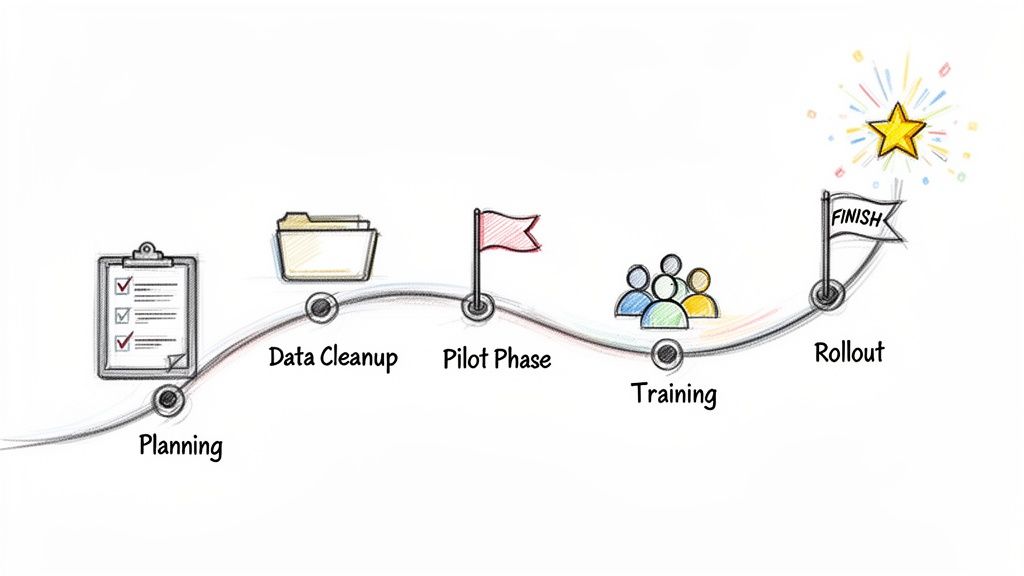
Moving your entire operation to a new platform sounds like a monster project, I get it. But a successful switch is all about breaking it down into small, manageable steps. This isn't a high-risk gamble; it's a strategic upgrade that pays off big when done right.
Think of it like moving your team into a brand-new, top-of-the-line office building. You wouldn’t just dump a bunch of boxes at the front door and wish everyone luck. You'd have a floor plan, label every box, and move one department at a time to keep business running. The exact same logic applies when you migrate to an all-in-one business platform.
Phase 1: Pre-Migration Planning and Data Cleanup
Before you even think about moving data, you need a plan. And the absolute first step is a brutal, honest audit of your existing data. Let's be real—your old, disconnected tools are probably swimming in duplicate contacts, outdated info, and messy formatting.
Moving all that junk into your shiny new platform is like filling your new office with clutter before you've even unpacked. Don't do it. This is your chance for a clean slate.
Take the time to:
Find and merge duplicates: Consolidate every record for the same person or company.
Archive old or inactive contacts: There’s no point in bringing leads from 5 years ago into your new system.
Standardize data fields: Make sure everyone uses "CA" for California, not a random mix of "Calif." and "Cali."
Once your data is clean, you can map it to the new platform. This is where you decide exactly where every piece of info from your old tools—contact names, deal stages, email history—is going to live in its new home. Good mapping ensures nothing critical gets lost in transit.
Phase 2: The Phased Rollout and Team Onboarding
Whatever you do, don't flip the switch for everyone at once. That’s a recipe for chaos. A phased rollout is safer and builds momentum.
Start by picking a small pilot team—maybe a couple of your best sales reps and one marketer. Let them be the first to dive in.
Your pilot team is your internal focus group. They’ll work out the kinks in your setup and give you priceless feedback before the full launch. Their success stories become your best internal marketing, getting the rest of the company excited about the change.
This is also the perfect time to find your internal champions. These are the people who just get the new system. They're naturally enthusiastic and will become go-to resources for their peers, which is invaluable for getting everyone on board.
The last piece is training. Don’t just herd everyone into a single, overwhelming session. Provide short, role-specific training that shows each person exactly how the platform makes their job easier. Show reps the automated sequences and teach marketers how to build campaigns. To see what that looks like in practice, check out our guide on how to create a workflow that connects different teams.
As you roll the platform out to more people, make sure to celebrate the early wins. Did the pilot team double their outreach? Did marketing break a record for new leads? Highlighting these successes proves the new system's value and turns a potentially stressful transition into a shared victory.
Frequently Asked Questions
Switching to an all in one business platform is a big move, so it’s natural to have questions. It’s a completely different way of running your sales and marketing. Let’s walk through the most common concerns we hear from teams so you can feel confident it's the right choice.
Is an All In One Platform Too Complex for My Small Team?
Not at all. In fact, it’s the opposite. The best platforms are built specifically to make life easier for small and mid-sized businesses, not add another layer of complexity.
Think about it: learning one intuitive system is way faster than trying to master five or six different tools that don't talk to each other. Because everything shares the same design and logic, your team gets up to speed much quicker. A good provider will also have your back with solid onboarding and support to make sure you hit the ground running.
What if I Need a Specialized Tool That Is Not Included?
This is a really important question. No single platform can do everything for everyone, and the good ones don't pretend to. A great all-in-one is built to be the core of your operation, not a walled garden.
It should handle 90% of what you need out of the box but also play nicely with others. Look for strong integration options—either through a marketplace, a tool like Zapier, or an open API—for those one or two specialized tools you can’t live without.
Before you commit to any platform, double-check that it can connect to your must-have software. This is non-negotiable. It ensures you get the benefits of a unified system without creating new data silos.
How Do I Justify the Cost of an All In One Platform?
You have to look at it as an investment in growth, not just another monthly bill. First, do the simple math. Add up what you’re currently paying for your CRM, email marketing tool, sales dialer, and any other subscriptions. You'll often find that a single platform costs less than the sum of all those separate tools.
But the real ROI comes from the “soft” savings and revenue gains:
The hours your team gets back every week from not having to do manual data entry.
The deals you save because leads no longer fall through the cracks between systems.
The power to make smarter, faster decisions because all your data is in one place.
When you add it all up, the platform often pays for itself through cost savings and new revenue.
Is My Business Too Small for This Type of Platform?
Honestly, it’s the other way around. Starting with a unified platform early on is a massive strategic advantage. You build a strong, scalable foundation from day one.
This helps you avoid the "data debt" and messy tech stack that so many companies accumulate. Fixing that mess later is expensive and painful. Modern platforms offer pricing that grows with you, making it a smart, affordable move for any small business ready to scale.
Ready to replace tool chaos with a single, powerful system? Stamina unifies your marketing, sales, and CRM into one AI-powered platform designed for growth. Discover how Stamina can transform your business.

