

When you hear the term ad hoc reporting, it’s just a business-friendly way of saying you can get custom-built answers to urgent, specific questions about your data—right now. It’s the ability to create one-off reports on the fly, so your team can make sharp, data-backed decisions without waiting days for an analyst to free up.
What Ad Hoc Reporting Means in Practice
Let's skip the dry, textbook definitions. Think of ad hoc reporting like asking your GPS for a detour in real time. Instead of using a printed map from last week, you're asking, "Show me the fastest route around this traffic jam, right now." It’s all about getting answers to unexpected questions, right when they matter most.
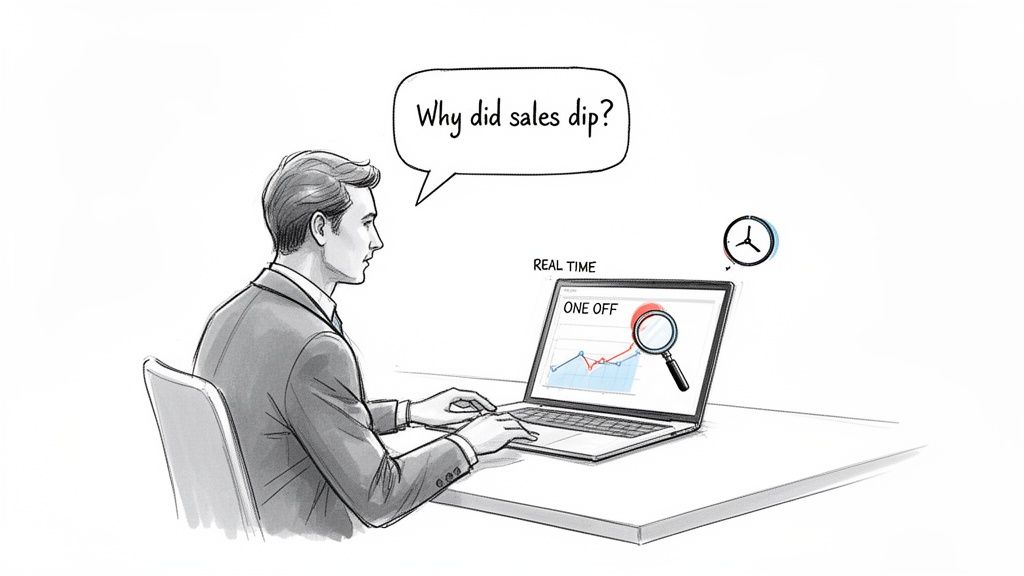
This gives anyone on your team the power to dig into weird anomalies or find opportunities hiding in plain sight. Instead of being stuck with static, pre-built reports, they can explore unique business situations as they happen.
Moving at the Speed of Business
For a growing business, this kind of agility is a massive competitive edge. Reacting quickly is everything. We saw this play out when a mid-sized U.S. bank used ad hoc reporting to navigate sudden interest rate hikes. They cut their report creation time from ten days down to just two—an 80% reduction in turnaround. That speed allowed them to make smart, strategic moves while the market was volatile. You can read more about how the bank achieved this on visbanking.com.
Ad hoc analysis is what lets your team shift from reacting to old data to proactively solving problems with current insights. It turns data from a historical record into a real-time decision-making tool.
From Questions to Actionable Insights
Ultimately, ad hoc reporting is the difference between asking, "Why did our sales in the Northeast dip last Tuesday?" and getting an answer today versus next week. It transforms your data from a passive file sitting in a folder into an active tool you can actually use.
This lets your teams:
Investigate specific issues without having to file a ticket with the tech team.
Spot emerging trends before everyone else does.
Answer follow-up questions instantly during a meeting.
When you give your sales and marketing teams self-service reporting, you build a culture of curiosity and data-driven action. It’s a place where everyone can jump in to find solutions and drive growth.
Choosing the Right Tool for the Job
To really get what ad hoc reporting can do for your business, you need to see how it fits in with the other tools in your data toolbox. It’s easy to get lost in the alphabet soup of reporting options, but each one has a very specific job.
Think of it like this: you have scheduled reports, dashboards, and ad hoc reports. Each one answers a different kind of question.
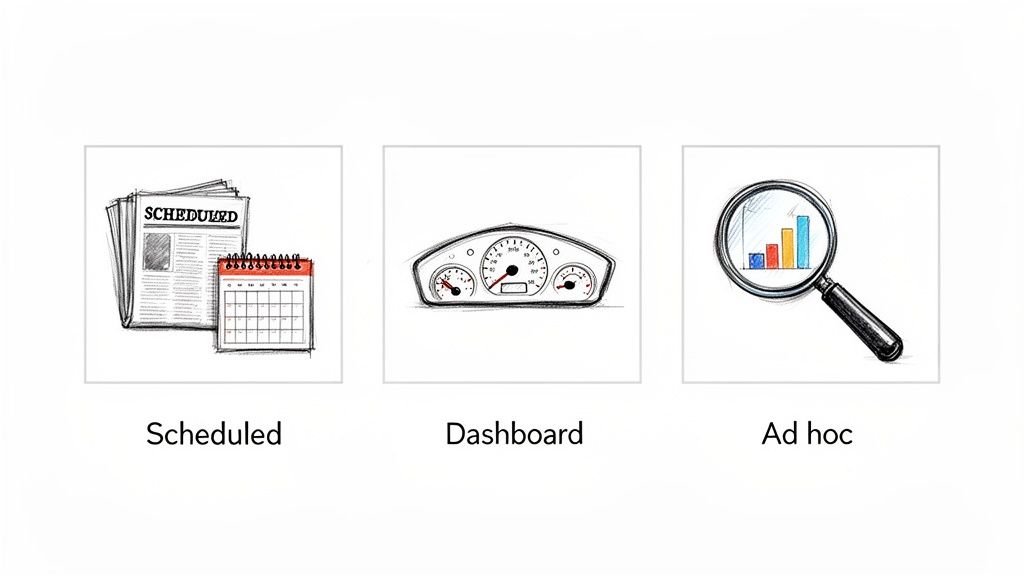
Scheduled reports are like your weekly newspaper subscription. They show up on time, cover the same general topics, and give you a reliable, static snapshot of what happened. They're perfect for consistent updates, like a weekly sales summary or a monthly marketing performance review.
Dashboards are your car’s instrument panel. They give you a live, high-level view of your most important metrics—your KPIs. You can see your speed, fuel, and engine temp at a glance. It's the best way to monitor performance in real time and spot when something is off.
When to Use Ad Hoc Reporting
So, what happens when you see a warning light on your dashboard? That's where ad hoc reporting comes in.
It’s your investigative tool—the magnifying glass you pull out when your dashboard shows a sudden drop in lead conversions. An ad hoc report is what lets you ask, "Why?" You can dig in, slice the data in new ways, and find the root cause hiding behind that top-level number.
Ad hoc reporting bridges the gap between seeing a problem on a dashboard and understanding its cause. It’s the tool for targeted, deep-dive investigations that scheduled reports are too rigid to handle.
This ability to investigate is a game-changer. Without it, your team is stuck staring at a worrying trend with no idea what to do next. Ad hoc analysis gives them the power to move from just observing to taking real action.
Comparing Your Reporting Options
Knowing when to use each tool keeps you from trying to perform surgery with a sledgehammer. Every type of report is built for a different purpose, a different user, and a different kind of business question.
This table breaks down the core differences.
Aspect | Ad Hoc Reporting | Scheduled Reporting | Dashboards |
|---|---|---|---|
Purpose | Investigate specific, one-time questions and anomalies. | Inform on a regular, predictable basis. | Monitor key performance metrics in real time. |
Typical User | Business users, managers, and analysts seeking deep answers. | Anyone needing consistent, high-level updates. | Executives and team leads needing quick status checks. |
Question Type | "Why did sales drop last Tuesday in this specific region?" | "What were our total sales each week last month?" | "What is our current sales pipeline value right now?" |
As you can see, each tool plays a unique role. While dashboards and scheduled reports are about monitoring and informing, ad hoc reporting means you have the power to truly explore your business data whenever a new question pops up.
To see how these concepts apply in a real-world sales environment, check out our guide on the differences between a sales engagement platform vs a CRM.
How Ad Hoc Reporting Fuels Your Revenue Engine
Connecting your data to actual revenue growth is what turns reporting from a chore into a strategic weapon. Ad hoc reporting isn’t about generating charts for the sake of it; it’s about arming your sales and marketing teams to act decisively the moment it matters most. That speed translates directly into faster sales cycles and smarter marketing spend.
Think of a sales manager who notices a top performer’s pipeline has suddenly gone quiet. Instead of waiting for the weekly summary, she can run an ad hoc report on the spot, filtering by deal stage and activity type. Within minutes, she sees the rep is drowning in unqualified leads from a new marketing source. She can step in immediately and get that rep back to closing.
Pivot with Precision and Speed
The same goes for marketing. Imagine a marketing lead launches a new ad campaign. The dashboard shows clicks are through the roof, but an ad hoc report reveals conversions are almost zero. By pulling click data and cross-referencing it with on-site behavior, she can find the bottleneck in hours, not weeks—and shift budget away from the failing campaign before another dollar is wasted.
This is where ad hoc analysis really proves its worth. It gives your team the power to:
Find your most valuable segments: Quickly pull reports that blend CRM and marketing data to see which customer profiles deliver the highest lifetime value.
Optimize where you spend time and money: Diagnose why one sales region is crushing it while another is lagging, then reallocate resources for the biggest impact.
Answer questions on the fly: Stop the guesswork in strategy meetings and start pulling up real data to back up your decisions.
The real power of ad hoc analysis is turning data into immediate action. It helps you find the "why" behind your metrics, letting you fix what’s broken and double down on what’s working—fast.
This builds a culture of curiosity and accountability, where everyone on the team can answer their own business questions. It’s a huge shift from the old model of waiting on a dedicated analyst for every little query. When your team can find their own insights, they become far more agile and proactive in driving revenue.
For sales teams, ad hoc reports clarify which activities lead to closed deals and where bottlenecks are slowing down the pipeline. To learn more about this, check out our guide on how to optimize your sales process with better data. This hands-on approach ensures your revenue engine is always firing on all cylinders, powered by real-time, actionable intelligence.
Theory is one thing, but seeing ad hoc reporting in the wild is what really makes the idea stick. Let's get out of the textbook and walk through a couple of real-world scenarios I’ve seen play out time and time again in small and growing businesses.
These stories show how getting quick, specific answers to urgent questions can solve painful problems and even uncover opportunities you didn't know you had.
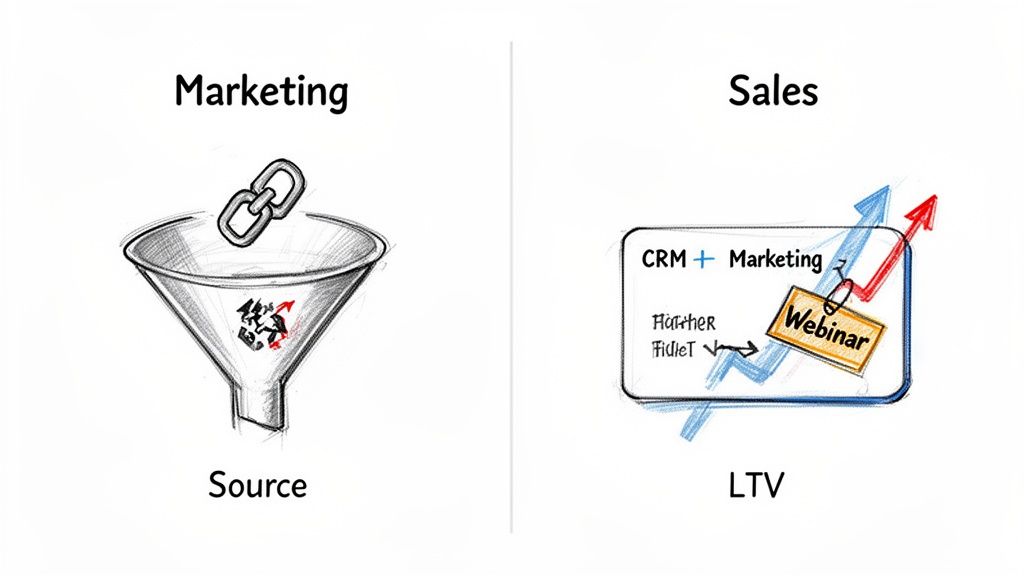
These aren't some obscure edge cases. They’re the kind of daily fires where fast, on-the-fly reporting proves its worth—getting you the right data when the clock is ticking.
The SaaS Marketing Manager and the Vanishing Trials
Picture a marketing manager at a growing SaaS company. She walks in Monday morning, glances at her main dashboard, and her stomach drops. Free trial sign-ups fell off a cliff over the weekend. All the top-level charts are blinking red, but they don't give her a clue why it's happening.
This is where ad hoc reporting comes in. Instead of waiting hours for an analyst to dig in, she pulls a report herself to ask a very specific question: "Show me conversion rates by traffic source from the last 72 hours."
The report comes back in minutes. She immediately sees the problem. One of her biggest affiliate partners is still sending a ton of traffic, but their conversion rate has tanked to almost zero. A quick click on their promotion link confirms it—it's broken. She gets on the phone, they fix the link, and trial sign-ups bounce back to normal. That one report just saved thousands in lost revenue.
An ad hoc report is the scalpel you use to dissect a problem. It gets you past knowing what happened (trials dropped) and straight to understanding why it happened (a specific affiliate link broke).
The Sales Director and the High-Value Leads
Now, imagine a sales director prepping for her quarterly strategy meeting. She has a strong gut feeling that leads coming from their recent webinars are way more valuable than leads from other channels, but she can't prove it. A standard sales report won't help, since it doesn’t connect marketing campaigns to long-term customer value.
She uses an ad hoc report to blend data from their CRM and marketing platform to answer one clear question: "What's the average lifetime value (LTV) of customers from our webinars compared to customers from paid search over the last six months?"
The on-the-fly analysis confirms her hunch and then some. Webinar leads have a 50% higher LTV and close faster. Armed with that single piece of data, she walks into the meeting and confidently makes the case to shift a chunk of the paid search budget into a bigger webinar program. The ability to create a workflow that connects teams and their data provides the hard evidence needed to make a strategic, revenue-driving decision.
In both of these situations, ad hoc reporting means the difference between reacting slowly based on a hunch and acting fast with solid proof.
How Stamina Delivers Instant Ad Hoc Answers
Let’s be honest—the biggest thing stopping most teams from using ad hoc reporting is scattered data. When your marketing data is in one system, your sales data is in another, and your CRM is off on its own, asking a simple question turns into a huge technical headache.
Stamina was built from the ground up to fix this. We unify all your marketing, sales, and CRM data into a single source of truth, creating the foundation you need for fast, on-the-fly analysis. This is what makes true self-service BI practical for lean SMB teams, not just a nice idea.
This is how Stamina acts as the central hub, connecting all your go-to-market data to power reports that actually make sense.
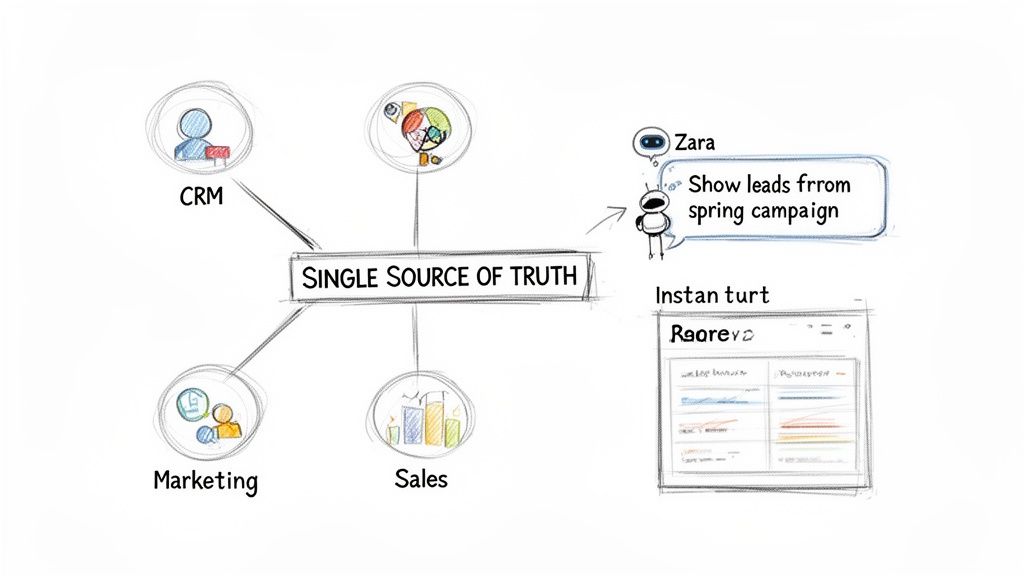
When every team is working from the same playbook, ad hoc reporting means you can finally get holistic answers that were impossible to piece together before.
Ask and You Shall Receive
Once your data is unified, ad hoc reporting stops being about technical skills and starts being about business curiosity. Stamina makes this even easier with our built-in AI SDR, Zara. Anyone on your team can just ask Zara questions in plain English and get an answer instantly.
This completely changes who gets to use data. You no longer need to be a data analyst or know SQL to get the information you need to do your job better.
The goal is to put actionable insights directly into the hands of the people who need them, right when they need them. It removes the technical burden and empowers your entire revenue team.
For example, a sales leader can instantly find out which reps are falling behind on follow-ups for high-intent leads. A marketer can quickly see which campaigns are generating the most pipeline—not just clicks or leads.
Turning Data into Actionable Insight
Imagine being able to ask questions like these and get an immediate, custom report back:
"Show me all leads from our spring campaign that haven't been contacted by sales yet."
"Which of our blog posts generated the most SQLs last quarter?"
"What's the average deal size for leads that came from LinkedIn versus Google Ads?"
This is the real power of conversational, self-service ad hoc reporting. It turns data from a static file you look at once a month into an interactive tool for making daily decisions.
The self-service business intelligence market is expected to jump from $6.73 billion in 2024 to $26.54 billion by 2032. But the dirty secret is that adoption has been stuck at 55% since 2014, mostly because the tools are too complex for small businesses.
Stamina bridges that gap, giving your sales and marketing teams the power to generate their own reports without ever needing to file an IT ticket. You can discover more about these reporting software trends and see how unified platforms are finally delivering on the promise of self-service BI.
Just jumping into your data without a plan is a recipe for disaster. Winging it with ad hoc analysis usually creates more confusion, not clarity.
To get real value, you need a simple, repeatable process. This framework makes sure your one-off reports deliver sharp, actionable insights instead of sending you down endless data rabbit holes.
It all starts with asking the right question. The quality of your report hinges entirely on how specific you are. Vague questions like, "What happened with sales last week?" are useless.
Instead, ask something sharp and focused. For example: "Why did conversion rates for our new lead magnet drop by 30% between Wednesday and Friday?" See the difference?
Form a Hypothesis Before You Dig
Once you have a focused question, take a minute to form a quick hypothesis. Don't overthink it—a hypothesis is just an educated guess.
For that lead magnet example, you might guess: "I bet a key traffic source stopped promoting our link, causing the drop."
This simple step gives your analysis a clear direction. It turns a vague fishing expedition into a focused investigation where you’re trying to prove or disprove a specific idea. Without a hypothesis, it’s way too easy to get lost and start seeing patterns that aren't even there.
The goal of ad hoc analysis isn't to just find interesting data points; it's to validate or invalidate a business assumption quickly so you can take the right next step.
Key Steps for Focused Analysis
To keep your analysis on track, just follow this simple playbook. It’ll guide you straight from question to action.
Define Your Specific Question: Start with a clear, measurable problem you need to solve.
Form a Quick Hypothesis: Make an educated guess about what’s causing the issue.
Identify the Necessary Data: Figure out exactly what metrics you need to test your hypothesis. For our example, you’d probably need traffic source data, conversion rates by day, and landing page views.
Visualize the Answer: Don't just pull numbers. Use a simple chart—like a line graph or bar chart—to make the data easy for everyone to understand, not just you.
Look for the "Why": The numbers are the what. Your job is to find the why. Explain what the data means in a business context. The goal is to deliver an insight, not just a data point.
This structured approach helps you avoid confirmation bias—the natural tendency to only see data that supports what you already believe. It forces you to look at the numbers objectively. To really get this right, it helps to understand the underlying structure of your data. You can learn more by exploring how to build an effective customer data model that makes clean reporting possible in the first place.
Your Ad Hoc Reporting Questions Answered
Once teams start digging into on-demand analysis, a few questions always pop up. Getting these sorted out early helps everyone understand exactly where ad hoc reporting fits into the daily grind.
Let's clear up some of the most common ones.
Do I Need to Be a Data Scientist for Ad Hoc Reporting?
Not even close. Modern tools like Stamina are built for business users, not data engineers. The only skills you really need are curiosity and a clear business question.
If you can ask, "Which marketing campaigns from last quarter brought in the most qualified leads?" then you're already halfway there. Good platforms do the heavy lifting for you, turning your questions into simple, clear reports.
How Is This Different from General Data Exploration?
Good question. They're related, but they serve different purposes. Think of data exploration as wandering through a forest just to see what you can find—it’s open-ended and all about discovery.
Ad hoc reporting is more like using a map and compass to find a specific landmark you need to get to. You might use exploration to spot something unusual, then run a targeted ad hoc report to figure out exactly why it happened.
Can an Ad Hoc Report Become a Standard Report?
Absolutely. In fact, that's a sign you're on the right track.
If you find yourself running the same ad hoc report every week—maybe checking sales velocity by region—it’s the perfect candidate for automation. A strong reporting platform will let you save that one-off report, schedule it to run automatically, and even pin it to a dashboard. This is how a one-time investigation becomes a routine, invaluable checkpoint.
Ready to empower your team with instant, actionable answers? Stamina unifies your marketing, sales, and CRM data, so anyone can get the insights they need with simple, AI-driven reporting. See how Stamina makes ad hoc reporting easy at stamina.io.

