
What Is a Customer Engagement Platform? A Guide for SMBs

Wondering what is a customer engagement platform? This guide explains CEPs, compares them to CRMs, and shows SMBs how to drive growth with a unified system.

0 - Minute Read

Your sales team works out of a CRM. Marketing runs email in a separate tool. Support has its own inbox. Website intent data sits in analytics, untouched. Someone exports CSVs every Friday to stitch a picture together, and by Monday that picture is already stale.

That setup works for a while. Then leads start slipping through gaps that aren’t obvious until pipeline slows down. A prospect downloads a guide, visits your pricing page twice, replies to a nurture email, and then gets a generic cold outbound message because none of your systems talk to each other. The problem isn’t effort. It’s fragmentation.

If you’ve been asking what is a customer engagement platform, you’re probably not looking for another software category to memorize. You’re trying to fix a practical problem. You want one system that helps your team see what customers are doing, respond in context, and stop losing momentum between marketing, sales, and service.

Your Business Has Outgrown Its Tools

A growing SMB usually doesn’t wake up one day and decide to build a messy stack. It happens one purchase at a time. You start with a CRM. Then add email automation. Then a live chat tool. Then a scheduler, analytics, forms, maybe a sales engagement tool, maybe a support platform. Each tool solves a local problem. Together, they create operational drag.

The symptoms are familiar. Sales asks marketing for lead history before a call. Marketing asks ops for a clean list because contact data is inconsistent. Founders step in to answer basic questions like, “Has this account already been contacted?” or “Why did this hot lead never get a follow-up?”

That’s where a customer engagement platform, or CEP, starts to matter. In plain terms, it gives you a central place to manage customer interactions across channels instead of forcing your team to jump between disconnected apps. It becomes the operating layer between customer signals and team action.

This isn’t a niche category anymore. The global customer engagement solutions market was valued at USD 28.13 billion in 2026 and is projected to reach USD 45.9 billion by 2031, growing at a 10.28% CAGR, according to Mordor Intelligence’s customer engagement solutions market analysis. That growth tells you something important. Businesses aren’t buying CEPs because the label sounds modern. They’re consolidating because disconnected systems are expensive to run and hard to scale.

For SMBs, the conversation has also shifted. The old question was, “Which tool should we add next?” The better question is, “Which platform can replace the patchwork?” That’s the logic behind an all-in-one business platform approach. Fewer handoffs. Fewer blind spots. Better timing when a lead is ready to talk.

You don’t need more dashboards. You need fewer systems making conflicting decisions about the same customer.

What a Customer Engagement Platform Actually Does

A CEP is the central nervous system for customer interactions. It collects signals from different places, turns them into a usable customer record, and helps your team act on that information across channels.
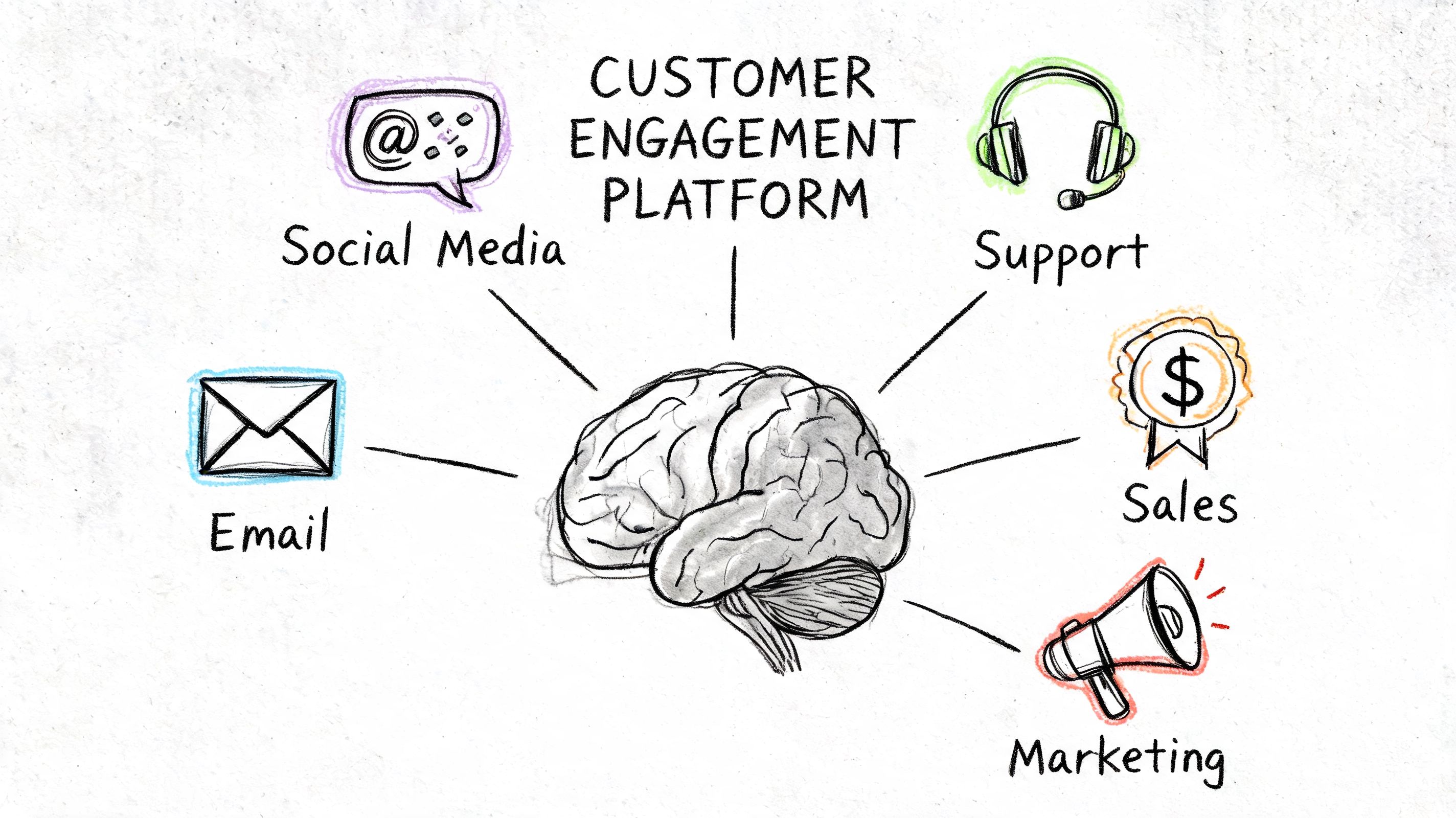
A hand-drawn illustration showing a central human brain connected to icons for social media, email, support, sales, and marketing.

It ingests data from all the places customers interact

Most businesses already have the raw material. Website visits, email clicks, form fills, purchases, support conversations, mobile activity, call notes. The issue is that this information lives in separate systems.

The technical core of a CEP is its ability to ingest data from disparate sources such as website, mobile, email, and POS systems to create unified, real-time customer profiles, enabling teams to act instantly on user behavior, as described in Blueshift’s guide to customer engagement platforms.

That sounds technical, but the practical meaning is simple. When someone takes an action, the platform updates their profile quickly enough for your team or automation to respond while intent is still fresh.

It creates one usable profile instead of five partial ones

The built-in Customer Data Platform, or CDP, is essential. A CEP doesn’t just store records. It resolves identity and builds a single profile that sales, marketing, and service can use.

A good profile includes more than contact fields. It shows behavior, lifecycle stage, recent engagement, channel preference, and account context. That changes the quality of every follow-up. A rep knows whether the lead came from a webinar, visited the pricing page, ignored two emails, or asked support a question last week.

Here’s the practical threshold I use. If your team still asks, “Can someone pull the full history on this account?” your data isn’t operational yet.

It orchestrates action across channels

Once data is unified, the CEP decides what happens next. That could mean:

  • Triggering outreach: send a nurture email after a demo request or route a high-intent visitor to sales.

  • Suppressing bad timing: stop promotional emails when a deal is in late-stage sales.

  • Coordinating channels: align email, SMS, web messages, and rep tasks so the customer doesn’t get conflicting communication.

This is the difference between storing customer information and using it. Teams that handle a mix of digital and relationship-driven communication can also learn from frameworks outside standard martech. For example, Resolut's AR communication guide is useful because it shows how communication discipline matters when multiple touchpoints and stakeholders are involved.

Practical rule: If the platform can’t help your team decide what to do next, it’s a database, not an engagement system.

CEP vs CRM vs CDP vs Marketing Automation

A lot of buying mistakes happen because these categories overlap just enough to create confusion. Founders hear “single customer view,” “automation,” and “personalization” from every vendor, then assume all these systems do the same job. They don’t.

Here’s the shortest useful version. A CRM manages relationships and pipeline. A CDP unifies customer data. Marketing automation runs campaigns. A CEP orchestrates engagement across the lifecycle using unified data and execution logic.

Platform comparison

Platform Type

Primary Job

Core User

Key Focus

CRM

Store account, contact, and deal activity

Sales team

Relationship management and pipeline visibility

CDP

Unify customer data from multiple sources

RevOps, data, marketing ops

Identity resolution and profile creation

Marketing Automation

Run campaigns and nurture flows

Marketing team

Lead nurturing and campaign execution

CEP

Coordinate personalized engagement across channels

Marketing, sales, success, RevOps

Real-time orchestration and lifecycle action

Where each platform helps

A CRM is the system most SMBs buy first. It’s where reps track deals, log notes, manage tasks, and forecast pipeline. It’s strong at relationship history and stage management. It’s usually weak at real-time behavioral engagement unless you bolt on other tools.

A CDP solves a different problem. It cleans up data fragmentation and creates a unified customer record. That’s useful if your stack is already large and you need identity resolution across systems. But a standalone CDP often stops at data readiness. It tells you what happened. It doesn’t always execute the next move.

Marketing automation is usually campaign-first. Think email sequences, nurture flows, list segmentation, form-triggered actions, and scheduled broadcasts. It helps teams scale communication, but it often remains marketing-centric. Sales and support context may stay outside the workflow.

A CEP sits closer to action across the full journey. It uses unified data to trigger and coordinate engagement, not just emails. In practice, that means it can connect website behavior, lifecycle stage, channel preference, and rep workflows into one operating layer.

Why the lines are blurring

The clean category definitions matter less than they used to. Modern platforms often combine CRM, automation, data unification, and engagement logic in one product. That’s why buyers should focus less on labels and more on architecture.

If you’re sorting through that overlap, this breakdown of sales engagement platform vs CRM differences and use cases is a useful companion because it highlights where sales execution starts to diverge from simple record-keeping.

A practical way to evaluate platforms is to ask four questions:

  1. Can it unify customer data without a separate data project

  2. Can it trigger actions in real time

  3. Can both marketing and sales use the same context

  4. Can it replace tools, not just connect to them

A CRM tells you the deal exists. A CDP tells you what the customer did. Marketing automation sends the campaign. A CEP is supposed to coordinate the whole thing.

For SMBs, this distinction matters because every extra platform creates another sync to maintain, another workflow to debug, and another place where context can break.

Core Features Every SMB Should Look For

Most feature lists are padded with enterprise language. SMBs need a shorter filter. The right CEP should remove manual work, tighten response time, and make cross-team coordination easier without creating a long implementation project.

Unified profiles that update fast enough to matter

A profile isn’t useful if it updates after the moment has passed. You want a platform that captures live behavior and reflects it in the customer record quickly enough to change outreach, routing, or nurture logic.

That means a rep can open a contact and see recent page views, email activity, prior conversations, and campaign membership in one place. If that context still requires switching tabs, the platform isn’t doing enough.

Journey orchestration that your team can actually run

SMBs don’t need a prettier workflow builder. They need automation that handles real operating conditions.

Look for the ability to:

  • Trigger by behavior: move someone into a sequence after a form submission, pricing page visit, or inbound reply.

  • Branch by context: send different follow-ups based on lifecycle stage, source, or account status.

  • Coordinate human tasks: create rep actions when automation reaches a handoff point.

This is where marketing automation for small business becomes a useful lens. Good automation doesn’t just send messages. It reduces the number of routine decisions your team has to make manually.

Omnichannel communication without channel chaos

A CEP should support communication across the places your customers already respond, not force everything into email because that’s what the system handles best.

For an SMB, omnichannel usually means practical coordination across email, forms, site behavior, sales activity, maybe SMS, maybe calling. The key isn’t having every possible channel. It’s making sure the channels you do use share the same customer context.

Segmentation that goes beyond static lists

Old segmentation is list-based. New segmentation is behavior-based. You want to group customers by what they’re doing now, not just who they were when they filled out a form three months ago.

That helps with simple but high-impact use cases:

  • Hot lead follow-up: people who visited a high-intent page recently

  • Reactivation: accounts that engaged before but went quiet

  • Sales timing: leads showing interest but not yet in active pipeline

Analytics tied to action

Dashboards are easy to buy and hard to use. The reporting inside a CEP should help your team decide what to change next.

Look for reporting that answers questions like:

  • Which channel is producing meaningful replies

  • Which campaigns move leads toward pipeline

  • Where handoffs are breaking

  • Which segments stall out before conversion

The test is straightforward. If the report doesn’t change a decision, it’s decoration.

Tangible Benefits and KPIs for Your Business

A CEP only matters if it changes business outcomes. Better architecture is nice. Better coordination is nice. What founders care about is whether the platform helps the business create more pipeline, retain more customers, and run leaner without dropping follow-ups.
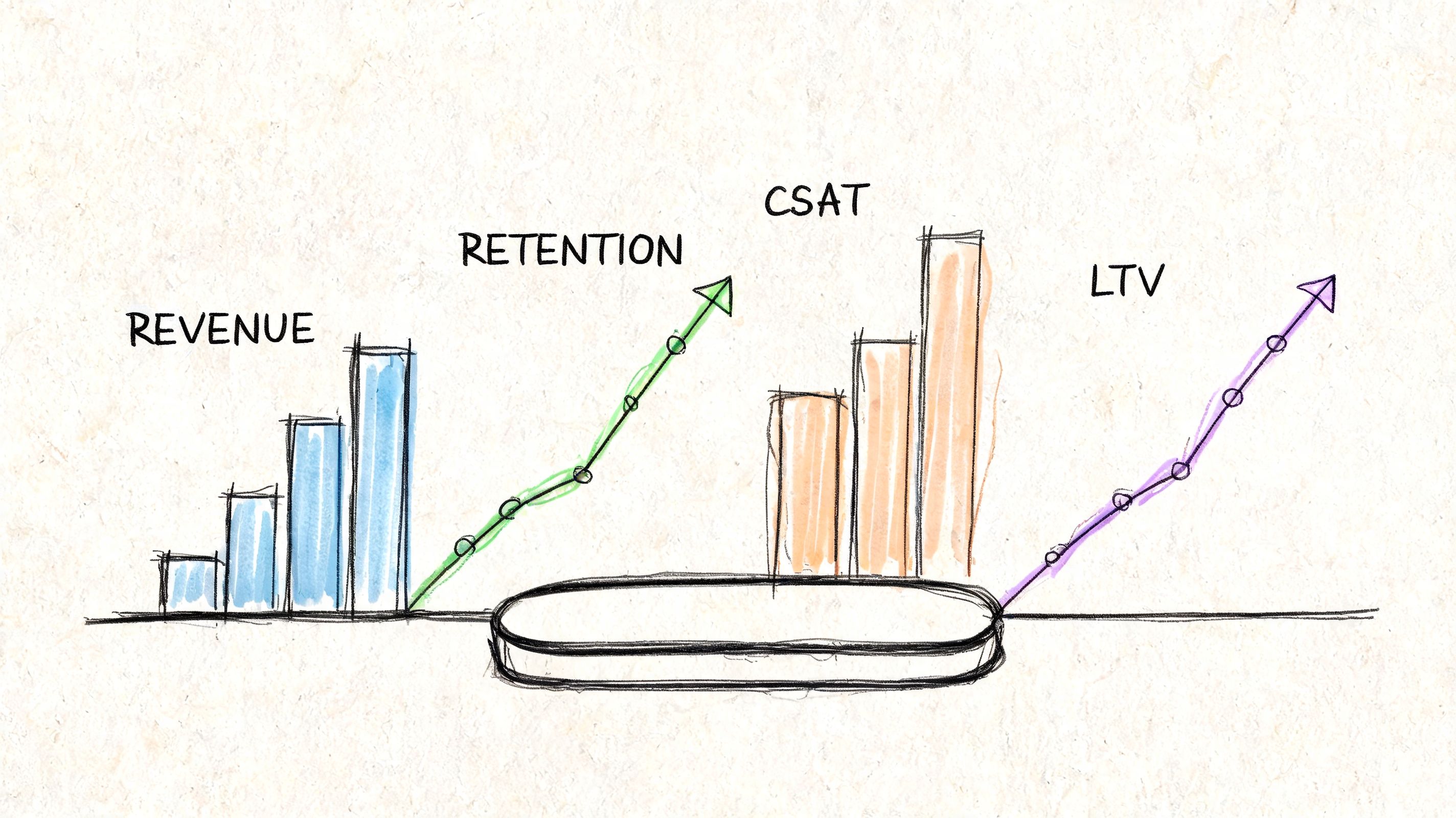
A hand-drawn illustration showing growth trends for Revenue, Retention, CSAT, and LTV metrics on a platform.

What improves when the platform is doing its job

The first gain is usually speed and consistency. Leads get routed faster. Follow-ups happen on time. Reps stop writing one-off messages for every situation because the system already knows the trigger and the context.

The second gain is better relevance. Messaging gets closer to what the customer did. That alone improves the quality of engagement because the outreach feels connected, not random.

Interactive content is a good example of how platform capability affects results. According to Involve.me’s customer engagement statistics, interactive content generates approximately 52.6% more engagement than static content, and buyers spend 53% more time engaging with it. For an SMB, that can mean using quizzes, assessments, calculators, or guided experiences instead of asking every lead to read another generic page and then book a call.

The KPIs worth tracking

Don’t measure a CEP by login activity or how many workflows your team built. Measure whether it improves the operating metrics that matter.

  • Engagement rate by channel: Which channels produce actual interaction, not just sends.

  • Lead-to-opportunity movement: Are engaged leads progressing into pipeline more consistently.

  • Pipeline velocity: Are qualified prospects moving faster because handoffs and follow-ups are tighter.

  • Customer retention signals: Are existing customers staying active, renewing, or expanding more consistently.

  • Cost per acquisition: Is better targeting reducing wasted spend and wasted rep effort.

  • Team response time: How quickly does someone get a relevant follow-up after a meaningful action.

What not to overvalue

A lot of teams get distracted by cosmetic improvements. A cleaner dashboard doesn’t create revenue. Neither does a giant workflow map no one wants to maintain.

The useful KPI is the one that forces a decision. If a metric looks good but doesn’t change action, it belongs in a vanity report.

The practical goal is simple. Your CEP should help the team do three things better: identify intent, respond in context, and maintain continuity across the customer journey. If those improve, revenue metrics usually follow.

The Shift to AI-Powered Revenue Platforms

The definition of a CEP is changing. The older model assumed you’d buy a customer engagement layer, then connect it to your CRM, data stack, marketing tools, and sales systems. That architecture can work in large organizations with dedicated ops and engineering support. It often breaks down in SMBs because the integration burden becomes the primary project.
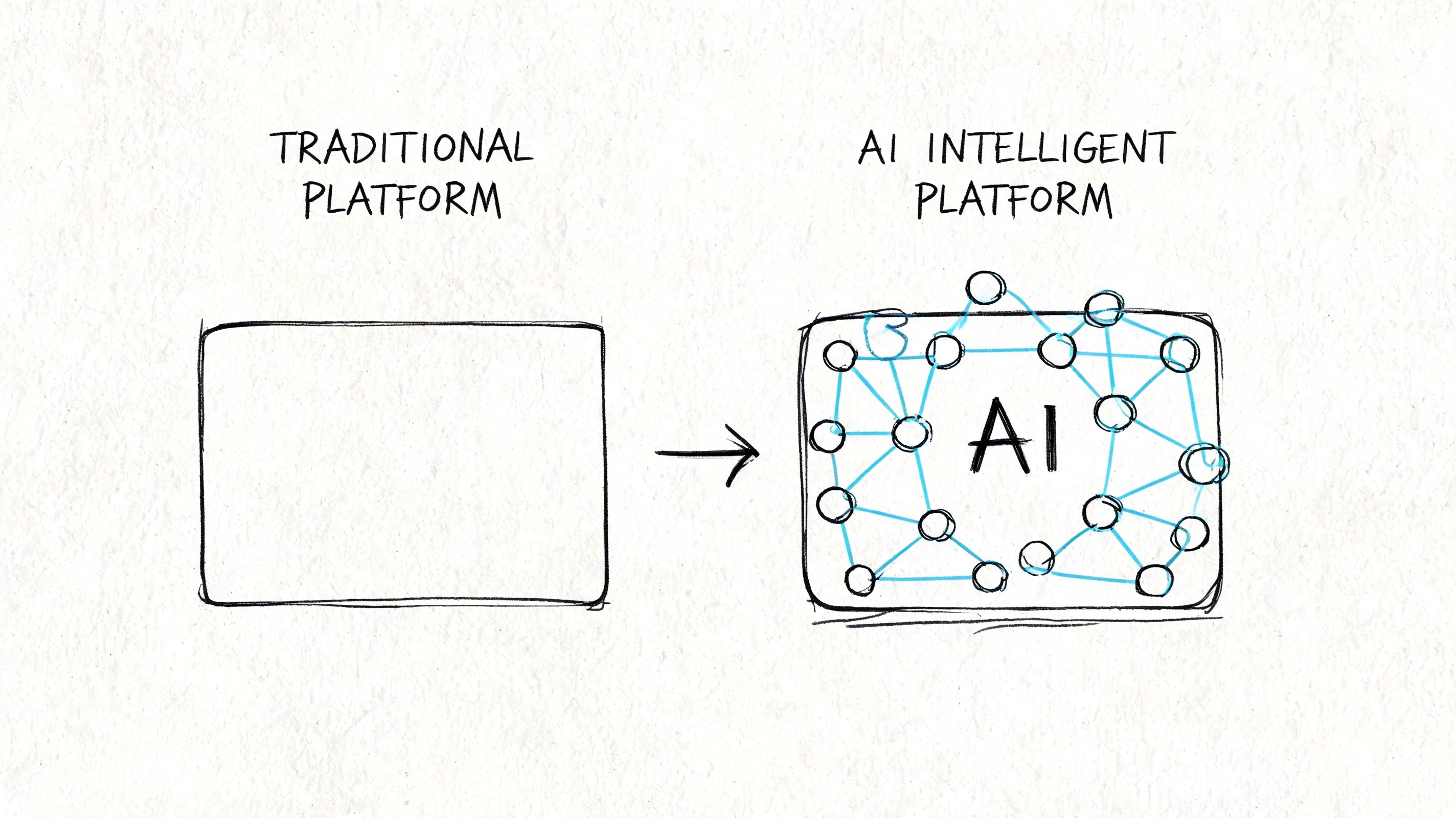
A hand-drawn comparison between a simple traditional platform box and an interconnected AI intelligent platform.

Many SMBs don’t fail at engagement strategy. They get stuck trying to wire everything together. One system owns contacts. Another owns campaigns. Another handles outbound. Another stores support history. AI gets added on top as a separate layer, which creates a new problem. The models don’t share enough context to coordinate well.

That’s why the market is shifting as SMBs favor consolidated, AI-native stacks over fragmented tools due to data silos, integration costs, and AI coordination complexity, a trend noted in Braze’s discussion of customer engagement platforms.

Why consolidation changes the economics

In a fragmented stack, every workflow depends on sync quality. If the sync breaks, timing breaks. If timing breaks, personalization turns into noise.

In a consolidated platform, customer data, automation logic, outreach execution, and CRM records live closer together. That reduces latency, duplicate work, and troubleshooting. It also changes how AI fits into the stack. Instead of adding isolated AI assistants to separate tools, you get one system working from one customer record.

That model is closer to a revenue operating system than a traditional CEP. It combines engagement with execution.

A practical example is AI sales assistants, which show how AI becomes more useful when it isn’t trapped in a single function. If the same platform can identify website intent, enrich prospect context, draft personalized outreach, and log activity in CRM, the AI has enough operational context to be useful.

What modern buyers should look for

The best question isn’t “Do we need a CEP?” It’s “Do we need a separate CEP at all?”

A modern all-in-one revenue platform can include CRM, marketing automation, sales engagement, and AI-driven prospecting in one system. Stamina is one example of that model. It combines marketing, sales, CRM, and an AI SDR into a single platform for SMBs that want one source of truth instead of multiple connected tools.

If you’re building an AI-led customer motion, this strategic roadmap for AI customer experience is worth reading because it frames AI adoption as an operating model decision, not just a tooling decision.

Here’s a quick visual overview of how this shift is playing out in practice.

The trade-off is real. Best-of-breed stacks can offer more specialized depth in each category. But most SMBs don’t need maximum category depth. They need systems that work together without a large ops burden. In that environment, the AI-native consolidated model is often the more practical choice.

How to Choose and Implement Your First Platform

The first platform decision should be smaller than organizations typically make it. You’re not designing the perfect future stack. You’re choosing the shortest path to cleaner data, faster follow-up, and more reliable execution.

Start with your current customer journey

Map the handoffs that currently leak momentum. Don’t overcomplicate this. Look at first touch, lead capture, qualification, follow-up, sales outreach, and post-conversion communication.

Ask simple questions:

  • Where does context get lost

  • Which follow-ups depend on manual work

  • Which team is waiting on another system before they can act

That exercise usually reveals whether your issue is messaging, routing, visibility, or tool sprawl.

Pick one to three operational goals

Avoid broad goals like “improve engagement.” Choose goals tied to a workflow. Examples include automating inbound lead routing, improving outbound personalization, or centralizing lifecycle communication so sales and marketing stop colliding.

The narrower the first use case, the easier implementation becomes. Early wins matter because team adoption follows visible usefulness, not theoretical capability.

Evaluate speed to value, not feature volume

Many SMBs abandon or underutilize enterprise platforms due to integration friction. The true cost of a platform includes the time, effort, and potential consulting fees required to connect it to existing systems, as noted in Equisoft’s customer engagement platform glossary.

That means your buying criteria should include:

  1. Time to first live workflow

  2. How much data cleanup is required upfront

  3. Whether sales and marketing can use it without heavy admin support

  4. How many existing tools it can replace

Buy the platform your team can operationalize, not the one with the longest enterprise checklist.

If you can’t picture the first campaign, first routing workflow, and first rep handoff inside the product, keep looking. A platform should reduce your operational surface area from day one.

If your team is juggling disconnected tools across sales, marketing, and CRM, Stamina is one option to evaluate. It brings those functions into a single AI-powered revenue and customer platform so SMBs can manage outreach, nurture, pipeline, and customer data from one place instead of stitching together separate systems.

Your sales team works out of a CRM. Marketing runs email in a separate tool. Support has its own inbox. Website intent data sits in analytics, untouched. Someone exports CSVs every Friday to stitch a picture together, and by Monday that picture is already stale.

That setup works for a while. Then leads start slipping through gaps that aren’t obvious until pipeline slows down. A prospect downloads a guide, visits your pricing page twice, replies to a nurture email, and then gets a generic cold outbound message because none of your systems talk to each other. The problem isn’t effort. It’s fragmentation.

If you’ve been asking what is a customer engagement platform, you’re probably not looking for another software category to memorize. You’re trying to fix a practical problem. You want one system that helps your team see what customers are doing, respond in context, and stop losing momentum between marketing, sales, and service.

Your Business Has Outgrown Its Tools

A growing SMB usually doesn’t wake up one day and decide to build a messy stack. It happens one purchase at a time. You start with a CRM. Then add email automation. Then a live chat tool. Then a scheduler, analytics, forms, maybe a sales engagement tool, maybe a support platform. Each tool solves a local problem. Together, they create operational drag.

The symptoms are familiar. Sales asks marketing for lead history before a call. Marketing asks ops for a clean list because contact data is inconsistent. Founders step in to answer basic questions like, “Has this account already been contacted?” or “Why did this hot lead never get a follow-up?”

That’s where a customer engagement platform, or CEP, starts to matter. In plain terms, it gives you a central place to manage customer interactions across channels instead of forcing your team to jump between disconnected apps. It becomes the operating layer between customer signals and team action.

This isn’t a niche category anymore. The global customer engagement solutions market was valued at USD 28.13 billion in 2026 and is projected to reach USD 45.9 billion by 2031, growing at a 10.28% CAGR, according to Mordor Intelligence’s customer engagement solutions market analysis. That growth tells you something important. Businesses aren’t buying CEPs because the label sounds modern. They’re consolidating because disconnected systems are expensive to run and hard to scale.

For SMBs, the conversation has also shifted. The old question was, “Which tool should we add next?” The better question is, “Which platform can replace the patchwork?” That’s the logic behind an all-in-one business platform approach. Fewer handoffs. Fewer blind spots. Better timing when a lead is ready to talk.

You don’t need more dashboards. You need fewer systems making conflicting decisions about the same customer.

What a Customer Engagement Platform Actually Does

A CEP is the central nervous system for customer interactions. It collects signals from different places, turns them into a usable customer record, and helps your team act on that information across channels.

A hand-drawn illustration showing a central human brain connected to icons for social media, email, support, sales, and marketing.

It ingests data from all the places customers interact

Most businesses already have the raw material. Website visits, email clicks, form fills, purchases, support conversations, mobile activity, call notes. The issue is that this information lives in separate systems.

The technical core of a CEP is its ability to ingest data from disparate sources such as website, mobile, email, and POS systems to create unified, real-time customer profiles, enabling teams to act instantly on user behavior, as described in Blueshift’s guide to customer engagement platforms.

That sounds technical, but the practical meaning is simple. When someone takes an action, the platform updates their profile quickly enough for your team or automation to respond while intent is still fresh.

It creates one usable profile instead of five partial ones

The built-in Customer Data Platform, or CDP, is essential. A CEP doesn’t just store records. It resolves identity and builds a single profile that sales, marketing, and service can use.

A good profile includes more than contact fields. It shows behavior, lifecycle stage, recent engagement, channel preference, and account context. That changes the quality of every follow-up. A rep knows whether the lead came from a webinar, visited the pricing page, ignored two emails, or asked support a question last week.

Here’s the practical threshold I use. If your team still asks, “Can someone pull the full history on this account?” your data isn’t operational yet.

It orchestrates action across channels

Once data is unified, the CEP decides what happens next. That could mean:

  • Triggering outreach: send a nurture email after a demo request or route a high-intent visitor to sales.

  • Suppressing bad timing: stop promotional emails when a deal is in late-stage sales.

  • Coordinating channels: align email, SMS, web messages, and rep tasks so the customer doesn’t get conflicting communication.

This is the difference between storing customer information and using it. Teams that handle a mix of digital and relationship-driven communication can also learn from frameworks outside standard martech. For example, Resolut's AR communication guide is useful because it shows how communication discipline matters when multiple touchpoints and stakeholders are involved.

Practical rule: If the platform can’t help your team decide what to do next, it’s a database, not an engagement system.

CEP vs CRM vs CDP vs Marketing Automation

A lot of buying mistakes happen because these categories overlap just enough to create confusion. Founders hear “single customer view,” “automation,” and “personalization” from every vendor, then assume all these systems do the same job. They don’t.

Here’s the shortest useful version. A CRM manages relationships and pipeline. A CDP unifies customer data. Marketing automation runs campaigns. A CEP orchestrates engagement across the lifecycle using unified data and execution logic.

Platform comparison

Platform Type

Primary Job

Core User

Key Focus

CRM

Store account, contact, and deal activity

Sales team

Relationship management and pipeline visibility

CDP

Unify customer data from multiple sources

RevOps, data, marketing ops

Identity resolution and profile creation

Marketing Automation

Run campaigns and nurture flows

Marketing team

Lead nurturing and campaign execution

CEP

Coordinate personalized engagement across channels

Marketing, sales, success, RevOps

Real-time orchestration and lifecycle action

Where each platform helps

A CRM is the system most SMBs buy first. It’s where reps track deals, log notes, manage tasks, and forecast pipeline. It’s strong at relationship history and stage management. It’s usually weak at real-time behavioral engagement unless you bolt on other tools.

A CDP solves a different problem. It cleans up data fragmentation and creates a unified customer record. That’s useful if your stack is already large and you need identity resolution across systems. But a standalone CDP often stops at data readiness. It tells you what happened. It doesn’t always execute the next move.

Marketing automation is usually campaign-first. Think email sequences, nurture flows, list segmentation, form-triggered actions, and scheduled broadcasts. It helps teams scale communication, but it often remains marketing-centric. Sales and support context may stay outside the workflow.

A CEP sits closer to action across the full journey. It uses unified data to trigger and coordinate engagement, not just emails. In practice, that means it can connect website behavior, lifecycle stage, channel preference, and rep workflows into one operating layer.

Why the lines are blurring

The clean category definitions matter less than they used to. Modern platforms often combine CRM, automation, data unification, and engagement logic in one product. That’s why buyers should focus less on labels and more on architecture.

If you’re sorting through that overlap, this breakdown of sales engagement platform vs CRM differences and use cases is a useful companion because it highlights where sales execution starts to diverge from simple record-keeping.

A practical way to evaluate platforms is to ask four questions:

  1. Can it unify customer data without a separate data project

  2. Can it trigger actions in real time

  3. Can both marketing and sales use the same context

  4. Can it replace tools, not just connect to them

A CRM tells you the deal exists. A CDP tells you what the customer did. Marketing automation sends the campaign. A CEP is supposed to coordinate the whole thing.

For SMBs, this distinction matters because every extra platform creates another sync to maintain, another workflow to debug, and another place where context can break.

Core Features Every SMB Should Look For

Most feature lists are padded with enterprise language. SMBs need a shorter filter. The right CEP should remove manual work, tighten response time, and make cross-team coordination easier without creating a long implementation project.

Unified profiles that update fast enough to matter

A profile isn’t useful if it updates after the moment has passed. You want a platform that captures live behavior and reflects it in the customer record quickly enough to change outreach, routing, or nurture logic.

That means a rep can open a contact and see recent page views, email activity, prior conversations, and campaign membership in one place. If that context still requires switching tabs, the platform isn’t doing enough.

Journey orchestration that your team can actually run

SMBs don’t need a prettier workflow builder. They need automation that handles real operating conditions.

Look for the ability to:

  • Trigger by behavior: move someone into a sequence after a form submission, pricing page visit, or inbound reply.

  • Branch by context: send different follow-ups based on lifecycle stage, source, or account status.

  • Coordinate human tasks: create rep actions when automation reaches a handoff point.

This is where marketing automation for small business becomes a useful lens. Good automation doesn’t just send messages. It reduces the number of routine decisions your team has to make manually.

Omnichannel communication without channel chaos

A CEP should support communication across the places your customers already respond, not force everything into email because that’s what the system handles best.

For an SMB, omnichannel usually means practical coordination across email, forms, site behavior, sales activity, maybe SMS, maybe calling. The key isn’t having every possible channel. It’s making sure the channels you do use share the same customer context.

Segmentation that goes beyond static lists

Old segmentation is list-based. New segmentation is behavior-based. You want to group customers by what they’re doing now, not just who they were when they filled out a form three months ago.

That helps with simple but high-impact use cases:

  • Hot lead follow-up: people who visited a high-intent page recently

  • Reactivation: accounts that engaged before but went quiet

  • Sales timing: leads showing interest but not yet in active pipeline

Analytics tied to action

Dashboards are easy to buy and hard to use. The reporting inside a CEP should help your team decide what to change next.

Look for reporting that answers questions like:

  • Which channel is producing meaningful replies

  • Which campaigns move leads toward pipeline

  • Where handoffs are breaking

  • Which segments stall out before conversion

The test is straightforward. If the report doesn’t change a decision, it’s decoration.

Tangible Benefits and KPIs for Your Business

A CEP only matters if it changes business outcomes. Better architecture is nice. Better coordination is nice. What founders care about is whether the platform helps the business create more pipeline, retain more customers, and run leaner without dropping follow-ups.

A hand-drawn illustration showing growth trends for Revenue, Retention, CSAT, and LTV metrics on a platform.

What improves when the platform is doing its job

The first gain is usually speed and consistency. Leads get routed faster. Follow-ups happen on time. Reps stop writing one-off messages for every situation because the system already knows the trigger and the context.

The second gain is better relevance. Messaging gets closer to what the customer did. That alone improves the quality of engagement because the outreach feels connected, not random.

Interactive content is a good example of how platform capability affects results. According to Involve.me’s customer engagement statistics, interactive content generates approximately 52.6% more engagement than static content, and buyers spend 53% more time engaging with it. For an SMB, that can mean using quizzes, assessments, calculators, or guided experiences instead of asking every lead to read another generic page and then book a call.

The KPIs worth tracking

Don’t measure a CEP by login activity or how many workflows your team built. Measure whether it improves the operating metrics that matter.

  • Engagement rate by channel: Which channels produce actual interaction, not just sends.

  • Lead-to-opportunity movement: Are engaged leads progressing into pipeline more consistently.

  • Pipeline velocity: Are qualified prospects moving faster because handoffs and follow-ups are tighter.

  • Customer retention signals: Are existing customers staying active, renewing, or expanding more consistently.

  • Cost per acquisition: Is better targeting reducing wasted spend and wasted rep effort.

  • Team response time: How quickly does someone get a relevant follow-up after a meaningful action.

What not to overvalue

A lot of teams get distracted by cosmetic improvements. A cleaner dashboard doesn’t create revenue. Neither does a giant workflow map no one wants to maintain.

The useful KPI is the one that forces a decision. If a metric looks good but doesn’t change action, it belongs in a vanity report.

The practical goal is simple. Your CEP should help the team do three things better: identify intent, respond in context, and maintain continuity across the customer journey. If those improve, revenue metrics usually follow.

The Shift to AI-Powered Revenue Platforms

The definition of a CEP is changing. The older model assumed you’d buy a customer engagement layer, then connect it to your CRM, data stack, marketing tools, and sales systems. That architecture can work in large organizations with dedicated ops and engineering support. It often breaks down in SMBs because the integration burden becomes the primary project.

A hand-drawn comparison between a simple traditional platform box and an interconnected AI intelligent platform.

Many SMBs don’t fail at engagement strategy. They get stuck trying to wire everything together. One system owns contacts. Another owns campaigns. Another handles outbound. Another stores support history. AI gets added on top as a separate layer, which creates a new problem. The models don’t share enough context to coordinate well.

That’s why the market is shifting as SMBs favor consolidated, AI-native stacks over fragmented tools due to data silos, integration costs, and AI coordination complexity, a trend noted in Braze’s discussion of customer engagement platforms.

Why consolidation changes the economics

In a fragmented stack, every workflow depends on sync quality. If the sync breaks, timing breaks. If timing breaks, personalization turns into noise.

In a consolidated platform, customer data, automation logic, outreach execution, and CRM records live closer together. That reduces latency, duplicate work, and troubleshooting. It also changes how AI fits into the stack. Instead of adding isolated AI assistants to separate tools, you get one system working from one customer record.

That model is closer to a revenue operating system than a traditional CEP. It combines engagement with execution.

A practical example is AI sales assistants, which show how AI becomes more useful when it isn’t trapped in a single function. If the same platform can identify website intent, enrich prospect context, draft personalized outreach, and log activity in CRM, the AI has enough operational context to be useful.

What modern buyers should look for

The best question isn’t “Do we need a CEP?” It’s “Do we need a separate CEP at all?”

A modern all-in-one revenue platform can include CRM, marketing automation, sales engagement, and AI-driven prospecting in one system. Stamina is one example of that model. It combines marketing, sales, CRM, and an AI SDR into a single platform for SMBs that want one source of truth instead of multiple connected tools.

If you’re building an AI-led customer motion, this strategic roadmap for AI customer experience is worth reading because it frames AI adoption as an operating model decision, not just a tooling decision.

Here’s a quick visual overview of how this shift is playing out in practice.

The trade-off is real. Best-of-breed stacks can offer more specialized depth in each category. But most SMBs don’t need maximum category depth. They need systems that work together without a large ops burden. In that environment, the AI-native consolidated model is often the more practical choice.

How to Choose and Implement Your First Platform

The first platform decision should be smaller than organizations typically make it. You’re not designing the perfect future stack. You’re choosing the shortest path to cleaner data, faster follow-up, and more reliable execution.

Start with your current customer journey

Map the handoffs that currently leak momentum. Don’t overcomplicate this. Look at first touch, lead capture, qualification, follow-up, sales outreach, and post-conversion communication.

Ask simple questions:

  • Where does context get lost

  • Which follow-ups depend on manual work

  • Which team is waiting on another system before they can act

That exercise usually reveals whether your issue is messaging, routing, visibility, or tool sprawl.

Pick one to three operational goals

Avoid broad goals like “improve engagement.” Choose goals tied to a workflow. Examples include automating inbound lead routing, improving outbound personalization, or centralizing lifecycle communication so sales and marketing stop colliding.

The narrower the first use case, the easier implementation becomes. Early wins matter because team adoption follows visible usefulness, not theoretical capability.

Evaluate speed to value, not feature volume

Many SMBs abandon or underutilize enterprise platforms due to integration friction. The true cost of a platform includes the time, effort, and potential consulting fees required to connect it to existing systems, as noted in Equisoft’s customer engagement platform glossary.

That means your buying criteria should include:

  1. Time to first live workflow

  2. How much data cleanup is required upfront

  3. Whether sales and marketing can use it without heavy admin support

  4. How many existing tools it can replace

Buy the platform your team can operationalize, not the one with the longest enterprise checklist.

If you can’t picture the first campaign, first routing workflow, and first rep handoff inside the product, keep looking. A platform should reduce your operational surface area from day one.

If your team is juggling disconnected tools across sales, marketing, and CRM, Stamina is one option to evaluate. It brings those functions into a single AI-powered revenue and customer platform so SMBs can manage outreach, nurture, pipeline, and customer data from one place instead of stitching together separate systems.

Share this article

Share this article

Send a shareable link to your team or anyone who might find it useful.

Send a shareable link to your team or anyone who might find it useful.

Copy link

Copied

Share directly to

Table of contents

Give Your Business the Stamina it needs to Thrive

PRODUCT

COMPANY

RESOURCES

© 2026 Stamina Software Technologies Inc. All rights reserved.

PRODUCT

COMPANY

RESOURCES

© 2026 Stamina Software Technologies Inc. All rights reserved.

PRODUCT

COMPANY

RESOURCES

© 2026 Stamina Software Technologies Inc. All rights reserved.