
Your sales team is probably not short on effort.
They are short on effective means.
A typical SMB sales floor looks busy all day. Reps are pulling lead lists, checking LinkedIn, cleaning contact data, writing first-touch emails, chasing no-replies, updating the CRM, and trying to remember who needs a sixth follow-up. Everyone is moving. Pipeline still feels thin.
That is the moment when most owners ask the wrong question. They ask whether they need more reps.
The better question is whether their current team is spending time on work that humans should be doing at all.
Your Sales Team Is Busy But Are They Productive
A founder hires one SDR. That SDR does solid work, but the list building is manual, follow-ups slip, and personalization gets lighter as volume goes up. The founder adds another rep. Output rises for a while, then the same bottlenecks return. Research takes too long. CRM hygiene gets messy. The team confuses activity with progress.
This is why ai sales assistants matter for SMBs. Not because they replace people, but because they take over the repetitive work that makes small teams feel permanently underwater.
The market has already moved. 43% of sales reps actively used AI tools in 2024, up from 24% in 2023, a 79% year-over-year increase, and sales professionals who use AI daily are twice as likely to exceed their targets compared to non-users according to Cirrus Insight’s review of AI adoption in sales.
That shift matters because your competitors do not need a larger team to create more touches anymore. They need a better operating model.
An AI sales assistant is often the first scalable “employee” an SMB adds. It does not get tired. It does not forget to follow up. It does not spend half a day researching a small batch of accounts. It gives your human team room to handle the parts of selling that still require judgment, trust, and timing.
If you are tracking how voice and conversational workflows are changing sales operations, The Rise of Agentic AI Voice Agents in 2025 is a useful companion read because it shows how AI is expanding from text automation into more active buyer engagement.
Practical takeaway: If your team is missing follow-ups, delaying first response, or limiting personalization because of workload, you do not have a motivation problem. You have a systems problem.
What Is an AI Sales Assistant and How Does It Work
Think of an AI sales assistant as a digital twin of your best SDR.
Not your most charismatic closer. Your best operator. The rep who researches accounts well, writes clean outreach, follows process, spots useful buying signals, and never lets a warm lead go cold.
That is the right mental model.
What it does
In practice, ai sales assistants handle a cluster of jobs that normally sit between prospecting and booked meetings:
Lead research: Pulling company context, role details, and fit signals together fast.
Qualification support: Sorting likely buyers from low-fit names.
Outreach drafting: Writing first-touch emails and follow-ups with relevant context.
Sequence execution: Sending the next message at the right point instead of relying on rep memory.
CRM support: Moving activity and notes into one system of record.
Used well, the assistant does not “run sales.” It runs the work around sales so humans can spend more of their day on conversations that matter.
Why the technology matters
Most SMB buyers do not need a deep technical lecture. They do need to know whether the system is working from real information or just making polished guesses.
The key concept is retrieval-augmented generation, usually shortened to RAG.
A simple way to understand it is this. Instead of relying only on what a language model learned during training, a RAG-based assistant pulls in current information from the systems you already use, such as your CRM, lead database, and account records, before generating a response.
That matters because sales data changes constantly. Contacts move roles. Accounts raise funding. A prospect downloads something new. A plain language model can sound confident while being outdated. A RAG-based assistant is designed to look things up first.
According to NVIDIA’s discussion of building an AI sales assistant, this approach lets the system combine knowledge sources like CRM data and B2B databases to generate hyper-personalized outreach. That same source notes that intelligent lead scoring can deliver up to a 25% increase in conversion rates and a 60% reduction in manual verification time.
What this looks like inside a workflow
A rep selects a target segment.
The assistant checks account fit against your CRM history, your ICP, and external business data. It drafts an outreach message using details tied to the prospect’s company and role. It queues follow-ups. It updates records as responses come in.
The rep reviews, edits where needed, and focuses on responses worth human attention.
That is very different from asking ChatGPT for a cold email. One is a workflow. The other is a writing prompt.
If your team still needs a quick primer on autonomous systems versus simple chat tools, this short explanation of what an AI agent is gives a useful baseline before you evaluate vendors.
Where SMBs usually get confused
Many owners buy for headline features instead of operating fit.
They ask whether the tool can write emails. Nearly all of them can. Tougher questions include:
What to check | Why it matters |
|---|---|
Data access | An assistant is only as useful as the CRM, contact, and account data it can reach |
Workflow depth | Drafting one email is easy. Running multi-step outreach cleanly is harder |
Human review controls | Your team needs approval rules, edit controls, and visibility into what gets sent |
Signal quality | Personalization based on weak or stale inputs becomes spam faster, not better |
CRM discipline | If the tool works outside your system of record, reporting gets worse |
One practical way to evaluate the category is to compare how different tools handle outreach, data, and automation depth. This roundup of https://stamina.io/blog/7-ai-sdr-agents-that-can-replace-your-sales-reps-(2025-review) is useful for seeing how AI SDR products are being positioned in the market.
Rule of thumb: If the product saves time but creates another place to manage data, it is not acting like a scalable employee. It is acting like another app your team has to babysit.
Key Capabilities That Supercharge Your Sales Team
The fastest way to judge ai sales assistants is to ignore the marketing language and look at daily output.
Do they help your team contact more qualified people, with better messaging, and with tighter follow-through?
ROI appears there.
Personalized outreach that does not collapse at scale
Manual personalization works until volume rises.
At low volume, a rep can open ten tabs, scan a prospect’s site, check LinkedIn, maybe notice a hiring push or product launch, and write something decent. Once the list gets bigger, the messages flatten into templates with one token variable. Buyers notice.
An AI assistant changes that operating rhythm. It can pull context from multiple sources, draft variants for different personas, and keep messaging aligned with account details without forcing a rep to repeat the same research loop all day.
Before, one SDR may spend a large block of the morning researching a short list and writing custom emails. After implementation, the rep can review AI-generated drafts, adjust tone for priority accounts, and spend the recovered time on live conversations and objection handling. Personalization becomes practical, not performative, at this stage. The goal is not to sound clever. The goal is to sound informed.
For teams comparing this capability in real workflows, Stamina’s personalization product page at https://stamina.io/product/personalization shows how platforms are packaging AI-assisted message generation and variants inside outbound execution.
Qualification that goes beyond title matching
Most SMB teams waste effort on “good-looking” leads that are just easy to find.
A title fit is not enough. Neither is company size alone. Good qualification usually needs several inputs at once, including role, business model, likely urgency, account context, and whether the contact matches the problem your offer solves.
An AI assistant is useful here because it does not review one signal at a time. It can evaluate many points together and help route attention to accounts that deserve it.
That changes rep behavior in small but important ways:
Less manual enrichment: Reps stop spending chunks of time confirming basic account details.
Better queue quality: The next call list is shaped by fit and signals, not by whichever spreadsheet was opened first.
Cleaner handoffs: Sales and marketing work from a tighter definition of who counts as ready.
A weak implementation still fails here. If your ICP is vague, the assistant will scale vagueness. If your CRM stages are messy, it will inherit the mess.
Follow-up persistence without rep fatigue
This is the capability SMBs usually undervalue until they see the gap in black and white.
Many sales are not lost on the first email. They are lost because nobody followed through with enough consistency.
Research cited by ContactSwing’s overview of AI sales call assistant features indicates that 80% of sales require five or more follow-ups, yet only 8% of salespeople exceed the fifth attempt. That same source notes that AI sales assistants address this by automating 24/7 multi-channel follow-up sequences across email, SMS, and social with dynamic personalization.
That matters because most SMB reps are not avoiding follow-up out of laziness. They are context-switching. A call comes in. A meeting runs long. A hot deal steals attention. The warm prospect from last week ages out.
An AI assistant is good at the exact work humans are bad at sustaining every day:
Remembering sequence state
Sending on schedule
Adjusting message variants
Catching non-responses without emotion
Keeping every lead in motion until a real outcome appears
Here is the embedded walkthrough before the comparison gets abstract:
Coaching and call support inside the workflow
The strongest ai sales assistants do more than outbound.
They also improve execution during and after conversations. Conversation intelligence can capture notes, pull out action items, surface missed questions, and turn calls into searchable team knowledge instead of private rep memory.
For SMB leaders, the operational win is simple. Your best rep’s habits stop living only in that rep’s head.
Tip: Start by automating follow-up and research before you automate more nuanced messaging decisions. Those are the fastest wins, and they create trust inside the team.
AI Sales Assistant vs Human SDR A Direct Comparison
The wrong framing is “AI or human.”
The useful framing is “Which work should a human own, and which work should software own?”
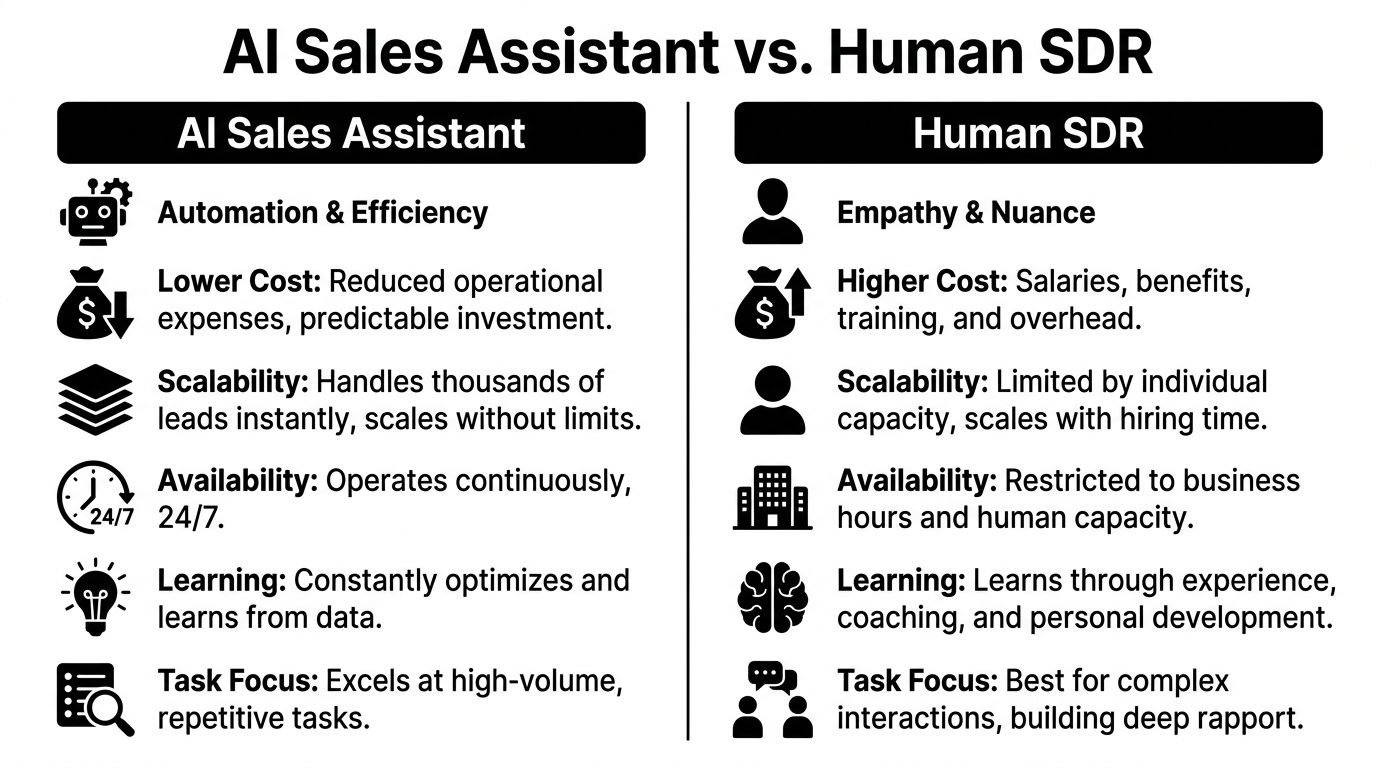
An SMB owner usually feels this trade-off in hiring terms. Another SDR means more coverage, but also more ramp time, more management, and more pressure to keep lead flow high enough to justify the seat. An AI sales assistant changes the equation because it expands capacity without asking a manager to train a new rep on every process detail.
Where AI wins cleanly
The AI side has obvious strengths.
| Criteria | AI sales assistant | Human SDR |
|---|---|
| Volume handling | Strong at high-volume prospecting and repeatable sequences | Limited by time and daily capacity | | Speed | Fast research, drafting, and task execution | Slower but more adaptive | | Consistency | Follows process every time when configured well | Varies by rep discipline | | Coverage | Keeps campaigns and follow-ups moving continuously | Bound by schedule and workload | | Admin burden | Good at repetitive actions and workflow support | Can get buried by non-selling work |
If your current bottlenecks are list prep, research, data cleanup, and follow-up execution, AI usually beats a human on speed and consistency.
Where humans still carry the deal
A strong SDR does several things current AI does not reliably replicate.
Humans read tone in difficult conversations. They know when a buyer is curious versus polite. They adapt in real time when a discovery call goes sideways. They negotiate internal politics inside the account. They build trust when there is risk, ambiguity, or resistance.
That is why the replacement narrative misses the point.
The most effective teams use AI for operational advantage and humans for judgment-heavy moments, including:
Discovery conversations
Objection handling
Multi-stakeholder coordination
Relationship building
Strategic account planning
What the hybrid model looks like in practice
In a healthy setup, the AI assistant handles the top and middle of the workflow. It identifies targets, enriches records, drafts outreach, runs sequences, and keeps records current. The human SDR steps in when a response signals intent, complexity, or risk.
That division of labor tends to improve two things at once. Reps spend more time selling, and managers get more predictable execution across the team.
A common pattern for SMBs looks like this:
AI owns first-touch scale
Humans own live qualification
AI owns follow-up infrastructure
Humans own deal movement
AI supports notes, reminders, and coaching
Humans own trust
Decision test: If the task depends on empathy, ambiguity, or persuasion, keep a human in charge. If the task depends on consistency, memory, or volume, let the AI carry it.
The hybrid model is not a compromise. It is the model that usually survives contact with real buyers.
A Practical Guide to Implementing an AI Sales Assistant
Most failed rollouts are not product failures.
They are implementation failures.
Teams buy ai sales assistants expecting instant output, then point the system at messy CRM data, a fuzzy ICP, and inconsistent messaging. The assistant works exactly as configured. Results disappoint. The owner decides the category is overhyped.
That is avoidable.
Start with one bottleneck, not the whole revenue stack
The cleanest first deployment is narrow.
Pick one painful, repetitive workflow. For most SMBs, that is outbound follow-up, lead research, or first-touch email drafting. Get one use case stable before adding call intelligence, routing logic, and advanced workflow automation.
A practical rollout sequence often looks like this:
Define your ICP clearly Give the system a real target. Industry, role, company profile, trigger conditions, and disqualifiers should be explicit.
Clean your source data Remove duplicates, outdated contacts, and stage confusion. If your CRM cannot tell a prospect from an opportunity cleanly, the assistant will inherit the ambiguity.
Set message guardrails Define tone, banned claims, personalization boundaries, and approval rules. Such guidelines ensure brand protection.
Launch one campaign family Run one outbound motion for one segment first. Avoid mixing too many personas or offers on day one.
Review outputs daily at the start Early review matters. You are training the workflow, not just observing it.
Build the AI around your sales process
The system should fit your motion.
If your team books demos from founder-led outbound, the assistant needs to support that style. If you sell through agencies, channel partners, or multiple personas, the prompts, stages, and handoff rules should match the actual process.
This is also where tooling matters. Some teams need a point solution for conversation intelligence. Others want one place to run campaigns, CRM, and outbound execution. If your priority is campaign orchestration inside a connected system, https://stamina.io/product/campaigns is one example of how vendors are packaging AI-assisted outreach and workflow control for SMB teams.
Measure the right outputs
Do not judge the rollout only on email copy quality.
The better indicators are operational:
What to measure | Why it matters |
|---|---|
Lead response speed | Shows whether the assistant is reducing delay |
Follow-up completion | Reveals whether leads are being worked fully |
Meeting quality | Prevents shallow automation from inflating weak bookings |
Lead-to-opportunity movement | Tells you whether targeting is improving |
Rep time allocation | Confirms whether humans are spending more time on selling |
The goal is not to admire automation. The goal is to make the team more effective.
Treat bias as an operating risk
This part gets skipped too often.
AI sales assistants can reflect bias in training data, lead scoring logic, and personalization patterns. According to Nooks’ discussion of AI sales assistants and fairness risks, biased training data can perpetuate inequities in lead scoring and personalization, and best practices require transparent models and regular audits so the system does not disadvantage non-traditional SMBs or diverse markets.
That is not a side issue. It is a practical issue.
If the assistant consistently favors one type of founder, market, region, or company profile without a valid business reason, your pipeline narrows and your outreach quality drops.
Use simple governance rules:
Audit lead prioritization: Check who gets ranked high and who gets ignored.
Review personalization patterns: Make sure message variants do not rely on stereotypes or weak assumptions.
Keep human override rights: Reps and managers must be able to intervene.
Document exclusions: If certain accounts or regions are deprioritized, there should be a clear business rationale.
Operational advice: The fastest way to lose trust in an AI rollout is to automate bad judgment. Review outputs with the same seriousness you would use when training a new rep.
See It in Action How Stamina's Zara AI Drives Real Results
The easiest way to understand an AI sales assistant is to watch the workflow from signal to meeting.
Consider a lean SMB team running outbound with limited headcount. Their challenge is not writing one good email. Their challenge is catching intent, researching quickly, acting fast, and keeping every touch connected to the CRM.
Workflow one from website visit to outbound sequence
A target account visits the site.
Instead of waiting for someone to notice the visit later, the system can flag that activity, connect it to company context, identify likely contacts, and draft outreach tied to what the buyer appears to care about. The rep does not start with a blank page. The rep starts with context and a ready-to-review sequence.
An integrated platform matters here. Website activity, contact discovery, message generation, and CRM tracking need to sit close enough together that speed is real, not theoretical.
Workflow two from account research to personalized touch
A rep wants to break into a segment with limited time.
Zara can support that by researching accounts, generating customized email variants, and maintaining follow-up logic after launch. The human seller reviews higher-priority accounts, adjusts messaging where nuance matters, and handles replies that require judgment.
That is the collaborative model in action. The AI does not replace the rep. It removes the repetitive effort that usually limits how much a small team can attempt in a week.
Workflow three from scattered activity to one operating system
Many SMBs do not have a sales problem first. They have a coordination problem.
Marketing runs campaigns in one tool. Sales sequences live in another. CRM data falls out of date. Follow-ups depend on individual rep discipline. AI is hard to trust because the underlying system is fragmented.
An all-in-one approach changes that. When prospecting, campaign execution, and CRM live together, the assistant has cleaner context and the team gets clearer accountability. That reduces the common failure mode where automation creates more tabs and more confusion.
If you want to see how this looks in a real customer environment, the Summit Life Group story is a practical example of how teams use a connected revenue platform to support growth workflows.
One product in this category is Stamina, which includes Zara, an AI SDR built into a broader revenue and CRM platform. In practical terms, that means teams can identify prospects, research them, generate personalized outreach, run follow-ups, and keep those actions tied to a central system of record instead of stitching together disconnected point tools.
That matters most for SMB owners who are not trying to build an experimental AI stack. They want reliable execution from a small team. They want their first AI “employee” to fit inside the business they already run.
The companies that get value from ai sales assistants tend to do three things well:
They assign the AI clear work
They keep humans on judgment-heavy moments
They measure whether the system improves throughput and meeting quality
That is the durable model. Not AI versus humans. AI with humans, under process, tied to revenue outcomes.
If your team is doing too much manual prospecting, missing follow-ups, or struggling to scale outbound without adding headcount, Stamina is worth a look. It combines CRM, campaigns, sales engagement, and Zara AI SDR in one platform, which makes it easier for SMBs to turn AI from a side experiment into part of the sales workflow.

