Customer Lifecycle Management: A Guide for Growing SMBs

Master customer lifecycle management with our complete guide for SMBs. Learn the stages, key metrics, and how to implement a winning strategy with Stamina.

0 - Minute Read

Your leads live in one tool. Your deals live in another. Support conversations sit in an inbox nobody checks before renewal time. Marketing celebrates campaign engagement while sales complains about lead quality, and nobody can say with confidence which customers are healthy, drifting, or ready to buy again.

That's a normal SMB setup. It's also why growth starts feeling harder than it should.

Customer lifecycle management isn't an enterprise-only discipline. It's the practical work of making sure every customer interaction connects to the next one, so your business stops leaking revenue between handoffs. For a growing company with a lean team, that matters more, not less.

Why Managing the Customer Lifecycle Matters for SMBs

Most SMB founders don't wake up thinking, “We need a lifecycle strategy.” They wake up thinking, “Why did that hot lead go cold?” or “Why did a customer churn when support said everything looked fine?” Those are lifecycle problems.

The issue usually isn't effort. It's fragmentation. Marketing sees clicks. Sales sees pipeline. Support sees tickets. Finance sees invoices. The customer experiences all of it as one relationship, but the business often manages it as separate departments with separate tools.

Small teams feel lifecycle failures faster

That gap hits smaller companies hard because there's less room for waste. If one handoff breaks, there usually isn't a dedicated operations person cleaning it up behind the scenes. And according to Gainsight's guide to the customer journey and lifecycle, 68% of SMBs lack formal Customer Success roles, which makes a cross-functional lifecycle approach even more important.

That's why customer lifecycle management works best when it's treated as a shared operating model, not a side project owned by one team.

A practical way to think about it is this:

  • Marketing owns attention: Bring in the right people, not just more people.

  • Sales owns momentum: Turn interest into a clear next step.

  • Service owns continuity: Help customers get value after the sale.

  • Leadership owns alignment: Make sure those motions connect.

If you're evaluating how a unified system supports that connection, it helps to understand what a customer engagement platform centralizes across the journey.

Practical rule: If your team has to ask three people what happened with one account, your lifecycle is broken.

Revenue improves when the experience stops resetting

Customers don't care which department touched the account last. They care whether the next interaction feels informed, timely, and useful. When every conversation starts from zero, trust drops. Sales cycles drag. Onboarding gets sloppy. Renewals become harder than they need to be.

For SMBs, good customer lifecycle management increases efficiency. It helps one team behave like a bigger one because information, context, and follow-up don't depend on memory. They depend on a system.

That's the main upside. You're not just “managing customers.” You're designing a cleaner path from first touch to repeat revenue.

What Is Customer Lifecycle Management Anyway

Customer lifecycle management is the discipline of guiding someone from first awareness to long-term loyalty without letting the relationship fall apart between stages.

The simplest analogy is a human relationship. You don't build trust by making a strong first impression and then disappearing. You build it by showing up appropriately at each stage. Early on, people need clarity. Later, they need consistency. Over time, they need proof that staying with you still makes sense.

A pencil sketch illustration showing the stages of human life progression alongside business growth and success symbols.

It's a strategy, not just software

A lot of teams confuse customer lifecycle management with CRM hygiene or email automation. Those tools matter, but they aren't the strategy. The strategy is deciding what your customer needs at each stage, who on your team owns that moment, and what signal tells you they're moving forward or drifting away.

Customer lifecycle management is the practice of delivering value and maintaining a strong relationship at every meaningful customer touchpoint.

That sounds simple. In practice, many businesses still operate in silos. Marketing generates leads and hands them off. Sales closes deals and hands them off. Support reacts when something breaks. Each team may perform well on its own terms, but the customer feels the seams.

That's why lifecycle thinking pairs well with strategic insights for modern businesses that move beyond rigid funnel logic and focus on connected experience.

What a fragmented approach gets wrong

Transactional businesses optimize for the immediate event. They ask:

  • Did the lead book a demo

  • Did the deal close

  • Did support answer the ticket

Lifecycle-driven businesses ask better questions:

  • Was the lead a good fit from the start

  • Did the buying experience match the promise made in marketing

  • Did the customer reach value quickly enough to want to stay

That difference matters because many businesses still organize around internal stages that don't match how customers decide. If you need a clearer baseline on the system side, this overview of customer relationship management is a useful companion to lifecycle strategy.

The mindset shift that changes execution

Customer lifecycle management works when you stop treating the sale as the finish line. The purchase is a transition point. It's where expectation turns into evaluation.

If the customer gets fast answers before buying but slow responses after signing, they notice. If sales promises a smooth rollout and onboarding feels improvised, they notice that too. Lifecycle management closes those gaps.

What you're really building is continuity. Not more messages. Not more tools. Continuity.

The 5 Core Stages of the Customer Lifecycle

A lifecycle only becomes useful when it's operational. For most SMBs, five stages are enough to create clarity without adding bureaucracy: Reach, Acquisition, Conversion, Retention, and Loyalty.

The important part isn't the label. It's making sure your stage definitions match how customers move. A Forrester study on customer life-cycle management found a major discrepancy between how firms design internal lifecycle programs and how customers experience their journey. That mismatch leads to ineffective strategies.

Reach

Reach is when a potential customer first becomes aware of your business. They may see your brand in search, hear about you from a referral, get an outbound email, or visit your site after seeing a social post.

The customer's goal is simple. They're trying to understand whether you're relevant.

Your goal is narrower than often understood. It's not maximum exposure. It's attracting attention from the right audience with the right problem.

Primary metric: Website traffic

This metric isn't perfect, but it gives SMBs a clean starting point. If traffic rises and nothing else improves, you probably have a targeting or message problem.

Acquisition

Acquisition starts when awareness turns into active interest. The prospect reads your pricing page, downloads a resource, replies to an email, asks for a demo, or starts comparing you with alternatives.

The customer wants confidence that your solution fits their situation. Your business needs to prove that fit without creating friction.

Weak lifecycle management quickly becomes apparent. Marketing may count a form fill as success, while sales sees an unqualified inquiry that was never likely to buy.

Primary metric: Marketing qualified leads

Use whatever qualification standard your team can apply consistently. The exact framework matters less than agreement on what “qualified” means.

For companies refining this handoff, it helps to define stages similarly to a sales pipeline framework, so marketing and sales aren't operating from different maps.

Conversion

Conversion is the moment interest turns into a customer relationship. In some businesses that means a closed deal. In others, it means a first purchase, signed contract, or activated subscription.

The customer wants a low-risk decision. They need clarity on value, terms, and next steps. Your goal is to remove doubt and reduce friction.

This stage often gets over-optimized in the wrong way. Teams obsess over persuasion tactics while ignoring operational drag. Slow follow-up, vague proposals, messy approvals, and unclear onboarding can kill momentum more reliably than weak copy.

Primary metric: Close rate

Close rate won't explain every problem, but it tells you whether the business is converting real opportunities into revenue.

Retention

Retention begins right after the sale. At this point, customers decide whether your product or service fits into their world well enough to stay.

The customer wants to achieve the outcome they bought. Your business wants them to reach value quickly, use what they purchased, and keep engaging.

A lot of SMBs underinvest here because the sale feels complete. That's a mistake. Most churn doesn't happen because the customer forgot your brand exists. It happens because they never built enough value into the relationship after the purchase.

Primary metric: Churn rate

If retention is weak, don't immediately blame price. Look first at onboarding, communication gaps, and whether customers understand how to succeed.

Loyalty

Loyalty is the stage where customers stay, buy again, refer others, or expand their relationship with you. This isn't about generic brand affection. It's about repeated proof that your business continues to be useful.

The customer wants reliability and recognition. Your business wants repeat revenue, stronger margins, and advocacy that lowers future acquisition friction.

Primary metric: Customer lifetime value

Loyalty is where lifecycle management starts compounding. A customer who stays longer, buys more, and recommends you makes every earlier stage more efficient.

The healthiest SMBs don't treat loyalty as a marketing campaign. They treat it as the outcome of doing the earlier stages well.

Key CLM Metrics You Can Actually Track

Most SMBs don't have a metrics problem. They have a visibility problem. The numbers they need exist somewhere, but they're scattered across ad platforms, inboxes, spreadsheets, billing tools, and support systems.

That's why customer lifecycle management should start with a small set of metrics that directly influence decisions. For most growing teams, that means customer lifetime value, customer acquisition cost, and churn rate.
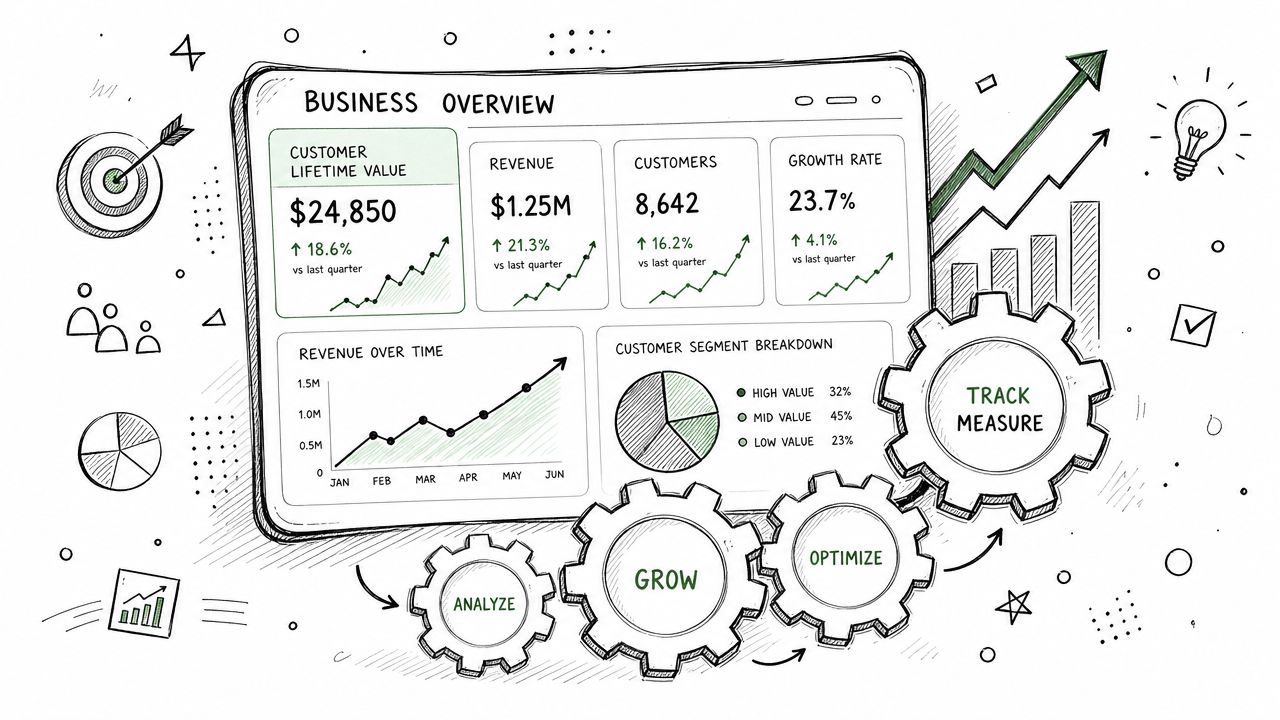
A sketched business dashboard showing customer lifetime value, revenue, and growth metrics with interlocking gear icons.

The three metrics that change behavior

Customer lifetime value tells you how much value a customer relationship produces over time. It helps you stop judging channels only by who converts first. Some sources bring in buyers who close quickly but disappear just as fast. Others create slower starts and stronger accounts.

Customer acquisition cost shows what it takes to win a customer. Founders often get surprised; a channel can look efficient in marketing reports and still become expensive once sales time, follow-up effort, and support load are included.

Churn rate is the cleanup metric. It exposes whether the business is keeping what it wins. If churn stays high, strong top-of-funnel activity can hide a broken post-sale experience.

Why disconnected tools make these metrics unreliable

Many SMBs stall because, according to Nextiva's overview of customer lifecycle management, 52% of SMBs still use disconnected tools, and 61% fail to act on early retention signals due to data latency. That's the operational cost of fragmentation.

If campaign data sits in one system, deal status in another, and customer issues in a third, your team can't answer basic commercial questions with confidence:

  • Which channels bring in customers who stay

  • Which lead sources create the most support-heavy accounts

  • What tends to happen right before a customer stops engaging

  • Where are new customers getting stuck after purchase

Reality check: A metric only matters if someone can act on it before the customer is gone.

What to track first

You don't need a perfect analytics stack to start. You need a usable view.

A practical first dashboard should show:

Metric

What it helps you decide

Customer lifetime value

Which channels and segments are worth more investment

Customer acquisition cost

Whether your go-to-market motion is efficient

Churn rate

Where post-sale experience is breaking down

For teams sharpening retention and repeat revenue strategy, Quikly's insights on customer loyalty are a useful complement because they frame lifetime value as an outcome of better engagement, not just better discounting.

The key is to avoid vanity reporting. If a metric doesn't help you reallocate budget, improve handoffs, or trigger outreach, it belongs lower on the list.

An SMB Playbook for Managing the Full Lifecycle with Stamina

Most lifecycle advice breaks down because it assumes you have separate specialists for outbound, CRM administration, marketing automation, and customer success. Most SMBs don't. They need one system that supports the whole motion without forcing constant exports, manual updates, or tool switching.
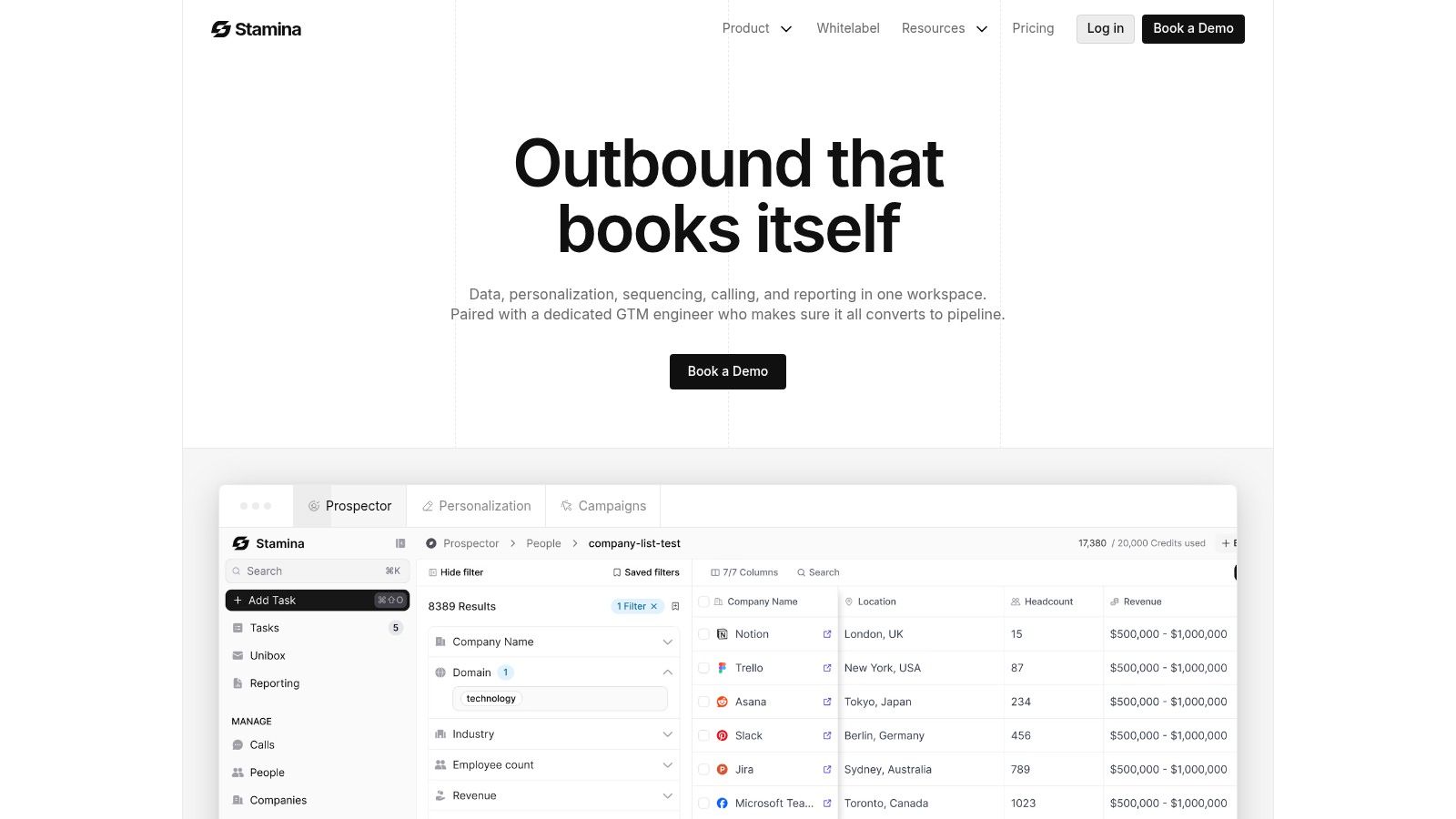
Screenshot from https://stamina.io

A unified setup matters because Certinia's guide to mastering customer lifecycle management notes that consolidating customer touchpoints into a single CRM platform directly correlates with increased renewal and expansion rates by enabling personalized, consistent experiences at scale.

Use one system to remove handoff loss

The strongest SMB lifecycle playbooks share a few traits:

  • One customer record: Activity, outreach, and deal context live together.

  • Stage ownership: Everyone knows who acts next.

  • Automation where repetition lives: Follow-ups, reminders, and nurture shouldn't rely on memory.

  • Human judgment where stakes are high: Important deals and at-risk accounts still need a person involved.

That balance is what makes an AI-powered platform useful. It shouldn't replace your team's judgment. It should remove the repetitive work that causes dropped balls.

Stamina's Customer Lifecycle Playbook

Stage

Business Goal

Stamina Feature

Example Play

Reach

Identify and contact relevant prospects

Zara AI SDR and Sales Engagement

Build a target list from buying signals, generate personalized outbound sequences, and start conversations without manual prospect research

Acquisition

Turn interest into qualified opportunities

Marketing Flows and Broadcasts

Send a follow-up nurture flow to prospects who engage with a campaign but don't book a meeting

Conversion

Move qualified deals to close with full context

Unified CRM

Track deal activity, objections, and stakeholder notes in one pipeline so handoffs don't erase context

Retention

Help new customers reach value quickly

Workflows

Trigger onboarding emails and internal tasks when a deal is marked closed-won

Loyalty

Deepen relationships and spot expansion paths

CRM plus cross-team automation

Use account activity and engagement history to prompt check-ins, referrals, or upsell conversations

What this looks like in practice

Reach with AI-assisted outbound

Most SMB outbound programs fail before they start because the team spends too much time researching accounts and not enough time contacting them. Zara, the AI SDR inside Stamina, changes that workflow. Instead of asking a rep to build every list and draft every sequence from scratch, the platform helps identify fit, generate personalized messages, and launch outreach faster.

That's especially useful when founders or lean SDR teams are still validating market segments and need volume without losing relevance.

Acquire with simple nurture, not overbuilt campaigns

Once a prospect engages, don't force every lead into a sales conversation immediately. Some need more proof first. Marketing Flows and Broadcasts let you keep contact warm with content, offers, reminders, or education based on behavior.

The mistake here is complexity. Most SMBs don't need a giant branching automation tree. They need a handful of clear follow-ups tied to real buyer actions.

If you want to see how that orchestration works at the system level, Stamina's automation workflows show the kind of cross-team triggers that make lifecycle management workable for a small team.

Here's a short product walkthrough worth watching before you design those automations:

Convert with shared deal context

Conversion gets easier when marketing, sales, and leadership are looking at the same record. If call notes live in one place and campaign engagement in another, reps waste time reconstructing the story. A unified CRM changes that.

A practical example: when a prospect replies to an outbound sequence, books a meeting, and later requests pricing, the rep should see that history in one timeline. That lets the conversation move forward instead of resetting.

Retain with triggered onboarding

The post-sale phase presents the biggest hidden leak for many SMBs. Closed-won often triggers celebration, not process. A better move is immediate post-sale automation.

A simple example play: the moment a deal moves to closed-won, trigger a three-part onboarding sequence, create an internal follow-up task, and alert the account owner to schedule the kickoff. That removes delay and makes the customer feel expected.

Build loyalty through informed follow-up

Loyalty doesn't come from occasional “checking in” emails. It comes from relevant follow-up tied to usage, milestones, and account history. If a customer engaged heavily with one feature set, your team should know when to introduce a related service, upgrade path, or referral request.

For a broader retention lens, this guide on how to increase customer lifetime value is useful because it focuses on extending relationship value through experience and timing, not just pushing additional offers.

The best lifecycle system for an SMB isn't the one with the most features. It's the one your team will actually use across marketing, sales, and customer management every week.

Putting It All Together Your First 90 Days

The biggest mistake SMBs make with customer lifecycle management is trying to design the finished system on day one. Don't. Build the first usable version, then improve it with real customer behavior.
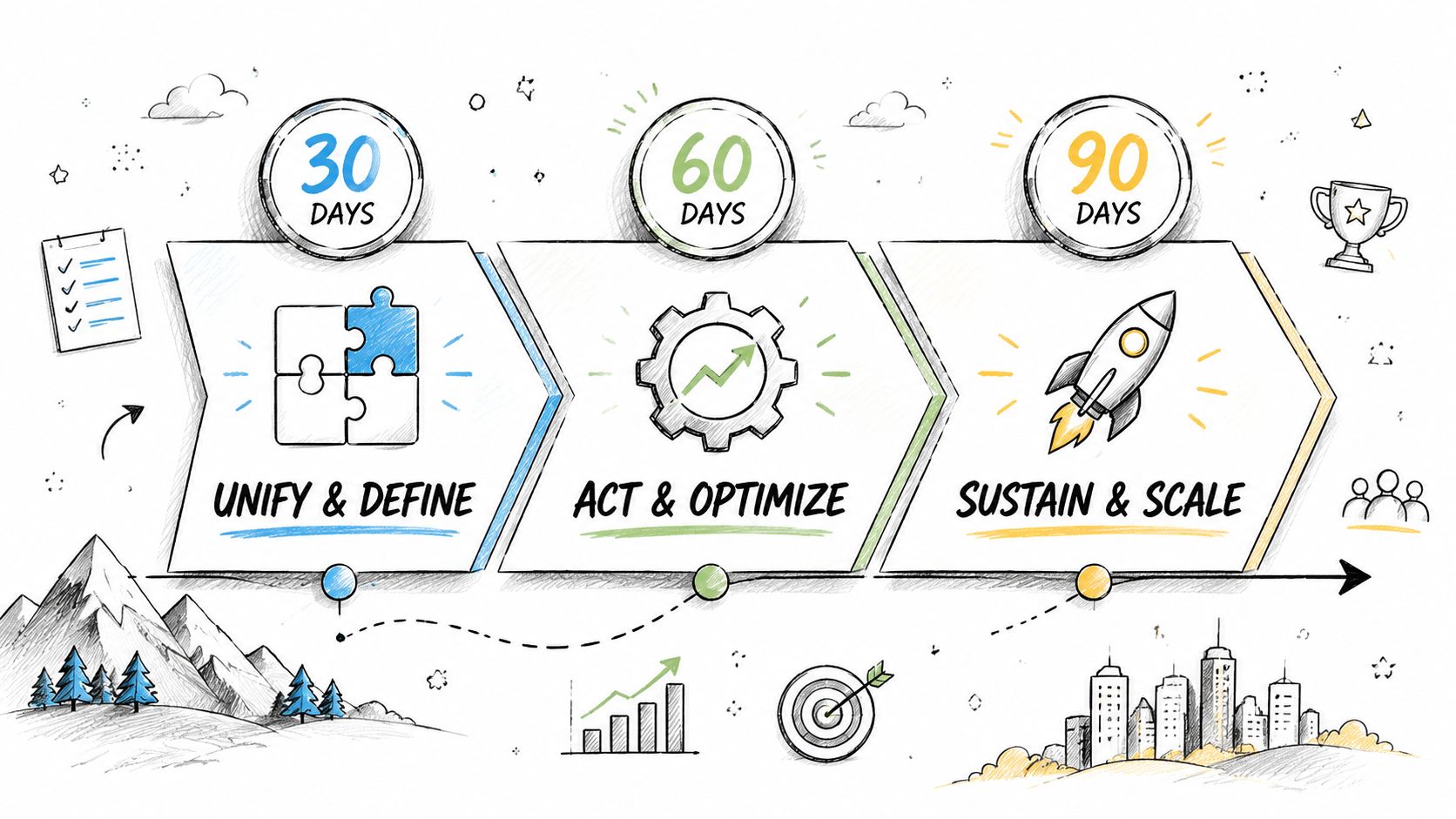
A hand-drawn business timeline illustration showing 30, 60, and 90-day phases for project development and growth.

A structured rollout matters because the business case is immediate. According to Klaviyo's explanation of customer lifecycle management, 1 in 5 buyers stop purchasing from brands they previously used, a 20% attrition rate that stronger lifecycle management is designed to reverse.

Days 1 to 30

Start by pulling customer data into one operating view. Don't chase every edge case. Focus on the records and events that determine movement across your lifecycle.

Define:

  • Stage entry rules: What makes someone a lead, opportunity, customer, or loyal account.

  • Ownership rules: Who acts when a customer changes stage.

  • Critical touchpoints: Which messages, meetings, or support events should always happen.

This is also the right time to identify one obvious leakage point. Maybe leads wait too long for follow-up. Maybe new customers don't hear from anyone after purchase. Pick one.

Days 31 to 60

Build a single automation that fixes that first leak.

For most SMBs, the best starting point is one of these:

  • Lead response workflow: Route and follow up faster after inbound interest.

  • Post-sale onboarding sequence: Confirm the purchase, explain next steps, and set expectations.

  • Re-engagement flow: Reach out when an existing customer goes quiet.

Don't over-design. The first workflow should be easy to monitor and easy to adjust.

Operator's note: A workflow is only “automated” if your team trusts it enough not to rebuild it manually every week.

Days 61 to 90

Review the first cohort that moved through your new process. Look at where customers advanced smoothly and where they still stalled.

Ask practical questions:

Review area

What to look for

Handoffs

Did the next owner have enough context to act quickly

Timing

Were key follow-ups sent early enough to matter

Messaging

Did communication match the customer's stage and needs

Friction

Where did customers stop responding or delay progress

Then refine one thing at a time. Adjust stage definitions. Tighten a trigger. Rewrite an onboarding email. Add one alert for an at-risk account. Customer lifecycle management gets stronger through iteration, not through a giant one-time build.

A good first 90 days won't give you a perfect machine. It will give you a shared system, a visible leak, and one repeatable fix. That's enough to change how your business grows.

If your team is tired of juggling separate tools for outreach, CRM, and follow-up, Stamina gives growing SMBs one AI-powered system to run the full customer lifecycle with less manual work and better visibility. It's built for companies that need cleaner handoffs, faster execution, and a single source of truth without stitching together an enterprise stack.

Your leads live in one tool. Your deals live in another. Support conversations sit in an inbox nobody checks before renewal time. Marketing celebrates campaign engagement while sales complains about lead quality, and nobody can say with confidence which customers are healthy, drifting, or ready to buy again.

That's a normal SMB setup. It's also why growth starts feeling harder than it should.

Customer lifecycle management isn't an enterprise-only discipline. It's the practical work of making sure every customer interaction connects to the next one, so your business stops leaking revenue between handoffs. For a growing company with a lean team, that matters more, not less.

Why Managing the Customer Lifecycle Matters for SMBs

Most SMB founders don't wake up thinking, “We need a lifecycle strategy.” They wake up thinking, “Why did that hot lead go cold?” or “Why did a customer churn when support said everything looked fine?” Those are lifecycle problems.

The issue usually isn't effort. It's fragmentation. Marketing sees clicks. Sales sees pipeline. Support sees tickets. Finance sees invoices. The customer experiences all of it as one relationship, but the business often manages it as separate departments with separate tools.

Small teams feel lifecycle failures faster

That gap hits smaller companies hard because there's less room for waste. If one handoff breaks, there usually isn't a dedicated operations person cleaning it up behind the scenes. And according to Gainsight's guide to the customer journey and lifecycle, 68% of SMBs lack formal Customer Success roles, which makes a cross-functional lifecycle approach even more important.

That's why customer lifecycle management works best when it's treated as a shared operating model, not a side project owned by one team.

A practical way to think about it is this:

  • Marketing owns attention: Bring in the right people, not just more people.

  • Sales owns momentum: Turn interest into a clear next step.

  • Service owns continuity: Help customers get value after the sale.

  • Leadership owns alignment: Make sure those motions connect.

If you're evaluating how a unified system supports that connection, it helps to understand what a customer engagement platform centralizes across the journey.

Practical rule: If your team has to ask three people what happened with one account, your lifecycle is broken.

Revenue improves when the experience stops resetting

Customers don't care which department touched the account last. They care whether the next interaction feels informed, timely, and useful. When every conversation starts from zero, trust drops. Sales cycles drag. Onboarding gets sloppy. Renewals become harder than they need to be.

For SMBs, good customer lifecycle management increases efficiency. It helps one team behave like a bigger one because information, context, and follow-up don't depend on memory. They depend on a system.

That's the main upside. You're not just “managing customers.” You're designing a cleaner path from first touch to repeat revenue.

What Is Customer Lifecycle Management Anyway

Customer lifecycle management is the discipline of guiding someone from first awareness to long-term loyalty without letting the relationship fall apart between stages.

The simplest analogy is a human relationship. You don't build trust by making a strong first impression and then disappearing. You build it by showing up appropriately at each stage. Early on, people need clarity. Later, they need consistency. Over time, they need proof that staying with you still makes sense.

A pencil sketch illustration showing the stages of human life progression alongside business growth and success symbols.

It's a strategy, not just software

A lot of teams confuse customer lifecycle management with CRM hygiene or email automation. Those tools matter, but they aren't the strategy. The strategy is deciding what your customer needs at each stage, who on your team owns that moment, and what signal tells you they're moving forward or drifting away.

Customer lifecycle management is the practice of delivering value and maintaining a strong relationship at every meaningful customer touchpoint.

That sounds simple. In practice, many businesses still operate in silos. Marketing generates leads and hands them off. Sales closes deals and hands them off. Support reacts when something breaks. Each team may perform well on its own terms, but the customer feels the seams.

That's why lifecycle thinking pairs well with strategic insights for modern businesses that move beyond rigid funnel logic and focus on connected experience.

What a fragmented approach gets wrong

Transactional businesses optimize for the immediate event. They ask:

  • Did the lead book a demo

  • Did the deal close

  • Did support answer the ticket

Lifecycle-driven businesses ask better questions:

  • Was the lead a good fit from the start

  • Did the buying experience match the promise made in marketing

  • Did the customer reach value quickly enough to want to stay

That difference matters because many businesses still organize around internal stages that don't match how customers decide. If you need a clearer baseline on the system side, this overview of customer relationship management is a useful companion to lifecycle strategy.

The mindset shift that changes execution

Customer lifecycle management works when you stop treating the sale as the finish line. The purchase is a transition point. It's where expectation turns into evaluation.

If the customer gets fast answers before buying but slow responses after signing, they notice. If sales promises a smooth rollout and onboarding feels improvised, they notice that too. Lifecycle management closes those gaps.

What you're really building is continuity. Not more messages. Not more tools. Continuity.

The 5 Core Stages of the Customer Lifecycle

A lifecycle only becomes useful when it's operational. For most SMBs, five stages are enough to create clarity without adding bureaucracy: Reach, Acquisition, Conversion, Retention, and Loyalty.

The important part isn't the label. It's making sure your stage definitions match how customers move. A Forrester study on customer life-cycle management found a major discrepancy between how firms design internal lifecycle programs and how customers experience their journey. That mismatch leads to ineffective strategies.

Reach

Reach is when a potential customer first becomes aware of your business. They may see your brand in search, hear about you from a referral, get an outbound email, or visit your site after seeing a social post.

The customer's goal is simple. They're trying to understand whether you're relevant.

Your goal is narrower than often understood. It's not maximum exposure. It's attracting attention from the right audience with the right problem.

Primary metric: Website traffic

This metric isn't perfect, but it gives SMBs a clean starting point. If traffic rises and nothing else improves, you probably have a targeting or message problem.

Acquisition

Acquisition starts when awareness turns into active interest. The prospect reads your pricing page, downloads a resource, replies to an email, asks for a demo, or starts comparing you with alternatives.

The customer wants confidence that your solution fits their situation. Your business needs to prove that fit without creating friction.

Weak lifecycle management quickly becomes apparent. Marketing may count a form fill as success, while sales sees an unqualified inquiry that was never likely to buy.

Primary metric: Marketing qualified leads

Use whatever qualification standard your team can apply consistently. The exact framework matters less than agreement on what “qualified” means.

For companies refining this handoff, it helps to define stages similarly to a sales pipeline framework, so marketing and sales aren't operating from different maps.

Conversion

Conversion is the moment interest turns into a customer relationship. In some businesses that means a closed deal. In others, it means a first purchase, signed contract, or activated subscription.

The customer wants a low-risk decision. They need clarity on value, terms, and next steps. Your goal is to remove doubt and reduce friction.

This stage often gets over-optimized in the wrong way. Teams obsess over persuasion tactics while ignoring operational drag. Slow follow-up, vague proposals, messy approvals, and unclear onboarding can kill momentum more reliably than weak copy.

Primary metric: Close rate

Close rate won't explain every problem, but it tells you whether the business is converting real opportunities into revenue.

Retention

Retention begins right after the sale. At this point, customers decide whether your product or service fits into their world well enough to stay.

The customer wants to achieve the outcome they bought. Your business wants them to reach value quickly, use what they purchased, and keep engaging.

A lot of SMBs underinvest here because the sale feels complete. That's a mistake. Most churn doesn't happen because the customer forgot your brand exists. It happens because they never built enough value into the relationship after the purchase.

Primary metric: Churn rate

If retention is weak, don't immediately blame price. Look first at onboarding, communication gaps, and whether customers understand how to succeed.

Loyalty

Loyalty is the stage where customers stay, buy again, refer others, or expand their relationship with you. This isn't about generic brand affection. It's about repeated proof that your business continues to be useful.

The customer wants reliability and recognition. Your business wants repeat revenue, stronger margins, and advocacy that lowers future acquisition friction.

Primary metric: Customer lifetime value

Loyalty is where lifecycle management starts compounding. A customer who stays longer, buys more, and recommends you makes every earlier stage more efficient.

The healthiest SMBs don't treat loyalty as a marketing campaign. They treat it as the outcome of doing the earlier stages well.

Key CLM Metrics You Can Actually Track

Most SMBs don't have a metrics problem. They have a visibility problem. The numbers they need exist somewhere, but they're scattered across ad platforms, inboxes, spreadsheets, billing tools, and support systems.

That's why customer lifecycle management should start with a small set of metrics that directly influence decisions. For most growing teams, that means customer lifetime value, customer acquisition cost, and churn rate.

A sketched business dashboard showing customer lifetime value, revenue, and growth metrics with interlocking gear icons.

The three metrics that change behavior

Customer lifetime value tells you how much value a customer relationship produces over time. It helps you stop judging channels only by who converts first. Some sources bring in buyers who close quickly but disappear just as fast. Others create slower starts and stronger accounts.

Customer acquisition cost shows what it takes to win a customer. Founders often get surprised; a channel can look efficient in marketing reports and still become expensive once sales time, follow-up effort, and support load are included.

Churn rate is the cleanup metric. It exposes whether the business is keeping what it wins. If churn stays high, strong top-of-funnel activity can hide a broken post-sale experience.

Why disconnected tools make these metrics unreliable

Many SMBs stall because, according to Nextiva's overview of customer lifecycle management, 52% of SMBs still use disconnected tools, and 61% fail to act on early retention signals due to data latency. That's the operational cost of fragmentation.

If campaign data sits in one system, deal status in another, and customer issues in a third, your team can't answer basic commercial questions with confidence:

  • Which channels bring in customers who stay

  • Which lead sources create the most support-heavy accounts

  • What tends to happen right before a customer stops engaging

  • Where are new customers getting stuck after purchase

Reality check: A metric only matters if someone can act on it before the customer is gone.

What to track first

You don't need a perfect analytics stack to start. You need a usable view.

A practical first dashboard should show:

Metric

What it helps you decide

Customer lifetime value

Which channels and segments are worth more investment

Customer acquisition cost

Whether your go-to-market motion is efficient

Churn rate

Where post-sale experience is breaking down

For teams sharpening retention and repeat revenue strategy, Quikly's insights on customer loyalty are a useful complement because they frame lifetime value as an outcome of better engagement, not just better discounting.

The key is to avoid vanity reporting. If a metric doesn't help you reallocate budget, improve handoffs, or trigger outreach, it belongs lower on the list.

An SMB Playbook for Managing the Full Lifecycle with Stamina

Most lifecycle advice breaks down because it assumes you have separate specialists for outbound, CRM administration, marketing automation, and customer success. Most SMBs don't. They need one system that supports the whole motion without forcing constant exports, manual updates, or tool switching.

Screenshot from https://stamina.io

A unified setup matters because Certinia's guide to mastering customer lifecycle management notes that consolidating customer touchpoints into a single CRM platform directly correlates with increased renewal and expansion rates by enabling personalized, consistent experiences at scale.

Use one system to remove handoff loss

The strongest SMB lifecycle playbooks share a few traits:

  • One customer record: Activity, outreach, and deal context live together.

  • Stage ownership: Everyone knows who acts next.

  • Automation where repetition lives: Follow-ups, reminders, and nurture shouldn't rely on memory.

  • Human judgment where stakes are high: Important deals and at-risk accounts still need a person involved.

That balance is what makes an AI-powered platform useful. It shouldn't replace your team's judgment. It should remove the repetitive work that causes dropped balls.

Stamina's Customer Lifecycle Playbook

Stage

Business Goal

Stamina Feature

Example Play

Reach

Identify and contact relevant prospects

Zara AI SDR and Sales Engagement

Build a target list from buying signals, generate personalized outbound sequences, and start conversations without manual prospect research

Acquisition

Turn interest into qualified opportunities

Marketing Flows and Broadcasts

Send a follow-up nurture flow to prospects who engage with a campaign but don't book a meeting

Conversion

Move qualified deals to close with full context

Unified CRM

Track deal activity, objections, and stakeholder notes in one pipeline so handoffs don't erase context

Retention

Help new customers reach value quickly

Workflows

Trigger onboarding emails and internal tasks when a deal is marked closed-won

Loyalty

Deepen relationships and spot expansion paths

CRM plus cross-team automation

Use account activity and engagement history to prompt check-ins, referrals, or upsell conversations

What this looks like in practice

Reach with AI-assisted outbound

Most SMB outbound programs fail before they start because the team spends too much time researching accounts and not enough time contacting them. Zara, the AI SDR inside Stamina, changes that workflow. Instead of asking a rep to build every list and draft every sequence from scratch, the platform helps identify fit, generate personalized messages, and launch outreach faster.

That's especially useful when founders or lean SDR teams are still validating market segments and need volume without losing relevance.

Acquire with simple nurture, not overbuilt campaigns

Once a prospect engages, don't force every lead into a sales conversation immediately. Some need more proof first. Marketing Flows and Broadcasts let you keep contact warm with content, offers, reminders, or education based on behavior.

The mistake here is complexity. Most SMBs don't need a giant branching automation tree. They need a handful of clear follow-ups tied to real buyer actions.

If you want to see how that orchestration works at the system level, Stamina's automation workflows show the kind of cross-team triggers that make lifecycle management workable for a small team.

Here's a short product walkthrough worth watching before you design those automations:

Convert with shared deal context

Conversion gets easier when marketing, sales, and leadership are looking at the same record. If call notes live in one place and campaign engagement in another, reps waste time reconstructing the story. A unified CRM changes that.

A practical example: when a prospect replies to an outbound sequence, books a meeting, and later requests pricing, the rep should see that history in one timeline. That lets the conversation move forward instead of resetting.

Retain with triggered onboarding

The post-sale phase presents the biggest hidden leak for many SMBs. Closed-won often triggers celebration, not process. A better move is immediate post-sale automation.

A simple example play: the moment a deal moves to closed-won, trigger a three-part onboarding sequence, create an internal follow-up task, and alert the account owner to schedule the kickoff. That removes delay and makes the customer feel expected.

Build loyalty through informed follow-up

Loyalty doesn't come from occasional “checking in” emails. It comes from relevant follow-up tied to usage, milestones, and account history. If a customer engaged heavily with one feature set, your team should know when to introduce a related service, upgrade path, or referral request.

For a broader retention lens, this guide on how to increase customer lifetime value is useful because it focuses on extending relationship value through experience and timing, not just pushing additional offers.

The best lifecycle system for an SMB isn't the one with the most features. It's the one your team will actually use across marketing, sales, and customer management every week.

Putting It All Together Your First 90 Days

The biggest mistake SMBs make with customer lifecycle management is trying to design the finished system on day one. Don't. Build the first usable version, then improve it with real customer behavior.

A hand-drawn business timeline illustration showing 30, 60, and 90-day phases for project development and growth.

A structured rollout matters because the business case is immediate. According to Klaviyo's explanation of customer lifecycle management, 1 in 5 buyers stop purchasing from brands they previously used, a 20% attrition rate that stronger lifecycle management is designed to reverse.

Days 1 to 30

Start by pulling customer data into one operating view. Don't chase every edge case. Focus on the records and events that determine movement across your lifecycle.

Define:

  • Stage entry rules: What makes someone a lead, opportunity, customer, or loyal account.

  • Ownership rules: Who acts when a customer changes stage.

  • Critical touchpoints: Which messages, meetings, or support events should always happen.

This is also the right time to identify one obvious leakage point. Maybe leads wait too long for follow-up. Maybe new customers don't hear from anyone after purchase. Pick one.

Days 31 to 60

Build a single automation that fixes that first leak.

For most SMBs, the best starting point is one of these:

  • Lead response workflow: Route and follow up faster after inbound interest.

  • Post-sale onboarding sequence: Confirm the purchase, explain next steps, and set expectations.

  • Re-engagement flow: Reach out when an existing customer goes quiet.

Don't over-design. The first workflow should be easy to monitor and easy to adjust.

Operator's note: A workflow is only “automated” if your team trusts it enough not to rebuild it manually every week.

Days 61 to 90

Review the first cohort that moved through your new process. Look at where customers advanced smoothly and where they still stalled.

Ask practical questions:

Review area

What to look for

Handoffs

Did the next owner have enough context to act quickly

Timing

Were key follow-ups sent early enough to matter

Messaging

Did communication match the customer's stage and needs

Friction

Where did customers stop responding or delay progress

Then refine one thing at a time. Adjust stage definitions. Tighten a trigger. Rewrite an onboarding email. Add one alert for an at-risk account. Customer lifecycle management gets stronger through iteration, not through a giant one-time build.

A good first 90 days won't give you a perfect machine. It will give you a shared system, a visible leak, and one repeatable fix. That's enough to change how your business grows.

If your team is tired of juggling separate tools for outreach, CRM, and follow-up, Stamina gives growing SMBs one AI-powered system to run the full customer lifecycle with less manual work and better visibility. It's built for companies that need cleaner handoffs, faster execution, and a single source of truth without stitching together an enterprise stack.

Share this article

Share this article

Send a shareable link to your team or anyone who might find it useful.

Send a shareable link to your team or anyone who might find it useful.

Copy link

Copied

Share directly to

Table of contents

Give Your Business the Stamina it needs to Thrive

PRODUCT

COMPANY

RESOURCES

© 2026 Stamina Software Technologies Inc. All rights reserved.

PRODUCT

COMPANY

RESOURCES

© 2026 Stamina Software Technologies Inc. All rights reserved.

PRODUCT

COMPANY

RESOURCES

© 2026 Stamina Software Technologies Inc. All rights reserved.