Master Sales Pipeline Stages: Build & Automate

Learn essential sales pipeline stages: prospecting to close. Get models, KPIs, and steps to build & automate your pipeline with Stamina.

0 - Minute Read

Your pipeline probably lives in too many places right now. Some deals sit in a spreadsheet. Some live in a rep's inbox. A few are in the CRM, but the stages mean different things to different people. Forecast calls become a debate instead of a review. Everyone has an opinion. Very few have proof.

That's where most SMB sales teams get stuck. They don't have a pipeline problem because they lack software. They have a pipeline problem because they lack stage discipline. A deal moves forward because a rep “feels good about it,” not because the buyer has done something that proves progress.

A useful pipeline fixes that. It gives your team a shared language, a visible path from first contact to close, and a way to spot stalled deals before the quarter slips away. Modern B2B teams typically organize the buying journey into 5 to 7 sales pipeline stages, with the exact count varying by complexity, as outlined by Salesforce's pipeline stages guide.

The mistake most guides make is treating stages like labels. Prospecting. Qualification. Proposal. Negotiation. Closed won. That list is fine as a starting point, but labels alone won't help you forecast. What matters is whether each stage has a verifiable exit criterion. If a deal can move from one stage to the next without evidence, your pipeline is lying to you.

From Sales Chaos to Pipeline Clarity

A messy sales process creates the same symptoms in almost every company. Reps chase the loudest lead instead of the best lead. Follow-ups happen late. Old opportunities stay open because nobody wants to mark them lost. Managers ask for pipeline updates and get stories instead of facts.

That chaos shows up in revenue long before it shows up in reports. You feel it when the month looks healthy on paper, but the deals that were supposed to close suddenly “push” again. You feel it when one rep says a deal is qualified because the prospect replied to an email, while another rep won't call anything qualified until budget and timing are confirmed.

What a pipeline actually does

A sales pipeline is a working model of your sales process. It breaks the journey into defined checkpoints so every opportunity has a current status, an expected next step, and a clear standard for moving forward.

Used properly, a pipeline does four jobs:

  • Creates visibility: Everyone can see where deals are and what's blocking them.

  • Improves coaching: Managers can inspect deal quality, not just activity volume.

  • Sharpens forecasting: Stage movement means something because stage definitions are consistent.

  • Protects rep time: Poor-fit opportunities get filtered out earlier.

Practical rule: If two reps would place the same deal in different stages, the stage definition is too vague.

Why vague stages fail

Most bad pipelines don't fail because they have the wrong number of stages. They fail because stages describe seller activity instead of buyer progress. “Sent proposal” is an action. It isn't proof that the deal is moving. A proposal that sits unopened for two weeks shouldn't count the same as a proposal the buying team reviewed with questions and a scheduled follow-up.

That's why pipeline design has to start with one question: What has the buyer done that proves this deal earned the right to advance?

When you build around that question, the pipeline stops being a reporting tool and starts becoming a revenue control system.

The Core Sales Pipeline Stages Explained

Think of sales pipeline stages like stations on a subway line. A buyer doesn't get to the next stop because the rep hopes they're ready. They move because they've met the condition to board the next segment.
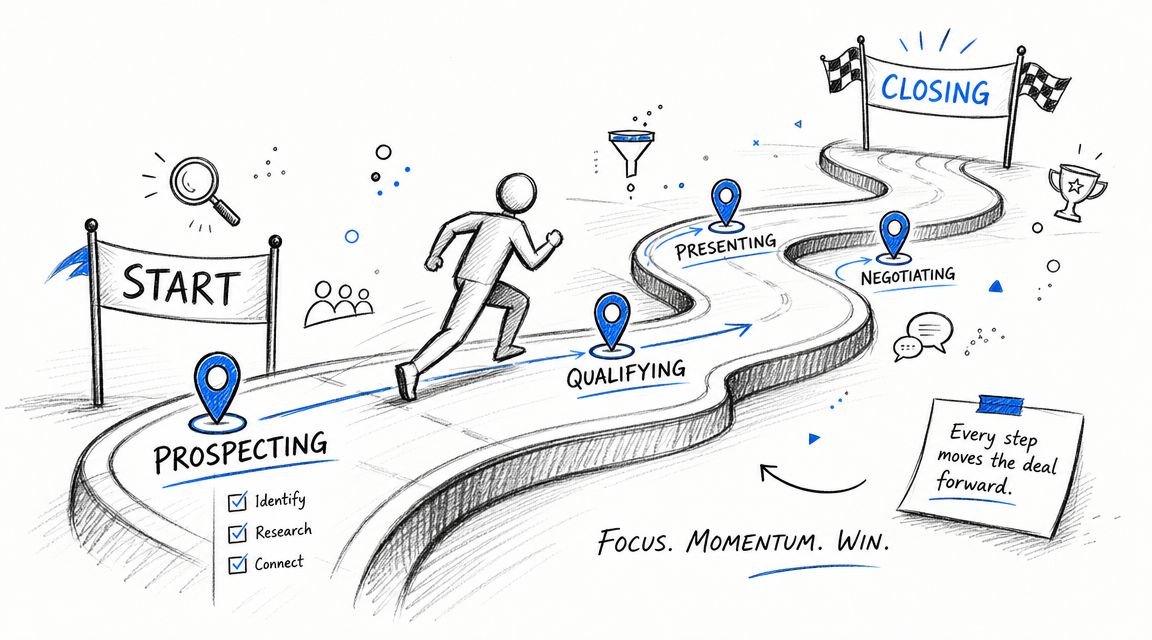
A hand-drawn illustration depicting the sales pipeline stages, from prospecting to closing, along a path with milestones.

A version of the same model is widely adopted. If you need a useful companion piece on how stages connect to day-to-day execution, the Formzz sales process article is worth reading alongside this topic. For a more operational view of running deals inside a system, this guide to pipeline management in sales adds the management layer many teams miss.

Prospecting

This stage is about identifying accounts and contacts worth pursuing. It includes outbound lists, inbound leads, referrals, partner introductions, and signals that suggest a potential fit.

The goal isn't volume for its own sake. The goal is to get the right people into the top of the funnel.

A real win at this stage: you've identified a legitimate potential buyer and secured enough context to attempt qualification.

Qualification

At this stage, organizations either build a clean pipeline or contaminate it. Qualification should answer whether the deal is worth sales time now. Good qualification checks buyer fit and buying readiness, not just interest.

Typical questions involve budget, authority, need, and timeline. But the deeper issue is whether those points are confirmed or assumed.

A real win at this stage: you have evidence the account fits your offer and the buyer has a credible reason to keep moving.

Good qualification removes deals from the pipeline just as often as it advances them. That's healthy.

Discovery or meeting

Now the rep earns the right to understand the buyer's situation in detail. In this stage, pain points, current process, desired outcomes, stakeholders, and decision dynamics become clear.

A weak discovery call creates generic notes. A strong one produces specifics that shape the deal.

A real win at this stage: the buyer has shared enough operational and business context that you can map your solution to a defined problem.

Proposal

This stage should not begin because a rep is eager to send pricing. It should begin because the buyer's needs are clear enough for a relevant proposal.

A proposal can be a formal document, pricing package, scope, or commercial plan. The format matters less than the timing.

A real win at this stage: the buyer receives a proposal tied to agreed needs, and there is a confirmed next conversation to review it.

Negotiation

This stage includes pricing discussions, scope changes, terms, approvals, procurement friction, and internal sign-off on the buyer side.

Many teams hide too much inside “negotiation.” If your deals involve legal, procurement, security, or executive approval, those may deserve separate treatment in a more complex model.

A real win at this stage: the buyer is actively working through final blockers, not passively “thinking it over.”

Closing

This is the outcome stage. The deal becomes closed won or closed lost.

The mistake here is treating a close as the finish line for learning. Every close should tell you something about the stages before it. Wins reveal what good progression looked like. Losses reveal where false confidence entered the pipeline.

Choosing Your Pipeline Model Standard vs SMB-Optimized

A pipeline should match the way your deals move. That's why copying an enterprise model into an SMB sales team often creates drag. More stages do not mean more control. Sometimes they mean more admin and less selling.

Benchmark guidance from monday.com's overview of sales pipeline stages suggests 5 to 6 stages are usually sufficient for simpler deals under $25K, while 7 to 10 stages fit more complex sales that involve procurement, legal review, and similar friction points.

Side-by-side comparison

Stage Number

Standard Enterprise Model

SMB-Optimized Model

1

Prospecting

Prospecting

2

Qualification

Qualification

3

Discovery

Discovery

4

Solution fit or demo

Proposal

5

Proposal

Decision

6

Negotiation

Closed won or lost

7

Procurement or approval


8

Closed won or lost


When the standard model makes sense

Use the longer model when your deals involve multiple stakeholders, technical review, or formal approval steps. In those environments, compressed stages hide where deals slow down. A deal may look stuck in “negotiation” when the actual issue is legal review or executive approval.

That matters because the manager's response changes depending on the blocker. Legal friction needs one intervention. Missing executive alignment needs another.

Why SMB teams usually need less

SMB teams often sell faster, with fewer stakeholders and shorter buying cycles. In that environment, every extra stage creates more room for inconsistent updates and unnecessary CRM work.

An efficient model usually works better when:

  • Deals close quickly: You don't need separate micro-stages for steps that happen within a short window.

  • The buyer set is smaller: Fewer stakeholders means fewer approval gates to track.

  • The team is lean: Managers need clarity they can inspect quickly during weekly reviews.

The right model is the smallest one that still shows you where deals actually break.

A simple decision filter

Choose your model based on three things:

  1. Average deal size
    Smaller, faster deals usually need less granularity.

  2. Buying friction
    If procurement, legal, or security repeatedly stall deals, create stages that make those blockers visible.

  3. Manager inspection needs
    If a stage doesn't help coaching, forecasting, or process control, it probably doesn't need to exist.

Measuring What Matters Key Metrics for Pipeline Health

A pipeline isn't healthy because it looks full. It's healthy when deals move through it at a pace and pattern you can trust.

Core pipeline metrics such as pipeline velocity, win rate by stage, average deal size, and sales cycle length matter because they show whether opportunities are progressing or getting stuck. They also help explain why stage discipline matters. Validity notes that it takes an average of eight touchpoints to win a sale, which is exactly why time-in-stage and progression matter so much.
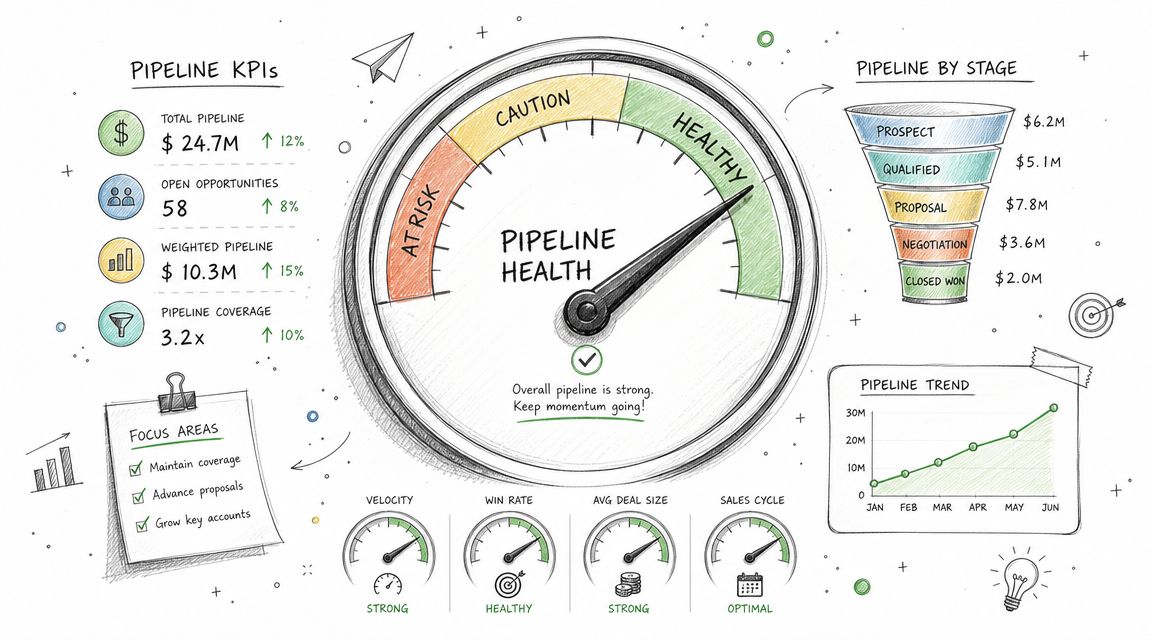
A hand-drawn business dashboard visualization showing sales pipeline KPIs, health gauge, and funnel stages.

If your CRM discipline is weak, fix that before you obsess over dashboard design. These CRM best practices are useful because they focus on the habits that make pipeline reporting credible.

Stage conversion rates

This tells you how many deals move from one stage to the next.

Simple formula:
Deals that advanced to the next stage ÷ deals that entered the current stage

If qualification-to-discovery conversion is weak, your top-of-funnel targeting may be off. If proposal-to-decision conversion is weak, the issue may be poor discovery, poor positioning, or weak commercial alignment.

Pipeline velocity

Velocity tells you how quickly your pipeline turns into revenue. The formula commonly used in pipeline management is:

(Number of opportunities × average deal value × win rate) ÷ average sales cycle length

Velocity is useful because it prevents a common leadership mistake. A big pipeline can still be a slow pipeline. If opportunities sit too long or conversion drops, revenue timing slips even when total pipeline looks impressive.

Sales cycle length

This tracks how long deals take to close. Watch it overall, then look at it by segment, rep, and source.

A rising cycle length often means one of two things. Either qualification is loose and weak-fit deals are hanging around too long, or later-stage blockers are not being surfaced early enough.

Win rate

Win rate is your overall effectiveness. On its own, it's incomplete. Combined with stage conversion data, it becomes useful.

A weak overall win rate can hide very different problems. One team may lose early because qualification is poor. Another may lose late because they reach proposal without enough stakeholder alignment.

A short diagnostic table

Metric

What it tells you

Common warning sign

Stage conversion

Where deals stall

One stage drops sharply vs others

Pipeline velocity

How fast pipeline turns into revenue

High pipeline value, slow closes

Sales cycle length

How long deals take to win

Deals aging without clear blocker

Win rate

How often opportunities close

Lots of late-stage losses

If you can't explain why deals are stuck, your stage definitions are probably too soft.

The Top Mistakes That Wreck Your Sales Forecast

Forecasts don't break at the end of the quarter. They break earlier, when the pipeline starts accepting fiction as progress.
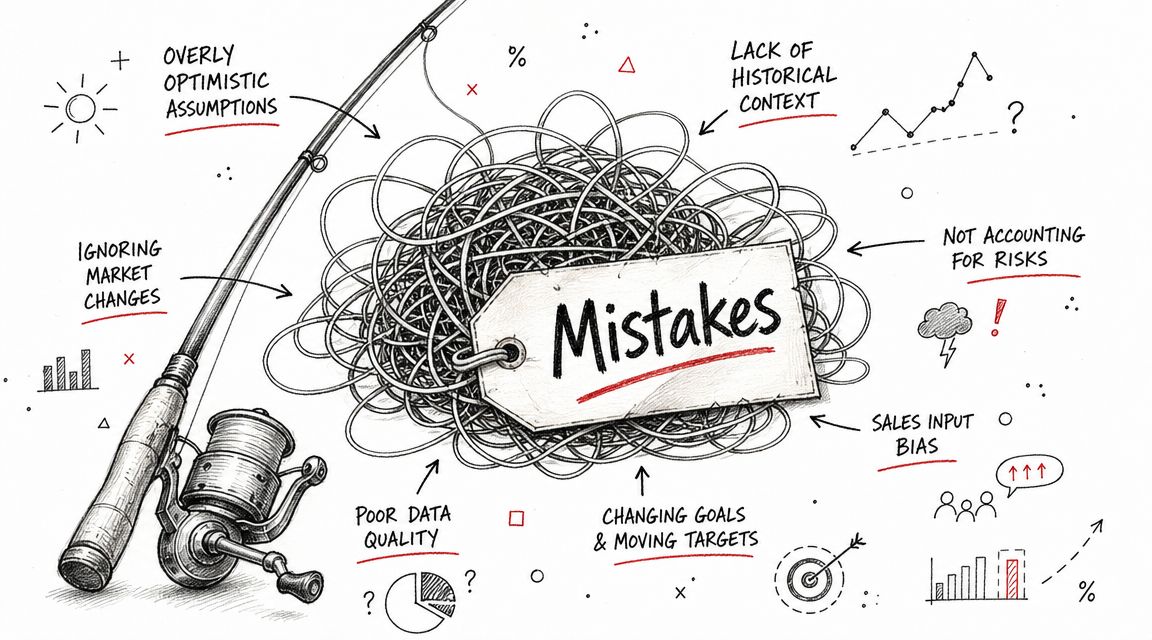
A hand-drawn illustration showing a fishing rod tangled in a mess labeled Mistakes representing sales planning errors.

The biggest forecasting mistake is simple. Reps are allowed to move deals forward based on instinct, optimism, or partial signals. That creates “fake progress,” where a deal appears advanced in the CRM but hasn't earned that position in the buyer's process.

A public benchmark cited by Salesmotion's pipeline stage analysis notes that deals are 233% less likely to close without decision-maker involvement. That's the exact kind of gap a stage model should expose. Too many teams mark deals as advanced while the actual buyer still hasn't entered the conversation.

Mistake one: activity disguised as progress

Sending a proposal is not progress. Holding a call is not progress. Logging an email is not progress.

Progress means the buyer has done something that reduces uncertainty. They confirmed budget. They introduced a decision-maker. They reviewed the proposal and agreed on next steps.

Weak exit criterion: “Rep had a positive call”
Strong exit criterion: “Buyer confirmed problem, stakeholders, and a scheduled next step”

Mistake two: keeping dead deals alive

Sales teams often carry stale deals because nobody wants to lose optionality. The result is a pipeline that looks safer than it is.

Dead deals create three problems:

  • Forecast inflation: The number is larger than reality.

  • Poor coaching: Managers spend time on deals that won't move.

  • Bad metric signals: Conversion and stage aging become harder to interpret.

A healthy pipeline closes lost deals promptly. It doesn't confuse “not now” with “still active.”

Mistake three: letting every rep define stages differently

This is the silent killer. One rep updates diligently. Another skips fields. A third moves deals based on enthusiasm. The CRM then turns into a shared system with private meanings.

Manager test: Ask three reps what must be true for a deal to enter proposal. If you get three different answers, your forecast is already compromised.

The fix is not another pipeline review meeting. The fix is a standard, written exit criterion for every stage, paired with system rules that enforce it. When stage movement requires evidence, the forecast gets cleaner fast.

How to Build Your Pipeline in Stamina A Practical Guide

The fastest way to improve pipeline quality is to design the process first, then configure the system to enforce it. Don't start by dragging deals across columns. Start by deciding what a buyer must prove at each step.
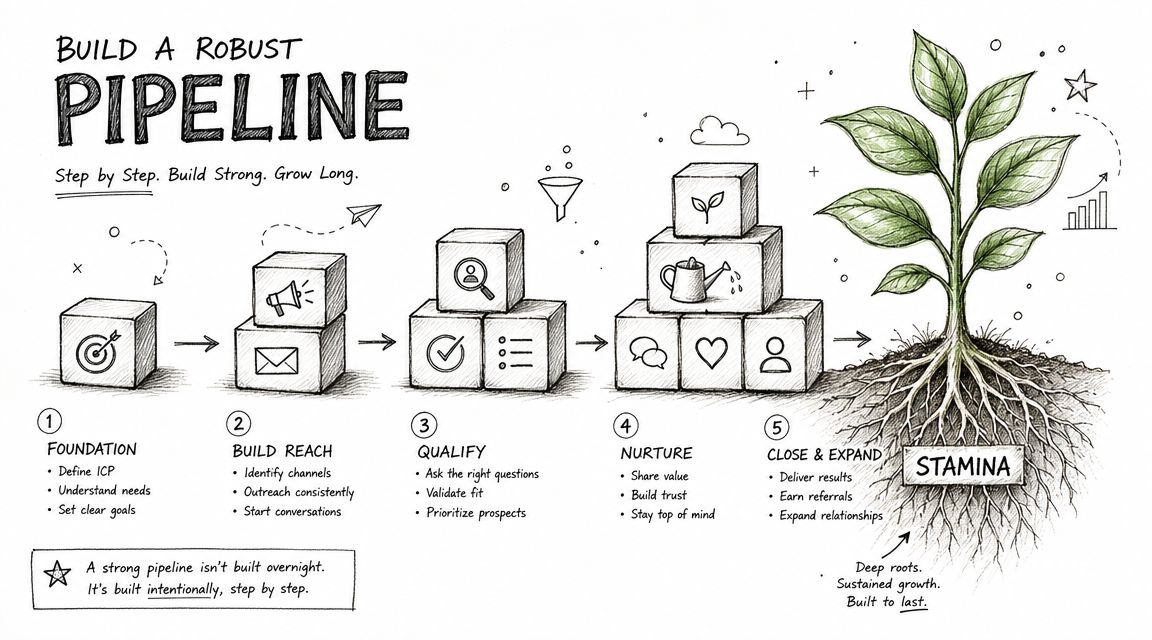
A hand-drawn illustration detailing five steps to build a robust sales pipeline, from foundation to growth.

If you want another practical framework for structuring the build, this guide on how to optimize your sales process is a solid external reference. For a platform-specific walkthrough, this resource on how to build a sales pipeline gives the operational detail teams usually need once they move from planning into setup.

Step one: build the stages around buyer proof

For most SMB teams, keep the first version simple:

  1. Prospecting

  2. Qualification

  3. Discovery

  4. Proposal

  5. Decision

  6. Closed won or lost

Then define the exit criteria in plain language. Qualification might require confirmed fit and a scheduled discovery conversation. Proposal might require documented pain points, buying context, and a committed review meeting.

Don't overcomplicate version one. Complexity belongs in rules, fields, and automation, not in a bloated stage list.

Step two: turn exit criteria into workflow rules

In this scenario, an AI-powered CRM becomes useful. Instead of asking reps to remember every requirement, you configure the system so certain fields, tasks, or evidence must exist before a deal can move.

For example:

  • Before proposal: require a completed discovery field and documented buyer need

  • Before decision: require proposal sent, buyer review completed, and next-step date

  • Before forecast commit: require decision-maker involvement to be logged

That structure is where Stamina fits naturally. It combines CRM, workflows, and AI-driven outreach in one system, so teams can manage stage movement, required fields, and automated handoffs without stitching together separate tools.

Here's a quick visual walkthrough of the kind of setup discipline teams need:

Step three: automate the top of the pipeline

Top-of-funnel quality determines everything downstream. If low-fit leads enter qualification, your later stages fill with noise.

Use AI and automation for the early work humans tend to do inconsistently:

  • Lead research: enrich account and contact context before outreach

  • Initial scoring: filter for fit before a rep spends time

  • Sequence triggers: launch outreach based on website, campaign, or social signals

  • Task creation: assign follow-up automatically when a buyer responds or books time

That's how you keep the pipeline disciplined without turning reps into data-entry clerks.

Your Next Step to a Predictable Pipeline

A good pipeline doesn't need more stages. It needs better standards. When every stage has a clear exit criterion, your team stops confusing activity with progress. Forecasts get tighter. Coaching gets sharper. Reps spend more time on real opportunities and less time nursing deals that were never serious.

For most SMB teams, the winning approach is straightforward. Use a simple stage model. Define what must be true before a deal advances. Track the few metrics that reveal movement and friction. Then automate the rules so the process holds up even when the team gets busy.

If you want to operationalize that discipline inside one system, book a walkthrough and see how it fits your motion through the Stamina demo page.

Stamina brings CRM, automation, and AI-powered outreach into one workflow so SMB teams can build a cleaner pipeline, enforce stage discipline, and forecast with more confidence. If that's the gap you're trying to close, start with Stamina.

Your pipeline probably lives in too many places right now. Some deals sit in a spreadsheet. Some live in a rep's inbox. A few are in the CRM, but the stages mean different things to different people. Forecast calls become a debate instead of a review. Everyone has an opinion. Very few have proof.

That's where most SMB sales teams get stuck. They don't have a pipeline problem because they lack software. They have a pipeline problem because they lack stage discipline. A deal moves forward because a rep “feels good about it,” not because the buyer has done something that proves progress.

A useful pipeline fixes that. It gives your team a shared language, a visible path from first contact to close, and a way to spot stalled deals before the quarter slips away. Modern B2B teams typically organize the buying journey into 5 to 7 sales pipeline stages, with the exact count varying by complexity, as outlined by Salesforce's pipeline stages guide.

The mistake most guides make is treating stages like labels. Prospecting. Qualification. Proposal. Negotiation. Closed won. That list is fine as a starting point, but labels alone won't help you forecast. What matters is whether each stage has a verifiable exit criterion. If a deal can move from one stage to the next without evidence, your pipeline is lying to you.

From Sales Chaos to Pipeline Clarity

A messy sales process creates the same symptoms in almost every company. Reps chase the loudest lead instead of the best lead. Follow-ups happen late. Old opportunities stay open because nobody wants to mark them lost. Managers ask for pipeline updates and get stories instead of facts.

That chaos shows up in revenue long before it shows up in reports. You feel it when the month looks healthy on paper, but the deals that were supposed to close suddenly “push” again. You feel it when one rep says a deal is qualified because the prospect replied to an email, while another rep won't call anything qualified until budget and timing are confirmed.

What a pipeline actually does

A sales pipeline is a working model of your sales process. It breaks the journey into defined checkpoints so every opportunity has a current status, an expected next step, and a clear standard for moving forward.

Used properly, a pipeline does four jobs:

  • Creates visibility: Everyone can see where deals are and what's blocking them.

  • Improves coaching: Managers can inspect deal quality, not just activity volume.

  • Sharpens forecasting: Stage movement means something because stage definitions are consistent.

  • Protects rep time: Poor-fit opportunities get filtered out earlier.

Practical rule: If two reps would place the same deal in different stages, the stage definition is too vague.

Why vague stages fail

Most bad pipelines don't fail because they have the wrong number of stages. They fail because stages describe seller activity instead of buyer progress. “Sent proposal” is an action. It isn't proof that the deal is moving. A proposal that sits unopened for two weeks shouldn't count the same as a proposal the buying team reviewed with questions and a scheduled follow-up.

That's why pipeline design has to start with one question: What has the buyer done that proves this deal earned the right to advance?

When you build around that question, the pipeline stops being a reporting tool and starts becoming a revenue control system.

The Core Sales Pipeline Stages Explained

Think of sales pipeline stages like stations on a subway line. A buyer doesn't get to the next stop because the rep hopes they're ready. They move because they've met the condition to board the next segment.

A hand-drawn illustration depicting the sales pipeline stages, from prospecting to closing, along a path with milestones.

A version of the same model is widely adopted. If you need a useful companion piece on how stages connect to day-to-day execution, the Formzz sales process article is worth reading alongside this topic. For a more operational view of running deals inside a system, this guide to pipeline management in sales adds the management layer many teams miss.

Prospecting

This stage is about identifying accounts and contacts worth pursuing. It includes outbound lists, inbound leads, referrals, partner introductions, and signals that suggest a potential fit.

The goal isn't volume for its own sake. The goal is to get the right people into the top of the funnel.

A real win at this stage: you've identified a legitimate potential buyer and secured enough context to attempt qualification.

Qualification

At this stage, organizations either build a clean pipeline or contaminate it. Qualification should answer whether the deal is worth sales time now. Good qualification checks buyer fit and buying readiness, not just interest.

Typical questions involve budget, authority, need, and timeline. But the deeper issue is whether those points are confirmed or assumed.

A real win at this stage: you have evidence the account fits your offer and the buyer has a credible reason to keep moving.

Good qualification removes deals from the pipeline just as often as it advances them. That's healthy.

Discovery or meeting

Now the rep earns the right to understand the buyer's situation in detail. In this stage, pain points, current process, desired outcomes, stakeholders, and decision dynamics become clear.

A weak discovery call creates generic notes. A strong one produces specifics that shape the deal.

A real win at this stage: the buyer has shared enough operational and business context that you can map your solution to a defined problem.

Proposal

This stage should not begin because a rep is eager to send pricing. It should begin because the buyer's needs are clear enough for a relevant proposal.

A proposal can be a formal document, pricing package, scope, or commercial plan. The format matters less than the timing.

A real win at this stage: the buyer receives a proposal tied to agreed needs, and there is a confirmed next conversation to review it.

Negotiation

This stage includes pricing discussions, scope changes, terms, approvals, procurement friction, and internal sign-off on the buyer side.

Many teams hide too much inside “negotiation.” If your deals involve legal, procurement, security, or executive approval, those may deserve separate treatment in a more complex model.

A real win at this stage: the buyer is actively working through final blockers, not passively “thinking it over.”

Closing

This is the outcome stage. The deal becomes closed won or closed lost.

The mistake here is treating a close as the finish line for learning. Every close should tell you something about the stages before it. Wins reveal what good progression looked like. Losses reveal where false confidence entered the pipeline.

Choosing Your Pipeline Model Standard vs SMB-Optimized

A pipeline should match the way your deals move. That's why copying an enterprise model into an SMB sales team often creates drag. More stages do not mean more control. Sometimes they mean more admin and less selling.

Benchmark guidance from monday.com's overview of sales pipeline stages suggests 5 to 6 stages are usually sufficient for simpler deals under $25K, while 7 to 10 stages fit more complex sales that involve procurement, legal review, and similar friction points.

Side-by-side comparison

Stage Number

Standard Enterprise Model

SMB-Optimized Model

1

Prospecting

Prospecting

2

Qualification

Qualification

3

Discovery

Discovery

4

Solution fit or demo

Proposal

5

Proposal

Decision

6

Negotiation

Closed won or lost

7

Procurement or approval


8

Closed won or lost


When the standard model makes sense

Use the longer model when your deals involve multiple stakeholders, technical review, or formal approval steps. In those environments, compressed stages hide where deals slow down. A deal may look stuck in “negotiation” when the actual issue is legal review or executive approval.

That matters because the manager's response changes depending on the blocker. Legal friction needs one intervention. Missing executive alignment needs another.

Why SMB teams usually need less

SMB teams often sell faster, with fewer stakeholders and shorter buying cycles. In that environment, every extra stage creates more room for inconsistent updates and unnecessary CRM work.

An efficient model usually works better when:

  • Deals close quickly: You don't need separate micro-stages for steps that happen within a short window.

  • The buyer set is smaller: Fewer stakeholders means fewer approval gates to track.

  • The team is lean: Managers need clarity they can inspect quickly during weekly reviews.

The right model is the smallest one that still shows you where deals actually break.

A simple decision filter

Choose your model based on three things:

  1. Average deal size
    Smaller, faster deals usually need less granularity.

  2. Buying friction
    If procurement, legal, or security repeatedly stall deals, create stages that make those blockers visible.

  3. Manager inspection needs
    If a stage doesn't help coaching, forecasting, or process control, it probably doesn't need to exist.

Measuring What Matters Key Metrics for Pipeline Health

A pipeline isn't healthy because it looks full. It's healthy when deals move through it at a pace and pattern you can trust.

Core pipeline metrics such as pipeline velocity, win rate by stage, average deal size, and sales cycle length matter because they show whether opportunities are progressing or getting stuck. They also help explain why stage discipline matters. Validity notes that it takes an average of eight touchpoints to win a sale, which is exactly why time-in-stage and progression matter so much.

A hand-drawn business dashboard visualization showing sales pipeline KPIs, health gauge, and funnel stages.

If your CRM discipline is weak, fix that before you obsess over dashboard design. These CRM best practices are useful because they focus on the habits that make pipeline reporting credible.

Stage conversion rates

This tells you how many deals move from one stage to the next.

Simple formula:
Deals that advanced to the next stage ÷ deals that entered the current stage

If qualification-to-discovery conversion is weak, your top-of-funnel targeting may be off. If proposal-to-decision conversion is weak, the issue may be poor discovery, poor positioning, or weak commercial alignment.

Pipeline velocity

Velocity tells you how quickly your pipeline turns into revenue. The formula commonly used in pipeline management is:

(Number of opportunities × average deal value × win rate) ÷ average sales cycle length

Velocity is useful because it prevents a common leadership mistake. A big pipeline can still be a slow pipeline. If opportunities sit too long or conversion drops, revenue timing slips even when total pipeline looks impressive.

Sales cycle length

This tracks how long deals take to close. Watch it overall, then look at it by segment, rep, and source.

A rising cycle length often means one of two things. Either qualification is loose and weak-fit deals are hanging around too long, or later-stage blockers are not being surfaced early enough.

Win rate

Win rate is your overall effectiveness. On its own, it's incomplete. Combined with stage conversion data, it becomes useful.

A weak overall win rate can hide very different problems. One team may lose early because qualification is poor. Another may lose late because they reach proposal without enough stakeholder alignment.

A short diagnostic table

Metric

What it tells you

Common warning sign

Stage conversion

Where deals stall

One stage drops sharply vs others

Pipeline velocity

How fast pipeline turns into revenue

High pipeline value, slow closes

Sales cycle length

How long deals take to win

Deals aging without clear blocker

Win rate

How often opportunities close

Lots of late-stage losses

If you can't explain why deals are stuck, your stage definitions are probably too soft.

The Top Mistakes That Wreck Your Sales Forecast

Forecasts don't break at the end of the quarter. They break earlier, when the pipeline starts accepting fiction as progress.

A hand-drawn illustration showing a fishing rod tangled in a mess labeled Mistakes representing sales planning errors.

The biggest forecasting mistake is simple. Reps are allowed to move deals forward based on instinct, optimism, or partial signals. That creates “fake progress,” where a deal appears advanced in the CRM but hasn't earned that position in the buyer's process.

A public benchmark cited by Salesmotion's pipeline stage analysis notes that deals are 233% less likely to close without decision-maker involvement. That's the exact kind of gap a stage model should expose. Too many teams mark deals as advanced while the actual buyer still hasn't entered the conversation.

Mistake one: activity disguised as progress

Sending a proposal is not progress. Holding a call is not progress. Logging an email is not progress.

Progress means the buyer has done something that reduces uncertainty. They confirmed budget. They introduced a decision-maker. They reviewed the proposal and agreed on next steps.

Weak exit criterion: “Rep had a positive call”
Strong exit criterion: “Buyer confirmed problem, stakeholders, and a scheduled next step”

Mistake two: keeping dead deals alive

Sales teams often carry stale deals because nobody wants to lose optionality. The result is a pipeline that looks safer than it is.

Dead deals create three problems:

  • Forecast inflation: The number is larger than reality.

  • Poor coaching: Managers spend time on deals that won't move.

  • Bad metric signals: Conversion and stage aging become harder to interpret.

A healthy pipeline closes lost deals promptly. It doesn't confuse “not now” with “still active.”

Mistake three: letting every rep define stages differently

This is the silent killer. One rep updates diligently. Another skips fields. A third moves deals based on enthusiasm. The CRM then turns into a shared system with private meanings.

Manager test: Ask three reps what must be true for a deal to enter proposal. If you get three different answers, your forecast is already compromised.

The fix is not another pipeline review meeting. The fix is a standard, written exit criterion for every stage, paired with system rules that enforce it. When stage movement requires evidence, the forecast gets cleaner fast.

How to Build Your Pipeline in Stamina A Practical Guide

The fastest way to improve pipeline quality is to design the process first, then configure the system to enforce it. Don't start by dragging deals across columns. Start by deciding what a buyer must prove at each step.

A hand-drawn illustration detailing five steps to build a robust sales pipeline, from foundation to growth.

If you want another practical framework for structuring the build, this guide on how to optimize your sales process is a solid external reference. For a platform-specific walkthrough, this resource on how to build a sales pipeline gives the operational detail teams usually need once they move from planning into setup.

Step one: build the stages around buyer proof

For most SMB teams, keep the first version simple:

  1. Prospecting

  2. Qualification

  3. Discovery

  4. Proposal

  5. Decision

  6. Closed won or lost

Then define the exit criteria in plain language. Qualification might require confirmed fit and a scheduled discovery conversation. Proposal might require documented pain points, buying context, and a committed review meeting.

Don't overcomplicate version one. Complexity belongs in rules, fields, and automation, not in a bloated stage list.

Step two: turn exit criteria into workflow rules

In this scenario, an AI-powered CRM becomes useful. Instead of asking reps to remember every requirement, you configure the system so certain fields, tasks, or evidence must exist before a deal can move.

For example:

  • Before proposal: require a completed discovery field and documented buyer need

  • Before decision: require proposal sent, buyer review completed, and next-step date

  • Before forecast commit: require decision-maker involvement to be logged

That structure is where Stamina fits naturally. It combines CRM, workflows, and AI-driven outreach in one system, so teams can manage stage movement, required fields, and automated handoffs without stitching together separate tools.

Here's a quick visual walkthrough of the kind of setup discipline teams need:

Step three: automate the top of the pipeline

Top-of-funnel quality determines everything downstream. If low-fit leads enter qualification, your later stages fill with noise.

Use AI and automation for the early work humans tend to do inconsistently:

  • Lead research: enrich account and contact context before outreach

  • Initial scoring: filter for fit before a rep spends time

  • Sequence triggers: launch outreach based on website, campaign, or social signals

  • Task creation: assign follow-up automatically when a buyer responds or books time

That's how you keep the pipeline disciplined without turning reps into data-entry clerks.

Your Next Step to a Predictable Pipeline

A good pipeline doesn't need more stages. It needs better standards. When every stage has a clear exit criterion, your team stops confusing activity with progress. Forecasts get tighter. Coaching gets sharper. Reps spend more time on real opportunities and less time nursing deals that were never serious.

For most SMB teams, the winning approach is straightforward. Use a simple stage model. Define what must be true before a deal advances. Track the few metrics that reveal movement and friction. Then automate the rules so the process holds up even when the team gets busy.

If you want to operationalize that discipline inside one system, book a walkthrough and see how it fits your motion through the Stamina demo page.

Stamina brings CRM, automation, and AI-powered outreach into one workflow so SMB teams can build a cleaner pipeline, enforce stage discipline, and forecast with more confidence. If that's the gap you're trying to close, start with Stamina.

Share this article

Share this article

Send a shareable link to your team or anyone who might find it useful.

Send a shareable link to your team or anyone who might find it useful.

Copy link

Copied

Share directly to

Table of contents

Give Your Business the Stamina it needs to Thrive