Drip Campaign Meaning Explained for Modern Sales

Uncover the true drip campaign meaning. Learn how automated sequences nurture leads, drive sales, and deliver massive ROI with our step-by-step guide.

0 - Minute Read

A drip campaign is a simple but powerful idea: a series of automated messages sent to a contact over time. Think of it as putting your most important communications on autopilot, delivering the right message at the right time without you lifting a finger. The whole point of a drip campaign is to nurture relationships through consistent, scheduled communication.

What a Drip Campaign Actually Means

Let's cut through the jargon.
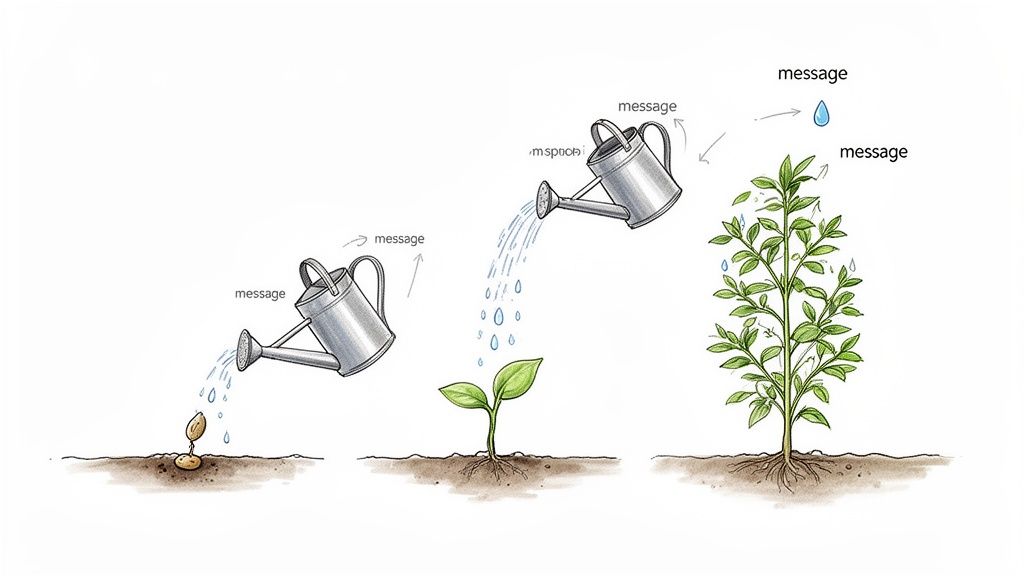
A three-stage illustration showing a plant growing from seed to tree, nurtured by watering cans labeled 'message'.

Imagine you're growing a plant from a seed. Flooding it with a bucket of water all at once would just overwhelm it and wash it away. What it really needs is a slow, steady "drip" of water over time. That consistent nurturing helps the seed sprout, build strong roots, and eventually grow into a healthy plant.

A drip campaign works the exact same way for your business relationships. It’s an automated sequence of messages—usually emails—that nurtures contacts based on a specific trigger, like signing up for your newsletter or downloading an ebook.

The Power of Automated Nurturing

The magic of a drip campaign is its "set it and forget it" nature. Once you build the sequence, the system takes over, sending your pre-written messages to every new person who triggers it. This ensures no lead ever falls through the cracks and everyone gets a consistent, on-brand experience.

This automated approach is far more effective than trying to send one-off messages manually. It lets you:

  • Build trust gradually. By sharing helpful tips or insights over time, you build credibility and become a resource, not just a vendor.

  • Stay top of mind. Regular, relevant communication means your brand is the first one people think of when they're finally ready to buy.

  • Guide prospects to a goal. Each message is a small step designed to move a person from initial curiosity to a final conversion.

A drip campaign turns your marketing from a series of random, loud blasts into a continuous, flowing conversation. It’s about building momentum, not just making noise.

Drip Campaigns vs. Email Broadcasts

It's easy to confuse drip campaigns with standard email broadcasts (like a newsletter), but they are fundamentally different tools for different jobs.

A broadcast is a one-time message sent to a big list all at once—think a new product announcement or a holiday sale. A drip campaign, on the other hand, is a personalized journey that's unique to each individual based on when they started it.

Here’s a quick breakdown of the differences.

Drip Campaign vs Email Broadcast at a Glance

This table shows you the core differences between a strategic drip campaign and a standard, one-off email broadcast.

Feature

Drip Campaign

Email Broadcast

Timing

Sent based on individual user triggers and a pre-set schedule.

Sent to everyone at the same time, on a date you choose.

Personalization

Highly personalized, as it relates to a specific user action.

Generally generic, intended for a broad audience.

Purpose

Designed to nurture leads or customers over a long period.

Focused on immediate announcements, promotions, or updates.

Scale

Scales automatically as new users trigger the sequence.

Requires manual setup and sending for each new message.

While both have their place in a good marketing strategy, understanding when to nurture with a drip campaign and when to announce with a broadcast is key to getting better results.

How a Drip Campaign Works Step by Step

So, how does a drip campaign actually work? It’s not just about sending a bunch of emails. It’s an automated system that feels surprisingly personal because it’s built around a person’s specific actions and a set of smart rules.

Think of it like a conversation that unfolds over time. It all starts with a trigger—the moment someone shows they’re interested. This could be downloading a guide, signing up for a webinar, or even just visiting a specific page on your site. That single action kicks off the entire sequence.

From there, the campaign follows a pre-built path of timed messages, all designed to guide that person toward a goal. But the real magic is in the campaign’s logic. This is what makes it feel responsive, using time delays and conditions to send the right message at the right time.

The Anatomy of an Automated Sequence

Let’s walk through a real-world example. Imagine you run a small business and offer a free "Beginner's Guide to SEO" on your website. A potential customer, let’s call him Alex, is interested and fills out a form to get it.

Here’s what happens next, step by step:

  1. The Trigger: Alex submits the form. That’s the starting gun. The system immediately enrolls him into your "SEO Guide Drip Campaign."

  2. Email 1 (Immediate): Instantly, an email lands in Alex's inbox with the link to the guide. You’ve delivered on your promise right away, which builds immediate trust.

  3. The Logic (Time Delay): The campaign now waits for two days. This gives Alex time to actually read the guide without feeling bombarded by follow-ups.

  4. Email 2 (Day 3): After the delay, a second email goes out. This one might have a subject like, "Got SEO questions?" and include a link to a blog post that digs deeper into a topic from the guide.

  5. The Logic (Conditional Split): Here’s where it gets smart. The system checks if Alex clicked the link in the second email. If he did, he's clearly engaged. The logic automatically moves him to a path for high-interest leads. If he didn’t click, he stays on the standard path.

  6. Email 3 (Day 7): Since Alex is engaged, his next email might offer a case study showing how you helped a similar company succeed with SEO. For someone who didn't click, the system might send a different resource—maybe a simpler checklist—to try and re-engage them.

The best part? This entire journey happens on autopilot. You can learn more about how to design these journeys by building automated workflows that connect marketing actions with real sales outcomes.

The power of a good drip campaign is its ability to deliver this kind of tailored experience at scale, turning a flicker of interest into a genuine sales conversation—all without you lifting a finger.

Powerful Drip Campaign Examples You Can Use

Knowing the theory behind a drip campaign is one thing, but seeing it in action is where the magic happens. Let's move past the definitions and look at some real-world examples that businesses use to drive growth every single day.

Think of these automated sequences as the engines that turn a flicker of initial interest into a lasting customer relationship.
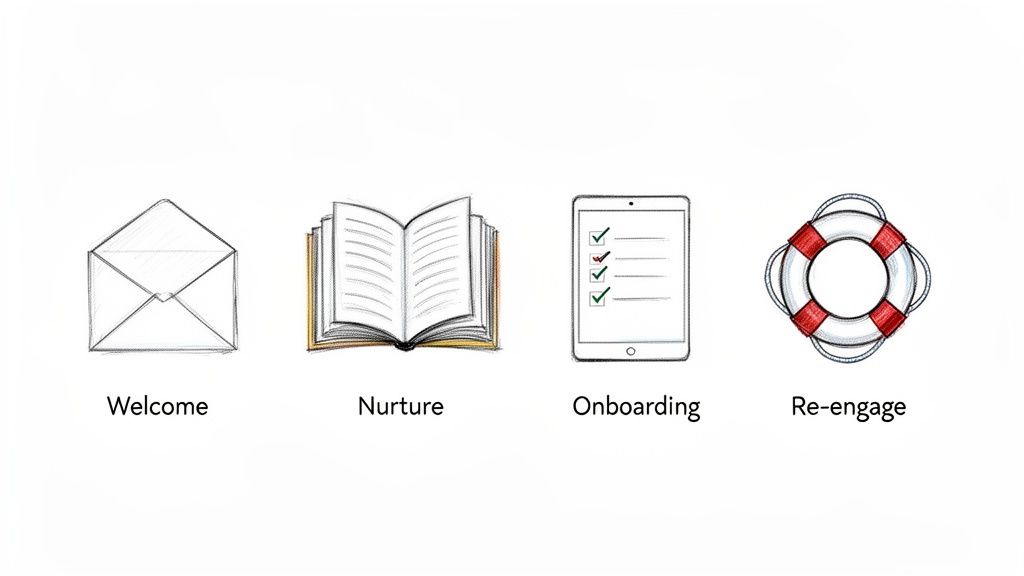
Illustration showing key stages of a customer engagement strategy: welcome, nurture, onboarding, re-engage.

Each example below is a blueprint. It has a clear goal, a specific trigger that kicks off the automation, and a sample sequence of messages. You can borrow these playbooks to build your own powerful campaigns right away.

The Warm Welcome Series

A welcome series is your one shot to make a great first impression. With automated flows seeing average open rates of over 48%, this is a massive opportunity to connect with new subscribers while your brand is fresh on their minds.

  • Goal: Introduce your brand, provide immediate value, and nudge them toward their first purchase or key action.

  • Trigger: Someone subscribes to your newsletter or creates a new account.

  • Sample Sequence:

    • Email 1 (Immediate): "Welcome! Here’s what to expect." This first touchpoint confirms their subscription, delivers any freebie you promised (like a discount code or PDF guide), and sets the stage for what’s coming next.

    • Email 2 (Day 3): "Our Story." Here's where you build a human connection. Share your brand’s mission, tell a story about why you started, or introduce the team.

    • Email 3 (Day 6): "Explore Our Best." Guide them to your most popular products, services, or content. Sprinkle in some social proof like customer testimonials to build trust.

The Lead Nurturing Sequence

Let's be real—not everyone who shows interest is ready to buy on day one. A lead nurturing drip campaign is all about playing the long game. It educates prospects, builds trust, and keeps your brand top-of-mind so when they are ready, you're the first one they call.

A lead nurturing sequence educates prospects over time, positioning your brand as a helpful expert rather than just another vendor pushing a sale.

  • Goal: Educate potential customers and gently guide them toward being sales-ready.

  • Trigger: A user downloads a top-of-funnel resource, like an ebook, or signs up for a webinar.

  • Sample Sequence:

    • Email 1 (Immediate): Delivers the resource they asked for. Simple and to the point.

    • Email 2 (Day 4): "Digging Deeper into [Topic]." Follow up with a related blog post or a case study that builds on what they just learned.

    • Email 3 (Day 9): "A Common Mistake to Avoid." Address a common pain point in your industry and offer a practical solution. This move cements your status as an expert.

    • Email 4 (Day 15): "Ready for the Next Step?" Now it's time for a soft pitch. Introduce your solution with a low-pressure call-to-action, like an invitation to a demo or a free trial.

The Re-Engagement Campaign

Over time, it's normal for some contacts to go quiet. A re-engagement or "win-back" campaign is your targeted effort to wake up these inactive users and remind them of your value before they hit unsubscribe for good.

  • Goal: Win back inactive subscribers and keep your email list clean and engaged.

  • Trigger: A contact hasn’t opened or clicked an email in 90 days.

  • Sample Sequence:

    • Email 1 (Day 91): "Is This Goodbye?" A simple, often plain-text email asking if they still want to hear from you. The direct approach often works wonders.

    • Email 2 (Day 95): "Here’s What You’ve Missed." Try to pique their interest again by highlighting new features, popular content, or a special "welcome back" offer.

    • Email 3 (Day 100): The final "unsubscribe" notice. Let them know you'll be removing them to respect their inbox, but give them one last link to stay subscribed if they've changed their mind.

These examples provide a solid foundation. If you're looking for more advanced strategies, you might explore how an AI SDR like Stamina's Zara can help generate and run highly personalized sequences at scale.

Building Your First Campaign with AI

Alright, enough theory. It’s time to build something. Launching your first drip campaign used to feel like a huge project, but modern AI tools have changed the game completely. This isn't about needing a developer; it's about having a smart framework that turns your marketing ideas into real sales results.
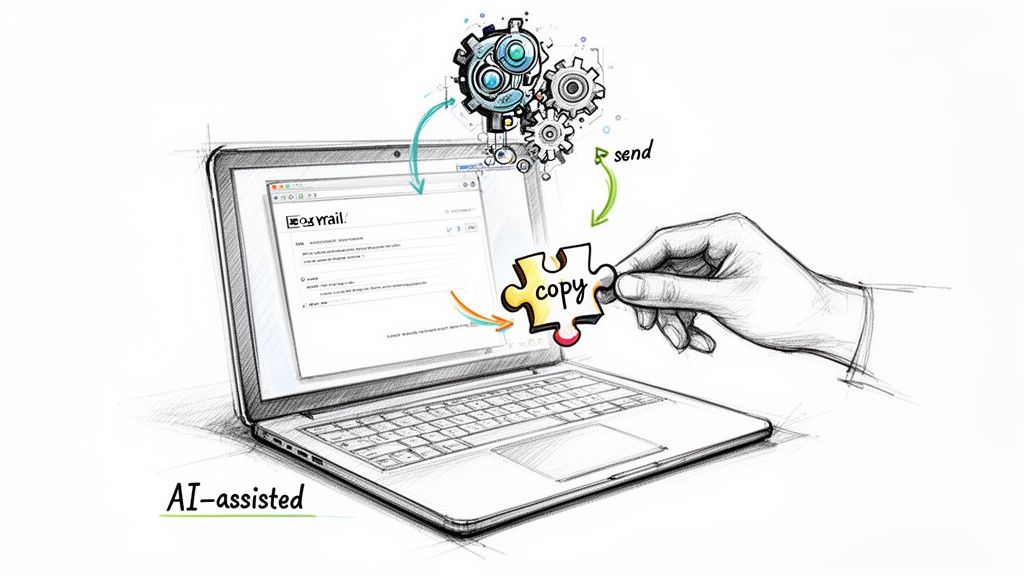
AI-assisted email process: hand copies content on laptop, gears show data flow for sending.

The starting point is always the same: pick one single goal. Are you trying to welcome new subscribers, follow up with leads from an ebook, or win back users who’ve gone quiet? A clear goal makes every other decision a lot easier.

Once you have your goal, you can map out the logic. This is just the "if-then" skeleton of your campaign. For example, if someone signs up for your webinar (the trigger), then send a welcome email right away. Wait three days, then send a follow-up with a link to the recording.

Letting AI Do the Heavy Lifting

This is where everything changes. Work that once took your team hours of brainstorming and writing can now be done in minutes with AI. Platforms like Stamina use AI for more than just sending emails—they use it to create them, acting as a true force multiplier.

Instead of staring at a blank page, you can now use AI to generate entire email sequences based on your goal. You just give it a prompt like, “Create a 5-step welcome series for new newsletter subscribers,” and the AI drafts compelling, personalized copy for every single touchpoint. It’s the fastest way to get past writer’s block and keep your tone consistent.

AI transforms drip campaign creation from a resource-draining chore into a fast, creative process. It lets any team, regardless of size, build sophisticated, high-performing sequences that feel personal and actually drive results.

A Practical AI-Powered Workflow

Let's walk through how this works for a real lead nurturing campaign.

  1. Define the Goal & Trigger: The goal is to get demo requests from leads who downloaded your "Social Media Guide." The trigger is the form they filled out to get the guide.

  2. Generate the Sequence with AI: You prompt your AI tool: “Generate a 4-part email drip campaign to nurture leads who downloaded our Social Media Guide. The goal is to book a demo.” The AI will instantly create a full sequence, complete with subject lines and body copy.

  3. Refine and Personalize: The AI gives you a great starting point. From there, you can jump in and tweak the copy to match your brand's voice and pop in personalization tokens like {{first_name}} or {{company_name}} that are pulled straight from your CRM.

  4. Optimize with AI Suggestions: The best tools can even suggest the ideal send times for each email, using engagement data to boost your open and click rates. For businesses ready to scale up their marketing, a full-featured email marketing automation platform is the clear next step.

When you bring AI into the mix, you’re doing more than just automating sends. You’re getting an intelligent partner that helps you write, schedule, and fine-tune your campaigns, freeing you up to focus on the bigger picture. This is what the drip campaign meaning has become—pure efficiency and impact.

Measuring Success and Optimizing for Better Results

Sending a drip campaign is easy. Getting results is the hard part. Once your sequence is live, the real work begins: digging into the data to see what’s actually connecting with your audience and what’s falling flat.

This is how you turn a decent campaign into one that consistently drives revenue.
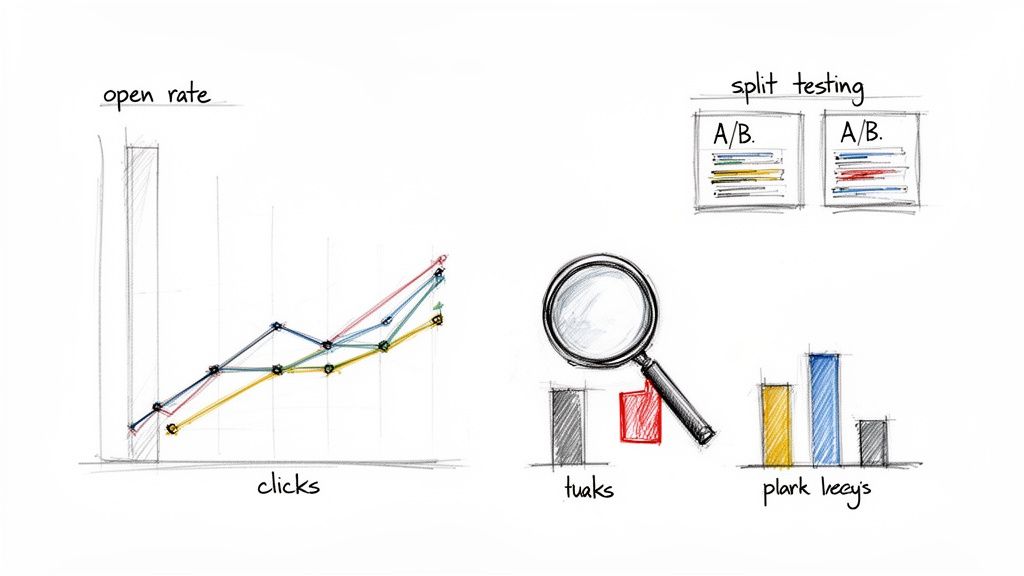
Hand-drawn sketches illustrating marketing data analysis, including open rates, clicks, split testing, and charts.

Don't just glance at the dashboard. You have to get your hands dirty and look at the story behind the numbers. A low open rate isn't just a percentage; it’s a bright red flag telling you something needs to be fixed—and it’s your job to figure out what.

Key Metrics to Track

To get a real feel for your campaign's health, you need to watch a few core metrics. These numbers tell you exactly how people are (or aren't) engaging with your emails.

  • Open Rate: This is the first gate you have to get through. It’s the percentage of people who opened your email. If this number is low, your subject line is probably weak, or you might have a sender reputation issue. For a deep dive on sender health, check out our guide on building a solid cold email infrastructure.

  • Click-Through Rate (CTR): This shows how many people clicked a link inside your email. A high open rate with a low CTR is a classic sign of a great subject line but a boring or irrelevant email body. Your call-to-action (CTA) probably isn't compelling enough.

  • Conversion Rate: This is the metric that really matters. It tells you how many people took the action you wanted, whether that was booking a demo, buying a product, or starting a trial. This is your ROI.

  • Unsubscribe Rate: A few unsubscribes are perfectly normal, but if you see a sudden spike, it's a warning. Your content might be off-target, or you're just emailing them way too often.

A drip campaign's data tells a story. A high click rate on your second email but a low rate on your third shows exactly where your audience loses interest, giving you a precise point to optimize.

The Power of A/B Testing

Knowing your metrics is only half the battle. The other half is using that information to make your campaign better. This is where A/B testing (or split testing) becomes your secret weapon.

A/B testing is simple: you create two versions of the same email (let’s call them A and B), change just one single thing, and see which one performs better.

You can test almost anything, but here are the big ones:

  • Subject Lines: Does a straightforward subject line get more opens than a clever one? Test it.

  • Call-to-Action (CTA): Does “Book a Demo” outperform “Learn More”? There's only one way to find out.

  • Email Copy: Should you tell a story or stick to the facts and data? Let your audience decide.

Send Version A to one part of your list and Version B to the other. The data will tell you which one won. This loop of testing, learning, and improving is what separates a static, forgettable drip campaign from a dynamic one that actually generates results.

Common Drip Campaign Mistakes to Avoid

Even the best drip campaigns can fall flat. It happens. You build a sequence with all the right intentions, but instead of creating happy customers, you just end up with a spike in unsubscribes.

The good news is that most failed campaigns make the same few mistakes. Once you know what they are, you can sidestep them and build sequences that actually feel helpful, not harassing.

Mistake #1: Treating Everyone the Same

The fastest way to get ignored is to send the same generic message to your entire list. This is easily the most common mistake I see. It’s like shouting into a crowded room—you’re just adding to the noise, and people will tune you out.

Your subscribers aren't a monolith. A brand new lead needs a warm welcome and some basic education. A long-time customer, on the other hand, might be ready for an advanced feature or a special offer.

When you ignore segmentation, you send irrelevant content. And sending irrelevant content is the quickest way to break trust.

Mistake #2: Sending Too Much, Too Soon

Just because you can send an email every day doesn’t mean you should. Bombarding a new contact with five emails in three days is a surefire way to get marked as spam.

Your goal is to be a welcome guest in someone's inbox, not a persistent pest. Each message should add value, not just noise, giving your audience time to digest the information before the next one arrives.

This aggressive approach leads to "list burnout." Your audience gets tired of hearing from you and either deletes your emails on sight or just unsubscribes. Give your messages room to breathe. Plan your delays thoughtfully—a two-day gap after a welcome email or a week between educational content feels respectful and lands much more effectively.

Mistake #3: Having a Fuzzy (or Missing) Call-to-Action

Every single email in your drip sequence needs a purpose. If you don't know what you want the reader to do, they definitely won't either.

Too many campaigns suffer from a confusing or nonexistent call-to-action (CTA). Don’t ask them to read a blog post, follow you on three social platforms, and check out a new product all in one email. They’ll get overwhelmed and do nothing.

Focus each message on one clear, specific goal. Guide them to the next logical step in their journey, and they’ll be far more likely to take it.

Frequently Asked Questions About Drip Campaigns

Even after you get the hang of what a drip campaign is, a few practical questions always pop up. We get them all the time from teams firing up their first automated campaigns.

Here are some quick answers to the most common ones.

What Is the Difference Between a Drip and a Nurture Campaign?

People often use these terms to mean the same thing, but there’s a small—yet important—difference. A classic drip campaign is all about timing. It sends a pre-set series of emails based on a simple schedule, like "wait three days, then send the next one."

A nurture campaign is the smarter, more modern version of a drip. It reacts to what your contacts actually do. For example, if someone clicks a link about a specific feature, the campaign can automatically send them down a different path with more relevant info.

Think of it this way: all nurture campaigns are a type of drip campaign, but not all drip campaigns are smart enough to be considered nurture campaigns.

How Many Emails Should Be in a Drip Sequence?

There's no magic number here. The right length depends entirely on your goal and your audience. A simple welcome series might only need 3-5 emails to get the job done and make a great first impression.

On the other hand, a long-term nurturing sequence for a high-value lead could have 10 or more messages spread out over a few months.

Don't fixate on a number. Instead, give every single email one clear job to do. Your sequence should be exactly as long as it needs to be to provide value and hit its goal—and not a single email longer.

Can I Run a Drip Campaign on a Small Budget?

Absolutely. This is one of the best things about modern automation tools. You don't need an enterprise budget to get powerful drip features, making this strategy a perfect fit for businesses of any size.

And it's a smart place to put your money. With automated email flows pulling in an average open rate of over 48%, the return on investment makes drip marketing one of the most cost-effective plays you can run.

Ready to build powerful, AI-driven drip campaigns that turn leads into revenue? Stamina unifies your marketing, sales, and CRM into one platform, allowing you to create and automate personalized sequences with ease. Discover how to grow your business faster at https://stamina.io.

Drafted with Outrank app

A drip campaign is a simple but powerful idea: a series of automated messages sent to a contact over time. Think of it as putting your most important communications on autopilot, delivering the right message at the right time without you lifting a finger. The whole point of a drip campaign is to nurture relationships through consistent, scheduled communication.

What a Drip Campaign Actually Means

Let's cut through the jargon.

A three-stage illustration showing a plant growing from seed to tree, nurtured by watering cans labeled 'message'.

Imagine you're growing a plant from a seed. Flooding it with a bucket of water all at once would just overwhelm it and wash it away. What it really needs is a slow, steady "drip" of water over time. That consistent nurturing helps the seed sprout, build strong roots, and eventually grow into a healthy plant.

A drip campaign works the exact same way for your business relationships. It’s an automated sequence of messages—usually emails—that nurtures contacts based on a specific trigger, like signing up for your newsletter or downloading an ebook.

The Power of Automated Nurturing

The magic of a drip campaign is its "set it and forget it" nature. Once you build the sequence, the system takes over, sending your pre-written messages to every new person who triggers it. This ensures no lead ever falls through the cracks and everyone gets a consistent, on-brand experience.

This automated approach is far more effective than trying to send one-off messages manually. It lets you:

  • Build trust gradually. By sharing helpful tips or insights over time, you build credibility and become a resource, not just a vendor.

  • Stay top of mind. Regular, relevant communication means your brand is the first one people think of when they're finally ready to buy.

  • Guide prospects to a goal. Each message is a small step designed to move a person from initial curiosity to a final conversion.

A drip campaign turns your marketing from a series of random, loud blasts into a continuous, flowing conversation. It’s about building momentum, not just making noise.

Drip Campaigns vs. Email Broadcasts

It's easy to confuse drip campaigns with standard email broadcasts (like a newsletter), but they are fundamentally different tools for different jobs.

A broadcast is a one-time message sent to a big list all at once—think a new product announcement or a holiday sale. A drip campaign, on the other hand, is a personalized journey that's unique to each individual based on when they started it.

Here’s a quick breakdown of the differences.

Drip Campaign vs Email Broadcast at a Glance

This table shows you the core differences between a strategic drip campaign and a standard, one-off email broadcast.

Feature

Drip Campaign

Email Broadcast

Timing

Sent based on individual user triggers and a pre-set schedule.

Sent to everyone at the same time, on a date you choose.

Personalization

Highly personalized, as it relates to a specific user action.

Generally generic, intended for a broad audience.

Purpose

Designed to nurture leads or customers over a long period.

Focused on immediate announcements, promotions, or updates.

Scale

Scales automatically as new users trigger the sequence.

Requires manual setup and sending for each new message.

While both have their place in a good marketing strategy, understanding when to nurture with a drip campaign and when to announce with a broadcast is key to getting better results.

How a Drip Campaign Works Step by Step

So, how does a drip campaign actually work? It’s not just about sending a bunch of emails. It’s an automated system that feels surprisingly personal because it’s built around a person’s specific actions and a set of smart rules.

Think of it like a conversation that unfolds over time. It all starts with a trigger—the moment someone shows they’re interested. This could be downloading a guide, signing up for a webinar, or even just visiting a specific page on your site. That single action kicks off the entire sequence.

From there, the campaign follows a pre-built path of timed messages, all designed to guide that person toward a goal. But the real magic is in the campaign’s logic. This is what makes it feel responsive, using time delays and conditions to send the right message at the right time.

The Anatomy of an Automated Sequence

Let’s walk through a real-world example. Imagine you run a small business and offer a free "Beginner's Guide to SEO" on your website. A potential customer, let’s call him Alex, is interested and fills out a form to get it.

Here’s what happens next, step by step:

  1. The Trigger: Alex submits the form. That’s the starting gun. The system immediately enrolls him into your "SEO Guide Drip Campaign."

  2. Email 1 (Immediate): Instantly, an email lands in Alex's inbox with the link to the guide. You’ve delivered on your promise right away, which builds immediate trust.

  3. The Logic (Time Delay): The campaign now waits for two days. This gives Alex time to actually read the guide without feeling bombarded by follow-ups.

  4. Email 2 (Day 3): After the delay, a second email goes out. This one might have a subject like, "Got SEO questions?" and include a link to a blog post that digs deeper into a topic from the guide.

  5. The Logic (Conditional Split): Here’s where it gets smart. The system checks if Alex clicked the link in the second email. If he did, he's clearly engaged. The logic automatically moves him to a path for high-interest leads. If he didn’t click, he stays on the standard path.

  6. Email 3 (Day 7): Since Alex is engaged, his next email might offer a case study showing how you helped a similar company succeed with SEO. For someone who didn't click, the system might send a different resource—maybe a simpler checklist—to try and re-engage them.

The best part? This entire journey happens on autopilot. You can learn more about how to design these journeys by building automated workflows that connect marketing actions with real sales outcomes.

The power of a good drip campaign is its ability to deliver this kind of tailored experience at scale, turning a flicker of interest into a genuine sales conversation—all without you lifting a finger.

Powerful Drip Campaign Examples You Can Use

Knowing the theory behind a drip campaign is one thing, but seeing it in action is where the magic happens. Let's move past the definitions and look at some real-world examples that businesses use to drive growth every single day.

Think of these automated sequences as the engines that turn a flicker of initial interest into a lasting customer relationship.

Illustration showing key stages of a customer engagement strategy: welcome, nurture, onboarding, re-engage.

Each example below is a blueprint. It has a clear goal, a specific trigger that kicks off the automation, and a sample sequence of messages. You can borrow these playbooks to build your own powerful campaigns right away.

The Warm Welcome Series

A welcome series is your one shot to make a great first impression. With automated flows seeing average open rates of over 48%, this is a massive opportunity to connect with new subscribers while your brand is fresh on their minds.

  • Goal: Introduce your brand, provide immediate value, and nudge them toward their first purchase or key action.

  • Trigger: Someone subscribes to your newsletter or creates a new account.

  • Sample Sequence:

    • Email 1 (Immediate): "Welcome! Here’s what to expect." This first touchpoint confirms their subscription, delivers any freebie you promised (like a discount code or PDF guide), and sets the stage for what’s coming next.

    • Email 2 (Day 3): "Our Story." Here's where you build a human connection. Share your brand’s mission, tell a story about why you started, or introduce the team.

    • Email 3 (Day 6): "Explore Our Best." Guide them to your most popular products, services, or content. Sprinkle in some social proof like customer testimonials to build trust.

The Lead Nurturing Sequence

Let's be real—not everyone who shows interest is ready to buy on day one. A lead nurturing drip campaign is all about playing the long game. It educates prospects, builds trust, and keeps your brand top-of-mind so when they are ready, you're the first one they call.

A lead nurturing sequence educates prospects over time, positioning your brand as a helpful expert rather than just another vendor pushing a sale.

  • Goal: Educate potential customers and gently guide them toward being sales-ready.

  • Trigger: A user downloads a top-of-funnel resource, like an ebook, or signs up for a webinar.

  • Sample Sequence:

    • Email 1 (Immediate): Delivers the resource they asked for. Simple and to the point.

    • Email 2 (Day 4): "Digging Deeper into [Topic]." Follow up with a related blog post or a case study that builds on what they just learned.

    • Email 3 (Day 9): "A Common Mistake to Avoid." Address a common pain point in your industry and offer a practical solution. This move cements your status as an expert.

    • Email 4 (Day 15): "Ready for the Next Step?" Now it's time for a soft pitch. Introduce your solution with a low-pressure call-to-action, like an invitation to a demo or a free trial.

The Re-Engagement Campaign

Over time, it's normal for some contacts to go quiet. A re-engagement or "win-back" campaign is your targeted effort to wake up these inactive users and remind them of your value before they hit unsubscribe for good.

  • Goal: Win back inactive subscribers and keep your email list clean and engaged.

  • Trigger: A contact hasn’t opened or clicked an email in 90 days.

  • Sample Sequence:

    • Email 1 (Day 91): "Is This Goodbye?" A simple, often plain-text email asking if they still want to hear from you. The direct approach often works wonders.

    • Email 2 (Day 95): "Here’s What You’ve Missed." Try to pique their interest again by highlighting new features, popular content, or a special "welcome back" offer.

    • Email 3 (Day 100): The final "unsubscribe" notice. Let them know you'll be removing them to respect their inbox, but give them one last link to stay subscribed if they've changed their mind.

These examples provide a solid foundation. If you're looking for more advanced strategies, you might explore how an AI SDR like Stamina's Zara can help generate and run highly personalized sequences at scale.

Building Your First Campaign with AI

Alright, enough theory. It’s time to build something. Launching your first drip campaign used to feel like a huge project, but modern AI tools have changed the game completely. This isn't about needing a developer; it's about having a smart framework that turns your marketing ideas into real sales results.

AI-assisted email process: hand copies content on laptop, gears show data flow for sending.

The starting point is always the same: pick one single goal. Are you trying to welcome new subscribers, follow up with leads from an ebook, or win back users who’ve gone quiet? A clear goal makes every other decision a lot easier.

Once you have your goal, you can map out the logic. This is just the "if-then" skeleton of your campaign. For example, if someone signs up for your webinar (the trigger), then send a welcome email right away. Wait three days, then send a follow-up with a link to the recording.

Letting AI Do the Heavy Lifting

This is where everything changes. Work that once took your team hours of brainstorming and writing can now be done in minutes with AI. Platforms like Stamina use AI for more than just sending emails—they use it to create them, acting as a true force multiplier.

Instead of staring at a blank page, you can now use AI to generate entire email sequences based on your goal. You just give it a prompt like, “Create a 5-step welcome series for new newsletter subscribers,” and the AI drafts compelling, personalized copy for every single touchpoint. It’s the fastest way to get past writer’s block and keep your tone consistent.

AI transforms drip campaign creation from a resource-draining chore into a fast, creative process. It lets any team, regardless of size, build sophisticated, high-performing sequences that feel personal and actually drive results.

A Practical AI-Powered Workflow

Let's walk through how this works for a real lead nurturing campaign.

  1. Define the Goal & Trigger: The goal is to get demo requests from leads who downloaded your "Social Media Guide." The trigger is the form they filled out to get the guide.

  2. Generate the Sequence with AI: You prompt your AI tool: “Generate a 4-part email drip campaign to nurture leads who downloaded our Social Media Guide. The goal is to book a demo.” The AI will instantly create a full sequence, complete with subject lines and body copy.

  3. Refine and Personalize: The AI gives you a great starting point. From there, you can jump in and tweak the copy to match your brand's voice and pop in personalization tokens like {{first_name}} or {{company_name}} that are pulled straight from your CRM.

  4. Optimize with AI Suggestions: The best tools can even suggest the ideal send times for each email, using engagement data to boost your open and click rates. For businesses ready to scale up their marketing, a full-featured email marketing automation platform is the clear next step.

When you bring AI into the mix, you’re doing more than just automating sends. You’re getting an intelligent partner that helps you write, schedule, and fine-tune your campaigns, freeing you up to focus on the bigger picture. This is what the drip campaign meaning has become—pure efficiency and impact.

Measuring Success and Optimizing for Better Results

Sending a drip campaign is easy. Getting results is the hard part. Once your sequence is live, the real work begins: digging into the data to see what’s actually connecting with your audience and what’s falling flat.

This is how you turn a decent campaign into one that consistently drives revenue.

Hand-drawn sketches illustrating marketing data analysis, including open rates, clicks, split testing, and charts.

Don't just glance at the dashboard. You have to get your hands dirty and look at the story behind the numbers. A low open rate isn't just a percentage; it’s a bright red flag telling you something needs to be fixed—and it’s your job to figure out what.

Key Metrics to Track

To get a real feel for your campaign's health, you need to watch a few core metrics. These numbers tell you exactly how people are (or aren't) engaging with your emails.

  • Open Rate: This is the first gate you have to get through. It’s the percentage of people who opened your email. If this number is low, your subject line is probably weak, or you might have a sender reputation issue. For a deep dive on sender health, check out our guide on building a solid cold email infrastructure.

  • Click-Through Rate (CTR): This shows how many people clicked a link inside your email. A high open rate with a low CTR is a classic sign of a great subject line but a boring or irrelevant email body. Your call-to-action (CTA) probably isn't compelling enough.

  • Conversion Rate: This is the metric that really matters. It tells you how many people took the action you wanted, whether that was booking a demo, buying a product, or starting a trial. This is your ROI.

  • Unsubscribe Rate: A few unsubscribes are perfectly normal, but if you see a sudden spike, it's a warning. Your content might be off-target, or you're just emailing them way too often.

A drip campaign's data tells a story. A high click rate on your second email but a low rate on your third shows exactly where your audience loses interest, giving you a precise point to optimize.

The Power of A/B Testing

Knowing your metrics is only half the battle. The other half is using that information to make your campaign better. This is where A/B testing (or split testing) becomes your secret weapon.

A/B testing is simple: you create two versions of the same email (let’s call them A and B), change just one single thing, and see which one performs better.

You can test almost anything, but here are the big ones:

  • Subject Lines: Does a straightforward subject line get more opens than a clever one? Test it.

  • Call-to-Action (CTA): Does “Book a Demo” outperform “Learn More”? There's only one way to find out.

  • Email Copy: Should you tell a story or stick to the facts and data? Let your audience decide.

Send Version A to one part of your list and Version B to the other. The data will tell you which one won. This loop of testing, learning, and improving is what separates a static, forgettable drip campaign from a dynamic one that actually generates results.

Common Drip Campaign Mistakes to Avoid

Even the best drip campaigns can fall flat. It happens. You build a sequence with all the right intentions, but instead of creating happy customers, you just end up with a spike in unsubscribes.

The good news is that most failed campaigns make the same few mistakes. Once you know what they are, you can sidestep them and build sequences that actually feel helpful, not harassing.

Mistake #1: Treating Everyone the Same

The fastest way to get ignored is to send the same generic message to your entire list. This is easily the most common mistake I see. It’s like shouting into a crowded room—you’re just adding to the noise, and people will tune you out.

Your subscribers aren't a monolith. A brand new lead needs a warm welcome and some basic education. A long-time customer, on the other hand, might be ready for an advanced feature or a special offer.

When you ignore segmentation, you send irrelevant content. And sending irrelevant content is the quickest way to break trust.

Mistake #2: Sending Too Much, Too Soon

Just because you can send an email every day doesn’t mean you should. Bombarding a new contact with five emails in three days is a surefire way to get marked as spam.

Your goal is to be a welcome guest in someone's inbox, not a persistent pest. Each message should add value, not just noise, giving your audience time to digest the information before the next one arrives.

This aggressive approach leads to "list burnout." Your audience gets tired of hearing from you and either deletes your emails on sight or just unsubscribes. Give your messages room to breathe. Plan your delays thoughtfully—a two-day gap after a welcome email or a week between educational content feels respectful and lands much more effectively.

Mistake #3: Having a Fuzzy (or Missing) Call-to-Action

Every single email in your drip sequence needs a purpose. If you don't know what you want the reader to do, they definitely won't either.

Too many campaigns suffer from a confusing or nonexistent call-to-action (CTA). Don’t ask them to read a blog post, follow you on three social platforms, and check out a new product all in one email. They’ll get overwhelmed and do nothing.

Focus each message on one clear, specific goal. Guide them to the next logical step in their journey, and they’ll be far more likely to take it.

Frequently Asked Questions About Drip Campaigns

Even after you get the hang of what a drip campaign is, a few practical questions always pop up. We get them all the time from teams firing up their first automated campaigns.

Here are some quick answers to the most common ones.

What Is the Difference Between a Drip and a Nurture Campaign?

People often use these terms to mean the same thing, but there’s a small—yet important—difference. A classic drip campaign is all about timing. It sends a pre-set series of emails based on a simple schedule, like "wait three days, then send the next one."

A nurture campaign is the smarter, more modern version of a drip. It reacts to what your contacts actually do. For example, if someone clicks a link about a specific feature, the campaign can automatically send them down a different path with more relevant info.

Think of it this way: all nurture campaigns are a type of drip campaign, but not all drip campaigns are smart enough to be considered nurture campaigns.

How Many Emails Should Be in a Drip Sequence?

There's no magic number here. The right length depends entirely on your goal and your audience. A simple welcome series might only need 3-5 emails to get the job done and make a great first impression.

On the other hand, a long-term nurturing sequence for a high-value lead could have 10 or more messages spread out over a few months.

Don't fixate on a number. Instead, give every single email one clear job to do. Your sequence should be exactly as long as it needs to be to provide value and hit its goal—and not a single email longer.

Can I Run a Drip Campaign on a Small Budget?

Absolutely. This is one of the best things about modern automation tools. You don't need an enterprise budget to get powerful drip features, making this strategy a perfect fit for businesses of any size.

And it's a smart place to put your money. With automated email flows pulling in an average open rate of over 48%, the return on investment makes drip marketing one of the most cost-effective plays you can run.

Ready to build powerful, AI-driven drip campaigns that turn leads into revenue? Stamina unifies your marketing, sales, and CRM into one platform, allowing you to create and automate personalized sequences with ease. Discover how to grow your business faster at https://stamina.io.

Drafted with Outrank app

Share this article

Share this article

Send a shareable link to your team or anyone who might find it useful.

Send a shareable link to your team or anyone who might find it useful.

Copy link

Copied

Share directly to

Table of contents

Give Your Business the Stamina it needs to Thrive