How to Create a Go to Market Strategy for Your SMB in 2026

Learn how to create a go to market strategy with our actionable playbook. Packed with real-world examples and AI-powered tactics for modern SMBs.

0 - Minute Read

A go-to-market strategy is more than just a list of launch tasks. It’s the playbook that gets your marketing, sales, and product teams all pulling in the same direction, focused on a single goal: successfully launching a product or conquering a new market.

Building Your GTM Strategy Foundation
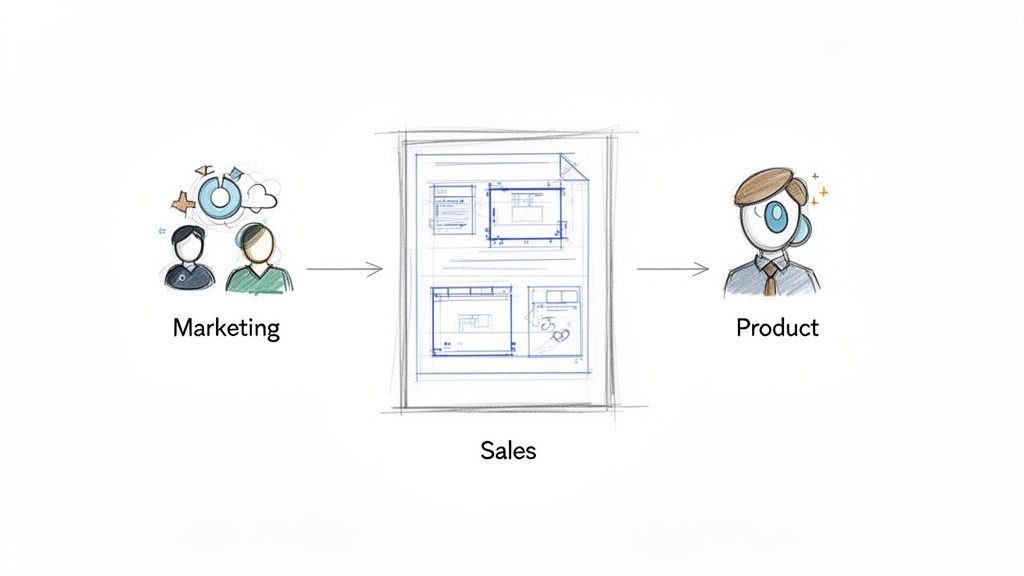
Flowchart showing marketing ideas leading to sales plans, which then inform product development.

For a small or medium-sized business, a Go-to-Market (GTM) strategy isn't just a checklist you run through and forget. Think of it as a living blueprint that keeps every department aligned and focused.

Honestly, the biggest hurdle for most SMBs isn't a lack of good ideas—it’s internal misalignment. This is what happens when marketing’s message doesn’t match the sales team’s pitch, or when the product team builds features without knowing what customers actually want. These disconnects create friction, confuse customers, and kill deals.

The Real Cost of Siloed Teams

I’ve seen this happen countless times. Your marketing team runs a brilliant campaign highlighting a new feature’s simplicity. A prospect, excited by the promise of an easy-to-use tool, books a demo. But the sales rep, who wasn't fully briefed on the new messaging, spends the entire demo diving into complex, power-user functions.

What's the result? A confused prospect and a lost sale. All that initial excitement evaporates because the story they were told didn't line up with the experience they got. This is exactly what a unified GTM strategy is built to prevent.

A go-to-market strategy’s true job is to create a single source of truth. It ensures every part of your business is focused on delivering exceptional and consistent value to your ideal customer.

At its core, a modern GTM strategy is built on several key pillars, each answering a critical question to guide your launch.

Core Components of a Modern GTM Strategy

GTM Component

Key Question It Answers

Primary Objective

Market Research

Where is the opportunity, and who are the competitors?

Identify a viable market niche and understand the competitive landscape.

Ideal Customer Profile (ICP)

Who is our perfect customer and what do they need?

Define a specific, targetable audience to focus all efforts on.

Messaging & Positioning

How do we talk about our product in a way that resonates?

Craft a compelling, consistent narrative that highlights unique value.

Pricing & Packaging

How much is our solution worth and how will we sell it?

Create a pricing structure that reflects value and drives adoption.

Channel & Sales Motion

Where will we find customers and how will we sell to them?

Select the most effective marketing and sales channels for your ICP.

Launch Plan & KPIs

What does success look like and how will we get there?

Set clear, measurable goals and create an actionable launch timeline.

Each of these components builds on the last, creating a cohesive plan that eliminates guesswork and aligns your entire organization.

Why Alignment Is Your Top Priority

This isn't just a hypothetical problem; it's a real, documented challenge. Recent research from the GTM Alliance found that alignment and buy-in ranked as the most important element of an effective go-to-market process. It was the top priority for 33.3% of surveyed GTM professionals.

This statistic shows a fundamental shift in what it takes to win. It’s no longer just about having the best product; it's about having the most cohesive team. This is precisely why platforms that unify marketing, sales, and CRM data are no longer a "nice-to-have."

A connected system like Stamina acts as the central nervous system for your GTM plan. When your teams operate from the same playbook and look at the same customer data, you can:

  • Ensure consistent messaging from the very first ad a prospect sees to their post-sale support ticket.

  • Create seamless handoffs between marketing and sales so that no warm lead ever falls through the cracks.

  • Feed real-world sales insights back into your product and marketing automation strategy.

Getting this foundation right is how you move from a collection of siloed departments to a streamlined revenue engine. The next sections will walk you through building each component of this strategy, starting with how to zero in on your ideal customer.

Pinpointing Your Ideal Customer and Market
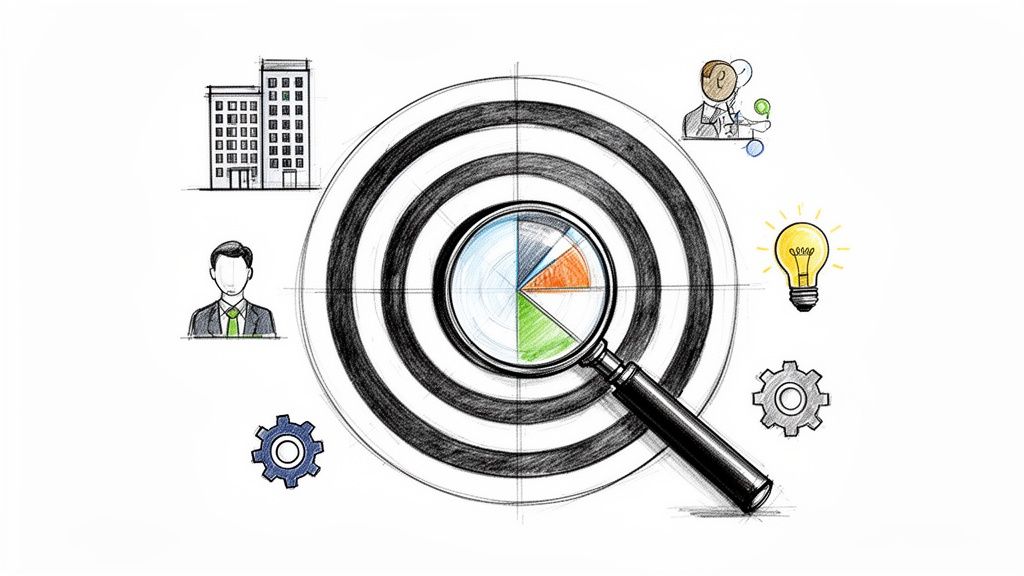
A hand-drawn sketch showing a target with a magnifying glass over a pie chart, surrounded by business icons.

Trying to sell your product to everyone is a classic startup mistake. It’s also the fastest way to burn your budget, confuse your prospects, and wear out your team. A winning go-to-market strategy starts with ruthless focus. You need to know exactly who you're selling to, why they should care, and where to find them.

This all starts with your Ideal Customer Profile (ICP). An ICP is a super-detailed description of the perfect company that will get the most value out of your product and become your biggest fan. Forget broad categories; we're talking about getting hyper-specific.

Moving Beyond Basic Demographics

A weak ICP sounds like, "We sell to tech companies." A strong ICP goes much deeper, moving past surface-level details to the traits that actually signal a real need for what you’re selling. These are usually broken down into firmographics, psychographics, and technographics.

  • Firmographics: These are the company-level basics. Think industry, annual revenue, employee count, and geographic location. A better starting point would be B2B SaaS companies in North America with 50-200 employees.

  • Psychographics: This is where it gets interesting. These are the human elements—the goals, challenges, and motivations of the people inside those companies. What keeps your ideal buyer up at night? What are their biggest frustrations at work?

  • Technographics: This is the tech stack your ideal customer already uses. Do they use a specific CRM? Are they running marketing on certain platforms? This info is a goldmine—it signals their needs and how mature their current processes are.

A truly effective ICP isn't just a persona; it's a blueprint. It describes the organization that will not only buy from you but also stick around, renew their contract, and tell others about you.

Once you have this blueprint, you can start to size up your opportunity. This means calculating your Total Addressable Market (TAM)—the total potential revenue you could make if you captured 100% of your target market. Of course, you’ll never get all of it, but understanding your TAM helps you set ambitious yet realistic growth goals. From there, you can narrow it down to your Serviceable Available Market (SAM) and a practical Serviceable Obtainable Market (SOM).

Validating Your ICP with Real Data

Theory is great, but a GTM strategy lives or dies on real-world data. The most critical step is validating that your ICP isn't just a fantasy on a whiteboard. You need to prove that these customers actually exist and that you can reach them.

This is where modern tools have completely changed the game for SMBs. In the past, this was a slow, expensive process full of guesswork. Today, you can use AI to instantly test your assumptions.

Let's say your ICP is "B2B software companies with 50-200 staff that recently hired a new VP of Marketing." That hiring event is a powerful buying trigger—a new leader often comes in with the budget and the authority to make changes.

With a platform like Stamina, you can plug those exact criteria into its AI engine, Zara. Within minutes, you can generate a validated list of companies and contacts that perfectly match your ICP. This simple action does two huge things at once:

  1. It proves your market exists. You’re not just guessing anymore; you have a tangible list of real prospects.

  2. It gives you an immediate list to work with. Your GTM strategy instantly moves from a document to an actionable sales pipeline.

This fast validation loop is a lifesaver. It lets you test and refine your ICP without burning months chasing a flawed assumption. You can see how other businesses have scaled up by taking a similarly focused approach. For instance, you can learn how BrothersFix scaled operations through smarter lead generation.

With a validated ICP, every other part of your go-to-market strategy falls into place. You'll know exactly who to target, what message will resonate, which channels to prioritize, and what pain points to solve in your sales calls.

Crafting Your Messaging and Choosing Your Channels
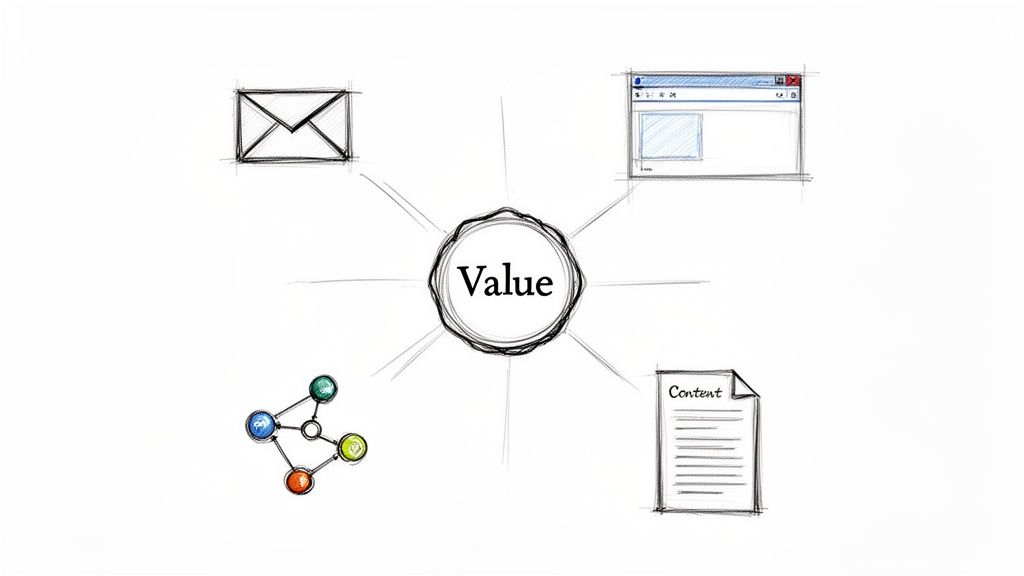
Sketch showing 'Value' at the center, linked to email, browser, content, and network elements.

Alright, so you’ve locked in who you're selling to. But a perfect Ideal Customer Profile (ICP) is worthless if you don’t have something compelling to say. If your message is generic or misses the mark on their real problems, you’re just shouting into the void.

This is where your value proposition and core messaging come in. They’re the heart of your entire GTM strategy.

Think of your value prop not as a catchy slogan, but as a dead-simple statement explaining the tangible results a customer gets from you. It has to immediately answer their first, most important question: "What's in it for me?"

Building a Message That Actually Resonates

I’ve seen too many companies build messages that fall flat. The ones that work are always built on three pillars:

  • Relevance: It has to nail your ICP’s biggest, hair-on-fire problem.

  • Unique Differentiation: It must clearly explain why you’re the only real choice.

  • Verifiable Proof: It should promise a specific, believable outcome you can prove.

The most common mistake? Focusing on features, not outcomes. Nobody buys a drill because they want a drill; they buy it because they want a hole. Your message needs to be about the "hole."

Instead of saying, “Our software has an AI-powered analytics dashboard,” you need to frame it around the outcome: “Our software gives you the exact insights to cut customer acquisition costs by 20%.”

That simple shift—from features to benefits—is what makes a prospect stop scrolling and actually listen. It’s how you turn a piece of tech into a must-have solution.

From Core Message to Personalized Outreach

Once you have your core message, the real work begins: adapting it for different channels and contexts. The copy on your landing page won't fly in a cold email. For a small team, this is where AI becomes your secret weapon.

This is a perfect use case for a platform like Stamina. You can feed your core value prop to its AI engine, Zara, and have it generate dozens of personalized email variations in minutes. Zara can tweak the message based on a prospect's role, industry, or even a recent company announcement. This lets a small team punch way above its weight class, making every touchpoint feel personal.

For example, your core message might be about improving sales team efficiency. For a VP of Sales, Zara might focus the email on pipeline velocity and hitting revenue targets. But for a Sales Manager, it might zero in on rep productivity and cutting out manual tasks. The core value is the same, but the delivery is customized. This is how you get your foot in the door, but make sure you set up your cold email infrastructure correctly first to ensure your messages actually land.

Prioritizing Your Go-to-Market Channels

With a strong message ready, the final piece is deciding where to deliver it. The temptation is to "spray and pray" across every social media platform, ad network, and content channel you can think of. That’s a fast track to a burnt-out team and an empty bank account.

Instead, a smart GTM strategy asks one simple question: Where does my ICP actually spend their time?

  • If your ICP is VPs of Engineering, they’re probably in niche Slack communities or on LinkedIn—not scrolling through TikTok.

  • If you’re targeting startup founders, they might be avid podcast listeners or active on X (formerly Twitter).

  • If you're selling to marketers, a killer SEO and content strategy is non-negotiable.

The goal isn't to be everywhere. It's to be in the right places, consistently. Just reaching your audience is a massive challenge; 6.9% of GTM professionals say it’s a major bottleneck. But that’s only half the battle. With only 42.3% of companies achieving significant adoption for new products, it's clear that effective nurturing is just as critical as the first touch.

Start with two or three channels you can realistically own. Master them, measure everything, and only expand once you have a clear, proven return.

Selecting Your Sales Motion and Pricing Model

You’ve got your ideal customer nailed down and your messaging is sharp. Now comes the big question in your go-to-market strategy: how are people actually going to buy from you?

This decision defines your sales motion and your pricing model — two pieces of the puzzle that have to fit together perfectly.

Choosing Your Sales Motion

The right sales motion almost always comes down to two things: your product’s complexity and its price point. A simple, low-cost tool needs a completely different sales approach than a high-ticket enterprise platform.

Most SMBs will land on one of these three models.

  • Product-Led Growth (PLG): This is where the product does the selling. Think of how Slack or Calendly got started. They offered a free trial or a freemium plan that let users see the value for themselves before ever talking to a salesperson. PLG is perfect for intuitive, low-friction products that people can figure out on their own.

  • Sales-Led Growth (SLG): This is the classic model. A sales team is out there prospecting, nurturing leads, and closing deals. It’s a must-have for complex or expensive products that demand custom setups, long sales cycles, or a consultative touch. Enterprise software giants like Oracle or Salesforce live and breathe this model.

  • Hybrid Model: This approach cherry-picks the best of both worlds. You might use a product-led motion to get a huge number of free users in the door, then have a sales team focus on identifying the big fish and upselling them to enterprise plans. It's an incredibly popular and effective model for modern SaaS companies.

Your go-to-market strategy isn't just about picking one model and sticking with it. The real magic happens when you understand how they can work together. A free trial might reel in the leads, but it's your sales team that can turn a small, happy user into a massive enterprise account.

So, how do you map your product to the right motion? It really comes down to complexity and cost. A simple, low-cost product is a natural fit for a product-led approach, where users can self-serve. As the complexity and price tag increase, you'll need a sales team to guide prospects through the process.

Here’s a quick way to see where you might fit.

Sales Motion vs. Product Complexity and Price

Sales Motion

Best For

Typical Price Point

Example

Product-Led

Simple, intuitive products that users can adopt on their own.

Low (e.g., $10-$99/month)

A project management tool

Sales-Led

Complex solutions requiring expert guidance and negotiation.

High (e.g., $10,000+ per year)

An ERP software system

Hybrid

Products that offer immediate value but have advanced enterprise features.

Varies (Freemium to Enterprise)

A CRM like Stamina

Once you’ve got your sales motion figured out, your pricing needs to support it. A cheap, self-serve product with a complicated pricing structure will just confuse people, while a sales-led motion needs a price point that justifies the cost of a sales team.

Structuring Your Pricing and Packaging

Your pricing isn't just a number—it’s a direct reflection of your value proposition. If you get this wrong, your entire GTM strategy can fall flat before it even gets off the ground.

There are a few common pricing models you’ll see, each with its own pros and cons:

  1. Tiered Pricing: This is the go-to model for SaaS. You create a few different packages (like Basic, Pro, and Enterprise) at different prices. Each tier unlocks more features or higher limits, creating a clear upgrade path as a customer’s business grows.

  2. Usage-Based Pricing: With this model, customers pay for what they use. Think of a cloud provider charging for data storage or an email platform charging per email sent. Customers often love this because the cost is directly tied to the value they’re getting.

  3. Flat-Rate Pricing: Simple and transparent. One price gets you one set of features. The downside is that it’s not very flexible and can make it tough to serve different types of customers effectively.

When you're putting your packages together, the goal is to make the next tier up feel like a no-brainer as a customer's needs expand. You can see some great examples of how to build these tiers by looking at different SaaS pricing strategies.

Ultimately, the right commercial model is what fuels your entire go-to-market plan, whether that’s converting thousands of free users or arming your sales team to close six-figure deals.

Executing Your Launch and Measuring What Matters
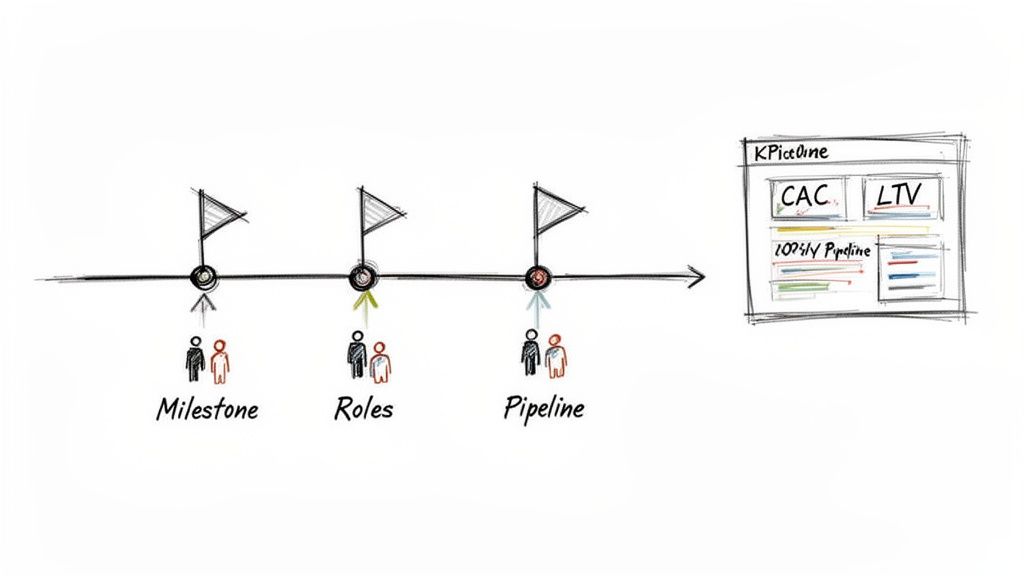
Illustration showing a project timeline with milestones, roles, and a pipeline, integrating with a KPI dashboard.

Alright, the moment of truth. All the planning and strategy docs are done. This is where your GTM strategy stops being a theory and starts being a real-world growth engine.

A great launch is a carefully orchestrated performance, not a chaotic scramble. It all comes down to a clear timeline, defined roles, and making sure your teams have everything they need to win from day one. But a big launch day means nothing if you can't tell whether it actually worked.

This is where so many companies stumble. They get distracted by vanity metrics like website traffic or social media likes. You need to be laser-focused on the Key Performance Indicators (KPIs) that really show if your GTM is a success.

Creating Your Launch Timeline and Collateral

Before you hit the big red “launch” button, you need a project plan. I’m talking about a simple timeline mapping out the weeks leading up to and immediately following your launch. This isn’t just a task list; it’s your roadmap for keeping everyone aligned.

Your timeline has to assign clear ownership for every key deliverable. Who’s writing the final blog post? Who’s training the sales team on the new messaging? When does the email campaign go out? Answering these questions now prevents panic later.

At the same time, you need to arm your teams with the right sales enablement collateral. This is the ammo they'll use in the trenches. At a minimum, you'll need:

  • Battle Cards: Quick one-pagers with key messaging, competitor weak spots, and answers to common objections.

  • Demo Scripts: A structured guide to make sure every salesperson tells the same powerful, consistent story.

  • Email Sequences: Pre-built outreach campaigns ready to go in your sales engagement tool, so reps can just personalize and send.

  • Case Studies: Real-world proof that shows prospects how other customers are already winning with your product.

When you create this collateral upfront, you ensure the entire revenue team is speaking the same language and telling the same story from the second you go live.

Focusing on GTM Metrics That Matter

Once you're live, it’s time to start measuring. Forget the noise and zero in on these four core GTM metrics. They are the undeniable proof of whether your strategy is hitting the mark.

  1. Customer Acquisition Cost (CAC): This is your total sales and marketing cost divided by the number of new customers you brought in. A high CAC is a red flag—it might mean your channels are too expensive or your messaging isn't converting. The goal of any GTM strategy is to find a scalable, profitable way to drive this number down.

  2. Customer Lifetime Value (LTV): This metric predicts how much revenue a single customer will bring in over their entire relationship with you. A healthy GTM strategy acquires customers where the LTV is way higher than the CAC. A good benchmark to aim for is an LTV:CAC ratio of 3:1 or higher.

  3. Pipeline Velocity: This tells you how fast deals are moving through your sales funnel, from first contact to close. If velocity is slow, it could point to friction in your sales process or a gap between what marketing promised and what sales is delivering.

  4. Channel Conversion Rates: Don't just track leads; track where your best leads come from. Knowing your LinkedIn ads convert at 5% while your SEO content converts at 2% tells you exactly where to double down on your budget.

These metrics aren't just numbers on a spreadsheet; they are the vital signs of your business. Monitoring them in real-time gives you an immediate, honest look at your ROI and tells you where to adjust your strategy.

And today, the GTM landscape is being completely reshaped by AI. Research shows a massive performance gap is opening up between companies that adopt AI and those that don't. AI-native organizations are seeing trial conversion rates of 56%, while their non-AI peers are stuck at just 32%. That’s a 75% difference in performance.

As you can see in the full 2025 State of Go-to-Market report, integrating AI throughout your GTM strategy is quickly becoming a non-negotiable competitive advantage.

Frequently Asked GTM Strategy Questions

As you start building out your go-to-market plan, a few questions always come up. I’ve seen them derail founders and teams time and time again. Here are my straight-to-the-point answers.

How Often Should I Revisit My Go-to-Market Strategy?

Your GTM strategy isn't a "set it and forget it" document. Think of it as a living guide. You absolutely need to do a full, deep-dive review at least once a year. You should also pull it out anytime something big changes—like a new, serious competitor shows up or you notice a fundamental shift in how your customers buy.

But don't wait a whole year to see if things are working. Your KPIs are your real-time dashboard. Keep a close eye on your core metrics—channel conversion rates, pipeline velocity, customer acquisition cost—every single month.

A sudden nosedive in a key metric is your smoke alarm. It doesn’t mean the whole house is on fire, but you need to find the source of the smoke—fast. It could be your messaging, your channel mix, or something else entirely. Investigate and adapt.

What Is the Biggest GTM Mistake SMBs Make?

Easy. The single most expensive mistake I see is a complete lack of focus. So many small and mid-sized businesses try to be everything to everyone, and it’s a guaranteed path to failure. It results in weak, generic marketing, terrible conversion rates, and a customer acquisition cost that will bleed you dry.

A winning GTM strategy is all about making hard choices. It means getting ruthless about defining your Ideal Customer Profile, creating a value proposition that makes you the only logical choice, and mastering just one or two channels. It's always better to own a small, profitable niche than to be a nobody in a massive market.

How Can I Create a GTM Strategy with a Small Budget?

A tight budget isn't a dealbreaker. It just forces you to be smarter and more disciplined. Your goal is to find high-leverage activities that don't depend on a huge ad spend.

First, nail your ICP and messaging. This costs you nothing but time and effort, and it gives you the highest ROI of anything you'll do. Once you know exactly who you're talking to and what they need to hear, everything else gets easier.

From there, pick one or two organic channels and commit to dominating them:

  • SEO-driven content: Write genuinely helpful articles that solve your ICP's most painful problems.

  • Targeted outreach: Use platforms like LinkedIn to connect directly with the right people. No fluff, just value.

  • Community building: Find out where your ideal customers hang out online and become a valuable member of that community.

This is where automation becomes your superpower. An AI-powered tool can manage personalized outreach at a scale that would normally require a small team, helping you execute like a bigger company without the payroll. Master one channel, then—and only then—add another.

Ready to build a focused, data-driven GTM strategy? Stamina unifies your marketing, sales, and CRM into one AI-powered platform, giving you the tools to find your ideal customers, personalize outreach, and measure what matters. See how it works at https://stamina.io.

A go-to-market strategy is more than just a list of launch tasks. It’s the playbook that gets your marketing, sales, and product teams all pulling in the same direction, focused on a single goal: successfully launching a product or conquering a new market.

Building Your GTM Strategy Foundation

Flowchart showing marketing ideas leading to sales plans, which then inform product development.

For a small or medium-sized business, a Go-to-Market (GTM) strategy isn't just a checklist you run through and forget. Think of it as a living blueprint that keeps every department aligned and focused.

Honestly, the biggest hurdle for most SMBs isn't a lack of good ideas—it’s internal misalignment. This is what happens when marketing’s message doesn’t match the sales team’s pitch, or when the product team builds features without knowing what customers actually want. These disconnects create friction, confuse customers, and kill deals.

The Real Cost of Siloed Teams

I’ve seen this happen countless times. Your marketing team runs a brilliant campaign highlighting a new feature’s simplicity. A prospect, excited by the promise of an easy-to-use tool, books a demo. But the sales rep, who wasn't fully briefed on the new messaging, spends the entire demo diving into complex, power-user functions.

What's the result? A confused prospect and a lost sale. All that initial excitement evaporates because the story they were told didn't line up with the experience they got. This is exactly what a unified GTM strategy is built to prevent.

A go-to-market strategy’s true job is to create a single source of truth. It ensures every part of your business is focused on delivering exceptional and consistent value to your ideal customer.

At its core, a modern GTM strategy is built on several key pillars, each answering a critical question to guide your launch.

Core Components of a Modern GTM Strategy

GTM Component

Key Question It Answers

Primary Objective

Market Research

Where is the opportunity, and who are the competitors?

Identify a viable market niche and understand the competitive landscape.

Ideal Customer Profile (ICP)

Who is our perfect customer and what do they need?

Define a specific, targetable audience to focus all efforts on.

Messaging & Positioning

How do we talk about our product in a way that resonates?

Craft a compelling, consistent narrative that highlights unique value.

Pricing & Packaging

How much is our solution worth and how will we sell it?

Create a pricing structure that reflects value and drives adoption.

Channel & Sales Motion

Where will we find customers and how will we sell to them?

Select the most effective marketing and sales channels for your ICP.

Launch Plan & KPIs

What does success look like and how will we get there?

Set clear, measurable goals and create an actionable launch timeline.

Each of these components builds on the last, creating a cohesive plan that eliminates guesswork and aligns your entire organization.

Why Alignment Is Your Top Priority

This isn't just a hypothetical problem; it's a real, documented challenge. Recent research from the GTM Alliance found that alignment and buy-in ranked as the most important element of an effective go-to-market process. It was the top priority for 33.3% of surveyed GTM professionals.

This statistic shows a fundamental shift in what it takes to win. It’s no longer just about having the best product; it's about having the most cohesive team. This is precisely why platforms that unify marketing, sales, and CRM data are no longer a "nice-to-have."

A connected system like Stamina acts as the central nervous system for your GTM plan. When your teams operate from the same playbook and look at the same customer data, you can:

  • Ensure consistent messaging from the very first ad a prospect sees to their post-sale support ticket.

  • Create seamless handoffs between marketing and sales so that no warm lead ever falls through the cracks.

  • Feed real-world sales insights back into your product and marketing automation strategy.

Getting this foundation right is how you move from a collection of siloed departments to a streamlined revenue engine. The next sections will walk you through building each component of this strategy, starting with how to zero in on your ideal customer.

Pinpointing Your Ideal Customer and Market

A hand-drawn sketch showing a target with a magnifying glass over a pie chart, surrounded by business icons.

Trying to sell your product to everyone is a classic startup mistake. It’s also the fastest way to burn your budget, confuse your prospects, and wear out your team. A winning go-to-market strategy starts with ruthless focus. You need to know exactly who you're selling to, why they should care, and where to find them.

This all starts with your Ideal Customer Profile (ICP). An ICP is a super-detailed description of the perfect company that will get the most value out of your product and become your biggest fan. Forget broad categories; we're talking about getting hyper-specific.

Moving Beyond Basic Demographics

A weak ICP sounds like, "We sell to tech companies." A strong ICP goes much deeper, moving past surface-level details to the traits that actually signal a real need for what you’re selling. These are usually broken down into firmographics, psychographics, and technographics.

  • Firmographics: These are the company-level basics. Think industry, annual revenue, employee count, and geographic location. A better starting point would be B2B SaaS companies in North America with 50-200 employees.

  • Psychographics: This is where it gets interesting. These are the human elements—the goals, challenges, and motivations of the people inside those companies. What keeps your ideal buyer up at night? What are their biggest frustrations at work?

  • Technographics: This is the tech stack your ideal customer already uses. Do they use a specific CRM? Are they running marketing on certain platforms? This info is a goldmine—it signals their needs and how mature their current processes are.

A truly effective ICP isn't just a persona; it's a blueprint. It describes the organization that will not only buy from you but also stick around, renew their contract, and tell others about you.

Once you have this blueprint, you can start to size up your opportunity. This means calculating your Total Addressable Market (TAM)—the total potential revenue you could make if you captured 100% of your target market. Of course, you’ll never get all of it, but understanding your TAM helps you set ambitious yet realistic growth goals. From there, you can narrow it down to your Serviceable Available Market (SAM) and a practical Serviceable Obtainable Market (SOM).

Validating Your ICP with Real Data

Theory is great, but a GTM strategy lives or dies on real-world data. The most critical step is validating that your ICP isn't just a fantasy on a whiteboard. You need to prove that these customers actually exist and that you can reach them.

This is where modern tools have completely changed the game for SMBs. In the past, this was a slow, expensive process full of guesswork. Today, you can use AI to instantly test your assumptions.

Let's say your ICP is "B2B software companies with 50-200 staff that recently hired a new VP of Marketing." That hiring event is a powerful buying trigger—a new leader often comes in with the budget and the authority to make changes.

With a platform like Stamina, you can plug those exact criteria into its AI engine, Zara. Within minutes, you can generate a validated list of companies and contacts that perfectly match your ICP. This simple action does two huge things at once:

  1. It proves your market exists. You’re not just guessing anymore; you have a tangible list of real prospects.

  2. It gives you an immediate list to work with. Your GTM strategy instantly moves from a document to an actionable sales pipeline.

This fast validation loop is a lifesaver. It lets you test and refine your ICP without burning months chasing a flawed assumption. You can see how other businesses have scaled up by taking a similarly focused approach. For instance, you can learn how BrothersFix scaled operations through smarter lead generation.

With a validated ICP, every other part of your go-to-market strategy falls into place. You'll know exactly who to target, what message will resonate, which channels to prioritize, and what pain points to solve in your sales calls.

Crafting Your Messaging and Choosing Your Channels

Sketch showing 'Value' at the center, linked to email, browser, content, and network elements.

Alright, so you’ve locked in who you're selling to. But a perfect Ideal Customer Profile (ICP) is worthless if you don’t have something compelling to say. If your message is generic or misses the mark on their real problems, you’re just shouting into the void.

This is where your value proposition and core messaging come in. They’re the heart of your entire GTM strategy.

Think of your value prop not as a catchy slogan, but as a dead-simple statement explaining the tangible results a customer gets from you. It has to immediately answer their first, most important question: "What's in it for me?"

Building a Message That Actually Resonates

I’ve seen too many companies build messages that fall flat. The ones that work are always built on three pillars:

  • Relevance: It has to nail your ICP’s biggest, hair-on-fire problem.

  • Unique Differentiation: It must clearly explain why you’re the only real choice.

  • Verifiable Proof: It should promise a specific, believable outcome you can prove.

The most common mistake? Focusing on features, not outcomes. Nobody buys a drill because they want a drill; they buy it because they want a hole. Your message needs to be about the "hole."

Instead of saying, “Our software has an AI-powered analytics dashboard,” you need to frame it around the outcome: “Our software gives you the exact insights to cut customer acquisition costs by 20%.”

That simple shift—from features to benefits—is what makes a prospect stop scrolling and actually listen. It’s how you turn a piece of tech into a must-have solution.

From Core Message to Personalized Outreach

Once you have your core message, the real work begins: adapting it for different channels and contexts. The copy on your landing page won't fly in a cold email. For a small team, this is where AI becomes your secret weapon.

This is a perfect use case for a platform like Stamina. You can feed your core value prop to its AI engine, Zara, and have it generate dozens of personalized email variations in minutes. Zara can tweak the message based on a prospect's role, industry, or even a recent company announcement. This lets a small team punch way above its weight class, making every touchpoint feel personal.

For example, your core message might be about improving sales team efficiency. For a VP of Sales, Zara might focus the email on pipeline velocity and hitting revenue targets. But for a Sales Manager, it might zero in on rep productivity and cutting out manual tasks. The core value is the same, but the delivery is customized. This is how you get your foot in the door, but make sure you set up your cold email infrastructure correctly first to ensure your messages actually land.

Prioritizing Your Go-to-Market Channels

With a strong message ready, the final piece is deciding where to deliver it. The temptation is to "spray and pray" across every social media platform, ad network, and content channel you can think of. That’s a fast track to a burnt-out team and an empty bank account.

Instead, a smart GTM strategy asks one simple question: Where does my ICP actually spend their time?

  • If your ICP is VPs of Engineering, they’re probably in niche Slack communities or on LinkedIn—not scrolling through TikTok.

  • If you’re targeting startup founders, they might be avid podcast listeners or active on X (formerly Twitter).

  • If you're selling to marketers, a killer SEO and content strategy is non-negotiable.

The goal isn't to be everywhere. It's to be in the right places, consistently. Just reaching your audience is a massive challenge; 6.9% of GTM professionals say it’s a major bottleneck. But that’s only half the battle. With only 42.3% of companies achieving significant adoption for new products, it's clear that effective nurturing is just as critical as the first touch.

Start with two or three channels you can realistically own. Master them, measure everything, and only expand once you have a clear, proven return.

Selecting Your Sales Motion and Pricing Model

You’ve got your ideal customer nailed down and your messaging is sharp. Now comes the big question in your go-to-market strategy: how are people actually going to buy from you?

This decision defines your sales motion and your pricing model — two pieces of the puzzle that have to fit together perfectly.

Choosing Your Sales Motion

The right sales motion almost always comes down to two things: your product’s complexity and its price point. A simple, low-cost tool needs a completely different sales approach than a high-ticket enterprise platform.

Most SMBs will land on one of these three models.

  • Product-Led Growth (PLG): This is where the product does the selling. Think of how Slack or Calendly got started. They offered a free trial or a freemium plan that let users see the value for themselves before ever talking to a salesperson. PLG is perfect for intuitive, low-friction products that people can figure out on their own.

  • Sales-Led Growth (SLG): This is the classic model. A sales team is out there prospecting, nurturing leads, and closing deals. It’s a must-have for complex or expensive products that demand custom setups, long sales cycles, or a consultative touch. Enterprise software giants like Oracle or Salesforce live and breathe this model.

  • Hybrid Model: This approach cherry-picks the best of both worlds. You might use a product-led motion to get a huge number of free users in the door, then have a sales team focus on identifying the big fish and upselling them to enterprise plans. It's an incredibly popular and effective model for modern SaaS companies.

Your go-to-market strategy isn't just about picking one model and sticking with it. The real magic happens when you understand how they can work together. A free trial might reel in the leads, but it's your sales team that can turn a small, happy user into a massive enterprise account.

So, how do you map your product to the right motion? It really comes down to complexity and cost. A simple, low-cost product is a natural fit for a product-led approach, where users can self-serve. As the complexity and price tag increase, you'll need a sales team to guide prospects through the process.

Here’s a quick way to see where you might fit.

Sales Motion vs. Product Complexity and Price

Sales Motion

Best For

Typical Price Point

Example

Product-Led

Simple, intuitive products that users can adopt on their own.

Low (e.g., $10-$99/month)

A project management tool

Sales-Led

Complex solutions requiring expert guidance and negotiation.

High (e.g., $10,000+ per year)

An ERP software system

Hybrid

Products that offer immediate value but have advanced enterprise features.

Varies (Freemium to Enterprise)

A CRM like Stamina

Once you’ve got your sales motion figured out, your pricing needs to support it. A cheap, self-serve product with a complicated pricing structure will just confuse people, while a sales-led motion needs a price point that justifies the cost of a sales team.

Structuring Your Pricing and Packaging

Your pricing isn't just a number—it’s a direct reflection of your value proposition. If you get this wrong, your entire GTM strategy can fall flat before it even gets off the ground.

There are a few common pricing models you’ll see, each with its own pros and cons:

  1. Tiered Pricing: This is the go-to model for SaaS. You create a few different packages (like Basic, Pro, and Enterprise) at different prices. Each tier unlocks more features or higher limits, creating a clear upgrade path as a customer’s business grows.

  2. Usage-Based Pricing: With this model, customers pay for what they use. Think of a cloud provider charging for data storage or an email platform charging per email sent. Customers often love this because the cost is directly tied to the value they’re getting.

  3. Flat-Rate Pricing: Simple and transparent. One price gets you one set of features. The downside is that it’s not very flexible and can make it tough to serve different types of customers effectively.

When you're putting your packages together, the goal is to make the next tier up feel like a no-brainer as a customer's needs expand. You can see some great examples of how to build these tiers by looking at different SaaS pricing strategies.

Ultimately, the right commercial model is what fuels your entire go-to-market plan, whether that’s converting thousands of free users or arming your sales team to close six-figure deals.

Executing Your Launch and Measuring What Matters

Illustration showing a project timeline with milestones, roles, and a pipeline, integrating with a KPI dashboard.

Alright, the moment of truth. All the planning and strategy docs are done. This is where your GTM strategy stops being a theory and starts being a real-world growth engine.

A great launch is a carefully orchestrated performance, not a chaotic scramble. It all comes down to a clear timeline, defined roles, and making sure your teams have everything they need to win from day one. But a big launch day means nothing if you can't tell whether it actually worked.

This is where so many companies stumble. They get distracted by vanity metrics like website traffic or social media likes. You need to be laser-focused on the Key Performance Indicators (KPIs) that really show if your GTM is a success.

Creating Your Launch Timeline and Collateral

Before you hit the big red “launch” button, you need a project plan. I’m talking about a simple timeline mapping out the weeks leading up to and immediately following your launch. This isn’t just a task list; it’s your roadmap for keeping everyone aligned.

Your timeline has to assign clear ownership for every key deliverable. Who’s writing the final blog post? Who’s training the sales team on the new messaging? When does the email campaign go out? Answering these questions now prevents panic later.

At the same time, you need to arm your teams with the right sales enablement collateral. This is the ammo they'll use in the trenches. At a minimum, you'll need:

  • Battle Cards: Quick one-pagers with key messaging, competitor weak spots, and answers to common objections.

  • Demo Scripts: A structured guide to make sure every salesperson tells the same powerful, consistent story.

  • Email Sequences: Pre-built outreach campaigns ready to go in your sales engagement tool, so reps can just personalize and send.

  • Case Studies: Real-world proof that shows prospects how other customers are already winning with your product.

When you create this collateral upfront, you ensure the entire revenue team is speaking the same language and telling the same story from the second you go live.

Focusing on GTM Metrics That Matter

Once you're live, it’s time to start measuring. Forget the noise and zero in on these four core GTM metrics. They are the undeniable proof of whether your strategy is hitting the mark.

  1. Customer Acquisition Cost (CAC): This is your total sales and marketing cost divided by the number of new customers you brought in. A high CAC is a red flag—it might mean your channels are too expensive or your messaging isn't converting. The goal of any GTM strategy is to find a scalable, profitable way to drive this number down.

  2. Customer Lifetime Value (LTV): This metric predicts how much revenue a single customer will bring in over their entire relationship with you. A healthy GTM strategy acquires customers where the LTV is way higher than the CAC. A good benchmark to aim for is an LTV:CAC ratio of 3:1 or higher.

  3. Pipeline Velocity: This tells you how fast deals are moving through your sales funnel, from first contact to close. If velocity is slow, it could point to friction in your sales process or a gap between what marketing promised and what sales is delivering.

  4. Channel Conversion Rates: Don't just track leads; track where your best leads come from. Knowing your LinkedIn ads convert at 5% while your SEO content converts at 2% tells you exactly where to double down on your budget.

These metrics aren't just numbers on a spreadsheet; they are the vital signs of your business. Monitoring them in real-time gives you an immediate, honest look at your ROI and tells you where to adjust your strategy.

And today, the GTM landscape is being completely reshaped by AI. Research shows a massive performance gap is opening up between companies that adopt AI and those that don't. AI-native organizations are seeing trial conversion rates of 56%, while their non-AI peers are stuck at just 32%. That’s a 75% difference in performance.

As you can see in the full 2025 State of Go-to-Market report, integrating AI throughout your GTM strategy is quickly becoming a non-negotiable competitive advantage.

Frequently Asked GTM Strategy Questions

As you start building out your go-to-market plan, a few questions always come up. I’ve seen them derail founders and teams time and time again. Here are my straight-to-the-point answers.

How Often Should I Revisit My Go-to-Market Strategy?

Your GTM strategy isn't a "set it and forget it" document. Think of it as a living guide. You absolutely need to do a full, deep-dive review at least once a year. You should also pull it out anytime something big changes—like a new, serious competitor shows up or you notice a fundamental shift in how your customers buy.

But don't wait a whole year to see if things are working. Your KPIs are your real-time dashboard. Keep a close eye on your core metrics—channel conversion rates, pipeline velocity, customer acquisition cost—every single month.

A sudden nosedive in a key metric is your smoke alarm. It doesn’t mean the whole house is on fire, but you need to find the source of the smoke—fast. It could be your messaging, your channel mix, or something else entirely. Investigate and adapt.

What Is the Biggest GTM Mistake SMBs Make?

Easy. The single most expensive mistake I see is a complete lack of focus. So many small and mid-sized businesses try to be everything to everyone, and it’s a guaranteed path to failure. It results in weak, generic marketing, terrible conversion rates, and a customer acquisition cost that will bleed you dry.

A winning GTM strategy is all about making hard choices. It means getting ruthless about defining your Ideal Customer Profile, creating a value proposition that makes you the only logical choice, and mastering just one or two channels. It's always better to own a small, profitable niche than to be a nobody in a massive market.

How Can I Create a GTM Strategy with a Small Budget?

A tight budget isn't a dealbreaker. It just forces you to be smarter and more disciplined. Your goal is to find high-leverage activities that don't depend on a huge ad spend.

First, nail your ICP and messaging. This costs you nothing but time and effort, and it gives you the highest ROI of anything you'll do. Once you know exactly who you're talking to and what they need to hear, everything else gets easier.

From there, pick one or two organic channels and commit to dominating them:

  • SEO-driven content: Write genuinely helpful articles that solve your ICP's most painful problems.

  • Targeted outreach: Use platforms like LinkedIn to connect directly with the right people. No fluff, just value.

  • Community building: Find out where your ideal customers hang out online and become a valuable member of that community.

This is where automation becomes your superpower. An AI-powered tool can manage personalized outreach at a scale that would normally require a small team, helping you execute like a bigger company without the payroll. Master one channel, then—and only then—add another.

Ready to build a focused, data-driven GTM strategy? Stamina unifies your marketing, sales, and CRM into one AI-powered platform, giving you the tools to find your ideal customers, personalize outreach, and measure what matters. See how it works at https://stamina.io.

Share this article

Share this article

Send a shareable link to your team or anyone who might find it useful.

Send a shareable link to your team or anyone who might find it useful.

Copy link

Copied

Share directly to

Table of contents

Give Your Business the Stamina it needs to Thrive