
If you're looking for artisan alternatives, you're likely not comparing one sales tool against another. You're reacting to a way of working that used to feel thoughtful and high quality, becoming a bottleneck. Reps hand-build lists. Managers review sequences line by line. Someone spends half a day checking job changes, funding news, and LinkedIn activity before sending ten emails. The work is careful, but it doesn't scale.
That hand-crafted approach retains value. It helps with enterprise deals, founder-led sales, and sensitive accounts where context matters. The problem is consistency. Manual outreach depends on individual effort, tribal knowledge, and a lot of hidden labor. As pipelines grow, quality slips. Follow-up timing drifts. Research gets skipped. Good reps become process glue instead of revenue drivers.
The teams pulling ahead aren't writing better cold emails. They're replacing manual prospecting with systems that can research accounts, prioritize signals, launch outreach across channels, and keep CRM data in sync without forcing reps to stitch together five separate tools.
That's the lens for this list. These artisan alternatives aren't merely competitors to Artisan the product. They're alternatives to artisan-style sales execution itself. Some are agentic platforms built to run large parts of outbound for you. Others give your team sharper control over data, sequencing, or multichannel execution. The right choice depends on where your current process breaks first: list building, personalization, deliverability, rep capacity, or stack sprawl.
1. 11x.ai
11x.ai fits teams that don't want a separate assistant layered into the workflow. They want an autonomous operator.
Its pitch is straightforward. Give the system a target motion, connect the stack, and let an AI SDR handle research, personalization, outreach, and booking flows with far less manual rep intervention than a traditional sequencing tool. That makes it one of the clearest artisan alternatives for companies trying to move away from rep-crafted outbound and toward agent-led execution.
Where it fits best
11x.ai is a better fit for organizations that already know their ICP and can support tighter process design. If your sales motion changes every week, a fully agentic system can feel heavy. If your motion is stable and your issue is scale, it starts to make more sense.
What stands out is the emphasis on orchestration and memory across workflows, not only single-message generation. It also positions itself for enterprise use, which matters if security reviews and integration depth are part of your buying process.
Practical rule: Don't buy an autonomous SDR because your team is behind on activity. Buy one because your outbound motion is already clear enough to automate.
There is a trade-off. Pricing is sales-led, and adoption requires comfort with handing meaningful control to software. That isn't a problem for every team, but it does force a management decision. Do you want AI to draft and assist, or do you want it to run?
If you're evaluating that broader shift, this guide to AI sales assistants is a useful companion.
Visit 11x.ai
2. Regie.ai
Regie.ai takes a different approach from pure AI agent vendors. It tries to replace a bundle of point tools with one coordinated prospecting environment.
That matters if your current outbound process is messy rather than fully manual. A lot of teams already have sequencing, enrichment, dialing, and intent data. They don't have them working together. Regie.ai appeals to those teams because it combines agents for discovery, prioritization, enrichment, visitor capture, sequencing, and dialing inside one operating layer.
Why operators like it
The practical advantage is budget clarity and workflow consolidation. Public pricing and visible seat minimums make it easier to evaluate than quote-only tools. Built-in credits for enrichment and AI also simplify the procurement conversation for small teams.
Its strongest use case is a sales org that wants broad channel coverage without assembling a custom stack from scratch. Dynamic sequencing and prompt-based steps can support more flexible prospecting motions than rigid cadence builders.
A notable trade-off sits in the plan structure. The listed minimum can feel too large for small teams, and the credits model needs monitoring if usage ramps fast.
Regie.ai makes the most sense when your problem is tool sprawl, not lack of features.
If you're comparing it with more fully autonomous products, this breakdown of proven Artisan.ai alternatives for better deliverability and scale helps frame the difference between AI-led and operator-led setups.
Visit Regie.ai
3. Apollo.io
A founder asks for outbound next week, not next quarter. The team needs contacts, sequences, a dialer, and basic reporting in one system, and nobody wants to buy five tools just to prove the motion works. Apollo.io is often the fastest answer to that problem.
That makes it a strong artisan alternative for teams trying to move away from hand-built prospecting without jumping straight into a fully autonomous sales setup. Apollo replaces a lot of the manual work that used to live in spreadsheets, browser tabs, and SDR inboxes. You can source leads, segment lists, launch outreach, and manage follow-up from one platform.
The trade-off is clear. Apollo does not aim to be your AI-run GTM engine. It is a broad, operator-driven system with useful automation layered in. That works well for teams that continue to want reps and managers making list decisions, sequence changes, and day-to-day judgment calls.
This is why Apollo tends to stick with early and mid-stage companies.
It gives smaller sales teams a practical path out of artisan outbound. Instead of manually researching accounts, exporting CSVs, enriching leads in batches, and stitching together separate sequencers, they can run a decent outbound program in one place. For many teams, that matters more than advanced orchestration or agent-led execution.
Friction often appears later. Credit limits, plan entitlements, and usage-based costs can become a significant operating constraint once volume rises. Data coverage is frequently good enough to start, but mature teams may want tighter governance, more flexible routing, or stronger automation across channels and systems.
Apollo is best for teams that want speed, coverage, and reasonable cost control. It is less suited to organizations that are explicitly replacing manual sales work with AI agents and system-level automation.
Visit Apollo.io
4. Clay
Clay isn't a typical sales engagement platform. It's a GTM workbench.
That distinction matters. If most artisan alternatives try to replace manual outreach with packaged automation, Clay helps you replace manual research with custom systems. You build enrichment waterfalls, define trigger logic, pull in external signals, run AI research, and push the output into your sequence or CRM layer.
Best for teams that want control
Clay is excellent for operators who don't trust generic personalization and want to engineer their own version of relevance. Job changes, company news, custom fields, niche account scoring, and bespoke lead routing are where it shines.
Its built-in sequencer makes it more practical than it used to be, but Clay still isn't the easiest option for teams that want a turnkey SDR engine. It rewards workflow design. If nobody on your team owns GTM systems, Clay can become a beautiful unfinished project.
A few reasons advanced teams choose it:
Custom enrichment logic: You can layer multiple data sources instead of depending on one vendor's default contact record.
Flexible AI research: Claygent-style workflows help generate account context that feels closer to research than surface-level merge tags.
Cost tuning: Bring-your-own-API-key options can reduce spend if your ops team is disciplined.
The catch is maintenance. Clay provides an advantage, but only if someone keeps the machine clean.
The teams that love Clay often don't want a vendor's opinionated workflow. They want their own.
Visit Clay
5. Reply.io (Jason)
A common transition point looks like this. The team has outgrown hand-built outbound, but leadership does not yet want to hand prospecting, messaging, and reply handling to a fully autonomous SDR platform. Reply.io sits in that middle ground.
Its Jason product adds AI prospecting, message generation, and reply handling on top of a sales engagement system that remains familiar to reps and managers. That matters for teams replacing artisan-style outbound processes in stages. You can move away from manual list building and one-off sequencing without redesigning the whole GTM motion at once.
Where Reply.io fits best
Reply.io works well for teams that want more automation than a standard sequencer, but yet want reps close to execution. The product packaging is easier to understand than many AI SDR tools, and the setup burden is lighter for smaller teams that need mailbox management and deliverability support bundled into the same motion.
The primary trade-off is control versus autonomy. Reply.io gives you an assisted model. Reps and managers can stay involved in targeting, messaging, and follow-up logic while Jason handles more of the repetitive work. More autonomous platforms push further. They are better suited to leadership teams that want software to run a larger share of outbound with less rep intervention.
A few practical points stand out:
Good fit for gradual automation: Teams can reduce manual prospecting and inbox triage without replacing the full sales engagement workflow overnight.
Easier change management: Reps usually understand the system faster because it still behaves like a familiar outbound platform.
Less opinionated than full AI SDR platforms: That flexibility helps if your team wants supervision, but it also means you may not get the same level of end-to-end automation.
The pricing trade-off is worth watching closely. Reply.io can make sense early, particularly if you value familiarity, but the stronger AI and data features sit higher in the product stack. As usage expands across channels, total cost can rise faster than teams expect.
Visit Reply.io
6. lemlist
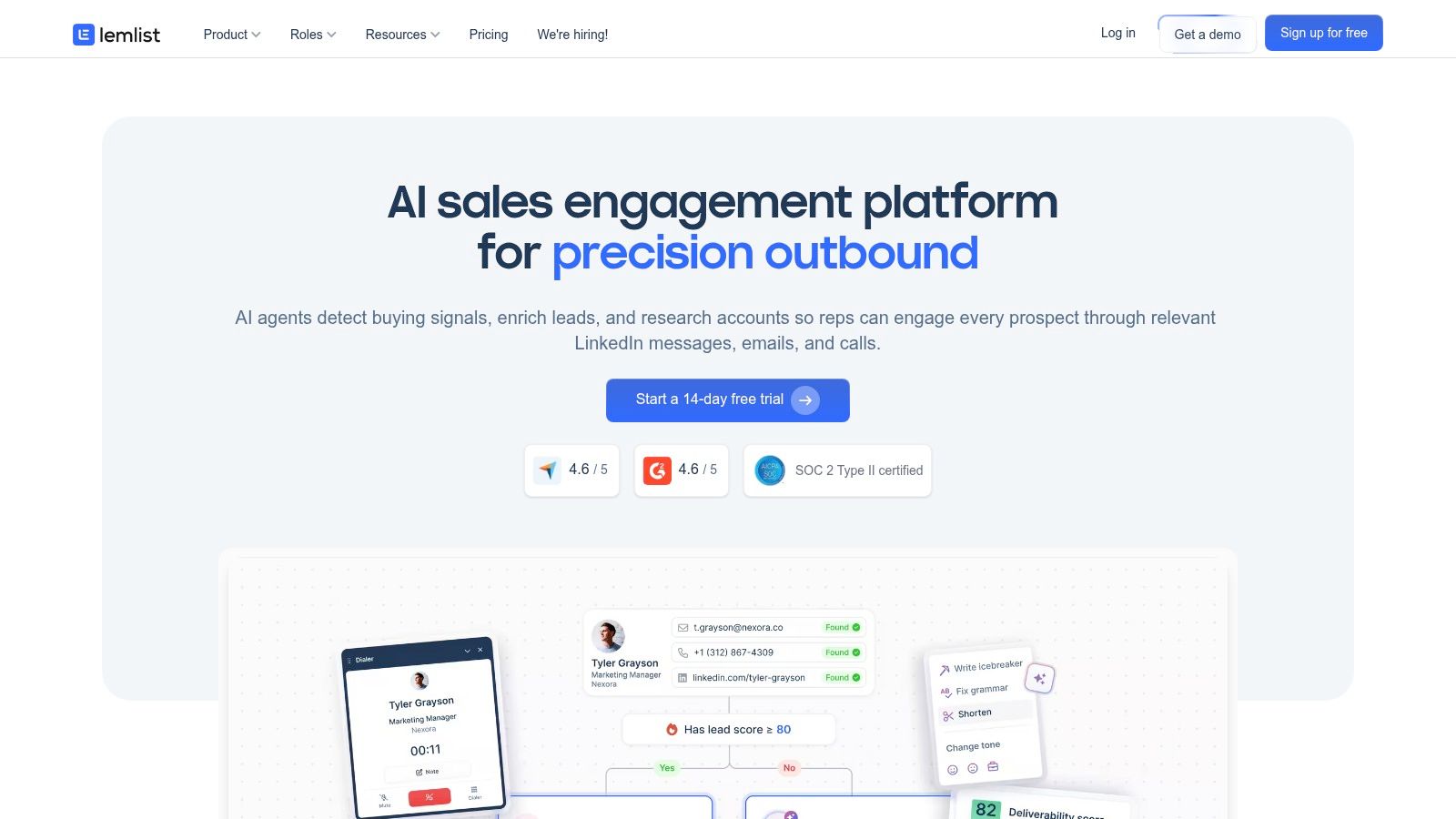
lemlist is what I recommend when a team's problem isn't strategy. It's execution hygiene.
A lot of outbound teams don't need an AI BDR. They need better deliverability, cleaner email operations, enough multichannel support to avoid being boxed into one lane, and a simple setup that reps will use. lemlist is built for that buyer.
What it does well
Its DNA remains email-first, and that's both the strength and limitation. For straightforward outbound motions, that focus helps. You get a deliverability hub, warmup support, personalization features, and multichannel actions without jumping into a bigger enterprise platform.
It's also easy to explain internally. Teams understand what they're buying and how it fits into their stack. That matters when sales leaders need momentum more than system redesign.
A few trade-offs are worth being honest about:
Great for lean outbound teams: You can get live quickly without building a heavy process layer.
Less ideal for complex GTM motions: If your team needs advanced routing, broad voice workflows, or deep operational control, you'll likely add other tools.
Costs can creep: Data and add-ons can stack if you rely on the platform for more than sending.
lemlist works best when you're replacing manual, rep-managed cold email with something cleaner and more repeatable, not when you're trying to rebuild your whole revenue engine.
Visit lemlist
7. Instantly
Instantly is for teams that care about throughput.
If your model depends on running many inboxes, managing warmup, and keeping email infrastructure efficient, Instantly is one of the most useful artisan alternatives on the market. It doesn't pretend to be a full GTM brain. It gives you sending capacity, lightweight workflow, and optional leads.
Best for agencies and high-volume senders
Here, the tool has a clean identity. Agencies, outbound shops, and SMB teams that want to control costs understand Instantly quickly. Public pricing helps, onboarding is direct, and you can scale account volume without immediately buying a heavyweight platform.
That said, the limits are obvious. It's email-centric. If your reps need richer enrichment, stronger dialing, or more serious CRM coordination, Instantly becomes one layer in the stack rather than the operating system.
The practical question is whether that's okay. Sometimes it is. If the business possesses data and process ownership elsewhere, Instantly does exactly what it should.
"Use Instantly when you know your motion and need clean email execution at volume."
If you're trying to compare that approach with more feature-rich cold email platforms, this guide to Instantly alternatives that deliver better cold email results is useful.
Visit Instantly
8. Outreach
A team starts with hand-built outbound. Reps write messages one by one, managers review call notes in spreadsheets, and RevOps patches together reporting after the fact. Outreach is what companies buy when they decide that model no longer scales.
That is the fundamental shift away from "artisan" sales work. Outreach is not merely a better sequencing tool. It is a system for turning individual rep effort into a repeatable operating model across email, calls, tasks, CRM workflows, and inspection.
Built for teams that need process control
Outreach has stayed relevant because it handles the parts of sales execution that frequently break as headcount grows. Sequence management, CRM sync, manager visibility, workflow rules, and forecasting all live closer together than they do in lighter tools. For organizations with SDRs, AEs, managers, and RevOps all touching the same motion, that matters.
The trade-off is straightforward. Outreach pays off when leadership already knows how it wants the sales process to run. If the team is still testing messaging, changing segments every month, or building outbound from scratch, the platform can feel heavier than the current motion requires.
This has played out frequently. Teams buy Outreach expecting it to create discipline for them. In practice, it works better when some discipline previously exists. Otherwise, you end up with an expensive layer on top of a fuzzy process.
That does not make it a bad Artisan alternative. It makes it a different kind of answer.
Outreach fits companies that are moving from manual, hand-crafted execution toward a managed revenue system. If your goal is governance, rep accountability, and consistent execution across a larger team, it is a serious option. If your goal is speed, experimentation, and low-friction setup, there are lighter choices. A good starting point is this comparison of Salesloft alternatives for teams evaluating sales engagement platforms.
Visit Outreach
9. Salesloft
Salesloft is the better answer when leadership wants an enterprise-grade engagement platform, but doesn't want outbound reduced to merely autonomous AI email.
It gives teams cadences, voice, conversation intelligence, analytics, and broader deal execution tooling in one established system. That makes it one of the strongest artisan alternatives for companies that believe humans should own the relationship while software structures the work around them.
Human-led selling with stronger infrastructure
The most important distinction is philosophical. Salesloft doesn't ask you to replace the SDR function. It gives SDRs, AEs, and managers a more disciplined way to operate.
That is particularly useful in mid-market and enterprise environments where phone, coaching, and compliance matter. One data point from the broader alternatives discussion is telling. Salesloft is referenced alongside phone-capable platforms, while Artisan is noted as lacking a phone or dialer in those comparisons, with Salesloft cited at approximately $125 per user in that context. The exact takeaway isn't that one is cheaper or better. It's that the category split is real. Some tools center autonomous email. Others center coordinated revenue execution.
Salesloft's trade-offs are familiar:
Strong fit for structured teams: Particularly where managers inspect activity and coach from call and sequence data.
Weaker fit for small orgs: Implementation and training can feel heavy.
Better for standardization than experimentation: It excels once the motion is understood.
If that's the direction you're evaluating, these Salesloft alternatives can help you compare different maturity levels of platform.
Visit Salesloft
10. Amplemarket
A common outbound scenario looks like this. The team has one tool for data, another for email, a dialer somewhere else, and shared inbox cleanup happening in spreadsheets and Slack. That is the modern version of artisan selling. It remains manual work, now spread across more software.
Amplemarket appeals to teams that want to get out of that trap without building a custom GTM system from scratch. It pulls prospect data, sequencing, calling, AI support, and inbox management into one operating layer, which cuts down the handoffs that frequently slow a small or mid-sized team.
That matters if the primary goal is not "buy another sales tool" but to replace hand-built prospecting workflows with a system that can scale.
Why teams buy it
Amplemarket fits best when a company wants one platform to run outbound with sensible defaults. The value is less about having the deepest feature in every category and more about reducing coordination costs across the stack. Fewer integrations often means fewer sync issues, fewer ownership gaps, and faster ramp time for reps.
I often see the strongest fit in lean GTM teams that need coverage across email, phone, and prospecting operations, but do not have a dedicated revops or growth engineering bench to stitch everything together.
The trade-off is straightforward. Teams that treat outbound as a custom-built machine often outgrow all-in-one design choices. If you want to control enrichment logic, route data through waterfalls, and test highly specific workflows, a modular setup can give you more room. Amplemarket is better for teams that want consistency and speed to execution.
As noted earlier in the broader AI SDR discussion, reply benchmarks across the category vary widely. The useful takeaway is not a single performance number. It is that results usually come from fit, targeting, and message quality first, then the platform that helps the team execute that motion consistently.
Visit Amplemarket
Top 10 Artisan Alternatives Comparison
Tool | Core features | Target audience & fit | Unique selling points | Pricing & scalability | Key limitations |
|---|---|---|---|---|---|
11x.ai | Autonomous AI SDR agents, multichannel outreach, contextual memory, booking flows, enterprise integrations | Teams wanting agentic, high-touch autonomous SDRs and enterprise readiness | End-to-end autonomous SDRs with continuous learning, 24/7 operation, enterprise security (SOC2) | Quote-based enterprise pricing, scales for large teams | Pricing opaque; steeper adoption curve for some teams |
Regie.ai | Sequencing agents, intent+fit prioritization, enrichment, dialer, website visitor research | Teams replacing multiple point tools for end-to-end prospecting | Transparent pricing, bundled enrichment/AI credits, broad channel coverage | Public pricing with seat minimums, credits model | 5-seat minimum may be high for tiny teams; credits need monitoring |
Apollo.io | Large B2B contact database, enrichment, sequencing, dialer, AI assistant, CRM basics | SMBs wanting database + engagement in one tool; freemium entry to test ICP | Large contact dataset, freemium tier, familiar all-in-one workflows | Freemium + paid tiers; cost affected by credits/overages | Data quality and entitlements vary; may be outgrown by enterprises |
Clay | Data orchestration, multi-provider enrichment waterfalls, AI research (Claygent), sequencer, API/webhooks | Advanced GTM/data teams building custom enrichment and personalization workflows | Highly flexible data/workflow design, bring-your-own-API, granular public pricing | Usage-based actions and data credits; free tier with unlimited seats | Technical setup required; actions/credits need operational oversight |
Reply.io (Jason) | Multichannel automation, AI SDR “Jason” (autopilot/co-pilot), unlimited mailboxes on tiers, deliverability tools | Teams wanting a packaged AI SDR with deliverability services and scale | Clear AI SDR packages, done-for-you deliverability, unlimited mailboxes on AI tiers | Published AI SDR pricing; scales with tiers and add-ons | Best features tied to higher-cost tiers; add-ons increase total cost |
lemlist | Email-first deliverability tools, AI personalization, lead DB, warmup booster | Lean teams focused on cold email deliverability and simple outbound | Strong deliverability hygiene, transparent pricing, easy onboarding | Transparent plans and free trial; credits/add-ons for leads | Email-first limits complex workflows; lead credits can add up |
Instantly | High-volume cold email, unlimited email accounts & warmup, optional verified leads, lightweight CRM | Agencies and SMBs prioritizing high throughput and cost control | Budget-friendly tiers, unlimited inboxes, public bundle pricing | Tiered monthly caps for send volumes; public pricing | Email-centric; lacks built-in enrichment or dialer features |
Outreach | Multichannel sequences, deep CRM integrations, conversation intelligence, revenue orchestration | Large enterprise revenue teams needing mature, governed engagement platform | Mature ecosystem, advanced analytics, conversation intelligence | Sales-led, quote-based pricing with seat minimums; enterprise scale | Expensive and complex; heavy change management for SMBs |
Salesloft | Cadences, dialer/voice, conversation intelligence, analytics, deal and pipeline views | Teams standardizing on a mainstream enterprise sales engagement stack | Category leader with broad GTM integrations and coaching tools | Quote-based, enterprise-leaning pricing and scale | Implementation and training effort can be significant for smaller teams |
Amplemarket | Built-in data/enrichment, sequences, AI co-pilot, voice/inbox handling, reply categorization | Lean teams wanting a single top-of-funnel platform to reduce vendor sprawl | All-in-one outbound stack with integrated reply handling and AI assistance | Quote-based pricing (not publicly listed); scales by quote | Pricing not transparent; less ideal for highly customized stacks |
Choosing Your GTM Engine From Point Tool to Unified Platform
A common SMB sales setup looks fine on a buying spreadsheet. One tool for data, one for sequencing, one for CRM, one for enrichment, one for website intent, and a few AI add-ons to patch the gaps. Six months later, reps are still copying notes between systems, managers are still asking for manual pipeline clean-up, and RevOps is stuck maintaining handoffs instead of improving performance.
That is the modern version of artisan selling. It remains manual work, now spread across more software. This represents the underlying shift behind "artisan alternatives." The goal is not replacing one niche tool with another. It is replacing hand-built sales execution with a system that can run repeatedly, with less manual intervention as volume grows.
Point tools retain their place. Clay is a strong fit when custom enrichment logic and workflow design are part of the strategy. Instantly works for teams that primarily need sending capacity and inbox infrastructure. Outreach and Salesloft fit organizations that possess defined process, admin support, and the budget for a governed engagement layer.
For many growing teams, though, the bigger problem is stack fragmentation. Prospect data lives in one product. Outreach runs in another. Pipeline context sits in the CRM. Marketing signals frequently never make it to sales at the right time. Reps fill the gaps by hand, and that manual layer becomes the effective operating model.
Stamina stands out because it addresses that operating model directly. It combines marketing, sales engagement, CRM, and AI SDR workflows in one system, so teams are not stitching together core execution across separate products. Zara, its AI SDR, handles prospect identification, research, and outreach creation. Sales teams can act on warm signals from website visits and social engagement. Marketing can run broadcasts and nurture in the same place where sales activity and pipeline are tracked.
The benefit is practical. Fewer sync issues. Less context loss between teams. A cleaner view of what is creating pipeline.
The buying decision should start with the bottleneck, not the category label. If the team loses time on list building and enrichment, choose the platform that improves data quality and targeting first. If cold outbound performance is limited by inbox health, fix sending infrastructure first. If the problem is visibility, choose the system that gives managers a usable picture of activity, pipeline, and conversion without extra reporting work. If every improvement requires another integration, it is time to evaluate a unified platform instead of another point solution.
AI has added urgency to this decision, but the hard part remains execution. Gartner's sales technology research has repeatedly pointed to the same pattern: adoption rises faster than operational maturity. Teams get value when AI is applied to a defined workflow with clean data, clear ownership, and measurable outcomes. They struggle when AI is layered onto a broken process and expected to fix it on its own.
Run a live test before committing. Use a real segment, a real offer, and a real rep workflow. Measure reply quality, meetings created, pipeline influence, admin time, and how much manual work still sits outside the platform after launch.
Teams that outgrow artisan sales execution often do not need more software. They need a GTM engine that reduces handoffs, keeps context in one place, and scales without adding more operational drag. For a closer look at that model, Explore Stamina's Platform.

