Sales Enablement Platform: Boost SMB Revenue in 2026

Discover how a sales enablement platform empowers your SMB. Explore key features, benefits, ROI, and select the best tool to grow revenue in 2026.

0 - Minute Read

Marketing says leads are coming in. Sales says none of them are ready. Reps keep asking for the latest deck, the right case study, the approved pricing slide, or a proposal template that doesn't look like it came from last year's laptop.

That kind of friction usually gets blamed on people. It's rarely a people problem. It's a systems problem.

When a growing SMB doesn't have a usable enablement system, every deal depends on memory, side chats, and whoever happens to know where the good materials live. That works when the founder runs every call. It breaks as soon as you add more reps, more channels, and more products.

Your Sales Team Is Flying Blind Without This System

A sales team can't execute consistently if the basics are scattered. One rep uses a strong one-pager. Another sends an outdated deck. A third writes outreach from scratch because they can't find anything useful. The result is predictable. Messaging drifts, follow-up slows down, and sales spends too much time preparing for conversations instead of having them.

That's where a sales enablement platform earns its place. Think of it as the operating layer between marketing's work and sales conversations. It organizes approved content, guides reps on what to use, and helps managers reinforce what is effective.

For SMBs, this matters more than it does for large enterprises. A small team feels every wasted hour. If two reps are searching for materials, rewriting emails, and rebuilding proposals, that lost time hits pipeline immediately. If you're also refining outbound, these practical cold email outreach techniques help tighten messaging, but the full benefit comes when those techniques are embedded in a system reps can readily use.

What the chaos usually looks like

  • Content lives everywhere: Google Drive, Slack threads, old email attachments, and someone's desktop.

  • Sales and marketing speak different languages: marketing produces assets, but sales can't tell which ones help move deals.

  • Managers coach from anecdotes: pipeline reviews focus on opinions because there's no clean link between materials, behavior, and outcomes.

  • New hires ramp slowly: they learn by asking around instead of following a structured path.

Practical rule: If your reps need to ask where the latest deck is, you don't have enablement. You have document storage.

This category keeps growing because the problem is real. The global sales enablement platform market is projected to reach USD 12.78 billion by 2030, growing at a CAGR of 15.8%, driven by automated content creation and workflow efficiency, according to Grand View Research via PR Newswire.

If you're trying to simplify the stack instead of adding one more point tool, an all-in-one business platform is often the right lens. The goal isn't more software. It's fewer gaps between lead generation, sales execution, and customer data.

What Is a Sales Enablement Platform Really

A CRM tells you who the buyer is, what stage the deal is in, and what activity happened. A sales enablement platform helps the rep decide how to move that deal forward.

That's why a plain cloud drive isn't enough. Google Drive can store files. It can't coach a rep, recommend the right asset for a live opportunity, or show whether a case study helped a deal progress. A CRM can log activity. It usually can't act like a smart library, training hub, and guided playbook at the same time.
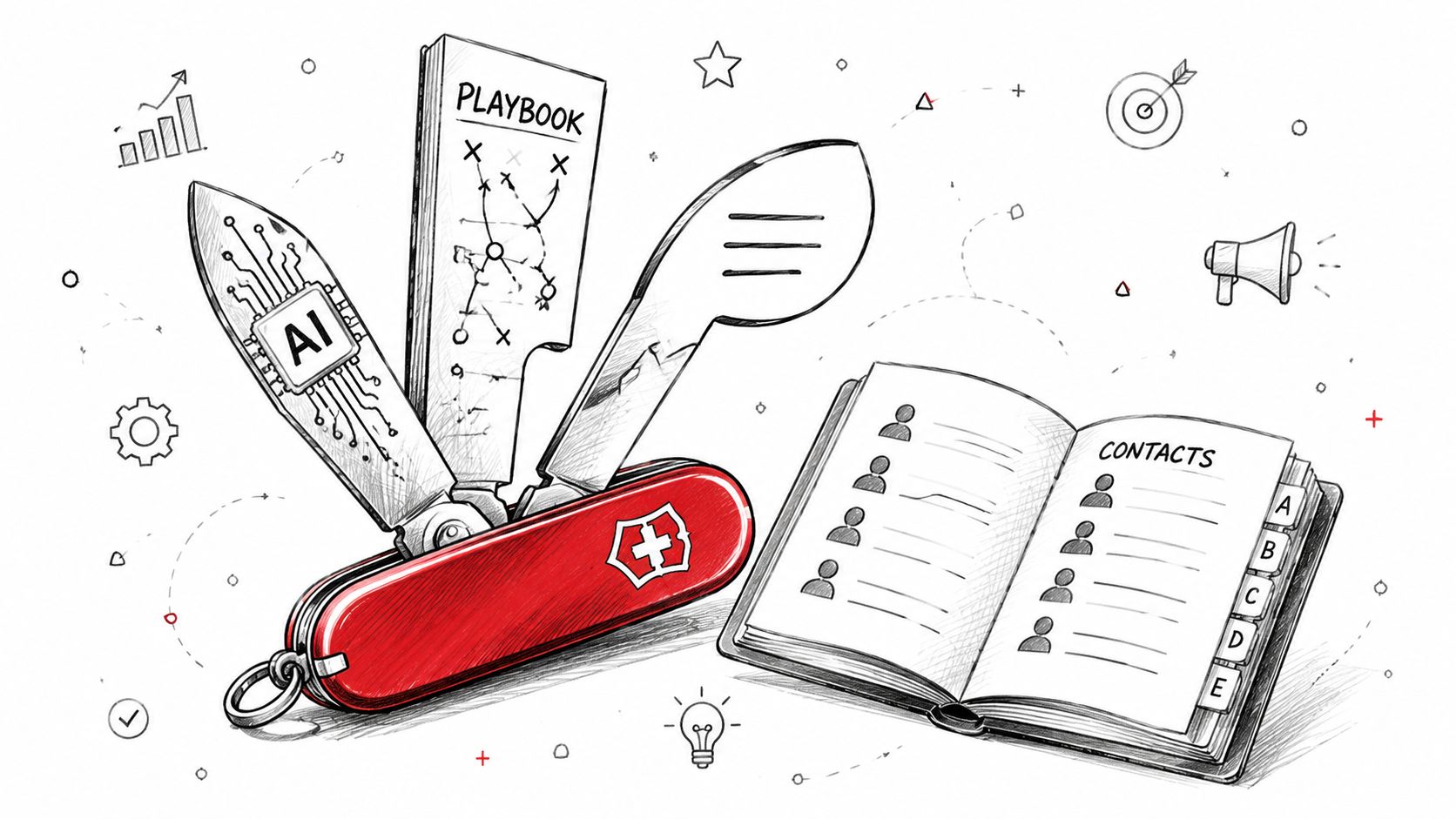
A Swiss army knife with integrated AI, a playbook, and contact book for business sales enablement tools.

The simple analogy

If your CRM is the address book and timeline, a sales enablement platform is the Swiss Army knife your team reaches for in the moment of execution. It combines content, context, training, and guidance in one working layer.

That difference matters because reps don't win deals by having data somewhere in the stack. They win deals by getting the right help at the right moment, without leaving the tools they already use.

The three jobs it should do

A real platform has to do three things well.

Equip the rep

The rep needs the right case study, talk track, proposal language, battlecard, or sequence at the moment it's needed. Not after a Slack message. Not after asking marketing. During the workflow.

The strongest systems also use a unified revenue data fabric, which means commercial data is treated as one connected asset instead of a bunch of loose integrations. That structure lets the platform surface relevant content and training based on deal stage, buyer persona, and account history, as described in this breakdown of modern enablement architecture.

Teach the rep

Enablement isn't only about assets. It's also about readiness. New hires need onboarding paths. Existing reps need coaching, refreshers, and reinforcement when products or markets shift.

A founder often assumes the team knows how to sell because they've heard the pitch before. In practice, most reps need repetition, examples, and easy access to approved messaging.

Optimize the motion

The platform should help leaders see which content gets used, which training gets completed, and which guidance gets ignored. Critically, it should help connect that behavior to what happens in live deals.

If you're sorting out where enablement ends and engagement begins, this comparison of a sales engagement platform vs CRM is useful. Most SMBs don't need abstract categories. They need to know which layer handles workflow, which handles execution, and which one ties the picture together.

The best enablement platforms don't replace sales judgment. They reduce how often reps have to improvise.

Core Features of a Modern Sales Enablement Platform

Most SMBs don't need a giant feature list. They need a platform that strengthens execution in a few places that matter every day. Four pillars separate a real sales enablement platform from a dressed-up content folder.

A hand-drawn sketch featuring four classical pillars, each topped with icons representing research, networking, growth, and intelligence.

Content management and delivery

This is the first test because it's where teams feel pain fastest. Reps need approved content that's current, searchable, and tied to real selling situations.

That priority isn't trivial. The content management and delivery segment is projected to hold an estimated 35.4% share in 2026, highlighting how central approved content storage and guided seller usage have become, according to Future Market Insights.

A good system doesn't just store PDFs. It answers practical questions like:

  • Which deck fits this buyer type

  • Which case study maps to this industry

  • Which one-pager should a rep send after a first demo

  • Which assets are outdated and should disappear from view

For outbound-heavy teams, pairing enablement with prospect research matters too. Tools that support B2B prospecting workflows are useful because good content only helps if reps are aiming it at the right accounts.

Sales training and coaching

Content without coaching creates a false sense of readiness. Reps may have the assets, but they still won't know how to use them in a live conversation.

Training inside an enablement platform should cover onboarding, objection handling, talk tracks, product updates, and manager-led reinforcement. The key is accessibility. If learning sits in a separate system and feels detached from daily selling, reps stop using it.

Strong coaching systems don't ask reps to pause work and enter a classroom. They insert learning into the exact moments where performance slips.

A new hire might review a call framework before a discovery meeting. A manager might assign a short refresher after hearing weak positioning on demos. The point is timing, not volume.

Here's a helpful overview of how these pieces come together in practice:

Buyer engagement and outreach

This pillar gets overlooked because many companies treat enablement and outreach as separate worlds. They shouldn't be separate.

Reps need email snippets, call scripts, follow-up templates, mutual action plans, and buyer-facing content that feels relevant to the account in front of them. Static content libraries can support this, but they often stop short of helping the rep act on live context.

That's why the best platforms either include or connect tightly to outreach systems, CRM records, and account-level signals. The rep shouldn't have to stitch together context from five tabs just to prepare for one meeting.

Analytics and insights

Usage analytics alone aren't enough. Knowing that a deck was opened doesn't tell you whether it helped. Knowing that training was completed doesn't tell you whether the rep improved.

Useful insight answers harder questions:

  • Which assets appear in deals that progress cleanly

  • Where reps struggle in the buyer journey

  • Which messaging gets reused by top performers

  • What managers should coach next

At this point, enablement shifts from library management to operational advantage. Once the platform starts showing patterns in content use, coaching, and buyer engagement, you're no longer guessing how your team sells.

The True ROI Beyond Just Using a Platform

A lot of software gets judged by logins. That's a weak standard for enablement.

If reps log in every day but still waste time hunting for the right material, adoption looks healthy while execution stays messy. If managers celebrate training completion but can't tell whether deals move faster, the platform becomes a reporting tool, not a revenue tool.

The bigger issue is common. 65% of companies struggle to link enablement activities to revenue outcomes because platforms often report content access rather than showing how enablement affects deal velocity or conversion, according to Fortune Business Insights.

What ROI should actually mean

For an SMB, enablement ROI should show up in four places:

  • More selling time: reps spend less time searching, recreating, and asking for help.

  • Better conversion: teams use stronger messaging and better-timed assets more consistently.

  • Shorter cycles: buyers get clearer answers faster, which reduces friction during evaluation.

  • Faster ramp: new hires stop learning through tribal knowledge alone.

Those outcomes are operational before they become financial. A founder usually notices them in the field first. Reps sound more consistent. Follow-up gets sharper. Managers spend less time correcting basics. Fewer deals stall because someone sent the wrong thing.

The metrics that matter more than adoption

A practical dashboard should connect enablement activity to pipeline movement. That means looking at behavior alongside outcomes, not in isolation.

A better measurement model includes questions like these:

  1. Did access improve execution
    Can reps find what they need quickly enough to use it in live selling moments?

  2. Did relevance improve deal quality Are the recommended assets and playbooks appropriate for the account, stage, and buyer role?

  3. Did visibility improve management decisions
    Can managers connect content use, coaching, and process adherence to deal progress?

If you're tightening this measurement layer, these sales rep productivity metrics are the right companion. They help distinguish activity volume from work that drives pipeline.

Usage is a health check. Revenue impact is the diagnosis.

That's the shift SMBs need to make. Don't ask whether people used the platform. Ask whether the platform improved how people sold.

How to Choose the Right Platform for Your SMB

Most SMBs make the same buying mistake. They evaluate a sales enablement platform like they're shopping for enterprise software. The result is bloat, slow implementation, and a tool reps avoid.

A better approach is to pressure-test the platform against your day-to-day reality. Can a rep use it during a live selling motion? Can a manager trust the data? Will it still work when your team grows?

The clearest usability test is simple. The highest-rated tools require a seller to find content in under three clicks, and if it takes more, adoption drops. Native CRM integration also matters because it helps track which content usage correlates with closed deals, as noted by Masset's review of enablement software.

The four checks that matter most

Speed and usability

If the platform feels like extra work, your team won't use it. Search has to be fast. Navigation has to make sense. Reps should be able to pull a case study or battlecard without breaking flow.

CRM integration

This isn't a nice-to-have. If your reps live in Salesforce or HubSpot, the enablement layer has to meet them there. Otherwise, the tool becomes another tab they ignore.

Unified data structure

A lot of tools claim to integrate. That doesn't mean they create one reliable operating picture. You want one source of truth across content, deal context, and rep activity, not a patchwork of syncs that drift over time.

Scalability

The platform should work for two reps today and a larger team later. That doesn't mean buying the biggest suite. It means choosing a system that won't force a rebuild once marketing, sales, and CRM processes become more complex.

SMB Sales Enablement Platform Evaluation Checklist

Criteria

What to Look For

Why It Matters for SMBs

Speed

Reps can find core content in under three clicks

Slow access kills adoption and wastes selling time

CRM integration

Native workflow inside the CRM your team already uses

Reduces context switching and improves tracking

Data architecture

One connected system for content, buyer context, and activity

Prevents new silos from replacing old ones

Scalability

Flexible enough to support more reps, content, and process

Avoids replatforming as the team grows

Governance

Clear ownership, approval, and version control for assets

Keeps reps from sending outdated materials

Coaching support

Onboarding paths, reinforcement, and manager guidance

Helps new hires ramp and keeps veterans aligned

A short vendor demo won't reveal much. Ask them to show a rep finding a case study, preparing for a meeting, and logging the content path back to a deal. If they can't show that clearly, the platform probably isn't ready for a growing SMB.

Putting the Platform to Work Real-World SMB Scenarios

A platform only matters if it changes daily work. Three common scenarios show where enablement pays off.

The new hire

Jane joins as an SDR on Monday. Without a structured platform, she spends her first week asking where the deck lives, which industries matter, and whether the messaging doc in Slack is current.

In a strong system, she gets a guided onboarding path. Her pitch examples, call notes, objection handling, and approved send-after assets are all in one place. She doesn't need to become an archaeologist before she can start prospecting.

The big demo

David has a meeting in twenty minutes with an account that suddenly added a new stakeholder. He needs a competitor battlecard, a case study from the right vertical, and proposal language that won't trigger a long approval cycle.

This is the moment where static libraries fail. Reps don't need “all content.” They need the right content under pressure. Teams that get good at empowering sales reps with content usually treat content as a live sales tool, not a marketing archive.

Good enablement shortens the distance between “I need this” and “I've already sent it.”

The pipeline review

Maria, the sales manager, isn't trying to admire dashboard activity. She wants to know why a cluster of deals keeps slowing down after discovery.

A useful platform lets her see patterns. Maybe one segment lacks the right follow-up material. Maybe newer reps are using weak positioning. Maybe one talk track consistently shows up in better-run opportunities. That makes coaching specific. Instead of telling the team to “tighten the pitch,” she can correct the exact behavior causing drag.

These are ordinary moments. That's why they matter. The value of enablement doesn't show up in a dramatic reveal. It shows up when routine sales work stops feeling improvisational.

The Stamina Advantage A Unified AI-Driven Approach

Most platforms solve one part of the problem. They store content well, or they coach well, or they support outreach well. SMBs usually don't struggle because they lack another feature. They struggle because the work is fragmented across too many systems.

That fragmentation is most obvious in the gap between static content and live account context. A rep opens the library, finds a decent asset, and still has to figure out whether the account has a new executive, a fresh trigger event, or a reason to care right now. The platform helps with storage but not with timing.

That's the gap many teams feel in daily execution. Most platforms fail to connect static content libraries with dynamic account intelligence, while 78% of reps spend over 20 minutes daily searching for or recreating materials. The direction of the category is toward AI-driven buying signals that surface relevant content automatically, according to MarketsandMarkets.

What a unified model changes

A unified revenue platform changes the architecture, not just the interface. Marketing activity, sales engagement, prospect data, and CRM records live in the same operating environment. That means the system can trigger action based on what's happening, not just what's been uploaded.

For an SMB, that leads to practical benefits:

  • Fewer handoffs: marketing, sales, and CRM data stop living in separate silos.

  • Better timing: outreach can reflect current buyer context instead of generic messaging.

  • Cleaner execution: workflows can move leads, tasks, and follow-up steps automatically.

  • Less tool sprawl: the team spends less time syncing systems and more time running pipeline.
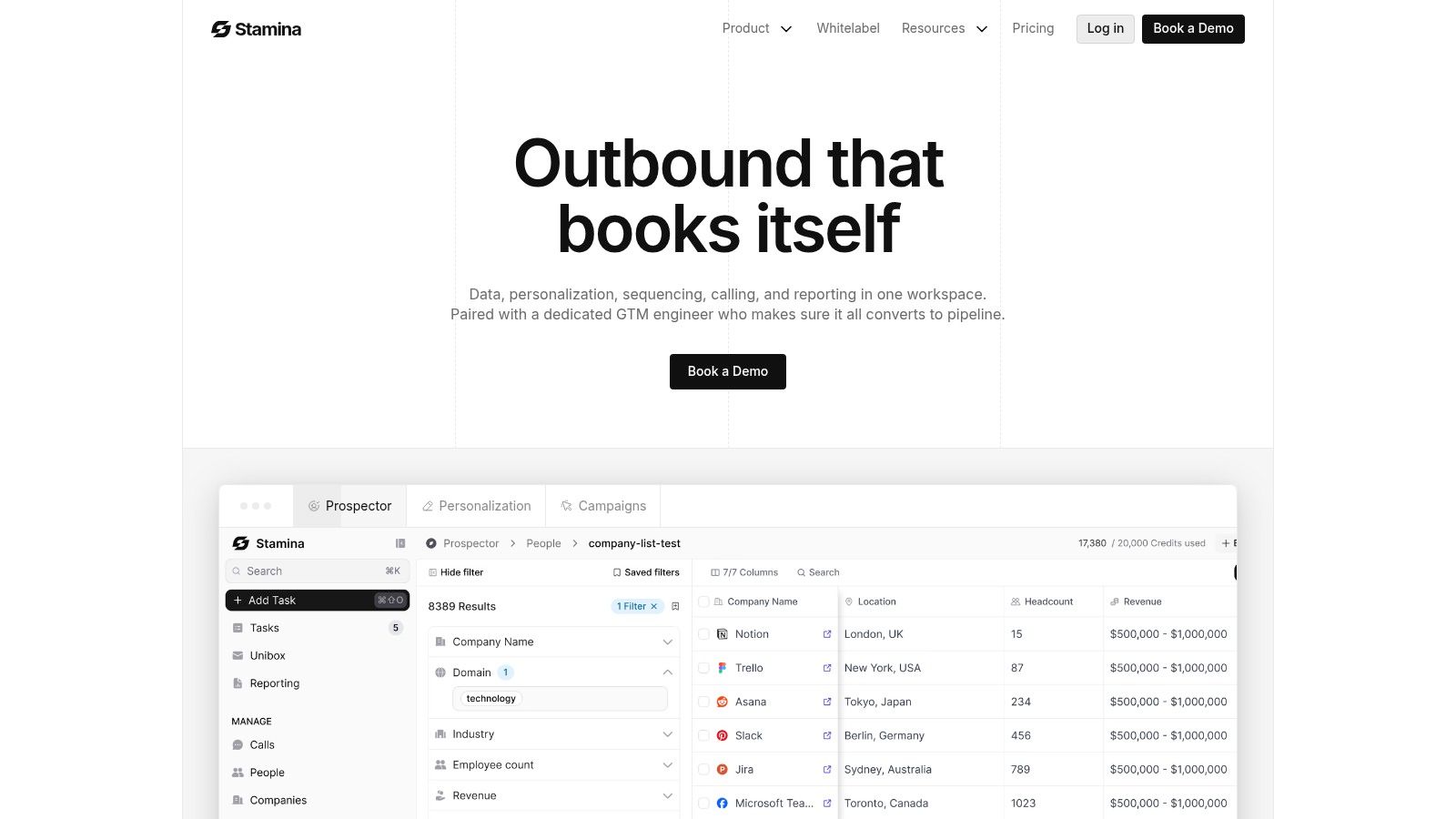
Screenshot from https://stamina.io

Why this matters for growing teams

SMBs don't have the luxury of hiring separate admins for every point tool. They need one environment that supports demand generation, outbound, nurturing, and pipeline management without creating a maintenance project.

That's where Stamina stands out. It isn't positioned as a narrow content repository. It works as a unified revenue and customer platform with shared data across marketing, sales, and CRM. Zara, its built-in AI SDR, helps close the gap between account intelligence and execution by identifying targets, researching them, and generating personalized outreach at scale. Instead of asking reps to manually bridge content, context, and action, the system is built to connect them from the start.

If your current stack makes reps hunt for information, rebuild outreach, and jump between disconnected tools, it's time to simplify. Stamina gives growing SMBs one AI-driven platform for prospecting, outreach, CRM, and cross-team revenue workflows so your team can spend less time stitching systems together and more time closing deals.

Marketing says leads are coming in. Sales says none of them are ready. Reps keep asking for the latest deck, the right case study, the approved pricing slide, or a proposal template that doesn't look like it came from last year's laptop.

That kind of friction usually gets blamed on people. It's rarely a people problem. It's a systems problem.

When a growing SMB doesn't have a usable enablement system, every deal depends on memory, side chats, and whoever happens to know where the good materials live. That works when the founder runs every call. It breaks as soon as you add more reps, more channels, and more products.

Your Sales Team Is Flying Blind Without This System

A sales team can't execute consistently if the basics are scattered. One rep uses a strong one-pager. Another sends an outdated deck. A third writes outreach from scratch because they can't find anything useful. The result is predictable. Messaging drifts, follow-up slows down, and sales spends too much time preparing for conversations instead of having them.

That's where a sales enablement platform earns its place. Think of it as the operating layer between marketing's work and sales conversations. It organizes approved content, guides reps on what to use, and helps managers reinforce what is effective.

For SMBs, this matters more than it does for large enterprises. A small team feels every wasted hour. If two reps are searching for materials, rewriting emails, and rebuilding proposals, that lost time hits pipeline immediately. If you're also refining outbound, these practical cold email outreach techniques help tighten messaging, but the full benefit comes when those techniques are embedded in a system reps can readily use.

What the chaos usually looks like

  • Content lives everywhere: Google Drive, Slack threads, old email attachments, and someone's desktop.

  • Sales and marketing speak different languages: marketing produces assets, but sales can't tell which ones help move deals.

  • Managers coach from anecdotes: pipeline reviews focus on opinions because there's no clean link between materials, behavior, and outcomes.

  • New hires ramp slowly: they learn by asking around instead of following a structured path.

Practical rule: If your reps need to ask where the latest deck is, you don't have enablement. You have document storage.

This category keeps growing because the problem is real. The global sales enablement platform market is projected to reach USD 12.78 billion by 2030, growing at a CAGR of 15.8%, driven by automated content creation and workflow efficiency, according to Grand View Research via PR Newswire.

If you're trying to simplify the stack instead of adding one more point tool, an all-in-one business platform is often the right lens. The goal isn't more software. It's fewer gaps between lead generation, sales execution, and customer data.

What Is a Sales Enablement Platform Really

A CRM tells you who the buyer is, what stage the deal is in, and what activity happened. A sales enablement platform helps the rep decide how to move that deal forward.

That's why a plain cloud drive isn't enough. Google Drive can store files. It can't coach a rep, recommend the right asset for a live opportunity, or show whether a case study helped a deal progress. A CRM can log activity. It usually can't act like a smart library, training hub, and guided playbook at the same time.

A Swiss army knife with integrated AI, a playbook, and contact book for business sales enablement tools.

The simple analogy

If your CRM is the address book and timeline, a sales enablement platform is the Swiss Army knife your team reaches for in the moment of execution. It combines content, context, training, and guidance in one working layer.

That difference matters because reps don't win deals by having data somewhere in the stack. They win deals by getting the right help at the right moment, without leaving the tools they already use.

The three jobs it should do

A real platform has to do three things well.

Equip the rep

The rep needs the right case study, talk track, proposal language, battlecard, or sequence at the moment it's needed. Not after a Slack message. Not after asking marketing. During the workflow.

The strongest systems also use a unified revenue data fabric, which means commercial data is treated as one connected asset instead of a bunch of loose integrations. That structure lets the platform surface relevant content and training based on deal stage, buyer persona, and account history, as described in this breakdown of modern enablement architecture.

Teach the rep

Enablement isn't only about assets. It's also about readiness. New hires need onboarding paths. Existing reps need coaching, refreshers, and reinforcement when products or markets shift.

A founder often assumes the team knows how to sell because they've heard the pitch before. In practice, most reps need repetition, examples, and easy access to approved messaging.

Optimize the motion

The platform should help leaders see which content gets used, which training gets completed, and which guidance gets ignored. Critically, it should help connect that behavior to what happens in live deals.

If you're sorting out where enablement ends and engagement begins, this comparison of a sales engagement platform vs CRM is useful. Most SMBs don't need abstract categories. They need to know which layer handles workflow, which handles execution, and which one ties the picture together.

The best enablement platforms don't replace sales judgment. They reduce how often reps have to improvise.

Core Features of a Modern Sales Enablement Platform

Most SMBs don't need a giant feature list. They need a platform that strengthens execution in a few places that matter every day. Four pillars separate a real sales enablement platform from a dressed-up content folder.

A hand-drawn sketch featuring four classical pillars, each topped with icons representing research, networking, growth, and intelligence.

Content management and delivery

This is the first test because it's where teams feel pain fastest. Reps need approved content that's current, searchable, and tied to real selling situations.

That priority isn't trivial. The content management and delivery segment is projected to hold an estimated 35.4% share in 2026, highlighting how central approved content storage and guided seller usage have become, according to Future Market Insights.

A good system doesn't just store PDFs. It answers practical questions like:

  • Which deck fits this buyer type

  • Which case study maps to this industry

  • Which one-pager should a rep send after a first demo

  • Which assets are outdated and should disappear from view

For outbound-heavy teams, pairing enablement with prospect research matters too. Tools that support B2B prospecting workflows are useful because good content only helps if reps are aiming it at the right accounts.

Sales training and coaching

Content without coaching creates a false sense of readiness. Reps may have the assets, but they still won't know how to use them in a live conversation.

Training inside an enablement platform should cover onboarding, objection handling, talk tracks, product updates, and manager-led reinforcement. The key is accessibility. If learning sits in a separate system and feels detached from daily selling, reps stop using it.

Strong coaching systems don't ask reps to pause work and enter a classroom. They insert learning into the exact moments where performance slips.

A new hire might review a call framework before a discovery meeting. A manager might assign a short refresher after hearing weak positioning on demos. The point is timing, not volume.

Here's a helpful overview of how these pieces come together in practice:

Buyer engagement and outreach

This pillar gets overlooked because many companies treat enablement and outreach as separate worlds. They shouldn't be separate.

Reps need email snippets, call scripts, follow-up templates, mutual action plans, and buyer-facing content that feels relevant to the account in front of them. Static content libraries can support this, but they often stop short of helping the rep act on live context.

That's why the best platforms either include or connect tightly to outreach systems, CRM records, and account-level signals. The rep shouldn't have to stitch together context from five tabs just to prepare for one meeting.

Analytics and insights

Usage analytics alone aren't enough. Knowing that a deck was opened doesn't tell you whether it helped. Knowing that training was completed doesn't tell you whether the rep improved.

Useful insight answers harder questions:

  • Which assets appear in deals that progress cleanly

  • Where reps struggle in the buyer journey

  • Which messaging gets reused by top performers

  • What managers should coach next

At this point, enablement shifts from library management to operational advantage. Once the platform starts showing patterns in content use, coaching, and buyer engagement, you're no longer guessing how your team sells.

The True ROI Beyond Just Using a Platform

A lot of software gets judged by logins. That's a weak standard for enablement.

If reps log in every day but still waste time hunting for the right material, adoption looks healthy while execution stays messy. If managers celebrate training completion but can't tell whether deals move faster, the platform becomes a reporting tool, not a revenue tool.

The bigger issue is common. 65% of companies struggle to link enablement activities to revenue outcomes because platforms often report content access rather than showing how enablement affects deal velocity or conversion, according to Fortune Business Insights.

What ROI should actually mean

For an SMB, enablement ROI should show up in four places:

  • More selling time: reps spend less time searching, recreating, and asking for help.

  • Better conversion: teams use stronger messaging and better-timed assets more consistently.

  • Shorter cycles: buyers get clearer answers faster, which reduces friction during evaluation.

  • Faster ramp: new hires stop learning through tribal knowledge alone.

Those outcomes are operational before they become financial. A founder usually notices them in the field first. Reps sound more consistent. Follow-up gets sharper. Managers spend less time correcting basics. Fewer deals stall because someone sent the wrong thing.

The metrics that matter more than adoption

A practical dashboard should connect enablement activity to pipeline movement. That means looking at behavior alongside outcomes, not in isolation.

A better measurement model includes questions like these:

  1. Did access improve execution
    Can reps find what they need quickly enough to use it in live selling moments?

  2. Did relevance improve deal quality Are the recommended assets and playbooks appropriate for the account, stage, and buyer role?

  3. Did visibility improve management decisions
    Can managers connect content use, coaching, and process adherence to deal progress?

If you're tightening this measurement layer, these sales rep productivity metrics are the right companion. They help distinguish activity volume from work that drives pipeline.

Usage is a health check. Revenue impact is the diagnosis.

That's the shift SMBs need to make. Don't ask whether people used the platform. Ask whether the platform improved how people sold.

How to Choose the Right Platform for Your SMB

Most SMBs make the same buying mistake. They evaluate a sales enablement platform like they're shopping for enterprise software. The result is bloat, slow implementation, and a tool reps avoid.

A better approach is to pressure-test the platform against your day-to-day reality. Can a rep use it during a live selling motion? Can a manager trust the data? Will it still work when your team grows?

The clearest usability test is simple. The highest-rated tools require a seller to find content in under three clicks, and if it takes more, adoption drops. Native CRM integration also matters because it helps track which content usage correlates with closed deals, as noted by Masset's review of enablement software.

The four checks that matter most

Speed and usability

If the platform feels like extra work, your team won't use it. Search has to be fast. Navigation has to make sense. Reps should be able to pull a case study or battlecard without breaking flow.

CRM integration

This isn't a nice-to-have. If your reps live in Salesforce or HubSpot, the enablement layer has to meet them there. Otherwise, the tool becomes another tab they ignore.

Unified data structure

A lot of tools claim to integrate. That doesn't mean they create one reliable operating picture. You want one source of truth across content, deal context, and rep activity, not a patchwork of syncs that drift over time.

Scalability

The platform should work for two reps today and a larger team later. That doesn't mean buying the biggest suite. It means choosing a system that won't force a rebuild once marketing, sales, and CRM processes become more complex.

SMB Sales Enablement Platform Evaluation Checklist

Criteria

What to Look For

Why It Matters for SMBs

Speed

Reps can find core content in under three clicks

Slow access kills adoption and wastes selling time

CRM integration

Native workflow inside the CRM your team already uses

Reduces context switching and improves tracking

Data architecture

One connected system for content, buyer context, and activity

Prevents new silos from replacing old ones

Scalability

Flexible enough to support more reps, content, and process

Avoids replatforming as the team grows

Governance

Clear ownership, approval, and version control for assets

Keeps reps from sending outdated materials

Coaching support

Onboarding paths, reinforcement, and manager guidance

Helps new hires ramp and keeps veterans aligned

A short vendor demo won't reveal much. Ask them to show a rep finding a case study, preparing for a meeting, and logging the content path back to a deal. If they can't show that clearly, the platform probably isn't ready for a growing SMB.

Putting the Platform to Work Real-World SMB Scenarios

A platform only matters if it changes daily work. Three common scenarios show where enablement pays off.

The new hire

Jane joins as an SDR on Monday. Without a structured platform, she spends her first week asking where the deck lives, which industries matter, and whether the messaging doc in Slack is current.

In a strong system, she gets a guided onboarding path. Her pitch examples, call notes, objection handling, and approved send-after assets are all in one place. She doesn't need to become an archaeologist before she can start prospecting.

The big demo

David has a meeting in twenty minutes with an account that suddenly added a new stakeholder. He needs a competitor battlecard, a case study from the right vertical, and proposal language that won't trigger a long approval cycle.

This is the moment where static libraries fail. Reps don't need “all content.” They need the right content under pressure. Teams that get good at empowering sales reps with content usually treat content as a live sales tool, not a marketing archive.

Good enablement shortens the distance between “I need this” and “I've already sent it.”

The pipeline review

Maria, the sales manager, isn't trying to admire dashboard activity. She wants to know why a cluster of deals keeps slowing down after discovery.

A useful platform lets her see patterns. Maybe one segment lacks the right follow-up material. Maybe newer reps are using weak positioning. Maybe one talk track consistently shows up in better-run opportunities. That makes coaching specific. Instead of telling the team to “tighten the pitch,” she can correct the exact behavior causing drag.

These are ordinary moments. That's why they matter. The value of enablement doesn't show up in a dramatic reveal. It shows up when routine sales work stops feeling improvisational.

The Stamina Advantage A Unified AI-Driven Approach

Most platforms solve one part of the problem. They store content well, or they coach well, or they support outreach well. SMBs usually don't struggle because they lack another feature. They struggle because the work is fragmented across too many systems.

That fragmentation is most obvious in the gap between static content and live account context. A rep opens the library, finds a decent asset, and still has to figure out whether the account has a new executive, a fresh trigger event, or a reason to care right now. The platform helps with storage but not with timing.

That's the gap many teams feel in daily execution. Most platforms fail to connect static content libraries with dynamic account intelligence, while 78% of reps spend over 20 minutes daily searching for or recreating materials. The direction of the category is toward AI-driven buying signals that surface relevant content automatically, according to MarketsandMarkets.

What a unified model changes

A unified revenue platform changes the architecture, not just the interface. Marketing activity, sales engagement, prospect data, and CRM records live in the same operating environment. That means the system can trigger action based on what's happening, not just what's been uploaded.

For an SMB, that leads to practical benefits:

  • Fewer handoffs: marketing, sales, and CRM data stop living in separate silos.

  • Better timing: outreach can reflect current buyer context instead of generic messaging.

  • Cleaner execution: workflows can move leads, tasks, and follow-up steps automatically.

  • Less tool sprawl: the team spends less time syncing systems and more time running pipeline.

Screenshot from https://stamina.io

Why this matters for growing teams

SMBs don't have the luxury of hiring separate admins for every point tool. They need one environment that supports demand generation, outbound, nurturing, and pipeline management without creating a maintenance project.

That's where Stamina stands out. It isn't positioned as a narrow content repository. It works as a unified revenue and customer platform with shared data across marketing, sales, and CRM. Zara, its built-in AI SDR, helps close the gap between account intelligence and execution by identifying targets, researching them, and generating personalized outreach at scale. Instead of asking reps to manually bridge content, context, and action, the system is built to connect them from the start.

If your current stack makes reps hunt for information, rebuild outreach, and jump between disconnected tools, it's time to simplify. Stamina gives growing SMBs one AI-driven platform for prospecting, outreach, CRM, and cross-team revenue workflows so your team can spend less time stitching systems together and more time closing deals.

Share this article

Share this article

Send a shareable link to your team or anyone who might find it useful.

Send a shareable link to your team or anyone who might find it useful.

Copy link

Copied

Share directly to

Table of contents

Give Your Business the Stamina it needs to Thrive

PRODUCT

COMPANY

RESOURCES

© 2026 Stamina Software Technologies Inc. All rights reserved.

PRODUCT

COMPANY

RESOURCES

© 2026 Stamina Software Technologies Inc. All rights reserved.

PRODUCT

COMPANY

RESOURCES

© 2026 Stamina Software Technologies Inc. All rights reserved.