
Your reps are active all day. The CRM is full of logged calls, emails, tasks, and follow-ups. Slack is busy. Calendars are packed.
But the board still asks the same question. If the team is working this hard, why isn't revenue moving the way it should?
That gap is where most SMB sales teams get stuck. They track a lot, but they don't measure the right things in the right sequence. Worse, they often treat reporting as the finish line instead of the starting point. Good sales rep productivity metrics don't just describe what happened. They show where effort is leaking, where coaching belongs, and which workflows should fire automatically before pipeline problems become forecast problems.
Why More Activity Is Not the Answer
A rep can make 100 calls and create no pipeline. Another can make 20 targeted calls, reach the right buyers, ask sharp qualification questions, and book meetings that advance. Counting both reps as equally productive because they were both "busy" is how teams burn out without improving output.
That's why activity by itself is a weak management system. It tells you motion happened. It doesn't tell you whether the motion was useful.
Busy work hides the real problem
A lot of SMB teams still respond to missed targets with a simple instruction: make more calls, send more emails, add more meetings. That can create a short burst of urgency, but it usually masks a deeper issue in targeting, qualification, messaging, or process discipline.
The bigger problem is that many reps don't even get enough time to sell. CSO Insights research found reps spend, on average, just 34% of their time on direct revenue-generating activities, while the other 66% goes to admin work, meetings, and data entry, as summarized in Everstage's breakdown of sales productivity statistics. If you're pushing for more activity inside a system that already wastes selling time, you're often just scaling inefficiency.
Practical rule: If a rep's calendar is full and results are flat, don't ask for more effort first. Ask where the time is going and what that effort is producing.
What managers should look for instead
The useful question isn't "Are reps active?" It's "Which activities consistently create movement?"
That shifts the conversation from volume to signal. For most SMB teams, that means separating metrics into a chain:
Top-of-funnel effort: Calls, emails, first touches, follow-up speed
Mid-funnel progress: Meetings held, opportunities created, stage movement
Bottom-funnel quality: Win rate, cycle health, forecast reliability
Time allocation: How much of the week goes to selling versus everything else
Teams that tighten this chain usually find obvious waste. Reps log duplicate notes. Managers ask for reports that the CRM should generate automatically. Handoffs create rework. Qualification rules change from one deal review to the next. That's where process cleanup matters more than adding another KPI, and that's also why sales process optimization usually produces better productivity gains than another push for brute-force outreach.
The Four Pillars of Sales Productivity Metrics
The cleanest way to evaluate sales rep productivity metrics is to stop treating them as one long list. Use four pillars instead. That gives managers a way to diagnose problems without jumping to the wrong fix.
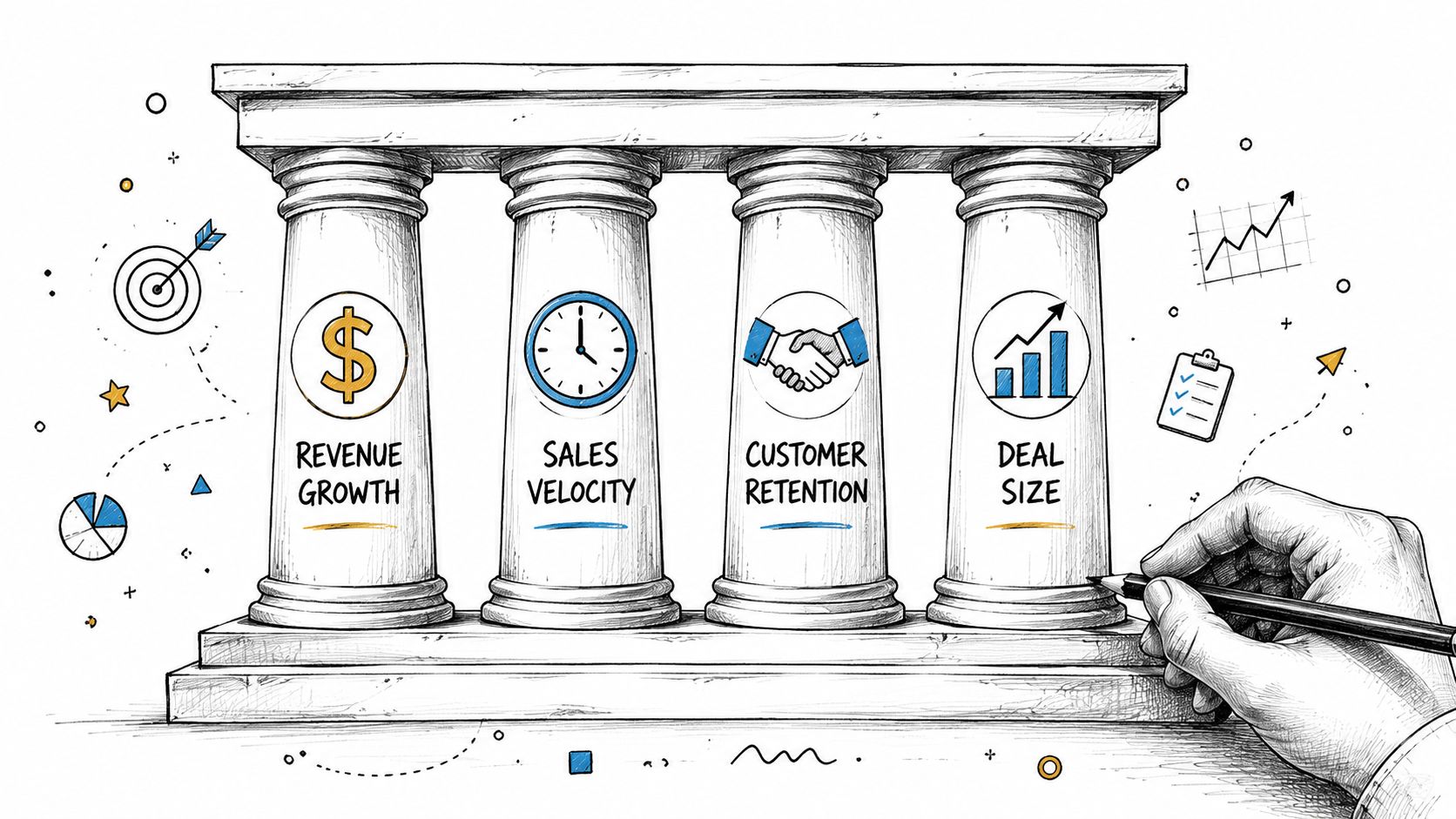
Consider the analogy of coaching an athlete. You don't only count how many workouts they completed. You also care about pace, technique, and whether those sessions led to actual results.
Activity metrics
These measure what the rep did. Calls made, emails sent, meetings booked, follow-ups completed, opportunities touched.
They matter because low output often starts with low effort or inconsistent coverage. But activity metrics are only useful when paired with a quality or conversion metric. Otherwise, they become vanity dashboards.
Efficiency metrics
These show how much effort was required to produce progress. Examples include activities per opportunity, meetings per opportunity created, or time spent on manual admin versus selling.
Efficiency metrics usually expose friction in the system, not laziness in the rep. If a seller needs too many touches to get basic movement, the issue may be weak targeting, scattered tools, bad routing, or pipeline clutter. This is also where a clearly defined sales pipeline stages model becomes essential. If stages are fuzzy, efficiency data becomes noise.
Effectiveness metrics
These answer how well the rep converts effort into advancement. Win rate, stage-to-stage conversion, qualification quality, forecast accuracy, and meeting-to-opportunity conversion sit here.
This is the pillar I trust most when a team is active but underperforming. Activity tells you reps are working. Effectiveness tells you whether they know how to win.
A rep with lower activity and stronger conversion is often healthier than a rep with huge volume and weak progression.
Outcome metrics
These show whether the business got the result it needed. Closed revenue, quota attainment, pipeline contribution, average cycle health, and closed-won volume all live here.
Outcome metrics are lagging by nature. They matter, but they're the worst place to start coaching because by the time they move, the root cause is already old. Use them to judge the score. Use the other three pillars to change it.
A practical framework looks like this:
Pillar | Core question | What it reveals |
|---|---|---|
Activity | Did the rep do enough? | Coverage and consistency |
Efficiency | Did the process waste effort? | Friction and tool/process drag |
Effectiveness | Did the effort convert? | Selling skill and deal quality |
Outcome | Did revenue move? | Business impact |
Managers don't need more metrics. They need a model that shows which kind of metric answers which kind of problem.
Essential Metrics with Formulas and SMB Benchmarks
Sales organizations don't fail because they track nothing. They fail because they track too much, mix leading and lagging indicators, and set targets with no useful baseline. A small, disciplined scorecard works better.
Long-running CSO Insights benchmarks show that only about 55 to 60% of B2B sales reps consistently hit annual quota, and average win rates often sit around 25 to 30%, as summarized by Enboarder's guide to sales rep productivity metrics. Those aren't perfect benchmarks for every company, but they do help SMB leaders judge whether the problem is too little pipeline, weak conversion, or both.
The short list that actually matters
Use this table as a starting point. The formulas are simple enough to calculate in any CRM, and the benchmark column only includes ranges supported by the verified data.
Category | Metric | Formula | SMB Benchmark |
|---|---|---|---|
Outcome | Quota Attainment | (Actual Revenue / Quota) x 100 | About 55 to 60% of reps in typical B2B orgs achieve annual quota consistently |
Effectiveness | Win Rate | (Closed-Won Opportunities / Total Opportunities) x 100 | About 25 to 30% in many B2B segments |
Activity | Opportunities Created per Rep | Total New Opportunities / Number of Reps | Track trend internally |
Efficiency | Activities per Opportunity | Total Sales Activities / Active Opportunities | Track by segment and role |
Effectiveness | Meeting-to-Opportunity Conversion | (Qualified Opportunities / Meetings Held) x 100 | Track trend internally |
Outcome | Revenue per Rep | Total Closed Revenue / Number of Reps | Track by tenure and territory |
Efficiency | Sales Cycle Length | Close Date - Opportunity Creation Date | Track trend internally |
Effectiveness | Stage Conversion Rate | (Deals Entering Next Stage / Deals in Prior Stage) x 100 | Track by stage |
Efficiency | Selling Time Ratio | Selling Time / Total Work Time | Compare with internal baseline |
Outcome | Pipeline Coverage | Open Pipeline / Quota | Track against your own sales model |
How to read the table correctly
Don't use all of these as equal-weight dashboard tiles. Group them.
For frontline coaching: Focus on win rate, stage conversion, meeting-to-opportunity conversion, and activities per opportunity.
For manager inspection: Add selling time ratio, cycle length, and pipeline coverage.
For executive review: Keep quota attainment, revenue per rep, and forecasted pipeline sufficiency.
A good metric should lead to a decision. If it doesn't change coaching, territory design, lead routing, or process design, it probably doesn't belong in your weekly review.
A note on operational metrics
If your team runs a phone-heavy motion, operational metrics matter too. Support and inside sales teams often borrow lessons from contact center operations, especially around call handling discipline. For teams trying to reduce wasted talk time without sacrificing quality, this resource on optimizing call center AHT is useful because it shows how handle-time thinking can improve workflow design when used carefully.
The trap is overcorrecting. A lower handle time isn't always better in sales. If reps rush discovery just to look efficient, conversion drops later. That's why I prefer pairing operational metrics with qualification and conversion metrics, then using lead scoring automation to help reps focus on buyers with a realistic chance of moving.
How to Collect and Visualize Performance Data
Most productivity reporting breaks long before the coaching conversation starts. The data is incomplete, stale, or inconsistent across tools. One rep logs calls manually, another batch-updates notes on Friday, and a manager exports three different reports into a spreadsheet to build a forecast they still don't trust.
That's not a measurement issue. It's a systems issue.
Manual tracking creates lag and argument
Spreadsheets feel flexible at first. Then they start producing familiar problems:
Different definitions: One manager counts a recycled deal as new pipeline, another doesn't.
Missing activity: Reps forget to log calls, emails, and next steps.
Late updates: Forecast reviews happen before the CRM reflects reality.
Shadow reporting: Teams build side spreadsheets because no one trusts the main dashboard.
The result is predictable. Managers spend review time debating data quality instead of coaching.
A strong system does three things automatically. It captures activity where work happens, standardizes key definitions, and visualizes exceptions fast enough for someone to act this week, not next month.
Forecast accuracy is where bad systems get exposed
This is one of the clearest reasons unified reporting matters. Teams whose reps maintain forecast accuracy within plus or minus 10 to 15% of actuals tend to have 20 to 25% better quota attainment, according to Revenue Grid's analysis of sales productivity metrics. You don't get that by asking reps to "keep the CRM updated." You get it with disciplined stage rules, probability logic, and regular deal review habits enforced by the system.
Forecast accuracy isn't a finance metric. It's a sales execution metric.
That same discipline improves coaching. If a rep repeatedly commits deals with no documented buyer next step, no confirmed timeline, and fuzzy qualification notes, the manager can address that behavior early.
For leaders comparing systems and dashboard approaches, DialNexa Labs on sales applications is a helpful reference because it frames how sales tracking tools should support both visibility and follow-through, not just activity capture.
What a useful dashboard should show
A usable dashboard doesn't try to display everything. It surfaces the few signals that drive action:
Rep-level trends: Activity, meetings, opportunities created, conversion, and forecast variance
Pipeline hygiene: Aging deals, stalled stages, missing next steps, low-confidence commits
Manager exceptions: Reps below baseline, sudden conversion drops, overloaded territories
Cross-team context: Marketing-sourced engagement, sales follow-up status, and handoff quality
A short video can also help teams align on what good visibility looks like in practice.
If leaders still need ad hoc exports every week to answer basic performance questions, the reporting layer isn't finished. That's usually the point where teams need a better definition of ad hoc reporting, and when to replace it with persistent operational dashboards.
Building Workflows That Drive Proactive Improvement
Dashboards don't improve performance. Actions do.
The leap happens when sales rep productivity metrics stop living in a report and start triggering workflows. That changes the manager's job from reviewing history to intervening while the quarter is still recoverable.

Build triggers around exceptions
What "bad" looks like is already known. It's just noticed too late. A better approach is to define simple workflow triggers tied to meaningful exceptions.
For example:
Low activity on active pipeline: Alert the manager when a rep owns open opportunities with no recent logged movement.
Stage stagnation: Trigger a pipeline review when deals sit too long in one stage without a documented next step.
Weak conversion pattern: Flag reps whose meeting volume is healthy but qualified opportunity creation stays soft.
Forecast drift: Notify leadership when commit deals lose buyer signals or probability inputs change suddenly.
These workflows don't need to be fancy. They need to be reliable. The best ones route the issue to the right person, include context, and create a next action automatically.
Move beyond rep-only attribution
This gets more important as SMB go-to-market motions become more connected. Traditional rep-level metrics assume the seller did most of the work that caused the deal to happen. That assumption is getting weaker.
Outfunnel notes that 60 to 70% of the buyer's journey now happens digitally before a rep gets involved, which is why their analysis of sales productivity argues that rep-centric measurement is incomplete. When a buyer arrives warm from nurture campaigns, website behavior, prior brand exposure, and account-based touches, a closed deal shouldn't be interpreted as pure rep output.
Treating every win as a rep-only win leads to bad coaching and bad resource allocation.
A practical workflow system should account for influence, not just ownership. If marketing engagement is high and sales conversion is low, coaching belongs in follow-up quality or qualification. If marketing engagement is low and sales activity is high, the issue may be upstream. That kind of cross-functional visibility is what turns metrics into operating decisions.
Three Playbooks to Improve Rep Productivity
When productivity slips, most managers either overreact or stay vague. Neither helps. The right move is to use a repeatable playbook tied to a specific pattern in the data.
Low activity and weak pipeline creation
A newer rep often shows this pattern first. Their dashboard doesn't look catastrophic. It just looks thin. Too few touches, too few follow-ups, and not enough new opportunities entering the pipe.
The diagnosis starts with work habits, not motivation. Is the rep losing time to admin? Are they bouncing between tools? Are they researching accounts too long before taking action?
Try this playbook:
Trigger: Activity trend falls below team baseline and opportunity creation stays light
Manager questions: Where is the rep spending time each day? Which accounts are they targeting? How many touches happen before they stop?
Actions: Tighten daily blocks for prospecting, reduce manual prep work, standardize sequences, and review list quality before pushing for more volume
This is also where AI-assisted outbound can help. If a rep is spending too much time drafting one-off emails and researching obvious fit signals manually, workflow automation and AI SDR support can restore selling time.
Healthy activity but low conversion
This is the classic false positive. On paper, the rep looks busy. In reality, they aren't moving buyers forward.
The common causes are weak discovery, poor qualification, generic messaging, or talking too early about the product before earning the right context. Managers often misread this as a top-of-funnel problem and ask for more calls. That usually makes things worse.
Use this playbook instead:
Trigger: Meetings are happening, but qualified opportunities or progression rates remain weak
Manager questions: Are buyers naming a real problem? Is there a clear next step? Did the rep confirm business pain, urgency, and decision process?
Actions: Review call recordings, coach discovery structure, tighten qualification rules, and rewrite early-stage messaging to speak to buyer problems instead of features
A rep in this scenario doesn't need more pressure. They need sharper execution.
Good pipeline but long sales cycles
Some reps can create demand but struggle to close. Their deals drag. Close dates move. Forecast confidence erodes.
That usually points to deal management discipline. The rep may be polite, responsive, and liked by buyers, but they're not controlling momentum. They leave meetings without firm next steps, let stakeholders stay vague, or allow evaluation cycles to drift.
Run this playbook:
Trigger: Deals enter pipeline, but stage aging grows and close dates keep slipping
Manager questions: Does every active deal have a named next step? Is the buyer process documented? Has the rep identified the blocker or are they just waiting?
Actions: Require mutual action plans, inspect stage exit criteria, coach deal control, and force cleanup of stale opportunities
The fastest way to improve a long cycle isn't pushing harder at the end. It's tightening deal commitments earlier.
These three patterns cover a lot of underperformance in SMB sales teams. The point isn't to memorize more metrics. It's to connect the metric pattern to a standard coaching response.
From Tracking Metrics to Building a Productivity Engine
The best sales teams don't treat metrics as surveillance. They treat them as operating inputs.
That's the shift that matters. Not more dashboards. Not more fields in the CRM. A system where activity, efficiency, effectiveness, and outcomes connect cleanly enough that leaders can diagnose issues early, automate the first response, and coach with evidence instead of instinct.
For SMBs, that matters even more because headcount is tighter and margin for process waste is smaller. A single rep losing time to bad routing, weak qualification, or stale pipeline hygiene has an outsized impact on the whole number. That's why sales rep productivity metrics should support action at three levels: rep coaching, manager inspection, and cross-functional process improvement.
If you want more examples of how teams turn sales insights into repeatable communication and coaching habits, the PitchSmart blog has useful sales messaging and enablement material worth browsing alongside your performance reviews.
The teams that improve fastest usually do four things well:
They keep the scorecard small
They trust the data source
They define workflow triggers in advance
They coach patterns, not anecdotes
When those pieces lock together, productivity stops being a reporting topic and becomes a revenue engine.
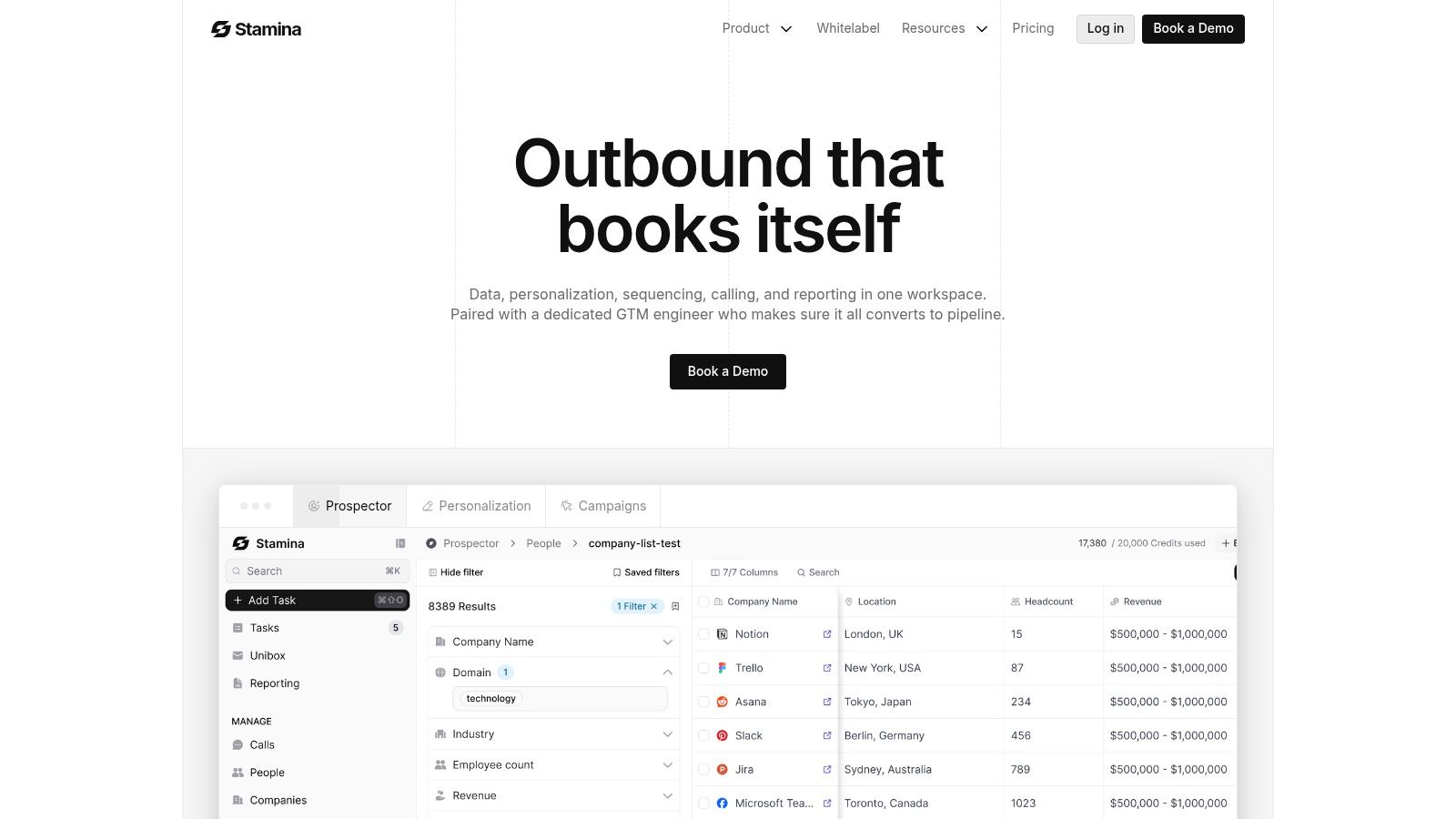
If you're ready to replace disconnected tools, manual reporting, and reactive coaching with one connected system, take a look at Stamina. It brings marketing, sales, and CRM data into a single source of truth, then helps teams automate outreach, nurture, pipeline visibility, and cross-team workflows so productivity metrics lead to action instead of more spreadsheet work.

