Your sales rep says the leads are weak. Marketing says the pipeline is full. The CRM says there are plenty of names to call. Nobody feels confident about which leads deserve attention first.
That's the moment most SMBs start looking at lead scoring automation.
Usually, the problem isn't lead volume alone. It's that qualification lives in too many places. Website activity sits in one tool. Email engagement sits in another. Sales notes live in the CRM. Someone exports a spreadsheet, adds a few filters, and calls it prioritization. Good leads wait too long. Weak leads get chased too hard. Sales stops trusting marketing handoffs.
A usable lead scoring system fixes that, but only if you build it in the right order. Start with a simple model your team can understand. Prove that the thresholds match real conversion behavior. Then, once your data is clean and centralized, move into AI-driven scoring that adapts faster than a static point sheet ever will.
Why Lead Scoring Automation Is a Game Changer for SMBs
A familiar SMB scenario looks like this. A founder or sales manager opens the CRM on Monday and sees new demo requests, ebook downloads, webinar signups, contact form fills, and a pile of older leads that never got worked properly. Everything looks urgent, so nothing gets handled with enough precision.
Manual qualification breaks down fast in that environment.
Reps start using shortcuts. They chase the loudest lead, the most recent lead, or the account with the biggest logo. Marketing keeps sending more names because volume is easy to report. The result is a cluttered funnel where sales-ready buyers get mixed in with students, job seekers, competitors, and curious browsers.
What changes when scoring becomes automatic
Lead scoring automation creates a shared operating system for sales and marketing. Instead of debating each lead one by one, the team agrees on what matters, then lets the system rank leads based on fit and behavior.
That changes three things immediately:
Sales gets focus: Reps spend more time on leads that resemble customers.
Marketing gets cleaner feedback: Campaigns can be judged by lead quality, not just form fills.
Handoffs get faster: When a lead crosses a clear threshold, someone acts.
A 2026 roundup citing a Forrester study reported that companies using next-generation predictive lead scoring saw conversion rates rise by 75%, with an additional 18 percentage-point lift for AI-native scoring platforms (predictive lead scoring statistics). That's why this stopped being a nice reporting feature and became a practical revenue operations tool.
If you want a useful primer before building your own framework, this overview on how to optimize sales with lead scoring strategies is a solid starting point.
Practical rule: If sales says “all inbound looks the same,” you don't have a lead volume problem. You have a prioritization problem.
Why SMBs benefit faster than large teams
Enterprise teams can hide bad qualification behind headcount. SMBs can't.
When you have a lean sales team, every weak handoff has a direct cost. A rep spending time on poor-fit leads isn't just inefficient. That rep is unavailable when a strong lead shows intent. Smaller teams also feel the damage from slow follow-up much more quickly because there usually isn't a dedicated ops layer catching mistakes in the background.
That's where a connected engagement system matters. A useful reference point is this explanation of what a customer engagement platform centralizes, because lead scoring only works well when the score reflects the full lead history, not isolated events.
The win isn't “having scores” in the CRM. It's creating a queue the team trusts enough to follow.
Defining Your Ideal Customer and Key Scoring Signals
Most first-time scoring models fail before the first point gets assigned. The team starts by asking, “What actions should be worth more?” when the better question is, “Who are we trying to sell to?”
If your ideal customer profile is fuzzy, your lead scoring automation will reward activity instead of buying likelihood.

Start with fit before intent
A strong scoring model separates fit from intent.
Fit answers whether this person or account matches the type of customer you can serve well. Intent answers whether they're showing signs of active evaluation. You need both. A perfect-fit prospect with no buying activity may need nurture. A high-activity lead with poor fit may waste sales time.
Use this simple lens:
Signal type | What it tells you | Typical examples |
|---|---|---|
Demographic | Who the person is | Job title, seniority, function |
Firmographic | What company they work for | Industry, company size, business model |
Behavioral | What they've done | Pricing page views, form fills, reply activity |
The signals that usually matter first
For SMBs, the most reliable early inputs tend to come from three places.
Demographic signals: A Head of Sales, RevOps Manager, Founder, or Marketing Director usually matters more than a generic contact with no role context.
Firmographic signals: Company type often tells you more than surface engagement. A lead from your target segment is usually worth more than a highly active visitor from a market you don't serve.
Behavioral signals: Actions close to purchase deserve more attention than passive content consumption. A pricing page view and a demo request are not equal to a blog visit.
Teams often need a more disciplined qualification habit. If you want a complementary framework for that process, these effective lead qualification strategies help sharpen the difference between raw interest and genuine pipeline potential.
Separate fit and engagement in your data model. If you blend them too early, you can't tell whether a high score means “great account” or “busy clicker.”
Don't let noisy activity dominate the model
A common mistake is overvaluing easy-to-capture engagement. Opens, casual page visits, and superficial clicks can make a lead look hotter than they really are, especially in an AI-assisted buying journey where people gather information quickly and inconsistently.
That's why many teams benefit from tracking fit and engagement as distinct fields rather than forcing everything into one number. You can still create a combined operational score later, but keeping the components separate makes it much easier to debug.
A useful supporting concept appears in this guide to marketing qualified leads, especially if your team still treats every conversion event as an MQL.
Build the ICP from customers, not aspirations
Don't build your first model around the customers you wish you had. Build it around the customers that close, stay, and expand.
Use a short working session and answer these questions:
Which roles consistently show up in closed-won deals
Which company types move through the funnel cleanly
Which behaviors appear before real sales conversations
Which signals should reduce confidence
That last point matters. Negative scoring is often more useful than teams expect. A personal email address for a B2B sale, stale activity, irrelevant geography, or unsubscribes can all stop weak leads from floating to the top.
Good lead scoring automation isn't about adding more signals. It's about choosing the few that reliably separate buyers from noise.
Building Your Scoring Model from Rules to AI
The best first model is not the smartest one. It's the one sales will use.
Most SMBs should begin with a rule-based model because it's transparent. Everyone can see why a lead got a score. If a rep disagrees, you can inspect the logic and change it. That's much harder when the team jumps into AI before the basics are stable.
A simple rule-based model you can launch quickly
Start with a small set of fit and behavior rules. Keep it readable. If your scoring sheet looks like tax code, nobody will trust it.
Here's a practical starter template.
Category | Attribute / Action | Points |
|---|---|---|
Demographic | Decision-maker or department head | High positive score |
Demographic | Individual contributor in target function | Moderate positive score |
Firmographic | Company matches target segment | High positive score |
Firmographic | Company is outside target market | Negative score |
Behavioral | Demo request or contact-us submission | High positive score |
Behavioral | Pricing page visit | Moderate to high positive score |
Behavioral | Repeat visits to product-focused pages | Moderate positive score |
Behavioral | Top-of-funnel blog visit only | Low positive score |
Behavioral | No recent activity or stale engagement | Negative score |
Behavioral | Unsubscribe or obvious disqualifier | Strong negative score |
That's enough to start. You don't need dozens of attributes in version one.
Set the first threshold with real closed-won data
The hardest part is rarely the point system. It's the threshold.
A practical starting point is to use the average score of leads that eventually became customers. One operational guide also notes that if your MQL-to-opportunity conversion rate falls below 15 to 20 percent, the threshold is probably too low and needs adjustment (how to build a lead scoring model that actually works).
That guidance matters because sales trust comes from outcome alignment, not math elegance.
If the threshold sends too many weak leads to sales, reps stop believing the score. Once that happens, the model is technically live and operationally dead.
What rule-based scoring does well
Rule-based systems are useful when:
Your data is still uneven: You can manually control what counts.
Sales needs explainability: Reps can see why a lead surfaced.
Your volume is manageable: You don't need heavy pattern detection yet.
They struggle when buyer behavior shifts, product lines diversify, or lead sources behave differently over time. Static weights age badly. What looked predictive last quarter can become noise.
When AI becomes the better next step
Once you have consistent lead capture, cleaner CRM data, and enough conversion history, AI scoring starts to make sense. Not because it's fashionable, but because it can spot combinations humans usually miss.
A useful way to think about the transition is this:
Model type | Best use case | Main weakness |
|---|---|---|
Rule-based | First rollout, clear team alignment | Gets stale and needs manual updates |
Hybrid | Teams with defined rules plus conversion history | Can become messy if logic overlaps |
AI-driven | Higher volume, enough historical outcomes, changing patterns | Harder to trust if data quality is weak |
AI works best as a refinement layer, not a replacement for judgment. It analyzes historical conversions, identifies which combinations of demographic, firmographic, and behavioral signals correlate with revenue, and adjusts weighting over time. That's useful when one behavior means very different things depending on account type, buying stage, or source.
For a practical look at how AI supports qualification and prioritization, this guide on using AI for lead generation is worth reviewing.
The safest migration path
Don't rip out your rules the day you switch on AI.
Run the AI model beside the rule-based one for a pilot period. Compare the leads each model prioritizes. Ask sales which ones feel more credible. Look at whether high-scoring AI leads move faster through the funnel. If they do, let AI influence the score more heavily. If not, fix the data before blaming the model.
That's the practical path for SMBs. Start with visible rules. Validate the threshold. Then let AI improve a system that already has operational discipline.
Unifying Your Data for Accurate Scoring
A lead score is only as reliable as the lead record behind it.
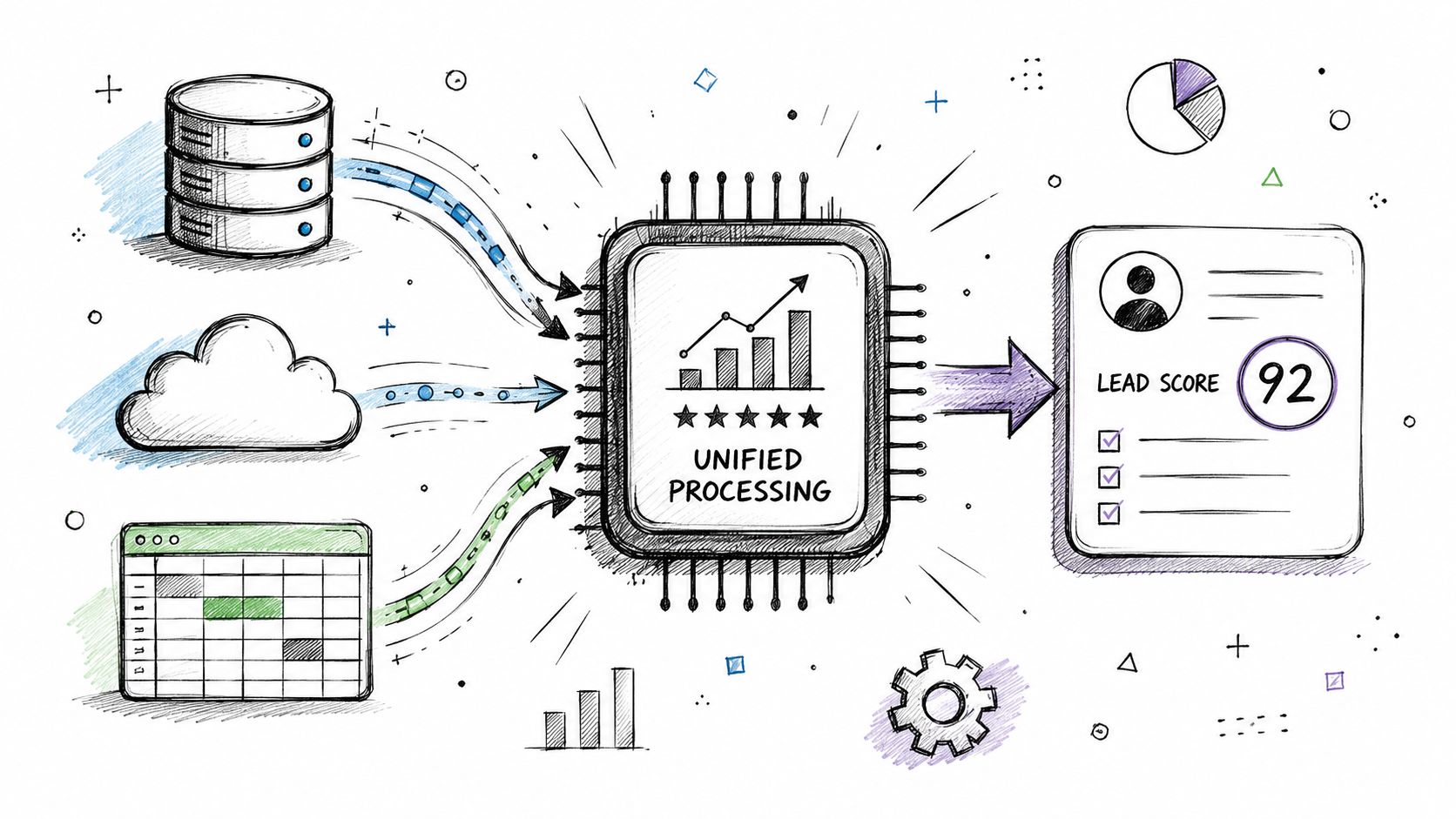
That sounds obvious, but most scoring problems are data problems wearing a strategy costume. Teams think the model is wrong when the bigger issue is that the model never saw the full picture. Website activity sits in analytics. Email behavior lives in the marketing tool. Sales calls are logged inconsistently. Some records are duplicated. Others are missing job titles, company names, or lifecycle status.
Why fragmented tools produce bad scores
When systems don't talk properly, the score becomes biased toward whichever platform captures the most visible activity.
That usually means inflated engagement scoring. A lead may look “hot” because they clicked several emails, while the CRM is missing the fact that they're outside your target segment. Or the opposite happens. A perfect-fit account gets buried because valuable website behavior never made it into the record sales sees.
The biggest failure mode in lead scoring is poor data quality. Duplicate, incomplete, or stale CRM records degrade model accuracy and cause mis-scored leads, even with a strong model in place (AI lead scoring and CRM data quality).
What a single source of truth actually changes
Unification isn't an abstract ops goal. It directly affects how scores behave in production.
When marketing, sales, and CRM data are connected, you can do things that fragmented stacks handle poorly:
Track full lead history: The score reflects both fit and recent behavior.
Update in near real time: A meaningful event can change routing quickly.
Reduce duplicate logic: You don't have separate definitions in separate tools.
Audit outcomes cleanly: You can compare score bands against actual conversion.
A connected system also makes governance easier. You can standardize field definitions, suppress obvious junk records, and make sure lifecycle stages mean the same thing across teams.
The model doesn't need every possible signal. It needs a clean version of the signals that matter.
Where SMBs usually get stuck
SMBs rarely fail here because they don't care about data. They fail because the stack grew in layers.
The founder picked a CRM. Marketing added an email tool. Sales added sequencing software. Someone connected forms through a middleware tool. Reporting ended up in a spreadsheet. Every new tool solved a local problem while making scoring harder at the system level.
That's why integration work matters more than scoring theory in the early phase. If your contact records don't stay consistent across systems, the score can't become a trusted operating signal.
If you're dealing with disconnected systems now, this breakdown of marketing automation and CRM integration is a practical reference for what needs to be unified before more advanced automation becomes dependable.
What to clean before you tune the model
Before you adjust weights or turn on AI, fix these basics:
Deduplicate contact and company records
Standardize core fields like job title, company, source, and lifecycle stage
Remove or quarantine stale records that distort behavior history
Make sure key activity events sync into the CRM record
Confirm that sales disposition data is being captured consistently
Teams often want smarter scoring when what they really need is cleaner input. Once the underlying data is unified, both rule-based and AI-driven scoring become dramatically easier to trust.
Creating Automated Workflows That Drive Action
A score by itself doesn't create revenue. It just labels urgency.
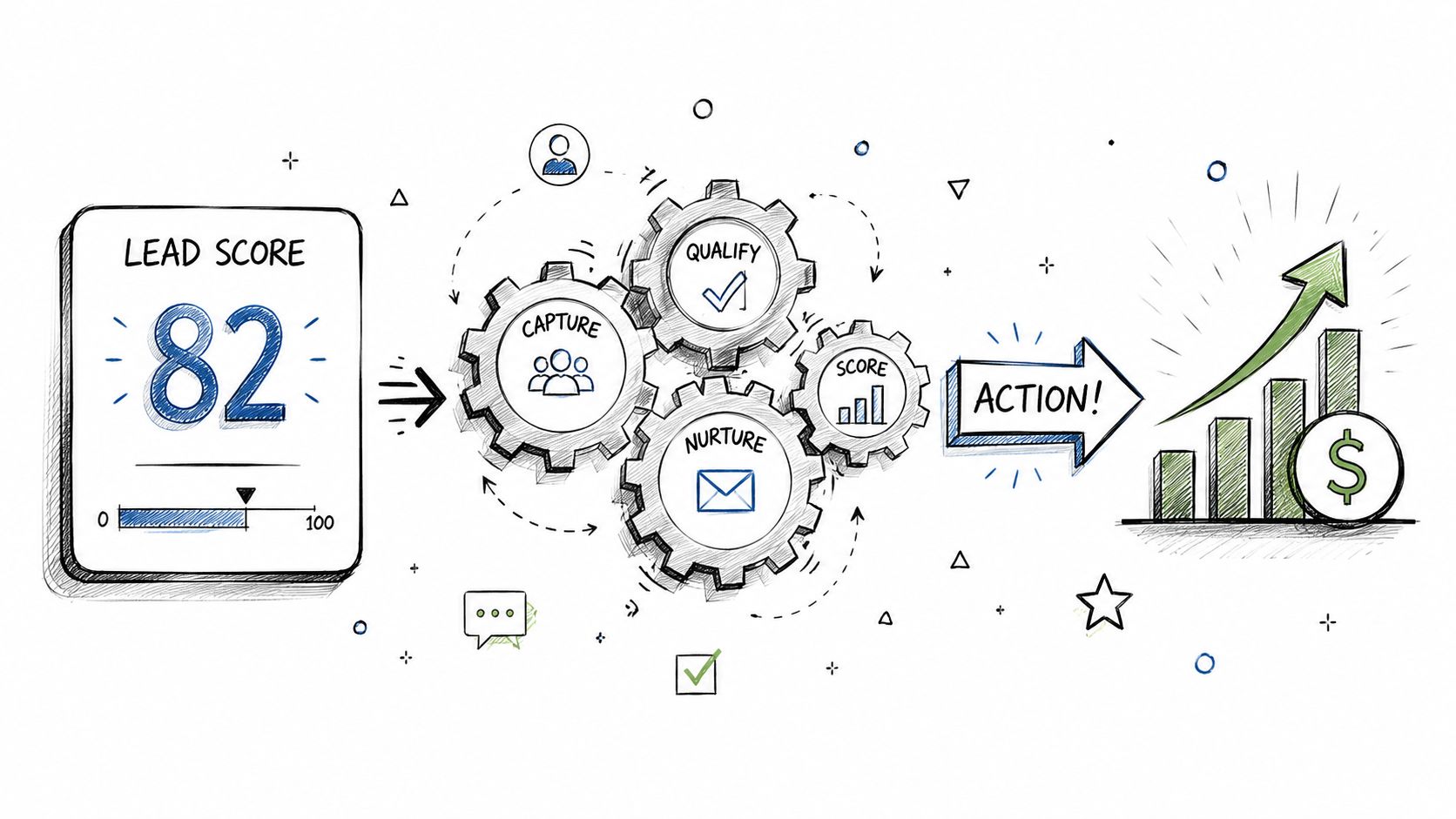
The payoff comes when lead scoring automation triggers the right next step without waiting for someone to notice the number. If your team still relies on a rep checking a report and deciding what to do manually, you've automated calculation, not execution.
Build actions around score bands
The cleanest way to operationalize scoring is to map score ranges to specific actions. Not vague intentions. Actual triggers.
A common structure looks like this:
Score band | What it usually means | Recommended action |
|---|---|---|
High score | Strong fit and strong intent | Route to sales immediately |
Mid-range score | Good potential, not ready yet | Enroll in nurture and monitor behavior |
Low score | Weak fit, weak intent, or both | Keep in light nurture or suppress from sales |
Negative or disqualified | Poor match or clear exclusion | Remove from active routing |
This works because it reduces hesitation. Reps don't have to ask what a score means. Marketing doesn't have to guess whether to nurture or hand off.
Automations that tend to work well first
For SMBs, the best first workflows are usually simple and operational:
Immediate sales alert: When a lead crosses your top threshold, create a CRM task and notify the owner.
Mid-funnel nurture: If a lead has some intent but not enough for handoff, place them into a targeted sequence based on segment or interest.
Re-engagement handling: If activity goes stale, reduce the score and move the lead into a lower-intensity stream.
Recycling logic: If sales disqualifies a lead for timing rather than fit, return it to nurture with a clear status.
Organizations using nurture workflows with lead scoring and behavioral triggers see MQL-to-SQL conversion rates 30 percent to 50 percent higher, with a median lift of 38 percent in Marketo benchmark data compared with batch-and-blast email (marketing automation benchmark data).
That result makes sense operationally. Generic follow-up treats all interest the same. Triggered workflows react to buyer behavior instead.
A useful adjacent lens is product and journey design. If you're thinking about how people experience these handoffs across channels, this comprehensive guide to AI user experience is worth reading.
Use workflows to protect sales time
One of the biggest mistakes in early scoring setups is sending every “good enough” lead to sales. That creates volume, not quality.
Mid-range leads often need more evidence before direct outreach. A useful workflow can wait for a second intent signal, such as repeated product-page activity or a higher-value conversion event, before promoting the lead. That protects rep time and keeps the handoff cleaner.
Here's a practical example of workflow design in action:
Top-band lead enters direct follow-up Sales gets a task, the owner is alerted, and the lead is marked high priority.
Mid-band lead enters segment-specific nurture Messaging matches use case, role, or industry instead of sending a generic drip.
Low-band lead gets limited automation Keep the record active, but don't put expensive human time behind it yet.
A short demo can help if you're designing these triggers visually:
The workflow should answer one question
Every threshold should answer this operational question. What happens next?
If a score doesn't trigger routing, nurture, suppression, reassignment, or escalation, it's just dashboard decoration. Good lead scoring automation turns qualification into coordinated motion across marketing and sales.
How to Monitor, Refine, and Prove Your ROI
No scoring model stays accurate on autopilot. Buyer behavior shifts. Campaign mix changes. Sales teams change how they qualify. If you don't review the model, drift sneaks in.
The right way to manage lead scoring automation is to validate it against funnel outcomes, not just whether the rules still look sensible.
The metrics that tell you if the model is working
Start with a short review cadence between marketing, sales, and whoever owns operations. Look at the same set of measures every time.
Conversion by score band: Higher bands should convert materially better than lower bands.
Sales acceptance rate: Reps should consistently accept leads routed at the threshold.
Time to conversion: Stronger scores should usually move faster.
Lead source quality: Compare how different channels perform once scored.
Sales feedback: Note where reps keep overriding the model.
A practical validation check is whether higher-score bands clearly outperform lower ones. If leads scoring 70 to 100 convert at 40 percent but the 40 to 69 band converts at 38 percent, the threshold isn't discriminating well enough and needs recalibration (how to measure lead scoring effectiveness).
Don't ask whether the score feels smart. Ask whether it separates buyers from non-buyers better than your old process did.
What to change when performance slips
If high-scoring leads aren't converting much better than everyone else, inspect the model in this order:
Data quality first
Threshold second
Weights third
Workflow timing fourth
That order matters. Teams often retune points when the actual issue is stale records or weak sales follow-up.
You should also listen for operational signals. If sales keeps saying “these are too early,” the threshold may be low. If marketing says good leads are sitting in nurture too long, the threshold may be high. The model gets better when both teams feed it evidence, not opinions alone.
Lead scoring earns trust when it becomes measurable, explainable, and adjustable. Once that loop is in place, you're not guessing which leads deserve attention. You're managing a system that gets sharper over time.
Stamina brings lead scoring automation, CRM, marketing workflows, and outbound execution into one connected platform, so SMB teams can stop stitching together fragmented tools and start acting on a reliable source of truth. If you want a practical way to unify your data, automate qualification, and turn scores into real pipeline action, take a look at Stamina.

