Marketing Qualified Leads: A Practical Guide to Drive Sales

Learn how to define, score, and manage marketing qualified leads (MQLs). This guide for SMBs covers MQL vs SQL, handoffs, KPIs, and AI-powered workflows.

0 - Minute Read

A marketing qualified lead is a prospect who has shown interest through marketing engagement and fits your ideal customer profile, making them ready for nurture or initial sales development follow-up. On average, about 31% of leads become MQLs and about 13% of MQLs become SQLs, while following up within the first hour can raise conversion to 53%.

That's why so many growing SMBs feel stuck in the same loop. Marketing is generating names. Sales is saying the leads aren't real. Ops is trying to clean up handoffs in a CRM that wasn't designed to connect the whole journey. And now AI is adding even more volume, which makes the pipeline look healthier than it is.

The fix usually isn't “more leads.” It's a cleaner qualification system.

When teams use marketing qualified leads well, they create a working middle layer between raw interest and direct sales outreach. That layer matters because not every ebook download deserves a sales call, and not every demo-page visitor should stay in a nurture flow. The point of an MQL framework is to make that call consistently, with rules both marketing and sales trust.

Understanding the Lead Lifecycle Stages

Most funnel problems are really definition problems. If your team uses “lead,” “MQL,” and “SQL” interchangeably, people will work the wrong records at the wrong time.

Marketing qualified leads emerged as a formal response to the need for better alignment between marketing and sales as digital lead generation scaled in the 2000s and 2010s. In practice, an MQL is a lead that has shown meaningful engagement, such as downloading gated content, registering for a webinar, repeatedly visiting high-intent pages, or submitting contact information, and is therefore judged more likely than a typical lead to become a customer but not yet ready for direct sales outreach, as explained in this overview of how qualified leads work in modern funnels.

A simple way to think about the lifecycle is a relay race. Each stage holds the baton for a different reason. Marketing starts the race by generating and nurturing attention. Sales development takes over when intent becomes clear. Sales takes the baton when there's a real opportunity.

An illustrated diagram of a customer journey starting from MQL and ending with revenue and success.

The stages that matter

A practical SMB funnel usually includes four working stages before a deal is active:

  • Lead
    A person or company has entered your database somehow. Maybe they filled out a form, subscribed to a newsletter, or came in from outbound research. At this point, you know they exist. You don't yet know if they matter.

  • MQL
    Marketing has enough evidence of fit and interest to say, “this record deserves closer attention.” The lead isn't necessarily ready for a full sales conversation, but they've done more than casually browse.

  • SAL
    Sales accepted lead is the checkpoint many SMBs skip, and that's a mistake. This is the moment sales reviews the MQL and formally accepts responsibility to act on it.

  • SQL
    The lead has been vetted by sales and is now treated as a real opportunity for direct sales pursuit.

Practical rule: If sales can reject a lead, you need a stage for acceptance before qualification. That's what keeps MQL and SQL from collapsing into the same label.

Lead stage definitions at a glance

Stage

Definition

Example Characteristic

Owner

Lead

A new contact or account with initial engagement or captured data

Filled out a basic form or joined a list

Marketing

MQL

A lead that matches your target profile and shows meaningful engagement

Repeated visits to pricing or product pages plus relevant job role

Marketing

SAL

An MQL that sales has reviewed and agreed to follow up on

Assigned to an SDR and accepted for outreach

Sales development

SQL

A lead confirmed by sales as a real opportunity worth active pursuit

Discovery confirms need, fit, and buying potential

Sales

Why the distinctions matter

Without stage discipline, two bad things happen fast.

First, sales wastes time on people who are still researching. Second, marketing gets blamed for “bad leads” when the core issue is that the company never agreed on what qualified means. A lead lifecycle isn't admin work. It's workload control.

For SMBs, this matters even more because rep time is scarce. You usually don't have extra SDR capacity to absorb noisy handoffs. Every stage needs to filter, not just label.

Building Your MQL Qualification Criteria

The biggest mistake I see is teams building MQL rules around isolated actions. Someone downloads one asset, hits one score threshold, and gets pushed to sales. That creates noise, not signal.

In most revenue operations frameworks, an MQL is a lead that has crossed a defined fit-and-intent threshold set by marketing and accepted by sales as worth direct follow-up. In practice, that means combining firmographic or demographic fit with behavioral signals, because one-off engagement is noisy while repeated high-intent actions plus ICP alignment increase conversion likelihood, as described in Thomasnet's breakdown of how fit and intent shape MQL qualification.

A hand-drawn funnel diagram illustrating the qualification process of marketing leads into serious buyers.

Start with fit, not clicks

A lead can be very active and still be wrong for your business. That's why fit comes first.

Fit usually includes:

  • Company profile
    Industry, company size, geography, and business model.

  • Role relevance
    Is this a decision-maker, influencer, or individual contributor with no path to budget?

  • Customer similarity
    Does this record resemble the accounts that already buy from you?

A small team doesn't need a complex scoring matrix to start. A clean yes, maybe, or no framework is enough if everyone uses it consistently.

Then layer in intent

Intent is what the lead does. But not all actions mean the same thing.

A webinar registration might signal curiosity. A return visit to a pricing page, product page, or booking flow often signals stronger buying motion. The key is sequence and repetition. One action can be accidental. A pattern usually isn't.

A simple MQL model often works better than a clever one:

  1. Set your ICP criteria
    Define who counts as a viable customer before you score engagement.

  2. List high-intent behaviors
    Focus on actions that typically show evaluation, not just awareness.

  3. Require both fit and intent
    Don't promote a lead to MQL if only one side is present.

  4. Create a review loop with sales
    If sales keeps rejecting a class of MQLs, tighten the rule.

A useful test is this: if a lead did exactly what your current MQL rule requires, would your SDR actually want to call them today?

What usually works and what doesn't

What works:

  • Clear ICP gating before engagement scoring

  • Repeated high-intent actions instead of one-off triggers

  • Short rule sets that ops can maintain

  • Shared review between marketing and sales

What doesn't:

  • Scoring everything just because your automation tool can

  • Giving too much weight to low-intent content

  • Treating email opens as strong buying signals

  • Never revisiting thresholds after launch

If you want a useful outside primer on the basics, this explanation of what is a marketing qualified lead is a good companion read. For the operational side, this guide on how to qualify leads in sales is a helpful way to connect MQL logic to downstream sales decisions.

Keep the model buildable

SMBs often overbuild scoring because they assume sophistication equals quality. It doesn't. A model your team understands will outperform a model nobody trusts.

Start with a few fit fields and a short list of meaningful behaviors. Then look at rejection patterns. If sales says the leads are active but irrelevant, your fit filters are weak. If the leads fit but still aren't ready, your intent threshold is too low.

The MQL to SQL Handoff Playbook

Most MQL programs fail at the handoff, not at the score. A lead gets labeled, routed, and forgotten. Or sales sees the notification too late and the momentum is gone.

That's why the handoff needs to operate like an SLA, not a polite suggestion.

A marketing professional passing an MQL baton to a sales representative in a professional business concept sketch.

A strong technical best practice is to calibrate criteria using historical conversion pathways. Teams should analyze which early-stage actions preceded closed-won deals and encode those signals into lead scoring, then periodically reassess scoring thresholds to keep the pipeline efficient, as outlined in TechnologyAdvice's article on defining qualified leads from historical conversion behavior.

What the SLA should include

A usable handoff agreement answers five questions:

  • When is a lead routed
    Spell out the exact trigger for MQL creation and assignment.

  • Who owns first response
    Name the SDR, AE, or queue logic. Don't leave ownership implied.

  • How fast follow-up must happen
    Define the response window internally and monitor adherence.

  • What counts as acceptance Sales should explicitly accept, not merely ignore.

  • What happens if the lead isn't ready
    Recycling rules matter as much as routing rules.

If you skip the recycling path, reps will either work weak leads too long or abandon them with no feedback. Neither helps marketing improve.

Build a closed-loop rejection system

The handoff gets cleaner when sales can reject a lead for specific reasons. Not “bad lead.” Specific reasons.

Use a short rejection menu such as:

Rejection reason

What it usually means

Wrong profile

Fit criteria need tightening

Too early

Intent threshold is too low

No response

Follow-up process may need more touches or different timing

Not in market

Nurture track should continue, but sales shouldn't hold it

Duplicate or existing account

Routing and CRM hygiene need work

Sales feedback is only useful when it can be grouped, reviewed, and acted on. Free-text complaints don't improve a funnel.

Many teams benefit from sharpening the distinction between MQLs and opportunities. If your team still treats every accepted lead like a deal, it helps to align around a clearer sales qualified lead definition before you push more records downstream.

Outreach needs a sequence, not a single touch

A handoff playbook should also define what the first few touches look like. Not full script language. Just enough process so reps behave consistently.

For teams that want a visual walkthrough of sales handoff discipline, this short video is useful:

A solid early sequence usually includes:

  1. Immediate first touch tied to the action that triggered qualification

  2. Second touch on another channel if available

  3. Contextual messaging based on the page, form, or asset involved

  4. Disposition update so marketing knows whether to recycle or escalate

The practical lesson is simple. An MQL isn't valuable because it exists in a report. It's valuable if somebody acts on it quickly, with context, and reports back what happened.

Measuring and Reporting on MQL Success

If your dashboard starts and ends with “number of MQLs created,” you're measuring production, not performance.

That's a problem because MQL programs can look busy while creating little pipeline value. A high MQL count might mean better targeting. It might also mean your threshold is too loose. The report alone won't tell you.

A 2026 HubSpot marketing statistics roundup reports that 40% of marketers identify lead quality and marketing qualified leads as their most important success metric. The same roundup says the average MQL-to-SQL conversion is about 13%, and that following up within the first hour can raise conversion to 53%, which is why MQL performance should be measured through both quality and speed in the same dashboard, not volume alone, according to HubSpot's marketing statistics roundup.

The metrics that actually matter

A usable SMB report usually centers on four views:

  • MQL volume by source
    Useful, but only as a starting point.

  • MQL-to-SQL conversion
    This tells you whether your qualification logic is producing leads sales can advance.

  • Speed to first action
    A strong MQL with slow follow-up often behaves like a weak MQL in practice.

  • Pipeline contribution
    You need to know which MQL sources produce opportunities, not just submissions.

A simple dashboard structure

You don't need a complicated BI project to start. A practical dashboard can answer:

Dashboard question

Why it matters

How many MQLs did each source create?

Reveals source mix and top-of-funnel concentration

How many became SQLs?

Tests MQL quality

How quickly did sales respond?

Shows whether handoff process is working

Which MQL cohorts influenced pipeline?

Connects qualification to revenue outcomes

Many SMBs discover that channel performance varies more by qualification discipline than by campaign creativity. A source can look strong at the lead stage and weak at the SQL stage. Another can generate fewer leads and still outperform because the leads are better aligned with your ICP.

Reporting should change behavior

Good reporting creates decisions. Bad reporting creates slides.

Watch for this pattern: if MQL volume rises while SQL creation stalls, your scoring model is getting softer or your sources are getting noisier.

Tie this work to your broader pipeline management process. That keeps MQL reporting anchored to actual deal progression instead of living in a separate marketing dashboard that sales ignores.

The best metric conversations are blunt. Which sources produce accepted leads? Which campaigns create early engagement but no real movement? Which follow-up gaps are self-inflicted? Those answers are what make MQL reporting useful.

Operationalizing MQLs with AI and Automation

AI makes MQL operations easier and riskier at the same time.

It makes them easier because systems can track behavior, enrich records, route leads, trigger nurtures, and draft outreach without a human moving rows in a spreadsheet. It makes them riskier because automation can manufacture activity faster than your team can verify intent.

As B2B teams rapidly adopt genAI for prospecting, there's a risk of lead inflation where volume increases without improving true purchase intent. The key is governance: tightening scoring thresholds when automation increases volume and validating MQLs against downstream pipeline rather than surface engagement alone, which Adobe discusses in its article on MQL governance in an AI-assisted environment.
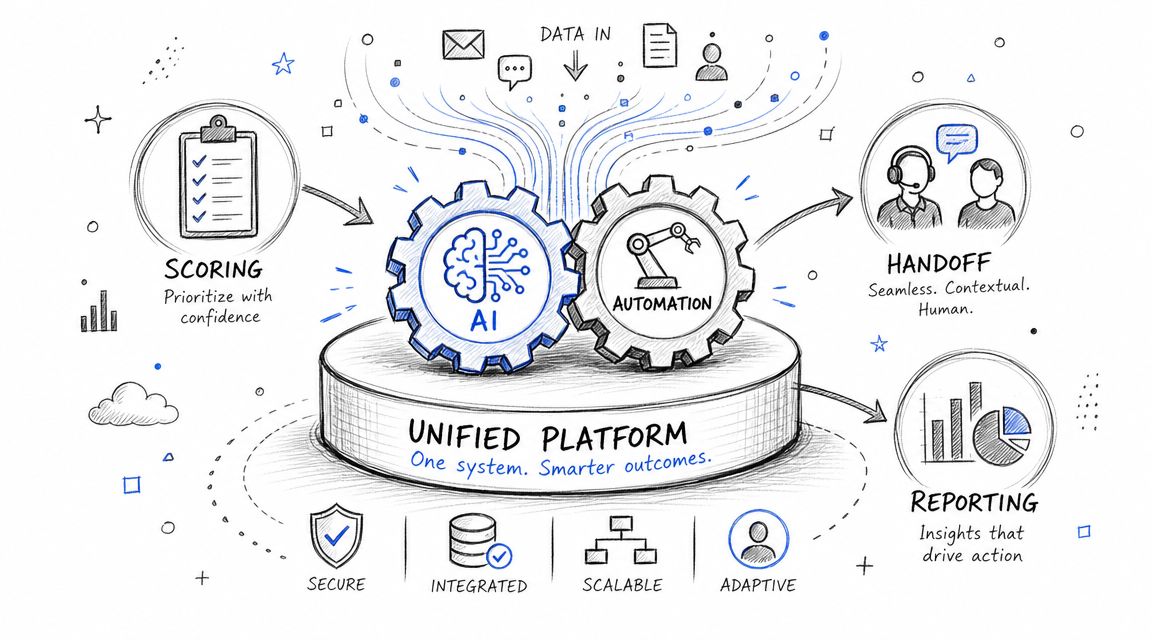
A diagram illustrating a unified platform featuring AI and automation for data management, lead scoring, and reporting.

Where automation helps

For a growing SMB, the operational burden usually shows up in five places:

  • Behavior tracking
    Leads engage across forms, pages, email, and outbound replies. Someone has to consolidate that.

  • Score updates
    Fit and intent change over time. Static records go stale fast.

  • Routing logic
    Once a lead qualifies, assignment should happen automatically.

  • Nurture branching
    Not-ready leads shouldn't disappear. They need the next best sequence.

  • Sales context
    Reps need to see why the lead qualified, not just that it did.

A unified system is useful here because it reduces the handoff friction between marketing automation, CRM, and outbound tools. In practice, platforms such as Stamina can centralize CRM data, trigger marketing automation workflows, and support AI-assisted SDR actions from the same operating layer, which is the kind of setup SMB teams usually need when they're trying to avoid spreadsheet-based qualification. If you're evaluating that operational side, this guide to marketing automation workflow design is a practical place to start.

Where AI creates false confidence

The trap is assuming more scored activity means more buying intent.

That's not always true. AI can increase email output, chatbot interactions, content production, and prospecting volume. It can also make low-signal engagement look more substantial than it is.

A few safeguards help:

  1. Raise the bar on weak signals
    Low-intent activities shouldn't qualify a lead by themselves.

  2. Audit downstream performance by source and trigger
    If a new AI-assisted motion creates MQLs that rarely become SQLs, adjust it quickly.

  3. Keep human review at the threshold edges
    Borderline leads often need judgment, not just scoring.

  4. Measure pipeline impact, not just captured demand
    Volume without progression is a reporting problem, not a growth strategy.

If you're exploring conversational capture or bot-led qualification, this resource on how chat tools can boost your sales growth is worth reviewing alongside your scoring model. The useful question isn't whether bots create more leads. It's whether the leads they create hold up under sales review.

The Future of MQLs and Intent Data

A lot of teams ask whether the MQL stage still works at all. It's a fair question.

Buyers do more research on their own now. They compare vendors anonymously, consume content across channels, and often avoid talking to sales until late in the process. That means traditional engagement triggers can miss genuine buying intent, and they can also overvalue shallow activity.

The right response isn't to throw out MQLs. It's to stop treating them as the full picture.

Engagement alone isn't enough

A buyer who downloads a guide may be early. A buyer who never fills out a form but keeps returning from a target account may be further along. That's why teams are increasingly pairing classic lead-level scoring with account context, source quality, and later-stage behavior.

In practice, a modern MQL framework works better when it asks a harder question: is this person showing interest, or is this account moving toward a buying decision?

The future of qualification is less about collecting more signals and more about weighting the right ones.

The principle still holds

Even with self-directed buyers, the underlying job hasn't changed. You still need a way to separate casual engagement from actionable intent. You still need a shared language between marketing and sales. You still need rules for when to nurture, when to call, and when to wait.

What will change is the evidence you use.

More teams will blend first-party engagement with account-level patterns, outbound response data, and broader intent signals. SMBs don't need a massive data stack to benefit from that shift. They need discipline. Define qualification clearly. Test it against downstream outcomes. Tighten it when automation adds noise. Keep it flexible enough to adapt as buyer behavior changes.

That's how marketing qualified leads stay useful. Not as a static label, but as a working decision model.

If your team is trying to connect lead capture, qualification, routing, nurture, and sales follow-up in one place, Stamina is built for that operating model. It combines CRM, marketing automation, sales engagement, and AI SDR support so SMBs can run a cleaner MQL process without stitching together separate systems.

A marketing qualified lead is a prospect who has shown interest through marketing engagement and fits your ideal customer profile, making them ready for nurture or initial sales development follow-up. On average, about 31% of leads become MQLs and about 13% of MQLs become SQLs, while following up within the first hour can raise conversion to 53%.

That's why so many growing SMBs feel stuck in the same loop. Marketing is generating names. Sales is saying the leads aren't real. Ops is trying to clean up handoffs in a CRM that wasn't designed to connect the whole journey. And now AI is adding even more volume, which makes the pipeline look healthier than it is.

The fix usually isn't “more leads.” It's a cleaner qualification system.

When teams use marketing qualified leads well, they create a working middle layer between raw interest and direct sales outreach. That layer matters because not every ebook download deserves a sales call, and not every demo-page visitor should stay in a nurture flow. The point of an MQL framework is to make that call consistently, with rules both marketing and sales trust.

Understanding the Lead Lifecycle Stages

Most funnel problems are really definition problems. If your team uses “lead,” “MQL,” and “SQL” interchangeably, people will work the wrong records at the wrong time.

Marketing qualified leads emerged as a formal response to the need for better alignment between marketing and sales as digital lead generation scaled in the 2000s and 2010s. In practice, an MQL is a lead that has shown meaningful engagement, such as downloading gated content, registering for a webinar, repeatedly visiting high-intent pages, or submitting contact information, and is therefore judged more likely than a typical lead to become a customer but not yet ready for direct sales outreach, as explained in this overview of how qualified leads work in modern funnels.

A simple way to think about the lifecycle is a relay race. Each stage holds the baton for a different reason. Marketing starts the race by generating and nurturing attention. Sales development takes over when intent becomes clear. Sales takes the baton when there's a real opportunity.

An illustrated diagram of a customer journey starting from MQL and ending with revenue and success.

The stages that matter

A practical SMB funnel usually includes four working stages before a deal is active:

  • Lead
    A person or company has entered your database somehow. Maybe they filled out a form, subscribed to a newsletter, or came in from outbound research. At this point, you know they exist. You don't yet know if they matter.

  • MQL
    Marketing has enough evidence of fit and interest to say, “this record deserves closer attention.” The lead isn't necessarily ready for a full sales conversation, but they've done more than casually browse.

  • SAL
    Sales accepted lead is the checkpoint many SMBs skip, and that's a mistake. This is the moment sales reviews the MQL and formally accepts responsibility to act on it.

  • SQL
    The lead has been vetted by sales and is now treated as a real opportunity for direct sales pursuit.

Practical rule: If sales can reject a lead, you need a stage for acceptance before qualification. That's what keeps MQL and SQL from collapsing into the same label.

Lead stage definitions at a glance

Stage

Definition

Example Characteristic

Owner

Lead

A new contact or account with initial engagement or captured data

Filled out a basic form or joined a list

Marketing

MQL

A lead that matches your target profile and shows meaningful engagement

Repeated visits to pricing or product pages plus relevant job role

Marketing

SAL

An MQL that sales has reviewed and agreed to follow up on

Assigned to an SDR and accepted for outreach

Sales development

SQL

A lead confirmed by sales as a real opportunity worth active pursuit

Discovery confirms need, fit, and buying potential

Sales

Why the distinctions matter

Without stage discipline, two bad things happen fast.

First, sales wastes time on people who are still researching. Second, marketing gets blamed for “bad leads” when the core issue is that the company never agreed on what qualified means. A lead lifecycle isn't admin work. It's workload control.

For SMBs, this matters even more because rep time is scarce. You usually don't have extra SDR capacity to absorb noisy handoffs. Every stage needs to filter, not just label.

Building Your MQL Qualification Criteria

The biggest mistake I see is teams building MQL rules around isolated actions. Someone downloads one asset, hits one score threshold, and gets pushed to sales. That creates noise, not signal.

In most revenue operations frameworks, an MQL is a lead that has crossed a defined fit-and-intent threshold set by marketing and accepted by sales as worth direct follow-up. In practice, that means combining firmographic or demographic fit with behavioral signals, because one-off engagement is noisy while repeated high-intent actions plus ICP alignment increase conversion likelihood, as described in Thomasnet's breakdown of how fit and intent shape MQL qualification.

A hand-drawn funnel diagram illustrating the qualification process of marketing leads into serious buyers.

Start with fit, not clicks

A lead can be very active and still be wrong for your business. That's why fit comes first.

Fit usually includes:

  • Company profile
    Industry, company size, geography, and business model.

  • Role relevance
    Is this a decision-maker, influencer, or individual contributor with no path to budget?

  • Customer similarity
    Does this record resemble the accounts that already buy from you?

A small team doesn't need a complex scoring matrix to start. A clean yes, maybe, or no framework is enough if everyone uses it consistently.

Then layer in intent

Intent is what the lead does. But not all actions mean the same thing.

A webinar registration might signal curiosity. A return visit to a pricing page, product page, or booking flow often signals stronger buying motion. The key is sequence and repetition. One action can be accidental. A pattern usually isn't.

A simple MQL model often works better than a clever one:

  1. Set your ICP criteria
    Define who counts as a viable customer before you score engagement.

  2. List high-intent behaviors
    Focus on actions that typically show evaluation, not just awareness.

  3. Require both fit and intent
    Don't promote a lead to MQL if only one side is present.

  4. Create a review loop with sales
    If sales keeps rejecting a class of MQLs, tighten the rule.

A useful test is this: if a lead did exactly what your current MQL rule requires, would your SDR actually want to call them today?

What usually works and what doesn't

What works:

  • Clear ICP gating before engagement scoring

  • Repeated high-intent actions instead of one-off triggers

  • Short rule sets that ops can maintain

  • Shared review between marketing and sales

What doesn't:

  • Scoring everything just because your automation tool can

  • Giving too much weight to low-intent content

  • Treating email opens as strong buying signals

  • Never revisiting thresholds after launch

If you want a useful outside primer on the basics, this explanation of what is a marketing qualified lead is a good companion read. For the operational side, this guide on how to qualify leads in sales is a helpful way to connect MQL logic to downstream sales decisions.

Keep the model buildable

SMBs often overbuild scoring because they assume sophistication equals quality. It doesn't. A model your team understands will outperform a model nobody trusts.

Start with a few fit fields and a short list of meaningful behaviors. Then look at rejection patterns. If sales says the leads are active but irrelevant, your fit filters are weak. If the leads fit but still aren't ready, your intent threshold is too low.

The MQL to SQL Handoff Playbook

Most MQL programs fail at the handoff, not at the score. A lead gets labeled, routed, and forgotten. Or sales sees the notification too late and the momentum is gone.

That's why the handoff needs to operate like an SLA, not a polite suggestion.

A marketing professional passing an MQL baton to a sales representative in a professional business concept sketch.

A strong technical best practice is to calibrate criteria using historical conversion pathways. Teams should analyze which early-stage actions preceded closed-won deals and encode those signals into lead scoring, then periodically reassess scoring thresholds to keep the pipeline efficient, as outlined in TechnologyAdvice's article on defining qualified leads from historical conversion behavior.

What the SLA should include

A usable handoff agreement answers five questions:

  • When is a lead routed
    Spell out the exact trigger for MQL creation and assignment.

  • Who owns first response
    Name the SDR, AE, or queue logic. Don't leave ownership implied.

  • How fast follow-up must happen
    Define the response window internally and monitor adherence.

  • What counts as acceptance Sales should explicitly accept, not merely ignore.

  • What happens if the lead isn't ready
    Recycling rules matter as much as routing rules.

If you skip the recycling path, reps will either work weak leads too long or abandon them with no feedback. Neither helps marketing improve.

Build a closed-loop rejection system

The handoff gets cleaner when sales can reject a lead for specific reasons. Not “bad lead.” Specific reasons.

Use a short rejection menu such as:

Rejection reason

What it usually means

Wrong profile

Fit criteria need tightening

Too early

Intent threshold is too low

No response

Follow-up process may need more touches or different timing

Not in market

Nurture track should continue, but sales shouldn't hold it

Duplicate or existing account

Routing and CRM hygiene need work

Sales feedback is only useful when it can be grouped, reviewed, and acted on. Free-text complaints don't improve a funnel.

Many teams benefit from sharpening the distinction between MQLs and opportunities. If your team still treats every accepted lead like a deal, it helps to align around a clearer sales qualified lead definition before you push more records downstream.

Outreach needs a sequence, not a single touch

A handoff playbook should also define what the first few touches look like. Not full script language. Just enough process so reps behave consistently.

For teams that want a visual walkthrough of sales handoff discipline, this short video is useful:

A solid early sequence usually includes:

  1. Immediate first touch tied to the action that triggered qualification

  2. Second touch on another channel if available

  3. Contextual messaging based on the page, form, or asset involved

  4. Disposition update so marketing knows whether to recycle or escalate

The practical lesson is simple. An MQL isn't valuable because it exists in a report. It's valuable if somebody acts on it quickly, with context, and reports back what happened.

Measuring and Reporting on MQL Success

If your dashboard starts and ends with “number of MQLs created,” you're measuring production, not performance.

That's a problem because MQL programs can look busy while creating little pipeline value. A high MQL count might mean better targeting. It might also mean your threshold is too loose. The report alone won't tell you.

A 2026 HubSpot marketing statistics roundup reports that 40% of marketers identify lead quality and marketing qualified leads as their most important success metric. The same roundup says the average MQL-to-SQL conversion is about 13%, and that following up within the first hour can raise conversion to 53%, which is why MQL performance should be measured through both quality and speed in the same dashboard, not volume alone, according to HubSpot's marketing statistics roundup.

The metrics that actually matter

A usable SMB report usually centers on four views:

  • MQL volume by source
    Useful, but only as a starting point.

  • MQL-to-SQL conversion
    This tells you whether your qualification logic is producing leads sales can advance.

  • Speed to first action
    A strong MQL with slow follow-up often behaves like a weak MQL in practice.

  • Pipeline contribution
    You need to know which MQL sources produce opportunities, not just submissions.

A simple dashboard structure

You don't need a complicated BI project to start. A practical dashboard can answer:

Dashboard question

Why it matters

How many MQLs did each source create?

Reveals source mix and top-of-funnel concentration

How many became SQLs?

Tests MQL quality

How quickly did sales respond?

Shows whether handoff process is working

Which MQL cohorts influenced pipeline?

Connects qualification to revenue outcomes

Many SMBs discover that channel performance varies more by qualification discipline than by campaign creativity. A source can look strong at the lead stage and weak at the SQL stage. Another can generate fewer leads and still outperform because the leads are better aligned with your ICP.

Reporting should change behavior

Good reporting creates decisions. Bad reporting creates slides.

Watch for this pattern: if MQL volume rises while SQL creation stalls, your scoring model is getting softer or your sources are getting noisier.

Tie this work to your broader pipeline management process. That keeps MQL reporting anchored to actual deal progression instead of living in a separate marketing dashboard that sales ignores.

The best metric conversations are blunt. Which sources produce accepted leads? Which campaigns create early engagement but no real movement? Which follow-up gaps are self-inflicted? Those answers are what make MQL reporting useful.

Operationalizing MQLs with AI and Automation

AI makes MQL operations easier and riskier at the same time.

It makes them easier because systems can track behavior, enrich records, route leads, trigger nurtures, and draft outreach without a human moving rows in a spreadsheet. It makes them riskier because automation can manufacture activity faster than your team can verify intent.

As B2B teams rapidly adopt genAI for prospecting, there's a risk of lead inflation where volume increases without improving true purchase intent. The key is governance: tightening scoring thresholds when automation increases volume and validating MQLs against downstream pipeline rather than surface engagement alone, which Adobe discusses in its article on MQL governance in an AI-assisted environment.

A diagram illustrating a unified platform featuring AI and automation for data management, lead scoring, and reporting.

Where automation helps

For a growing SMB, the operational burden usually shows up in five places:

  • Behavior tracking
    Leads engage across forms, pages, email, and outbound replies. Someone has to consolidate that.

  • Score updates
    Fit and intent change over time. Static records go stale fast.

  • Routing logic
    Once a lead qualifies, assignment should happen automatically.

  • Nurture branching
    Not-ready leads shouldn't disappear. They need the next best sequence.

  • Sales context
    Reps need to see why the lead qualified, not just that it did.

A unified system is useful here because it reduces the handoff friction between marketing automation, CRM, and outbound tools. In practice, platforms such as Stamina can centralize CRM data, trigger marketing automation workflows, and support AI-assisted SDR actions from the same operating layer, which is the kind of setup SMB teams usually need when they're trying to avoid spreadsheet-based qualification. If you're evaluating that operational side, this guide to marketing automation workflow design is a practical place to start.

Where AI creates false confidence

The trap is assuming more scored activity means more buying intent.

That's not always true. AI can increase email output, chatbot interactions, content production, and prospecting volume. It can also make low-signal engagement look more substantial than it is.

A few safeguards help:

  1. Raise the bar on weak signals
    Low-intent activities shouldn't qualify a lead by themselves.

  2. Audit downstream performance by source and trigger
    If a new AI-assisted motion creates MQLs that rarely become SQLs, adjust it quickly.

  3. Keep human review at the threshold edges
    Borderline leads often need judgment, not just scoring.

  4. Measure pipeline impact, not just captured demand
    Volume without progression is a reporting problem, not a growth strategy.

If you're exploring conversational capture or bot-led qualification, this resource on how chat tools can boost your sales growth is worth reviewing alongside your scoring model. The useful question isn't whether bots create more leads. It's whether the leads they create hold up under sales review.

The Future of MQLs and Intent Data

A lot of teams ask whether the MQL stage still works at all. It's a fair question.

Buyers do more research on their own now. They compare vendors anonymously, consume content across channels, and often avoid talking to sales until late in the process. That means traditional engagement triggers can miss genuine buying intent, and they can also overvalue shallow activity.

The right response isn't to throw out MQLs. It's to stop treating them as the full picture.

Engagement alone isn't enough

A buyer who downloads a guide may be early. A buyer who never fills out a form but keeps returning from a target account may be further along. That's why teams are increasingly pairing classic lead-level scoring with account context, source quality, and later-stage behavior.

In practice, a modern MQL framework works better when it asks a harder question: is this person showing interest, or is this account moving toward a buying decision?

The future of qualification is less about collecting more signals and more about weighting the right ones.

The principle still holds

Even with self-directed buyers, the underlying job hasn't changed. You still need a way to separate casual engagement from actionable intent. You still need a shared language between marketing and sales. You still need rules for when to nurture, when to call, and when to wait.

What will change is the evidence you use.

More teams will blend first-party engagement with account-level patterns, outbound response data, and broader intent signals. SMBs don't need a massive data stack to benefit from that shift. They need discipline. Define qualification clearly. Test it against downstream outcomes. Tighten it when automation adds noise. Keep it flexible enough to adapt as buyer behavior changes.

That's how marketing qualified leads stay useful. Not as a static label, but as a working decision model.

If your team is trying to connect lead capture, qualification, routing, nurture, and sales follow-up in one place, Stamina is built for that operating model. It combines CRM, marketing automation, sales engagement, and AI SDR support so SMBs can run a cleaner MQL process without stitching together separate systems.

Share this article

Share this article

Send a shareable link to your team or anyone who might find it useful.

Send a shareable link to your team or anyone who might find it useful.

Copy link

Copied

Share directly to

Table of contents

Give Your Business the Stamina it needs to Thrive

PRODUCT

COMPANY

RESOURCES

© 2026 Stamina Software Technologies Inc. All rights reserved.

PRODUCT

COMPANY

RESOURCES

© 2026 Stamina Software Technologies Inc. All rights reserved.

PRODUCT

COMPANY

RESOURCES

© 2026 Stamina Software Technologies Inc. All rights reserved.