
A Sales Qualified Lead (SQL) is a potential customer that your sales team has vetted and confirmed is ready for a direct sales conversation, based on their intent, budget, and authority. In strong B2B pipelines, 13-25% of MQLs become SQLs, and 20-50% of SQLs become customers, which is why getting this stage right matters so much.
If you're running an SMB, this probably feels familiar. Marketing is sending leads. Sales is staying busy. Your CRM is full. But revenue still feels harder to predict than it should.
That usually means you don't have a lead volume problem. You have a lead qualification problem.
A lot of founders assume more leads will fix the pipeline. Usually, more raw leads just create more noise. A significant shift happens when your team gets disciplined about identifying the few prospects who are ready to buy, then moving on them fast. That's what learning what is a sales qualified lead really gives you: a cleaner funnel, less wasted rep time, and a sales process you can manage.
The Problem with Just Getting More Leads
Most SMB sales teams don't fail because nobody is interested. They fail because reps spend their week sorting through people who looked promising on paper but were never close to buying.
A typical version looks like this. Marketing runs campaigns, webinars, outbound, referrals, and content. Leads come in. A rep sees a form fill, sends an email, maybe makes a call, and starts chasing. Two weeks later, they learn the prospect has no budget, no urgency, or no decision-making power.
That pattern is expensive. On average, organizations generate about 1,877 leads per month, but 80% never convert into customers according to Cirrus Insight lead generation statistics. That's not a top-of-funnel win. That's a filtering problem.
Busy doesn't mean productive
When founders tell me, "My team is slammed," I don't automatically hear "demand is strong." I hear, "your reps may be acting like human spam filters."
An SQL fixes that because it marks the moment a lead stops being just "interested" and becomes sales-ready. Not curious. Not vaguely engaged. Ready for a real buying conversation.
The best pipelines don't send every lead to sales. They protect sales time by sending only the leads that earned a real conversation.
Here's the practical difference:
More leads can make dashboards look healthy.
More qualified leads give reps a real chance to close.
A clear SQL definition keeps marketing and sales from arguing about lead quality every week.
If you're trying to improve top-of-funnel performance, Receiver has a useful collection of lead generation strategies worth reviewing. But lead generation only works when there's a clear rule for what happens after someone raises their hand.
What an SQL solves for the business
An SQL gives your company a shared answer to one simple question: which leads deserve sales time right now?
For an SMB, that matters more than most founders realize. You don't have a giant SDR bench. You don't have time for every rep to invent their own qualification logic. You need a repeatable standard.
Without that standard, marketing celebrates volume, sales complains about quality, and leadership gets pipeline reports that don't mean much. With it, your funnel gets narrower, but a lot more useful.
The Critical Shift from MQL to SQL
The most common confusion is this: people use MQL and SQL like they're interchangeable. They aren't.
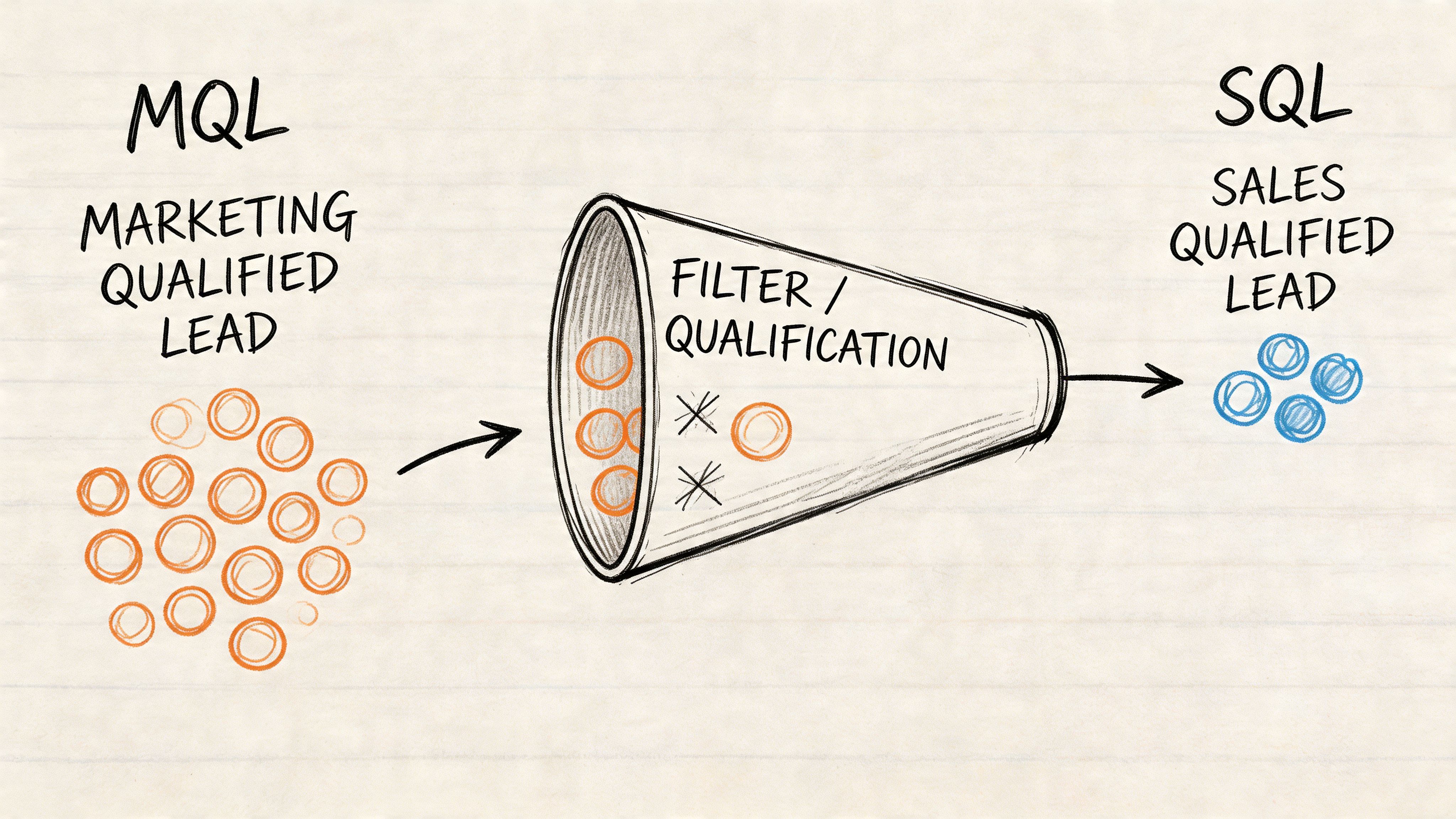
An MQL is a lead marketing believes is promising based on engagement. An SQL is a lead sales has reviewed and accepted as worth active pursuit.
A simple fishing analogy helps. An MQL is a fish nibbling near the bait. An SQL is the one you've checked, measured, and decided to keep because it fits what you're trying to catch.
MQL vs SQL at a glance
Attribute | Marketing Qualified Lead (MQL) | Sales Qualified Lead (SQL) |
|---|---|---|
Owner | Marketing | Sales |
Main signal | Engagement and fit | Buying intent and readiness |
Typical evidence | Content downloads, email clicks, form fills | Discovery call, demo request, budget discussion, confirmed authority |
Question being answered | "Should we keep nurturing this lead?" | "Should sales actively work this lead now?" |
Next step | Nurture, score, educate | Sales outreach, qualification call, opportunity creation |
Where teams get stuck
The handoff gets messy when marketing says, "they engaged a lot," and sales says, "that doesn't mean they'll buy."
Both teams are right. Engagement matters. It just isn't enough on its own.
A founder reading a pricing page three times and requesting a demo is different from an intern who downloaded a guide six weeks ago. Both may look active in a dashboard. Only one looks like an SQL.
If you want a deeper breakdown of where sales and marketing definitions tend to diverge, Stamina has a useful explainer on the difference between sales and marketing.
What changes at the SQL stage
When a lead becomes an SQL, the standard changes from interest to commercial intent. Sales now wants answers to questions like:
Does this company fit our ICP
Is the pain real enough to justify change
Is there a buyer involved
Is there a timeline that makes this worth prioritizing
An MQL says, "this person noticed us." An SQL says, "this person might buy from us."
That distinction matters because it changes how your team behaves. Marketing can afford broad reach. Sales can't. Reps need fewer names and stronger reasons to engage.
For SMBs, the application of old enterprise playbooks can become a burden. Manual review works when you have layers of ops support and large SDR teams. Smaller teams need something tighter, faster, and less dependent on heroics.
Defining Your SQL Qualification Criteria
Organizations don't struggle because SQL is a hard concept. They struggle because they never define it precisely enough to use day to day.
If your reps qualify leads based on gut feel, every seller creates a different pipeline. You need criteria that are simple enough to apply and strong enough to protect sales time.
Start with BANT, but don't stop there
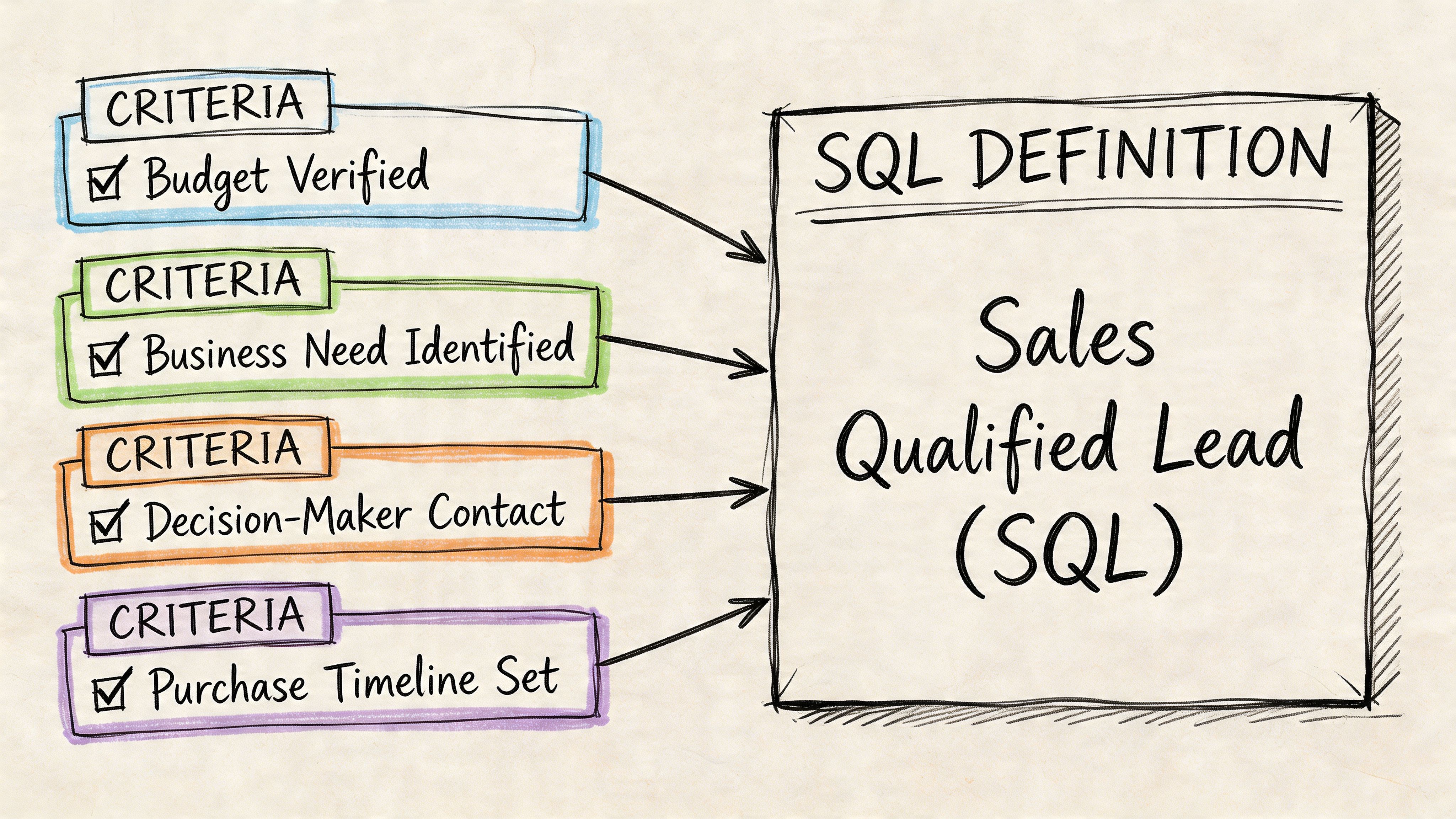
A common approach begins with BANT:
Budget. Can they pay for a solution like yours?
Authority. Are you talking to someone who can approve or strongly influence the purchase?
Need. Do they have a problem your product solves?
Timeline. Is there a real purchase window?
BANT is useful because it forces clarity. If a rep can't answer those four areas, the lead probably isn't sales-ready yet.
But SMBs often need a more flexible model. Early-stage buyers don't always show up with budget neatly approved. That's why many smaller teams prefer CHAMP:
Challenges come first, so the rep focuses on the pain before forcing a budget conversation.
Authority still matters, but influence can matter almost as much in a smaller buying group.
Money matters, but the conversation is often about whether the problem is costly enough to justify action.
Prioritization helps uncover whether this project is important now or just interesting someday.
A practical overview of what is a Sales Qualified Lead (SQL) can help if you want a second framing of these models.
Add lead scoring so the process scales
Frameworks help reps think. Lead scoring helps the business scale.
For many platforms, a scoring threshold of 70-80+ points is used to trigger a sales handoff, and this filtering can reduce sales cycle time by 30-50% as reps focus on higher-intent leads, according to Salesforce's SQL guidance.
That doesn't mean every company should copy the same score. It means you need a system.
A basic SMB model usually includes:
Firmographic fit for industry, company size, geography, and role
Behavioral signals like pricing page visits, repeat site activity, replies, demo requests, and sales email engagement
Negative signals for poor fit, student traffic, job seekers, or people outside your target market
A simple way to build your criteria
Use one workshop with sales and marketing and answer these questions:
Who counts as a good-fit company
What actions show real buying intent
What disqualifies a lead immediately
What score or rule moves someone to sales
What information must exist before the handoff
If your CRM setup is messy, it's worth tightening that before you automate anything. This guide to CRM best practices is a practical place to start.
Practical rule: If a rep can't explain why a lead is an SQL in one sentence, the criteria still aren't clear enough.
Mastering the Sales Handoff Process
A qualified lead can still die in the handoff. It is during this stage that many SMB funnels break.
Think about the handoff like a relay race. Marketing's job isn't just to run hard. It's to pass the baton cleanly. Sales doesn't want to restart the race, hunt for context, or guess what happened before the lead hit the queue.

What has to be in the baton pass
When a lead crosses into SQL, the CRM record should already contain the essentials. At minimum, sales should see:
Why this lead qualified. The trigger event, score, or specific action.
Who they are. Company, role, and fit notes.
What they care about. Pain point, use case, or challenge.
How urgent it is. Whether there's a near-term buying window.
What happened already. Emails, forms, meetings, replies, and campaign history.
Without that context, reps waste time re-asking basic questions. The buyer feels like they're starting over. Momentum drops.
Urgency is one of the most important fields. Zendesk's SQL overview notes that SQLs with a defined purchase timeline of less than 90 days convert three times faster than leads with longer or unclear timelines.
Build an SLA, even if your team is small
A handoff process isn't just a CRM status change. It needs a simple service level agreement between marketing and sales.
That agreement should answer:
When does a lead become an SQL
Who owns the first outreach
How fast sales must respond
What happens if the lead isn't ready after contact
When the lead returns to nurture
If your team has SDRs, those ownership rules should be explicit. This explainer on what an SDR does in sales is useful if you're formalizing that role for the first time.
Here's a short walkthrough that shows the handoff mindset in action:
A sloppy handoff tells the buyer your teams don't talk. A strong handoff makes your company feel coordinated before the deal even starts.
Keep one source of truth
The fastest way to ruin SQLs is to split the story across too many tools. Marketing data in one app, sales notes in another, website intent somewhere else, and nobody sees the full picture.
Even a basic setup should let both teams see the same record, the same activity history, and the same qualification notes. Otherwise, you aren't managing a funnel. You're managing guesses.
Key Metrics for Tracking SQL Performance
If you don't measure SQL performance, the label becomes a feel-good tag in the CRM. You need a few numbers that tell you whether qualification is working or just creating ceremony.
The three metrics that matter most
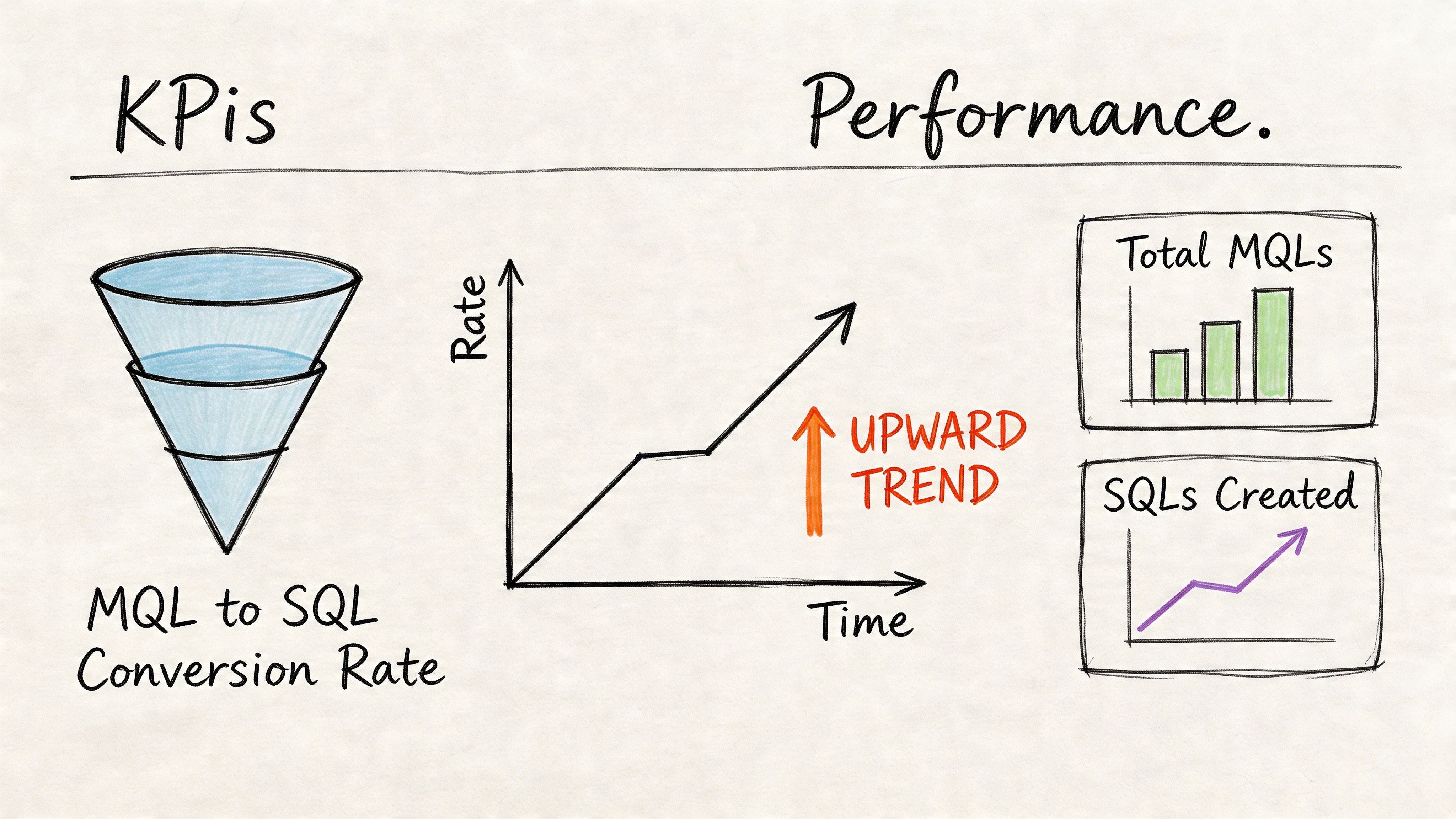
Start with these:
Metric | What it tells you | How to use it |
|---|---|---|
MQL to SQL rate | Whether marketing is sending leads sales actually accepts | Low performance often means weak fit or unclear definitions |
SQL to opportunity rate | Whether qualified leads are turning into real pipeline | Weak results usually point to bad qualification or poor first-call execution |
Opportunity to close rate | Whether the pipeline created from SQLs is winnable | Low rates can signal pricing, positioning, or late-stage sales issues |
High-performing B2B teams see 13-25% of MQLs become SQLs, and 20-50% of SQLs become customers, according to AgentiveAIQ's SQL benchmarks. If you're consistently under those ranges, something is off in quality, process, or both.
How to read the numbers without overcomplicating them
A low MQL to SQL rate usually means marketing and sales are using different definitions of "good lead."
A healthy MQL to SQL rate paired with weak SQL to opportunity performance usually means leads are being labeled as sales-ready too early.
A decent pipeline with weak opportunity to close results points further down-funnel. The SQL process may be fine. Your issue might be discovery, pricing, proof, or stakeholder management.
Don't use SQL metrics to blame teams. Use them to find where the funnel stops making sense.
For SMB founders, this is the part that makes SQL useful. It turns lead quality from a vague complaint into something diagnosable.
How Stamina Automates SQL Identification and Conversion
In particular, AI changes the game for smaller teams.
Traditional SQL processes were built for companies with large sales orgs, manual qualification layers, and enough headcount to review leads by hand. Most SMBs don't have that luxury. The founder, marketer, AE, and SDR are often wearing overlapping hats.
That makes speed and consistency more important than theory.
Among SMBs, AI adoption in lead qualification grew 45% year-over-year in 2025, and AI-driven SQL identification can reduce qualification time from days to hours while boosting conversion rates by over 20% compared with manual-only processes, according to ThomasNet's sales qualified lead analysis.
Why AI helps in practical terms
AI tools are useful here because they can process signals that humans often miss or don't have time to stitch together:
Website behavior that shows repeated high-intent activity
Social and engagement signals that suggest active evaluation
CRM context that reveals whether the account matches your ICP
Workflow triggers that route leads immediately instead of waiting for someone to notice
For an SMB, that's the difference between reacting late and acting while intent is still fresh.
One option in this category is Stamina, which combines CRM, marketing, and sales data in one system and uses Zara, its built-in AI SDR, to identify and act on likely SQLs using behavioral and account signals. If you're comparing this category of tooling, Stamina's overview of AI sales assistants is a helpful place to understand how these systems work in practice.
What changes when the process is automated
The key advantage isn't just scoring leads faster. It's that the next action can happen immediately.
A high-intent lead can be routed to a rep, enrolled in a customized sequence, flagged for follow-up, or pushed into a specific pipeline without someone manually updating fields. That matters because SMB teams lose SQLs in the gaps between tools and tasks, not just in the qualification conversation itself.
AI also helps standardize decisions. Instead of one rep treating a pricing-page visitor as urgent and another ignoring it, the system applies the same logic every time. That doesn't replace human judgment. It gives human judgment a cleaner starting point.
For founders, the takeaway is simple. If your SQL process depends on people remembering to check five systems, score leads manually, and hand off context perfectly, it won't hold up as volume grows. AI-supported qualification gives smaller teams a way to operate with more discipline without adding layers of headcount.
Your Actionable SQL Implementation Checklist
You don't need a giant revenue ops project to put this in place. You need a few clear decisions, one working process, and the discipline to review it regularly.
The checklist
Get sales and marketing in one room Agree on the definition of a good lead. Not in theory. In plain language your team will use.
Define your ICP together
List the company types, buyer roles, and common use cases that make someone a strong fit. Also list who should never become an SQL.Choose your qualification framework
Use BANT if your buying process is straightforward. Use CHAMP if your team needs a pain-first model that fits SMB selling better.Build a lead scoring model
Include both fit and intent. Decide which actions matter, which ones don't, and what threshold triggers review or handoff.Set the handoff rule
Decide exactly when marketing stops owning the lead and sales starts. Write it down. Put it in the CRM workflow.Define the required fields
Sales shouldn't receive a lead without key context. Make the CRM capture qualification notes, activity history, use case, and urgency.Create a response SLA
Decide who follows up, how quickly they respond, and what happens if the lead isn't ready yet.Track the three core metrics
Watch MQL to SQL, SQL to opportunity, and opportunity to close. Review them monthly.
Keep the first version simple
This is often overbuilt. Don't.
Start with a version your team can follow consistently. Tighten it after you see where the leaks are. A simple SQL process that's used every day beats an elaborate framework sitting in a slide deck.
Start with one clear rule: sales time is reserved for leads that show fit, intent, and a plausible path to purchase.
If you treat SQL as a shared operating rule instead of a marketing label, your funnel gets more honest very quickly. That's when forecasting improves, follow-up gets sharper, and your team spends more time selling to people who are ready to buy.
If you want one system to manage qualification, handoff, outreach, and follow-up without stitching together separate tools, take a look at Stamina. It brings CRM, marketing, sales workflows, and AI SDR capabilities into one place so SMB teams can identify SQLs faster and act on them with less manual work.

