

Unlock the Difference Between Sales & Marketing

Grasp the core difference between sales & marketing. Align teams, set shared goals, & leverage a unified platform to boost SMB revenue in 2026.

0 - Minute Read

You can spot the problem before anyone says it out loud.

Marketing says lead volume is up, campaigns are working, and the pipeline should be fuller than it looks. Sales says the leads are weak, follow-up takes too much manual effort, and quota is getting harder, not easier. The founder sits in the middle, paying for both teams and wondering why revenue still feels unpredictable.

That tension is seldom about bad people. It is about a bad system.

The core difference between sales & marketing matters, but definitions alone will not fix the fights. SMBs need operating rules, shared data, fast handoffs, and one place where both teams can see the same funnel. Once that happens, the argument changes from “your team is the problem” to “this stage in the process is broken.” That is a much easier problem to solve.

Why Sales and Marketing Teams So Often Disagree

The pattern is familiar. Marketing launches campaigns, generates interest, and sends leads into the CRM. Sales opens the list, works a few contacts, ignores others, and then reports back that the leads were not serious buyers. Marketing hears that as laziness. Sales hears pushback as denial.

A conceptual sketch showing a tug-of-war match between business figures representing Sales and Marketing departments.

In most SMBs, the conflict starts with incentives. Marketing is asked to create awareness, drive engagement, and keep the top of the funnel moving. Sales is asked to close business now. One team gets rewarded for volume and reach. The other gets judged on conversion and revenue.

The teams often work from different realities

Marketing may be looking at campaign responses, form fills, webinar signups, or content engagement. Sales is looking at active opportunities, deal stages, and whether a real buyer will take a meeting. Both views are legitimate. The trouble starts when there is no agreed definition of what should move from one team to the next.

A few common symptoms appear:

  • Lead quality arguments: Marketing says the lead met the form criteria. Sales says the account has no urgency, budget, or fit.

  • Tool fragmentation: One team works from email and campaign tools. The other lives in the CRM. Context gets lost between systems.

  • Slow follow-up: A lead comes in warm, then waits. By the time sales reaches out, the buyer has cooled off.

  • No feedback loop: Sales rejects leads informally, but nobody updates targeting, scoring, or nurture logic.

Misalignment is usually an operations problem wearing a culture problem as a disguise.

What works and what does not

What does not work is telling the teams to “collaborate better” without changing the mechanics. Shared Slack channels do not fix broken qualification. Weekly meetings do not fix missing ownership rules. More dashboards do not help if everyone trusts different data.

What works is tighter process design:

  • a documented handoff point

  • one owner for each stage

  • visible lead history

  • clear recycle rules

  • shared review of lead quality

The difference between sales & marketing becomes productive when each team knows its job and trusts the transfer between jobs. Without that, every missed number turns into a blame exercise.

Sales vs Marketing A Side-by-Side Comparison

Sales and marketing support the same commercial outcome, but they do different work on different timelines.

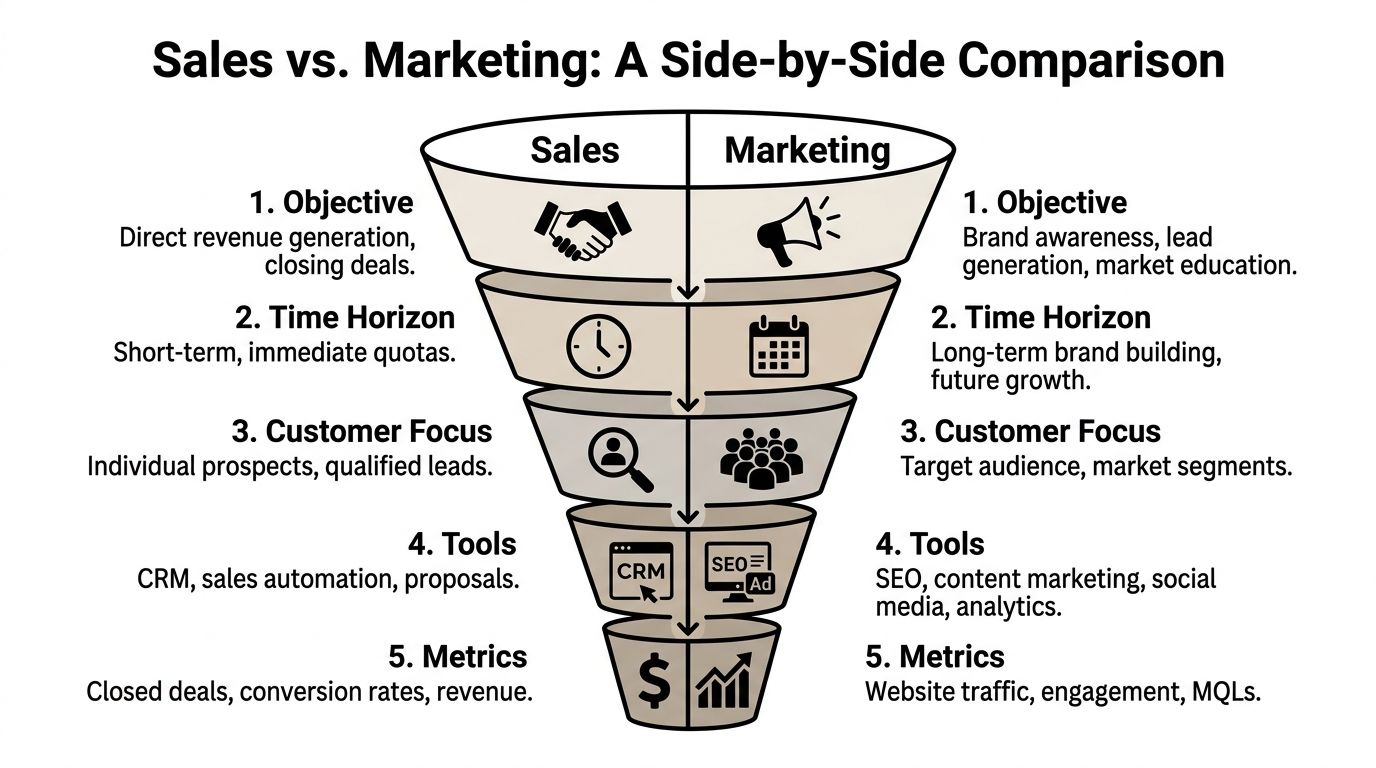
Marketing builds awareness, shapes demand, and attracts people who may become buyers later. Sales takes qualified interest and turns it into committed revenue. According to Salesforce on the difference between sales and marketing, marketing emphasizes long-term brand building and lead generation, while sales focuses on short-term revenue generation, with marketing tracking MQLs and sales tracking SQLs, closed deals, and direct revenue. The same source notes that typical conversion rates from MQL to SQL range from 13-20% in B2B contexts.
Infographic

Core differences in one view

Dimension

Marketing

Sales

Primary goal

Build awareness, educate the market, generate interest

Convert qualified interest into revenue

Time horizon

Longer-term

Shorter-term

Audience focus

Segments, personas, broader market groups

Individual accounts, contacts, active opportunities

Typical activities

Content, SEO, paid campaigns, webinars, email nurture, messaging

Outreach, qualification, discovery, demos, proposals, negotiation

Funnel role

Top and middle of funnel

Middle to bottom of funnel

Main lead type

MQL

SQL

Success view

Engagement quality and pipeline creation

Deal progression and closed business

Communication style

One-to-many and automated

One-to-one and personalized

The mindset gap matters

Marketing asks, “How do we create more qualified interest from the right audience?”

Sales asks, “Which buyer is ready enough to talk now, and how do we close them?”

Marketing wins by creating momentum. Sales wins by turning momentum into commitment.

Neither team can replace the other. A business with strong marketing and weak sales generates activity without revenue. A business with strong sales and weak marketing often survives on founder-led hustle, referrals, and inconsistent outbound until growth stalls.

Where founders get this wrong

SMB founders collapse both functions into one rough idea: “get customers.” That sounds efficient, but it creates confusion fast.

If one person owns everything, they often default to whichever task feels urgent. That means sales conversations get attention while long-term demand generation slips. Then a few months later the pipeline dries up, and everyone wants more leads.

The cleaner approach is to separate responsibilities even when the same person wears both hats. The same operator can handle sales and marketing, but the work still needs different goals, workflows, and review cycles.

A practical way to think about the split

Use this quick framing when you define ownership:

  • Marketing owns market attention: positioning, campaigns, content, nurture, and the early signals that indicate interest.

  • Sales owns buying progress: qualification, direct outreach, objection handling, meeting conversion, and deal advancement.

  • Revenue operations owns the plumbing: lifecycle stages, automation, reporting, and process discipline.

If you want the difference between sales & marketing in one sentence, it is this:

Marketing creates the conditions for buying. Sales helps a specific buyer make the decision.

That distinction reduces overlap without creating silos. It also makes handoffs easier because each team understands what “done” looks like before the next team takes over.

Mastering the Critical Handoff from MQL to SQL

Most revenue friction does not happen at the campaign level or the closing stage. It happens in the handoff.

Marketing says, “This lead engaged, fits the audience, and should be worked.” Sales says, “This person downloaded something, but that does not mean they are worth a rep’s time.” Both can be right if nobody defined the handoff well.
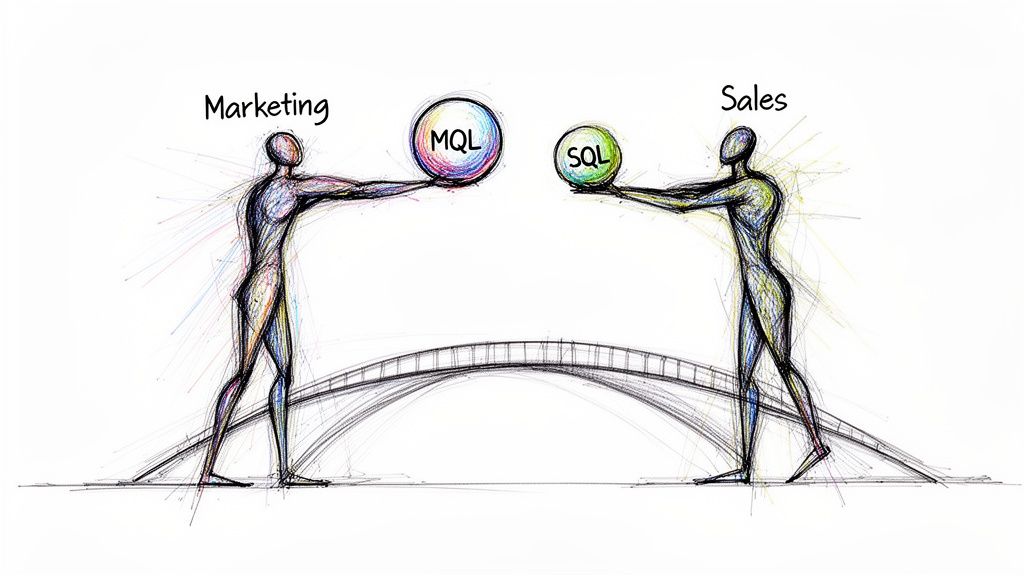
A stylized sketch of Marketing and Sales figures exchanging MQL and SQL globes across a bridge.

According to Zendesk on sales and marketing alignment, 79% of MQLs are never contacted by sales in siloed B2B operations, and aligned teams convert twice as many leads into opportunities. That is why the MQL-to-SQL transition deserves process design, not vague good intentions.

Define the two stages clearly

An MQL is a lead marketing has reason to believe is relevant and engaged. That judgment comes from fit and behavior. Fit means the account or person resembles the audience you want. Behavior means they did something meaningful, such as responding to a campaign, visiting key pages, or engaging with nurture content.

An SQL is a lead sales has reviewed and accepted as a viable opportunity to pursue directly.

The practical mistake is treating engagement as intent. A person can be interested in a topic without being ready to buy. Marketing should not call every active contact “sales-ready.” Sales should not reject leads without recording why.

What a good handoff looks like

A useful handoff includes context, not a name and email address.

Sales should be able to see:

  • Source history: which campaign, form, or channel brought the lead in

  • Behavior trail: what the person clicked, downloaded, replied to, or revisited

  • Fit data: company, role, geography, segment, and any known disqualifiers

  • Suggested next step: call now, enroll in outreach, or return to nurture

If your nurture is weak, fix that before you blame lead quality. Many SMBs hand leads to sales too early because they lack structured education. A simple drip campaign meaning guide is a good starting point for designing sequences that warm leads before a rep steps in.

Use explicit acceptance and rejection reasons

Do not let sales ignore leads. Add a short required field when a rep rejects or recycles one.

Examples:

  • not the right company type

  • no active need

  • wrong contact

  • timing issue

  • duplicate

  • not enough context to work

That feedback gives marketing something to improve. Without it, every rejected lead becomes anecdotal.

A short explainer can help teams reset how they think about the transfer:

Audit the handoff with a simple checklist

Run through these questions with both teams in the same room:

  1. What exact behaviors qualify an MQL?
    If the answer is fuzzy, sales will not trust the stage.

  2. Who accepts the lead, and by when?
    If ownership is unclear, leads sit untouched.

  3. What information must exist before routing?
    Reps need enough context to personalize first contact.

  4. When does sales recycle a lead instead of discarding it?
    Timing issues should feed nurture, not a dead list.

  5. How does marketing learn from rejected SQL candidates?
    Without structured feedback, the same poor-fit leads keep coming back.

A clean MQL-to-SQL handoff is where the difference between sales & marketing stops being conceptual and starts affecting revenue every day.

How to Build a Sales and Marketing Service Level Agreement

If your teams are aligned only through verbal expectations, they are not aligned. They are improvising.

An effective service level agreement, or SLA, turns hand-wavy promises into operating commitments. It says what marketing will deliver, what sales will do next, how quickly follow-up happens, and which metrics both teams review together.

Start with response rules

Speed matters because interest decays quickly. According to Crunchbase on sales vs marketing metrics and alignment, a lead response time under 5 minutes can lead to 391% higher contact rates, and unified scorecards can raise sales productivity to 65% selling time while shared goals can increase win rates by 15-20%.

That does not mean every SMB can respond instantly at all hours. It does mean you should write down the response expectation for business hours, after-hours leads, and routed accounts.

A practical SLA includes:

  • Inbound lead response: who responds, in what channel, and within what window

  • Outbound ownership: when sales can pursue a contact generated by marketing

  • Routing logic: which rep, territory, segment, or queue gets the lead

  • Recycling conditions: what sends a lead back to nurture instead of closing it out

Put shared KPIs above team vanity metrics

Marketing-only dashboards and sales-only dashboards often make the conflict worse. Your SLA should include a short list of metrics that both teams are accountable for together.

Use measures such as:

  • Lead acceptance rate: are routed leads trusted and worked?

  • Stage conversion quality: where do leads stall after handoff?

  • Pipeline velocity: is the movement from interest to opportunity improving?

  • Customer acquisition efficiency: are campaigns and rep effort creating profitable growth?

If your reporting setup is messy, map the workflow first. A practical resource on how to create a workflow for business growth can help teams define triggers, ownership, and handoff actions before they try to perfect dashboards.

The best SLA is short, specific, and enforced weekly. If it reads like legal copy, nobody will use it.

Build the document around commitments

A useful SLA can fit on one page. It should answer five questions.

What counts as a qualified lead

List the criteria. Include both fit and behavior. Keep it strict enough that sales trusts it, but not so strict that marketing cannot create pipeline.

What marketing owes sales

Document the fields, context, and lifecycle stage required before a lead is routed. If required information is missing, the lead should not move.

What sales owes marketing

State the follow-up expectation, acceptance or rejection process, and the required rejection reasons. Most SLAs break at this point. Marketing gets held to volume. Sales is held to nothing except broad revenue targets.

What happens to recycled leads

Recycled does not mean failed. It means “not ready now.” Build a return path into nurture, with clear rules for when the lead can come back for sales attention.

When both teams review the data

Set a recurring cadence. Weekly is best for tactical review. Monthly works for trend analysis and targeting changes.

What fails in practice

Three things break the SLA after it is written:

  • No enforcement: everyone agrees in a kickoff meeting, then old habits return.

  • Too many edge cases: teams create exceptions until the rules mean nothing.

  • No owner: someone needs to run the meeting, maintain definitions, and update stages.

The difference between sales & marketing gets much easier to manage when both teams sign up to the same operating terms. Without an SLA, every lead dispute is personal. With one, it becomes a process issue that can be fixed.

Bridging the Gap with Stamina’s Unified Platform

Most SMBs do not have a sales problem or a marketing problem in isolation. They have a coordination problem.

The top of the funnel lives in one tool. Outbound lives in another. The CRM is partially updated. Lead notes sit in inboxes. Nobody trusts the lifecycle stages because each system tells a slightly different story. That is where alignment efforts stall.
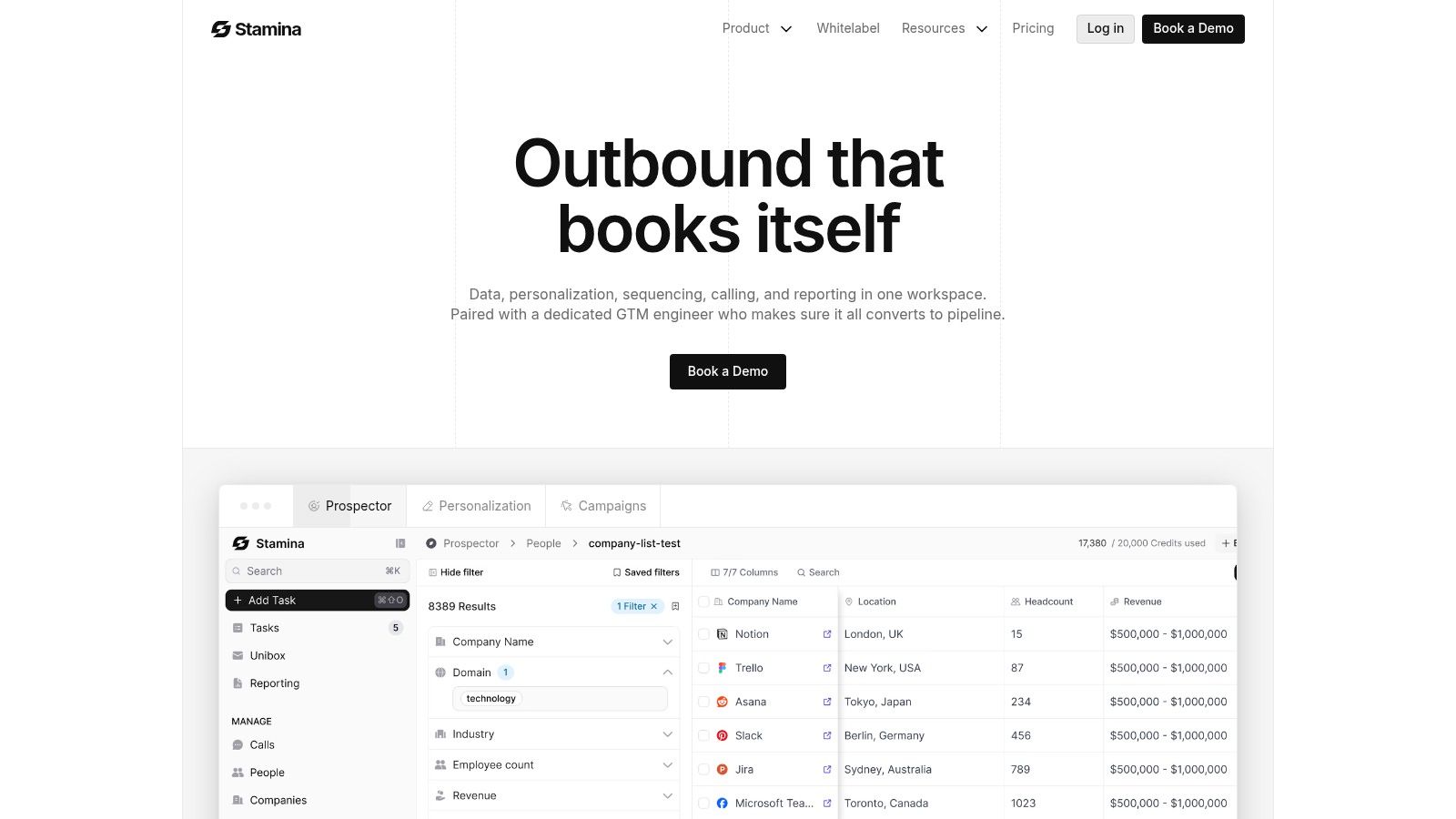
Screenshot from https://stamina.io/

The strongest case for a unified platform is not convenience. It is operational control. When marketing, sales engagement, and CRM activity live together, you stop losing context during handoffs.

Why unified systems change behavior

According to GrowthMethod on marketing vs sales for SMBs, 68% of SMBs report siloed sales-marketing teams cost them 10-20% in lost revenue, and the same source says Gartner reported a 45% rise in AI adoption for revenue ops among SMBs in 2026 as a projection. It also notes that platforms integrating AI SDRs and CRM are driving 30% higher pipeline velocity by automating handoffs and reducing disputes over lead quality.

That matters because SMBs seldom have excess headcount to solve process failure manually. If one person is acting as marketer in the morning, SDR at noon, and account executive in the afternoon, every missing field and every delayed follow-up creates drag.

What a unified setup should do

A platform that helps should support the full motion, not just one team’s task list.

Look for these capabilities:

  • Shared contact and account history: campaign engagement, outreach activity, notes, and pipeline status in one record

  • Marketing automation tied to lifecycle stages: a lead can move into nurture, re-enter sales outreach, or trigger a task without manual copying

  • Sales engagement with context: reps can see what the lead did before they write the first message

  • Workflow orchestration: routing, reminders, recycle rules, and ownership changes happen automatically

  • CRM as the source of truth: not a separate reporting layer patched on afterward

This is also where campaign execution matters. If your broadcasts, automated flows, and outbound sequences sit apart from the CRM, you are rebuilding the same alignment problem every week. A connected campaigns system such as Stamina Campaigns helps keep acquisition, nurture, and follow-up tied to the same buyer record.

How AI helps without replacing judgment

AI is useful when it removes repetitive work and preserves context. It is not useful when it sprays generic outreach or promotes weak leads as if they were ready.

In practice, AI should help with tasks such as:

Workflow problem

Better AI-assisted approach

Leads arrive without enough context

Enrich records and summarize prior engagement for the rep

Sales follow-up is inconsistent

Generate first-draft personalized outreach based on known signals

Marketing nurture is generic

Trigger segment-specific flows based on behavior and stage

Leads fall between teams

Automate routing, reminders, and recycle paths

Good automation narrows the gap between intent and action. Bad automation just speeds up confusion.

What works for SMB founders

Founders should resist buying separate point tools for every micro-problem unless they have strong revops support. More software means more places for the same lead to disappear.

A better operating model looks like this:

  • marketing captures and nurtures interest

  • AI-assisted outreach handles early personalized follow-up where appropriate

  • sales works accepted opportunities in the same system

  • recycled leads return to nurture automatically

  • leadership reviews one funnel, not three partial ones

That is how the difference between sales & marketing becomes manageable. You preserve role clarity, but the system removes the friction between roles.

Unified Reporting Measuring What Matters

Most SMB reports are built for departmental comfort, not revenue clarity.

Marketing reports clicks, opens, traffic, and campaign activity. Sales reports calls, meetings, proposals, and closed deals. Each set of numbers can look respectable while the business still struggles to grow efficiently.

Replace activity reporting with funnel reporting

A useful dashboard follows the buyer path from first signal to closed business. It does not stop at team boundaries.

That means leadership should be able to answer questions like:

  • Where are leads entering the funnel?

  • Which stages leak the most?

  • How long does movement between stages take?

  • Which sources create accepted opportunities, not just responses?

  • Which recycled leads come back and convert later?

If your team still builds custom spreadsheets every month, the reporting model is probably too fragmented. A practical explanation of ad hoc reporting means is helpful here, especially for founders who are trying to move from one-off analysis to repeatable operational reporting.

The dashboard should match decision-making

Do not overload the dashboard with every available field. Build it around decisions the team needs to make.

For example:

Decision

Reporting view needed

Should we invest more in this channel?

Stage progression by source, not just top-of-funnel activity

Is sales following up fast enough?

Lead response timing and acceptance status

Is nurture doing its job?

Re-entry into pipeline after recycle

Are we attracting the right accounts?

Fit and conversion by segment

A founder should be able to open the dashboard and immediately spot whether the issue is targeting, handoff quality, rep response, or late-stage execution.

Watch for false confidence

Vanity metrics create false optimism. A campaign can produce engagement without producing sales-ready demand. A rep can log heavy activity without advancing good opportunities.

The better discipline is to pair indicators across the funnel:

  • Volume with acceptance

  • Engagement with qualification

  • Opportunities with progression

  • Revenue with acquisition efficiency

If a metric cannot influence a decision, it belongs in a supporting report, not the main revenue dashboard.

One source of truth changes meeting quality

When teams review different exports, meetings turn into data disputes. When they review one shared funnel, they can spend the meeting fixing the process instead.

That is the reporting shift SMBs need. Not more charts. Better accountability. The difference between sales & marketing still exists in the work itself, but reporting should connect both functions to the same commercial outcome.

Common Sales and Marketing Alignment Questions

Can one person handle both sales and marketing in a startup

Yes, but only if you separate the work operationally. One person can wear both hats, but they should still run different workflows, goals, and review cadences for each function. Otherwise, urgent sales tasks crowd out the marketing work that keeps future demand alive.

What is the first step if my teams are already blaming each other

Audit the handoff. Do not start with culture workshops. Start with definitions, routing rules, response expectations, and rejection reasons. Much conflict eases once both teams can see exactly where leads stall or lose context.

Should marketing be responsible for revenue

Marketing should be tied to revenue outcomes, but not judged only on closed deals. Its role is upstream. The cleaner approach is shared revenue accountability with stage-specific ownership. Marketing should own the quality of demand creation. Sales should own the quality of direct conversion work.

How often should sales and marketing meet together

A weekly tactical review works well for most SMBs. Keep it tight. Review new lead quality, response compliance, stage leakage, and recycled leads. Use a monthly session for bigger changes such as targeting, messaging, and workflow updates.

What if sales says marketing leads are bad

Ask for coded rejection reasons, not opinions. “Bad leads” is useless feedback. “Wrong segment,” “no active need,” or “wrong contact” gives marketing something to fix. If sales cannot explain rejection consistently, the process is too subjective.

How long does alignment take

You can improve handoff quality quickly once ownership and lifecycle rules are documented. Larger gains come after teams have a few review cycles to tighten definitions, fix routing, and adjust nurture paths. The important point is to treat alignment as an operating system, not a one-time project.

Do we need separate tools for each team

No. SMBs benefit more from connected systems than from specialized point tools scattered across departments. If the tools force your team to duplicate data, manually relay context, or rebuild reports outside the system, they are adding friction.

If your team is tired of juggling disconnected tools and arguing over lead quality, Stamina gives growing SMBs one place to run marketing, sales engagement, and CRM together. It is built for the work this article described: cleaner handoffs, better follow-up, shared visibility, and AI-assisted execution that keeps revenue operations moving.

You can spot the problem before anyone says it out loud.

Marketing says lead volume is up, campaigns are working, and the pipeline should be fuller than it looks. Sales says the leads are weak, follow-up takes too much manual effort, and quota is getting harder, not easier. The founder sits in the middle, paying for both teams and wondering why revenue still feels unpredictable.

That tension is seldom about bad people. It is about a bad system.

The core difference between sales & marketing matters, but definitions alone will not fix the fights. SMBs need operating rules, shared data, fast handoffs, and one place where both teams can see the same funnel. Once that happens, the argument changes from “your team is the problem” to “this stage in the process is broken.” That is a much easier problem to solve.

Why Sales and Marketing Teams So Often Disagree

The pattern is familiar. Marketing launches campaigns, generates interest, and sends leads into the CRM. Sales opens the list, works a few contacts, ignores others, and then reports back that the leads were not serious buyers. Marketing hears that as laziness. Sales hears pushback as denial.

A conceptual sketch showing a tug-of-war match between business figures representing Sales and Marketing departments.

In most SMBs, the conflict starts with incentives. Marketing is asked to create awareness, drive engagement, and keep the top of the funnel moving. Sales is asked to close business now. One team gets rewarded for volume and reach. The other gets judged on conversion and revenue.

The teams often work from different realities

Marketing may be looking at campaign responses, form fills, webinar signups, or content engagement. Sales is looking at active opportunities, deal stages, and whether a real buyer will take a meeting. Both views are legitimate. The trouble starts when there is no agreed definition of what should move from one team to the next.

A few common symptoms appear:

  • Lead quality arguments: Marketing says the lead met the form criteria. Sales says the account has no urgency, budget, or fit.

  • Tool fragmentation: One team works from email and campaign tools. The other lives in the CRM. Context gets lost between systems.

  • Slow follow-up: A lead comes in warm, then waits. By the time sales reaches out, the buyer has cooled off.

  • No feedback loop: Sales rejects leads informally, but nobody updates targeting, scoring, or nurture logic.

Misalignment is usually an operations problem wearing a culture problem as a disguise.

What works and what does not

What does not work is telling the teams to “collaborate better” without changing the mechanics. Shared Slack channels do not fix broken qualification. Weekly meetings do not fix missing ownership rules. More dashboards do not help if everyone trusts different data.

What works is tighter process design:

  • a documented handoff point

  • one owner for each stage

  • visible lead history

  • clear recycle rules

  • shared review of lead quality

The difference between sales & marketing becomes productive when each team knows its job and trusts the transfer between jobs. Without that, every missed number turns into a blame exercise.

Sales vs Marketing A Side-by-Side Comparison

Sales and marketing support the same commercial outcome, but they do different work on different timelines.

Marketing builds awareness, shapes demand, and attracts people who may become buyers later. Sales takes qualified interest and turns it into committed revenue. According to Salesforce on the difference between sales and marketing, marketing emphasizes long-term brand building and lead generation, while sales focuses on short-term revenue generation, with marketing tracking MQLs and sales tracking SQLs, closed deals, and direct revenue. The same source notes that typical conversion rates from MQL to SQL range from 13-20% in B2B contexts.

Infographic

Core differences in one view

Dimension

Marketing

Sales

Primary goal

Build awareness, educate the market, generate interest

Convert qualified interest into revenue

Time horizon

Longer-term

Shorter-term

Audience focus

Segments, personas, broader market groups

Individual accounts, contacts, active opportunities

Typical activities

Content, SEO, paid campaigns, webinars, email nurture, messaging

Outreach, qualification, discovery, demos, proposals, negotiation

Funnel role

Top and middle of funnel

Middle to bottom of funnel

Main lead type

MQL

SQL

Success view

Engagement quality and pipeline creation

Deal progression and closed business

Communication style

One-to-many and automated

One-to-one and personalized

The mindset gap matters

Marketing asks, “How do we create more qualified interest from the right audience?”

Sales asks, “Which buyer is ready enough to talk now, and how do we close them?”

Marketing wins by creating momentum. Sales wins by turning momentum into commitment.

Neither team can replace the other. A business with strong marketing and weak sales generates activity without revenue. A business with strong sales and weak marketing often survives on founder-led hustle, referrals, and inconsistent outbound until growth stalls.

Where founders get this wrong

SMB founders collapse both functions into one rough idea: “get customers.” That sounds efficient, but it creates confusion fast.

If one person owns everything, they often default to whichever task feels urgent. That means sales conversations get attention while long-term demand generation slips. Then a few months later the pipeline dries up, and everyone wants more leads.

The cleaner approach is to separate responsibilities even when the same person wears both hats. The same operator can handle sales and marketing, but the work still needs different goals, workflows, and review cycles.

A practical way to think about the split

Use this quick framing when you define ownership:

  • Marketing owns market attention: positioning, campaigns, content, nurture, and the early signals that indicate interest.

  • Sales owns buying progress: qualification, direct outreach, objection handling, meeting conversion, and deal advancement.

  • Revenue operations owns the plumbing: lifecycle stages, automation, reporting, and process discipline.

If you want the difference between sales & marketing in one sentence, it is this:

Marketing creates the conditions for buying. Sales helps a specific buyer make the decision.

That distinction reduces overlap without creating silos. It also makes handoffs easier because each team understands what “done” looks like before the next team takes over.

Mastering the Critical Handoff from MQL to SQL

Most revenue friction does not happen at the campaign level or the closing stage. It happens in the handoff.

Marketing says, “This lead engaged, fits the audience, and should be worked.” Sales says, “This person downloaded something, but that does not mean they are worth a rep’s time.” Both can be right if nobody defined the handoff well.

A stylized sketch of Marketing and Sales figures exchanging MQL and SQL globes across a bridge.

According to Zendesk on sales and marketing alignment, 79% of MQLs are never contacted by sales in siloed B2B operations, and aligned teams convert twice as many leads into opportunities. That is why the MQL-to-SQL transition deserves process design, not vague good intentions.

Define the two stages clearly

An MQL is a lead marketing has reason to believe is relevant and engaged. That judgment comes from fit and behavior. Fit means the account or person resembles the audience you want. Behavior means they did something meaningful, such as responding to a campaign, visiting key pages, or engaging with nurture content.

An SQL is a lead sales has reviewed and accepted as a viable opportunity to pursue directly.

The practical mistake is treating engagement as intent. A person can be interested in a topic without being ready to buy. Marketing should not call every active contact “sales-ready.” Sales should not reject leads without recording why.

What a good handoff looks like

A useful handoff includes context, not a name and email address.

Sales should be able to see:

  • Source history: which campaign, form, or channel brought the lead in

  • Behavior trail: what the person clicked, downloaded, replied to, or revisited

  • Fit data: company, role, geography, segment, and any known disqualifiers

  • Suggested next step: call now, enroll in outreach, or return to nurture

If your nurture is weak, fix that before you blame lead quality. Many SMBs hand leads to sales too early because they lack structured education. A simple drip campaign meaning guide is a good starting point for designing sequences that warm leads before a rep steps in.

Use explicit acceptance and rejection reasons

Do not let sales ignore leads. Add a short required field when a rep rejects or recycles one.

Examples:

  • not the right company type

  • no active need

  • wrong contact

  • timing issue

  • duplicate

  • not enough context to work

That feedback gives marketing something to improve. Without it, every rejected lead becomes anecdotal.

A short explainer can help teams reset how they think about the transfer:

Audit the handoff with a simple checklist

Run through these questions with both teams in the same room:

  1. What exact behaviors qualify an MQL?
    If the answer is fuzzy, sales will not trust the stage.

  2. Who accepts the lead, and by when?
    If ownership is unclear, leads sit untouched.

  3. What information must exist before routing?
    Reps need enough context to personalize first contact.

  4. When does sales recycle a lead instead of discarding it?
    Timing issues should feed nurture, not a dead list.

  5. How does marketing learn from rejected SQL candidates?
    Without structured feedback, the same poor-fit leads keep coming back.

A clean MQL-to-SQL handoff is where the difference between sales & marketing stops being conceptual and starts affecting revenue every day.

How to Build a Sales and Marketing Service Level Agreement

If your teams are aligned only through verbal expectations, they are not aligned. They are improvising.

An effective service level agreement, or SLA, turns hand-wavy promises into operating commitments. It says what marketing will deliver, what sales will do next, how quickly follow-up happens, and which metrics both teams review together.

Start with response rules

Speed matters because interest decays quickly. According to Crunchbase on sales vs marketing metrics and alignment, a lead response time under 5 minutes can lead to 391% higher contact rates, and unified scorecards can raise sales productivity to 65% selling time while shared goals can increase win rates by 15-20%.

That does not mean every SMB can respond instantly at all hours. It does mean you should write down the response expectation for business hours, after-hours leads, and routed accounts.

A practical SLA includes:

  • Inbound lead response: who responds, in what channel, and within what window

  • Outbound ownership: when sales can pursue a contact generated by marketing

  • Routing logic: which rep, territory, segment, or queue gets the lead

  • Recycling conditions: what sends a lead back to nurture instead of closing it out

Put shared KPIs above team vanity metrics

Marketing-only dashboards and sales-only dashboards often make the conflict worse. Your SLA should include a short list of metrics that both teams are accountable for together.

Use measures such as:

  • Lead acceptance rate: are routed leads trusted and worked?

  • Stage conversion quality: where do leads stall after handoff?

  • Pipeline velocity: is the movement from interest to opportunity improving?

  • Customer acquisition efficiency: are campaigns and rep effort creating profitable growth?

If your reporting setup is messy, map the workflow first. A practical resource on how to create a workflow for business growth can help teams define triggers, ownership, and handoff actions before they try to perfect dashboards.

The best SLA is short, specific, and enforced weekly. If it reads like legal copy, nobody will use it.

Build the document around commitments

A useful SLA can fit on one page. It should answer five questions.

What counts as a qualified lead

List the criteria. Include both fit and behavior. Keep it strict enough that sales trusts it, but not so strict that marketing cannot create pipeline.

What marketing owes sales

Document the fields, context, and lifecycle stage required before a lead is routed. If required information is missing, the lead should not move.

What sales owes marketing

State the follow-up expectation, acceptance or rejection process, and the required rejection reasons. Most SLAs break at this point. Marketing gets held to volume. Sales is held to nothing except broad revenue targets.

What happens to recycled leads

Recycled does not mean failed. It means “not ready now.” Build a return path into nurture, with clear rules for when the lead can come back for sales attention.

When both teams review the data

Set a recurring cadence. Weekly is best for tactical review. Monthly works for trend analysis and targeting changes.

What fails in practice

Three things break the SLA after it is written:

  • No enforcement: everyone agrees in a kickoff meeting, then old habits return.

  • Too many edge cases: teams create exceptions until the rules mean nothing.

  • No owner: someone needs to run the meeting, maintain definitions, and update stages.

The difference between sales & marketing gets much easier to manage when both teams sign up to the same operating terms. Without an SLA, every lead dispute is personal. With one, it becomes a process issue that can be fixed.

Bridging the Gap with Stamina’s Unified Platform

Most SMBs do not have a sales problem or a marketing problem in isolation. They have a coordination problem.

The top of the funnel lives in one tool. Outbound lives in another. The CRM is partially updated. Lead notes sit in inboxes. Nobody trusts the lifecycle stages because each system tells a slightly different story. That is where alignment efforts stall.

Screenshot from https://stamina.io/

The strongest case for a unified platform is not convenience. It is operational control. When marketing, sales engagement, and CRM activity live together, you stop losing context during handoffs.

Why unified systems change behavior

According to GrowthMethod on marketing vs sales for SMBs, 68% of SMBs report siloed sales-marketing teams cost them 10-20% in lost revenue, and the same source says Gartner reported a 45% rise in AI adoption for revenue ops among SMBs in 2026 as a projection. It also notes that platforms integrating AI SDRs and CRM are driving 30% higher pipeline velocity by automating handoffs and reducing disputes over lead quality.

That matters because SMBs seldom have excess headcount to solve process failure manually. If one person is acting as marketer in the morning, SDR at noon, and account executive in the afternoon, every missing field and every delayed follow-up creates drag.

What a unified setup should do

A platform that helps should support the full motion, not just one team’s task list.

Look for these capabilities:

  • Shared contact and account history: campaign engagement, outreach activity, notes, and pipeline status in one record

  • Marketing automation tied to lifecycle stages: a lead can move into nurture, re-enter sales outreach, or trigger a task without manual copying

  • Sales engagement with context: reps can see what the lead did before they write the first message

  • Workflow orchestration: routing, reminders, recycle rules, and ownership changes happen automatically

  • CRM as the source of truth: not a separate reporting layer patched on afterward

This is also where campaign execution matters. If your broadcasts, automated flows, and outbound sequences sit apart from the CRM, you are rebuilding the same alignment problem every week. A connected campaigns system such as Stamina Campaigns helps keep acquisition, nurture, and follow-up tied to the same buyer record.

How AI helps without replacing judgment

AI is useful when it removes repetitive work and preserves context. It is not useful when it sprays generic outreach or promotes weak leads as if they were ready.

In practice, AI should help with tasks such as:

Workflow problem

Better AI-assisted approach

Leads arrive without enough context

Enrich records and summarize prior engagement for the rep

Sales follow-up is inconsistent

Generate first-draft personalized outreach based on known signals

Marketing nurture is generic

Trigger segment-specific flows based on behavior and stage

Leads fall between teams

Automate routing, reminders, and recycle paths

Good automation narrows the gap between intent and action. Bad automation just speeds up confusion.

What works for SMB founders

Founders should resist buying separate point tools for every micro-problem unless they have strong revops support. More software means more places for the same lead to disappear.

A better operating model looks like this:

  • marketing captures and nurtures interest

  • AI-assisted outreach handles early personalized follow-up where appropriate

  • sales works accepted opportunities in the same system

  • recycled leads return to nurture automatically

  • leadership reviews one funnel, not three partial ones

That is how the difference between sales & marketing becomes manageable. You preserve role clarity, but the system removes the friction between roles.

Unified Reporting Measuring What Matters

Most SMB reports are built for departmental comfort, not revenue clarity.

Marketing reports clicks, opens, traffic, and campaign activity. Sales reports calls, meetings, proposals, and closed deals. Each set of numbers can look respectable while the business still struggles to grow efficiently.

Replace activity reporting with funnel reporting

A useful dashboard follows the buyer path from first signal to closed business. It does not stop at team boundaries.

That means leadership should be able to answer questions like:

  • Where are leads entering the funnel?

  • Which stages leak the most?

  • How long does movement between stages take?

  • Which sources create accepted opportunities, not just responses?

  • Which recycled leads come back and convert later?

If your team still builds custom spreadsheets every month, the reporting model is probably too fragmented. A practical explanation of ad hoc reporting means is helpful here, especially for founders who are trying to move from one-off analysis to repeatable operational reporting.

The dashboard should match decision-making

Do not overload the dashboard with every available field. Build it around decisions the team needs to make.

For example:

Decision

Reporting view needed

Should we invest more in this channel?

Stage progression by source, not just top-of-funnel activity

Is sales following up fast enough?

Lead response timing and acceptance status

Is nurture doing its job?

Re-entry into pipeline after recycle

Are we attracting the right accounts?

Fit and conversion by segment

A founder should be able to open the dashboard and immediately spot whether the issue is targeting, handoff quality, rep response, or late-stage execution.

Watch for false confidence

Vanity metrics create false optimism. A campaign can produce engagement without producing sales-ready demand. A rep can log heavy activity without advancing good opportunities.

The better discipline is to pair indicators across the funnel:

  • Volume with acceptance

  • Engagement with qualification

  • Opportunities with progression

  • Revenue with acquisition efficiency

If a metric cannot influence a decision, it belongs in a supporting report, not the main revenue dashboard.

One source of truth changes meeting quality

When teams review different exports, meetings turn into data disputes. When they review one shared funnel, they can spend the meeting fixing the process instead.

That is the reporting shift SMBs need. Not more charts. Better accountability. The difference between sales & marketing still exists in the work itself, but reporting should connect both functions to the same commercial outcome.

Common Sales and Marketing Alignment Questions

Can one person handle both sales and marketing in a startup

Yes, but only if you separate the work operationally. One person can wear both hats, but they should still run different workflows, goals, and review cadences for each function. Otherwise, urgent sales tasks crowd out the marketing work that keeps future demand alive.

What is the first step if my teams are already blaming each other

Audit the handoff. Do not start with culture workshops. Start with definitions, routing rules, response expectations, and rejection reasons. Much conflict eases once both teams can see exactly where leads stall or lose context.

Should marketing be responsible for revenue

Marketing should be tied to revenue outcomes, but not judged only on closed deals. Its role is upstream. The cleaner approach is shared revenue accountability with stage-specific ownership. Marketing should own the quality of demand creation. Sales should own the quality of direct conversion work.

How often should sales and marketing meet together

A weekly tactical review works well for most SMBs. Keep it tight. Review new lead quality, response compliance, stage leakage, and recycled leads. Use a monthly session for bigger changes such as targeting, messaging, and workflow updates.

What if sales says marketing leads are bad

Ask for coded rejection reasons, not opinions. “Bad leads” is useless feedback. “Wrong segment,” “no active need,” or “wrong contact” gives marketing something to fix. If sales cannot explain rejection consistently, the process is too subjective.

How long does alignment take

You can improve handoff quality quickly once ownership and lifecycle rules are documented. Larger gains come after teams have a few review cycles to tighten definitions, fix routing, and adjust nurture paths. The important point is to treat alignment as an operating system, not a one-time project.

Do we need separate tools for each team

No. SMBs benefit more from connected systems than from specialized point tools scattered across departments. If the tools force your team to duplicate data, manually relay context, or rebuild reports outside the system, they are adding friction.

If your team is tired of juggling disconnected tools and arguing over lead quality, Stamina gives growing SMBs one place to run marketing, sales engagement, and CRM together. It is built for the work this article described: cleaner handoffs, better follow-up, shared visibility, and AI-assisted execution that keeps revenue operations moving.

Share this article

Share this article

Send a shareable link to your team or anyone who might find it useful.

Send a shareable link to your team or anyone who might find it useful.

Copy link

Copied

Share directly to

Table of contents

Give Your Business the Stamina it needs to Thrive