What Is Behavioural Segmentation in Marketing? a 2026 Guide

Learn what is behavioural segmentation in marketing, the criteria that matter, real SMB examples, and how AI-driven platforms turn behaviour into pipeline.

0 - Minute Read

Behavioural segmentation in marketing is grouping customers by what they do, browsing, buying, and engaging, rather than by who they are. In a survey of more than 800 marketers across 23 sectors, 44% said behaviour was their main segmentation basis, and 91% said it was the most effective method in recent campaigns, which is why what is behavioural segmentation in marketing matters so much right now.

You've probably seen the problem already. Two teams can sell the same product, to the same market, with very different results, because one team builds campaigns around job titles and company size while the other reacts to clicks, purchases, repeat visits, and loyalty signals.

The Behavioural Segmentation Shift That Is Reshaping Marketing

A founder sells a subscription box to the same broad audience as a competitor, but one team keeps missing the mark. They target by role and region, while the other team notices who browses the pricing page twice, who orders every month, and who opens every reorder reminder. That second team writes less generic copy and gets much closer to the customer's actual intent.

A professional man and woman working side by side on laptops analyzing marketing data and growth strategies.

Behavioural segmentation means dividing an audience by observable actions, not static traits. That includes browsing, buying, product usage, engagement, and loyalty patterns, so the segment reflects what a customer is doing right now rather than what a profile says about them.

The shift is now mainstream. In the Marketing Week survey of more than 800 marketers across 23 sectors, behaviour was the most commonly used segmentation basis at 44%, ahead of location at 42% and age at 38%. The same survey found that 91% of respondents said behaviour was the most effective segmentation method in recent campaigns, and 73% said it had become more effective over the previous five years. That tells you this isn't a niche tactic, it's become the default way many teams think about targeting. Marketing Week's survey of behaviour-led segmentation

Practical rule: if a customer action changes what you should say next, it belongs in a behavioural segment.

That's why an SMB-friendly explanation matters. A small team doesn't need a theory about audience identity, it needs a way to spot who is ready to buy, who needs a nudge, and who should be routed to sales or nurture. If you're mapping that foundation, pairing behavioural segmentation with a clearer intent layer like intent data makes the strategy easier to operationalize.

Why the shift keeps accelerating

Digital systems made this possible. Web visits, app events, cart activity, email engagement, and transactions all create a live trail of behaviour, and that trail is far more actionable than a frozen demographic profile.

For SMBs, that matters because the segment is only useful if it updates with the customer. A person can move from curious visitor to hot lead to repeat buyer in a few days, and your messaging has to move with them. Behavioural segmentation is the mechanism that makes that possible.

The Core Criteria Behind Behavioural Segmentation

The classic framework is broader than commonly assumed. Salesforce groups behavioural segmentation into six major subcategories, purchasing behaviour, occasion purchasing, customer usage, benefits sought, loyalty gauge, and buying stage. Those categories give you a practical way to move from raw behaviour to a segment that matches the journey.

The six levers in plain English

  • Purchasing behaviour: how people buy, including frequency, recency, and order patterns.

  • Occasion purchasing: the timing or trigger behind a buy, such as a recurring need or seasonal moment.

  • Customer usage: how often and how much someone uses the product or service.

  • Benefits sought: what outcome they want, like convenience, quality, or problem-solving.

  • Loyalty gauge: how attached they are, from first-time buyer to repeat advocate.

  • Buying stage: where they sit in the journey, from awareness to repeat purchase.

A gym tracker makes this easier to picture. A single weigh-in tells you little, but repeated visits, class attendance, and milestone streaks show whether someone is a casual starter, a steady user, or a loyal member. Behavioural segmentation works the same way, each event adds context, and the pattern matters more than the isolated action.

A segment should behave like a live snapshot, not a permanent label.

That's the technical difference from static targeting. Behavioural segments are time-ordered, which means a customer can move between them as usage, recency, or loyalty changes. If your system does not refresh often enough, you end up targeting someone based on last month's intent instead of today's reality.

Which behaviour maps to which stage

A few simple patterns do most of the work. Repeated site visits can point to consideration, feature adoption can point to product fit, and repeat purchasing can point to retention potential. Occasion-based buying is useful when your customers come back on a rhythm, while loyalty signals help you separate one-time buyers from people worth nurturing more aggressively.

The important part is not memorizing the labels. It's learning to read behaviour as a sequence. When you do that, the segment becomes useful for messaging, channel choice, and timing, not just reporting.

Behavioural Versus Demographic Segmentation

Demographic data still has a place, but it answers a different question. Age, income, and location help with broad reach and media planning, while behaviour shows what someone is likely to do next. That's why many teams use demographics as a filter and behaviour as the decision layer.

Behavioural vs Demographic Segmentation at a Glance

Behavioural Segmentation

Demographic Segmentation

Dimension

Actions, engagement, usage, loyalty

Age, income, role, location

What it tells you

Intent and lifecycle stage

Identity and broad fit

Best use

Timing, personalization, retention, sales routing

Initial audience sizing, media planning

Strength

More precise next-best-action targeting

Easier to understand at a glance

Limitation

Needs fresh data and discipline

Can miss what the customer is actually doing

The reason behaviour usually wins is simple. It predicts the next move better because it reflects what the customer is doing now. That is why segmented campaigns have been associated with 30% more opens and 50% more click-throughs than unsegmented campaigns in the performance benchmarks cited in the brief, and why optimized segmentation can improve customer lifetime value by about 22%. Customer segmentation statistics and benchmarks

Use demographics when you need a starting frame. A local services company may still care whether a customer is in the service area, and a B2B team may still need company size or role to qualify leads. But once a person is in market, behaviour should drive the follow-up.

Where behaviour takes over

Behaviour pulls ahead in three moments. First, when timing matters, like cart abandonment or a demo request. Second, when churn risk is visible through declining usage or fewer return visits. Third, when sales needs to route a high-intent account quickly rather than wait for a static profile to catch up.

The mental model is straightforward. Demographics tell you who fits the audience, behaviour tells you who fits the moment.

Real SMB Examples That Bring Behavioural Segments to Life

A DTC skincare brand can learn more from refill timing than from age brackets. If a customer buys a cleanser every six weeks, the brand can segment by purchase cadence and occasion purchasing, then send a reorder reminder before the product runs out. The message isn't “you're a 28 to 34 year old woman,” it's “you're due for your next refill.”

A B2B SaaS team has a different signal. During a free trial, some users adopt advanced features quickly while others log in once and disappear. The first group belongs in a high-intent segment, and the sales team can follow up with a personalised outreach sequence, while the dormant group gets a lighter nurture path focused on activation. The behaviour being tracked is feature adoption, not job title.

A local services company can build value from loyalty and review frequency. Repeat customers who leave reviews, refer friends, or book follow-up appointments are different from one-off buyers who never return. The loyal segment gets appreciation offers or referral asks, while lapsed buyers get a simple re-engagement message that references the last service they booked.

What these examples have in common

Each one starts with a behaviour that maps to a business outcome. Reorder timing supports retention, feature adoption supports conversion, and repeat engagement supports loyalty. None of those moves require a huge data team, they just require a clean view of the event that matters.

  • Replenishment cadence: useful for products people buy again on a schedule.

  • Feature adoption: useful for trials, onboarding, and expansion.

  • Loyalty actions: useful for referrals, reviews, and retention.

The pattern is the same across SMBs. You identify the repeated action, decide what it says about intent, then match the offer to that stage.

Implementation Steps for Behavioural Segmentation
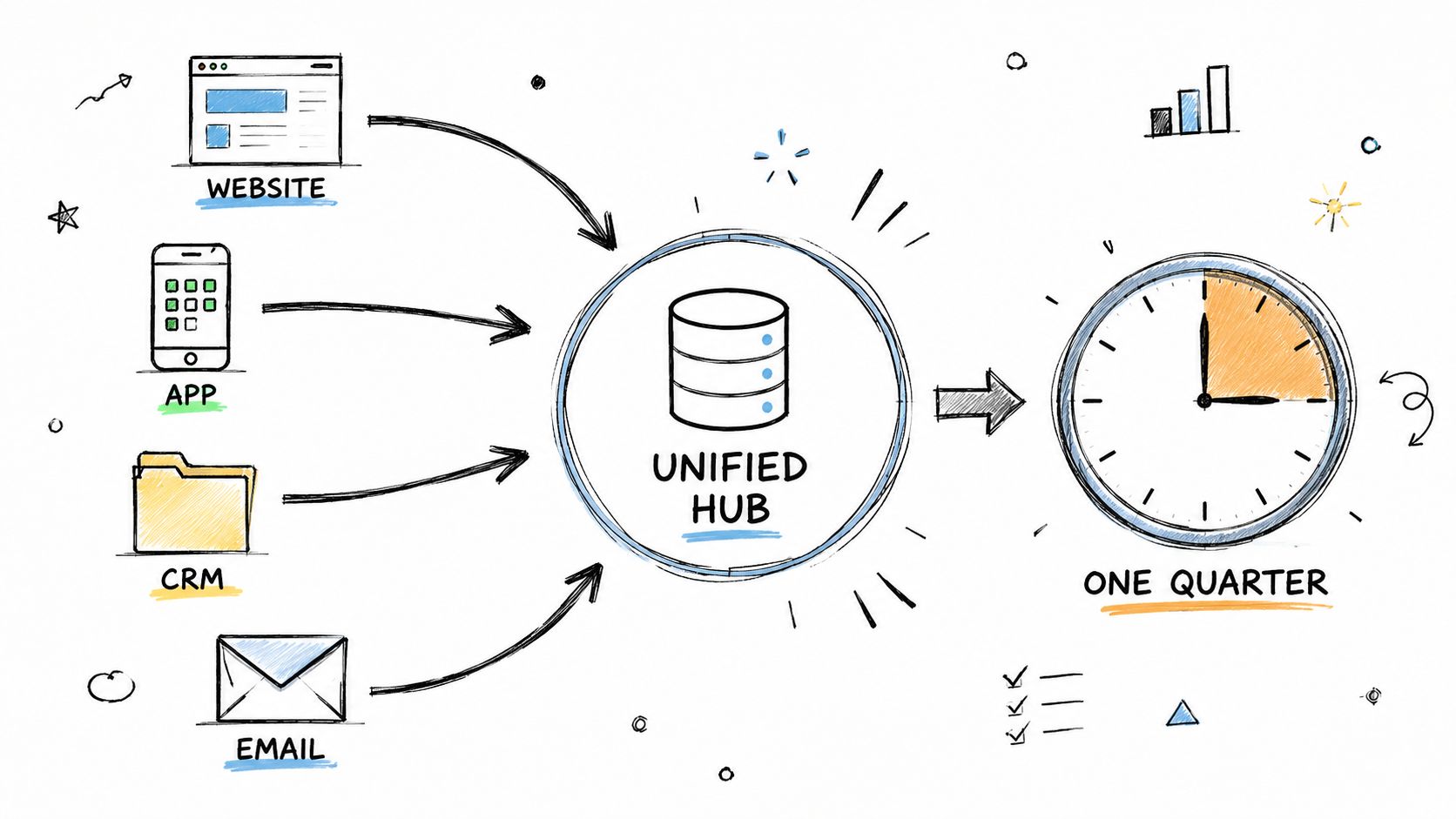
A diagram illustrating data integration from website, app, CRM, and email into a unified hub over one quarter.

The cleanest rollout starts with first-party events. Collect website activity, app events, CRM updates, and email interactions, then make sure those signals describe the same person or account. Without that shared profile, your segments end up fragmented across tools and nobody trusts the output.

The next step is deciding how much logic you need. Rule-based segments are fine for obvious triggers like repeated cart abandonment or trial inactivity, while AI scoring helps when you want to rank many signals and surface the strongest intent patterns. For teams trying to estimate where the business impact will come from, it helps to calculate your ROI before adding more automation, because not every segment deserves the same level of effort.

A practical sequence SMB teams can run

  1. Collect the event stream. Capture page visits, form fills, product usage, email actions, and purchase events from the systems you already own.

  2. Unify the profile. Merge records so sales, marketing, and CRM all see the same customer history.

  3. Score the behaviour. Use simple rules first, then layer in AI or propensity models when the signal volume justifies it.

  4. Activate the segment. Push it into email, on-site experiences, sales outreach, or nurture workflows.

  5. Measure the result. Track opens, replies, demo bookings, and revenue, not just clicks.

If a segment can't trigger a message, task, or workflow, it's probably a reporting view, not an operating segment.

A lot of teams get stuck here. They collect the data, but they never wire it into action. If you're trying to centralize that flow, customer data integration is the backbone, because behavioural segmentation only pays off when the data reaches the teams that can use it.

Keep the loop tight

Segments need refresh logic. A lead who looked hot last week may not be hot today, and a customer who was inactive can become engaged again after one strong interaction. That's why the activation layer matters as much as the model layer, the message only works if it reaches the customer at the right moment.

Which Behaviours Actually Predict Revenue

Not every signal deserves equal weight. A customer can scroll, open, and click without buying, and those actions may tell you very little unless they repeat or line up with a deeper intent pattern. The useful task is separating intent signals from noise signals.

Intent signals usually show commitment or urgency. Repeated pricing visits, demo requests, product feature adoption, high session frequency, and repeat purchase cadence all tell you something about likely revenue impact. Noise signals are weaker on their own, like a single passive scroll or a generic open, because they often reflect curiosity rather than purchase readiness.

A simple way to rank behaviour

Think in terms of recency and frequency first. If someone keeps returning to a pricing page, that behaviour deserves more weight than a one-off click from an email. If a customer uses a core feature every week, that says more about retention than a single log-in.

AI makes this easier when you have enough event volume. It can cluster similar users, score likelihood to convert, and surface micro-segments that a manual rule set would miss. SMBs don't need to overcomplicate the first pass, but they do need a way to suppress low-quality audiences instead of wasting spend on them.

One strong behavioural signal usually beats ten weak ones, especially when you're deciding where to spend time or budget.

Sales and marketing often benefit from the same logic. If a signal can guide outreach, it should also guide spend. A useful companion when you're evaluating how much a segment is worth is lead scoring automation, because scoring and segmentation work best when they share the same behavioural inputs.

The deeper point is practical. Behavioural segmentation should not become a way to celebrate activity for its own sake. It should help you find the events that predict conversion, retention, or expansion, then use those events to shape action.

Common Mistakes SMBs Make With Behavioural Segments

The first mistake is letting segments go stale. A team builds an audience once, never refreshes it, and keeps sending offers to people whose behaviour has already changed. The fix is simple, rebuild or refresh the segment on a schedule that matches the customer's buying cycle.

The second mistake is treating every event as equally important. A page view, a demo request, and a trial activation are not the same thing, even if they all sit in the same dashboard. Weight the signals by intent, not by convenience.

The third mistake is relying on weak or brittle data. If the team overuses third-party tracking or ignores consent, the segment becomes unstable and hard to trust. First-party discipline matters because it gives you a more durable base to work from, especially as privacy rules shift.

Five failure modes and the fix

  • Stale segments: old audiences keep receiving new messages. Fix: refresh segments continuously or near real time.

  • Equal-weight thinking: every click gets the same importance. Fix: rank signals by intent and proximity to revenue.

  • Privacy shortcuts: tracking rules don't match the data policy. Fix: build from first-party sources and clear consent.

  • Tool sprawl: one segment lives in email, another in CRM, another in ads. Fix: centralize the profile before activation.

  • Vanity measurement: the team celebrates opens but ignores pipeline. Fix: tie every segment to sales or revenue outcomes.

The fourth mistake is letting the stack fragment. If sales, marketing, and CRM each maintain their own version of the segment, nobody knows which one is current. The fifth mistake is measuring only clicks and opens, which makes busy campaigns look better than they are.

A good review question is blunt, did the segment change what the business did next? If the answer is no, the segment wasn't operational enough.

Bringing It All Together With an AI-Driven Platform

A behavioural system works best when one layer holds the data and another layer acts on it. Stamina does that by unifying behavioural, CRM, and engagement data, then using that shared layer to power marketing, sales, and CRM workflows in one place. If you want the broader automation frame, marketing automation with AI shows how the same idea extends beyond segmentation alone.

Zara, the built-in AI SDR, can use behavioural signals to identify, research, and contact ideal customers. Sales Engagement can turn warm visitor and social signals into outbound sequences, while marketers can build broadcasts and nurture flows from the same customer history. That's the payoff, the segment isn't sitting in a dashboard, it's moving work into the right workflow.

For SMBs, that means behavioural segmentation becomes an operating system for revenue, not just a targeting trick. The event comes in, the segment updates, and the right team acts on it.

If you're ready to turn customer behaviour into live segments, outreach, and nurture that move pipeline, visit Stamina and see how a unified AI-powered platform can connect your marketing, sales, and CRM around the same customer signals.

Behavioural segmentation in marketing is grouping customers by what they do, browsing, buying, and engaging, rather than by who they are. In a survey of more than 800 marketers across 23 sectors, 44% said behaviour was their main segmentation basis, and 91% said it was the most effective method in recent campaigns, which is why what is behavioural segmentation in marketing matters so much right now.

You've probably seen the problem already. Two teams can sell the same product, to the same market, with very different results, because one team builds campaigns around job titles and company size while the other reacts to clicks, purchases, repeat visits, and loyalty signals.

The Behavioural Segmentation Shift That Is Reshaping Marketing

A founder sells a subscription box to the same broad audience as a competitor, but one team keeps missing the mark. They target by role and region, while the other team notices who browses the pricing page twice, who orders every month, and who opens every reorder reminder. That second team writes less generic copy and gets much closer to the customer's actual intent.

A professional man and woman working side by side on laptops analyzing marketing data and growth strategies.

Behavioural segmentation means dividing an audience by observable actions, not static traits. That includes browsing, buying, product usage, engagement, and loyalty patterns, so the segment reflects what a customer is doing right now rather than what a profile says about them.

The shift is now mainstream. In the Marketing Week survey of more than 800 marketers across 23 sectors, behaviour was the most commonly used segmentation basis at 44%, ahead of location at 42% and age at 38%. The same survey found that 91% of respondents said behaviour was the most effective segmentation method in recent campaigns, and 73% said it had become more effective over the previous five years. That tells you this isn't a niche tactic, it's become the default way many teams think about targeting. Marketing Week's survey of behaviour-led segmentation

Practical rule: if a customer action changes what you should say next, it belongs in a behavioural segment.

That's why an SMB-friendly explanation matters. A small team doesn't need a theory about audience identity, it needs a way to spot who is ready to buy, who needs a nudge, and who should be routed to sales or nurture. If you're mapping that foundation, pairing behavioural segmentation with a clearer intent layer like intent data makes the strategy easier to operationalize.

Why the shift keeps accelerating

Digital systems made this possible. Web visits, app events, cart activity, email engagement, and transactions all create a live trail of behaviour, and that trail is far more actionable than a frozen demographic profile.

For SMBs, that matters because the segment is only useful if it updates with the customer. A person can move from curious visitor to hot lead to repeat buyer in a few days, and your messaging has to move with them. Behavioural segmentation is the mechanism that makes that possible.

The Core Criteria Behind Behavioural Segmentation

The classic framework is broader than commonly assumed. Salesforce groups behavioural segmentation into six major subcategories, purchasing behaviour, occasion purchasing, customer usage, benefits sought, loyalty gauge, and buying stage. Those categories give you a practical way to move from raw behaviour to a segment that matches the journey.

The six levers in plain English

  • Purchasing behaviour: how people buy, including frequency, recency, and order patterns.

  • Occasion purchasing: the timing or trigger behind a buy, such as a recurring need or seasonal moment.

  • Customer usage: how often and how much someone uses the product or service.

  • Benefits sought: what outcome they want, like convenience, quality, or problem-solving.

  • Loyalty gauge: how attached they are, from first-time buyer to repeat advocate.

  • Buying stage: where they sit in the journey, from awareness to repeat purchase.

A gym tracker makes this easier to picture. A single weigh-in tells you little, but repeated visits, class attendance, and milestone streaks show whether someone is a casual starter, a steady user, or a loyal member. Behavioural segmentation works the same way, each event adds context, and the pattern matters more than the isolated action.

A segment should behave like a live snapshot, not a permanent label.

That's the technical difference from static targeting. Behavioural segments are time-ordered, which means a customer can move between them as usage, recency, or loyalty changes. If your system does not refresh often enough, you end up targeting someone based on last month's intent instead of today's reality.

Which behaviour maps to which stage

A few simple patterns do most of the work. Repeated site visits can point to consideration, feature adoption can point to product fit, and repeat purchasing can point to retention potential. Occasion-based buying is useful when your customers come back on a rhythm, while loyalty signals help you separate one-time buyers from people worth nurturing more aggressively.

The important part is not memorizing the labels. It's learning to read behaviour as a sequence. When you do that, the segment becomes useful for messaging, channel choice, and timing, not just reporting.

Behavioural Versus Demographic Segmentation

Demographic data still has a place, but it answers a different question. Age, income, and location help with broad reach and media planning, while behaviour shows what someone is likely to do next. That's why many teams use demographics as a filter and behaviour as the decision layer.

Behavioural vs Demographic Segmentation at a Glance

Behavioural Segmentation

Demographic Segmentation

Dimension

Actions, engagement, usage, loyalty

Age, income, role, location

What it tells you

Intent and lifecycle stage

Identity and broad fit

Best use

Timing, personalization, retention, sales routing

Initial audience sizing, media planning

Strength

More precise next-best-action targeting

Easier to understand at a glance

Limitation

Needs fresh data and discipline

Can miss what the customer is actually doing

The reason behaviour usually wins is simple. It predicts the next move better because it reflects what the customer is doing now. That is why segmented campaigns have been associated with 30% more opens and 50% more click-throughs than unsegmented campaigns in the performance benchmarks cited in the brief, and why optimized segmentation can improve customer lifetime value by about 22%. Customer segmentation statistics and benchmarks

Use demographics when you need a starting frame. A local services company may still care whether a customer is in the service area, and a B2B team may still need company size or role to qualify leads. But once a person is in market, behaviour should drive the follow-up.

Where behaviour takes over

Behaviour pulls ahead in three moments. First, when timing matters, like cart abandonment or a demo request. Second, when churn risk is visible through declining usage or fewer return visits. Third, when sales needs to route a high-intent account quickly rather than wait for a static profile to catch up.

The mental model is straightforward. Demographics tell you who fits the audience, behaviour tells you who fits the moment.

Real SMB Examples That Bring Behavioural Segments to Life

A DTC skincare brand can learn more from refill timing than from age brackets. If a customer buys a cleanser every six weeks, the brand can segment by purchase cadence and occasion purchasing, then send a reorder reminder before the product runs out. The message isn't “you're a 28 to 34 year old woman,” it's “you're due for your next refill.”

A B2B SaaS team has a different signal. During a free trial, some users adopt advanced features quickly while others log in once and disappear. The first group belongs in a high-intent segment, and the sales team can follow up with a personalised outreach sequence, while the dormant group gets a lighter nurture path focused on activation. The behaviour being tracked is feature adoption, not job title.

A local services company can build value from loyalty and review frequency. Repeat customers who leave reviews, refer friends, or book follow-up appointments are different from one-off buyers who never return. The loyal segment gets appreciation offers or referral asks, while lapsed buyers get a simple re-engagement message that references the last service they booked.

What these examples have in common

Each one starts with a behaviour that maps to a business outcome. Reorder timing supports retention, feature adoption supports conversion, and repeat engagement supports loyalty. None of those moves require a huge data team, they just require a clean view of the event that matters.

  • Replenishment cadence: useful for products people buy again on a schedule.

  • Feature adoption: useful for trials, onboarding, and expansion.

  • Loyalty actions: useful for referrals, reviews, and retention.

The pattern is the same across SMBs. You identify the repeated action, decide what it says about intent, then match the offer to that stage.

Implementation Steps for Behavioural Segmentation

A diagram illustrating data integration from website, app, CRM, and email into a unified hub over one quarter.

The cleanest rollout starts with first-party events. Collect website activity, app events, CRM updates, and email interactions, then make sure those signals describe the same person or account. Without that shared profile, your segments end up fragmented across tools and nobody trusts the output.

The next step is deciding how much logic you need. Rule-based segments are fine for obvious triggers like repeated cart abandonment or trial inactivity, while AI scoring helps when you want to rank many signals and surface the strongest intent patterns. For teams trying to estimate where the business impact will come from, it helps to calculate your ROI before adding more automation, because not every segment deserves the same level of effort.

A practical sequence SMB teams can run

  1. Collect the event stream. Capture page visits, form fills, product usage, email actions, and purchase events from the systems you already own.

  2. Unify the profile. Merge records so sales, marketing, and CRM all see the same customer history.

  3. Score the behaviour. Use simple rules first, then layer in AI or propensity models when the signal volume justifies it.

  4. Activate the segment. Push it into email, on-site experiences, sales outreach, or nurture workflows.

  5. Measure the result. Track opens, replies, demo bookings, and revenue, not just clicks.

If a segment can't trigger a message, task, or workflow, it's probably a reporting view, not an operating segment.

A lot of teams get stuck here. They collect the data, but they never wire it into action. If you're trying to centralize that flow, customer data integration is the backbone, because behavioural segmentation only pays off when the data reaches the teams that can use it.

Keep the loop tight

Segments need refresh logic. A lead who looked hot last week may not be hot today, and a customer who was inactive can become engaged again after one strong interaction. That's why the activation layer matters as much as the model layer, the message only works if it reaches the customer at the right moment.

Which Behaviours Actually Predict Revenue

Not every signal deserves equal weight. A customer can scroll, open, and click without buying, and those actions may tell you very little unless they repeat or line up with a deeper intent pattern. The useful task is separating intent signals from noise signals.

Intent signals usually show commitment or urgency. Repeated pricing visits, demo requests, product feature adoption, high session frequency, and repeat purchase cadence all tell you something about likely revenue impact. Noise signals are weaker on their own, like a single passive scroll or a generic open, because they often reflect curiosity rather than purchase readiness.

A simple way to rank behaviour

Think in terms of recency and frequency first. If someone keeps returning to a pricing page, that behaviour deserves more weight than a one-off click from an email. If a customer uses a core feature every week, that says more about retention than a single log-in.

AI makes this easier when you have enough event volume. It can cluster similar users, score likelihood to convert, and surface micro-segments that a manual rule set would miss. SMBs don't need to overcomplicate the first pass, but they do need a way to suppress low-quality audiences instead of wasting spend on them.

One strong behavioural signal usually beats ten weak ones, especially when you're deciding where to spend time or budget.

Sales and marketing often benefit from the same logic. If a signal can guide outreach, it should also guide spend. A useful companion when you're evaluating how much a segment is worth is lead scoring automation, because scoring and segmentation work best when they share the same behavioural inputs.

The deeper point is practical. Behavioural segmentation should not become a way to celebrate activity for its own sake. It should help you find the events that predict conversion, retention, or expansion, then use those events to shape action.

Common Mistakes SMBs Make With Behavioural Segments

The first mistake is letting segments go stale. A team builds an audience once, never refreshes it, and keeps sending offers to people whose behaviour has already changed. The fix is simple, rebuild or refresh the segment on a schedule that matches the customer's buying cycle.

The second mistake is treating every event as equally important. A page view, a demo request, and a trial activation are not the same thing, even if they all sit in the same dashboard. Weight the signals by intent, not by convenience.

The third mistake is relying on weak or brittle data. If the team overuses third-party tracking or ignores consent, the segment becomes unstable and hard to trust. First-party discipline matters because it gives you a more durable base to work from, especially as privacy rules shift.

Five failure modes and the fix

  • Stale segments: old audiences keep receiving new messages. Fix: refresh segments continuously or near real time.

  • Equal-weight thinking: every click gets the same importance. Fix: rank signals by intent and proximity to revenue.

  • Privacy shortcuts: tracking rules don't match the data policy. Fix: build from first-party sources and clear consent.

  • Tool sprawl: one segment lives in email, another in CRM, another in ads. Fix: centralize the profile before activation.

  • Vanity measurement: the team celebrates opens but ignores pipeline. Fix: tie every segment to sales or revenue outcomes.

The fourth mistake is letting the stack fragment. If sales, marketing, and CRM each maintain their own version of the segment, nobody knows which one is current. The fifth mistake is measuring only clicks and opens, which makes busy campaigns look better than they are.

A good review question is blunt, did the segment change what the business did next? If the answer is no, the segment wasn't operational enough.

Bringing It All Together With an AI-Driven Platform

A behavioural system works best when one layer holds the data and another layer acts on it. Stamina does that by unifying behavioural, CRM, and engagement data, then using that shared layer to power marketing, sales, and CRM workflows in one place. If you want the broader automation frame, marketing automation with AI shows how the same idea extends beyond segmentation alone.

Zara, the built-in AI SDR, can use behavioural signals to identify, research, and contact ideal customers. Sales Engagement can turn warm visitor and social signals into outbound sequences, while marketers can build broadcasts and nurture flows from the same customer history. That's the payoff, the segment isn't sitting in a dashboard, it's moving work into the right workflow.

For SMBs, that means behavioural segmentation becomes an operating system for revenue, not just a targeting trick. The event comes in, the segment updates, and the right team acts on it.

If you're ready to turn customer behaviour into live segments, outreach, and nurture that move pipeline, visit Stamina and see how a unified AI-powered platform can connect your marketing, sales, and CRM around the same customer signals.

Share this article

Share this article

Send a shareable link to your team or anyone who might find it useful.

Send a shareable link to your team or anyone who might find it useful.

Copy link

Copied

Share directly to

Table of contents

Give Your Business the Stamina it needs to Thrive

PRODUCT

COMPANY

RESOURCES

© 2026 Stamina Software Technologies Inc. All rights reserved.

PRODUCT

COMPANY

RESOURCES

© 2026 Stamina Software Technologies Inc. All rights reserved.

PRODUCT

COMPANY

RESOURCES

© 2026 Stamina Software Technologies Inc. All rights reserved.