
What is an SDR in Sales? Your Complete 2026 Guide

Unsure what is an SDR in sales? Explore the SDR role, key metrics, and how AI SDRs are transforming modern business development.

0 - Minute Read

An SDR, or Sales Development Representative, is the person on your sales team who lives at the very top of the sales funnel. Their entire job is to find and qualify potential customers, building a pipeline of solid opportunities for the rest of the team to close.

Think of them as the advance scouts for your sales army. They go out, map the territory, and find the high-value targets.

The Role of an SDR Explained
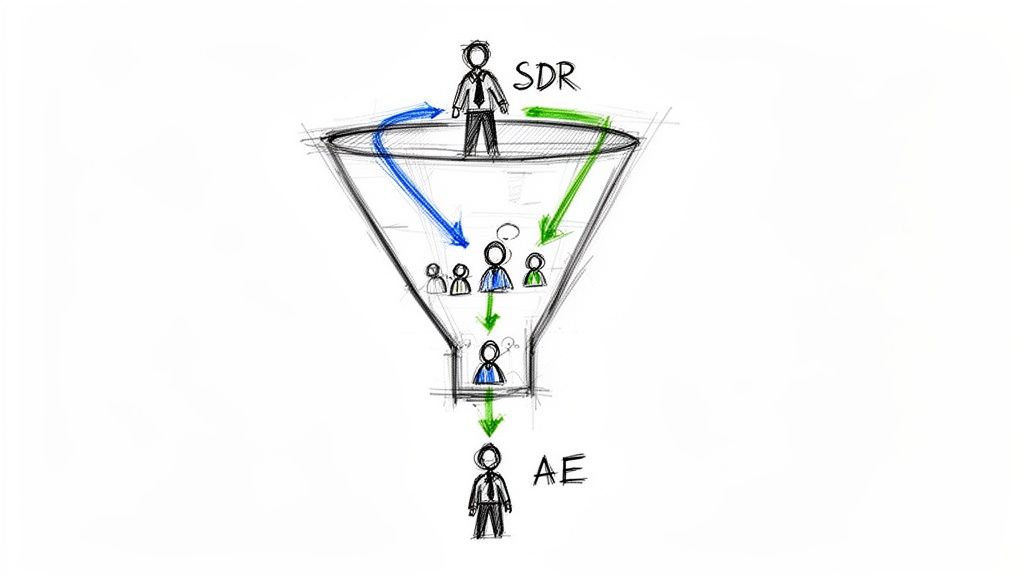
A hand-drawn sales funnel illustration showing an SDR at the top, generating leads, which convert to an AE.

Before we dive deeper, it's crucial to understand what a Sales Development Representative is and why this role exists. The SDR's mission is simple but challenging: identify potential leads, connect with them, and qualify their interest.

Once a lead is qualified, the SDR hands it off as a sales-ready meeting to an Account Executive (AE). They are the gatekeepers who ensure your closers only spend time on conversations that can actually lead to revenue. This focus is their superpower.

SDR At a Glance

Here’s a quick breakdown of the SDR's role to see where they fit in the bigger picture.

Key Aspect

Description

Primary Goal

Generate qualified meetings and opportunities.

Position in Funnel

Top of Funnel (TOFU).

Core Activities

Prospecting, outreach, and lead qualification.

Key Metric

Number of Sales Qualified Opportunities (SQOs) created.

Hands Off to

Account Executive (AE).

This table shows how SDRs are specialists. Their success isn't measured in closed deals, but in the quality and quantity of the pipeline they build.

Why This Specialization Is a Game-Changer

Imagine a top-tier restaurant where the head chef also has to greet guests, take every order, and wash the dishes. The food would suffer, right? The same thing happens in sales.

When you have specialized SDRs, you free up your highly-skilled (and expensive) Account Executives to do what they do best: run demos, navigate complex deals, and close new business. This division of labor isn't just about efficiency; it's how you build a scalable sales machine.

This model is a fundamental piece of a modern go-to-market strategy. It puts specialists in charge of each stage of the buyer's journey.

An SDR’s job is to take a prospect from a state of total unawareness to being actively engaged and scheduled for a qualified meeting with an Account Executive.

Your Most Critical Growth Engine

Whether you use human reps or AI SDRs, the function is non-negotiable for any modern sales team. They are absolute pipeline-building powerhouses.

In fact, SDRs are often responsible for generating anywhere from 46% to 73% of a company's total pipeline. A single good SDR can produce an average pipeline of $3 million annually.

Here are the four core activities that drive this impact:

  • Prospecting: Actively hunting for potential customers who match your Ideal Customer Profile (ICP). This involves research, list building, and identifying the right contacts.

  • Outreach: Kicking off conversations through a mix of channels—cold email, cold calls, and social media (like LinkedIn).

  • Qualification: Vetting prospects to confirm they have a real need, the budget to buy, and the authority to make a decision. This is where they weed out the tire-kickers.

  • Scheduling: The grand finale. Booking a qualified discovery call or demo directly onto an AE's calendar.

Ultimately, the SDR is the first real human touchpoint a future customer has with your brand. They set the tone for the entire relationship, making them absolutely essential for scaling revenue predictably and efficiently.

A Day in the Life of a Sales Development Representative
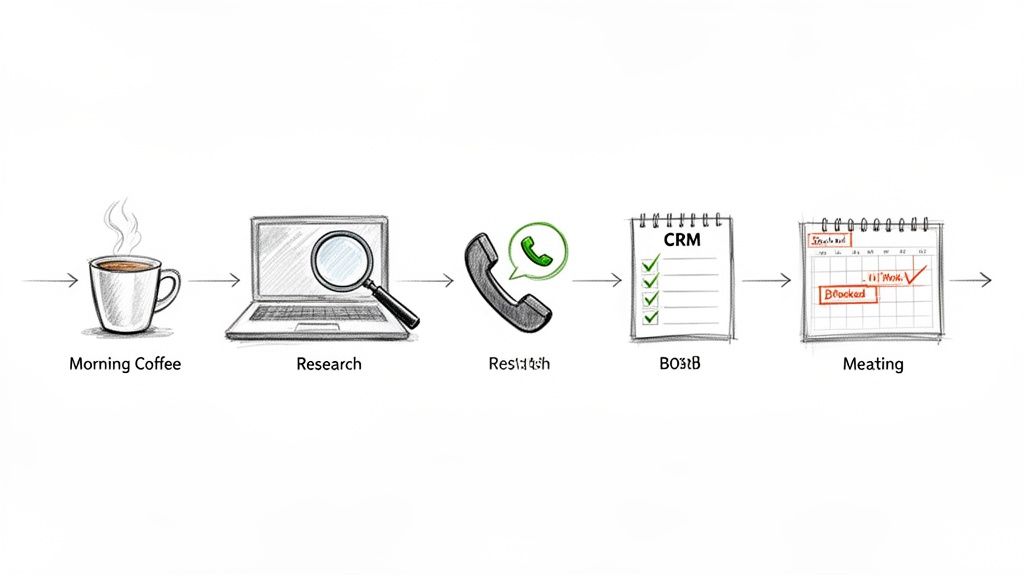
Illustrated daily workflow for a sales professional: morning coffee, research, outreach calls, CRM management, and scheduled meetings.

So what does an SDR actually do all day? Let’s walk through a typical day to see how the sausage gets made.

Forget the stereotype of someone just smiling and dialing. A great SDR’s day is a highly structured mix of research, creative outreach, and relentless follow-up. It's part science, part art, but it’s all aimed at one thing: booking qualified meetings.

An SDR’s day isn’t a list of random calls. It's a process. And that process usually starts with quiet, focused work—not the phone.

The Morning Block: Deep Research and Personalization

The first couple of hours are golden. This is when an SDR digs into their leads to find an angle. They’re not just scrolling through their CRM; they’re looking for buying signals and context. Who just opened an email? Who downloaded a whitepaper?

This is strategic intelligence gathering. SDRs fire up tools like LinkedIn Sales Navigator to go deep on their top prospects. They’re hunting for connection points, not just job titles.

  • Did a prospect just post about a problem their company is struggling with?

  • Did their company announce a new funding round or office expansion?

  • Do we share a mutual connection or belong to the same alumni group?

This is the ammunition for personalization. A generic email gets deleted in a second. An email that mentions a prospect’s recent promotion or a piece of company news gets a reply. That’s how you cut through the noise.

After the research, it’s time to build the outreach. This might be a multi-step sequence with a personalized email, a LinkedIn connection request, and a call scheduled for two days later. Many SDRs use automated tools to run a drip campaign to nurture leads so no one falls through the cracks.

The Midday Blitz: High-Volume Outreach

With research and personalized messages ready to go, the late morning and early afternoon shift into execution mode. This is the "blitz"—a focused block of high-volume activity.

This means hitting the phones and sending out those carefully crafted emails. It’s not uncommon for a productive SDR to make 50-100 calls in a single day.

Most of those calls will hit voicemail. That’s okay. The goal isn’t just to get someone on the line; it’s to leave a crisp, compelling message that makes them curious enough to check their email.

"Hi [Prospect Name], this is [SDR Name] from [Company]. I saw your team is hiring for new engineering roles, which often puts a strain on legacy infrastructure. I have an idea on how you can scale your platform without the headache and wanted to share it. I'll send a brief email with the subject line 'Engineering Scale.' Thanks."

This is also prime time for social selling. SDRs are active on LinkedIn, engaging with a prospect’s posts, sharing relevant content, and building a reputation as a helpful expert, not just another salesperson.

The Afternoon Session: Qualification and CRM Discipline

When a prospect finally picks up the phone or replies to an email, the SDR’s job instantly pivots from outreach to qualification. They use frameworks like BANT (Budget, Authority, Need, Timeline) to see if this is a real opportunity or just a dead end.

A quick BANT qualification might sound something like this:

  1. Budget: "Just to make sure I’m not wasting your time, do you all have a budget set aside for new tools like this?"

  2. Authority: "Got it. Are you the main person who would make a decision on this, or are there others on the team we should loop in?"

  3. Need: "You mentioned [the pain point]. How is that problem affecting your team’s goals for the quarter?"

  4. Timeline: "If we could actually solve that for you, when would be the ideal time to get a solution in place?"

If the lead checks all the boxes, the SDR’s final move is to book the meeting for an Account Executive. But the work isn't over.

Every single call, email, and note has to be logged in the CRM. This CRM discipline is non-negotiable. A clean and detailed record ensures a smooth handoff, giving the AE all the context they need to walk into their call fully prepared.

The day winds down with planning for tomorrow—analyzing what worked, tweaking subject lines, and lining up the next batch of prospects. Then, they do it all over again.

SDR vs BDR vs AE: Decoding Your Sales Team
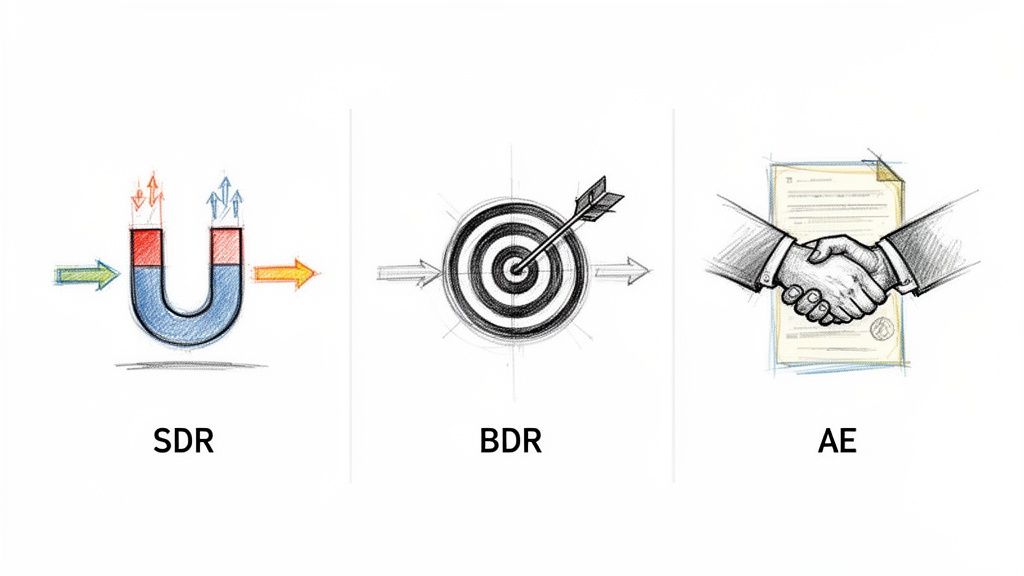
Illustration of sales roles: SDR attracting leads, BDR targeting prospects, and AE closing deals.

When you're building a sales team, you run into an alphabet soup of job titles: SDR, BDR, AE. They all drive revenue, but they play very different positions on the field. Getting this wrong is a classic mistake. It's like asking your star quarterback to also play linebacker—you’ll burn them out and lose the game.

The easiest way to break it down is to think of SDRs and BDRs as the "openers" who create opportunities. Account Executives (AEs) are your "closers" who turn those opportunities into signed contracts.

Where it gets interesting is the difference between an SDR and a BDR. It all comes down to how they open those doors.

The SDR: The Inbound Specialist

A Sales Development Representative (SDR) is your frontline qualifier for inbound leads. These are prospects who have already found you and shown interest by raising their hand in some way.

Think of leads coming from:

  • Website forms, like a demo request or an ebook download.

  • Webinar attendees who signed up for your latest event.

  • Marketing Qualified Leads (MQLs) that your marketing team has warmed up.

Because these leads are already "warm," the SDR's job isn't to create interest from scratch. Their mission is to qualify that interest, fast. They confirm the prospect has a real need, the right budget, and the authority to buy before booking a qualified meeting for an AE.

The BDR: The Outbound Hunter

In contrast, the Business Development Representative (BDR) is a pure outbound hunter. BDRs don't wait for leads to come to them; they go out and find them. Their job is to create opportunities out of thin air.

A BDR's primary function is to turn cold prospects into warm opportunities through strategic research and personalized outreach.

BDRs are the engine of proactive growth. They spend their days building lists of ideal customers, making cold calls, writing targeted email sequences, and connecting with people on LinkedIn. They generate demand where it didn't exist before, a role that takes serious grit, research skills, and resilience.

The AE: The Deal Closer

The Account Executive (AE) is the one who takes the qualified meeting from an SDR or BDR and carries it across the finish line. Once a meeting is on the calendar, the AE owns the relationship and the deal cycle from that point forward.

AEs are responsible for running product demos, navigating complex buying committees, negotiating contracts, and, ultimately, closing deals. Their success is measured in one thing: closed-won revenue. They depend entirely on the pipeline that SDRs and BDRs build to hit their quota.

To make it even clearer, let's put these roles side-by-side.

SDR vs BDR vs Account Executive (AE) Comparison

This table gives you a quick snapshot of how these three critical roles fit together to build a powerful sales motion.

Role

Primary Focus

Lead Type

Key Metric

SDR

Qualifying Inbound Leads

Warm/Inbound

Meetings Booked

BDR

Prospecting Outbound Leads

Cold/Outbound

Opportunities Created

AE

Closing Deals

Hot/Qualified

Revenue Closed

Understanding this division of labor is the first step toward building a specialized, high-performance sales team. It ensures you have experts dedicated to each critical stage of the buyer's journey, from initial awareness to a signed contract.

Skills and Metrics of a High-Performing SDR

Knowing what an SDR does day-to-day is just the start. The real question is, what separates a good SDR from a truly great one?

It's not just about being busy; it's about being effective. Top performers blend specific skills with a sharp focus on the numbers that actually drive revenue. They don't just make calls—they start valuable conversations. They don't just send emails—they deliver insights that demand a reply.

Let's break down the DNA of a high-performing SDR.

The Essential Soft Skills for SDRs

Soft skills are the engine. These are the traits that let a rep handle constant rejection, stay motivated, and build real rapport with complete strangers. You can't really teach this stuff, but you can hire for it.

  • Resilience: The SDR role is a grind. Hearing "no" is a daily, often hourly, event. The ability to shake off a tough call and jump right into the next one with genuine enthusiasm is the single most important trait.

  • Intellectual Curiosity: Great SDRs are genuinely curious people. They want to understand a prospect's business, their challenges, and their industry. This curiosity is what fuels good research and helps them ask smart questions instead of just pitching.

  • Coachability: The best SDRs are sponges. They listen to their call recordings, ask for advice, and are always looking to improve their approach. They see feedback not as criticism, but as the fastest path to a bigger commission check.

An SDR with resilience, curiosity, and coachability can be trained on any tool or product. Without these, even the most technically skilled rep will eventually burn out or hit a wall.

Critical Hard Skills Every SDR Must Master

If soft skills are the engine, hard skills are the vehicle that gets you there. These are the teachable abilities that turn that raw potential into actual pipeline. A top SDR is fluent in the tools and tactics of modern sales.

This includes proficiency in:

  • CRM Mastery: The CRM is an SDR's second brain. Clean data entry, consistent activity tracking, and managing lead statuses are non-negotiable. This is what ensures a smooth handoff to an AE and a pipeline you can actually trust.

  • Deep Research Abilities: Top SDRs are expert-level researchers. They live in tools like LinkedIn Sales Navigator to find company news, hiring trends, and personal details that make their outreach feel relevant and timely.

  • Sales Engagement Tool Proficiency: Platforms that automate email sequences and call cadences are the backbone of an SDR's workflow. Knowing how to build, test, and tweak these sequences is what separates the amateurs from the pros.

The Metrics That Truly Matter

Activity metrics like 100 calls a day or 500 emails a week are easy to track, but they don't tell you much. An elite SDR team is measured on outcomes, not just effort.

To really understand what an SDR is in sales, you have to look at the metrics that tie directly to revenue.

These are the key performance indicators (KPIs) that define success:

  1. Meetings Booked: This is the baseline. It’s the raw number of discovery calls or demos the SDR successfully schedules on an Account Executive's calendar.

  2. Sales Accepted Leads (SALs): This is where quality control comes in. An SAL is a meeting that the AE has reviewed and "accepted," confirming the prospect is qualified and the opportunity is real. Not all meetings are created equal, and this metric proves it.

  3. Pipeline Influence: This is the ultimate metric. It measures the total dollar value of the sales pipeline that came directly from an SDR's meetings. This is what connects the SDR's daily grind to the company's bottom line.

Focusing on SALs and pipeline influence instead of just raw meeting numbers is a game-changer. It incentivizes SDRs to book the right meetings, not just any meeting. This alignment makes the entire sales floor more efficient and drives real, measurable growth.

The Rise of the AI SDR in Modern Sales

An AI robot performing data input and analysis with a complex data processing system.

The traditional SDR role is a proven workhorse, but it's held back by human limits on speed and scale. Now, a new category is emerging that changes the math on prospecting: the AI SDR. This isn't about getting rid of your sales team; it's about making them exponentially more powerful by automating the grunt work.

An AI SDR is an autonomous agent built to handle the core SDR functions—prospecting, account research, and personalized outreach—but with the speed and consistency only a machine can deliver. Suddenly, even a small team can run an enterprise-level prospecting operation.

How AI SDRs Change the Game

Think of an AI SDR, like Stamina's Zara, as a tireless digital teammate working 24/7. It executes the time-sucking tasks that burn out even the best human reps.

While a human SDR spends hours researching a handful of prospects, an AI SDR can analyze thousands in minutes. It connects the dots between data points across the web, automatically pinpointing pain points and buying signals that would take a human all day to find.

This is the strategic edge that lets modern teams scale their pipeline without just throwing more people at the problem. Instead of burying your top talent in data entry, you free them up for what they do best.

  • Building Relationships: With prospecting on autopilot, human reps can pour their energy into nurturing warm leads and forging real connections.

  • Strategic Selling: They can focus on navigating complex deals and creatively solving problems for prospects who are already qualified.

  • Closing Deals: Most importantly, your closers get to spend more time in demos and negotiations—the activities that directly drive revenue.

The point of an AI SDR isn't to replace your people. It’s to empower them by automating the mechanical work, letting humans focus on the uniquely human side of selling.

Deep Product Knowledge on Demand

One of the biggest advantages of an AI SDR is its flawless product knowledge. An informed buyer can easily stump a human rep—in fact, 95% of SDRs struggle to answer technical questions correctly. An AI SDR, on the other hand, can be trained on your entire company knowledge base.

It gets instant access to every technical spec sheet, case study, and product update you have. So when a sharp prospect asks a tough question about API integrations or security protocols, the AI SDR provides a perfect, immediate answer. This builds massive credibility from the first touchpoint and dramatically shortens the sales cycle.

As AI becomes more integrated into the sales stack, having the best AI sales tools gives your team the automation and intelligence needed to stay ahead.

Automating Personalized Outreach at Scale

The real magic of an AI SDR is its ability to combine deep research with mass personalization. Before now, you always had to make a choice: send generic emails to thousands of people, or send highly personalized emails to a few dozen.

AI SDRs completely demolish that trade-off. For example, Zara can identify your ideal customer profiles, run deep-dive research on every single contact, and then auto-generate thousands of hyper-personalized emails. Each message is uniquely crafted with details relevant only to that specific prospect. You can learn more about how this works by checking out the top AI SDR agents that can replace your sales reps) and their capabilities.

This approach delivers something that used to be impossible: bespoke outreach at an industrial scale. It lets your team connect with a much larger slice of your market in a way that feels personal and relevant, leading to more qualified meetings booked automatically. The result is a sales pipeline that grows faster and more predictably than ever before.

Alright, let's turn this playbook into something you can actually use. Building an SDR program from scratch (or fixing a broken one) feels like a massive task, but it really boils down to a few key decisions you make upfront.

Get these right, and you'll build a predictable engine for booking qualified meetings. Get them wrong, and you'll just be spinning your wheels.

Step 1: Nail Your Ideal Customer Profile (ICP)

Before you write a single email or hire your first rep, you have to know exactly who you're selling to. This isn't about creating a vague persona—it's about defining your Ideal Customer Profile (ICP) with military precision.

This is a non-negotiable first step. Your ICP is a spec sheet for the perfect company you can help.

It should include firmographics like:

  • Company size (both in revenue and employee count)

  • Industry or vertical

  • Geographic footprint

  • Specific technologies they already use (or don't use)

Think of your ICP less like a friendly suggestion and more like the strict targeting parameters for a missile launch. An SDR program without a crystal-clear ICP is just expensive, high-activity guesswork. You’ll stay busy, but you won't hit any real targets.

Step 2: Set Goals That Actually Matter

Once you know who you're aiming for, you need to define what a "win" looks like. And let me be clear: tracking raw activity like 100 calls or 500 emails a day is a vanity metric. It’s a trap that makes teams feel productive while generating zero pipeline.

Instead, focus on the outcomes that lead directly to revenue.

These are the only metrics that count:

  1. Meetings Booked: The raw number of appointments your SDRs set. This is your top-of-funnel output.

  2. Sales Accepted Leads (SALs): The number of those meetings that your AEs agree are qualified and worth pursuing. This is your quality filter.

  3. Pipeline Influenced: The total dollar value of the opportunities that originate from your SDR team's efforts. This is the ultimate measure of their impact.

Tying your SDRs' success to these KPIs ensures they’re focused on the same thing as the rest of the company: closing deals, not just filling calendars.

Step 3: Build Your Tech Stack the Smart Way

Your technology should be a force multiplier for your team, not another system they have to fight with. The goal is to build a simple, unified stack that keeps all your data in one place and makes your SDRs’ lives easier. Forgetting to do this is how crucial lead information gets lost in the cracks between tools.

Understanding the real differences between a sales engagement platform vs a CRM is fundamental here. You need both, but they should work together seamlessly.

A modern platform like Stamina is built to be that single source of truth. It combines your CRM with powerful sales engagement and marketing automation, creating one cohesive system where every prospecting action is tracked and connected to a result.

Step 4: Launch Your Outreach Motion with AI on Day One

Here’s where you can get a massive, unfair advantage. Instead of waiting months to hire, onboard, and ramp up a human SDR team, you can deploy an AI SDR from the moment you’re ready to start.

An AI SDR, like Stamina's Zara, automates the most brutal, time-consuming parts of prospecting.

Zara can instantly identify thousands of prospects that fit your ICP, conduct deep-dive research on every single one, and then run hyper-personalized outreach campaigns at a scale no human team could ever dream of matching.

This means you can switch on a powerful, data-driven prospecting engine today and start booking qualified demos while your AEs do what they do best—close deals.

SDR FAQs: The Questions We Hear Most

You’ve got the big picture on what an SDR does. But when it's time to actually build the team, the practical, real-world questions always surface.

Let's break down the common ones to give you the clarity you need.

What Is a Typical SDR Salary?

An SDR's pay is almost always a split between a base salary and commission. It's all about rewarding them for hitting the targets that matter—booked meetings and qualified pipeline.

While it varies by city and company, a fully ramped-up SDR in the U.S. can expect their on-target earnings (OTE) to land somewhere between $70,000 and $90,000.

Here’s how that usually breaks down:

  • Base Salary: Roughly $50,000 to $60,000. This gives them stability.

  • Variable Commission: An extra $20,000 to $30,000 tied directly to their quota for booked meetings or Sales Accepted Leads (SALs). This drives performance.

This pay structure keeps your SDRs focused on hitting the outcomes that feed your entire sales engine.

How Long Does It Take to Onboard an SDR?

This is a big one. You need to plan for a ramp-up time of about three to six months for a new SDR to become fully productive.

That might sound like a long time, but this period is for more than just hitting quota. It’s when they truly learn your product, master your tech stack, and fine-tune their outreach. A rushed onboarding is the number one reason new SDRs flame out.

A huge mistake teams make is expecting a new hire to perform like a veteran in their first 30 days. Real onboarding needs a structured plan: product training, system tutorials, and a gradual ramp-up of outreach goals. Think of it as an investment in consistent, long-term pipeline.

Is an SDR an Entry-Level Position?

Yes, absolutely. The SDR role is one of the best gateways into a tech sales career. It’s built for hungry, resilient people who might not have direct sales experience but have the drive to learn.

They get foundational training in everything from communication and research to general business savvy. The best part? High-performing SDRs often have a clear promotion track, typically moving into an Account Executive (AE) role within 12 to 18 months.

This makes your SDR team an incredible internal talent pipeline for your future closers.

Ready to build a powerful prospecting engine without the long ramp-up time? With Stamina, you can deploy an AI SDR to start identifying ideal customers, conducting deep research, and booking qualified demos automatically. See how it works at https://stamina.io.

An SDR, or Sales Development Representative, is the person on your sales team who lives at the very top of the sales funnel. Their entire job is to find and qualify potential customers, building a pipeline of solid opportunities for the rest of the team to close.

Think of them as the advance scouts for your sales army. They go out, map the territory, and find the high-value targets.

The Role of an SDR Explained

A hand-drawn sales funnel illustration showing an SDR at the top, generating leads, which convert to an AE.

Before we dive deeper, it's crucial to understand what a Sales Development Representative is and why this role exists. The SDR's mission is simple but challenging: identify potential leads, connect with them, and qualify their interest.

Once a lead is qualified, the SDR hands it off as a sales-ready meeting to an Account Executive (AE). They are the gatekeepers who ensure your closers only spend time on conversations that can actually lead to revenue. This focus is their superpower.

SDR At a Glance

Here’s a quick breakdown of the SDR's role to see where they fit in the bigger picture.

Key Aspect

Description

Primary Goal

Generate qualified meetings and opportunities.

Position in Funnel

Top of Funnel (TOFU).

Core Activities

Prospecting, outreach, and lead qualification.

Key Metric

Number of Sales Qualified Opportunities (SQOs) created.

Hands Off to

Account Executive (AE).

This table shows how SDRs are specialists. Their success isn't measured in closed deals, but in the quality and quantity of the pipeline they build.

Why This Specialization Is a Game-Changer

Imagine a top-tier restaurant where the head chef also has to greet guests, take every order, and wash the dishes. The food would suffer, right? The same thing happens in sales.

When you have specialized SDRs, you free up your highly-skilled (and expensive) Account Executives to do what they do best: run demos, navigate complex deals, and close new business. This division of labor isn't just about efficiency; it's how you build a scalable sales machine.

This model is a fundamental piece of a modern go-to-market strategy. It puts specialists in charge of each stage of the buyer's journey.

An SDR’s job is to take a prospect from a state of total unawareness to being actively engaged and scheduled for a qualified meeting with an Account Executive.

Your Most Critical Growth Engine

Whether you use human reps or AI SDRs, the function is non-negotiable for any modern sales team. They are absolute pipeline-building powerhouses.

In fact, SDRs are often responsible for generating anywhere from 46% to 73% of a company's total pipeline. A single good SDR can produce an average pipeline of $3 million annually.

Here are the four core activities that drive this impact:

  • Prospecting: Actively hunting for potential customers who match your Ideal Customer Profile (ICP). This involves research, list building, and identifying the right contacts.

  • Outreach: Kicking off conversations through a mix of channels—cold email, cold calls, and social media (like LinkedIn).

  • Qualification: Vetting prospects to confirm they have a real need, the budget to buy, and the authority to make a decision. This is where they weed out the tire-kickers.

  • Scheduling: The grand finale. Booking a qualified discovery call or demo directly onto an AE's calendar.

Ultimately, the SDR is the first real human touchpoint a future customer has with your brand. They set the tone for the entire relationship, making them absolutely essential for scaling revenue predictably and efficiently.

A Day in the Life of a Sales Development Representative

Illustrated daily workflow for a sales professional: morning coffee, research, outreach calls, CRM management, and scheduled meetings.

So what does an SDR actually do all day? Let’s walk through a typical day to see how the sausage gets made.

Forget the stereotype of someone just smiling and dialing. A great SDR’s day is a highly structured mix of research, creative outreach, and relentless follow-up. It's part science, part art, but it’s all aimed at one thing: booking qualified meetings.

An SDR’s day isn’t a list of random calls. It's a process. And that process usually starts with quiet, focused work—not the phone.

The Morning Block: Deep Research and Personalization

The first couple of hours are golden. This is when an SDR digs into their leads to find an angle. They’re not just scrolling through their CRM; they’re looking for buying signals and context. Who just opened an email? Who downloaded a whitepaper?

This is strategic intelligence gathering. SDRs fire up tools like LinkedIn Sales Navigator to go deep on their top prospects. They’re hunting for connection points, not just job titles.

  • Did a prospect just post about a problem their company is struggling with?

  • Did their company announce a new funding round or office expansion?

  • Do we share a mutual connection or belong to the same alumni group?

This is the ammunition for personalization. A generic email gets deleted in a second. An email that mentions a prospect’s recent promotion or a piece of company news gets a reply. That’s how you cut through the noise.

After the research, it’s time to build the outreach. This might be a multi-step sequence with a personalized email, a LinkedIn connection request, and a call scheduled for two days later. Many SDRs use automated tools to run a drip campaign to nurture leads so no one falls through the cracks.

The Midday Blitz: High-Volume Outreach

With research and personalized messages ready to go, the late morning and early afternoon shift into execution mode. This is the "blitz"—a focused block of high-volume activity.

This means hitting the phones and sending out those carefully crafted emails. It’s not uncommon for a productive SDR to make 50-100 calls in a single day.

Most of those calls will hit voicemail. That’s okay. The goal isn’t just to get someone on the line; it’s to leave a crisp, compelling message that makes them curious enough to check their email.

"Hi [Prospect Name], this is [SDR Name] from [Company]. I saw your team is hiring for new engineering roles, which often puts a strain on legacy infrastructure. I have an idea on how you can scale your platform without the headache and wanted to share it. I'll send a brief email with the subject line 'Engineering Scale.' Thanks."

This is also prime time for social selling. SDRs are active on LinkedIn, engaging with a prospect’s posts, sharing relevant content, and building a reputation as a helpful expert, not just another salesperson.

The Afternoon Session: Qualification and CRM Discipline

When a prospect finally picks up the phone or replies to an email, the SDR’s job instantly pivots from outreach to qualification. They use frameworks like BANT (Budget, Authority, Need, Timeline) to see if this is a real opportunity or just a dead end.

A quick BANT qualification might sound something like this:

  1. Budget: "Just to make sure I’m not wasting your time, do you all have a budget set aside for new tools like this?"

  2. Authority: "Got it. Are you the main person who would make a decision on this, or are there others on the team we should loop in?"

  3. Need: "You mentioned [the pain point]. How is that problem affecting your team’s goals for the quarter?"

  4. Timeline: "If we could actually solve that for you, when would be the ideal time to get a solution in place?"

If the lead checks all the boxes, the SDR’s final move is to book the meeting for an Account Executive. But the work isn't over.

Every single call, email, and note has to be logged in the CRM. This CRM discipline is non-negotiable. A clean and detailed record ensures a smooth handoff, giving the AE all the context they need to walk into their call fully prepared.

The day winds down with planning for tomorrow—analyzing what worked, tweaking subject lines, and lining up the next batch of prospects. Then, they do it all over again.

SDR vs BDR vs AE: Decoding Your Sales Team

Illustration of sales roles: SDR attracting leads, BDR targeting prospects, and AE closing deals.

When you're building a sales team, you run into an alphabet soup of job titles: SDR, BDR, AE. They all drive revenue, but they play very different positions on the field. Getting this wrong is a classic mistake. It's like asking your star quarterback to also play linebacker—you’ll burn them out and lose the game.

The easiest way to break it down is to think of SDRs and BDRs as the "openers" who create opportunities. Account Executives (AEs) are your "closers" who turn those opportunities into signed contracts.

Where it gets interesting is the difference between an SDR and a BDR. It all comes down to how they open those doors.

The SDR: The Inbound Specialist

A Sales Development Representative (SDR) is your frontline qualifier for inbound leads. These are prospects who have already found you and shown interest by raising their hand in some way.

Think of leads coming from:

  • Website forms, like a demo request or an ebook download.

  • Webinar attendees who signed up for your latest event.

  • Marketing Qualified Leads (MQLs) that your marketing team has warmed up.

Because these leads are already "warm," the SDR's job isn't to create interest from scratch. Their mission is to qualify that interest, fast. They confirm the prospect has a real need, the right budget, and the authority to buy before booking a qualified meeting for an AE.

The BDR: The Outbound Hunter

In contrast, the Business Development Representative (BDR) is a pure outbound hunter. BDRs don't wait for leads to come to them; they go out and find them. Their job is to create opportunities out of thin air.

A BDR's primary function is to turn cold prospects into warm opportunities through strategic research and personalized outreach.

BDRs are the engine of proactive growth. They spend their days building lists of ideal customers, making cold calls, writing targeted email sequences, and connecting with people on LinkedIn. They generate demand where it didn't exist before, a role that takes serious grit, research skills, and resilience.

The AE: The Deal Closer

The Account Executive (AE) is the one who takes the qualified meeting from an SDR or BDR and carries it across the finish line. Once a meeting is on the calendar, the AE owns the relationship and the deal cycle from that point forward.

AEs are responsible for running product demos, navigating complex buying committees, negotiating contracts, and, ultimately, closing deals. Their success is measured in one thing: closed-won revenue. They depend entirely on the pipeline that SDRs and BDRs build to hit their quota.

To make it even clearer, let's put these roles side-by-side.

SDR vs BDR vs Account Executive (AE) Comparison

This table gives you a quick snapshot of how these three critical roles fit together to build a powerful sales motion.

Role

Primary Focus

Lead Type

Key Metric

SDR

Qualifying Inbound Leads

Warm/Inbound

Meetings Booked

BDR

Prospecting Outbound Leads

Cold/Outbound

Opportunities Created

AE

Closing Deals

Hot/Qualified

Revenue Closed

Understanding this division of labor is the first step toward building a specialized, high-performance sales team. It ensures you have experts dedicated to each critical stage of the buyer's journey, from initial awareness to a signed contract.

Skills and Metrics of a High-Performing SDR

Knowing what an SDR does day-to-day is just the start. The real question is, what separates a good SDR from a truly great one?

It's not just about being busy; it's about being effective. Top performers blend specific skills with a sharp focus on the numbers that actually drive revenue. They don't just make calls—they start valuable conversations. They don't just send emails—they deliver insights that demand a reply.

Let's break down the DNA of a high-performing SDR.

The Essential Soft Skills for SDRs

Soft skills are the engine. These are the traits that let a rep handle constant rejection, stay motivated, and build real rapport with complete strangers. You can't really teach this stuff, but you can hire for it.

  • Resilience: The SDR role is a grind. Hearing "no" is a daily, often hourly, event. The ability to shake off a tough call and jump right into the next one with genuine enthusiasm is the single most important trait.

  • Intellectual Curiosity: Great SDRs are genuinely curious people. They want to understand a prospect's business, their challenges, and their industry. This curiosity is what fuels good research and helps them ask smart questions instead of just pitching.

  • Coachability: The best SDRs are sponges. They listen to their call recordings, ask for advice, and are always looking to improve their approach. They see feedback not as criticism, but as the fastest path to a bigger commission check.

An SDR with resilience, curiosity, and coachability can be trained on any tool or product. Without these, even the most technically skilled rep will eventually burn out or hit a wall.

Critical Hard Skills Every SDR Must Master

If soft skills are the engine, hard skills are the vehicle that gets you there. These are the teachable abilities that turn that raw potential into actual pipeline. A top SDR is fluent in the tools and tactics of modern sales.

This includes proficiency in:

  • CRM Mastery: The CRM is an SDR's second brain. Clean data entry, consistent activity tracking, and managing lead statuses are non-negotiable. This is what ensures a smooth handoff to an AE and a pipeline you can actually trust.

  • Deep Research Abilities: Top SDRs are expert-level researchers. They live in tools like LinkedIn Sales Navigator to find company news, hiring trends, and personal details that make their outreach feel relevant and timely.

  • Sales Engagement Tool Proficiency: Platforms that automate email sequences and call cadences are the backbone of an SDR's workflow. Knowing how to build, test, and tweak these sequences is what separates the amateurs from the pros.

The Metrics That Truly Matter

Activity metrics like 100 calls a day or 500 emails a week are easy to track, but they don't tell you much. An elite SDR team is measured on outcomes, not just effort.

To really understand what an SDR is in sales, you have to look at the metrics that tie directly to revenue.

These are the key performance indicators (KPIs) that define success:

  1. Meetings Booked: This is the baseline. It’s the raw number of discovery calls or demos the SDR successfully schedules on an Account Executive's calendar.

  2. Sales Accepted Leads (SALs): This is where quality control comes in. An SAL is a meeting that the AE has reviewed and "accepted," confirming the prospect is qualified and the opportunity is real. Not all meetings are created equal, and this metric proves it.

  3. Pipeline Influence: This is the ultimate metric. It measures the total dollar value of the sales pipeline that came directly from an SDR's meetings. This is what connects the SDR's daily grind to the company's bottom line.

Focusing on SALs and pipeline influence instead of just raw meeting numbers is a game-changer. It incentivizes SDRs to book the right meetings, not just any meeting. This alignment makes the entire sales floor more efficient and drives real, measurable growth.

The Rise of the AI SDR in Modern Sales

An AI robot performing data input and analysis with a complex data processing system.

The traditional SDR role is a proven workhorse, but it's held back by human limits on speed and scale. Now, a new category is emerging that changes the math on prospecting: the AI SDR. This isn't about getting rid of your sales team; it's about making them exponentially more powerful by automating the grunt work.

An AI SDR is an autonomous agent built to handle the core SDR functions—prospecting, account research, and personalized outreach—but with the speed and consistency only a machine can deliver. Suddenly, even a small team can run an enterprise-level prospecting operation.

How AI SDRs Change the Game

Think of an AI SDR, like Stamina's Zara, as a tireless digital teammate working 24/7. It executes the time-sucking tasks that burn out even the best human reps.

While a human SDR spends hours researching a handful of prospects, an AI SDR can analyze thousands in minutes. It connects the dots between data points across the web, automatically pinpointing pain points and buying signals that would take a human all day to find.

This is the strategic edge that lets modern teams scale their pipeline without just throwing more people at the problem. Instead of burying your top talent in data entry, you free them up for what they do best.

  • Building Relationships: With prospecting on autopilot, human reps can pour their energy into nurturing warm leads and forging real connections.

  • Strategic Selling: They can focus on navigating complex deals and creatively solving problems for prospects who are already qualified.

  • Closing Deals: Most importantly, your closers get to spend more time in demos and negotiations—the activities that directly drive revenue.

The point of an AI SDR isn't to replace your people. It’s to empower them by automating the mechanical work, letting humans focus on the uniquely human side of selling.

Deep Product Knowledge on Demand

One of the biggest advantages of an AI SDR is its flawless product knowledge. An informed buyer can easily stump a human rep—in fact, 95% of SDRs struggle to answer technical questions correctly. An AI SDR, on the other hand, can be trained on your entire company knowledge base.

It gets instant access to every technical spec sheet, case study, and product update you have. So when a sharp prospect asks a tough question about API integrations or security protocols, the AI SDR provides a perfect, immediate answer. This builds massive credibility from the first touchpoint and dramatically shortens the sales cycle.

As AI becomes more integrated into the sales stack, having the best AI sales tools gives your team the automation and intelligence needed to stay ahead.

Automating Personalized Outreach at Scale

The real magic of an AI SDR is its ability to combine deep research with mass personalization. Before now, you always had to make a choice: send generic emails to thousands of people, or send highly personalized emails to a few dozen.

AI SDRs completely demolish that trade-off. For example, Zara can identify your ideal customer profiles, run deep-dive research on every single contact, and then auto-generate thousands of hyper-personalized emails. Each message is uniquely crafted with details relevant only to that specific prospect. You can learn more about how this works by checking out the top AI SDR agents that can replace your sales reps) and their capabilities.

This approach delivers something that used to be impossible: bespoke outreach at an industrial scale. It lets your team connect with a much larger slice of your market in a way that feels personal and relevant, leading to more qualified meetings booked automatically. The result is a sales pipeline that grows faster and more predictably than ever before.

Alright, let's turn this playbook into something you can actually use. Building an SDR program from scratch (or fixing a broken one) feels like a massive task, but it really boils down to a few key decisions you make upfront.

Get these right, and you'll build a predictable engine for booking qualified meetings. Get them wrong, and you'll just be spinning your wheels.

Step 1: Nail Your Ideal Customer Profile (ICP)

Before you write a single email or hire your first rep, you have to know exactly who you're selling to. This isn't about creating a vague persona—it's about defining your Ideal Customer Profile (ICP) with military precision.

This is a non-negotiable first step. Your ICP is a spec sheet for the perfect company you can help.

It should include firmographics like:

  • Company size (both in revenue and employee count)

  • Industry or vertical

  • Geographic footprint

  • Specific technologies they already use (or don't use)

Think of your ICP less like a friendly suggestion and more like the strict targeting parameters for a missile launch. An SDR program without a crystal-clear ICP is just expensive, high-activity guesswork. You’ll stay busy, but you won't hit any real targets.

Step 2: Set Goals That Actually Matter

Once you know who you're aiming for, you need to define what a "win" looks like. And let me be clear: tracking raw activity like 100 calls or 500 emails a day is a vanity metric. It’s a trap that makes teams feel productive while generating zero pipeline.

Instead, focus on the outcomes that lead directly to revenue.

These are the only metrics that count:

  1. Meetings Booked: The raw number of appointments your SDRs set. This is your top-of-funnel output.

  2. Sales Accepted Leads (SALs): The number of those meetings that your AEs agree are qualified and worth pursuing. This is your quality filter.

  3. Pipeline Influenced: The total dollar value of the opportunities that originate from your SDR team's efforts. This is the ultimate measure of their impact.

Tying your SDRs' success to these KPIs ensures they’re focused on the same thing as the rest of the company: closing deals, not just filling calendars.

Step 3: Build Your Tech Stack the Smart Way

Your technology should be a force multiplier for your team, not another system they have to fight with. The goal is to build a simple, unified stack that keeps all your data in one place and makes your SDRs’ lives easier. Forgetting to do this is how crucial lead information gets lost in the cracks between tools.

Understanding the real differences between a sales engagement platform vs a CRM is fundamental here. You need both, but they should work together seamlessly.

A modern platform like Stamina is built to be that single source of truth. It combines your CRM with powerful sales engagement and marketing automation, creating one cohesive system where every prospecting action is tracked and connected to a result.

Step 4: Launch Your Outreach Motion with AI on Day One

Here’s where you can get a massive, unfair advantage. Instead of waiting months to hire, onboard, and ramp up a human SDR team, you can deploy an AI SDR from the moment you’re ready to start.

An AI SDR, like Stamina's Zara, automates the most brutal, time-consuming parts of prospecting.

Zara can instantly identify thousands of prospects that fit your ICP, conduct deep-dive research on every single one, and then run hyper-personalized outreach campaigns at a scale no human team could ever dream of matching.

This means you can switch on a powerful, data-driven prospecting engine today and start booking qualified demos while your AEs do what they do best—close deals.

SDR FAQs: The Questions We Hear Most

You’ve got the big picture on what an SDR does. But when it's time to actually build the team, the practical, real-world questions always surface.

Let's break down the common ones to give you the clarity you need.

What Is a Typical SDR Salary?

An SDR's pay is almost always a split between a base salary and commission. It's all about rewarding them for hitting the targets that matter—booked meetings and qualified pipeline.

While it varies by city and company, a fully ramped-up SDR in the U.S. can expect their on-target earnings (OTE) to land somewhere between $70,000 and $90,000.

Here’s how that usually breaks down:

  • Base Salary: Roughly $50,000 to $60,000. This gives them stability.

  • Variable Commission: An extra $20,000 to $30,000 tied directly to their quota for booked meetings or Sales Accepted Leads (SALs). This drives performance.

This pay structure keeps your SDRs focused on hitting the outcomes that feed your entire sales engine.

How Long Does It Take to Onboard an SDR?

This is a big one. You need to plan for a ramp-up time of about three to six months for a new SDR to become fully productive.

That might sound like a long time, but this period is for more than just hitting quota. It’s when they truly learn your product, master your tech stack, and fine-tune their outreach. A rushed onboarding is the number one reason new SDRs flame out.

A huge mistake teams make is expecting a new hire to perform like a veteran in their first 30 days. Real onboarding needs a structured plan: product training, system tutorials, and a gradual ramp-up of outreach goals. Think of it as an investment in consistent, long-term pipeline.

Is an SDR an Entry-Level Position?

Yes, absolutely. The SDR role is one of the best gateways into a tech sales career. It’s built for hungry, resilient people who might not have direct sales experience but have the drive to learn.

They get foundational training in everything from communication and research to general business savvy. The best part? High-performing SDRs often have a clear promotion track, typically moving into an Account Executive (AE) role within 12 to 18 months.

This makes your SDR team an incredible internal talent pipeline for your future closers.

Ready to build a powerful prospecting engine without the long ramp-up time? With Stamina, you can deploy an AI SDR to start identifying ideal customers, conducting deep research, and booking qualified demos automatically. See how it works at https://stamina.io.

Share this article

Share this article

Send a shareable link to your team or anyone who might find it useful.

Send a shareable link to your team or anyone who might find it useful.

Copy link

Copied

Share directly to

Table of contents

Give Your Business the Stamina it needs to Thrive