How to Qualify Leads in Sales: Master Sales Lead

Master how to qualify leads in sales with our 2026 guide. Explore BANT, MEDDIC, scoring, & AI to close more deals faster.

0 - Minute Read

Your team is generating leads. The CRM is full. Calendars look busy. Revenue still feels harder than it should.

That usually means the problem isn’t top-of-funnel volume. It’s qualification. Reps are spending time on people who downloaded a guide, opened an email, or looked vaguely interested, but were never realistic buyers. Marketing calls them leads. Sales calls them junk. The pipeline gets crowded, forecasting gets fuzzy, and good opportunities wait too long for a real conversation.

If you're figuring out how to qualify leads in sales, the fix isn't another spreadsheet or a longer discovery script. It's a system that tells your team who deserves attention now, who belongs in nurture, and who should be disqualified early. The companies that get this right don't just talk about frameworks. They operationalize them.

Why Most Sales Pipelines Leak and How Qualification Plugs The Holes

A leaky pipeline usually starts with a simple mistake. Teams treat lead capture as progress.

It isn't. A lead is only valuable when someone can prove two things. First, the account fits the type of customer you can effectively help. Second, the person or buying group shows enough intent to justify sales time. Without that filter, the funnel gets wider at the top and weaker everywhere else.

The cost of weak qualification is bigger than often acknowledged. According to research on lead qualification and sales conversion bottlenecks, only 10% of prospects become qualified leads, only 1-6% become customers, 79% of marketing leads never convert because of ineffective nurturing, and 44% of sales reps complain about lead quality. That's not a minor efficiency issue. That's a revenue operations problem.

What a qualified lead actually means

A qualified lead isn't just someone who filled out a form. It's someone who matches your ideal customer profile, shows credible buying intent, and can move through a real buying process.

That sounds obvious, but teams still confuse activity with readiness. A contact who visits your blog twice is active. A buyer who returns to pricing, attends a webinar, replies to outreach, and fits your target account profile is a very different signal.

Practical rule: If your reps are asking, "Why did this get assigned to me?" your qualification model is broken.

Qualification also has to be shared across teams. Marketing can't optimize for form fills while sales optimizes for closeable opportunities. If you need a clean way to think about handoffs, this guide on aligning sales and marketing efforts is useful because it clarifies where MQLs and SQLs often get mixed up.

A strong process also tightens execution across the rest of the funnel. Teams that want better handoffs, faster response, and cleaner stage definitions usually need broader sales process optimization, not just better rep coaching.

Where most leaks actually happen

The biggest pipeline leaks usually show up in a few places:

  • Weak entry criteria means almost anyone can become an MQL.

  • Slow follow-up lets high-intent buyers cool off before a rep engages.

  • No disqualification rules keeps low-probability deals sitting in pipeline stages for too long.

  • Poor nurturing causes decent-fit leads to disappear because nobody owns the middle.

The fix is straightforward, but it requires discipline. Score fit. Score behavior. Validate with conversation. Disqualify when needed. Nurture the rest.

That's what turns qualification from a sales buzzword into a control system.

Choosing Your Qualification Framework BANT MEDDIC or CHAMP

Sales teams don't fail because they lack a framework. They fail because they use the wrong one for their sales motion.

BANT, MEDDIC, and CHAMP all work. What matters is whether the framework matches your deal size, buying complexity, and the amount of information your reps can realistically gather early. If you're selling into SMBs with short cycles, a heavyweight enterprise framework can slow reps down. If you're selling multi-stakeholder software, a lightweight framework can hide risk until late-stage deals fall apart.

There's another issue most guides skip. Qualification isn't only about deciding who to pursue. It's also about deciding who to stop chasing. As noted in this lead qualification framework discussion for B2B teams, only 13% of MQLs typically convert to SQLs, which is exactly why disqualification needs to be built into the framework, not treated as an afterthought.

Qualification Frameworks Compared

Framework

Stands For

Best For

Key Focus

BANT

Budget, Authority, Need, Timeline

Shorter sales cycles, straightforward buying decisions

Fast screening for purchase readiness

MEDDIC

Metrics, Economic Buyer, Decision Criteria, Decision Process, Identify Pain, Champion

Complex B2B sales, enterprise accounts, multi-stakeholder deals

Deal control and buying-process depth

CHAMP

Challenges, Authority, Money, Prioritization

Consultative selling, problem-led discovery, mid-market motions

Customer pain and business priority

When BANT still works

BANT gets dismissed too quickly. In the right environment, it's efficient.

If your team sells a clear solution to a clear buyer and the buying process isn't political or drawn out, BANT gives reps a fast way to assess whether a deal belongs in active pursuit. Budget tells you if the opportunity is real. Authority tells you whether you're speaking to someone who can move it. Need confirms relevance. Timeline shows urgency.

Where BANT breaks is in more layered deals. Buyers often don't reveal budget early. Authority is distributed. Need exists, but not at the executive level yet. Timeline is fuzzy because internal alignment hasn't happened.

Use BANT when speed matters more than nuance.

Where MEDDIC earns its keep

MEDDIC is for teams that can't afford surprises late in the cycle.

If your reps are selling a platform, replacing an incumbent, or navigating procurement, legal, security, and multiple stakeholders, MEDDIC gives structure to the details that decide whether a deal closes. It pushes reps to identify the economic buyer, understand decision criteria, and map the decision process before the deal gets deep enough to consume serious resources.

In complex deals, "they liked the demo" is not deal progress. Knowing how they buy is deal progress.

The trade-off is obvious. MEDDIC takes time. Reps need stronger discovery skills, cleaner account research, and better manager inspection. For low-value or high-volume sales, that's too heavy.

Why CHAMP feels more modern

CHAMP starts with the buyer's challenge, which makes it useful for teams that sell through diagnosis rather than feature explanation.

That shift matters. Many prospects won't discuss budget cleanly at the start, but they will talk about the operational pain that's forcing them to explore options. CHAMP helps reps earn the right to ask harder questions by starting where the buyer already has emotional and business clarity.

It's a strong fit when your reps need to build urgency, not just confirm it.

A practical read on the three frameworks looks like this:

  • Choose BANT when reps need a fast pass or fail screen.

  • Choose MEDDIC when a missed stakeholder or unknown buying step can kill the deal later.

  • Choose CHAMP when your team wins by diagnosing pain and shaping priority.

Build disqualification into the framework

Many teams squander time. They define qualification criteria, but they never define exit criteria.

Every framework should answer these questions:

  • Who is a poor fit by profile

  • Who has interest but no urgency

  • Who should stay in nurture instead of pipeline

  • Who should be closed out completely

For SMB teams especially, this matters a lot. Reps don't have spare capacity for "maybe next year" deals disguised as active opportunities. A low-urgency lead isn't always a bad lead. It's often just a nurture lead.

The best qualification systems don't reward optimism. They reward accuracy.

How to Build a Lead Scoring Model That Finds Buyers

Frameworks help reps think. Lead scoring helps teams operate.

Without scoring, qualification stays subjective. One SDR thinks a lead is promising because they replied. Another ignores the same lead because the company is too small. A scoring model fixes that by turning fit and intent into something consistent enough to route, prioritize, and inspect.
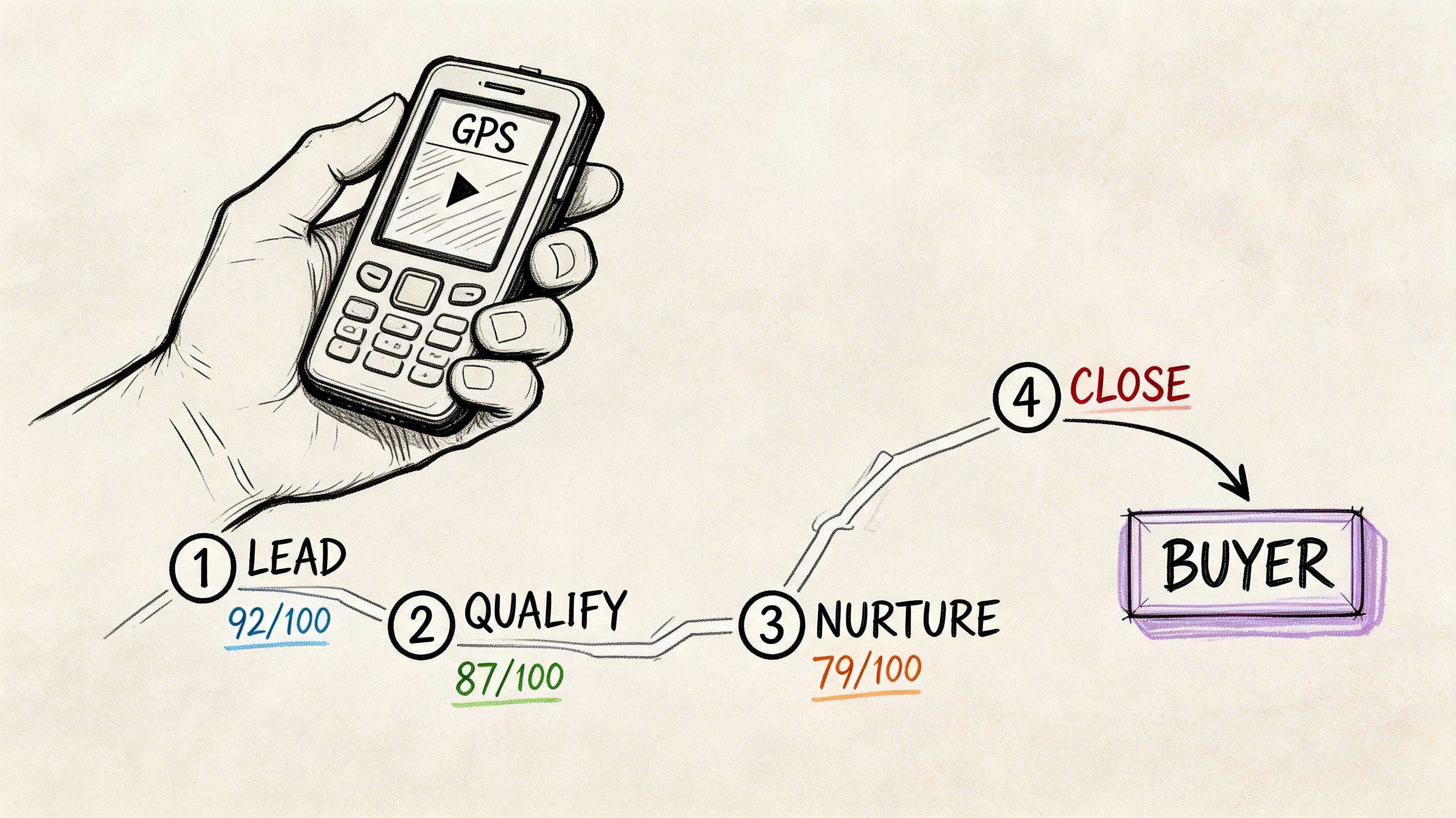
A hand holding a mobile phone representing a business process flow from lead qualification to buyer conversion.

The goal isn't to create a perfect mathematical truth. It's to create a model that reliably pushes reps toward better conversations.

According to Consensus guidance on lead qualification checklists and scoring, a multi-stage qualification framework with behavioral scoring can boost MQL-to-SQL conversions from a baseline of 13% to over 40%. That's why scoring should sit inside your sales process, not beside it.

Start with ICP fit

Start with the things a lead either is or isn't. This is your explicit data.

That usually includes company size, industry, geography, role, use case, and current tools. If your best customers share clear traits, score those traits first. Fit should matter before behavior, because the wrong account can look active and still never become a customer.

A practical model often includes signals like these:

  • Target role match such as founder, VP, or head of function in the teams you sell to

  • Company profile fit based on size, segment, or industry relevance

  • Technology environment if your product works best with specific systems already in place

  • Use-case relevance pulled from form responses, booking notes, or outbound research

Keep it simple enough that managers and reps can explain why a lead earned the score.

Add behavioral signals that show intent

Fit alone doesn't tell you who's ready. That's where implicit data matters.

Behavioral scoring should reward the actions that correlate with buying interest, not vanity engagement. A homepage visit is weak. A return trip to pricing, a demo request, product logins, feature exploration, or repeat engagement with bottom-of-funnel content are much stronger.

For teams that want cleaner data and segmentation, strong CRM best practices matter because scoring quality depends on data hygiene, naming conventions, and stage discipline.

Here’s the shift sales teams need to make:

  1. Score meaningful activity, not every click
    If you reward every open and visit, you'll flood reps with noise.

  2. Weight recency
    A lead who engaged today is different from one who did the same thing a month ago.

  3. Recognize stacked intent
    One pricing page visit doesn't mean much. Pricing page visit plus reply plus webinar attendance is stronger.

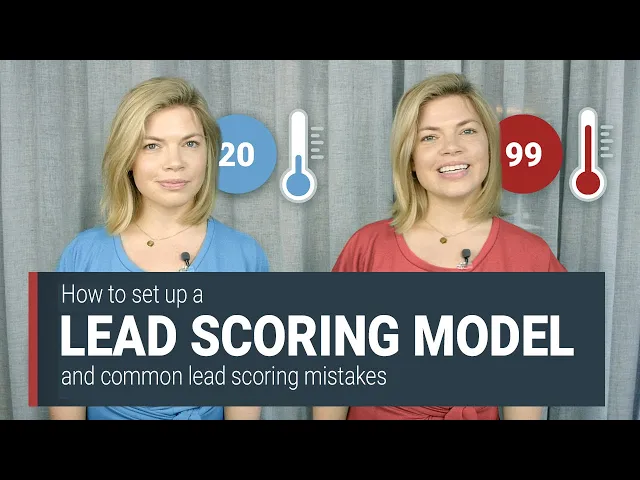
Before you design your own rubric, this walkthrough gives a useful visual frame for thinking about scoring and qualification in motion.

Use negative scoring and stage thresholds

Most lead scoring models fail because they only add points. They don't subtract them.

Negative scoring is how you protect rep time. If a lead unsubscribes, stops engaging, doesn't match your segment, or shows signs that the opportunity isn't active, the score should drop. This prevents the classic problem where old activity keeps weak leads looking warmer than they are.

Manager check: If your reps can't explain why a lead was routed today, your score isn't operational. It's decorative.

You'll also need thresholds. One threshold for MQL. Another for sales acceptance. Another for SQL after discovery validation. The exact point values should come from your own funnel and win data, but the principle stays the same. Marketing engagement alone should not be enough to create pipeline.

Validate the score with conversation

A score should trigger action, not replace judgment.

Once a lead crosses your threshold, reps still need to validate the basics through outreach and discovery. Is there a real problem? Is there urgency? Can the contact involve the right people? Did the behavioral spike reflect curiosity or actual buying motion?

The best scoring models don't just find buyers. They help teams say no faster to everyone else.

Mastering Discovery With Questions That Uncover Need

A lead score gets you to the conversation. Discovery determines whether the opportunity deserves pipeline.

During lead qualification, many teams lose control. Reps either rush into pitching or they ask a robotic checklist of qualification questions that buyers can feel from a mile away. Good discovery doesn't sound like interrogation. It sounds like someone who knows what matters, asks sharp questions, and listens for what the buyer isn't saying yet.

According to lead generation and nurturing benchmarks on response speed and qualification, companies that contact leads within one hour are 7x more likely to qualify them, and effective nurturing generates 50% more sales-ready leads at 33% lower cost, while nurtured leads make 47% larger purchases. That makes discovery the moment where speed and nurturing meet. You either open a real sales process, or you drop the lead into the right next step.

A line drawing illustration showing two people communicating, with one questioning and the other understanding client needs.

Questions that work by framework

The framework should shape the conversation, but it shouldn't make the rep sound scripted.

For BANT, keep the questions direct and practical:

  • Budget
    "How are you thinking about investment for solving this problem?"

  • Authority
    "Who else needs to be involved if this moves forward?"

  • Need
    "What's happening in the business that made this worth looking at now?"

  • Timeline
    "If you decide to act, when do you want a solution in place?"

For MEDDIC, the questions need more depth:

  • Metrics
    "What needs to improve for this to count as a win internally?"

  • Economic buyer
    "Who owns the final approval when a project like this gets funded?"

  • Decision process
    "What usually has to happen between this call and a signed agreement?"

  • Pain and champion
    "Who inside the business feels this pain most strongly, and who would push for change?"

For CHAMP, lead with the business problem:

  • Challenges
    "What's creating the most friction for the team today?"

  • Authority
    "Who's directly responsible for fixing that?"

  • Money
    "If this stays unresolved, what's the cost or impact to the business?"

  • Prioritization
    "Where does solving this sit compared with the other projects competing for attention?"

The follow-up questions that reveal truth

The first answer is rarely the full answer.

Reps need a second layer of questions that test urgency, ownership, and seriousness. That's where discovery moves from surface-level interest to qualification.

Use follow-ups like these:

  • To test urgency
    "What happens if this doesn't get fixed this quarter?"

  • To test ownership
    "Who would feel the consequences most directly?"

  • To test process
    "Has your team bought a tool like this before? How did that decision get made?"

  • To test motivation
    "Why are you exploring this now instead of later?"

A lot of useful discovery also happens after the call. Email replies, meeting attendance, and whether the buyer brings in other stakeholders are all part of qualification. Reps who want stronger follow-up usually benefit from better copywriting for email, because the post-call sequence often determines whether early interest becomes a real sales process.

Buyers don't mind questions. They mind pointless questions.

Short scripts for common brush-offs

The first objection is often reflex, not rejection. Give SDRs language that keeps the conversation moving without sounding combative.

If they say "Just send me an email"
Try: "Happy to. So I send something relevant, what's the main issue you're trying to solve?"

If they say "I don't have time"
Try: "Understood. Usually that means this isn't a priority, or it's a big priority and your calendar is packed. Which is it?"

If they say "We're all set"
Try: "Makes sense. A lot of teams say that when they have something in place but still see gaps. What's working well today, and what's still frustrating?"

What good discovery sounds like

Strong discovery has a rhythm:

  1. Open with context from the trigger that got the meeting.

  2. Diagnose the problem before talking about your product.

  3. Map people and process before assuming the contact can buy.

  4. Confirm urgency before creating pipeline.

  5. Decide the next step based on evidence, not rep optimism.

If the lead is real, discovery should make the deal clearer. If the lead isn't real, discovery should make disqualification easier.

Your Sales Qualification Playbook for SDRs

Individual rep skill matters. A repeatable playbook matters more.

When SDR teams struggle with qualification, it usually isn't because they don't know the questions. It's because the handoffs, stage definitions, and next-step rules are fuzzy. One rep books anything with a pulse. Another disqualifies too aggressively. Marketing celebrates MQL volume while sales managers complain that meetings aren't turning into pipeline.

A useful playbook fixes that by defining what each stage means operationally.

Define the stages with zero ambiguity

At minimum, your team needs working definitions for MQL, SAL, and SQL.

An MQL is a lead that matches enough of your ICP and engagement criteria to deserve human review or automated follow-up. It has marketing value, not confirmed sales value.

An SAL is a lead sales has reviewed and accepted for active outreach. This process forces ownership. The lead is no longer floating between systems or teams.

An SQL is a lead validated through conversation or a high-confidence combination of fit, behavior, and buying signals. This is the point where you can justify pipeline creation or a full sales cycle.

Set handoff rules your team can inspect

The fastest way to create friction is to let every rep interpret stage movement differently.

Use simple operating rules like these:

  • MQL to SAL
    Sales accepts the lead only if profile fit is present and the engagement signal is meaningful enough to warrant direct outreach.

  • SAL to SQL
    A rep confirms need, urgency, buying involvement, or another framework-based threshold your team agrees on.

  • SQL to nurture or closed lost
    If urgency is weak, the buyer can't mobilize a process, or the fit isn't strong enough, the deal exits active pipeline.

The key is consistency. If managers inspect one thing and reps log another, the system breaks fast.

Track the metrics that reveal qualification quality

A qualification process should answer operational questions, not just produce dashboards.

Track metrics that help you understand where quality rises or falls:

KPI

What it tells you

MQL to SAL rate

Whether marketing is sending leads sales will actually accept

SAL to SQL rate

Whether outreach and first conversations are filtering correctly

Lead response speed

Whether your team is engaging while intent is still fresh

Nurture reactivation quality

Whether "not now" leads are coming back stronger later

SQL creation by source

Which channels produce buyers, not just names

You don't need dozens of qualification metrics. You need a short set that exposes waste.

Build the operating rhythm around disqualification

Many SDR teams are taught to push for meetings. Fewer are taught how to disqualify cleanly.

That creates bloated pipeline stages full of low-urgency accounts, non-buyers, and contacts who liked the content but never had purchase intent. A stronger playbook gives reps permission to move leads out just as confidently as they move them forward.

Field note: The cleanest pipelines come from teams that treat disqualification as good judgment, not failure.

A practical SDR rhythm looks like this:

  1. Review inbound and scored outbound daily

  2. Respond fast to leads showing clear intent

  3. Run structured discovery

  4. Advance only when the evidence is there

  5. Route low-urgency leads into nurture with a defined trigger for re-entry

  6. Close out bad-fit leads instead of keeping them in "maybe" stages

That last step matters more than most leaders think. Qualification gets stronger when reps stop confusing politeness with opportunity.

Scale Qualification with an AI-Powered CRM

Manual qualification works at small scale. Then volume rises, data quality slips, follow-up slows down, and the cracks widen.

The problem isn't that reps don't care. The problem is that humans aren't good at constantly checking site activity, enriching contact data, updating scores, writing personalized outreach, and deciding in real time which lead should move where. That's exactly where a unified AI platform changes the economics of qualification.
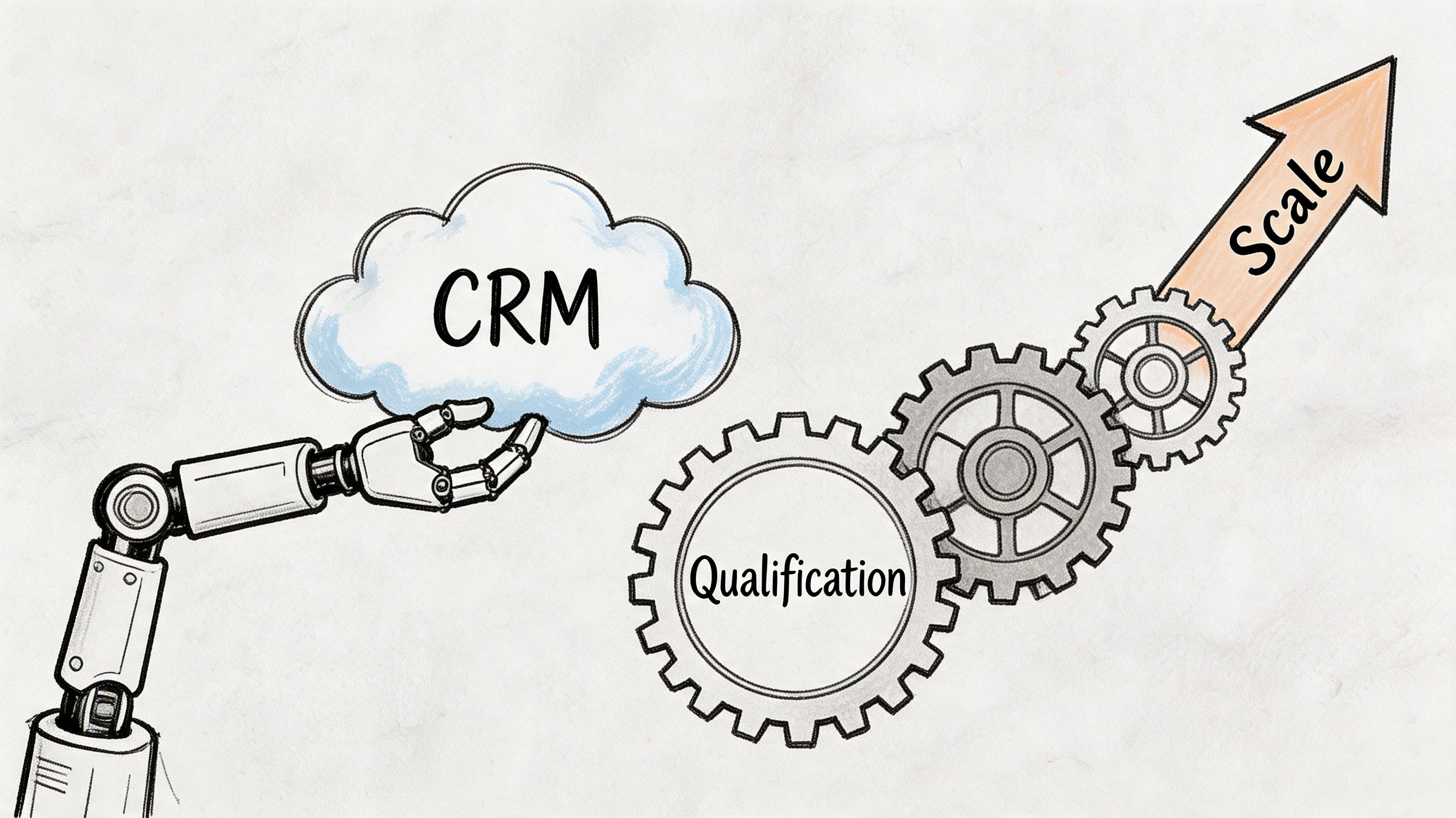
A robotic arm interacting with a CRM cloud icon linked to qualification gears pushing towards scaling success.

According to analysis of AI-assisted sales qualification and CRM workflows, teams using AI-powered lead scoring see a 35-50% uplift in MQL-to-SQL conversion rates compared to the manual average of 13%. The same source notes that AI-driven enrichment can boost data completeness by 40%, product-usage signals can be 3x more predictive of conversion, and poor lead quality contributes to 25% rep churn. That's the operational case for automation in one paragraph.

What AI should automate first

If you're operationalizing how to qualify leads in sales, start with the parts that are repetitive, high-volume, and easy to break when done manually.

The highest-value automations usually include:

  • Enrichment on entry
    When a lead comes in, the system should append role, company details, relevant firmographic data, and context that helps routing.

  • Dynamic scoring
    Scores should update when a buyer revisits pricing, replies to an email, books a meeting, or shows product-usage behavior.

  • Routing and ownership
    High-intent leads should go to the right rep immediately, not wait for someone to notice them.

  • Nurture and disqualification workflows
    Low-urgency leads should enter the right sequence automatically. Bad-fit leads should stop consuming sales time.

This is also where modern teams start to increase conversion rates with AI, because AI doesn't just speed up qualification. It reduces the lag between signal, decision, and action.

Why unified systems beat point solutions

Most SMB teams don't need more disconnected tools. They need fewer handoffs.

If website signals live in one system, email engagement in another, CRM notes in a third, and scoring rules in a spreadsheet, the qualification process becomes slow and fragile. Reps waste time reconstructing context that should already be available. Managers review stale data. Marketing can't see what sales accepted or rejected.

A unified setup solves that by putting scoring, outreach, workflows, and pipeline management in one operating system. That matters because qualification is not one event. It's a chain of events. The moment one handoff goes missing, the chain weakens.

What better execution looks like in practice

A scalable AI-powered CRM should do more than store contacts.

It should let your team run qualification as a live process:

  1. Capture inbound and outbound signals in one place

  2. Enrich the record automatically

  3. Update the lead score based on fit and behavior

  4. Route hot leads to a rep or sequence

  5. Launch nurture for low-priority or low-urgency leads

  6. Feed rep activity and buyer responses back into the score

For teams evaluating platforms, this isn't just a sales feature question. It's a workflow design question. If you're exploring where AI belongs in this stack, this overview of AI sales assistants is a useful reference point because it maps how AI can support prospecting, qualification, and follow-up without replacing rep judgment.

The overlooked advantage is better disqualification

Most conversations about AI focus on finding more leads. The bigger operational win is often faster disqualification.

An AI-powered system can recognize stale engagement, weak fit, unsubscribes, missing buying signals, or repeated non-response and downgrade the opportunity automatically. That keeps reps working the leads with the highest probability and stops the pipeline from filling with false positives.

Good automation doesn't just find who to call. It protects your team from calling the wrong people for too long.

That's what scaling qualification really means. Not more activity. Better allocation.

Stamina brings that allocation into one place. It combines marketing, sales engagement, CRM, workflows, and an AI SDR so growing teams can score leads, enrich records, automate nurture, and route qualified opportunities without stitching together a stack of point tools. If you want a cleaner way to operationalize qualification and stop pipeline leaks before they start, take a look at Stamina.

Your team is generating leads. The CRM is full. Calendars look busy. Revenue still feels harder than it should.

That usually means the problem isn’t top-of-funnel volume. It’s qualification. Reps are spending time on people who downloaded a guide, opened an email, or looked vaguely interested, but were never realistic buyers. Marketing calls them leads. Sales calls them junk. The pipeline gets crowded, forecasting gets fuzzy, and good opportunities wait too long for a real conversation.

If you're figuring out how to qualify leads in sales, the fix isn't another spreadsheet or a longer discovery script. It's a system that tells your team who deserves attention now, who belongs in nurture, and who should be disqualified early. The companies that get this right don't just talk about frameworks. They operationalize them.

Why Most Sales Pipelines Leak and How Qualification Plugs The Holes

A leaky pipeline usually starts with a simple mistake. Teams treat lead capture as progress.

It isn't. A lead is only valuable when someone can prove two things. First, the account fits the type of customer you can effectively help. Second, the person or buying group shows enough intent to justify sales time. Without that filter, the funnel gets wider at the top and weaker everywhere else.

The cost of weak qualification is bigger than often acknowledged. According to research on lead qualification and sales conversion bottlenecks, only 10% of prospects become qualified leads, only 1-6% become customers, 79% of marketing leads never convert because of ineffective nurturing, and 44% of sales reps complain about lead quality. That's not a minor efficiency issue. That's a revenue operations problem.

What a qualified lead actually means

A qualified lead isn't just someone who filled out a form. It's someone who matches your ideal customer profile, shows credible buying intent, and can move through a real buying process.

That sounds obvious, but teams still confuse activity with readiness. A contact who visits your blog twice is active. A buyer who returns to pricing, attends a webinar, replies to outreach, and fits your target account profile is a very different signal.

Practical rule: If your reps are asking, "Why did this get assigned to me?" your qualification model is broken.

Qualification also has to be shared across teams. Marketing can't optimize for form fills while sales optimizes for closeable opportunities. If you need a clean way to think about handoffs, this guide on aligning sales and marketing efforts is useful because it clarifies where MQLs and SQLs often get mixed up.

A strong process also tightens execution across the rest of the funnel. Teams that want better handoffs, faster response, and cleaner stage definitions usually need broader sales process optimization, not just better rep coaching.

Where most leaks actually happen

The biggest pipeline leaks usually show up in a few places:

  • Weak entry criteria means almost anyone can become an MQL.

  • Slow follow-up lets high-intent buyers cool off before a rep engages.

  • No disqualification rules keeps low-probability deals sitting in pipeline stages for too long.

  • Poor nurturing causes decent-fit leads to disappear because nobody owns the middle.

The fix is straightforward, but it requires discipline. Score fit. Score behavior. Validate with conversation. Disqualify when needed. Nurture the rest.

That's what turns qualification from a sales buzzword into a control system.

Choosing Your Qualification Framework BANT MEDDIC or CHAMP

Sales teams don't fail because they lack a framework. They fail because they use the wrong one for their sales motion.

BANT, MEDDIC, and CHAMP all work. What matters is whether the framework matches your deal size, buying complexity, and the amount of information your reps can realistically gather early. If you're selling into SMBs with short cycles, a heavyweight enterprise framework can slow reps down. If you're selling multi-stakeholder software, a lightweight framework can hide risk until late-stage deals fall apart.

There's another issue most guides skip. Qualification isn't only about deciding who to pursue. It's also about deciding who to stop chasing. As noted in this lead qualification framework discussion for B2B teams, only 13% of MQLs typically convert to SQLs, which is exactly why disqualification needs to be built into the framework, not treated as an afterthought.

Qualification Frameworks Compared

Framework

Stands For

Best For

Key Focus

BANT

Budget, Authority, Need, Timeline

Shorter sales cycles, straightforward buying decisions

Fast screening for purchase readiness

MEDDIC

Metrics, Economic Buyer, Decision Criteria, Decision Process, Identify Pain, Champion

Complex B2B sales, enterprise accounts, multi-stakeholder deals

Deal control and buying-process depth

CHAMP

Challenges, Authority, Money, Prioritization

Consultative selling, problem-led discovery, mid-market motions

Customer pain and business priority

When BANT still works

BANT gets dismissed too quickly. In the right environment, it's efficient.

If your team sells a clear solution to a clear buyer and the buying process isn't political or drawn out, BANT gives reps a fast way to assess whether a deal belongs in active pursuit. Budget tells you if the opportunity is real. Authority tells you whether you're speaking to someone who can move it. Need confirms relevance. Timeline shows urgency.

Where BANT breaks is in more layered deals. Buyers often don't reveal budget early. Authority is distributed. Need exists, but not at the executive level yet. Timeline is fuzzy because internal alignment hasn't happened.

Use BANT when speed matters more than nuance.

Where MEDDIC earns its keep

MEDDIC is for teams that can't afford surprises late in the cycle.

If your reps are selling a platform, replacing an incumbent, or navigating procurement, legal, security, and multiple stakeholders, MEDDIC gives structure to the details that decide whether a deal closes. It pushes reps to identify the economic buyer, understand decision criteria, and map the decision process before the deal gets deep enough to consume serious resources.

In complex deals, "they liked the demo" is not deal progress. Knowing how they buy is deal progress.

The trade-off is obvious. MEDDIC takes time. Reps need stronger discovery skills, cleaner account research, and better manager inspection. For low-value or high-volume sales, that's too heavy.

Why CHAMP feels more modern

CHAMP starts with the buyer's challenge, which makes it useful for teams that sell through diagnosis rather than feature explanation.

That shift matters. Many prospects won't discuss budget cleanly at the start, but they will talk about the operational pain that's forcing them to explore options. CHAMP helps reps earn the right to ask harder questions by starting where the buyer already has emotional and business clarity.

It's a strong fit when your reps need to build urgency, not just confirm it.

A practical read on the three frameworks looks like this:

  • Choose BANT when reps need a fast pass or fail screen.

  • Choose MEDDIC when a missed stakeholder or unknown buying step can kill the deal later.

  • Choose CHAMP when your team wins by diagnosing pain and shaping priority.

Build disqualification into the framework

Many teams squander time. They define qualification criteria, but they never define exit criteria.

Every framework should answer these questions:

  • Who is a poor fit by profile

  • Who has interest but no urgency

  • Who should stay in nurture instead of pipeline

  • Who should be closed out completely

For SMB teams especially, this matters a lot. Reps don't have spare capacity for "maybe next year" deals disguised as active opportunities. A low-urgency lead isn't always a bad lead. It's often just a nurture lead.

The best qualification systems don't reward optimism. They reward accuracy.

How to Build a Lead Scoring Model That Finds Buyers

Frameworks help reps think. Lead scoring helps teams operate.

Without scoring, qualification stays subjective. One SDR thinks a lead is promising because they replied. Another ignores the same lead because the company is too small. A scoring model fixes that by turning fit and intent into something consistent enough to route, prioritize, and inspect.

A hand holding a mobile phone representing a business process flow from lead qualification to buyer conversion.

The goal isn't to create a perfect mathematical truth. It's to create a model that reliably pushes reps toward better conversations.

According to Consensus guidance on lead qualification checklists and scoring, a multi-stage qualification framework with behavioral scoring can boost MQL-to-SQL conversions from a baseline of 13% to over 40%. That's why scoring should sit inside your sales process, not beside it.

Start with ICP fit

Start with the things a lead either is or isn't. This is your explicit data.

That usually includes company size, industry, geography, role, use case, and current tools. If your best customers share clear traits, score those traits first. Fit should matter before behavior, because the wrong account can look active and still never become a customer.

A practical model often includes signals like these:

  • Target role match such as founder, VP, or head of function in the teams you sell to

  • Company profile fit based on size, segment, or industry relevance

  • Technology environment if your product works best with specific systems already in place

  • Use-case relevance pulled from form responses, booking notes, or outbound research

Keep it simple enough that managers and reps can explain why a lead earned the score.

Add behavioral signals that show intent

Fit alone doesn't tell you who's ready. That's where implicit data matters.

Behavioral scoring should reward the actions that correlate with buying interest, not vanity engagement. A homepage visit is weak. A return trip to pricing, a demo request, product logins, feature exploration, or repeat engagement with bottom-of-funnel content are much stronger.

For teams that want cleaner data and segmentation, strong CRM best practices matter because scoring quality depends on data hygiene, naming conventions, and stage discipline.

Here’s the shift sales teams need to make:

  1. Score meaningful activity, not every click
    If you reward every open and visit, you'll flood reps with noise.

  2. Weight recency
    A lead who engaged today is different from one who did the same thing a month ago.

  3. Recognize stacked intent
    One pricing page visit doesn't mean much. Pricing page visit plus reply plus webinar attendance is stronger.

Before you design your own rubric, this walkthrough gives a useful visual frame for thinking about scoring and qualification in motion.

Use negative scoring and stage thresholds

Most lead scoring models fail because they only add points. They don't subtract them.

Negative scoring is how you protect rep time. If a lead unsubscribes, stops engaging, doesn't match your segment, or shows signs that the opportunity isn't active, the score should drop. This prevents the classic problem where old activity keeps weak leads looking warmer than they are.

Manager check: If your reps can't explain why a lead was routed today, your score isn't operational. It's decorative.

You'll also need thresholds. One threshold for MQL. Another for sales acceptance. Another for SQL after discovery validation. The exact point values should come from your own funnel and win data, but the principle stays the same. Marketing engagement alone should not be enough to create pipeline.

Validate the score with conversation

A score should trigger action, not replace judgment.

Once a lead crosses your threshold, reps still need to validate the basics through outreach and discovery. Is there a real problem? Is there urgency? Can the contact involve the right people? Did the behavioral spike reflect curiosity or actual buying motion?

The best scoring models don't just find buyers. They help teams say no faster to everyone else.

Mastering Discovery With Questions That Uncover Need

A lead score gets you to the conversation. Discovery determines whether the opportunity deserves pipeline.

During lead qualification, many teams lose control. Reps either rush into pitching or they ask a robotic checklist of qualification questions that buyers can feel from a mile away. Good discovery doesn't sound like interrogation. It sounds like someone who knows what matters, asks sharp questions, and listens for what the buyer isn't saying yet.

According to lead generation and nurturing benchmarks on response speed and qualification, companies that contact leads within one hour are 7x more likely to qualify them, and effective nurturing generates 50% more sales-ready leads at 33% lower cost, while nurtured leads make 47% larger purchases. That makes discovery the moment where speed and nurturing meet. You either open a real sales process, or you drop the lead into the right next step.

A line drawing illustration showing two people communicating, with one questioning and the other understanding client needs.

Questions that work by framework

The framework should shape the conversation, but it shouldn't make the rep sound scripted.

For BANT, keep the questions direct and practical:

  • Budget
    "How are you thinking about investment for solving this problem?"

  • Authority
    "Who else needs to be involved if this moves forward?"

  • Need
    "What's happening in the business that made this worth looking at now?"

  • Timeline
    "If you decide to act, when do you want a solution in place?"

For MEDDIC, the questions need more depth:

  • Metrics
    "What needs to improve for this to count as a win internally?"

  • Economic buyer
    "Who owns the final approval when a project like this gets funded?"

  • Decision process
    "What usually has to happen between this call and a signed agreement?"

  • Pain and champion
    "Who inside the business feels this pain most strongly, and who would push for change?"

For CHAMP, lead with the business problem:

  • Challenges
    "What's creating the most friction for the team today?"

  • Authority
    "Who's directly responsible for fixing that?"

  • Money
    "If this stays unresolved, what's the cost or impact to the business?"

  • Prioritization
    "Where does solving this sit compared with the other projects competing for attention?"

The follow-up questions that reveal truth

The first answer is rarely the full answer.

Reps need a second layer of questions that test urgency, ownership, and seriousness. That's where discovery moves from surface-level interest to qualification.

Use follow-ups like these:

  • To test urgency
    "What happens if this doesn't get fixed this quarter?"

  • To test ownership
    "Who would feel the consequences most directly?"

  • To test process
    "Has your team bought a tool like this before? How did that decision get made?"

  • To test motivation
    "Why are you exploring this now instead of later?"

A lot of useful discovery also happens after the call. Email replies, meeting attendance, and whether the buyer brings in other stakeholders are all part of qualification. Reps who want stronger follow-up usually benefit from better copywriting for email, because the post-call sequence often determines whether early interest becomes a real sales process.

Buyers don't mind questions. They mind pointless questions.

Short scripts for common brush-offs

The first objection is often reflex, not rejection. Give SDRs language that keeps the conversation moving without sounding combative.

If they say "Just send me an email"
Try: "Happy to. So I send something relevant, what's the main issue you're trying to solve?"

If they say "I don't have time"
Try: "Understood. Usually that means this isn't a priority, or it's a big priority and your calendar is packed. Which is it?"

If they say "We're all set"
Try: "Makes sense. A lot of teams say that when they have something in place but still see gaps. What's working well today, and what's still frustrating?"

What good discovery sounds like

Strong discovery has a rhythm:

  1. Open with context from the trigger that got the meeting.

  2. Diagnose the problem before talking about your product.

  3. Map people and process before assuming the contact can buy.

  4. Confirm urgency before creating pipeline.

  5. Decide the next step based on evidence, not rep optimism.

If the lead is real, discovery should make the deal clearer. If the lead isn't real, discovery should make disqualification easier.

Your Sales Qualification Playbook for SDRs

Individual rep skill matters. A repeatable playbook matters more.

When SDR teams struggle with qualification, it usually isn't because they don't know the questions. It's because the handoffs, stage definitions, and next-step rules are fuzzy. One rep books anything with a pulse. Another disqualifies too aggressively. Marketing celebrates MQL volume while sales managers complain that meetings aren't turning into pipeline.

A useful playbook fixes that by defining what each stage means operationally.

Define the stages with zero ambiguity

At minimum, your team needs working definitions for MQL, SAL, and SQL.

An MQL is a lead that matches enough of your ICP and engagement criteria to deserve human review or automated follow-up. It has marketing value, not confirmed sales value.

An SAL is a lead sales has reviewed and accepted for active outreach. This process forces ownership. The lead is no longer floating between systems or teams.

An SQL is a lead validated through conversation or a high-confidence combination of fit, behavior, and buying signals. This is the point where you can justify pipeline creation or a full sales cycle.

Set handoff rules your team can inspect

The fastest way to create friction is to let every rep interpret stage movement differently.

Use simple operating rules like these:

  • MQL to SAL
    Sales accepts the lead only if profile fit is present and the engagement signal is meaningful enough to warrant direct outreach.

  • SAL to SQL
    A rep confirms need, urgency, buying involvement, or another framework-based threshold your team agrees on.

  • SQL to nurture or closed lost
    If urgency is weak, the buyer can't mobilize a process, or the fit isn't strong enough, the deal exits active pipeline.

The key is consistency. If managers inspect one thing and reps log another, the system breaks fast.

Track the metrics that reveal qualification quality

A qualification process should answer operational questions, not just produce dashboards.

Track metrics that help you understand where quality rises or falls:

KPI

What it tells you

MQL to SAL rate

Whether marketing is sending leads sales will actually accept

SAL to SQL rate

Whether outreach and first conversations are filtering correctly

Lead response speed

Whether your team is engaging while intent is still fresh

Nurture reactivation quality

Whether "not now" leads are coming back stronger later

SQL creation by source

Which channels produce buyers, not just names

You don't need dozens of qualification metrics. You need a short set that exposes waste.

Build the operating rhythm around disqualification

Many SDR teams are taught to push for meetings. Fewer are taught how to disqualify cleanly.

That creates bloated pipeline stages full of low-urgency accounts, non-buyers, and contacts who liked the content but never had purchase intent. A stronger playbook gives reps permission to move leads out just as confidently as they move them forward.

Field note: The cleanest pipelines come from teams that treat disqualification as good judgment, not failure.

A practical SDR rhythm looks like this:

  1. Review inbound and scored outbound daily

  2. Respond fast to leads showing clear intent

  3. Run structured discovery

  4. Advance only when the evidence is there

  5. Route low-urgency leads into nurture with a defined trigger for re-entry

  6. Close out bad-fit leads instead of keeping them in "maybe" stages

That last step matters more than most leaders think. Qualification gets stronger when reps stop confusing politeness with opportunity.

Scale Qualification with an AI-Powered CRM

Manual qualification works at small scale. Then volume rises, data quality slips, follow-up slows down, and the cracks widen.

The problem isn't that reps don't care. The problem is that humans aren't good at constantly checking site activity, enriching contact data, updating scores, writing personalized outreach, and deciding in real time which lead should move where. That's exactly where a unified AI platform changes the economics of qualification.

A robotic arm interacting with a CRM cloud icon linked to qualification gears pushing towards scaling success.

According to analysis of AI-assisted sales qualification and CRM workflows, teams using AI-powered lead scoring see a 35-50% uplift in MQL-to-SQL conversion rates compared to the manual average of 13%. The same source notes that AI-driven enrichment can boost data completeness by 40%, product-usage signals can be 3x more predictive of conversion, and poor lead quality contributes to 25% rep churn. That's the operational case for automation in one paragraph.

What AI should automate first

If you're operationalizing how to qualify leads in sales, start with the parts that are repetitive, high-volume, and easy to break when done manually.

The highest-value automations usually include:

  • Enrichment on entry
    When a lead comes in, the system should append role, company details, relevant firmographic data, and context that helps routing.

  • Dynamic scoring
    Scores should update when a buyer revisits pricing, replies to an email, books a meeting, or shows product-usage behavior.

  • Routing and ownership
    High-intent leads should go to the right rep immediately, not wait for someone to notice them.

  • Nurture and disqualification workflows
    Low-urgency leads should enter the right sequence automatically. Bad-fit leads should stop consuming sales time.

This is also where modern teams start to increase conversion rates with AI, because AI doesn't just speed up qualification. It reduces the lag between signal, decision, and action.

Why unified systems beat point solutions

Most SMB teams don't need more disconnected tools. They need fewer handoffs.

If website signals live in one system, email engagement in another, CRM notes in a third, and scoring rules in a spreadsheet, the qualification process becomes slow and fragile. Reps waste time reconstructing context that should already be available. Managers review stale data. Marketing can't see what sales accepted or rejected.

A unified setup solves that by putting scoring, outreach, workflows, and pipeline management in one operating system. That matters because qualification is not one event. It's a chain of events. The moment one handoff goes missing, the chain weakens.

What better execution looks like in practice

A scalable AI-powered CRM should do more than store contacts.

It should let your team run qualification as a live process:

  1. Capture inbound and outbound signals in one place

  2. Enrich the record automatically

  3. Update the lead score based on fit and behavior

  4. Route hot leads to a rep or sequence

  5. Launch nurture for low-priority or low-urgency leads

  6. Feed rep activity and buyer responses back into the score

For teams evaluating platforms, this isn't just a sales feature question. It's a workflow design question. If you're exploring where AI belongs in this stack, this overview of AI sales assistants is a useful reference point because it maps how AI can support prospecting, qualification, and follow-up without replacing rep judgment.

The overlooked advantage is better disqualification

Most conversations about AI focus on finding more leads. The bigger operational win is often faster disqualification.

An AI-powered system can recognize stale engagement, weak fit, unsubscribes, missing buying signals, or repeated non-response and downgrade the opportunity automatically. That keeps reps working the leads with the highest probability and stops the pipeline from filling with false positives.

Good automation doesn't just find who to call. It protects your team from calling the wrong people for too long.

That's what scaling qualification really means. Not more activity. Better allocation.

Stamina brings that allocation into one place. It combines marketing, sales engagement, CRM, workflows, and an AI SDR so growing teams can score leads, enrich records, automate nurture, and route qualified opportunities without stitching together a stack of point tools. If you want a cleaner way to operationalize qualification and stop pipeline leaks before they start, take a look at Stamina.

Share this article

Share this article

Send a shareable link to your team or anyone who might find it useful.

Send a shareable link to your team or anyone who might find it useful.

Copy link

Copied

Share directly to

Table of contents

Give Your Business the Stamina it needs to Thrive