Your team is sending emails every week. Some are outbound. Some are follow-ups. Some are nurture touches that looked solid in the draft and weak in the inbox. Open rates feel uneven. Replies are thin. The copy sounds polished, but not persuasive.
That means the problem is not email as a channel. It is the writing.
For SMB teams, copywriting for email sits close to revenue. A weak landing page can hide for a while. A weak sales deck might only hurt later-stage conversations. Weak email copy fails fast. Buyers ignore it, skim it, or file it mentally with every other generic message asking for “15 minutes.”
Modern platforms make sending easier. AI makes drafting faster. Neither fixes bland messaging. In practice, they raise the bar. When every team can generate emails in seconds, the teams that win are the ones that know how to make those emails feel relevant, useful, and worth answering.
Why Great Email Copy Is Your Unfair Advantage
Email is still one of the strongest revenue channels available. Businesses see an average return of $36 to $44 for every $1 spent, which translates to 3,600 to 4,400 percent ROI, and automated emails generate 320 percent more revenue than non-automated emails according to CodeCrew’s email marketing statistics roundup.
That matters more for SMBs than for large teams with budget to burn.
When a smaller company gets email right, it compounds. One strong follow-up sequence creates pipeline. One well-written nurture flow revives stalled leads. One clear reactivation email pulls old opportunities back into active conversations. The channel is cheap to run, fast to test, and close enough to buying intent that improvements show up in meetings, demos, and closed revenue.
Why copy matters more now
A lot of teams assume automation lowers the need for strong writing. The opposite is true.
Automation scales whatever you already have. If your message is generic, you scale generic. If your copy relies on tired filler, every prospect gets the same tired filler faster. The companies benefiting from AI and workflow tools are not the ones sending more words. They are the ones sending clearer ones.
Practical rule: Automation is a force multiplier, not a rescue plan. Fix the message first, then scale it.
There is another reason this matters. SMBs do not have clean lines between sales and marketing. The same prospect might see an outbound email, a nurture email, a founder note, and a product announcement inside one buying cycle. If those messages sound disconnected, trust drops. If they sound aligned, the company feels sharper. That alignment gets easier when sales, marketing, and CRM live closer together, which is the core issue behind the difference between sales and marketing.
Good copy creates that alignment. It gives the buyer one consistent answer to three questions:
Why should I care
Why should I trust you
Why should I act now
Most inboxes are full of competent emails. Few contain emails that feel timely, specific, and easy to respond to. That gap is where strong copywriting for email becomes an unfair advantage.
The Anatomy of a High-Converting Email
Underperforming emails usually miss in several small places at once. The subject line feels generic. The first line burns attention. The body explains too much. The CTA asks for a bigger commitment than the buyer is ready to make.
High-converting emails are built tighter than that.
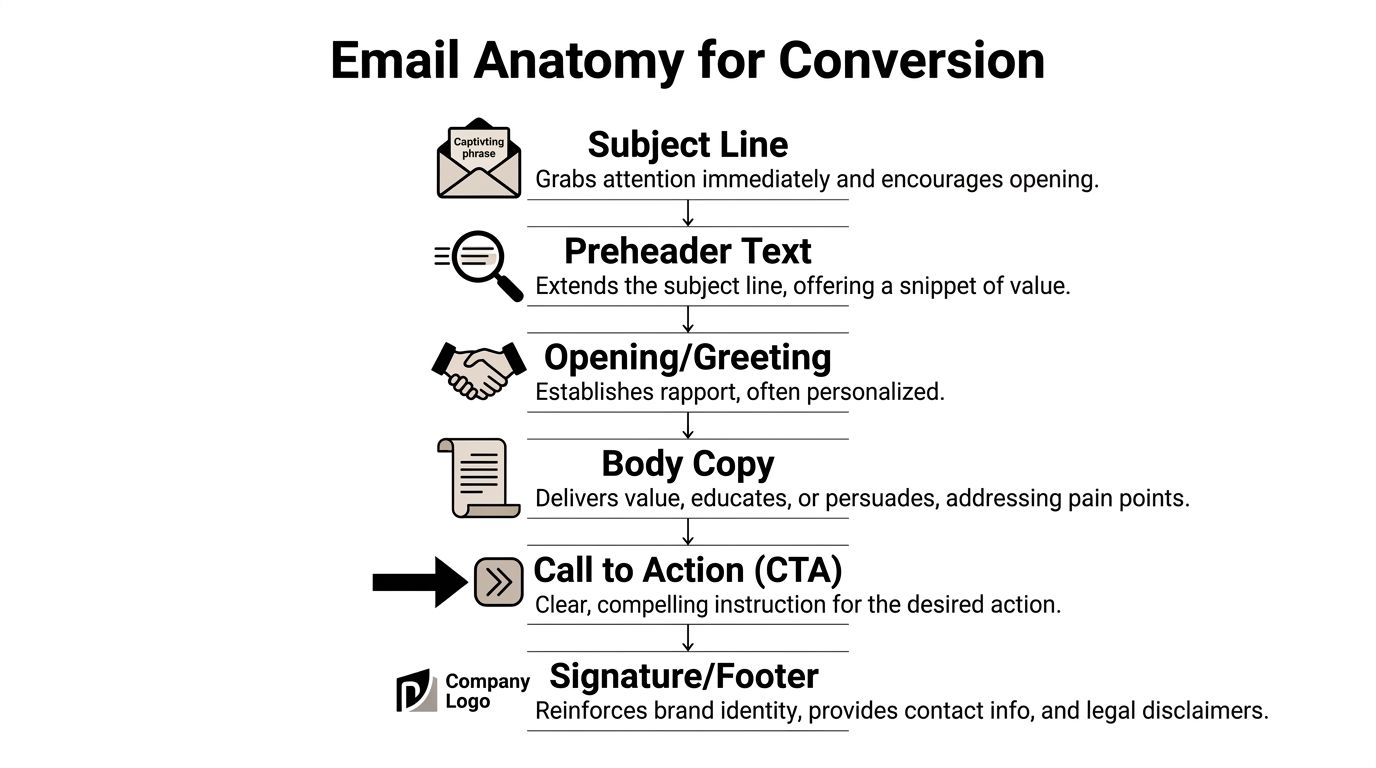
A simple test helps here. Read the email once and ask four questions.
Why would this person open it?
Why would they keep reading?
Why would they believe it?
Why would they reply now?
If one answer is weak, the whole message usually underperforms. SMB B2B teams feel this fast because email is rarely a standalone asset. It sits inside outbound, lead follow-up, lifecycle nurture, and sales handoff. Platforms like Stamina make the operational side easier by pulling CRM context, intent signals, and sequence logic into one place. That raises the standard for the copy itself. The message still has to earn the response.
Start with the subject line
The subject line sets the contract. It tells the reader whether the email looks relevant, credible, and worth ten more seconds.
In B2B, good subject lines usually do one of three things:
Show context: “Question about your inbound handoff”
Show an outcome: “Reducing no-show demos”
Show an observation: “Noticed your pricing page update”
The goal of personalization is to signal relevance, not just to add a first name. “Jamie, quick question” says almost nothing. “Question about demo follow-up speed” gives the buyer a reason to care before they open.
Keep subject lines short enough to scan on mobile. Keep them specific enough to sound like a real person wrote them. Avoid common traps:
Fake familiarity: “Quick one”
Empty urgency: “Important”
Overwritten teaser copy: “A novel idea that could reshape your growth strategy”
The opening needs to earn the next line
The first sentence has one job. Create enough relevance to keep the reader from deleting the message.
That usually comes from a trigger, a problem, or a useful outcome. Good openers sound grounded in something the buyer recognizes right away.
Examples:
“Saw you’re hiring AEs, and lead routing often gets messy during that ramp.”
“Teams with plenty of demo requests still lose meetings when follow-up is inconsistent.”
“You probably do not need more leads. You may need faster handoff after form fills.”
This is one place where integrated tooling helps. If Stamina is already syncing CRM stage, site activity, and prior touch history, the opener can reference a real condition instead of a generic pain point. That shortens the distance between “another sales email” and “this might be relevant.”
Body copy should be compact and directional
The body does not need to cover every feature, objection, and proof point. It needs to move the conversation one step forward.
For SMB outreach, shorter usually wins because the buyer can understand the point in seconds. Three compact elements are enough in many emails:
What is happening
Why it matters
What to do next
Frameworks help when a draft starts expanding:
Framework | When to use it | Example shape |
|---|---|---|
PAS | Pain is obvious but ignored | Problem, agitation, simple path forward |
AIDA | Offer needs more build-up | Attention, interest, desire, action |
BAB | You can show contrast clearly | Before, after, bridge |
PAS works especially well for outbound and reactivation because it keeps the copy disciplined.
Example:
Problem: “Your reps are probably spending time writing follow-ups instead of sending them.”
Agitation: “That slows response time and creates uneven messaging across the team.”
Solution: “A tighter sequence with role-based variants fixes both.”
The trade-off is real. Short copy gets read more often, but it can feel thin if the offer is unfamiliar or expensive. In those cases, add one proof point or one concrete example, not a full product tour.
The CTA should feel easy
A strong CTA reduces decision load. It gives the recipient a clear, low-effort next step.
Weak CTA:
“Let me know if you’d like to explore a synergistic partnership.”
Stronger CTA:
“Open to seeing the sequence structure we use for no-response follow-ups?”
That ask is easier to answer because the commitment is smaller and the outcome is clear. For teams writing reminders, re-engagement emails, or response nudges, these proven survey reminder email sample templates are useful because they show how a short prompt can create action without sounding pushy.
A good CTA also matches buyer intent. Cold prospects respond better to “want the outline?” than “book 30 minutes.” Warm leads and active opportunities can handle a stronger ask.
Do not waste the P.S.
Plenty of recipients skim to the bottom first. The P.S. gives you one more chance to restate value or lower the pressure.
Use it for a practical detail, a softer reply path, or a useful alternative.
Tip: If the main CTA asks for a meeting, the P.S. can offer an easier option such as “happy to send the outline by email.”
Follow-ups deserve the same level of care as first touches. Teams refining second and third emails should study a practical how to follow up no response email approach and adapt the wording to their sales cycle, offer, and buyer stage.
Personalization and Segmentation Beyond First Names
The fastest way to make email copy worse is to confuse personalization with mail merge.
“Hi Sarah” is not personalization. It is formatting.
Real personalization changes the substance of the email. It changes what you talk about, what proof you use, what CTA you choose, and sometimes whether you should send the email at all.
A before and after example
Here is the kind of email SMB teams still send:
Before
Hi Jamie, I work with companies like yours to improve sales efficiency and drive more pipeline. I would love to show you how our platform can help your team automate outreach and improve conversion. Are you available next week for a quick call?
Nothing is technically wrong with it. It is also easy to ignore.
Now watch what happens when the copy uses context from the account, role, and behavior.
After
Hi Jamie,
Noticed your team is adding reps while pushing more traffic to demo pages. That usually creates a familiar problem. More lead volume, but slower follow-up and inconsistent messaging across SDRs.
I put together a few ways SMB teams tighten that gap using role-based sequences and website-visitor signals. Want me to send the outline?
This version works better because it is grounded in a believable observation. It also asks for less.
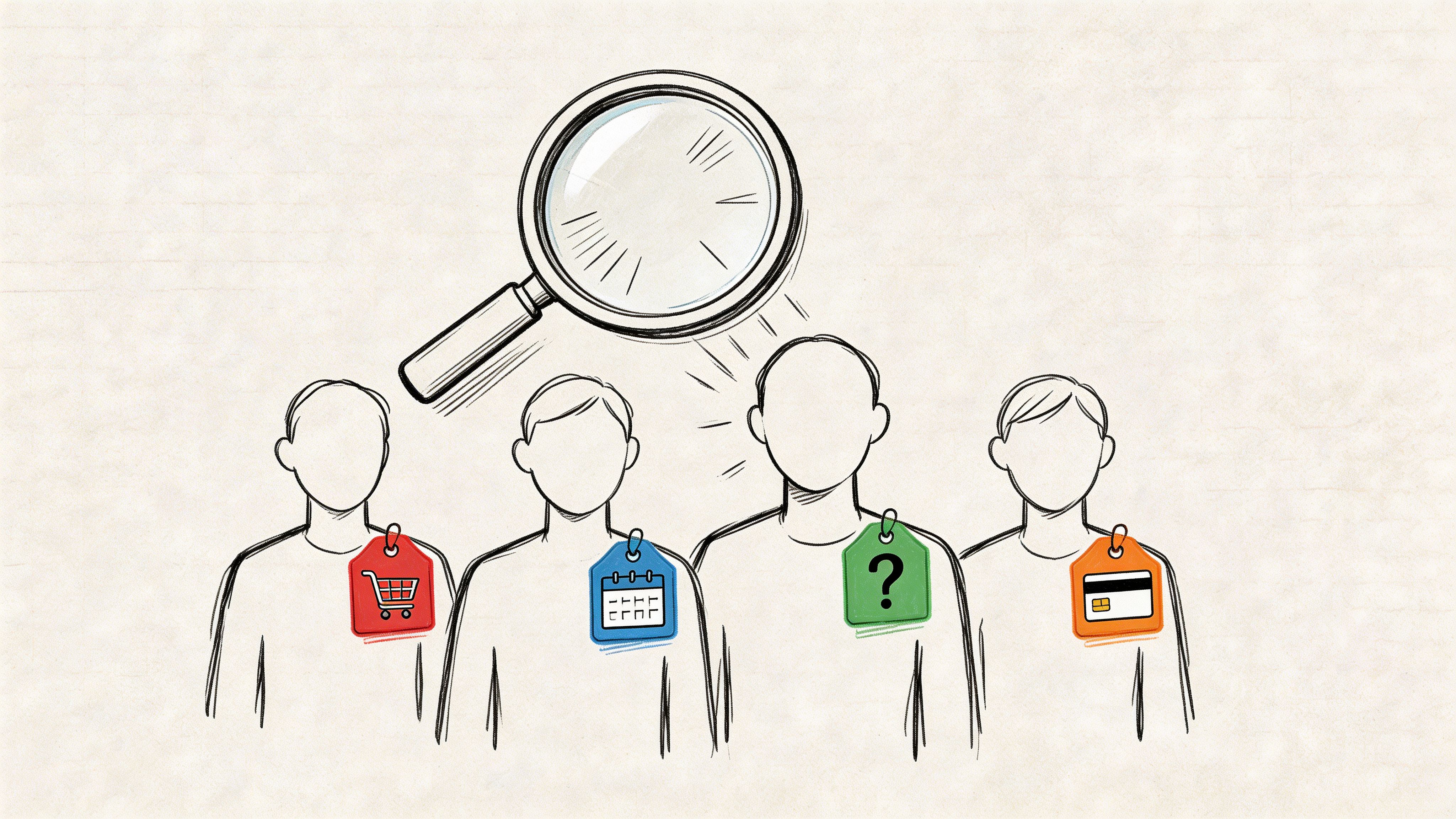
Segment by decision context
The most useful segments in B2B are not cosmetic. They are tied to buying context.
A practical segmentation model looks like this:
By role: A founder cares about pipeline efficiency. A sales manager cares about rep execution. A marketer cares about conversion across lifecycle stages.
By deal stage: New lead copy should diagnose. Mid-funnel copy should reduce risk. Late-stage copy should resolve objections.
By behavior: Website visits, content consumption, prior replies, and form fills all change what should come next.
By source: A referral email should sound different from cold outbound. An inbound demo request should sound different from a re-engagement touch.
When teams ignore this, the copy gets broad. Broad copy tends to turn into feature lists.
Practical rule: Segment around what the recipient is trying to decide, not around what is easy to export from the CRM.
Using AI without sounding like AI
This is the pressure point for many teams now. Recent data cited by WiseStamp’s email copywriting article says 68 percent of SMB marketers use AI for over 40 percent of their email drafts, yet 54 percent report lower conversions due to “soulless” copy.
That matches what operators see in the field. AI drafts are often structurally fine and emotionally flat.
The fix is not to stop using AI. The fix is to give AI better raw material and a tighter editing pass.
Use AI for:
First-pass variants
Industry-specific rewrites
Subject line options
Follow-up branches based on reply type
Do not let AI finalize:
The opening observation
The emotional tone
The CTA phrasing
The proof points that need to sound credible
A useful editing checklist:
Cut any sentence that could fit any prospect.
Replace abstract claims with one concrete observation.
Swap “we help businesses” language for outcome language tied to the role.
Read it aloud. Robotic copy is easy to hear.
Integrated tools matter here because they bring the context closer to the draft. A platform like Stamina’s personalization workflow can pull CRM data, buying signals, and outreach logic into the same system where variants are generated. That changes the job of the writer. You stop writing every email from scratch and start shaping better prompts, better segments, and better edits.
Humanized personalization sounds narrower
A lot of teams are afraid to be specific because they think specific means risky. In practice, the opposite is true.
Generic copy forces the reader to do interpretive work. Specific copy lets them recognize themselves quickly.
Try this contrast:
Weak line | Stronger line |
|---|---|
“We help companies grow revenue.” | “We help teams respond faster when high-intent leads hit the site.” |
“Our software improves outreach.” | “Your reps get usable first-draft emails instead of blank-screen writing time.” |
“We support personalization at scale.” | “Each sequence can change by role, intent signal, and pipeline stage.” |
That is the significant leap in copywriting for email. Not adding tokens. Increasing relevance.
Designing Email Sequences That Nurture and Convert
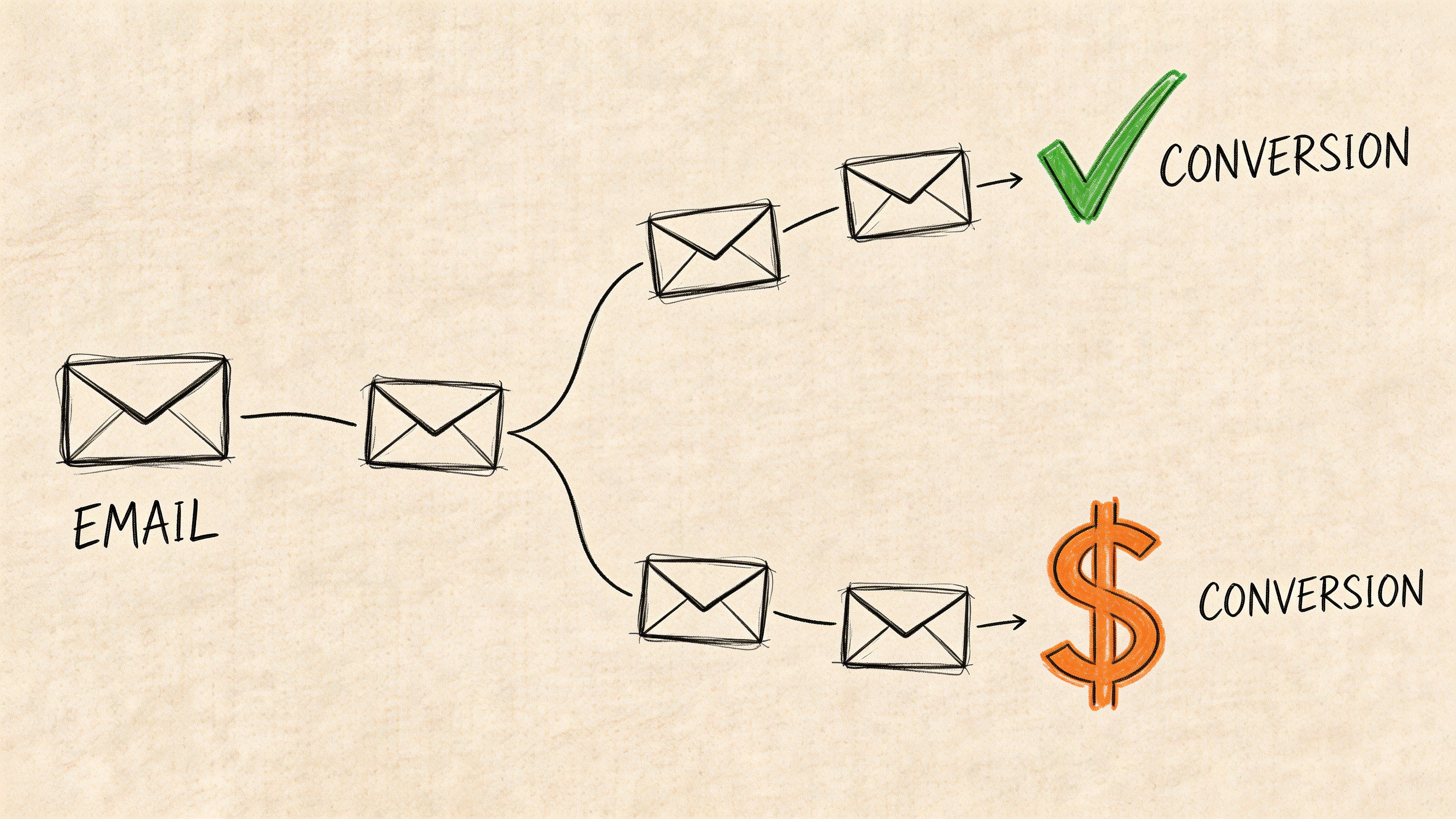
One good email can start a conversation. A good sequence builds momentum.
That matters because buyers rarely act on the first touch. They need context, repetition, and a reason to revisit the problem. The copy has to evolve across the sequence instead of repeating the same ask in slightly different wording.
Two sequence types that SMBs need
The first is the marketing nurture flow. This is for leads who raised a hand but are not ready to buy.
The second is the sales outreach cadence. This is for accounts you want to create demand with, even if there is no active conversation yet.
They should not sound the same.
A nurture flow should reduce uncertainty
A practical nurture sequence often follows this progression:
Email one confirms the problem and the next step.
Email two teaches something useful.
Email three handles a common hesitation.
Email four offers a clear action.
The copy should feel advisory. It should not rush to a pitch in every message.
A common mistake is sending four product-heavy emails in a row. That can create fatigue, especially for inbound leads still comparing options.
If part of your flow includes collecting customer feedback or reviving a stalled response, these survey reminder email sample templates are helpful examples of concise reminder language. The structure works well when you need to nudge action without increasing friction.
Outbound needs progression, not repetition
Sales sequences break when every touch says the same thing.
A better outbound cadence changes the angle each time:
| Touch | Purpose | Copy angle |
|---|---|
| Email one | Earn attention | Observation and relevance | | Email two | Add value | Useful idea or teardown | | Email three | Reduce resistance | Address likely objection | | Email four | Reframe | Different pain or stakeholder angle | | Email five | Close softly | Permission-based CTA |
That is what makes sequences feel thoughtful instead of automated.
For teams building multi-step follow-up logic, it helps to understand drip campaign meaning at the workflow level, not just the template level. Sequence performance depends on message order, branch logic, and timing, not only on individual email quality.
Channel mix changes how the copy should read
Email does not need to do all the work. If a rep also connects on LinkedIn, comments on a post, or reaches out after a website visit, the next email can be shorter because some context already exists.
That means sequence copy should react to channel history.
If the prospect viewed your pricing page, the next touch can be direct. If they ignored three emails but engaged with a social post, the next message can acknowledge the topic instead of restarting cold. Good systems let sales and marketing see the same timeline so the copy reflects reality.
A useful walkthrough on sequence thinking is below.
Key takeaway: The job of a sequence is not to repeat your value proposition. It is to help the buyer understand it from the right angle at the right moment.
When teams get this right, nurture feels relevant and outbound feels deliberate. When they get it wrong, every email sounds like a resend of the last one.
Testing Metrics and Continuous Optimization
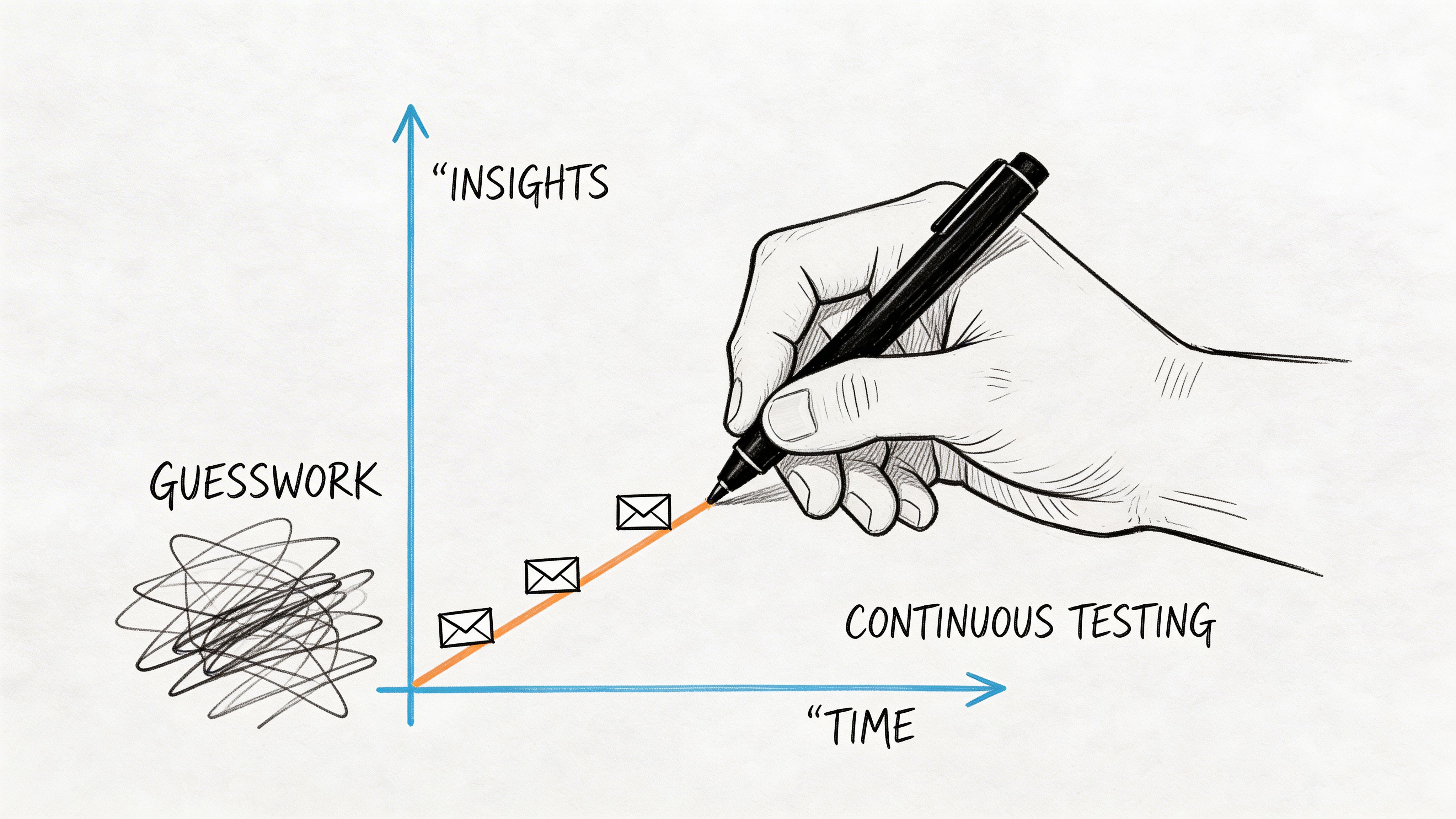
Effective email testing produces trustworthy decisions, but a common pitfall is chasing patterns in open rates instead of measuring what changed revenue.
A familiar SMB B2B scenario looks like this. The marketing team ships a nurture email with a new subject line. Sales sends a follow-up sequence to the same segment with a different CTA. Opens tick up, replies stay flat, pipeline does not move, and nobody can tell whether the copy improved or the audience changed. That is a reporting problem first, and a copy problem second.
The job is to tie copy changes to buying behavior.
Focus on metrics that map to pipeline
For B2B email, each metric answers a different question:
Unique open rate shows whether the subject line and sender context earned attention
Click-through rate shows whether the body copy and offer created enough interest to act
Reply rate shows whether outbound messaging felt relevant enough to start a conversation
Conversion rate shows whether the email contributed to a real business outcome
Open rate still has value, but it is an early signal, not the finish line.
The useful diagnostic question is simple: where does momentum break? Low opens usually point to subject line quality, sender trust, or weak audience selection. Strong opens with weak clicks usually point to body copy, offer clarity, or CTA friction. Clicks without downstream conversion often point outside the email itself, such as the landing page, demo flow, form length, or slow follow-up from sales.
Test one variable with a clear success metric
Disciplined testing beats constant rewriting.
According to Leadpages’ email copywriting best practices, A/B testing subject lines, clearer CTAs, conversational language, and sharper segmentation can materially improve campaign performance. The point is not to chase benchmark numbers. The point is to isolate the variable so the result is usable.
A practical testing workflow looks like this:
Pick one variable. Subject line, first line, CTA, offer framing, or proof point.
Hold everything else steady. If the audience, send time, and body copy all change, the result is hard to trust.
Set the win condition before launch. Use opens for subject line tests. Use clicks, replies, or conversions for body and CTA tests.
Record the change and the context. Include audience segment, send date, and sequence step so the lesson survives past one campaign.
This matters more in B2B teams using shared sales and marketing systems. In a connected platform like Stamina, the team can compare email performance against CRM stage movement, prior touches, and sequence history. That closes a gap that hurts a lot of SMB teams. Copy stops being judged only by email metrics and starts being judged by whether it helped create qualified pipeline.
What to test first
If the team does not have a consistent optimization habit yet, start with the tests that usually produce the fastest learning:
Subject lines: direct value proposition versus curiosity
Opening lines: problem-first versus trigger-event-first
CTA style: ask for a meeting versus ask for a low-friction next step
Offer framing: feature-led versus outcome-led
Segmentation: one broad version versus role-specific copy
Small changes at the top and bottom of the email often beat a full rewrite.
In practice, the highest-return edits are usually the opening line and the CTA. Buyers decide quickly whether a message is relevant, and they hesitate when the next step feels too expensive. Fix those two points first, then work inward.
Your Path to Mastering Email Copywriting
Strong email copy is rarely clever. It is clear, relevant, and easy to act on.
That is the pattern across everything that works. The subject line earns attention. The opening proves the message is for this person. The body stays tight. The CTA lowers friction. Personalization changes the substance, not just the greeting. Sequences build trust by changing the angle over time. Testing turns guesswork into a repeatable process.
The biggest shift for SMB teams is operational, not literary. You are not just writing isolated campaigns anymore. You are managing a system of outreach, follow-up, nurture, and conversion across sales and marketing. That makes copywriting for email part writing skill, part data skill, and part workflow discipline.
The good news is that this is learnable.
You do not need to become a brand poet. You need to become sharper at noticing what the buyer cares about, stricter about what deserves to stay in the draft, and more disciplined about measuring what moved.
Start with one email. Rewrite the opening so it names a real problem. Tighten the CTA so it asks for one simple action. Then send the stronger version and watch what changes.
If your team wants one system for CRM, outreach, nurturing, and AI-assisted email drafting, Stamina gives SMBs a connected way to manage that work without stitching together separate tools.

