When you pour time into crafting the perfect cold email only to be met with radio silence, it’s easy to feel defeated. We’ve all been there, staring at a sent folder full of unanswered messages. But here’s the thing: that silence is rarely a hard ‘no.’
More often than not, it’s a ‘not right now,’ a ‘too busy,’ or simply a ‘lost in my inbox.’ A single, well-timed follow-up can often be the nudge that turns that silence into a real conversation. The key is to move past the generic "just checking in" pings and build a sequence that offers genuine value with every touch.
Why Silence Isn't a Dead End
Every unanswered email isn't a lost deal; it's an opportunity waiting for the right prompt. Your prospect’s inbox is a battlefield, and your first message probably got buried under a mountain of other priorities. Silence isn't rejection. It's just noise.
Data consistently shows that a huge chunk of replies come from the second, third, or even fourth email in a sequence. Sending just one follow-up can dramatically boost your response rates.
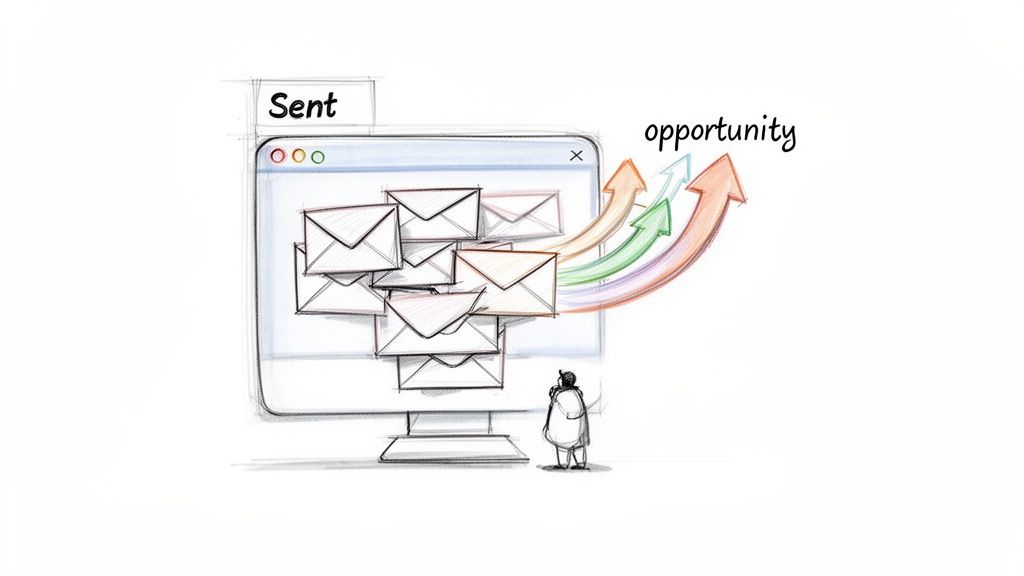
The trick is to reframe the non-response. It’s not a failure—it’s the first step in a smarter conversation. A thoughtful follow-up bumps your name back to the top of their inbox and shows you’re persistent and genuinely interested in helping.
The Difference Between ‘Persistent’ and ‘Pushy’
A random, haphazard approach to following up is almost as bad as not doing it at all. Bombarding a prospect with generic reminders is a one-way ticket to the spam folder. But a well-designed sequence can actually build rapport. The goal is to be politely persistent, not pushy.
This comes down to a few core ideas I've seen work time and time again:
Find the right rhythm. The timing of your follow-up is just as important as the message itself. Sending another email a few hours later feels aggressive, but waiting two weeks lets the lead go cold. I generally find a 2-3 day waiting period is a good starting point.
Give them a reason to reply. Every single follow-up needs to add new value. This isn’t the time to just "check in." Share a relevant case study, a helpful article you saw, or a quick insight about their industry. This positions you as a helpful resource, not just another salesperson.
Show you did your homework. Generic templates are the enemy of engagement. Your follow-up has to prove you’re a human who has invested time. Reference their company’s latest news, a post they shared on LinkedIn, or their specific role. It makes all the difference.
A no-response isn’t a ‘no.’ It’s a ‘not now’ or ‘show me something more interesting.’ Your job is to give them enough value in your follow-ups to turn that ‘not now’ into a ‘let’s talk.’
To help you get started, here are a few core principles you can apply right away to improve your reply rates.
Quick Wins for Your Next Follow-Up
Principle | Actionable Tip | Expected Impact |
|---|---|---|
Context is King | Reply in the same email thread. This keeps all context in one place and makes it easy for the prospect to recall your original message. | Higher open rates and quicker recall of your value proposition. |
Add New Value | Instead of "just checking in," offer a new resource—a blog post, a short case study, or a helpful tool that relates to their problem. | Positions you as a helpful expert, not a persistent salesperson. |
Keep it Short | Your follow-up should be shorter than your initial email. Aim for 2-4 sentences max. Make it easy to read and respond to on a phone. | Increased likelihood of getting a quick reply because it’s less work for the prospect. |
End with a Soft CTA | Instead of asking for a meeting, try a lower-commitment question like, "Is this something on your radar for this quarter?" | Reduces pressure and makes it easier for the prospect to give a simple 'yes' or 'no' response, opening the door for more conversation. |
Applying these small tweaks can make a massive difference, turning silent prospects into engaged leads.
This is exactly where tools like Stamina come into play. Instead of manually tracking who to follow up with and when, you can automate these personalized, multi-touch sequences. It turns that dreaded silent inbox into a predictable pipeline of conversations, ensuring no lead ever falls through the cracks again.
Nailing Your Follow-Up Timing and Frequency
The moment you hit “send” on an email, the clock starts ticking. Wait too long, and a warm lead goes cold. Ping them too fast, and you just come off as aggressive, earning a one-way ticket to their spam folder. So, what’s the sweet spot?
Finding the right rhythm isn’t guesswork. It’s a calculated strategy that keeps you top-of-mind without being a nuisance. While the perfect timing depends on how warm the lead is—someone who just checked your pricing page deserves a quicker follow-up than a totally cold prospect—you need a solid baseline to start from.
Finding Your Initial Cadence
Your first follow-up is the most important one. Sending it too soon feels desperate, but waiting more than a week means you’ve probably been forgotten.
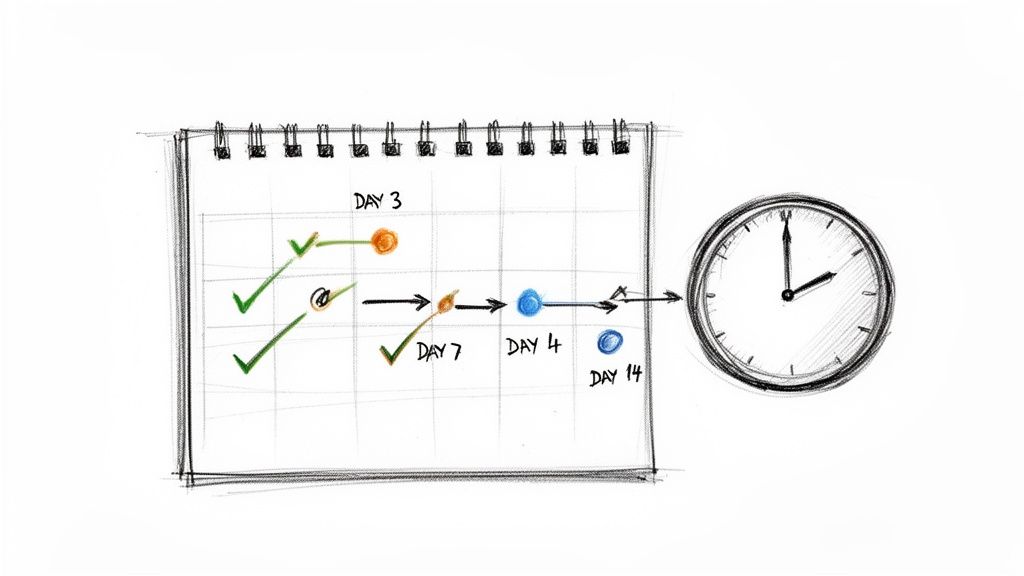
A good rule of thumb is to wait two to three days after your initial email. This gives your prospect enough time to see and process your first message without letting the trail go cold. From there, you can gradually space out your next emails.
Here’s a simple, effective cadence I’ve seen work wonders:
Follow-Up 1: 3 days after the initial email.
Follow-Up 2: 4-5 days after the first follow-up.
Follow-Up 3: 7 days after the second follow-up.
This escalating timeline shows polite persistence without crowding their inbox. And the data backs this up. Research from Mailforge.ai shows that sending two to three follow-ups can boost response rates by up to 65.8%. In fact, that first follow-up alone can drive a massive 49% spike in replies.
The Best Days and Times to Send
It’s not just about how long you wait; it’s also about when you send. Hitting send at 8 PM on a Friday is a surefire way to get your email buried in the weekend pile-up. The data consistently points to mid-mornings on Tuesdays and Thursdays as prime sending time.
Key Takeaway: Your prospect's inbox is freshest and their focus is sharpest during these windows. Aim to send your emails between 9 AM and 11 AM in their local time zone to get the best visibility.
Automating this is a total game-changer. A platform like Stamina lets you schedule your entire sequence in advance, ensuring every touchpoint lands at the perfect moment, no matter where your prospect is. If you're interested in the technical side of this, our guide on setting up a solid cold email infrastructure is a great next step.
Here’s a look at how you can visually build and time an automated sequence in Stamina, setting specific wait times between each step.
With a tool like this, you can stop sending sporadic manual pings and start running a calculated outreach strategy that actually gets replies.
Crafting Follow-Up Emails That Get Read
When a prospect goes silent, it's easy to think the conversation is over. But your goal isn't just to remind them you exist; it's to prove you’re a resource worth their time. A great follow-up isn't a polite nudge—it's a fresh chance to connect by offering new value.
This means every part of your email, from the subject line down to your sign-off, has to be intentional.
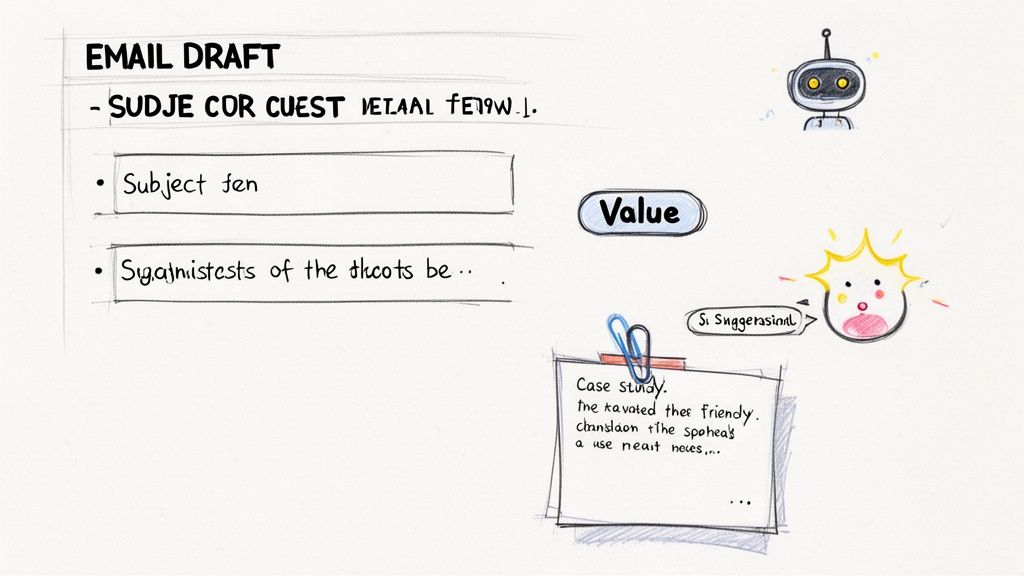
The first hurdle is always the inbox. Your subject line is the gatekeeper, and vague phrases like "Checking in" or "Following up" are the fastest way to get ignored. You need to aim for clarity and context.
One of the simplest and most effective tactics is to reply in the same email thread. This adds "Re:" to the subject line, giving them instant context and making it easy to find your original message. If you do start a new thread, make the subject line count.
Subject Lines That Cut Through the Clutter
A strong follow-up subject line should be concise and either reference your last conversation or offer something new. It has to stand out in an inbox that’s already overflowing.
Here are a few approaches I’ve seen work well:
Contextual: "Follow up on our chat about [Topic]"
Value-Driven: "A resource for [Company Name] re: [Pain Point]"
Direct Question: "Next steps for [Your Product]?"
The key is to be instantly recognizable. You want them to see your name and know your message is relevant, not just another generic blast.
A follow-up email is a test of your relevance. Don't just ask for their time—earn it by giving them something useful. Around 20% of conversions happen after a follow-up, proving that persistence paired with value is a winning formula.
Writing Body Copy That Respects Their Time
Once they’ve opened your email, you have only a few seconds to make your point. Long, dense paragraphs are a non-starter. Your follow-up needs to be concise, scannable, and focused on one clear goal.
Start by briefly reminding them why you reached out in the first place. Don't make them dig through an email thread to remember who you are. A quick, one-sentence reminder is all you need. Something like, "I'm following up on my email last week about improving your team's lead management."
Now for the most important part of your follow-up: the "value-add." This is what separates a helpful check-in from an annoying ping. Instead of just asking if they read your last email, offer them something new.
Share a relevant case study: "I thought you might find this case study on how [Similar Company] solved [Problem] interesting."
Reference a company achievement: "Congrats on the recent funding round! As you scale, managing new leads becomes critical."
Offer a quick, actionable insight: "I noticed your team is hiring for SDRs. Here's a quick article on onboarding them faster."
This approach positions you as a thoughtful expert, not just another salesperson. If you want to dive deeper into building these types of campaigns, our guide on effective email marketing offers more strategies.
Platforms like Stamina can help by using AI to generate these personalized hooks automatically. Our built-in AI, Zara, can analyze a prospect's profile and suggest unique value-adds, making sure each touchpoint feels custom-crafted and genuinely helpful without all the manual effort. It’s a game-changer for scaling your outreach while keeping the personalization human.
Designing a Multi-Channel Follow-Up Sequence
Relying on a string of emails to follow up is a rookie mistake. You might get a bite, but you’re leaving a ton of opportunity on the table. Decision-makers live across a dozen different platforms, and your outreach has to show up where they are.
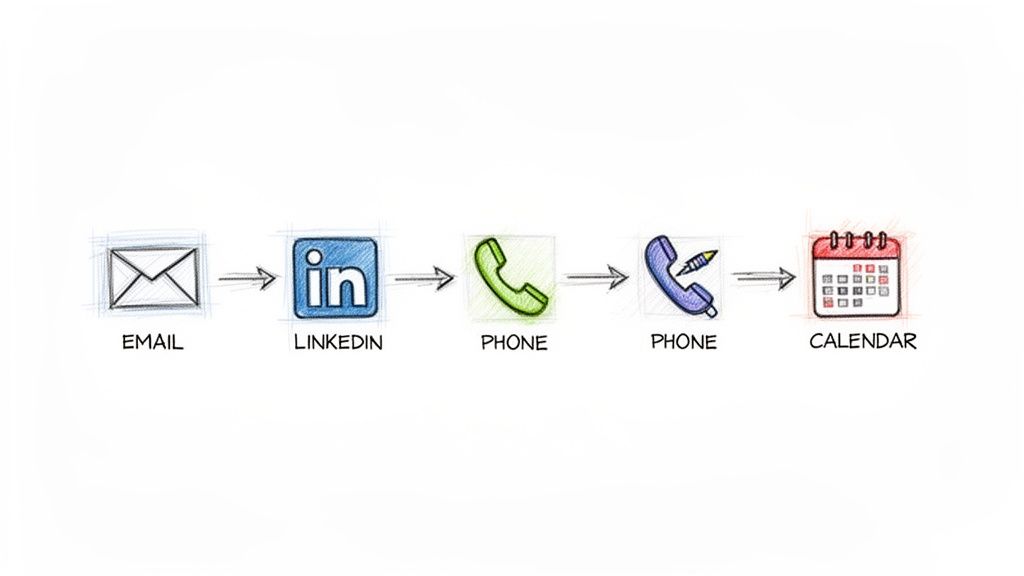
The best sequences blend email with other channels, like LinkedIn, to create a conversation that feels more natural and persistent. Instead of hitting their inbox four times in a row and burning out your welcome, you can build a varied, multi-touch experience.
Orchestrating Your First Touchpoints
The goal here is to make each touchpoint build on the last. A timely LinkedIn connection request or a thoughtful comment can warm up a prospect right before your next email lands, making them way more likely to open it.
You create a sense of familiarity. Suddenly, you're not just another name in their inbox.
Here’s a simple but effective opening play I've used countless times:
Day 1 (Email): Send your initial, personalized email.
Day 2 (LinkedIn): Visit their LinkedIn profile. It’s a small, low-pressure action that often triggers a "who's viewed your profile" notification. Your name is now on their radar.
Day 4 (Email): Send your first follow-up email.
This simple combo reinforces your presence without being annoying. You’re no longer just an email address; you're a real person showing genuine interest.
Building a Complete Multi-Touch Sequence
As you build out a longer sequence, it's all about balancing persistence with variety. The data consistently shows just how critical a well-structured follow-up plan is. Instantly's 2026 Cold Email Benchmark Report, for example, found that while 58% of replies come from the first email, a massive 42% come from the follow-ups.
You can dig into the full cold email performance report, but the takeaway is clear: giving up after one email means you’re missing almost half of your potential replies.
The most successful teams I’ve seen typically use a sequence of four to seven touchpoints. Anything less and you’re probably quitting too soon. Anything more, and you risk diminishing returns unless each message adds serious new value.
A well-timed LinkedIn interaction is the perfect assist for your email follow-up. It turns a cold pitch into a familiar conversation and dramatically increases your chances of getting a reply.
Here is a sample 7-touch sequence you can adapt and make your own:
Day 1: Send the personalized email.
Day 2: View their LinkedIn profile.
Day 4: Send a follow-up email, adding a small piece of new value.
Day 7: Send a LinkedIn connection request with a short note referencing your email.
Day 10: If they accept, engage with one of their recent LinkedIn posts with a thoughtful comment.
Day 12: Send a third email, maybe referencing your LinkedIn interaction or a relevant case study.
Day 16: Send a final, concise "break-up" email. Be polite, close the loop, but leave the door open.
This kind of structured approach, often called a drip campaign, makes sure you stay top-of-mind. Trying to track all this manually across multiple channels is a nightmare at scale. A unified platform like Stamina lets you build and automate these cross-channel workflows, so every touchpoint is perfectly timed. It frees you up to focus on what matters: the conversations your strategic follow-ups create.
Automating and Measuring Your Follow-Up Success
Let's be real—manually tracking every single follow-up is a recipe for disaster. Once you’re sending more than a handful of emails, it's just not possible. This is where you stop drowning in spreadsheets and start building smart, repeatable sequences that run on their own.
With a platform like Stamina, you can set up automated follow-up sequences in minutes. You decide the timing between each touchpoint, mix in different channels like LinkedIn, and set rules to automatically stop the sequence the moment a prospect replies. That way, your outreach stays timely and relevant without you having to micromanage it.
If you’re just getting started, our guide on how to create an automated workflow is the perfect place to begin.
From Open Rates to Revenue Metrics
Automating your outreach isn't just about sending more emails—it's about gathering the right data to make smarter decisions. And honestly, while metrics like open rates and clicks are nice to look at, they don’t pay the bills.
You need to shift your focus to analytics that actually measure business impact:
Reply Rate: What percentage of prospects are actually getting back to you?
Positive Reply Rate: How many of those replies are genuine interest, not just "unsubscribe" or "not interested"?
Meetings Booked: The ultimate goal. How many follow-ups directly lead to a demo or call in the calendar?
This data-driven approach is non-negotiable. Ignoring follow-ups means you’re potentially leaving a near-50% uplift in reply rates on the table. A single cold email might get a 5.1% response, but a structured sequence consistently pushes that number way higher, especially when you nail the personalization. You can dig into more of these cold outreach statistics to see just how much of a difference it makes.
Using A/B Testing to Optimize Performance
The best part about automating your sequences is that you can test and refine your approach on the fly. This is where A/B testing becomes your best friend. Create two slightly different versions of a follow-up—maybe you change the subject line, the call-to-action, or the value prop—and see which one performs better.
The goal isn't just to find what works, but to understand why it works. A unified dashboard gives you a single source of truth to measure the direct ROI of every follow-up effort, moving you from guesswork to a predictable revenue engine.
A good analytics dashboard, like the one in Stamina, will show you exactly which sequences and messages are driving the most positive replies and meetings.
This kind of at-a-glance visibility helps you double down on the strategies that are working and quickly cut what isn't, turning your follow-up game into a well-oiled machine.
Common Questions About Following Up on No-Response Emails
Even the best follow-up sequence runs into tricky situations. Every sales rep I know has faced these moments—the outright "no," the frustrating silence, and the dreaded decision of when to finally walk away.
Let's break down how to handle these common roadblocks so you can navigate them with confidence.
What If a Prospect Says No?
Getting a "no" can sting, but it's rarely a dead end. More often than not, it’s just a “no for now.” How you react is what keeps the door open for later.
The worst thing you can do is get defensive or push your case. Instead, reply with grace. A simple, professional sign-off respects their decision and leaves a positive final impression.
"Thanks for letting me know. I appreciate your candor. If priorities change down the road, I'd be happy to reconnect. Wishing you and the team at [Company Name] all the best."
This response is polite and professional. It positions you as a helpful resource for the future, not a pushy salesperson who can't take no for an answer.
What If They Open Emails but Never Reply?
This is probably the most frustrating scenario in sales. You see multiple email opens, which signals clear interest, but the radio silence is just confusing. Are they busy? Are they forwarding it internally? Or are they just not convinced?
Whatever the reason, this is your cue to change your approach. Sending another generic "just checking in" email is a waste of time.
Instead, try one of these moves:
Switch the Ask: Ditch the meeting request for now. Ask a simple, low-effort question like, "Was this relevant to what your team is working on?"
Offer a Different Value Prop: If you led with saving time, pivot to cost savings. Share a new case study or a different angle they haven't seen.
Change the Channel: If email is a dead end, try a timely LinkedIn connection request. A thoughtful comment on their company's latest post can also put you back on their radar in a new, less direct context.
This shows you’re paying attention and adapting based on their behavior, not just blindly running an automated sequence.
How to Write a Breakup Email
After multiple unanswered follow-ups, it's time to send a breakup email. This isn't about being dramatic—it's a strategic move to close the loop professionally. It also happens to be one of the most effective ways to get a last-minute reply.
The goal is to politely signal that you’re moving on unless they say otherwise.
Here’s a clean and direct template I've seen work countless times:
"Hi [Name], I've tried to connect a few times without success. It seems like now isn't the right time, so I'll be closing your file for now. If you do become interested in [solving a problem] in the future, please don't hesitate to reach out."
This message creates a subtle sense of urgency and gives them one last, easy chance to say, "Wait, I'm still interested!" You'd be surprised how often that happens.
Ready to turn these answers into action? With Stamina, you can build, automate, and measure all of these follow-up strategies in one place. Stop guessing and start converting more silent prospects into qualified meetings at https://stamina.io.

