Client Relationship Management Financial Services

Master client relationship management financial services. Our 2026 guide covers compliance, personalization, KPIs, and AI-powered CRM for growing your firm.

0 - Minute Read

If you're running a small advisory firm, RIA, insurance practice, or regional financial services business, there's a good chance your client data lives in too many places. Meeting notes sit in email. Follow-ups live in a calendar. Compliance evidence is buried in PDFs. Marketing runs in one tool, onboarding in another, and no one fully trusts the spreadsheet that tries to tie it all together.

That setup works until it doesn't. A missed review meeting, an undocumented suitability conversation, or a client who disengages can expose the true cost of fragmented systems. In financial services, relationship quality and regulatory discipline are tightly linked. You can't separate growth from recordkeeping, or personalization from auditability.

That's why client relationship management in financial services isn't just software selection. It's an operating model. The right CRM becomes the system that organizes client history, surfaces risk, supports compliant outreach, and helps a smaller firm deliver a level of consistency that used to require a larger team.

The Modern Financial Advisor's Dilemma

Most smaller firms don't struggle because they lack client care. They struggle because the business outgrows memory.

An advisor starts the day with good intentions. Review a book of households. Follow up on a rollover opportunity. Check whether a client sent KYC documents. Confirm that a recent life event is reflected in the financial plan. By noon, that work has already been split across inboxes, custodial portals, planning software, and handwritten reminders.

The problem isn't busyness. It's context fragmentation.

When client information is scattered, three things happen fast:

  • Service gets inconsistent. One client receives a thoughtful, timely follow-up. Another waits because no one saw the note from the last call.

  • Compliance becomes reactive. Teams reconstruct what happened after the fact instead of recording decisions as part of the workflow.

  • Growth stalls. Advisors spend time searching, reconciling, and remembering instead of advising and deepening relationships.

A modern CRM fixes that only when it's treated as a business system, not a contact database. In financial services, it needs to function as the firm's relationship engine. It should capture interactions, assign next actions, connect household records, preserve service history, and make the right information visible at the right moment.

Practical rule: If a client conversation changes advice, risk posture, product suitability, or service level, it should be structured inside the CRM, not left in someone's notes.

This matters even more for SMB firms. Large institutions can absorb inefficiency with headcount. Smaller teams can't. They need systems that reduce admin work without weakening trust. They also need tools that support enterprise-grade discipline without requiring an enterprise implementation project.

Good client relationship management in financial services turns scattered activity into a repeatable process. That's how a firm moves from heroic individual effort to dependable client experience.

What CRM Really Means in Financial Services

An advisor finishes a review meeting with a business owner and learns three things in 20 minutes: the owner plans to sell in two years, wants to add a key-person policy, and needs to bring a spouse into the next planning discussion. If that information lives in scattered notes, the firm loses context, misses timing, and increases risk. In financial services, CRM means capturing those signals in a system that can route work, preserve the record, and prompt the next compliant action.

A hand-drawn illustration showing a business handshake with security, growth, and analytics icons representing professional services.

A static record versus a working system

Financial firms do not need better contact storage. They need a working relationship system.

A true financial services CRM connects people, households, accounts, advice history, service obligations, and open tasks in one place. It should also pull in signals from custodians, portfolio systems, document workflows, and communication tools so advisors and operations staff can act from the same record. For SMB firms, that matters even more. They rarely have a large operations bench or internal IT team to stitch together five separate tools and police the handoffs between them.

Analysts at Nucleus Research found that CRM pays back when firms use it to improve process execution, not just record activity. Their research on CRM ROI supports a simple point. The return comes from better follow-up, cleaner handoffs, and more consistent service, not from having a bigger database alone.

What should that system answer on demand?

Question

What the CRM should show

Who is involved in this relationship?

Household members, business entities, trustees, beneficiaries, centers of influence

What has already happened?

Meetings, recommendations, service requests, approvals, outstanding documents

What changed?

New goals, life events, product needs, risk updates, communication preferences

What happens next?

Assigned task, owner, due date, workflow stage, required review or outreach

Why financial firms need more than sales automation

Sales automation is only one layer of the job. Financial services firms also need a system that supports onboarding, annual reviews, client servicing, referrals, renewals, and retention across a long relationship life.

That changes how the platform should be evaluated.

A generic CRM may let a small team log calls and create tasks. A platform built for financial services should also support relationship hierarchies, recurring review schedules, approval paths, document status, and communication history tied to advice and service obligations. Advisor Momentum's CRM guide gives a useful advisor-specific view of those requirements, while a practical overview of what customer relationship management should centralize is helpful for firms aligning leadership, compliance, and operations around one definition.

AI changes the equation for smaller firms. It can summarize meetings, surface next-best actions, draft follow-up, identify service gaps, and flag records that need attention. The trade-off is clear. Automation saves time only if the underlying data model is structured enough to support supervision and review.

A financial CRM should reduce memory work, shorten response time, and make the next right action obvious.

What a smaller firm should look for

The best platform for an SMB advisory or financial services team usually has fewer moving parts, stronger defaults, and faster time to value. That often beats a feature-heavy system that needs months of customization before anyone trusts it.

Look for these traits:

  • Structured relationship data: Household links, related entities, beneficiaries, and adviser assignments should be native objects, not manual workarounds.

  • Lifecycle workflows: Onboarding, account opening, periodic reviews, service requests, and retention plays should run from predefined workflows.

  • Usable AI in context: Meeting summaries, task suggestions, segmentation, and outreach prompts should sit inside the daily workflow, not in a separate tool.

  • Practical integrations: The platform should connect to your portfolio system, email, calendar, forms, and document tools without creating duplicate records.

  • Admin controls a small team can manage: Permissions, templates, automations, and reporting should be maintainable without a full-time systems administrator.

For smaller firms, the goal is not to copy an enterprise stack. The goal is to deliver enterprise-level personalization and control with a platform your team can run. That is what CRM really means in financial services.

Navigating Compliance and Data Security with Confidence

Compliance is where many CRM projects either become valuable or become shelfware. In financial services, a CRM isn't just a productivity tool. It's part of the firm's control environment.

A digital illustration showing a cloud computing icon protected by a shield and padlock with compliance documents.

A generic platform may let you log notes and tasks. That's not enough when you need defensible records tied to KYC, suitability, disclosures, service delivery, and complaint handling. The difference shows up during audits, internal reviews, and client disputes.

What audit-ready actually looks like

An audit-ready CRM doesn't rely on heroic cleanup before an exam. It structures the data correctly from the start.

That matters because expert-level financial service CRMs require a Consumer Duty outcomes data model where vulnerability markers are first-class fields, and board reporting must be query-based to retrieve seven years of suitability and service history against specific clients, advisers, and products without manual reconstruction, as described by Bespoke CRM's guidance for UK financial advisers.

For smaller firms, that idea is powerful. It means compliance doesn't have to depend on one operations person knowing where everything lives. The system itself should make retrieval possible.

A practical setup includes:

  • Immutable activity history: Staff can see who changed what and when.

  • Structured risk and vulnerability fields: Important client conditions shouldn't be buried in free-text notes.

  • Query-based reporting: Boards and compliance officers should pull records by client, adviser, product, and timeframe.

  • Integrated evidence capture: Meeting notes, approvals, and suitability records should connect to the client timeline.

Why architecture matters more than feature checklists

Many firms buy for front-end usability and only later discover they built a compliance gap. The issue usually isn't whether the tool can store documents. The issue is whether the data model supports retrieval, supervision, and defensible reporting.

That becomes even more important once AI enters the stack. AI-generated meeting notes, summaries, and recommendations can reduce admin work, but they also create governance questions. Firms adopting these tools should think carefully about access controls, data flow, and review processes. For a useful broader perspective on that side of the problem, AgentStack's article on strategies for securing AI deployments is worth reading.

When firms need flexible structured records, systems like custom business objects for regulated workflows illustrate the broader principle well. The platform has to reflect your actual advisory process, not force everything into generic contact and deal fields.

Here's a quick test I use with clients evaluating platforms:

If you ask this question

A weak system says

A strong system says

Can we track vulnerability markers structurally?

"Put it in notes"

"Yes, as governed fields"

Can we produce board-ready reporting directly?

"Export and rebuild it"

"Run a query"

Can AI notes sync without double-keying?

"Manually paste them in"

"Yes, through stable integration"

This walkthrough is a helpful visual companion to the governance discussion above.

Compliance gets easier when good recordkeeping is the default path, not an extra task at the end of the day.

A smaller firm doesn't need an oversized enterprise stack. It does need disciplined data structure, clean integrations, and a platform that treats compliance as part of client service, not a separate afterthought.

From Mass Market to Markets of One

Many firms still segment clients almost entirely by revenue, AUM, or service tier. That's understandable. Those categories are easy to report on. They're also too blunt to drive meaningful personalization.

The better question is not just what a client is worth today. It's what the client needs right now.

A digital illustration showing a crowd connecting to diverse financial professionals surrounded by business and financial icons.

Why life-stage segmentation works better

Revenue-based segmentation tells you how to allocate service capacity. It doesn't tell you which conversation is most relevant. A business owner preparing for succession, a new parent thinking about protection and college planning, and a pre-retiree focused on drawdown strategy may all fall into different emotional and planning contexts even if their account values look similar.

That gap is why Bill Good Marketing's resource on target markets for financial advisors notes that most content assumes segmentation is purely revenue-driven and overlooks rising demand for life-stage segmentation, such as divorcees and pre-retirees. It also notes that advisors who focus on profession, age, and specific needs see stronger alignment.

The practical implication is simple. If your CRM only stores investable assets and service tier, you can't personalize at a useful level.

How to make segmentation operational

Life-stage segmentation fails when it stays conceptual. It works when the CRM turns it into triggers, audiences, and workflows.

A smaller firm can make this real with a model like this:

  • Client context fields: Capture profession, family changes, retirement horizon, business ownership, estate planning needs, and communication preferences.

  • Trigger events: Log milestones such as inheritance, sale of a business, marriage, divorce, or approaching retirement.

  • Workflow actions: Route the right educational content, review agenda, or adviser outreach based on those changes.

For example, a new child shouldn't just update a note. It should trigger a review of beneficiary designations, protection needs, education planning, and cash flow assumptions. A client nearing retirement should move into a sequence centered on income strategy, withdrawal planning, tax coordination, and estate readiness.

Tools built for CRM personalization workflows show the operational pattern clearly. Segmentation becomes useful when it drives the next best action automatically, while still leaving room for adviser judgment.

Clients rarely feel understood because you know their net worth. They feel understood because you know what season of life they're in.

SMB firms can compete well. They often know clients more personally than large institutions do. A modern CRM lets them preserve that advantage at scale instead of losing it as the book grows.

Orchestrating the Entire Client Lifecycle

The strongest firms don't manage relationships one meeting at a time. They run a lifecycle.

That starts before the client signs. The first inquiry, first discovery call, and first onboarding task set the tone for everything that follows. If those steps are scattered, clients feel the seams immediately. If they're orchestrated well, the firm feels calm, prepared, and trustworthy.

Onboarding is where retention starts

A lot of churn gets created early. Clients don't usually leave because of one catastrophic event. They leave because the relationship never fully took root.

Wolf Financial's article on client retention strategies in financial services notes that a 5% increase in client retention can raise profits by 25% to 95%, and that advanced CRM systems can identify at-risk clients 60 to 90 days before they depart by tracking behavioral signals.

That should change how firms think about onboarding. The purpose isn't just paperwork completion. It's building momentum, clarity, and confidence.

A good CRM-driven onboarding flow usually includes:

  1. Expectation setting
    Service cadence, responsibilities, and milestones are clear from the start.

  2. Document and data capture
    KYC, beneficiary information, product context, and household relationships get recorded in the right structure.

  3. Early engagement tasks
    Review meetings, follow-up questions, and planning deliverables are scheduled before silence sets in.

The middle years need orchestration too

Once a client is onboarded, many firms slip into a loose rhythm. Annual reviews happen eventually. Market updates get sent broadly. Notes get logged unevenly. That approach is manageable until the team grows or the client base becomes more complex.

A mature CRM keeps the relationship moving through planned touchpoints:

  • Annual and semiannual reviews linked to client goals and product mix

  • Household-level reminders for trusts, beneficiaries, and policy updates

  • Issue tracking so service requests don't vanish into inboxes

  • Opportunity flags when a life event suggests a planning need

One missed review rarely causes attrition by itself. Repeated silence does.

Spotting risk before the client leaves

The best use of CRM data isn't reporting on what already happened. It's detecting relationship drift while there's still time to act.

In practice, at-risk signals often show up as a mix of behavior and process gaps. A client logs in less often. An annual review gets postponed. Asset movement slows. A planned follow-up never happens. None of those is definitive alone. Together, they deserve attention.

When a client disengages, the warning signs are usually visible. Firms just need a system that surfaces them before the relationship is lost.

For smaller firms, automation helps without replacing the human element. The platform can flag inactivity, queue an outreach task, and assemble the relevant history. The adviser still owns the conversation. That's the right division of labor.

Measuring What Matters for Growth

A common failure pattern looks like growth on paper and strain everywhere else. New households are coming in, advisers are busy, marketing is active, yet onboarding slows, follow-ups slip, and revenue per relationship stays flat. If the CRM only reports activity volume, leadership misses the underlying issue.

A financial services CRM should measure client economics and execution quality. For SMB firms, that matters even more. They do not have a large operations team to absorb broken processes, and they cannot afford enterprise software that needs months of configuration before anyone sees value.

The metrics that actually matter

The best scorecards are tight and tied to decisions. Teams should be able to review them quickly, spot where service is breaking down, and assign action.

A practical growth view often includes:

Metric

Why it matters

CRM signal behind it

Retention

Protects recurring revenue and long-term asset value

Review completion, response patterns, service consistency

AUM growth per household

Shows whether relationships are deepening

Opportunity tracking, life-event workflows, referral mapping

Cross-sell penetration

Measures relevance of advice and planning breadth

Product fit signals, segment-specific campaigns, meeting outcomes

Time to onboard

Reflects operational efficiency and early trust

Task completion, document collection, owner accountability

These are management metrics. They show whether the firm is building a repeatable growth engine or relying on individual heroics.

I usually add one more layer for smaller firms: capacity. How many households can each adviser and service team member support well before response times slip or compliance tasks start bunching up? That number matters because growth that overwhelms the team quickly turns into attrition risk.

Proving the CRM is paying for itself

The return rarely comes from the software alone. It comes from better operating discipline, applied consistently across the client lifecycle.

In practice, firms see value when the system helps them do a few things reliably:

  • Catch stalled onboarding before a new client loses confidence

  • Prompt timely outreach around reviews, rate changes, and life events

  • Keep service history complete enough for any team member to step in

  • Show household-level opportunity without digging across four systems

  • Reduce manual work in approval, documentation, and follow-up workflows

That is why an all-in-one business platform for SMB firms often outperforms a patchwork stack. The gain is not just cleaner reporting. The gain is that growth, service, and compliance data live in the same operating system, so small teams can deliver enterprise-grade consistency without enterprise-grade overhead.

A CRM pays for itself when advisers spend less time reconstructing context and more time acting on it.

If reporting still centers on call counts and email volume, the firm is measuring effort. Growth comes from connecting execution to retention, wallet share, onboarding speed, and team capacity. That is the level where CRM becomes a management system for a modern advisory business.

The Unfair Advantage of an AI-Powered Unified Platform

Most SMB firms don't lose to bigger competitors because they care less. They lose because their systems are fragmented.

Marketing runs in one app. Sales follow-up sits somewhere else. Client records are split between a CRM, planning tool, inbox, and spreadsheet. Every handoff creates delay, duplicate entry, and a little more risk. By the time a firm tries to personalize outreach or monitor client health, the data is already out of sync.

A unified platform changes that equation.
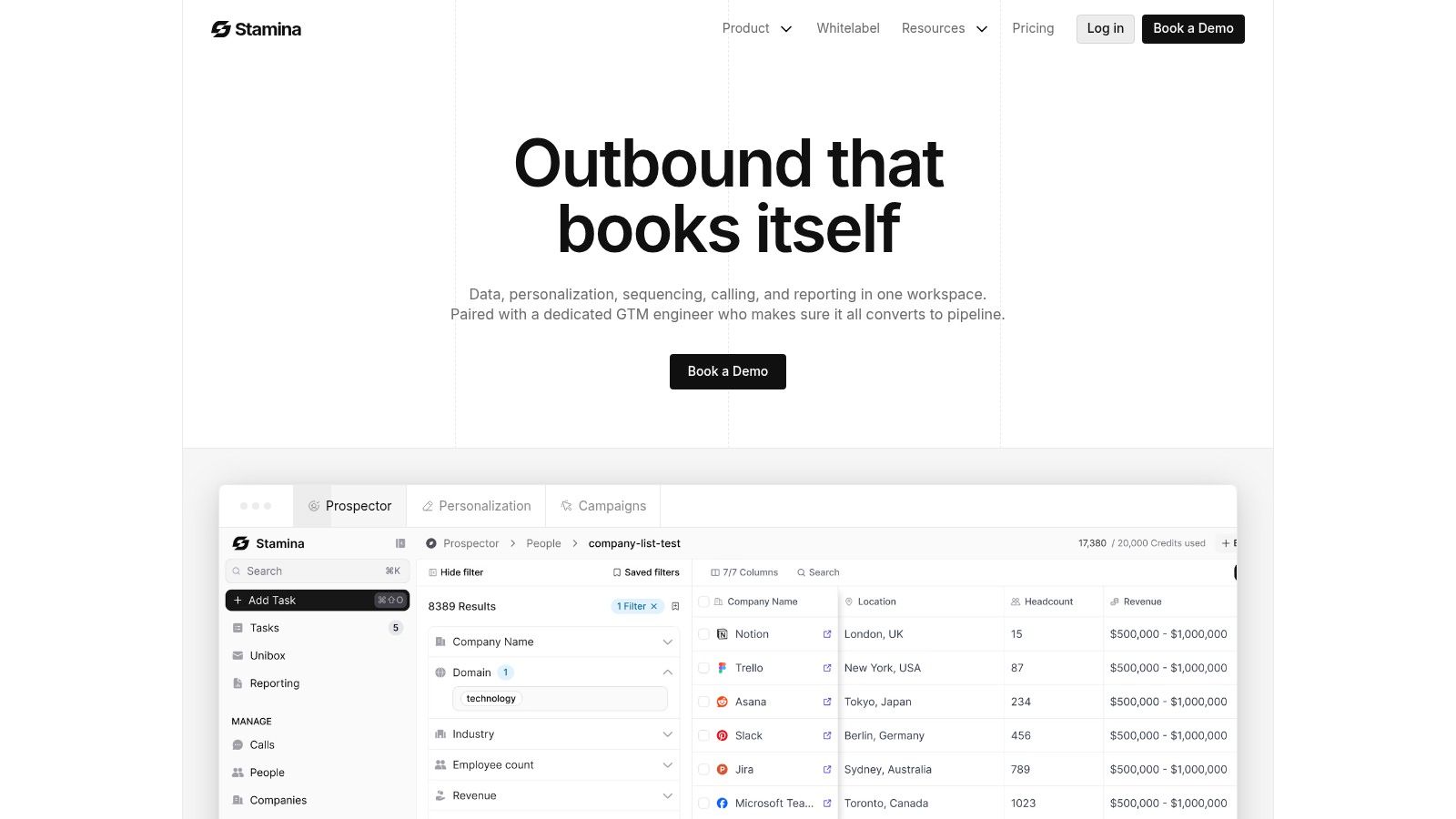
Screenshot from https://stamina.io

Why unification matters more than adding another tool

The main gain isn't convenience. It's coordination.

When marketing, sales, and CRM activity sit in one system, firms can connect signals that would otherwise remain isolated. A contact engages with a campaign, schedules a meeting, completes onboarding tasks, and later triggers a retention alert. In a patchwork stack, each of those events may be visible in a different place. In a unified stack, they form one operating picture.

That setup is especially powerful when AI is applied to the full workflow rather than bolted onto a single feature. Flycast Media's discussion of CRM for financial services notes that modern financial CRMs use predictive analytics to identify attrition risks and growth opportunities by analyzing portfolio size and investment preferences, turning historical reporting into a sales tool through forecasted client needs.

For SMB firms, that matters because AI can handle the work that usually requires extra headcount:

  • Summarizing interactions so advisers don't lose context

  • Surfacing risk signals before client disengagement becomes obvious

  • Generating personalized outreach based on segment and lifecycle stage

  • Coordinating workflows across prospecting, nurturing, and account management

Enterprise capability without enterprise overhead

Smaller firms don't need a giant implementation project. They need systems that reduce complexity instead of adding more of it.

An all-in-one approach works best when it gives the team one source of truth, one workflow layer, and one place to measure relationship performance. That's the practical case for an all-in-one business platform. The advantage isn't abstract. It shows up in fewer handoff errors, cleaner records, and faster execution.

The best part is that AI doesn't have to make the firm feel automated in a bad way. Used well, it removes repetitive work so advisers can spend more time in the conversations that build trust.

A smaller financial services firm can now deliver a more consistent, more personalized, and more compliant client experience without hiring an army or maintaining a sprawling IT stack. This represents a fundamental shift.

If your team is trying to replace disconnected tools with one system that unifies marketing, sales, and CRM, Stamina is built for that job. It gives growing SMBs a single source of truth, AI-powered outreach and nurturing, flexible CRM workflows, and the operational simplicity needed to scale personalized client engagement without taking on enterprise-level overhead.

If you're running a small advisory firm, RIA, insurance practice, or regional financial services business, there's a good chance your client data lives in too many places. Meeting notes sit in email. Follow-ups live in a calendar. Compliance evidence is buried in PDFs. Marketing runs in one tool, onboarding in another, and no one fully trusts the spreadsheet that tries to tie it all together.

That setup works until it doesn't. A missed review meeting, an undocumented suitability conversation, or a client who disengages can expose the true cost of fragmented systems. In financial services, relationship quality and regulatory discipline are tightly linked. You can't separate growth from recordkeeping, or personalization from auditability.

That's why client relationship management in financial services isn't just software selection. It's an operating model. The right CRM becomes the system that organizes client history, surfaces risk, supports compliant outreach, and helps a smaller firm deliver a level of consistency that used to require a larger team.

The Modern Financial Advisor's Dilemma

Most smaller firms don't struggle because they lack client care. They struggle because the business outgrows memory.

An advisor starts the day with good intentions. Review a book of households. Follow up on a rollover opportunity. Check whether a client sent KYC documents. Confirm that a recent life event is reflected in the financial plan. By noon, that work has already been split across inboxes, custodial portals, planning software, and handwritten reminders.

The problem isn't busyness. It's context fragmentation.

When client information is scattered, three things happen fast:

  • Service gets inconsistent. One client receives a thoughtful, timely follow-up. Another waits because no one saw the note from the last call.

  • Compliance becomes reactive. Teams reconstruct what happened after the fact instead of recording decisions as part of the workflow.

  • Growth stalls. Advisors spend time searching, reconciling, and remembering instead of advising and deepening relationships.

A modern CRM fixes that only when it's treated as a business system, not a contact database. In financial services, it needs to function as the firm's relationship engine. It should capture interactions, assign next actions, connect household records, preserve service history, and make the right information visible at the right moment.

Practical rule: If a client conversation changes advice, risk posture, product suitability, or service level, it should be structured inside the CRM, not left in someone's notes.

This matters even more for SMB firms. Large institutions can absorb inefficiency with headcount. Smaller teams can't. They need systems that reduce admin work without weakening trust. They also need tools that support enterprise-grade discipline without requiring an enterprise implementation project.

Good client relationship management in financial services turns scattered activity into a repeatable process. That's how a firm moves from heroic individual effort to dependable client experience.

What CRM Really Means in Financial Services

An advisor finishes a review meeting with a business owner and learns three things in 20 minutes: the owner plans to sell in two years, wants to add a key-person policy, and needs to bring a spouse into the next planning discussion. If that information lives in scattered notes, the firm loses context, misses timing, and increases risk. In financial services, CRM means capturing those signals in a system that can route work, preserve the record, and prompt the next compliant action.

A hand-drawn illustration showing a business handshake with security, growth, and analytics icons representing professional services.

A static record versus a working system

Financial firms do not need better contact storage. They need a working relationship system.

A true financial services CRM connects people, households, accounts, advice history, service obligations, and open tasks in one place. It should also pull in signals from custodians, portfolio systems, document workflows, and communication tools so advisors and operations staff can act from the same record. For SMB firms, that matters even more. They rarely have a large operations bench or internal IT team to stitch together five separate tools and police the handoffs between them.

Analysts at Nucleus Research found that CRM pays back when firms use it to improve process execution, not just record activity. Their research on CRM ROI supports a simple point. The return comes from better follow-up, cleaner handoffs, and more consistent service, not from having a bigger database alone.

What should that system answer on demand?

Question

What the CRM should show

Who is involved in this relationship?

Household members, business entities, trustees, beneficiaries, centers of influence

What has already happened?

Meetings, recommendations, service requests, approvals, outstanding documents

What changed?

New goals, life events, product needs, risk updates, communication preferences

What happens next?

Assigned task, owner, due date, workflow stage, required review or outreach

Why financial firms need more than sales automation

Sales automation is only one layer of the job. Financial services firms also need a system that supports onboarding, annual reviews, client servicing, referrals, renewals, and retention across a long relationship life.

That changes how the platform should be evaluated.

A generic CRM may let a small team log calls and create tasks. A platform built for financial services should also support relationship hierarchies, recurring review schedules, approval paths, document status, and communication history tied to advice and service obligations. Advisor Momentum's CRM guide gives a useful advisor-specific view of those requirements, while a practical overview of what customer relationship management should centralize is helpful for firms aligning leadership, compliance, and operations around one definition.

AI changes the equation for smaller firms. It can summarize meetings, surface next-best actions, draft follow-up, identify service gaps, and flag records that need attention. The trade-off is clear. Automation saves time only if the underlying data model is structured enough to support supervision and review.

A financial CRM should reduce memory work, shorten response time, and make the next right action obvious.

What a smaller firm should look for

The best platform for an SMB advisory or financial services team usually has fewer moving parts, stronger defaults, and faster time to value. That often beats a feature-heavy system that needs months of customization before anyone trusts it.

Look for these traits:

  • Structured relationship data: Household links, related entities, beneficiaries, and adviser assignments should be native objects, not manual workarounds.

  • Lifecycle workflows: Onboarding, account opening, periodic reviews, service requests, and retention plays should run from predefined workflows.

  • Usable AI in context: Meeting summaries, task suggestions, segmentation, and outreach prompts should sit inside the daily workflow, not in a separate tool.

  • Practical integrations: The platform should connect to your portfolio system, email, calendar, forms, and document tools without creating duplicate records.

  • Admin controls a small team can manage: Permissions, templates, automations, and reporting should be maintainable without a full-time systems administrator.

For smaller firms, the goal is not to copy an enterprise stack. The goal is to deliver enterprise-level personalization and control with a platform your team can run. That is what CRM really means in financial services.

Navigating Compliance and Data Security with Confidence

Compliance is where many CRM projects either become valuable or become shelfware. In financial services, a CRM isn't just a productivity tool. It's part of the firm's control environment.

A digital illustration showing a cloud computing icon protected by a shield and padlock with compliance documents.

A generic platform may let you log notes and tasks. That's not enough when you need defensible records tied to KYC, suitability, disclosures, service delivery, and complaint handling. The difference shows up during audits, internal reviews, and client disputes.

What audit-ready actually looks like

An audit-ready CRM doesn't rely on heroic cleanup before an exam. It structures the data correctly from the start.

That matters because expert-level financial service CRMs require a Consumer Duty outcomes data model where vulnerability markers are first-class fields, and board reporting must be query-based to retrieve seven years of suitability and service history against specific clients, advisers, and products without manual reconstruction, as described by Bespoke CRM's guidance for UK financial advisers.

For smaller firms, that idea is powerful. It means compliance doesn't have to depend on one operations person knowing where everything lives. The system itself should make retrieval possible.

A practical setup includes:

  • Immutable activity history: Staff can see who changed what and when.

  • Structured risk and vulnerability fields: Important client conditions shouldn't be buried in free-text notes.

  • Query-based reporting: Boards and compliance officers should pull records by client, adviser, product, and timeframe.

  • Integrated evidence capture: Meeting notes, approvals, and suitability records should connect to the client timeline.

Why architecture matters more than feature checklists

Many firms buy for front-end usability and only later discover they built a compliance gap. The issue usually isn't whether the tool can store documents. The issue is whether the data model supports retrieval, supervision, and defensible reporting.

That becomes even more important once AI enters the stack. AI-generated meeting notes, summaries, and recommendations can reduce admin work, but they also create governance questions. Firms adopting these tools should think carefully about access controls, data flow, and review processes. For a useful broader perspective on that side of the problem, AgentStack's article on strategies for securing AI deployments is worth reading.

When firms need flexible structured records, systems like custom business objects for regulated workflows illustrate the broader principle well. The platform has to reflect your actual advisory process, not force everything into generic contact and deal fields.

Here's a quick test I use with clients evaluating platforms:

If you ask this question

A weak system says

A strong system says

Can we track vulnerability markers structurally?

"Put it in notes"

"Yes, as governed fields"

Can we produce board-ready reporting directly?

"Export and rebuild it"

"Run a query"

Can AI notes sync without double-keying?

"Manually paste them in"

"Yes, through stable integration"

This walkthrough is a helpful visual companion to the governance discussion above.

Compliance gets easier when good recordkeeping is the default path, not an extra task at the end of the day.

A smaller firm doesn't need an oversized enterprise stack. It does need disciplined data structure, clean integrations, and a platform that treats compliance as part of client service, not a separate afterthought.

From Mass Market to Markets of One

Many firms still segment clients almost entirely by revenue, AUM, or service tier. That's understandable. Those categories are easy to report on. They're also too blunt to drive meaningful personalization.

The better question is not just what a client is worth today. It's what the client needs right now.

A digital illustration showing a crowd connecting to diverse financial professionals surrounded by business and financial icons.

Why life-stage segmentation works better

Revenue-based segmentation tells you how to allocate service capacity. It doesn't tell you which conversation is most relevant. A business owner preparing for succession, a new parent thinking about protection and college planning, and a pre-retiree focused on drawdown strategy may all fall into different emotional and planning contexts even if their account values look similar.

That gap is why Bill Good Marketing's resource on target markets for financial advisors notes that most content assumes segmentation is purely revenue-driven and overlooks rising demand for life-stage segmentation, such as divorcees and pre-retirees. It also notes that advisors who focus on profession, age, and specific needs see stronger alignment.

The practical implication is simple. If your CRM only stores investable assets and service tier, you can't personalize at a useful level.

How to make segmentation operational

Life-stage segmentation fails when it stays conceptual. It works when the CRM turns it into triggers, audiences, and workflows.

A smaller firm can make this real with a model like this:

  • Client context fields: Capture profession, family changes, retirement horizon, business ownership, estate planning needs, and communication preferences.

  • Trigger events: Log milestones such as inheritance, sale of a business, marriage, divorce, or approaching retirement.

  • Workflow actions: Route the right educational content, review agenda, or adviser outreach based on those changes.

For example, a new child shouldn't just update a note. It should trigger a review of beneficiary designations, protection needs, education planning, and cash flow assumptions. A client nearing retirement should move into a sequence centered on income strategy, withdrawal planning, tax coordination, and estate readiness.

Tools built for CRM personalization workflows show the operational pattern clearly. Segmentation becomes useful when it drives the next best action automatically, while still leaving room for adviser judgment.

Clients rarely feel understood because you know their net worth. They feel understood because you know what season of life they're in.

SMB firms can compete well. They often know clients more personally than large institutions do. A modern CRM lets them preserve that advantage at scale instead of losing it as the book grows.

Orchestrating the Entire Client Lifecycle

The strongest firms don't manage relationships one meeting at a time. They run a lifecycle.

That starts before the client signs. The first inquiry, first discovery call, and first onboarding task set the tone for everything that follows. If those steps are scattered, clients feel the seams immediately. If they're orchestrated well, the firm feels calm, prepared, and trustworthy.

Onboarding is where retention starts

A lot of churn gets created early. Clients don't usually leave because of one catastrophic event. They leave because the relationship never fully took root.

Wolf Financial's article on client retention strategies in financial services notes that a 5% increase in client retention can raise profits by 25% to 95%, and that advanced CRM systems can identify at-risk clients 60 to 90 days before they depart by tracking behavioral signals.

That should change how firms think about onboarding. The purpose isn't just paperwork completion. It's building momentum, clarity, and confidence.

A good CRM-driven onboarding flow usually includes:

  1. Expectation setting
    Service cadence, responsibilities, and milestones are clear from the start.

  2. Document and data capture
    KYC, beneficiary information, product context, and household relationships get recorded in the right structure.

  3. Early engagement tasks
    Review meetings, follow-up questions, and planning deliverables are scheduled before silence sets in.

The middle years need orchestration too

Once a client is onboarded, many firms slip into a loose rhythm. Annual reviews happen eventually. Market updates get sent broadly. Notes get logged unevenly. That approach is manageable until the team grows or the client base becomes more complex.

A mature CRM keeps the relationship moving through planned touchpoints:

  • Annual and semiannual reviews linked to client goals and product mix

  • Household-level reminders for trusts, beneficiaries, and policy updates

  • Issue tracking so service requests don't vanish into inboxes

  • Opportunity flags when a life event suggests a planning need

One missed review rarely causes attrition by itself. Repeated silence does.

Spotting risk before the client leaves

The best use of CRM data isn't reporting on what already happened. It's detecting relationship drift while there's still time to act.

In practice, at-risk signals often show up as a mix of behavior and process gaps. A client logs in less often. An annual review gets postponed. Asset movement slows. A planned follow-up never happens. None of those is definitive alone. Together, they deserve attention.

When a client disengages, the warning signs are usually visible. Firms just need a system that surfaces them before the relationship is lost.

For smaller firms, automation helps without replacing the human element. The platform can flag inactivity, queue an outreach task, and assemble the relevant history. The adviser still owns the conversation. That's the right division of labor.

Measuring What Matters for Growth

A common failure pattern looks like growth on paper and strain everywhere else. New households are coming in, advisers are busy, marketing is active, yet onboarding slows, follow-ups slip, and revenue per relationship stays flat. If the CRM only reports activity volume, leadership misses the underlying issue.

A financial services CRM should measure client economics and execution quality. For SMB firms, that matters even more. They do not have a large operations team to absorb broken processes, and they cannot afford enterprise software that needs months of configuration before anyone sees value.

The metrics that actually matter

The best scorecards are tight and tied to decisions. Teams should be able to review them quickly, spot where service is breaking down, and assign action.

A practical growth view often includes:

Metric

Why it matters

CRM signal behind it

Retention

Protects recurring revenue and long-term asset value

Review completion, response patterns, service consistency

AUM growth per household

Shows whether relationships are deepening

Opportunity tracking, life-event workflows, referral mapping

Cross-sell penetration

Measures relevance of advice and planning breadth

Product fit signals, segment-specific campaigns, meeting outcomes

Time to onboard

Reflects operational efficiency and early trust

Task completion, document collection, owner accountability

These are management metrics. They show whether the firm is building a repeatable growth engine or relying on individual heroics.

I usually add one more layer for smaller firms: capacity. How many households can each adviser and service team member support well before response times slip or compliance tasks start bunching up? That number matters because growth that overwhelms the team quickly turns into attrition risk.

Proving the CRM is paying for itself

The return rarely comes from the software alone. It comes from better operating discipline, applied consistently across the client lifecycle.

In practice, firms see value when the system helps them do a few things reliably:

  • Catch stalled onboarding before a new client loses confidence

  • Prompt timely outreach around reviews, rate changes, and life events

  • Keep service history complete enough for any team member to step in

  • Show household-level opportunity without digging across four systems

  • Reduce manual work in approval, documentation, and follow-up workflows

That is why an all-in-one business platform for SMB firms often outperforms a patchwork stack. The gain is not just cleaner reporting. The gain is that growth, service, and compliance data live in the same operating system, so small teams can deliver enterprise-grade consistency without enterprise-grade overhead.

A CRM pays for itself when advisers spend less time reconstructing context and more time acting on it.

If reporting still centers on call counts and email volume, the firm is measuring effort. Growth comes from connecting execution to retention, wallet share, onboarding speed, and team capacity. That is the level where CRM becomes a management system for a modern advisory business.

The Unfair Advantage of an AI-Powered Unified Platform

Most SMB firms don't lose to bigger competitors because they care less. They lose because their systems are fragmented.

Marketing runs in one app. Sales follow-up sits somewhere else. Client records are split between a CRM, planning tool, inbox, and spreadsheet. Every handoff creates delay, duplicate entry, and a little more risk. By the time a firm tries to personalize outreach or monitor client health, the data is already out of sync.

A unified platform changes that equation.

Screenshot from https://stamina.io

Why unification matters more than adding another tool

The main gain isn't convenience. It's coordination.

When marketing, sales, and CRM activity sit in one system, firms can connect signals that would otherwise remain isolated. A contact engages with a campaign, schedules a meeting, completes onboarding tasks, and later triggers a retention alert. In a patchwork stack, each of those events may be visible in a different place. In a unified stack, they form one operating picture.

That setup is especially powerful when AI is applied to the full workflow rather than bolted onto a single feature. Flycast Media's discussion of CRM for financial services notes that modern financial CRMs use predictive analytics to identify attrition risks and growth opportunities by analyzing portfolio size and investment preferences, turning historical reporting into a sales tool through forecasted client needs.

For SMB firms, that matters because AI can handle the work that usually requires extra headcount:

  • Summarizing interactions so advisers don't lose context

  • Surfacing risk signals before client disengagement becomes obvious

  • Generating personalized outreach based on segment and lifecycle stage

  • Coordinating workflows across prospecting, nurturing, and account management

Enterprise capability without enterprise overhead

Smaller firms don't need a giant implementation project. They need systems that reduce complexity instead of adding more of it.

An all-in-one approach works best when it gives the team one source of truth, one workflow layer, and one place to measure relationship performance. That's the practical case for an all-in-one business platform. The advantage isn't abstract. It shows up in fewer handoff errors, cleaner records, and faster execution.

The best part is that AI doesn't have to make the firm feel automated in a bad way. Used well, it removes repetitive work so advisers can spend more time in the conversations that build trust.

A smaller financial services firm can now deliver a more consistent, more personalized, and more compliant client experience without hiring an army or maintaining a sprawling IT stack. This represents a fundamental shift.

If your team is trying to replace disconnected tools with one system that unifies marketing, sales, and CRM, Stamina is built for that job. It gives growing SMBs a single source of truth, AI-powered outreach and nurturing, flexible CRM workflows, and the operational simplicity needed to scale personalized client engagement without taking on enterprise-level overhead.

Share this article

Share this article

Send a shareable link to your team or anyone who might find it useful.

Send a shareable link to your team or anyone who might find it useful.

Copy link

Copied

Share directly to

Table of contents

Give Your Business the Stamina it needs to Thrive

PRODUCT

COMPANY

RESOURCES

© 2026 Stamina Software Technologies Inc. All rights reserved.

PRODUCT

COMPANY

RESOURCES

© 2026 Stamina Software Technologies Inc. All rights reserved.

PRODUCT

COMPANY

RESOURCES

© 2026 Stamina Software Technologies Inc. All rights reserved.