
You’re probably doing the hard part already. You’re paying for ads, publishing content, running outbound, collecting demo requests, and pushing people into forms.
Then substantial lead loss begins.
A lead downloads something on Tuesday. Sales doesn’t see it until Thursday. Marketing sends a generic newsletter on Friday. The CRM has half the activity, the email platform has the other half, and nobody can tell whether the lead is warming up or walking away.
That’s the everyday reality for SMBs. It’s not usually a traffic problem. It’s a follow-up problem.
Why Your Hard-Earned Leads Are Going Cold
A small team launches a campaign, sees form fills come in, and feels good for a day or two. Then the spreadsheet grows, inboxes pile up, and follow-up becomes inconsistent.
One lead gets a fast response. Another gets a stale template. A third never gets touched because their details stayed in the marketing tool and never made it into the CRM.
That’s how a funnel turns into a leaky bucket.
For SMBs, data silos between tools are a major cause of lead decay, resulting in 79% of marketing leads never converting, often due to inadequate nurturing, according to this lead nurturing statistics roundup.salesgenie.com/blog/lead-nurturing-statistics/). The same issue gets worse when low-quality behavior data or social signals feed bad follow-up logic.
Where the leak usually starts
The failure point usually isn’t strategy. It’s operations.
The handoff breaks: Marketing captures interest, but sales never gets the full context.
The messaging stays generic: A lead who visited pricing gets the same email as someone who read a top-of-funnel blog post.
The timing slips: Buyers cool off while the team decides who owns next steps.
The data gets messy: Duplicate records, missing fields, and partial activity logs make automation unreliable.
If that sounds familiar, your problem isn’t that lead nurturing marketing automation is too advanced for your business. It’s that your current setup makes simple nurturing harder than it should be.
Leads don’t usually go cold all at once. Teams let them cool through small delays, weak context, and disconnected systems.
A good nurture system plugs those leaks. It makes sure every lead gets timely follow-up, relevant content, and a clear route into sales when intent is real.
It also forces better discipline. You can’t build useful automation on vague stages and messy contact records. That’s why teams that want stronger nurture performance often start by tightening fundamentals like field hygiene, ownership rules, and message quality. If your emails still sound broad and forgettable, this guide to copywriting for email is a practical place to sharpen the core asset your workflows depend on.
What Lead Nurturing Automation Actually Is
Lead nurturing is often explained in abstract terms. In practice, it’s simple.
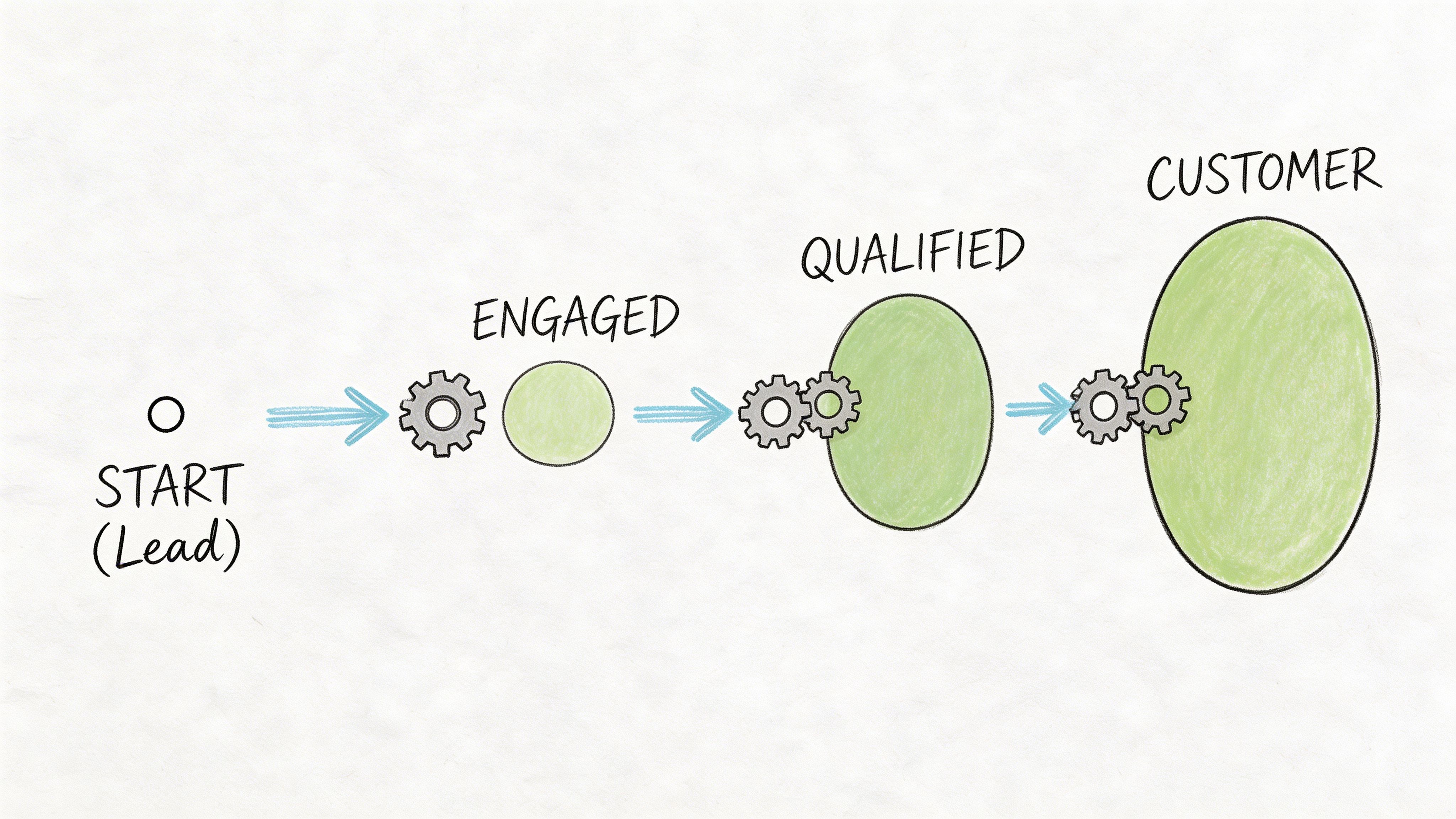
A person shows interest. Your company keeps the conversation useful until that person is ready to buy, ready to talk, or clearly not a fit.
Marketing automation is the system that makes that happen consistently instead of relying on memory, spreadsheets, and whoever remembered to follow up before lunch.
Think like a good shopkeeper
The easiest way to understand nurturing is to picture a good shopkeeper.
They don’t chase everyone who walks through the door. They pay attention. They ask a useful question. They notice what someone’s looking at. They make a relevant recommendation. They know when to help and when to back off.
That’s nurturing.
Now add scale. Instead of one shopkeeper helping one customer, you have a growing pipeline of leads coming from forms, outbound replies, content, referrals, and website visits. A human team can’t manually track every signal for every contact without dropping balls.
That’s where automation comes in.
What automation does inside the process
Automation handles the operational side of the relationship.
It watches for signals, updates records, moves people into the right sequences, alerts sales when intent rises, and keeps communication moving when your team is busy. Done well, it feels personal to the buyer and manageable to the team.
Done badly, it becomes spam with rules attached.
Here’s the difference:
Weak automation sends the same sequence to everyone, regardless of source, stage, or behavior.
Useful automation changes the next message based on what the lead did.
Weak automation stops at email scheduling.
Useful automation connects email, CRM updates, task creation, lead scoring, and sales alerts.
Practical rule: If your workflow can’t answer “why did this person get this message right now,” it isn’t ready.
The combined idea that matters
Lead nurturing marketing automation is the use of software to deliver relevant, timely, and stage-aware communication to prospects without forcing your team to manage every touch by hand.
That means:
Capturing context from forms, pages viewed, replies, meetings, and CRM history.
Deciding next actions based on rules or scores.
Delivering messages that match where the lead is in the buying process.
Handing off to sales when the person is showing real buying intent.
Looping outcomes back into the system so marketing and sales learn what’s working.
What it is not
A lot of SMBs buy software expecting lead nurturing marketing automation to fix sloppy process on its own. It won’t.
It isn’t:
A batch email calendar
A replacement for qualification
A substitute for clear messaging
A black box that magically creates revenue
It’s infrastructure. It works when your funnel stages are defined, your contact data is usable, and your sales team trusts what the system sends them.
That’s why unified systems matter. Nurturing gets stronger when the same platform can see campaign engagement, website behavior, pipeline stage, and rep activity together. Without that shared view, the automation is guessing.
The Business Case for SMBs
SMBs don’t need another marketing hobby. They need a revenue process that produces qualified pipeline without adding headcount every time lead volume rises.
That’s the compelling case for lead nurturing marketing automation.
According to Sender’s lead nurturing statistics, lead nurturing with marketing automation generates 50% more sales-ready leads at 33% lower cost, and nurtured leads make 47% larger purchases on average than non-nurtured leads.
That changes the conversation from “should we automate” to “where are we still losing money by not doing it well.”
It protects small teams from manual chaos
Most SMB teams don’t have room for wasted motion.
When one marketer is running campaigns, writing emails, cleaning lists, and trying to support sales, manual nurturing becomes inconsistent fast. Automation removes the repetitive parts so the team can spend time on decisions that matter.
A good system handles:
Immediate response: New leads don’t sit untouched while someone checks forms.
Routine follow-up: Educational emails, reminders, and check-ins go out on schedule.
Stage movement: Leads can be routed based on behavior instead of gut feel alone.
Sales alerts: Reps know when to step in without watching every contact manually.
It improves both volume and quality
A lot of teams focus only on top-of-funnel volume. That’s incomplete.
More leads don’t help if sales gets flooded with bad-fit contacts, unready buyers, or people who clicked once and disappeared. Nurturing adds the missing layer. It helps teams separate curiosity from intent.
That’s why automation tends to work best when it’s connected to qualification logic, not just content delivery. The system should help answer questions like:
Business question | What automation should reveal |
|---|---|
Which leads are engaged? | Who is opening, clicking, revisiting key pages, or replying |
Which leads are qualified? | Who matches your target account profile and behavior criteria |
Which leads need more education? | Who is active but still early in the buying process |
Which leads need sales now? | Who crossed a threshold that indicates readiness |
It tightens the sales and marketing handoff
The handoff between marketing and sales is where many SMB funnels break.
Marketing says the lead is warm. Sales says the lead isn’t ready. Neither side trusts the other because the data is incomplete or late.
Automation improves that handoff when both teams work from the same activity trail. Sales can see what the lead consumed. Marketing can see what happened after the handoff. The argument shifts from opinion to evidence.
The most useful nurture programs don’t just send content. They decide when a lead deserves a salesperson’s time.
It makes growth less fragile
Manual systems can hold together when lead volume is low. They usually crack as soon as campaigns work.
That’s the hidden cost of not automating. Success creates more inbound, more outbound replies, more follow-up, and more opportunities to lose track of who needs what.
Lead nurturing marketing automation gives SMBs a way to scale attention, not just acquisition. That matters because revenue isn’t created when a lead enters the database. It’s created when the right follow-up turns interest into pipeline.
Core Strategies for Automated Nurturing
The mechanics matter, but the strategy matters more. Most underperforming nurture programs fail before the first email sends.
They fail because the team never decided who should get what, when they should get it, and what signal means “send to sales.”
Three pieces carry most of the load: segmentation, personalization, and lead scoring.
Segment by context, not just list source
A lot of SMBs segment too narrowly or too loosely.
Too narrowly means endless micro-lists nobody maintains. Too loosely means one nurture track for everyone. Neither works.
Start with segments that change message relevance in a meaningful way:
Lead source: Webinar registrants usually need different follow-up than outbound replies.
Role or company fit: A founder, marketing manager, and operations lead often care about different outcomes.
Stage of intent: Someone reading educational content shouldn’t get the same push as someone revisiting pricing.
Product interest: Contacts exploring one use case need content tied to that use case.
A practical segmentation model is usually enough if sales can recognize it and marketing can run it.
Personalize with behavior, not just first name fields
First-name personalization is table stakes. It doesn’t move much on its own.
Real personalization comes from matching the message to the lead’s behavior and current questions. If someone attended a webinar, send a follow-up tied to the topic they raised their hand for. If they spent time on solution pages, move from education toward proof and objections.
What works:
Behavior-based timing
Copy tied to a problem the lead already showed interest in
Offers that match stage, such as guides early and demos later
Sales outreach that references recent actions
What doesn’t work:
A single evergreen sequence for every contact
Personalization tokens with generic body copy
Aggressive demo asks before intent is clear
Automations built on incomplete CRM fields
For teams thinking through longer sequences, this explainer on drip campaign meaning is useful because it separates timed sequences from actual nurture logic.
Good personalization answers the lead’s next question. Bad personalization repeats the company’s pitch with a merge field on top.
Lead scoring is where marketing and sales finally agree
Lead scoring gives the team a shared language for readiness.
According to Coffee & Dunn’s guide to lead nurturing marketing automation, lead scoring models assign points using explicit data, such as job title, and implicit actions, such as a demo request worth +25 to +50 points. Teams can then define thresholds that trigger sales alerts, and this can boost conversion rates by up to 75%.
That matters because it creates a repeatable rule for handoff.
Sample Lead Scoring Model for an SMB
Action or Attribute | Example | Points |
|---|---|---|
Job title fit | Decision-maker title | +10 to +20 |
Company fit | Matches target company profile | Qualitative fit factor |
Demo request | Requests a demo | +25 to +50 |
Pricing page visit | Revisits pricing | +15 to +30 |
Webinar attendance | Attends a webinar | +15 to +25 |
Case study download | Downloads proof-focused content | +10 to +15 |
Unsubscribe | Opts out of emails | -20 |
The exact values depend on your business, but the shape of the model should be familiar. High-fit profile plus high-intent behavior should reach sales quickly. Low-fit or low-intent contacts should stay in education until they do something stronger.
Keep the model usable
The best scoring model is the one your team will maintain.
Use a simple threshold system. Cold leads get educational nurture. Warm leads get stronger proof and more frequent touchpoints. When someone crosses the agreed score, the system creates a task or alerts sales.
Then review it regularly.
Check false positives: Which “qualified” leads weren’t really ready?
Check false negatives: Which closed deals scored too low for too long?
Check data inputs: Are forms, website events, and CRM fields reliable enough to trust?
Scoring isn’t magic. It’s an operating agreement between marketing and sales, backed by behavior.
Building Your First Automated Nurture Workflows
Most SMBs don’t need an elaborate journey map on day one. They need a few workflows that cover the obvious gaps and remove dependence on manual follow-up.
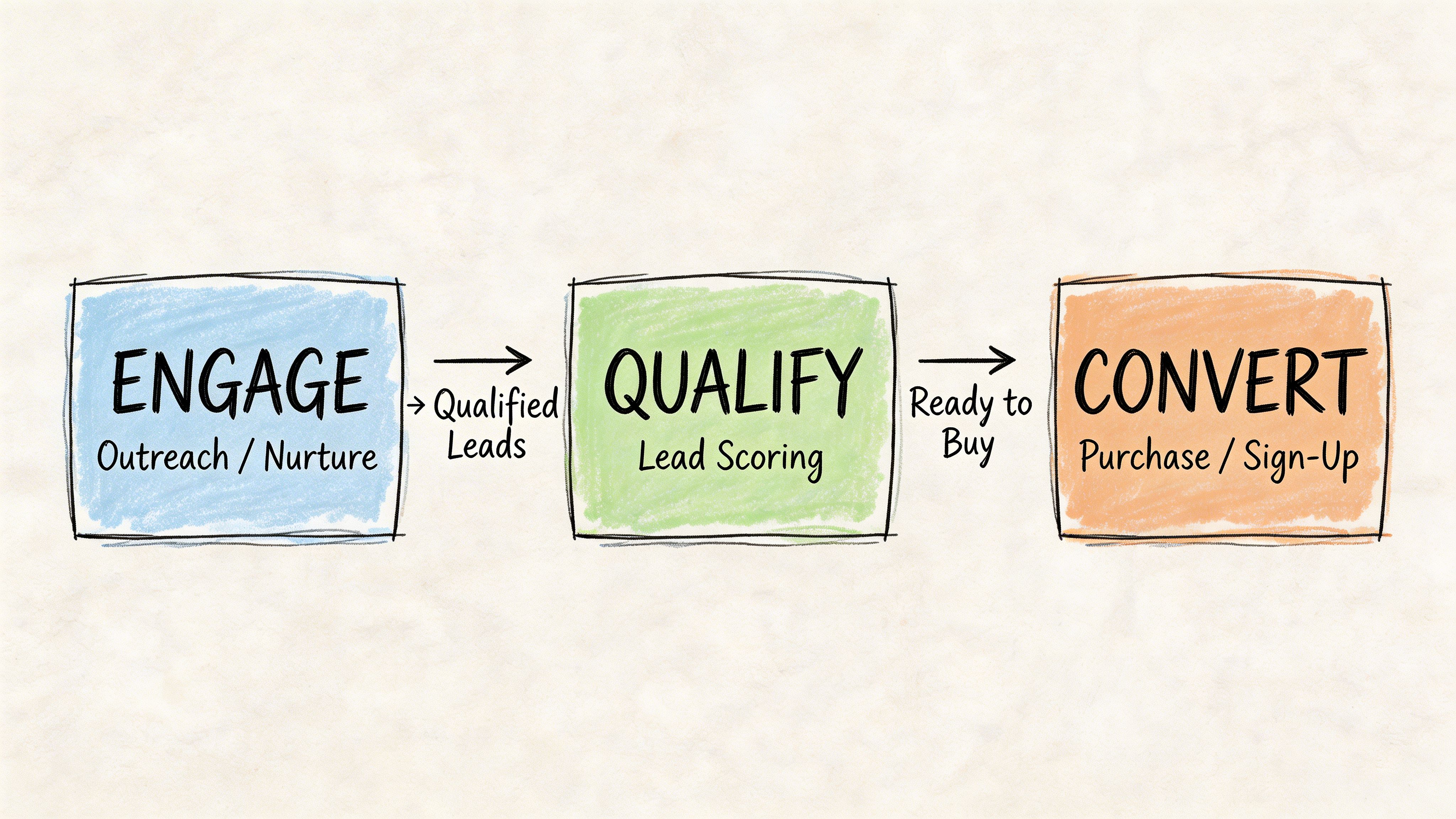
That usually starts with three automations: a welcome series, a re-engagement flow, and a high-intent trigger.
The welcome series
A new lead has the highest context right after signup, inquiry, or first conversion. That’s when your company is freshest in their mind.
Yet, at this stage, many SMBs send one auto-confirmation and then disappear.
A solid welcome workflow does three things well:
It confirms the action the person just took.
It sets expectations about what they’ll receive next.
It gives one clear next step that fits early-stage intent.
A practical sequence might look like this:
Email one: Deliver the asset or confirm the signup. Keep the CTA simple.
Email two: Add context. Explain the problem your product solves and who it helps.
Email three: Introduce proof. Share a use case, customer outcome type, or common implementation path.
Branching rule: If the lead clicks high-intent content, raise score or route to a different track.
The mistake here is over-selling too early. Most welcome sequences fail because they treat every new contact like an urgent sales opportunity.
The re-engagement flow
Every database has contacts who were once active and then disappeared. Don’t leave them parked forever.
A re-engagement workflow should identify silence, send a small number of focused messages, and either pull the lead back into active nurture or reduce future outreach.
This flow works best when it asks a direct question. Not “still interested?” in a lazy way, but something tied to value.
Try angles like:
Problem check-in: Is this still a priority?
Use-case shift: Has your team moved to a different workflow or tool stack?
Offer reset: Would a shorter guide, quick walkthrough, or reply-based conversation help more?
If they engage again, route them based on the signal. If they don’t, stop forcing activity. Healthy nurture systems know when to pause.
The high-intent trigger
At this point, lead nurturing marketing automation becomes revenue-facing.
A high-intent trigger responds to actions that usually happen close to a buying decision. Pricing page visits are the classic example. Demo requests, repeated solution-page views, or replies asking implementation questions also qualify.
According to Salesforce’s overview of automated lead nurturing, automated triggered events such as follow-ups after a pricing page visit can produce 68% higher open rates and 241% higher click rates than generic batch emails.
That outperformance makes sense. The message is timely, specific, and connected to a real action.
Here’s the workflow logic:
Trigger: Contact revisits pricing or another bottom-of-funnel page.
System action: Increase score, log the event, and notify the assigned owner.
Marketing follow-up: Send a short email that addresses decision-stage concerns.
Sales action: If the score or profile meets threshold, create a task for direct outreach.
Fallback path: If no response, continue with a brief proof-oriented sequence rather than a generic newsletter.
Don’t trigger sales just because someone clicked once. Trigger sales when fit and behavior line up.
That’s why unified platforms help so much here. Tools like HubSpot, Marketo, ActiveCampaign, and Stamina can build workflows that combine messaging, CRM updates, and sales tasks. The important point isn’t the brand name. It’s that the workflow should live close to your CRM and rep activity, not in an isolated email tool.
Workflow design mistakes that create noise
Teams usually know they should automate. They struggle with knowing what to avoid.
Common mistakes include:
Too many branches too early: Complex logic makes workflows fragile.
No exit conditions: Leads keep receiving nurture after booking a meeting.
Weak ownership rules: Sales gets alerted, but nobody’s clearly responsible.
Content mismatch: Early-stage leads receive late-stage asks.
No suppression logic: Existing opportunities still get prospecting emails.
A workflow should be easy to explain in one sentence. “If a new lead downloads X, they receive this sequence unless they book a meeting or hit a score threshold.” If it cannot be explained concisely, the team won’t operate it cleanly.
Here’s a useful walkthrough on workflow thinking in practice:
Start with one route through the funnel
You do not need dozens of workflows to get value.
One strong welcome sequence, one re-engagement path, and one high-intent trigger cover a surprising amount of ground for an SMB. Once those work, add more based on actual gaps in the funnel, not on what looks impressive in an automation canvas.
The best early workflows feel boring to the team building them. They’re clear, stable, and tied to obvious moments where leads are otherwise falling through.
Measuring Success and Proving ROI
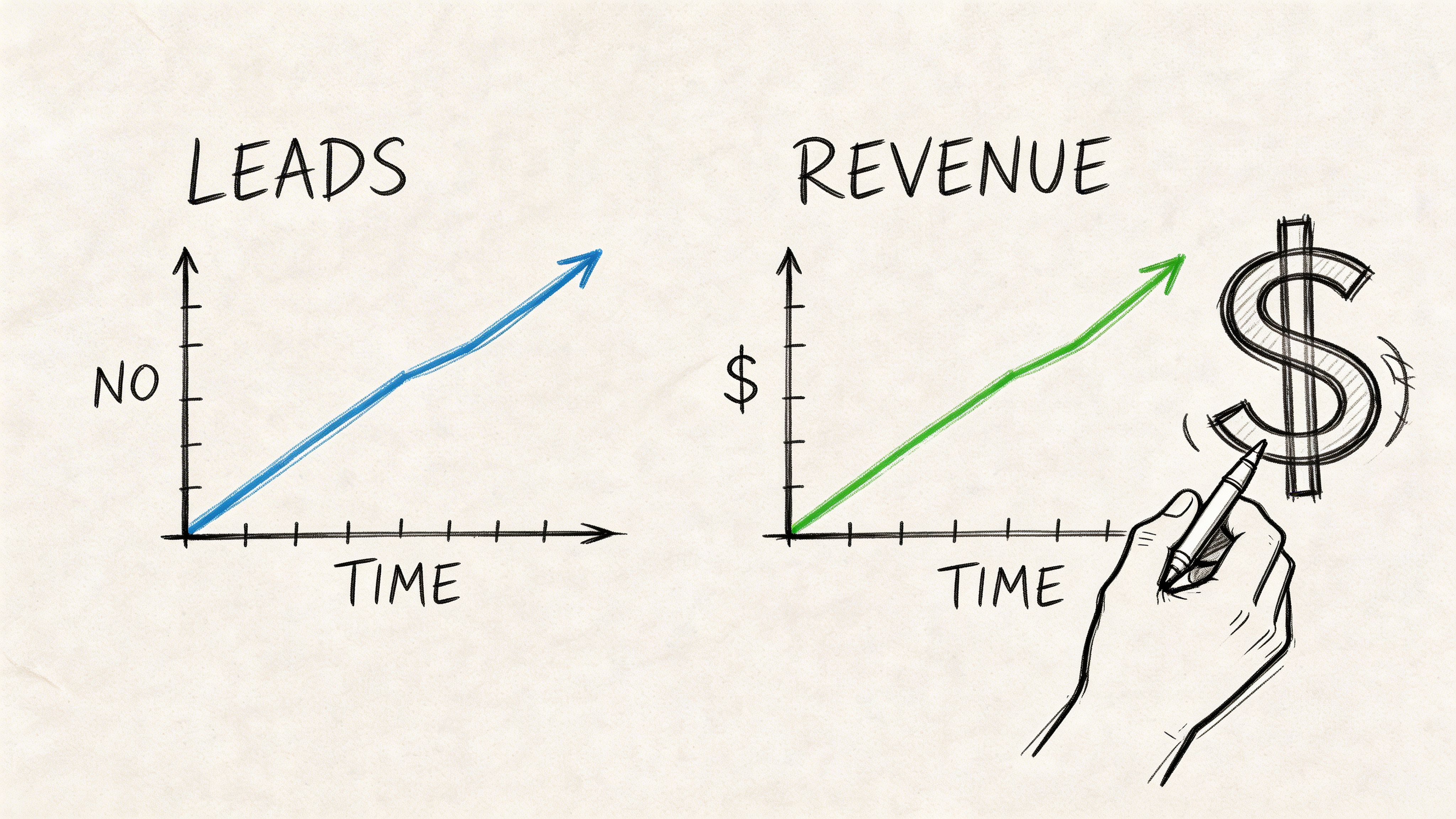
The hardest part of nurturing for many SMBs isn’t building workflows. It’s proving those workflows influenced revenue.
That’s where teams drift into vanity metrics. Open rates look decent. Clicks are happening. Sales still asks the obvious question: did any of this create pipeline?
According to HubSpot’s lead nurturing tools guide, automation can produce strong returns, with 37% of email sales coming from just 2% of volume, but many SMBs still struggle to measure it. The same source notes that the 79% lead loss rate is often tied to nurturing gaps, and without a unified CRM to track multi-touch attribution, marketers can’t connect workflows to revenue.
Stop reporting on email performance alone
Email metrics are useful diagnostics. They are not the business outcome.
If a nurture program gets clicks but never changes qualification, velocity, or pipeline creation, it’s not doing enough. The reporting model has to connect activity to movement.
Track the metrics that reflect commercial progress:
MQL creation: Which nurtured leads become marketing-qualified
SQL creation: Which of those become accepted by sales
Lead-to-opportunity movement: How many nurtured contacts enter pipeline
Sales cycle length: Whether nurtured leads move faster once engaged
Cost per qualified lead: Whether your automation is improving efficiency
Revenue influence: Whether nurtured contacts appear in closed-won paths
Build one source of truth
ROI blindness usually comes from architecture, not effort.
Marketing has campaign data. Sales has call notes. The CRM has opportunity stages. The email platform has engagement events. None of them line up cleanly, so reporting turns into manual stitching and educated guesses.
A unified system fixes that by tying three things together:
Layer | What it should capture | Why it matters |
|---|---|---|
Engagement data | Opens, clicks, page visits, replies, form fills | Shows buying signals and content interaction |
CRM data | Ownership, stage, pipeline movement, outcome | Shows where leads go after engagement |
Workflow data | Triggers, delays, branch paths, task creation | Shows what automation actually did |
When those three layers sit together, you can answer practical questions without exporting five CSVs.
Use cohort thinking, not one-off anecdotes
A common reporting mistake is claiming success from isolated wins.
One rep says a nurture email revived a deal. That’s good to hear, but it isn’t a measurement framework. You need to compare groups over time.
Look at:
Leads that entered nurture vs leads that did not
Contacts that hit a high-intent trigger vs those that stayed in generic broadcast lists
Segments by source, fit, or workflow path
Handoff quality by rep or team
This helps you see whether the system changes outcomes consistently.
If a workflow only looks good inside the email dashboard, it hasn’t earned budget yet.
Make attribution practical
Perfect attribution is unrealistic for most SMBs. Useful attribution is enough.
Start with questions your team can answer reliably:
Which workflows generate the most qualified handoffs?
Which triggers produce meetings or opportunities?
Which segments stall after nurture starts?
Where does sales reject “qualified” leads most often?
Which nurture paths touch deals that eventually close?
That’s enough to improve spend decisions, scoring logic, and content priorities.
Review the system like an operator
A nurture engine should be reviewed the same way you review pipeline.
Look for breakpoints:
Leads entering but not progressing
Scores rising without sales acceptance
Opportunities created without prior nurture touches
Sequences with engagement but no commercial movement
Workflow branches no one has audited in months
The best ROI conversations happen when marketing and sales inspect the same dashboard and agree on the same definitions. If the platform can’t make that possible, proving value will stay harder than it should be.
Putting Your Nurturing System in Place
Most SMBs don’t need a full rebuild. They need a cleaner operating model.
The biggest gains usually come from getting the data into one place, building a few dependable workflows, and measuring the parts of the process that affect pipeline instead of just engagement.
Unify the data first
If activity lives in separate tools, your nurture logic will always be partial.
Start by deciding where contact records, ownership, stage, and engagement history should live. That system needs to be the place both marketing and sales trust. If you’re tightening the structure of that database, these CRM best practices are worth applying before you automate more on top of bad records.
Start with one workflow that solves one leak
Don’t begin with a huge journey map.
Pick one spot where leads routinely get lost. For most SMBs, that’s new inbound leads who receive either delayed follow-up or no relevant follow-up at all. Build one welcome workflow that responds fast, uses clear message sequencing, and hands off cleanly when intent rises.
Once that works, add a re-engagement flow or a high-intent trigger.
Measure movement, then refine
A live workflow is not a finished workflow.
Review whether leads are moving from engagement into qualification and from qualification into real sales conversations. Check where sales disagrees with the scoring. Check where leads stall. Adjust the logic, message timing, and exit conditions based on those observations.
This is what separates a tool setup from a revenue engine. The engine improves because the team keeps tuning it against pipeline outcomes.
Lead nurturing marketing automation works when it’s treated as an operating system for follow-up, not a side project owned by one person in marketing.
If your team wants one place to run outreach, nurture leads, track CRM activity, and connect marketing actions to sales outcomes, Stamina is built for that unified workflow. It combines marketing, sales engagement, and CRM data so SMBs can automate follow-up without losing visibility into what drives pipeline.

