Master Your Message for LinkedIn Connection Success

Boost your acceptance rate! Discover 8 proven message for linkedin connection templates with deep analysis to start more sales conversations.

0 - Minute Read

Your connection note is rarely failing because it is too short or too direct. It fails because the prospect cannot see a reason to accept.

Generic networking language trained buyers to ignore requests on sight. “I’d like to add you to my professional network” asks for attention without earning it. Swapping in a first name, company name, or job title does not fix that. Buyers recognize token personalization fast, especially when they get similar notes every week.

The primary job of a message for linkedin connection is not to sound polite. It is to establish relevance in a tiny space. Strong requests usually do three things well. They show you noticed a business signal, connect that signal to a likely priority or problem, and keep the next step light. Weak requests skip all three, then rely on volume.

That trade-off matters because LinkedIn caps how many connection requests you can send, as noted earlier in the article. If each request is a limited shot, wasted outreach becomes a capacity problem, not just a copy problem.

There is also a scaling problem. Reps know generic notes underperform, but manual research does not scale. The practical answer is structured personalization. Use a repeatable workflow that pulls visible signals such as hiring activity, role changes, posted content, funding news, or territory expansion, then turns those signals into short, relevant openers. Teams using AI personalization workflows for outbound messaging can do this faster without sending the same note to everyone.

The goal is simple. Give the prospect a reason to care before you ask for anything.

If you want more context on modern prospecting strategies on LinkedIn, this section sets up the message frameworks that follow. They are built to earn acceptance, start conversations, and create a clean path from connection request to pipeline.

1. The Personalized Value-First Connection Message

Generic connection notes do not fail because they are rude. They fail because they give the buyer no reason to care.

A value-first message starts with a visible business signal and turns it into a relevant observation. The signal can be a hiring push, a product launch, a new market entry, a leadership change, or a theme from the prospect’s recent posts. The observation should show that you understand what usually happens next.
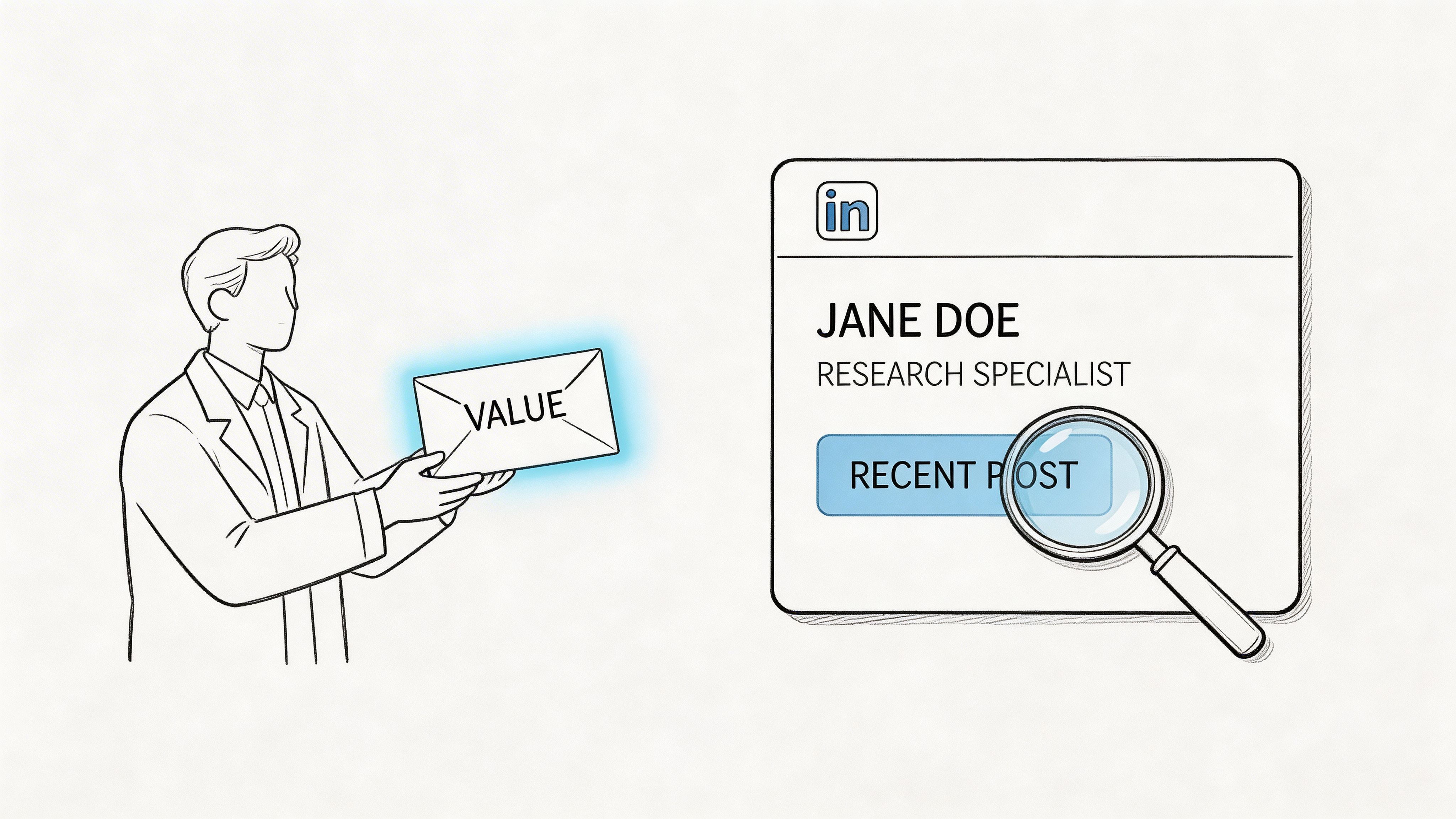
A line-art illustration showing a professional holding a letter labeled value, targeting a LinkedIn profile.

A practical example:

“Hi Dana, noticed your team is hiring across outbound and RevOps. We often see reporting gaps show up before volume issues do. Thought it would be useful to connect.”

That message earns attention because it does real work in one short note. It shows you looked. It ties the signal to a plausible priority. It keeps the ask low-pressure.

Why this format works

Sales reps often waste this format by cramming in the full pitch. They explain the product, list benefits, and ask for time on the calendar before trust exists. That is the wrong trade-off for a connection request.

The better approach is restraint. Give the prospect a sharp reason to recognize themselves in the message, then stop. As noted earlier in the article, template benchmarks can look strong on paper. The part that matters in practice is fit. A template only works when the opening line reflects something true about the account.

That is also why this approach scales better than people expect. The manual version takes too long. The automated version sounds fake. The middle ground is the usable one. Pull recent signals with a system, then let the rep shape the final sentence. Teams using personalized outreach workflows can produce relevant first drafts faster while keeping the final wording specific to the buyer.

Lead with a business truth the prospect already recognizes.

How to write it without sounding manufactured

Start with one concrete trigger. Then connect it to one likely implication. Do not stack three observations in one note. Brevity reads as confidence here.

Good version: “Hi Elena, saw the expansion into EMEA. Cross-region handoffs usually get messy before teams notice it in reporting. Thought it made sense to connect.”

Weak version: “Hi Elena, love what your company is doing. We help fast-growing teams streamline operations, improve efficiency, and drive revenue. Open to a quick chat?”

The first message shows judgment. The second sounds interchangeable.

A few operating rules help:

  • Tie the note to something visible and recent.

  • Mention one likely challenge, not a full diagnosis.

  • Keep the CTA to “connect” or “compare notes.”

  • Cut generic claims about helping companies grow.

  • Rewrite any sentence that could be pasted to 50 other prospects.

If you want another framework for lowering friction through shared context, see how to reach out to someone with a mutual connection on LinkedIn.

For SMB and mid-market teams, this message type is usually the best place to start. It creates relevance without overusing social proof, and it gives managers a clean structure for QA. Segment by role, company stage, and trigger type. Then coach reps on the part that machines still struggle with: choosing the insight that matters.

2. The Mutual Connection Advantage Message

A mutual connection message works for one reason. It cuts perceived risk.

Senior buyers do not accept connection requests because the copy is clever. They accept when the context feels safe, relevant, and familiar. A shared contact can do that fast, but only if the relationship is real enough to mean something.

A clean example:

“Hi Omar, saw we both know Priya Shah. We’ve both spent time around B2B growth teams. Thought it made sense to connect.”
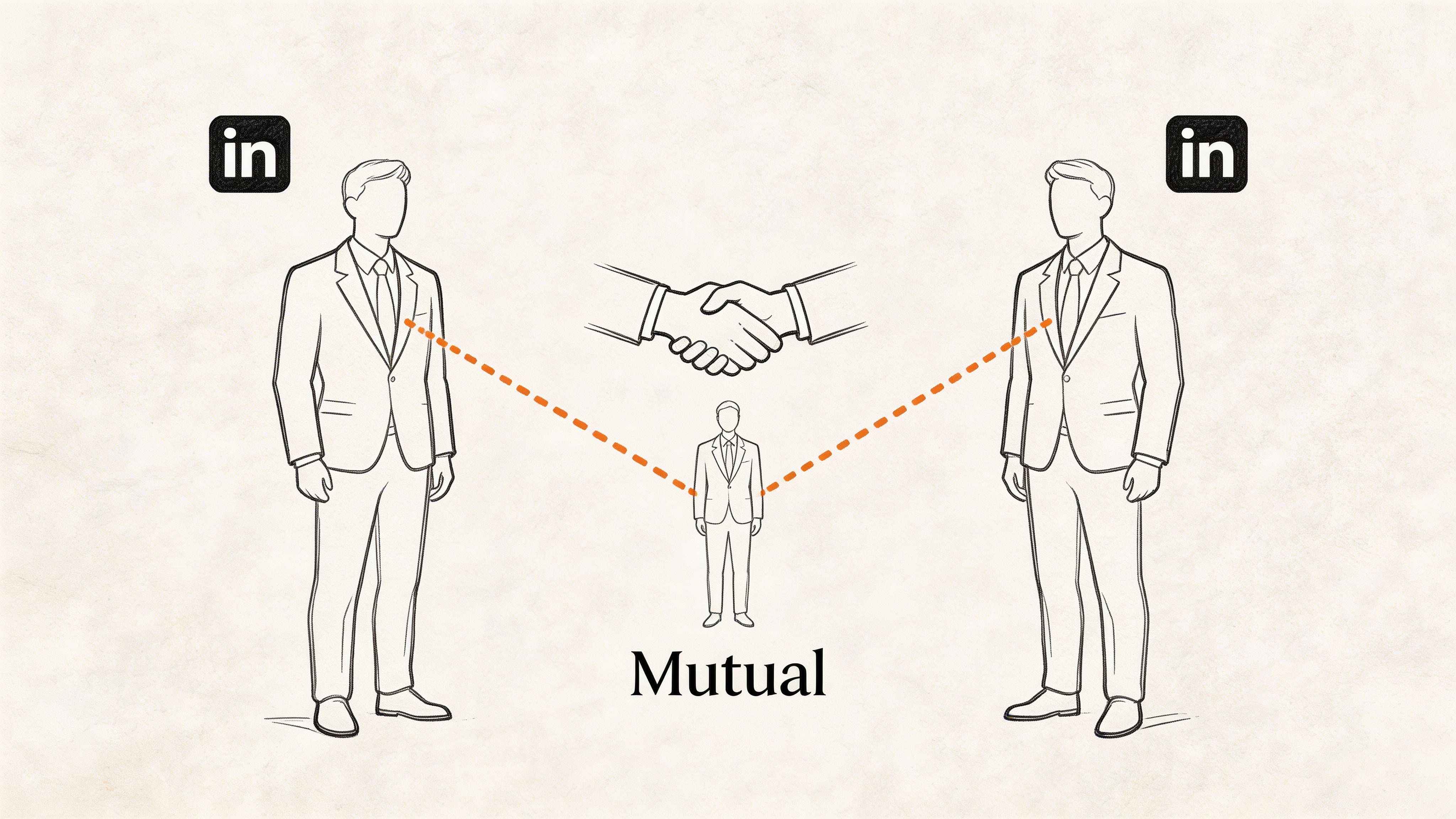
An illustration showing two professionals connected through a mutual contact on the LinkedIn networking platform.

That note works because it does one job well. It gives Omar a credible reason to recognize your name. It does not turn Priya into an unpaid referral source, and it does not rush into a pitch before trust exists.

Why this message gets accepted

Shared context lowers friction. The prospect no longer has to guess whether you are a random seller, a loose acquaintance, or someone adjacent to their network for a legitimate reason.

That distinction matters more than reps think.

I use this format when the mutual connection changes how the recipient interprets the request. If the shared contact is a former colleague, trusted peer, investor, client, or active community member, the note has weight. If it is a weak overlap from a large network, the same message feels lazy.

Use one of these anchors:

  • A real shared contact: Someone the prospect knows well enough to recognize immediately.

  • A credible shared circle: A niche operator group, cohort, event, or association with actual relevance.

  • A recent mention: Only when the mutual contact gave permission or the context is clearly appropriate.

The trade-off is simple. Strong context increases trust. Weak context makes the sender look opportunistic.

Where reps get it wrong

A lot of outbound reps treat any mutual as useful proof. It is not.

“Looks like we both know John” says almost nothing if John connects with everyone. The same goes for broad community references like “we’re both in Pavilion” or “we both follow RevGenius” when there is no sign of actual interaction. The buyer reads that as filler, not familiarity.

A better standard is this:

Mention the mutual connection only if it answers the prospect’s silent question: “Why are you reaching out to me?”

If it does not answer that question, remove it.

How to use this at scale without sounding automated

This is one of the easiest message types to personalize with AI, and one of the easiest to ruin with bad enrichment.

The playbook is straightforward. Pull mutual connections, group overlap, past employers, and shared communities into your prospecting workflow. Then score each overlap for strength before a rep sends anything. A weak match should never make it into the final note. A strong match should still be reviewed by a human, because the risk is not technical. It is social. One careless name-drop can burn trust with both the prospect and the shared contact.

For teams, I recommend a simple rule set:

  • Prioritize mutuals the rep can explain in one sentence.

  • Exclude high-volume connectors with little actual relationship value.

  • Ask whether the shared contact would be comfortable being mentioned.

  • Keep the request focused on connecting, not booking a meeting.

If you need examples of outreach etiquette around shared contacts, this guide on how to reach out to someone with a mutual connection on LinkedIn is directionally useful.

I like this message most for enterprise accounts, agency prospecting, and any sale where trust carries more weight than novelty. Used well, it does more than raise acceptance. It gives your follow-up a cleaner starting point, which is where pipeline gets built.

3. The Educational Resource or Insight-Share Message

The fastest way to make a LinkedIn connection request feel different is to stop treating it like a disguised meeting ask.

A good insight-share message gives the buyer a reason to connect before they know whether they want a conversation. That matters because senior prospects protect their attention. They will ignore another vague intro. They will often accept a note tied to a relevant idea, benchmark, or resource they can use.

Example:

“Hi Leah, we put together a short breakdown of how lean SDR teams are handling LinkedIn follow-up. It looked relevant to your team at NorthPeak. Happy to connect and send it over.”

Why this message works

This format earns interest through relevance. The prospect can quickly answer one question: is this useful to me right now?

That is a key advantage. The connection request does not need to close the sale. It needs to create a credible next step. Educational messages do that well because they make the follow-up feel natural instead of forced.

I use this approach when I have something specific to share, not just content for content’s sake. If the asset is generic, the message falls apart. Buyers can spot recycled thought leadership immediately.

What makes the resource credible

Specificity does the heavy lifting here.

“We have some insights for sales leaders” is forgettable. “We reviewed how outbound teams handle first-touch LinkedIn follow-up after demo requests go cold” gives the buyer enough context to judge relevance in seconds.

Use a short checklist before sending:

  • Keep the topic narrow. Tie it to the buyer’s role, team structure, or current motion.

  • Name the payoff. Say what they will learn or compare.

  • Write the note so it stands on its own. The connection request should make sense even if no link gets clicked.

  • Be honest about the source. If it is an internal memo, say it is an internal memo.

  • Match the asset to the account tier. A one-page takeaway works for volume outreach. A custom teardown is better for high-value accounts.

The trade-off is time. Strong insight-based outreach takes more preparation than a minimal note, but it gives reps a cleaner path into the first follow-up and a better chance of turning the connection into pipeline.

How to scale this without losing relevance

Teams usually get sloppy here. They automate the asset mention, but they do not validate whether the asset fits the prospect.

A better workflow is simple. Build three to five resources around repeatable buyer problems. Tag each one by persona, industry, and trigger. Then use AI to draft the opening line based on the prospect’s role, recent hiring, product motion, or public posts. The rep should still approve the final note. AI is good at speeding up relevance matching. It is not good at judgment.

If your team needs help tightening the wording, these copywriting principles for email outreach carry over well to LinkedIn connection notes too.

This message type works best for founders, consultants, marketers, and sales teams with a real library of useful material. It also works for SDR teams if marketing has built assets for clear buyer problems, not just broad awareness campaigns.

Keep the note short. Save the insight for after they accept.

4. The Question-Based Engagement Message

Questions get overused on LinkedIn because reps treat them like a trick. They are not a trick. They work when the question proves you understand the buyer’s situation and gives them an easy way to engage.

A strong version looks like this:

“Hi Marcus, saw your team hiring across both marketing and sales. How are you handling inbound handoff today as volume grows? Thought it made sense to connect.”

The point is not curiosity for its own sake. The point is to start a business conversation before you ever ask for time.

What makes the question work

Question-based notes perform best when the prospect already shows some signal. Hiring. New leadership. Product expansion. A clear operational change. Without that context, the question can feel random and intrusive.

Keep it to one question. Make it specific. Aim for a question that does one job well:

  • Expose a current priority

  • Reflect the prospect’s environment

  • Open the door to a useful follow-up

That last part matters. A good question does not just earn acceptance. It gives your team a cleaner next step after the connection comes through, which is where revenue gets created.

How to write better questions

Strong question:

“As your outbound team grows, what breaks first. targeting, messaging, or follow-up?”

Weak question:

“Would you be interested in learning how we help companies improve outreach?”

The first asks about their process. The second asks for permission to pitch.

That distinction is small on paper and significant in practice. Buyers will answer operational questions. They ignore vendor-first questions because they have seen them a hundred times.

I train reps to pressure-test every question with one rule.

If the prospect can answer with “yes,” “no,” or nothing useful, rewrite the question.

There is a trade-off here. This format often produces better conversations, but it can lower raw acceptance rates compared with a lighter note. That is usually a fair exchange for high-intent accounts. If a prospect replies with a real answer, the rep already has context for the next message, the discovery call, and the account plan.

This also scales better than many teams expect. AI can pull signals from hiring trends, job changes, recent posts, or company announcements, then draft three to five question angles tied to those signals. The rep still needs to choose the best one. Judgment matters more than speed. Good personalization is not adding a first name and a question mark. It is choosing the one question that matches the account’s likely priority.

The writing discipline carries over to email too. Teams that get sharp at short, relevant questions on LinkedIn usually improve their outbound emails as well. The same principles show up in this guide to copywriting for outbound messages.

Use this message type when you see real intent and want conversation quality over connection volume. That is the right trade in sales.

5. The Specific Use Case or Social Proof Message

Social proof can help. Sloppy social proof hurts.

This is the framework many teams overuse because it feels safe. Mention a client, mention a result, ask to connect. The problem is that most of those messages sound interchangeable.

Because the article must stay factual, I would not invent a flashy customer metric just to make the note punchier. In real outreach, only use social proof you can stand behind and are allowed to share.

A solid version looks like this:

“Hi Nina, we recently supported a SaaS team with a similar handoff problem between SDR and AE workflows. Your setup looked familiar from your recent hiring. Thought it might be useful to connect.”

Why this approach still works

Prospects often need pattern recognition. They want to know whether you understand companies like theirs, not just companies in general.

That is why adjacent relevance matters more than bragging. Similar business model. Similar GTM motion. Similar stage. Similar internal bottleneck.

The best social proof note does not scream “look how great we are.” It says, “we have seen this movie before.”

LaGrowthMachine data cited by Cognism found blank notes at 31 percent acceptance and short personalized intros at 32 percent, as summarized in the verified material above. That narrow difference is a useful reminder. Not every personalized note creates a big lift by itself. Social proof only helps when it sharpens relevance.

What to include and what to leave out

Use this framework when you have a believable similarity and a clear reason it matters.

  • Name the problem category: Handoff, follow-up, segmentation, pipeline visibility, onboarding.

  • Anchor to their world: Industry, team structure, motion, or current initiative.

  • Keep the proof light: Save the full case study for later unless the claim is public and approved.

What not to do:

  • Mention a giant brand that makes your relevance look weaker, not stronger.

  • Force hard metrics into the note if the metric is not the point.

  • Use a case study from a totally different market and expect the buyer to connect the dots.

The strongest version of this message often sounds understated. That is a good sign. Connection requests are earned through credibility, not chest-thumping.

6. The Time-Sensitive or Trigger-Based Message

The right trigger beats a clever note.

A buyer who just stepped into a new role, announced a launch, opened a new market, or started hiring already has a live problem set. That context creates urgency for you. Your job is to connect the trigger to the likely business change without sounding like you scraped a headline and fired off a template.

A hand-drawn illustration showing a man looking at a calendar marked with October 15 and a rocket ship.

Example:

“Hi Sam, congrats on the new VP Sales role. New leaders usually review process, reporting, and tooling early. Thought it made sense to connect.”

Why trigger timing works

Fresh events lower the mental effort required to understand your outreach. The prospect does not need to guess why you reached out. The reason is obvious, current, and tied to something they are already dealing with.

This is its primary advantage. It is also its constraint.

Trigger-based messages have a short shelf life. A role change from three days ago feels relevant. The same trigger from two months ago feels lazy unless you can connect it to a clear follow-on issue, such as hiring, territory changes, or a system rollout. Speed matters here more than polish.

I like this message type because it scales well if the team is disciplined. It also breaks fast when reps treat every trigger as equal. A profile view is weak. A funding announcement without a clear use case is weak. A new VP of Sales paired with active SDR hiring is much stronger because it points to a real operational shift.

How to build trigger-based outreach that holds up

Use a small set of triggers and map each one to a likely business problem.

  • Role changes: Strong for leaders who tend to reassess process, reporting, vendors, or team structure in the first phase.

  • Hiring spikes: Useful when growth usually creates handoff issues, enablement gaps, or inconsistent follow-up.

  • Product launches or market expansion: Best when your offer helps reduce rollout friction or supports a new motion.

  • Recent posts or interviews: Good if you can respond to a specific point they raised, not just congratulate them.

  • Stack changes or job descriptions: Helpful when the signal suggests a workflow change, data issue, or new operational priority.

This works best when reps know what happens after each trigger. That is the difference between activity and judgment. A trigger should answer two questions before a note goes out: why now, and why you?

For larger teams, AI can help score triggers, pull the public context, and draft a first pass at the note. Human review still matters. AI is good at speed and pattern matching. It is bad at deciding whether a trigger is commercially meaningful or just recent. Use it to save research time, then have reps tighten the message around one likely pain point.

The sequencing logic is similar to a drip campaign strategy built around timed follow-up signals. One event can justify a connection request. Several aligned signals usually justify a stronger point of view.

A quick explainer helps if your team needs a visual walkthrough:

The trade-off is simple. Trigger-based outreach can produce some of your best acceptance and reply quality because the timing is real. It also demands faster execution, better enrichment, and tighter rep judgment than broad evergreen messaging. Use it where speed is realistic and the trigger clearly maps to revenue potential.

7. The Soft Introduction or Referral Message

This is the closest thing to cheating, and I mean that in a good way.

A soft introduction message works because the trust transfer already happened before you sent the note. The recipient is not evaluating you from zero. They are evaluating whether the mutual person they trust made a smart connection.

Example:

“Hi Elena, Chris Martin suggested I reach out. He mentioned your team is reviewing outbound workflow issues, and thought we should connect.”

Why referral framing is different

This is not the same as casually mentioning a shared contact. The contact is not just overlap. They are actively creating the bridge.

That distinction matters. The note can stay very short because the endorsement carries the weight. If you add too much pitch, you dilute the strongest asset in the message.

Expandi’s H1 2025 State of LinkedIn Outreach report says messenger campaigns to warmed first-degree connections reached a 16.86 percent reply rate, according to the Expandi outreach report. A referral or soft intro creates a similar warming effect because the interaction is not purely cold anymore.

The practical rules

Use this framework carefully.

  • Get permission first: Never borrow someone’s name without asking.

  • Brief the referrer: Give them one sentence they can pass along.

  • Keep your note light: The intro should do the heavy lifting.

  • Respond fast: When a referral opens the door, slow follow-up wastes social capital.

The referral message should sound like a continuation of an existing conversation, not the start of a canned sales sequence.

This framework is ideal for founders, agency owners, consultants, and senior sales leaders who already have partner ecosystems, customer advocates, or investor networks. It is less about scale and more about conversion quality.

The trade-off is obvious. You cannot automate trust. AI can help identify who knows whom, surface customer advocates, and draft a clean note. But someone still has to earn the relationship that makes the referral believable in the first place.

8. The Direct and Minimal Message

Sometimes the best message for linkedin connection is barely a message at all.

That sounds like bad advice until you understand the context. This format works when the prospect already has a reason to trust your relevance. Maybe they know your company. Maybe you engaged with their content recently. Maybe your own profile is strong enough that a low-friction note is enough.

Example:

“Hi Rachel, enjoyed your post on partner-led growth. Would love to connect.”

Why less can be more

LaGrowthMachine’s numbers show that blank notes and short intros can perform similarly in some cases, with a small edge to the short personalized version in the verified material above. That is a useful reminder that forcing complexity into every request is not always the answer.

There are moments when a direct, minimal note works because it does not trigger resistance. It feels easy to accept. No pressure. No bait. No obvious setup.

This is especially useful for:

  • Busy executives

  • Visible creators

  • Founder-to-founder outreach

  • Prospects already familiar with your brand

  • People whose content you have engaged with meaningfully

The hidden requirement

Minimal does not mean generic.

“Let’s connect” without context is lazy. “Enjoyed your post on pricing strategy” is specific enough to signal intent without turning the note into a pitch.

The catch is what happens next. This framework depends on your follow-up. If they accept and you disappear, the connection becomes dead weight. If they accept and you immediately send a bloated pitch, you undo the low-friction advantage.

That is why teams using this format need a clean post-acceptance sequence and a sensible follow-up approach when someone does not respond. The initial note creates access. The next message creates movement.

I like this style for top-tier lists where overengineering the connection request can make you sound needy. Keep it clean. Keep it human. Then earn the conversation after the accept.

8-Point LinkedIn Connection Message Comparison

Approach

Implementation complexity

Resource requirements

Expected outcomes

Ideal use cases

Key advantages

Personalized Value-First Connection Message

Medium: requires tailoring or AI templates

Prospect research tools or AI SDRs; time to validate insights

Higher acceptance and relevant follow-ups when personalized

SMB sales, research-first outreach at scale

Demonstrates relevance, positions sender as helpful, scalable with AI

Mutual Connection Advantage Message

Low–Medium: depends on existing network

Strong professional network or CRM signals; verification time

Dramatically higher acceptance rates (warm introductions)

High-priority targets and account-based outreach

Social proof and instant credibility; reduces perceived risk

Educational Resource / Insight-Share Message

Medium: needs quality content and targeting

Marketing assets (reports, case studies), content customization

Good acceptance and thought-leadership positioning; drives engagement

Content-driven ABM, nurture sequences, industry audiences

Immediate value exchange; establishes expertise and opens follow-ups

Question-Based Engagement Message

Medium: requires thoughtful, research-based questions

Prospect intelligence and time for authentic follow-up

High engagement and conversational responses; variable conversion

Consultative selling, discovery calls, rapport building

Sparks dialogue, shows curiosity, reverses sales dynamic

Specific Use Case / Social Proof Message

Medium: depends on available case studies and permissions

Customer stories, metrics, legal/marketing sign-off

Persuasive acceptance and higher conversion when highly relevant

Industry-matched prospects and SMBs who recognize references

Concrete credibility through real outcomes and third-party validation

Time-Sensitive / Trigger-Based Message

High: needs real-time detection and fast execution

Signal monitoring tools, automated workflows, rapid response capacity

Very high relevance and response if timing is right; loses impact if delayed

Event-driven outreach (funding, role changes, launches)

Timely, opportunistic hook that demonstrates attentiveness

Soft Introduction / Referral Message

Medium: requires coordination with introducer

Network of advocates or partners; coordination time

Highest acceptance and accelerated trust; faster pipeline progression

High-value deals, partner/advocate-driven prospecting

Third-party endorsement yields strong credibility and warm entry

Direct & Minimal (Low-Friction) Message

Low: quick to create and send

Minimal resources; relies on sender brand or simple specificity

Low–moderate acceptance unless sender has strong brand; fast scaling

Busy executives, thought leaders, top-tier targets

Low friction, authentic tone, quick to scale and follow up

From Connection to Conversion Your Action Plan

LinkedIn connection requests do not fail because reps lack templates. They fail because teams treat every prospect like the same buyer.

The eight message types above are useful only if your team knows when to use each one. A value-first note works well when the prospect will respond to a practical outcome. A mutual connection message works better when trust is a key hurdle. A trigger-based message can outperform both, but only if your team catches the signal early and follows up fast. The trade-off is simple. The more context a message depends on, the harder it is to scale. The less context it uses, the easier it is to send, but the lower the odds that it starts a real conversation.

Start with a controlled test. Choose two approaches that rely on different kinds of relevance, then run them against the same segment, during the same time window, with similar rep skill. That gives you a cleaner read on message performance. Comparing a warm founder network against cold enterprise outreach gives you noise, not insight.

Measure the outcomes that matter first. Track acceptance rate and reply rate. Then track what happens after the accept. Which message creates a real business conversation. Which one produces a booked meeting. Which one gets accepted often but stalls in follow-up. That is how a connection strategy turns into a pipeline strategy.

A few operating rules keep this practical:

  • Match the message to the sales motion: Use trigger-based notes for active change, referral or mutual-connection notes for strategic accounts, and direct minimal notes for high-volume outreach or senior buyers who prefer brevity.

  • Separate signal gathering from final writing: AI can pull role changes, hiring activity, recent posts, and account context fast. Reps should still check the draft and sharpen the point before sending.

  • Write the post-accept message before the request goes live: If the next step is weak, the accept has little value.

  • Retire patterns that start sounding mass-produced: Prospects notice recycled phrasing quickly, especially in crowded markets.

Teams also get better results when LinkedIn is part of one coordinated outbound system. If the connection note says one thing, the follow-up email says another, and the rep opens the call with a third angle, trust drops. Buyers feel the inconsistency immediately.

Connected systems solve that problem. When account research, CRM history, website signals, and outbound sequencing sit in separate tools, personalization slows down and quality slips. Stamina can help here in a practical way because it combines sales, marketing, and CRM workflows with AI-assisted outreach, making it easier to build message variants, keep context consistent, and manage follow-up without extra manual handoffs.

One more rule matters. Optimize for conversion, not for the accept itself.

A connection request is only the first small commitment. Revenue comes from what happens next: a relevant follow-up, a sharp point of view, and a message sequence that matches the buyer's situation instead of forcing them into your template.

If your team wants to turn LinkedIn outreach into a more structured revenue motion, take a look at Stamina. It brings sales, marketing, and CRM data into one system and includes AI SDR workflows that can help teams research prospects, generate personalized outreach variants, and manage follow-up with more consistency.

Your connection note is rarely failing because it is too short or too direct. It fails because the prospect cannot see a reason to accept.

Generic networking language trained buyers to ignore requests on sight. “I’d like to add you to my professional network” asks for attention without earning it. Swapping in a first name, company name, or job title does not fix that. Buyers recognize token personalization fast, especially when they get similar notes every week.

The primary job of a message for linkedin connection is not to sound polite. It is to establish relevance in a tiny space. Strong requests usually do three things well. They show you noticed a business signal, connect that signal to a likely priority or problem, and keep the next step light. Weak requests skip all three, then rely on volume.

That trade-off matters because LinkedIn caps how many connection requests you can send, as noted earlier in the article. If each request is a limited shot, wasted outreach becomes a capacity problem, not just a copy problem.

There is also a scaling problem. Reps know generic notes underperform, but manual research does not scale. The practical answer is structured personalization. Use a repeatable workflow that pulls visible signals such as hiring activity, role changes, posted content, funding news, or territory expansion, then turns those signals into short, relevant openers. Teams using AI personalization workflows for outbound messaging can do this faster without sending the same note to everyone.

The goal is simple. Give the prospect a reason to care before you ask for anything.

If you want more context on modern prospecting strategies on LinkedIn, this section sets up the message frameworks that follow. They are built to earn acceptance, start conversations, and create a clean path from connection request to pipeline.

1. The Personalized Value-First Connection Message

Generic connection notes do not fail because they are rude. They fail because they give the buyer no reason to care.

A value-first message starts with a visible business signal and turns it into a relevant observation. The signal can be a hiring push, a product launch, a new market entry, a leadership change, or a theme from the prospect’s recent posts. The observation should show that you understand what usually happens next.

A line-art illustration showing a professional holding a letter labeled value, targeting a LinkedIn profile.

A practical example:

“Hi Dana, noticed your team is hiring across outbound and RevOps. We often see reporting gaps show up before volume issues do. Thought it would be useful to connect.”

That message earns attention because it does real work in one short note. It shows you looked. It ties the signal to a plausible priority. It keeps the ask low-pressure.

Why this format works

Sales reps often waste this format by cramming in the full pitch. They explain the product, list benefits, and ask for time on the calendar before trust exists. That is the wrong trade-off for a connection request.

The better approach is restraint. Give the prospect a sharp reason to recognize themselves in the message, then stop. As noted earlier in the article, template benchmarks can look strong on paper. The part that matters in practice is fit. A template only works when the opening line reflects something true about the account.

That is also why this approach scales better than people expect. The manual version takes too long. The automated version sounds fake. The middle ground is the usable one. Pull recent signals with a system, then let the rep shape the final sentence. Teams using personalized outreach workflows can produce relevant first drafts faster while keeping the final wording specific to the buyer.

Lead with a business truth the prospect already recognizes.

How to write it without sounding manufactured

Start with one concrete trigger. Then connect it to one likely implication. Do not stack three observations in one note. Brevity reads as confidence here.

Good version: “Hi Elena, saw the expansion into EMEA. Cross-region handoffs usually get messy before teams notice it in reporting. Thought it made sense to connect.”

Weak version: “Hi Elena, love what your company is doing. We help fast-growing teams streamline operations, improve efficiency, and drive revenue. Open to a quick chat?”

The first message shows judgment. The second sounds interchangeable.

A few operating rules help:

  • Tie the note to something visible and recent.

  • Mention one likely challenge, not a full diagnosis.

  • Keep the CTA to “connect” or “compare notes.”

  • Cut generic claims about helping companies grow.

  • Rewrite any sentence that could be pasted to 50 other prospects.

If you want another framework for lowering friction through shared context, see how to reach out to someone with a mutual connection on LinkedIn.

For SMB and mid-market teams, this message type is usually the best place to start. It creates relevance without overusing social proof, and it gives managers a clean structure for QA. Segment by role, company stage, and trigger type. Then coach reps on the part that machines still struggle with: choosing the insight that matters.

2. The Mutual Connection Advantage Message

A mutual connection message works for one reason. It cuts perceived risk.

Senior buyers do not accept connection requests because the copy is clever. They accept when the context feels safe, relevant, and familiar. A shared contact can do that fast, but only if the relationship is real enough to mean something.

A clean example:

“Hi Omar, saw we both know Priya Shah. We’ve both spent time around B2B growth teams. Thought it made sense to connect.”

An illustration showing two professionals connected through a mutual contact on the LinkedIn networking platform.

That note works because it does one job well. It gives Omar a credible reason to recognize your name. It does not turn Priya into an unpaid referral source, and it does not rush into a pitch before trust exists.

Why this message gets accepted

Shared context lowers friction. The prospect no longer has to guess whether you are a random seller, a loose acquaintance, or someone adjacent to their network for a legitimate reason.

That distinction matters more than reps think.

I use this format when the mutual connection changes how the recipient interprets the request. If the shared contact is a former colleague, trusted peer, investor, client, or active community member, the note has weight. If it is a weak overlap from a large network, the same message feels lazy.

Use one of these anchors:

  • A real shared contact: Someone the prospect knows well enough to recognize immediately.

  • A credible shared circle: A niche operator group, cohort, event, or association with actual relevance.

  • A recent mention: Only when the mutual contact gave permission or the context is clearly appropriate.

The trade-off is simple. Strong context increases trust. Weak context makes the sender look opportunistic.

Where reps get it wrong

A lot of outbound reps treat any mutual as useful proof. It is not.

“Looks like we both know John” says almost nothing if John connects with everyone. The same goes for broad community references like “we’re both in Pavilion” or “we both follow RevGenius” when there is no sign of actual interaction. The buyer reads that as filler, not familiarity.

A better standard is this:

Mention the mutual connection only if it answers the prospect’s silent question: “Why are you reaching out to me?”

If it does not answer that question, remove it.

How to use this at scale without sounding automated

This is one of the easiest message types to personalize with AI, and one of the easiest to ruin with bad enrichment.

The playbook is straightforward. Pull mutual connections, group overlap, past employers, and shared communities into your prospecting workflow. Then score each overlap for strength before a rep sends anything. A weak match should never make it into the final note. A strong match should still be reviewed by a human, because the risk is not technical. It is social. One careless name-drop can burn trust with both the prospect and the shared contact.

For teams, I recommend a simple rule set:

  • Prioritize mutuals the rep can explain in one sentence.

  • Exclude high-volume connectors with little actual relationship value.

  • Ask whether the shared contact would be comfortable being mentioned.

  • Keep the request focused on connecting, not booking a meeting.

If you need examples of outreach etiquette around shared contacts, this guide on how to reach out to someone with a mutual connection on LinkedIn is directionally useful.

I like this message most for enterprise accounts, agency prospecting, and any sale where trust carries more weight than novelty. Used well, it does more than raise acceptance. It gives your follow-up a cleaner starting point, which is where pipeline gets built.

3. The Educational Resource or Insight-Share Message

The fastest way to make a LinkedIn connection request feel different is to stop treating it like a disguised meeting ask.

A good insight-share message gives the buyer a reason to connect before they know whether they want a conversation. That matters because senior prospects protect their attention. They will ignore another vague intro. They will often accept a note tied to a relevant idea, benchmark, or resource they can use.

Example:

“Hi Leah, we put together a short breakdown of how lean SDR teams are handling LinkedIn follow-up. It looked relevant to your team at NorthPeak. Happy to connect and send it over.”

Why this message works

This format earns interest through relevance. The prospect can quickly answer one question: is this useful to me right now?

That is a key advantage. The connection request does not need to close the sale. It needs to create a credible next step. Educational messages do that well because they make the follow-up feel natural instead of forced.

I use this approach when I have something specific to share, not just content for content’s sake. If the asset is generic, the message falls apart. Buyers can spot recycled thought leadership immediately.

What makes the resource credible

Specificity does the heavy lifting here.

“We have some insights for sales leaders” is forgettable. “We reviewed how outbound teams handle first-touch LinkedIn follow-up after demo requests go cold” gives the buyer enough context to judge relevance in seconds.

Use a short checklist before sending:

  • Keep the topic narrow. Tie it to the buyer’s role, team structure, or current motion.

  • Name the payoff. Say what they will learn or compare.

  • Write the note so it stands on its own. The connection request should make sense even if no link gets clicked.

  • Be honest about the source. If it is an internal memo, say it is an internal memo.

  • Match the asset to the account tier. A one-page takeaway works for volume outreach. A custom teardown is better for high-value accounts.

The trade-off is time. Strong insight-based outreach takes more preparation than a minimal note, but it gives reps a cleaner path into the first follow-up and a better chance of turning the connection into pipeline.

How to scale this without losing relevance

Teams usually get sloppy here. They automate the asset mention, but they do not validate whether the asset fits the prospect.

A better workflow is simple. Build three to five resources around repeatable buyer problems. Tag each one by persona, industry, and trigger. Then use AI to draft the opening line based on the prospect’s role, recent hiring, product motion, or public posts. The rep should still approve the final note. AI is good at speeding up relevance matching. It is not good at judgment.

If your team needs help tightening the wording, these copywriting principles for email outreach carry over well to LinkedIn connection notes too.

This message type works best for founders, consultants, marketers, and sales teams with a real library of useful material. It also works for SDR teams if marketing has built assets for clear buyer problems, not just broad awareness campaigns.

Keep the note short. Save the insight for after they accept.

4. The Question-Based Engagement Message

Questions get overused on LinkedIn because reps treat them like a trick. They are not a trick. They work when the question proves you understand the buyer’s situation and gives them an easy way to engage.

A strong version looks like this:

“Hi Marcus, saw your team hiring across both marketing and sales. How are you handling inbound handoff today as volume grows? Thought it made sense to connect.”

The point is not curiosity for its own sake. The point is to start a business conversation before you ever ask for time.

What makes the question work

Question-based notes perform best when the prospect already shows some signal. Hiring. New leadership. Product expansion. A clear operational change. Without that context, the question can feel random and intrusive.

Keep it to one question. Make it specific. Aim for a question that does one job well:

  • Expose a current priority

  • Reflect the prospect’s environment

  • Open the door to a useful follow-up

That last part matters. A good question does not just earn acceptance. It gives your team a cleaner next step after the connection comes through, which is where revenue gets created.

How to write better questions

Strong question:

“As your outbound team grows, what breaks first. targeting, messaging, or follow-up?”

Weak question:

“Would you be interested in learning how we help companies improve outreach?”

The first asks about their process. The second asks for permission to pitch.

That distinction is small on paper and significant in practice. Buyers will answer operational questions. They ignore vendor-first questions because they have seen them a hundred times.

I train reps to pressure-test every question with one rule.

If the prospect can answer with “yes,” “no,” or nothing useful, rewrite the question.

There is a trade-off here. This format often produces better conversations, but it can lower raw acceptance rates compared with a lighter note. That is usually a fair exchange for high-intent accounts. If a prospect replies with a real answer, the rep already has context for the next message, the discovery call, and the account plan.

This also scales better than many teams expect. AI can pull signals from hiring trends, job changes, recent posts, or company announcements, then draft three to five question angles tied to those signals. The rep still needs to choose the best one. Judgment matters more than speed. Good personalization is not adding a first name and a question mark. It is choosing the one question that matches the account’s likely priority.

The writing discipline carries over to email too. Teams that get sharp at short, relevant questions on LinkedIn usually improve their outbound emails as well. The same principles show up in this guide to copywriting for outbound messages.

Use this message type when you see real intent and want conversation quality over connection volume. That is the right trade in sales.

5. The Specific Use Case or Social Proof Message

Social proof can help. Sloppy social proof hurts.

This is the framework many teams overuse because it feels safe. Mention a client, mention a result, ask to connect. The problem is that most of those messages sound interchangeable.

Because the article must stay factual, I would not invent a flashy customer metric just to make the note punchier. In real outreach, only use social proof you can stand behind and are allowed to share.

A solid version looks like this:

“Hi Nina, we recently supported a SaaS team with a similar handoff problem between SDR and AE workflows. Your setup looked familiar from your recent hiring. Thought it might be useful to connect.”

Why this approach still works

Prospects often need pattern recognition. They want to know whether you understand companies like theirs, not just companies in general.

That is why adjacent relevance matters more than bragging. Similar business model. Similar GTM motion. Similar stage. Similar internal bottleneck.

The best social proof note does not scream “look how great we are.” It says, “we have seen this movie before.”

LaGrowthMachine data cited by Cognism found blank notes at 31 percent acceptance and short personalized intros at 32 percent, as summarized in the verified material above. That narrow difference is a useful reminder. Not every personalized note creates a big lift by itself. Social proof only helps when it sharpens relevance.

What to include and what to leave out

Use this framework when you have a believable similarity and a clear reason it matters.

  • Name the problem category: Handoff, follow-up, segmentation, pipeline visibility, onboarding.

  • Anchor to their world: Industry, team structure, motion, or current initiative.

  • Keep the proof light: Save the full case study for later unless the claim is public and approved.

What not to do:

  • Mention a giant brand that makes your relevance look weaker, not stronger.

  • Force hard metrics into the note if the metric is not the point.

  • Use a case study from a totally different market and expect the buyer to connect the dots.

The strongest version of this message often sounds understated. That is a good sign. Connection requests are earned through credibility, not chest-thumping.

6. The Time-Sensitive or Trigger-Based Message

The right trigger beats a clever note.

A buyer who just stepped into a new role, announced a launch, opened a new market, or started hiring already has a live problem set. That context creates urgency for you. Your job is to connect the trigger to the likely business change without sounding like you scraped a headline and fired off a template.

A hand-drawn illustration showing a man looking at a calendar marked with October 15 and a rocket ship.

Example:

“Hi Sam, congrats on the new VP Sales role. New leaders usually review process, reporting, and tooling early. Thought it made sense to connect.”

Why trigger timing works

Fresh events lower the mental effort required to understand your outreach. The prospect does not need to guess why you reached out. The reason is obvious, current, and tied to something they are already dealing with.

This is its primary advantage. It is also its constraint.

Trigger-based messages have a short shelf life. A role change from three days ago feels relevant. The same trigger from two months ago feels lazy unless you can connect it to a clear follow-on issue, such as hiring, territory changes, or a system rollout. Speed matters here more than polish.

I like this message type because it scales well if the team is disciplined. It also breaks fast when reps treat every trigger as equal. A profile view is weak. A funding announcement without a clear use case is weak. A new VP of Sales paired with active SDR hiring is much stronger because it points to a real operational shift.

How to build trigger-based outreach that holds up

Use a small set of triggers and map each one to a likely business problem.

  • Role changes: Strong for leaders who tend to reassess process, reporting, vendors, or team structure in the first phase.

  • Hiring spikes: Useful when growth usually creates handoff issues, enablement gaps, or inconsistent follow-up.

  • Product launches or market expansion: Best when your offer helps reduce rollout friction or supports a new motion.

  • Recent posts or interviews: Good if you can respond to a specific point they raised, not just congratulate them.

  • Stack changes or job descriptions: Helpful when the signal suggests a workflow change, data issue, or new operational priority.

This works best when reps know what happens after each trigger. That is the difference between activity and judgment. A trigger should answer two questions before a note goes out: why now, and why you?

For larger teams, AI can help score triggers, pull the public context, and draft a first pass at the note. Human review still matters. AI is good at speed and pattern matching. It is bad at deciding whether a trigger is commercially meaningful or just recent. Use it to save research time, then have reps tighten the message around one likely pain point.

The sequencing logic is similar to a drip campaign strategy built around timed follow-up signals. One event can justify a connection request. Several aligned signals usually justify a stronger point of view.

A quick explainer helps if your team needs a visual walkthrough:

The trade-off is simple. Trigger-based outreach can produce some of your best acceptance and reply quality because the timing is real. It also demands faster execution, better enrichment, and tighter rep judgment than broad evergreen messaging. Use it where speed is realistic and the trigger clearly maps to revenue potential.

7. The Soft Introduction or Referral Message

This is the closest thing to cheating, and I mean that in a good way.

A soft introduction message works because the trust transfer already happened before you sent the note. The recipient is not evaluating you from zero. They are evaluating whether the mutual person they trust made a smart connection.

Example:

“Hi Elena, Chris Martin suggested I reach out. He mentioned your team is reviewing outbound workflow issues, and thought we should connect.”

Why referral framing is different

This is not the same as casually mentioning a shared contact. The contact is not just overlap. They are actively creating the bridge.

That distinction matters. The note can stay very short because the endorsement carries the weight. If you add too much pitch, you dilute the strongest asset in the message.

Expandi’s H1 2025 State of LinkedIn Outreach report says messenger campaigns to warmed first-degree connections reached a 16.86 percent reply rate, according to the Expandi outreach report. A referral or soft intro creates a similar warming effect because the interaction is not purely cold anymore.

The practical rules

Use this framework carefully.

  • Get permission first: Never borrow someone’s name without asking.

  • Brief the referrer: Give them one sentence they can pass along.

  • Keep your note light: The intro should do the heavy lifting.

  • Respond fast: When a referral opens the door, slow follow-up wastes social capital.

The referral message should sound like a continuation of an existing conversation, not the start of a canned sales sequence.

This framework is ideal for founders, agency owners, consultants, and senior sales leaders who already have partner ecosystems, customer advocates, or investor networks. It is less about scale and more about conversion quality.

The trade-off is obvious. You cannot automate trust. AI can help identify who knows whom, surface customer advocates, and draft a clean note. But someone still has to earn the relationship that makes the referral believable in the first place.

8. The Direct and Minimal Message

Sometimes the best message for linkedin connection is barely a message at all.

That sounds like bad advice until you understand the context. This format works when the prospect already has a reason to trust your relevance. Maybe they know your company. Maybe you engaged with their content recently. Maybe your own profile is strong enough that a low-friction note is enough.

Example:

“Hi Rachel, enjoyed your post on partner-led growth. Would love to connect.”

Why less can be more

LaGrowthMachine’s numbers show that blank notes and short intros can perform similarly in some cases, with a small edge to the short personalized version in the verified material above. That is a useful reminder that forcing complexity into every request is not always the answer.

There are moments when a direct, minimal note works because it does not trigger resistance. It feels easy to accept. No pressure. No bait. No obvious setup.

This is especially useful for:

  • Busy executives

  • Visible creators

  • Founder-to-founder outreach

  • Prospects already familiar with your brand

  • People whose content you have engaged with meaningfully

The hidden requirement

Minimal does not mean generic.

“Let’s connect” without context is lazy. “Enjoyed your post on pricing strategy” is specific enough to signal intent without turning the note into a pitch.

The catch is what happens next. This framework depends on your follow-up. If they accept and you disappear, the connection becomes dead weight. If they accept and you immediately send a bloated pitch, you undo the low-friction advantage.

That is why teams using this format need a clean post-acceptance sequence and a sensible follow-up approach when someone does not respond. The initial note creates access. The next message creates movement.

I like this style for top-tier lists where overengineering the connection request can make you sound needy. Keep it clean. Keep it human. Then earn the conversation after the accept.

8-Point LinkedIn Connection Message Comparison

Approach

Implementation complexity

Resource requirements

Expected outcomes

Ideal use cases

Key advantages

Personalized Value-First Connection Message

Medium: requires tailoring or AI templates

Prospect research tools or AI SDRs; time to validate insights

Higher acceptance and relevant follow-ups when personalized

SMB sales, research-first outreach at scale

Demonstrates relevance, positions sender as helpful, scalable with AI

Mutual Connection Advantage Message

Low–Medium: depends on existing network

Strong professional network or CRM signals; verification time

Dramatically higher acceptance rates (warm introductions)

High-priority targets and account-based outreach

Social proof and instant credibility; reduces perceived risk

Educational Resource / Insight-Share Message

Medium: needs quality content and targeting

Marketing assets (reports, case studies), content customization

Good acceptance and thought-leadership positioning; drives engagement

Content-driven ABM, nurture sequences, industry audiences

Immediate value exchange; establishes expertise and opens follow-ups

Question-Based Engagement Message

Medium: requires thoughtful, research-based questions

Prospect intelligence and time for authentic follow-up

High engagement and conversational responses; variable conversion

Consultative selling, discovery calls, rapport building

Sparks dialogue, shows curiosity, reverses sales dynamic

Specific Use Case / Social Proof Message

Medium: depends on available case studies and permissions

Customer stories, metrics, legal/marketing sign-off

Persuasive acceptance and higher conversion when highly relevant

Industry-matched prospects and SMBs who recognize references

Concrete credibility through real outcomes and third-party validation

Time-Sensitive / Trigger-Based Message

High: needs real-time detection and fast execution

Signal monitoring tools, automated workflows, rapid response capacity

Very high relevance and response if timing is right; loses impact if delayed

Event-driven outreach (funding, role changes, launches)

Timely, opportunistic hook that demonstrates attentiveness

Soft Introduction / Referral Message

Medium: requires coordination with introducer

Network of advocates or partners; coordination time

Highest acceptance and accelerated trust; faster pipeline progression

High-value deals, partner/advocate-driven prospecting

Third-party endorsement yields strong credibility and warm entry

Direct & Minimal (Low-Friction) Message

Low: quick to create and send

Minimal resources; relies on sender brand or simple specificity

Low–moderate acceptance unless sender has strong brand; fast scaling

Busy executives, thought leaders, top-tier targets

Low friction, authentic tone, quick to scale and follow up

From Connection to Conversion Your Action Plan

LinkedIn connection requests do not fail because reps lack templates. They fail because teams treat every prospect like the same buyer.

The eight message types above are useful only if your team knows when to use each one. A value-first note works well when the prospect will respond to a practical outcome. A mutual connection message works better when trust is a key hurdle. A trigger-based message can outperform both, but only if your team catches the signal early and follows up fast. The trade-off is simple. The more context a message depends on, the harder it is to scale. The less context it uses, the easier it is to send, but the lower the odds that it starts a real conversation.

Start with a controlled test. Choose two approaches that rely on different kinds of relevance, then run them against the same segment, during the same time window, with similar rep skill. That gives you a cleaner read on message performance. Comparing a warm founder network against cold enterprise outreach gives you noise, not insight.

Measure the outcomes that matter first. Track acceptance rate and reply rate. Then track what happens after the accept. Which message creates a real business conversation. Which one produces a booked meeting. Which one gets accepted often but stalls in follow-up. That is how a connection strategy turns into a pipeline strategy.

A few operating rules keep this practical:

  • Match the message to the sales motion: Use trigger-based notes for active change, referral or mutual-connection notes for strategic accounts, and direct minimal notes for high-volume outreach or senior buyers who prefer brevity.

  • Separate signal gathering from final writing: AI can pull role changes, hiring activity, recent posts, and account context fast. Reps should still check the draft and sharpen the point before sending.

  • Write the post-accept message before the request goes live: If the next step is weak, the accept has little value.

  • Retire patterns that start sounding mass-produced: Prospects notice recycled phrasing quickly, especially in crowded markets.

Teams also get better results when LinkedIn is part of one coordinated outbound system. If the connection note says one thing, the follow-up email says another, and the rep opens the call with a third angle, trust drops. Buyers feel the inconsistency immediately.

Connected systems solve that problem. When account research, CRM history, website signals, and outbound sequencing sit in separate tools, personalization slows down and quality slips. Stamina can help here in a practical way because it combines sales, marketing, and CRM workflows with AI-assisted outreach, making it easier to build message variants, keep context consistent, and manage follow-up without extra manual handoffs.

One more rule matters. Optimize for conversion, not for the accept itself.

A connection request is only the first small commitment. Revenue comes from what happens next: a relevant follow-up, a sharp point of view, and a message sequence that matches the buyer's situation instead of forcing them into your template.

If your team wants to turn LinkedIn outreach into a more structured revenue motion, take a look at Stamina. It brings sales, marketing, and CRM data into one system and includes AI SDR workflows that can help teams research prospects, generate personalized outreach variants, and manage follow-up with more consistency.

Share this article

Share this article

Send a shareable link to your team or anyone who might find it useful.

Send a shareable link to your team or anyone who might find it useful.

Copy link

Copied

Share directly to

Table of contents

Give Your Business the Stamina it needs to Thrive