
Most advice on sdr vs bdr starts with the wrong question. SMB founders are told to pick a lane. Hire an SDR if inbound is strong. Hire a BDR if pipeline is thin. That framing made sense when the jobs were cleanly separated and the tooling was fragmented.
It makes less sense now.
If you're running a small team, the primary issue usually isn't title design. It's coverage. You need someone, or something, to respond fast when interest appears, prospect intelligently when it doesn't, and keep context intact from first touch through handoff. Splitting that into two hires too early often creates extra management work before it creates extra pipeline.
That's why the old SDR-versus-BDR argument is wearing out. AI tools are letting single reps handle both motions more effectively, and the unified model can cut hiring needs by 50 to 70 percent while 60 percent of sales leaders report AI is already reducing role silos as of early 2026, according to DemandDrive's analysis of the outdated SDR and BDR split.
For a growing business, that changes the starting point. You don't need a philosophical answer to sdr vs bdr. You need a practical operating model that creates meetings, protects lead response speed, and doesn't break when one rep goes on vacation.
Why the SDR vs BDR Debate Is Outdated for SMBs
The classic distinction is still useful. SDRs usually work inbound interest. BDRs usually create outbound interest. The issue isn't that these definitions are wrong. The issue is that founders often over-apply them too early.
A five-person revenue team doesn't need elegant specialization if leads are sitting untouched in the CRM and nobody is consistently prospecting. In that environment, a split team can produce a strange result: one person waits for form fills, another person pushes cold outreach, and neither owns the full top-of-funnel picture.
What actually breaks first
For SMBs, the first sales development problem is usually one of these:
Slow response to inbound because marketing leads arrive, but nobody owns fast follow-up.
Inconsistent outbound because prospecting happens only when the founder panics about pipeline.
Bad handoffs because notes, intent, and context don't move cleanly to the AE.
Headcount inefficiency because two partially utilized reps cost more than one fully utilized rep with the right system.
Most SMBs don't have an SDR problem or a BDR problem first. They have a coverage problem.
That matters because the practical answer isn't always "hire one of each." Often it's "build one unified motion, then split it later if the load justifies it."
Why the title matters less than the motion
Titles are inconsistent across companies anyway. Some firms call all prospecting reps SDRs. Others use BDR for the same work. The bigger operational question is simple: who handles warm demand, who creates net-new demand, and how do those workflows share data?
For most SMBs, one coordinated function beats two loosely connected ones. That's especially true when AI can handle repetitive qualification, research, and outreach support across both motions.
Defining the Core Sales Development Roles
Before replacing the old model, it's worth being clear about what the old model is.
SDR stands for Sales Development Representative. In the traditional setup, this rep handles inbound leads, qualifies interest, and routes the right opportunities to an AE.
BDR stands for Business Development Representative. In the traditional setup, this rep works outbound, identifies target accounts, starts conversations, and books meetings from cold or lightly engaged prospects.
Those definitions are still useful because they describe two very different jobs.
What an SDR is really hired to do
An SDR is usually the first human follow-up after a buyer raises a hand. That could be a demo request, a pricing-page visit, a contact form, or a lower-intent marketing conversion. The SDR's job is to move fast, ask smart qualification questions, and decide whether the lead deserves AE time.
The skill set is less about brute-force outreach and more about triage. Good SDRs recognize buying signals quickly, keep calls structured, and avoid turning warm demand into administrative backlog. If you want a deeper breakdown of the role itself, Stamina has a solid primer on what an SDR in sales actually does.
What a BDR is really hired to do
A BDR starts from zero. There is no form fill to react to. There may not even be awareness. The rep has to identify accounts, decide which contacts matter, craft outreach that earns attention, and keep working the sequence long enough to get a response.
That makes BDR work more research-heavy and persistence-heavy. The best BDRs don't just "do activity." They build account momentum. They know when to use a cold call, when to use email, and when to step back and let timing change.
Why founders confuse them
They both sit at the top of the funnel. They both book meetings. They both feed AEs.
That's where the similarity ends. SDRs are optimizing response and qualification. BDRs are optimizing access and engagement. If you don't separate those objectives conceptually, you end up measuring the wrong work in the wrong way.
SDR vs BDR A Detailed Side-by-Side Comparison
Here's the cleanest way to think about sdr vs bdr in a traditional team.
Criterion | Sales Development Representative (SDR) | Business Development Representative (BDR) |
|---|---|---|
Primary motion | Inbound lead qualification | Outbound prospecting |
Lead source | Marketing-generated or hand-raise leads | Cold or net-new target accounts |
Core objective | Qualify and route sales-ready demand | Create demand where none exists yet |
Main daily focus | Fast follow-up, discovery, routing | Research, outreach, persistence |
Typical workflow | Respond, qualify, book, hand off | Identify, sequence, engage, book |
Success depends on | Speed, consistency, qualification quality | Relevance, targeting, endurance |
AE relationship | Protects AE calendars from low-fit leads | Opens doors AEs wouldn't reach alone |
Common failure mode | Slow response or weak qualification | High activity with low message quality |
The benchmark gap is real
The operating tempo is completely different. An inbound SDR may target speed-to-lead under 5 minutes and book 8 to 12 meetings weekly from 40 to 60 leads worked daily, while an outbound BDR may make 80 to 100 touches daily across 10 to 15 target accounts to book 4 to 6 meetings weekly, according to PipelineRoad's SDR and BDR benchmarks.
That alone tells you why founders get confused. The SDR often looks "more efficient" on paper because inbound intent compresses the funnel. The BDR looks less efficient because outbound requires more touches per result. But those are different games.
Conversion dynamics tell you how to manage each role
Inbound quality varies wildly. Low-intent inbound leads such as content downloads convert to meetings at 5 to 10 percent, while high-intent actions like demo requests and pricing-page visits convert at 75 to 80 percent, according to Smith Digital's breakdown of BDR and SDR conversion dynamics. That's why SDR teams need good routing and lead prioritization, not just fast response.
Outbound is harder to predict. BDRs often need 18 or more dials to connect by phone, and callback rates sit below 1 percent in the same source. So if you manage a BDR like an SDR, you'll punish the rep for working a noisier channel.
Practical rule: Don't compare SDRs and BDRs using the same activity-to-meeting logic. Compare each role against the motion it's responsible for.
What each role is actually optimizing
For SDRs, the levers are usually:
Response speed
Qualification consistency
Meeting show quality
Handoff completeness
For BDRs, the levers are different:
Account selection
Message relevance
Channel mix
Sequence persistence
Many first-time founders go wrong when they hire a "sales development rep" and then ask for both instant lead response and deep account-based prospecting, without changing process, tooling, or measurement. That isn't role compression. That's role confusion.
Sample Org Structures and Career Paths
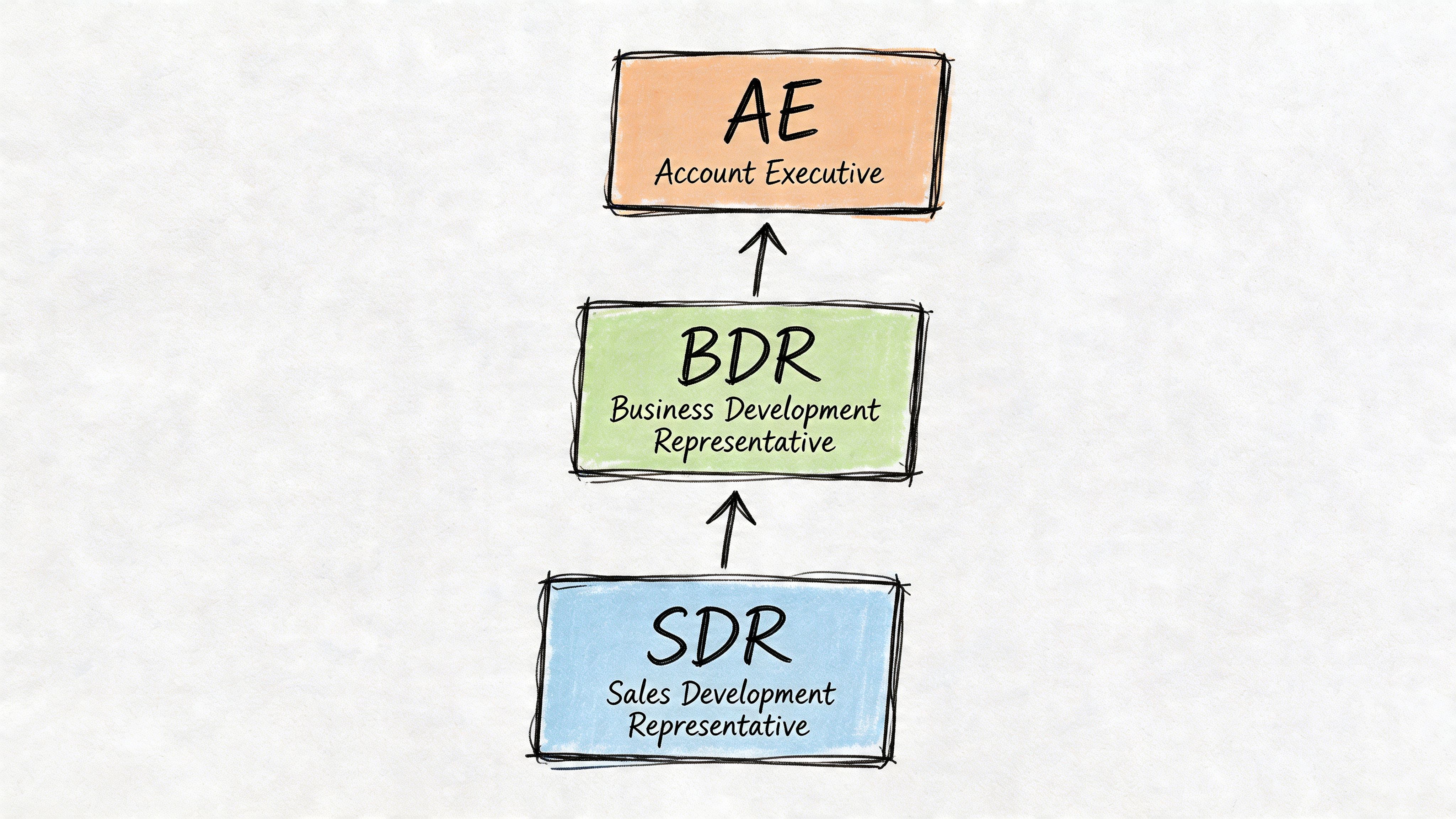
A traditional org chart puts SDRs and BDRs at the front of the revenue engine, feeding qualified meetings into AEs.
How the classic structure works
In a clean specialization model, marketing or inbound channels create demand, SDRs qualify that demand, BDRs prospect into named accounts or new segments, and AEs run the sales cycle. In bigger teams, SDRs and BDRs may report to a sales development leader while AEs report to a closing manager or head of sales.
That looks tidy on paper. In smaller companies, it often creates extra seams.
The more handoffs you add, the more rigor you need around notes, qualification criteria, ownership windows, and CRM discipline. Without that rigor, founders end up paying for specialization while still doing cleanup themselves.
Compensation and ratio planning
The compensation gap between the titles is smaller than often assumed. In 2026, median on-target earnings are $85,000 for SDRs and $83,000 for BDRs, with top performers in either role clearing $130,000 or more, according to Prospéo's 2026 SDR and BDR compensation benchmarks. The same source says many teams target roughly 1 sales development rep for every 2.6 Account Executives.
That tells founders two important things.
First, this usually isn't a "which role pays more" decision. It's a workflow decision. Second, if you don't yet have enough AE capacity or enough lead flow to support a specialized pod, splitting SDR and BDR roles early can create utilization problems.
Career progression in practice
Most reps treat SDR and BDR jobs as entry points into closing roles. The common next step is AE. If you're hiring for growth, that matters because you're not just filling meetings. You're building a bench.
For founders, the practical question is whether you want your first sales development hire to learn one narrow motion or a broader top-of-funnel craft. In small companies, broad exposure is often better training. Reps learn qualification, prospecting, messaging, and handoff judgment in one seat. Later, if they move into a closing role such as account executive, they carry cleaner funnel intuition with them.
A narrow role is easier to coach. A broad role is often better for early-stage learning. Pick based on your management capacity, not theory.
Comparing Inbound and Outbound Outreach Playbooks
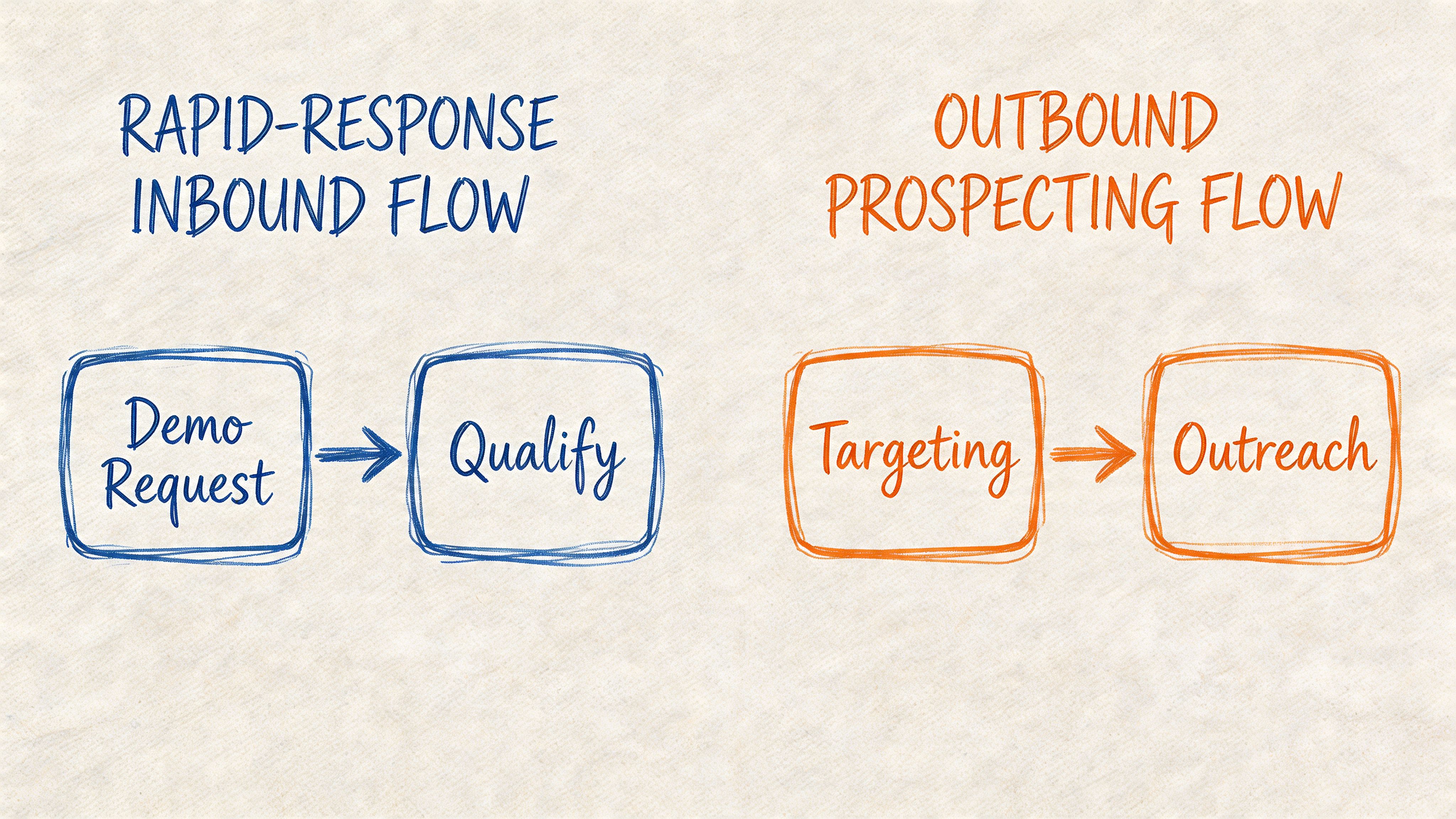
The best way to understand sdr vs bdr is to watch the motions side by side.
The inbound SDR playbook
A prospect submits a demo request. The SDR sees it immediately, checks firmographic fit, reviews the page path or form context, and reaches out fast. The call isn't a full sales cycle. It's a short qualification step.
A good inbound playbook usually looks like this:
Triage the lead based on fit and intent.
Respond quickly by phone or email.
Run focused discovery around need, timing, and stakeholder context.
Book the AE meeting while interest is still live.
Write a useful handoff note so the buyer doesn't have to repeat everything.
Speed beats creativity. A beautifully written reply sent too late is still a bad SDR motion.
The outbound BDR playbook
Now take a target account with no inbound signal. The BDR starts with research. Which team likely owns the pain? What trigger makes the outreach relevant? Which contact is worth the first attempt?
The sequence is usually multi-touch and multi-channel:
Day one might be a personalized email tied to the account's context.
Another touch could be a cold call to test access and gather signal.
A later step might use social engagement or a tighter follow-up angle.
Subsequent steps keep the thread alive without repeating the same generic pitch.
The writing style matters more here. If your outbound messaging sounds templated, it dies. Teams that need help improving outbound messaging usually benefit from stronger copywriting for email before they add more sequence volume.
What works and what doesn't
Inbound works when reps respond fast, qualify tightly, and hand off cleanly. It fails when reps treat every lead the same.
Outbound works when reps narrow the account list, personalize around real context, and stay persistent without becoming repetitive. It fails when managers worship activity totals and ignore whether the account strategy makes sense.
The AI Unification How Stamina Merges SDR and BDR Functions
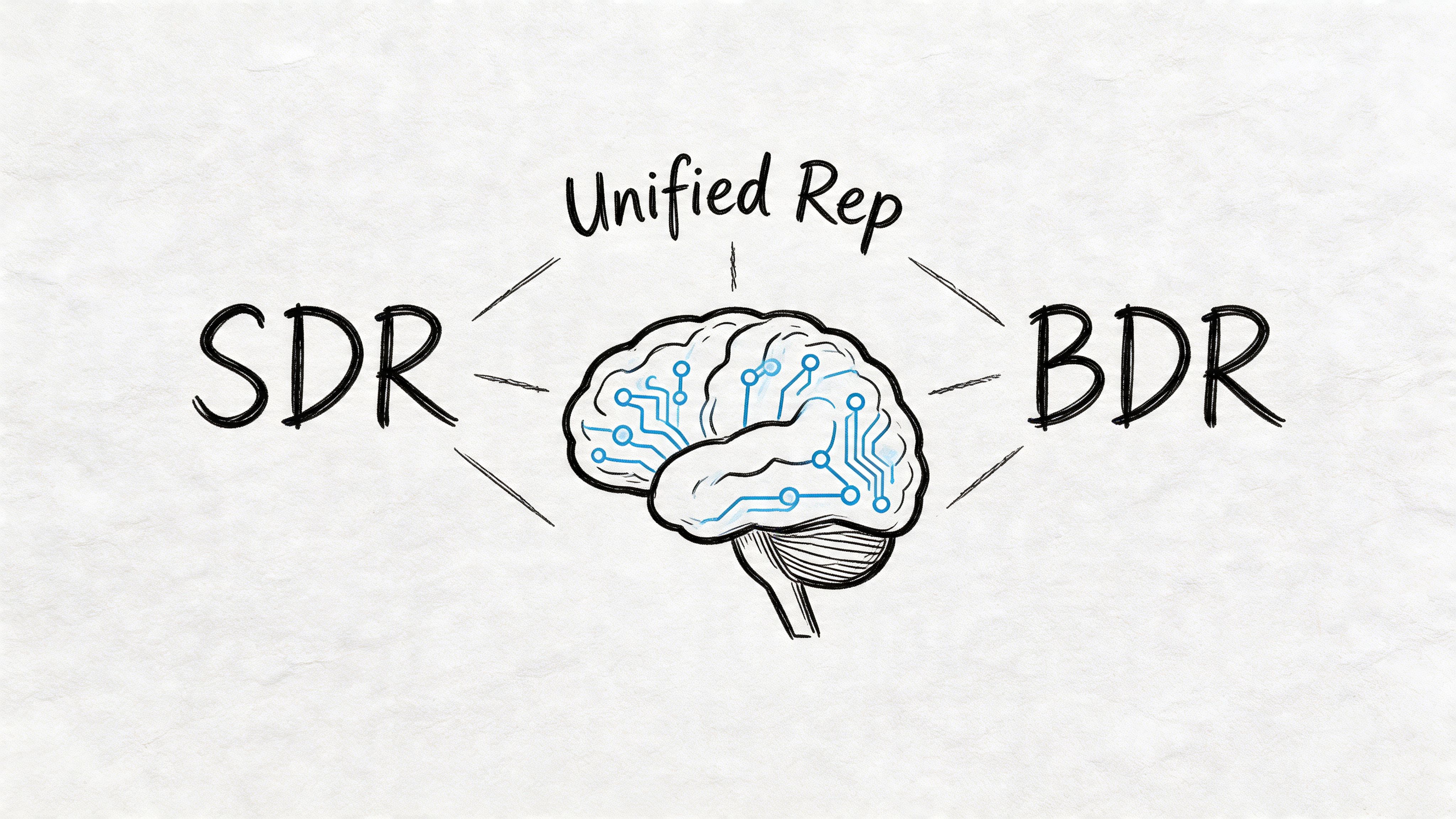
The strongest argument against the old sdr vs bdr split isn't philosophical. It's operational. SMBs need one system that can absorb inbound interest, drive outbound creation, and preserve context across both.
Why unification is now realistic
Historically, asking one rep to do both jobs often meant one of two bad outcomes. Either inbound got delayed while the rep was buried in prospecting, or outbound got neglected because inbound felt more urgent.
AI changes that because it can take over large parts of the repetitive layer. According to ZoomInfo's analysis of AI SDR performance, AI SDRs can provide immediate technical answers in 87 percent of cases versus 15 percent for humans, and reduce lead qualification time from 8.3 days to 2.1 days.
Those aren't small workflow tweaks. They change what one person can realistically oversee.
What the unified model looks like
In a unified setup, the rep still owns judgment. They decide which hand-raisers deserve immediate live follow-up, which accounts belong in outbound plays, and when to escalate to an AE. The platform handles a big share of the execution load.
That means one operating layer can:
Capture and qualify inbound without waiting for a dedicated SDR queue.
Research and sequence outbound accounts without requiring a separate BDR team.
Keep CRM context in one place so handoffs don't lose history.
Support follow-up at scale while preserving personalization.
One example is AI sales assistants, including platforms that combine CRM, sales engagement, and AI SDR capability in the same workflow. In that model, Stamina can support both motions through one system: inbound lead management on the CRM and engagement side, and outbound prospecting through Zara, its built-in AI SDR that identifies, researches, and contacts target prospects.
Where AI helps most, and where it doesn't
AI is strongest at repeatable work. Research assistance. Message drafting. sequence execution. Qualification support. Immediate responses to common technical questions. Data capture.
It is not a replacement for sales judgment. A founder still needs clear qualification rules. An AE still needs useful opportunity context. Someone still has to decide what your ICP is, which accounts matter, and what kind of message your market will answer.
This walkthrough shows the broader shift in action:
Unified sales development works when AI handles the repetitive layer and a human owns prioritization, context, and escalation.
That's why the modern answer for many SMBs isn't "SDR or BDR." It's "one revenue development function, supported by AI, with clean rules for when a human steps in."
When to Specialize A Guide for Growing Teams
The unified model is the right default for many SMBs. It isn't the permanent answer for every company.
Specialization starts to make sense when one motion becomes heavy enough to deserve dedicated ownership, or when the skills diverge enough that one queue is hurting the other.
Good reasons to split the roles
You should seriously consider separate SDR and BDR seats when:
Inbound volume becomes a daily bottleneck and response speed starts slipping because the same rep is juggling prospecting.
Outbound turns strategic and you need deeper account planning, tighter persona mapping, and more deliberate multi-threading.
AE feedback shows handoff problems because one person is moving too fast between very different tasks.
Management depth improves and you can coach two motions properly instead of naming them and hoping.
Bad reasons to split the roles
Don't specialize just because larger companies do. Don't create two titles because recruiters told you that's the "proper" structure. And don't assume separate roles fix poor messaging, weak ICP definition, or messy CRM habits.
Those problems survive any org chart.
A simple founder rule
Start unified if you're still proving repeatability. Split when you can point to a real operational constraint, not a theoretical one.
If inbound is healthy but underworked, fix responsiveness. If pipeline is thin, fix outbound consistency. If both matter and headcount is tight, run one motion across both with AI support and strong process discipline. Then specialize later, once the business has earned the complexity.
If you're building your first sales development motion and want one system for outbound prospecting, inbound follow-up, CRM, and AI SDR support, take a look at Stamina. It's built for SMB teams that need coverage across the funnel without stitching together separate tools and roles too early.

