A lead fills out your demo form on Tuesday morning. Marketing tags it as high intent. Sales doesn't see the campaign context, asks generic qualification questions on Wednesday, and the buyer goes quiet by Friday. Nobody did obviously bad work. The handoff failed.
That's the problem most SMBs are dealing with when they ask what is cross team collaboration. They're not asking for a softer culture. They're asking why work slows down, context disappears, and revenue leaks between teams that are all trying to help.
For revenue teams, cross-team collaboration is less about harmony and more about execution. Marketing, sales, and CRM operations have to move like connected parts of one system. If one part lags, the buyer feels it immediately.
What Cross-Team Collaboration Really Means
Cross-team collaboration is structured coordination across team boundaries to achieve one shared business result. In an SMB revenue org, that usually means marketing creates demand, sales converts it, and CRM workflows keep follow-up, attribution, and ownership clean.

That sounds obvious, but many teams still treat collaboration like a vibe. They say they want alignment, then leave the actual mechanics undefined. Who owns the lead after a webinar? What data must marketing pass to sales? When does CRM automation trigger a task versus an email sequence? If those rules aren't clear, “working together” turns into polite confusion.
It's not the same as ordinary teamwork
A sales team collaborating internally is teamwork. Marketing and sales coordinating qualification rules, lead routing, follow-up expectations, and reporting is cross-team collaboration.
The difference is dependency management. Work crosses an organizational boundary. That introduces handoffs, delays, mismatched definitions, and accountability gaps.
A good way to think about it is a relay race. Inside one team, people can adjust in stride because they use the same language and manager. Across teams, the baton exchange matters more than raw speed. You can have a strong runner in every lane and still lose because the handoff is sloppy.
The real test is execution
Most explanations stop at “shared goals” and “communication.” That's incomplete. A more useful question is whether collaboration improved execution or just increased coordination overhead. Workboard's guidance gets at the core issue: the challenge isn't defining collaboration, it's proving it improved execution rather than adding meetings, and more communication only helps when it reduces ambiguity and handoff friction (cross-functional collaboration guidance from Workboard).
Practical rule: If a new collaboration ritual doesn't make ownership, timing, or decision rights clearer, it's probably just another meeting.
For SMB leaders, that's the shift that matters. Cross-team collaboration isn't “marketing and sales should talk more.” It's “marketing, sales, and CRM should operate through a designed workflow that reduces dropped context and stalled deals.”
If you're trying to break down silos for teams, start there. Not with slogans. With the exact places work changes hands.
The Payoff and The Pitfalls
When cross-team collaboration works, buyers get a smoother experience and your team spends less time cleaning up preventable mistakes. Marketing doesn't just generate names. It passes usable context. Sales doesn't just chase leads. It follows a clear qualification path. CRM doesn't just store data. It enforces the process everyone agreed to.
That changes day-to-day execution in visible ways.
Where the payoff shows up
A common example is campaign-to-pipeline flow. Marketing launches a segment-specific campaign. Sales knows the message, offer, objections, and intended next step before outreach starts. CRM already reflects the source and route. The rep doesn't need to ask, “What did this lead download?” or “Who owns this follow-up?” The work moves faster because context travels with it.
Another benefit is reduced rework. When teams agree upfront on definitions, fewer leads get bounced back with “not qualified,” fewer records sit unassigned, and fewer follow-ups happen twice. You remove the low-value effort that creeps in when teams are technically involved in the same motion but operationally disconnected.
The upside is real, but so is the cost of doing it badly
Collaboration has a trade-off. It can improve speed, but it can also slow teams down when every issue requires group consensus.
That tension matters. Guidance summarized by Mural notes a tradeoff between collaboration and autonomy. Teams may resist sacrificing authority, and collaboration often fails when ownership gets blurred or subject-matter accountability weakens (cross-functional collaboration perspective from Mural).
Collaboration fails fast when everyone can comment but nobody clearly owns the next move.
That's why some initiatives should stay tightly owned by one team. If a sales manager is refining call coaching, sales should own it. If marketing is updating ad creative, marketing should own it. Not every task becomes better because more departments touch it.
When collaboration helps and when it hurts
Use this simple split:
Use cross-team collaboration for shared outcomes. Revenue handoffs, lifecycle stages, lead qualification rules, pipeline definitions, onboarding transitions, and reporting logic all affect more than one team.
Keep work within one team when expertise is concentrated. Script refinement, campaign design, territory planning, and list hygiene can stay local unless they create a downstream dependency.
Escalate only at boundary points. Pull in another team when ownership changes, data changes, or customer experience changes.
A lot of founders overcorrect. They spot silos, then create joint meetings for everything. That usually produces calendar congestion, slower decisions, and frustration from specialists who feel second-guessed.
A better model is selective collaboration with clear edges. If you're tightening revenue operations, practical sales and marketing alignment best practices prove useful. The goal isn't universal involvement. It's clean coordination where one team's output becomes another team's input.
Blueprints for Success Common Collaboration Frameworks
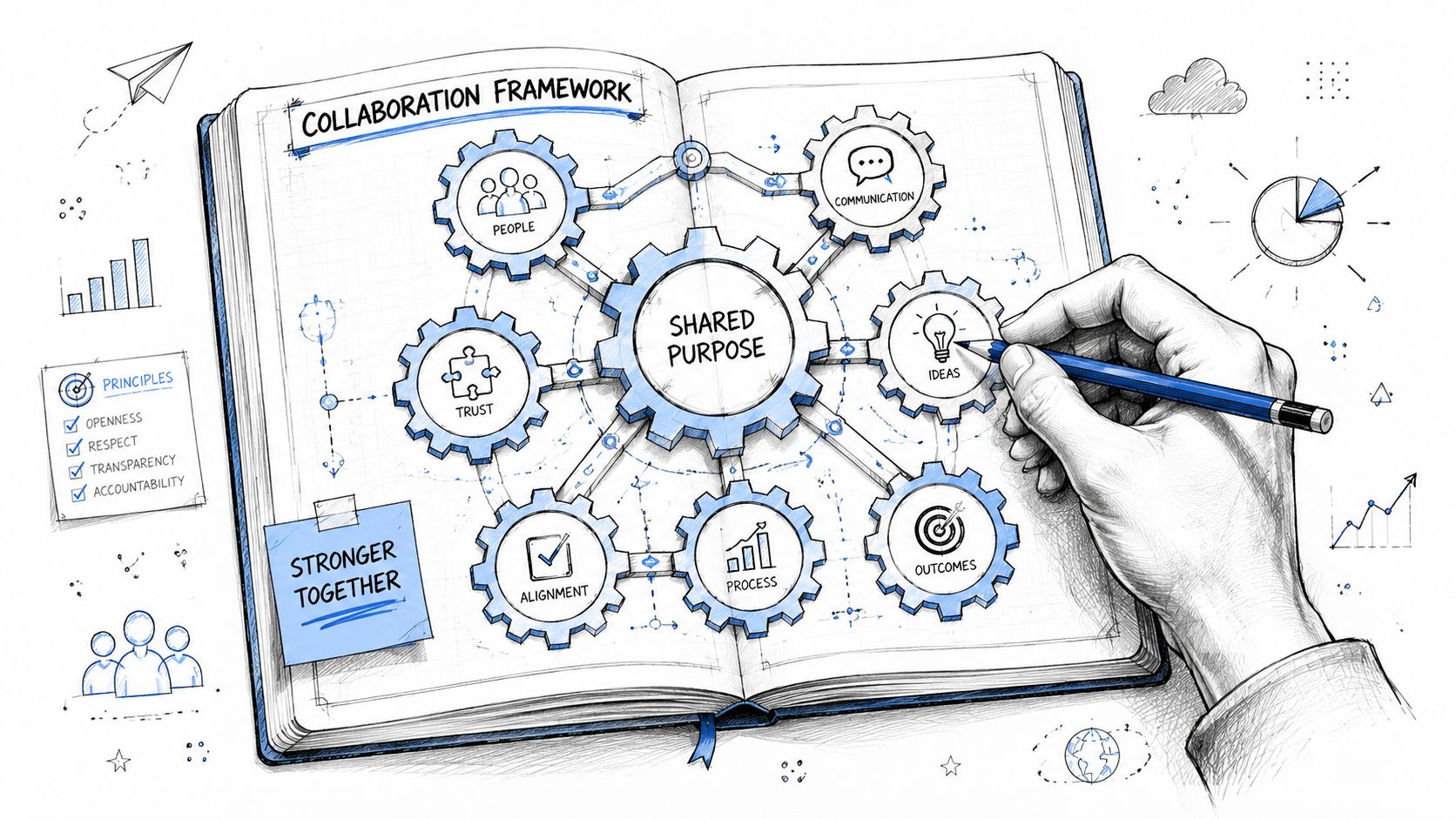
Frameworks matter because collaboration breaks down fastest when people think they've agreed but haven't. A simple structure prevents that. You don't need enterprise bureaucracy. You need a repeatable operating model that an SMB can maintain.
RACI as a role map
RACI is useful because it answers four different questions that teams often mash together:
Responsible: Who does the work
Accountable: Who owns the outcome
Consulted: Who gives input before a decision
Informed: Who needs visibility after the decision
For SMB revenue teams, this is practical, not academic. A lead routing change might have RevOps or CRM admin as Responsible, the head of sales as Accountable, marketing as Consulted, and SDR leadership as Informed. Once that's written down, fewer people step on each other.
Think of RACI as a wiring diagram. It won't generate power by itself, but it shows where signals should go and where they shouldn't.
Pods for shared customer outcomes
A pod is a small cross-functional group formed around one outcome rather than one department. Instead of marketing, sales, and operations each optimizing their own lane, a pod might own “inbound demo conversion” or “reactivation of stale pipeline.”
This works well when a problem spans teams every day. A pod doesn't replace departments. It creates a mini operating unit with shared context and faster decision loops.
Good pod design usually includes:
One clear goal. Not “improve collaboration.” Something concrete like demo scheduling flow or lifecycle conversion hygiene.
A small set of members. Enough functions to solve the problem, not every stakeholder in the company.
One coordinator. Someone keeps work moving, resolves ambiguity, and pushes decisions to closure.
If you need a model for documenting that handoff logic, a practical workflow design approach helps translate broad intentions into tasks, triggers, and owners.
Operating rhythms for recurring work
Not every collaboration problem needs a formal matrix or pod. Sometimes the missing piece is a fixed rhythm.
That means agreeing on the cadence and purpose of recurring coordination:
weekly pipeline review for stuck handoffs
campaign launch review before leads enter routing
monthly cleanup of lifecycle stages and ownership rules
fast escalation path when SLA risk appears
A rhythm works like a maintenance schedule for a machine. You don't wait for the engine to fail. You check the points where failure usually starts.
This walkthrough is a useful visual primer before you formalize your own process:
The best framework is the lightest one that removes ambiguity. If your team can't explain who owns a handoff, who decides, and where progress is visible, you don't have collaboration yet. You have hopeful improvisation.
An Implementation Roadmap for SMBs
Most SMBs shouldn't roll this out company-wide on day one. Start with one revenue motion that already causes friction. Demo requests. Webinar follow-up. Lead recycling. Expansion opportunities. Pick the process that people complain about because that's where the waste is easiest to see.
A practical model is to treat collaboration as an engineered system. Global Integration's guidance is sharp on this point: cross-team collaboration works best when teams define shared outcomes first, then map handoffs, service-level agreements, operating rhythms, and a single shared work tracker. That structure reduces coordination latency and information asymmetry, especially when marketing, sales, and CRM actions are tightly coupled (practical guide to cross-functional team working).
Step 1 Define one shared outcome
Don't begin with “improve alignment.” That's too vague to manage.
Start with a business result both teams can see and influence. For example:
lead-to-meeting flow
meeting attendance quality
recycle and reactivation process
handoff from SDR to AE
no-response follow-up coverage
The shared outcome must be one sentence long. If it takes a paragraph to explain, the work isn't scoped tightly enough.
Step 2 Map the handoffs in plain language
Write the workflow the way work happens, not the way the org chart suggests it should happen.
A basic map should answer:
What triggers the process?
Which team touches it first?
What information must be passed?
What decision changes the owner?
Where does the work stall most often?
This exercise exposes hidden gaps fast. You'll usually find one of three issues: missing data, unclear ownership, or inconsistent timing.
Operator's note: If your team says “it depends” at every transition point, the workflow isn't designed yet.
Step 3 Set SLAs that protect momentum
An SLA is a promise about speed, quality, or completeness at a handoff.
For SMB revenue teams, useful SLAs are often qualitative and operational:
sales acknowledges routed leads within the agreed response window
marketing passes campaign source and offer context with the lead
CRM rules assign ownership immediately when stage criteria are met
stale leads return to nurture under a defined condition
The point isn't bureaucracy. It's making wait time visible before it becomes pipeline loss.
Step 4 Establish one shared tracker
You need one place where everyone can see status, blockers, and owner changes. That could be a CRM pipeline view, a project board, or a shared dashboard. What matters is that teams stop maintaining parallel versions of the truth in chat, spreadsheets, and private notes.
A strong shared tracker includes:
Current owner: Who has the ball right now
Next action: What must happen next
Blocker reason: Why work can't move
Timestamped transition: When ownership changed
Escalation path: Who resolves disputes or delays
Step 5 Create a lightweight operating rhythm
SMBs don't need a committee. They need predictable review points.
One short recurring check-in can focus on boundary issues only: handoff failures, stalled items, SLA misses, and definition changes. Keep internal team discussions inside each function. Use the cross-team rhythm for shared dependencies.
Step 6 Assign one horizontal coordinator
Cross-team work often fails because every manager owns part of the process but nobody owns the flow across the whole thing.
That coordinator doesn't need formal authority over every department. They need the mandate to keep decisions moving, surface risks, and force clarity when ownership gets muddy. In smaller businesses, this may be a founder, RevOps lead, sales manager, or marketing ops generalist.
Step 7 Run a pilot, then standardize
Pilot the system on one motion before expanding it. Document what created delay, what reduced confusion, and which rules people ignored. Then turn that into a short playbook.
Don't try to make the process perfect first. Make it visible first. Visible problems are fixable. Hidden ones become habits.
How to Measure What Matters Collaboration KPIs
If you can't tell whether collaboration improved execution, you're guessing. That's a common sticking point for teams. They feel busier, but they can't prove whether cross-team work is helping or just generating more check-ins.
A practical way to measure collaboration is to treat it as a process variable. Count outlines one usable definition: cross-team collaboration can be measured as the share of cross-team interactions over total possible interactions, using things like joint meetings, shared deliverables, cross-department task assignments, and inter-team communication. The value of that approach is that it turns collaboration into something trackable and benchmarkable, not just cultural language (cross-team collaboration rate definition).
Start with a collaboration rate
This is not the only KPI, but it's a useful starting point because it forces teams to define what counts as meaningful interaction.
For example, in a revenue context, you might include:
a shared campaign-to-sales planning session
a co-owned deliverable such as qualification criteria
a cross-team task assignment tied to a live pipeline motion
documented communication attached to a handoff
That gives you a baseline. Then you compare it with operational outcomes. If collaboration rate rises but handoffs are still messy, your interactions may be frequent but low quality.
Use leading and lagging indicators together
A good dashboard combines behavioral signals with execution outcomes. If you want help structuring that view, this guide on how to build a great team performance dashboard is a useful complement to revenue ops reporting.
Here's a practical KPI set for SMB revenue teams:
KPI | Type | What It Measures | Example for Marketing & Sales |
|---|---|---|---|
Collaboration rate | Leading | Share of meaningful cross-team interactions over total possible interactions | Joint planning, shared deliverables, and task handoffs between campaign launch and sales follow-up |
Handoff cycle time | Leading | How long work sits between one team finishing and the next team acting | Time from lead qualification to first sales action |
Decision latency | Leading | Time required to resolve a cross-team issue or exception | Delay between flagging lead-routing conflict and approving the fix |
Rework volume | Leading | How often work must be redone because requirements or ownership were unclear | Leads sent back to marketing due to missing context |
Share completed without escalation | Leading | How often work moves end-to-end without intervention from managers | Campaign follow-up flows that run without manual dispute |
Pipeline progression quality | Lagging | Whether leads move through stages in a cleaner, more consistent way | Fewer stuck records between MQL-style and sales-owned stages |
Customer journey consistency | Lagging | Whether the buyer experiences fewer disconnects between teams | Messaging from ad to SDR outreach matches intent and offer |
Revenue process visibility | Lagging | Whether leaders can see where friction actually occurs | Shared reporting across marketing source, sales action, and CRM state |
Don't measure activity in isolation
The trap is counting meetings, messages, or comments and calling that success. Activity isn't proof.
What matters is whether communication reduces ambiguity. Standardized request formats and visible ownership at each transition point make that easier to see because they expose where requests are incomplete and where work stalls. For many SMBs, ad hoc reporting then becomes important. You need the ability to inspect odd cases quickly, not just review static dashboards after the fact.
More collaboration is only useful when it produces cleaner handoffs, faster decisions, or less rework.
If your metrics don't connect interaction to execution, you're measuring noise.
From Silos to Synergy The Role of a Unified Platform
Manual collaboration breaks first at the exact points where SMBs start growing. One team works in email. Another updates a spreadsheet. Sales logs notes in the CRM after the fact. Marketing tracks campaign intent elsewhere. Everyone believes they're aligned until a lead gets missed, a stage goes stale, or a customer gets contradictory outreach.
That's why process alone isn't enough. A framework tells people what should happen. A unified platform makes the right process easier to follow and harder to ignore.
Why fragmented tools create fragile coordination
When systems don't share context, teams compensate with meetings, chat messages, and manual reminders. That might hold for a small volume of work, but it doesn't scale well. Every extra handoff becomes another chance for data loss or timing slippage.
A unified platform gives teams:
One operational record. Marketing activity, sales action, and CRM status live in the same working environment.
Automatic handoff enforcement. Triggers, task creation, and ownership changes happen from agreed rules.
Shared visibility. Everyone can see what changed, who owns it, and what's blocked.
Cleaner reporting. Leaders stop reconciling multiple versions of the same pipeline story.
Technology should reinforce the process
A platform isn't a substitute for decision rights, SLA design, or role clarity. It supports them.
If you've already defined the handoff rules, the platform should enforce them. If you've already agreed on collaboration KPIs, the platform should surface them without manual stitching. If your revenue team depends on quick transitions from campaign response to rep action, automation should keep that flow moving.
This is what the operating layer should look like in practice:

For founders evaluating systems, the key question isn't “Does this have lots of features?” It's “Can this serve as the single source of truth for cross-team revenue work?” If the answer is no, your team will keep inventing side channels.
A strong all-in-one business platform reduces that fragility because it connects the work itself, not just the reporting after the work is done.
Start Collaborating Smarter Not Harder
What is cross team collaboration, really? For an SMB, it's a designed operating system for shared outcomes. Not a slogan. Not a standing meeting. Not a vague request for better alignment.
The practical version is straightforward. Define one shared result. Map the handoffs. Clarify ownership. Set the rules for timing and escalation. Track whether those changes reduced friction. Then support the process with technology that keeps context intact.
That's also why many collaboration efforts disappoint. Companies add communication before they add structure. They ask teams to cooperate more without deciding who owns what, when work changes hands, or how success will be measured.
A good first move tomorrow is simple. Pick one revenue handoff that routinely causes confusion and document it on one page. Include trigger, owner, required context, next action, and escalation path. That single exercise often reveals more than another month of status meetings.
If you want the process to stick, document it somewhere teams can effectively use. A guide on building a living internal knowledge base is helpful here because collaboration improves when rules, definitions, and workflows are easy to find and update.
Small businesses don't need perfect collaboration. They need reliable collaboration at the moments that affect pipeline, customer experience, and team speed. Build that first.
If you want one system for marketing, sales, and CRM to work from the same source of truth, take a look at Stamina. It helps growing SMBs connect demand generation, outreach, CRM, and workflow automation so cross-team revenue work is easier to run and easier to measure.

