
End the War Between Sales and Marketing for Good
If your sales team says marketing sends junk leads, and your marketing team says sales ignores good ones, you're dealing with a common SMB problem. It usually starts small. A rep skips follow-up on a form fill because the account doesn't look promising. Marketing sees that same lead sit untouched in the CRM and assumes sales doesn't care. A few months later, both teams are defending their own numbers instead of building pipeline together.
That friction slows growth more than most owners realize. Teams create duplicate workflows, argue over definitions, and make decisions from partial data. Buyers feel it too. They get one message in an email campaign, another on a sales call, and a third after they become a customer. The handoff feels sloppy because it is.
There's a better way to run this. Strong sales and marketing alignment has been associated with 20% annual revenue growth on average, yet only 8% of B2B organizations report being highly aligned, and three-quarters of companies still struggle with alignment-related friction according to a commonly cited benchmark summarized by Elevation Marketing's review of alignment research.
This guide gives you 10 practical sales and marketing alignment best practices that work in real operating environments, not just strategy decks. If you're running a growing SMB, the priority isn't perfection. It's building a shared system your team will implement.
1. Establish Unified Goals and KPIs Across Sales and Marketing
Most alignment problems start with separate scoreboards. Marketing gets praised for lead volume. Sales gets judged on closed revenue. When the company misses target, both teams can point to “success” inside their own department.
That setup guarantees conflict. You need shared KPIs that both teams influence and both teams review together. For most SMBs, that means focusing on qualified pipeline, conversion through lifecycle stages, revenue by source, and lead follow-up compliance instead of vanity metrics in isolation.

A lot of teams also benefit from explicitly defining where marketing ends and sales begins. If your team still mixes up demand generation, qualification, prospecting, and closing, this breakdown of the difference between sales and marketing helps clarify ownership without creating silos.
What shared KPIs should look like
A simple SMB scorecard usually works better than a complicated executive dashboard no one opens. Pick a small set of outcomes and make them visible in one place.
Qualified pipeline created: Track the pipeline both teams helped generate, not just raw leads or individual rep activity.
Lead acceptance and progression: Measure whether sales accepts leads and whether those leads move forward.
Revenue contribution by source: Show what turned into business.
Retention impact: Keep an eye on what happens after the sale, especially when messaging consistency matters.
Independent industry research cited by Demandbase links tight alignment to 36% higher customer retention rates, which is a useful reminder that alignment affects the entire revenue cycle, not only top-of-funnel activity. See Demandbase's discussion of alignment and retention.
Practical rule: If a metric can be “won” by one team while the business still loses, it's the wrong primary KPI.
One good working rhythm is a quarterly goal-setting session, then monthly business reviews against the same scorecard. If you want a lightweight planning structure, the framework behind The OKR Hub on marketing strategy can help organize shared objectives without making the process bureaucratic.
2. Implement a Formal Lead Scoring and Lead Routing Process
A lead handoff shouldn't depend on whether someone noticed a Slack message or remembered to check a spreadsheet. That's where alignment breaks in practice. Marketing believes it delivered interest. Sales sees a queue full of names with no context.
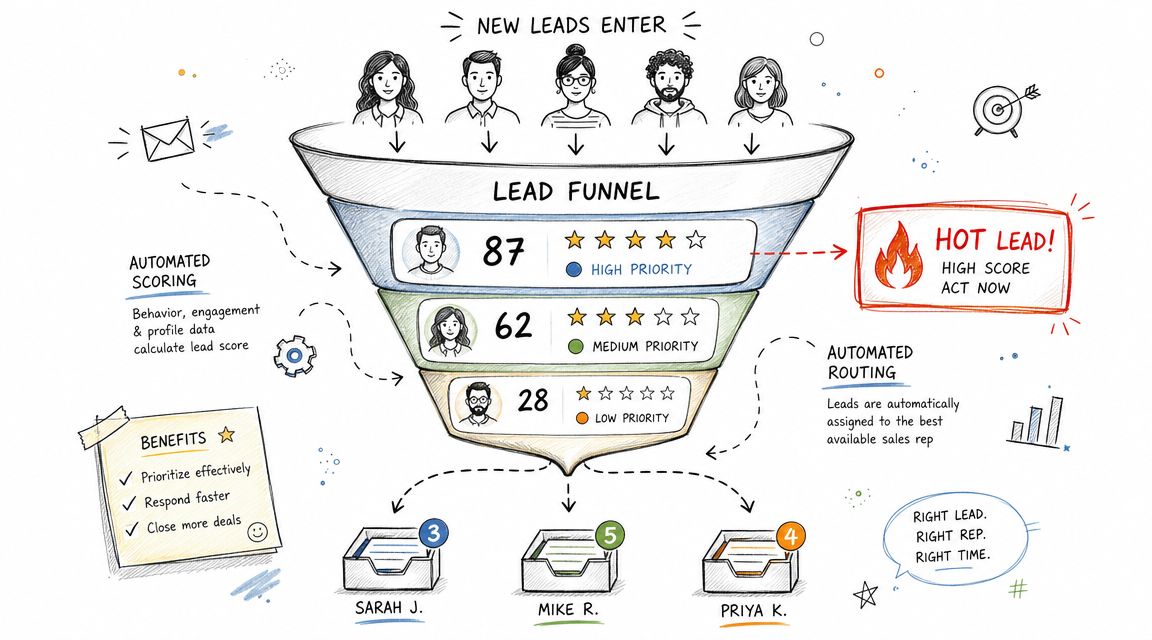
A scoring model fixes part of that problem by ranking intent and fit. Routing fixes the rest by sending the lead to the right owner fast.
To make the process more concrete, start with the lifecycle language your team already uses. This guide on marketing qualified leads is useful because many SMBs discover they've never defined MQL and SQL in a way both teams can follow.
Here's a visual way to think about the flow from inquiry to rep ownership.
Build the model from real buying signals
Don't overengineer your first scoring system. Start with signals your team already trusts. In an SMB environment, that often includes:
Fit signals: Industry, company size, geography, and use case.
Intent signals: Demo requests, pricing-page visits, repeat site sessions, and direct replies.
Negative signals: Student emails, competitors, unsupported markets, or duplicate records.
Routing rules: Territory, account owner, product line, or vertical specialization.
A practical example: if a prospect from your target segment downloads a buying guide, returns to the site, and requests a demo, that lead should not land in a general queue. It should trigger an assignment, a notification, and a next step the rep can execute immediately.
The common mistake is treating scoring as a one-time project. It isn't. Reps need to tell marketing which “high-score” leads were bad fits, and marketing needs closed-loop feedback on what patterns convert.
If your team wants a walkthrough of how automation can support this handoff, this short video is a useful starting point.
3. Create Documented Service Level Agreements Between Sales and Marketing
If there's no written agreement, there is no real alignment. There are only opinions.
A service level agreement forces both teams to stop speaking in generalities. Marketing commits to the quantity and quality of leads it will deliver. Sales commits to what happens next, including how quickly reps respond and how they log outcomes.
Industry guidance from Dock recommends a formal SLA that defines both lead quantity and quality, paired with shared dashboards, CRM-connected reporting, and at least weekly or bi-weekly syncs so both teams manage the same pipeline. See Dock's sales and marketing alignment guide.
Keep the first SLA simple
Your first SLA doesn't need legal language or a giant policy doc. It needs clear expectations that managers can enforce. A good SMB version usually includes:
Lead definition: What counts as qualified enough for a sales review.
Follow-up expectation: Who responds, in what channel, and how the action gets logged.
Disposition options: Accepted, disqualified, nurture, duplicate, or no response.
Recycling rules: How leads go back to marketing when timing is wrong but fit is right.
Sales should never reject a lead with a vague note like “bad fit.” Force a reason code. That's where process improvement starts.
A simple template might read like this in plain English: marketing sends only leads that match agreed fit criteria and show buying intent, sales reviews each new assigned lead promptly, and any non-sales-ready lead gets returned to a nurture path with a clear reason. That may sound basic, but it removes a huge amount of emotional argument.
What doesn't work is an SLA nobody checks. Review it in your recurring pipeline meeting. If marketing misses quality standards, fix targeting. If sales misses follow-up expectations, fix workflow and manager accountability.
4. Adopt Account-Based Marketing for Coordinated Targeting
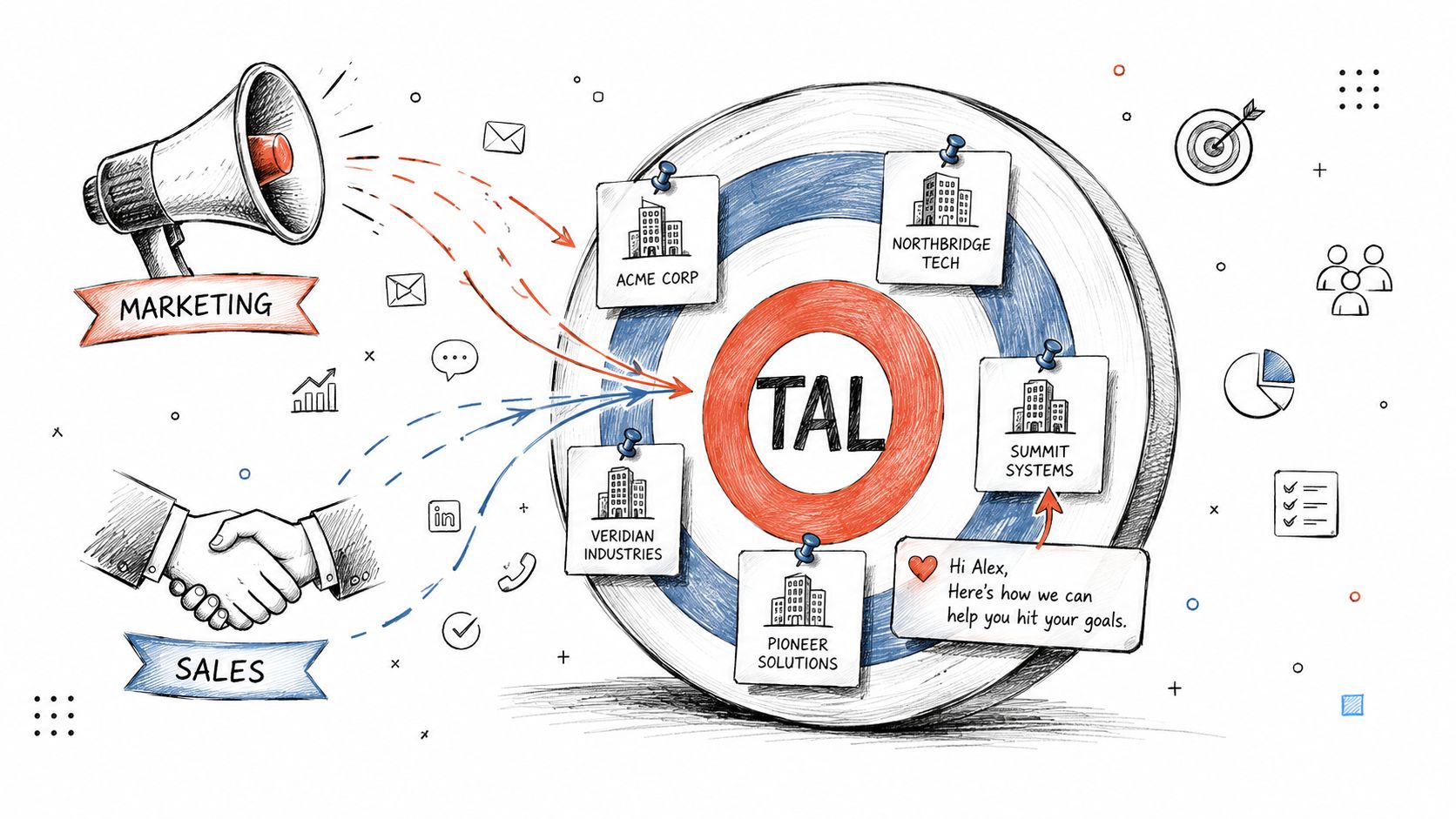
If you sell into a defined set of accounts, broad lead volume can create more noise than value. Account-based marketing works because sales and marketing start with the same target list instead of waiting to align after leads come in.
For SMBs, ABM doesn't require expensive software or a giant ops team. It starts with a shortlist of target accounts for your business. Sales brings market reality. Marketing brings segmentation, messaging, and campaign execution. Both teams work the same list.
What good SMB ABM looks like
A clean ABM motion usually includes named account selection, clear ownership, coordinated outreach, and shared review of account engagement. The mistake is calling something ABM when it's really just regular outbound with a better slide.
A simple pattern that works:
Choose a narrow ICP: Pick the segment where your product already wins.
Build a target account list: Start with accounts reps would be excited to call.
Create account-specific messaging: Tailor emails, landing pages, and sales talk tracks by industry or use case.
Coordinate touches: Marketing warms the account. Sales follows with relevant outreach, not generic cadence spam.
A software company selling to local service businesses might run industry-specific campaigns for multi-location operators while reps follow up with examples tied to scheduling, pipeline visibility, or reactivation workflows. A B2B agency might build a target list of e-commerce brands, then align ad messaging, outbound email, and follow-up content around the same operational pain points.
ABM fails when marketing targets one list and sales chases another. Keep one list, one owner view, and one meeting where account progress gets reviewed together.
5. Implement Closed-Loop Reporting and Win/Loss Analysis
If marketing can't see what happened after handoff, and sales can't see what happened before the first call, you're operating blind from both sides.
Closed-loop reporting fixes that by connecting source, campaign, lead status, opportunity progression, and final outcome in one system. Win/loss analysis adds context that raw reports miss. You learn not just what closed, but why.
Track the buyer journey end to end
At minimum, your CRM should show where the lead came from, what campaigns touched it, who owned follow-up, what stage it reached, and the final disposition. If that data sits across spreadsheets, inboxes, and disconnected tools, you won't get agreement on performance because no one is looking at the same record.
A useful monthly review asks questions like:
Which campaigns produced accepted pipeline?
Where do leads stall after handoff?
Which objections show up repeatedly in lost deals?
Which sources create customers that stay and expand?
The fastest way to improve alignment is to review a handful of recent wins and losses together, with the timeline visible from first touch to close.
Real-world pattern: marketing may think a webinar underperformed because attendance was modest, while sales may know several attendees later entered active pipeline after direct follow-up. The opposite happens too. A campaign may generate lots of form fills but few serious conversations. Closed-loop reporting exposes both truths.
Keep win/loss review disciplined. Don't turn it into a blame session. Pull a small sample, read the notes, listen to calls if you have them, and ask what should change in targeting, messaging, qualification, or process.
6. Develop Collaborative Content and Messaging Strategy
One of the clearest signs of misalignment is when marketing content sounds polished, but sales calls sound like a different company. Prospects notice that immediately.
The fix isn't “more content.” It's shared messaging built from real buyer conversations. Marketing should own structure and consistency. Sales should shape relevance through the objections and questions reps hear every week.
Build content from live deal friction
Start with what prospects ask in discovery calls, demos, and objection handling. Then turn those moments into usable assets. That usually means fewer ebooks and more practical sales enablement.
Useful content types for aligned teams include:
One-pagers: Short summaries by use case, vertical, or persona.
Battle cards: Talking points for competitor comparisons and objection handling.
Follow-up assets: Case examples, product explainers, and implementation overviews reps can send after calls.
Email templates: Reusable but customizable language tied to specific buyer problems.
A good example is a managed IT provider whose marketing team builds a security checklist based on the exact compliance concerns sales hears in calls. Reps use it pre-meeting to create urgency and post-meeting to reinforce the value narrative. Marketing gets an asset tied to real buyer needs. Sales gets something they'll use.
What doesn't work is a content library with no owner, no tags, and no retirement process. If reps can't find the latest deck in seconds, they'll keep using old files. Put content in one searchable library and review usage regularly.
7. Prioritize Lead Nurturing for Pre-Sales-Ready Prospects
Sales shouldn't have to work every lead right now. Marketing shouldn't assume every non-response means a dead prospect. Most SMBs need a middle path, and that's what nurturing provides.
A healthy nurture system protects rep time while keeping future buyers engaged. It also reduces the emotional argument around “bad leads” because the company has somewhere useful to put leads that fit the ICP but aren't ready to talk.
Define recycle and nurture rules clearly
A lead usually falls into nurture for one of three reasons. The timing is off, the contact needs education, or the account is relevant but not yet active. The mistake is treating all three scenarios the same.
Create a few distinct nurture paths:
Early-stage education: For people researching the problem.
Use-case nurture: For leads tied to a specific workflow or pain point.
Re-engagement: For prospects that went dark after a conversation.
Recycled sales leads: For contacts sales reviewed and returned with a clear reason.
Operationally, alignment is key. Sales needs an easy way to send a lead back to marketing with context. Marketing needs automation that respects what sales already learned. If a rep marks a contact “not this quarter” and marketing immediately sends a generic demo push, the system isn't aligned.
A practical SMB example is a home services software vendor that routes “interested but not switching this season” leads into a seasonal nurture sequence with relevant operational tips, then alerts sales when engagement picks up again. That keeps the relationship warm without wasting rep time.
8. Use AI and Predictive Analytics to Identify and Prioritize Opportunities
AI won't fix broken alignment on its own. It will scale whatever process you already have, good or bad. But once your lead stages, CRM ownership, and handoff rules are clean, AI can help both teams focus on the right opportunities faster.
The best use case for SMBs isn't flashy automation. It's prioritization. Which accounts deserve attention now? Which contacts are showing signs of intent? Which next step should happen automatically instead of relying on someone remembering?

If you're evaluating practical applications, this guide on how to use AI for lead generation is a good reference point for combining research, outreach, and qualification in one motion.
Where AI helps most
In aligned teams, AI usually adds value in a few specific places:
Lead prioritization: Surface contacts or accounts with strong fit and fresh activity.
Workflow triggers: Launch follow-up sequences or internal alerts when intent signals appear.
Message assistance: Help reps personalize outreach using known account context.
Nurture coordination: Move leads into the right flow based on behavior, not guesswork.
For teams refining these workflows, this article on optimizing lead nurturing efforts is useful background reading because prioritization and nurture design are closely linked.
Don't ask AI to decide strategy. Ask it to reduce manual sorting, improve timing, and keep both teams working from the same signals.
A common example is using AI to identify website visitors from target accounts, score interest based on pages viewed, and trigger a coordinated play: marketing sends a relevant follow-up while sales gets a prompt with account context. That's valuable because both teams act from one set of signals, not because the model is magical.
9. Build a Shared RevOps Function and Infrastructure
Alignment usually breaks in the gaps between tools. The CRM says one thing. The email platform says another. Sales uses a spreadsheet because they don't trust the dashboard. Marketing exports lists because fields aren't clean. Now everyone is “data-driven,” but nobody agrees on the data.
That's why even a small company benefits from a RevOps owner, even if it's one person wearing multiple hats. Someone has to own field definitions, routing logic, lifecycle stages, dashboards, and system hygiene.
For SMBs trying to reduce tool sprawl, an all-in-one business platform can simplify this work by keeping marketing, sales, and CRM activity in one operating environment instead of stitching together a stack of point solutions.
What RevOps should own
RevOps doesn't replace sales or marketing leadership. It keeps both teams operating from the same infrastructure.
Core responsibilities usually include:
System design: Lifecycle stages, lead statuses, pipeline definitions, and ownership rules.
Data governance: Naming conventions, deduplication, required fields, and reporting standards.
Automation: Routing, notifications, enrichment, task creation, and recycle workflows.
Single source of truth: Dashboards both teams trust enough to use in meetings.
A practical SMB scenario: a founder-led team starts with separate tools for forms, email sends, outbound sequences, and CRM notes. Nothing syncs well, so handoffs rely on manual updates. A RevOps pass usually consolidates fields, removes duplicate statuses, standardizes campaign attribution, and creates one pipeline review dashboard. That doesn't feel glamorous, but it removes a huge amount of daily friction.
What doesn't work is making ops the cleanup crew after every team invents its own process. RevOps needs authority to set rules, not just repair damage.
10. Invest in Sales Enablement and Joint Training Programs
You can't align teams if they never learn together. Shared dashboards and SLAs matter, but behavior changes when sales and marketing hear the same buyer language, review the same examples, and practice the same messaging.
Training is where alignment becomes operational muscle. It's also where many SMBs underinvest because everyone is too busy. Then they pay for it in inconsistent discovery, weak follow-up, and marketing assets nobody uses.
Train on real scenarios, not generic theory
The best joint training sessions are built around current deals, objections, lost opportunities, and new campaigns. Keep them practical and short enough that the team won't resent them.
Strong formats include:
Call review sessions: Listen to real conversations and discuss what helped or hurt.
Campaign launch briefings: Marketing explains the angle, audience, and expected rep follow-up.
Objection workshops: Sales shares what buyers push back on, marketing helps sharpen the response.
New-hire onboarding: Teach customer journey, messaging, CRM rules, and handoff expectations in one program.
A strong example is a SaaS company launching a new offer for agencies. Marketing briefs sales on positioning, the audience, and content assets. Sales then role-plays discovery and follow-up based on that message. Customer success adds onboarding reality so promises stay credible. That kind of joint session prevents three departments from telling three different stories.
If your business is also building repeatable automation around training and execution, this guide on unlock business growth with automation offers a useful operational perspective.
The rule is simple. If marketing creates a message, sales should practice using it. If sales hears a new objection pattern, marketing should update the narrative and assets.
10-Point Sales & Marketing Alignment Comparison
Practice | Implementation Complexity | Resource Requirements | Expected Outcomes | Ideal Use Cases | Key Advantages |
|---|---|---|---|---|---|
Establish Unified Goals and KPIs Across Sales and Marketing | Medium–High (organizational change, cross-team alignment) | Shared analytics, dashboards, leadership time | Aligned incentives, clearer pipeline visibility, coordinated revenue impact | Organizations with siloed metrics or scaling revenue operations | Eliminates conflicting objectives; drives data-driven decisions |
Implement a Formal Lead Scoring and Lead Routing Process | Medium (modeling + automation rules) | Clean integrated data, scoring tools, routing engine | Faster contact times, higher conversion, prioritized outreach | High lead volume environments and SDR teams | Prioritizes best leads; reduces lead waste and manual triage |
Create Documented SLAs Between Sales and Marketing | Medium (negotiation, governance) | Time for agreement, SLA tracking, shared dashboards | Clear responsibilities, improved response times, accountability | Teams facing handoff disputes or unclear expectations | Establishes mutual accountability and dispute framework |
Adopt Account-Based Marketing (ABM) for Coordinated Targeting | High (personalization, coordinated campaigns) | Account research, personalized content, intent tools, dedicated resources | Larger deals, higher win rates, coordinated multi-stakeholder outreach | B2B firms targeting mid-market or enterprise accounts | Focuses resources on high-value accounts; aligns teams on targets |
Implement Closed-Loop Reporting and Win/Loss Analysis | Medium (tracking + qualitative research) | CRM discipline, analytics tools, interview resources | Better attribution, refined messaging, continuous improvement | Organizations needing campaign ROI clarity and iterative learning | Reveals true ROI and surfaces actionable improvements |
Develop Collaborative Content and Messaging Strategy | Medium (workshops, content creation) | Time from sales + marketing, content production and library | Consistent messaging, faster sales cycles, better objection handling | Companies with inconsistent buyer messaging or sales enablement gaps | Ensures content addresses real buyer objections; saves rep time |
Prioritize Lead Nurturing for Pre-Sales-Ready Prospects | Medium (automation + segmentation) | Marketing automation, content library, segmentation capability | Higher conversion over time, fewer premature sales touches | Long buying cycles or high volume of early-stage leads | Maintains engagement and improves timing of sales handoff |
Use AI and Predictive Analytics to Identify and Prioritize Opportunities | High (models, validation, privacy) | Clean data, AI/predictive tools, analytics expertise | Improved prioritization, greater outreach efficiency, objective signals | Large datasets, need for scale and precise prioritization | Scales research; removes bias and surfaces high-intent signals |
Build a Shared RevOps Function and Infrastructure | High (integration, governance, change mgmt) | RevOps hires, platform consolidation, integration work | Single source of truth, improved data quality, faster insights | Growing companies with tool sprawl and cross-team friction | Eliminates silos; centralizes ownership for systems and data |
Invest in Sales Enablement and Joint Training Programs | Medium (curriculum + ongoing coaching) | Training development, LMS/tools, coaching time | Faster rep ramp, higher productivity, improved close rates | Rapid hiring, new products, or inconsistent sales performance | Codifies best practices; improves rep confidence and consistency |
Your Quick-Start Alignment Checklist
Alignment isn't a one-time fix. It's an operating model. The good news is that SMBs don't need a massive reorg to get traction. They need a few clear rules, one shared system, and a management rhythm that keeps both teams honest.
Start with the point of highest friction. For many companies, that's lead handoff. If marketing believes sales ignores leads, and sales believes marketing sends the wrong ones, don't begin with a full funnel transformation project. Begin with a written definition of a qualified lead, a routing rule, and a visible response expectation. That alone changes the tone of the relationship because complaints now point back to a process, not a personality conflict.
The next step is visibility. Build one closed-loop report that follows a lead from source to outcome. Keep it simple. You want both teams looking at the same record and asking the same questions. Which campaigns create accepted pipeline? Which leads stall after assignment? Which objections appear in lost deals? Once those answers are visible, alignment gets easier because debates become specific.
Then create a regular operating cadence. Weekly or bi-weekly syncs work well because they keep problems small. Review pipeline, lead quality, SLA compliance, and feedback from recent wins and losses. Don't treat these meetings as status theatre. They should end with decisions. Tighten routing. Rewrite a nurture flow. Update a one-pager. Fix a field in the CRM. Small operational changes, repeated consistently, do more than grand alignment speeches ever will.
Use this short checklist to get started:
Schedule a joint meeting: Pick one shared KPI both teams can influence.
Draft a simple SLA: Define lead quality, handoff rules, and follow-up expectations.
Build one closed-loop report: Track a campaign from click to close.
Create one recycle workflow: Give sales a clean way to return leads for nurture.
Review one win and one loss together: Use real examples to improve messaging and qualification.
If you want these practices to stick, unified infrastructure helps. Stamina is one option for teams that want marketing, sales, and CRM activity in a connected workflow instead of spread across disconnected tools. That matters because alignment gets much easier when handoffs, reporting, outreach, and customer records live in the same place.
The goal isn't to make sales and marketing identical. They should stay distinct in expertise. The goal is to make them interdependent by design, with shared metrics, shared data, and shared accountability for revenue.
If you want to put these sales and marketing alignment best practices into one operating system, explore Stamina to see how unified marketing, sales, and CRM workflows can reduce handoff friction for a growing SMB.

