Best Time to Send Newsletter: Your 2026 Guide

Discover the best time to send newsletter in 2026. Our guide covers industry benchmarks, testing frameworks, and finding optimal send times for your audience.

0 - Minute Read

The popular advice says to send your newsletter on Tuesday at 10 AM and call it a day. That shortcut is useful as a starting point, but it's incomplete, because the right send time depends on what you want the newsletter to do, who you're sending to, and how your audience behaves.

A newsletter that needs opens doesn't always need the same timing as one that needs clicks or conversions. If your real goal is demo requests, purchases, or downloads, then a benchmark that only optimizes visibility can leave money on the table. For a broader playbook on lifting inbox performance, strategies to improve email opens are useful, but timing is only one lever.

The practical question isn't “What's the single best time to send a newsletter?” It's “What's the best time for this list, this offer, and this KPI?” If you already know the mechanics of scheduling, Stamina's guide on how to schedule an email is a handy reference for the execution side.

Why Sending at Tuesday 10 AM Is Incomplete Advice

Tuesday at 10 AM is a decent default, not a universal answer. It works because weekday mornings often match inbox-checking habits, and send-time optimization still matters most when it reflects the recipient's local time zone. But that only gets you to a starting point. A schedule that fits one list can miss the mark for another, especially when the campaign has a specific business goal.

If you already know how to handle the execution side, Stamina's guide on how to schedule an email covers the mechanics. The harder question is deciding which time deserves to be scheduled in the first place.

Opens are not the same as outcomes

A strong open rate can hide a weak campaign. A newsletter may get read in the morning and still fail to produce clicks, demo requests, purchases, or downloads if the audience is not ready to act. That is why timing should follow the outcome you care about, not only the metric that is easiest to celebrate.

A practical rule helps here.

Practical rule: If the newsletter's job is visibility, favor the inbox-checking habit. If the job is action, look harder at the time when readers actually have mental space to respond.

That distinction matters for growing SMBs, where one send may need to educate, nurture, and convert at the same time. A welcome issue, a product announcement, and a lead-gen newsletter can all go to the same list, but they do not need the same send hour. For broader support on inbox performance, strategies to improve email opens can help, but timing still has to match the job of the email.

Generic timing advice breaks down fast

Once your list includes different roles, devices, and time zones, one fixed send time starts to blur the results. A B2B services firm with buyers reading at desks will behave differently from an ecommerce brand whose subscribers browse after work. Even inside one list, buyer intent can change the right hour.

The better move is simple. Start with the benchmark, then test your own audience until the schedule reflects real behavior. That is how you get past “industry average” and find the timing that supports actual conversions.

Newsletter Timing Benchmarks for 2026

The broad industry pattern is stable enough to use as a starting point. Weekday mornings still lead for newsletter engagement, and many current guides point to Tuesday through Thursday from about 9 AM to 12 PM local time as the safest default. Mailchimp's system summary also places the strongest overall newsletter send time at 10 AM in the recipient's own time zone. Mailchimp's send-time optimization summary

2026 Newsletter Send Time Benchmarks by Goal

Goal

Best Day(s)

Best Time Window (Local Time)

Visibility and opens

Tuesday through Thursday

9 AM to 12 PM

Broad newsletter default

Tuesday

About 10 AM

Clicks and downstream action

Thursday or Friday

5 PM to 8 PM

Use the table as a benchmark, not a rule. Morning sends match inbox-checking habits, while later weekday windows can work better when you want readers to take action after the workday has settled.

Benchmarks are strongest when you treat them as hypotheses

Use these numbers as a testable assumption. If the newsletter is meant to be read quickly and remembered, a mid-morning send is a logical first test. If the campaign needs a form fill, cart visit, or signup, a later send may line up better with the time readers are ready to act.

That same pattern shows up in other channels too. Social timing guides such as Optimal Instagram posting times make the same point, broad best-practice windows help, but audience-specific behavior still decides the final answer.

The benchmark is only useful if it narrows the test, not if it ends it.

If you want to improve early performance, Stamina's guide on how to improve email open rates fits well with timing work, because subject line quality and send time interact.

Four Factors That Influence Your Perfect Send Time
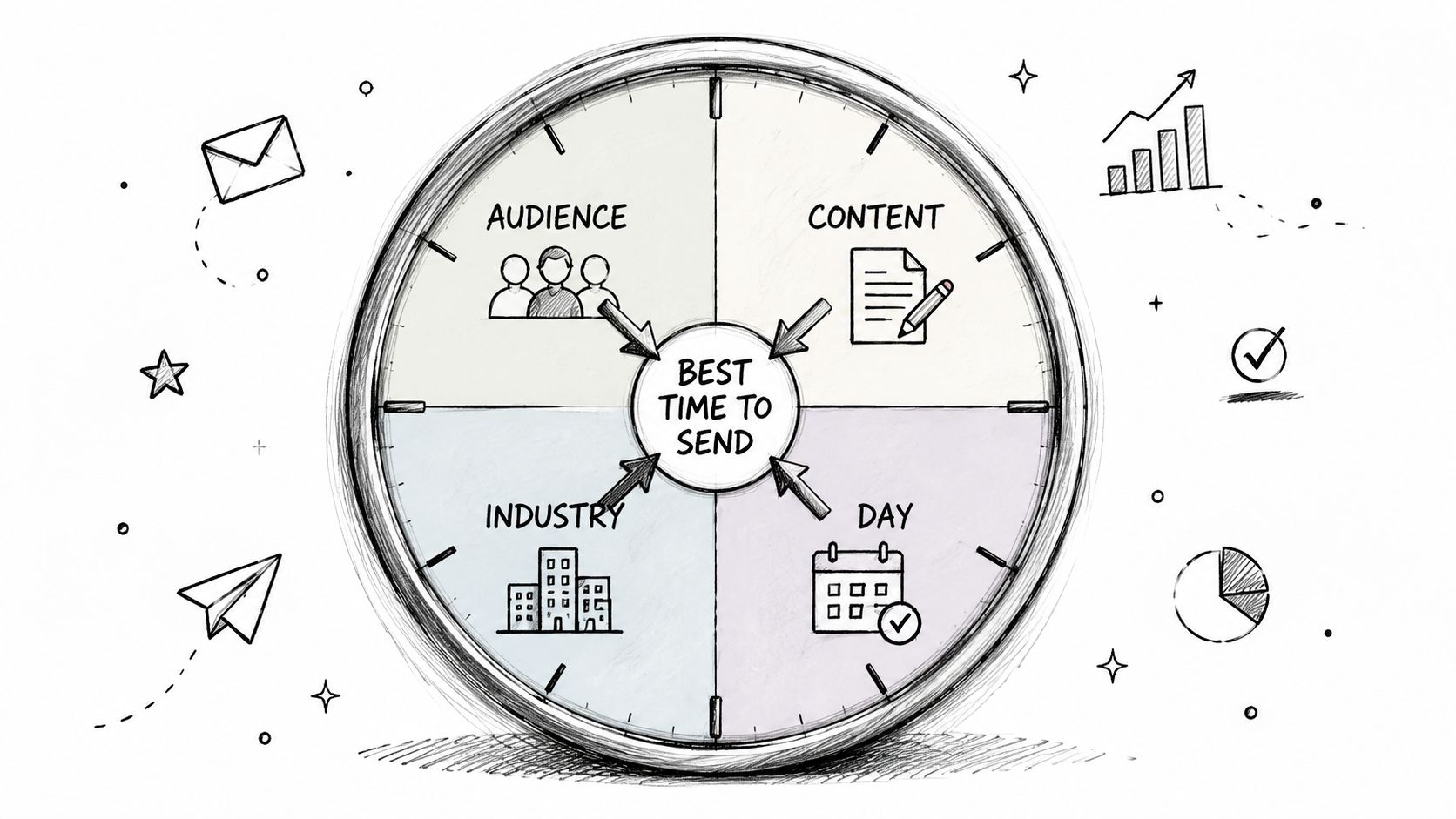
A hand-drawn clock illustration showing factors like audience, content, industry, and day for timing emails.

The best send time changes because people don't read email in a vacuum. They read at different moments, on different devices, for different reasons. MailerLite's 2026 analysis reports that open rates peak between 8 AM and 11 AM, while click rates peak between 8 PM and 9 PM; Beehiiv reports a 34.9% engagement rate for sends between 9 AM and 12 PM and 27.6% for 12 PM to 3 PM. That split is the clearest proof that timing depends on the metric you care about. MailerLite's 2026 send-time analysis

Audience behavior comes first

B2B readers often check email when the day starts, while consumer audiences are more likely to open messages during quieter personal windows. That doesn't mean every B2B list behaves the same way, or every B2C audience waits until evening. It does mean the workday rhythm of your list should influence the first hypothesis you test.

Device use changes the window

Desktop behavior and mobile behavior don't line up perfectly. Morning opens often happen in a fast scan mode, while evening sessions can be slower and more deliberate. If your list tends to read on mobile, the inbox may be opened during a commute, a break, or after dinner, which changes both attention span and click intent.

Time zones can quietly wreck a good schedule

If you send to one global list at one global hour, some readers will receive the message at the wrong local moment. That's why “send by local time” features matter. They preserve the intended experience and keep your morning message from landing in someone's late-night inbox.

Buying cycle and intent decide whether timing helps or hurts

A reader researching options is easier to reach in a morning scan. A reader ready to compare offers or buy often behaves later in the day when they have more time. That's why the same newsletter can perform differently when the goal shifts from education to action.

A key insight is this. Best send time is not a single variable. It's the intersection of who's on the list, what device they use, what time zone they're in, and whether they're ready to buy or just browse.

A Simple Framework for Testing Your Send Times
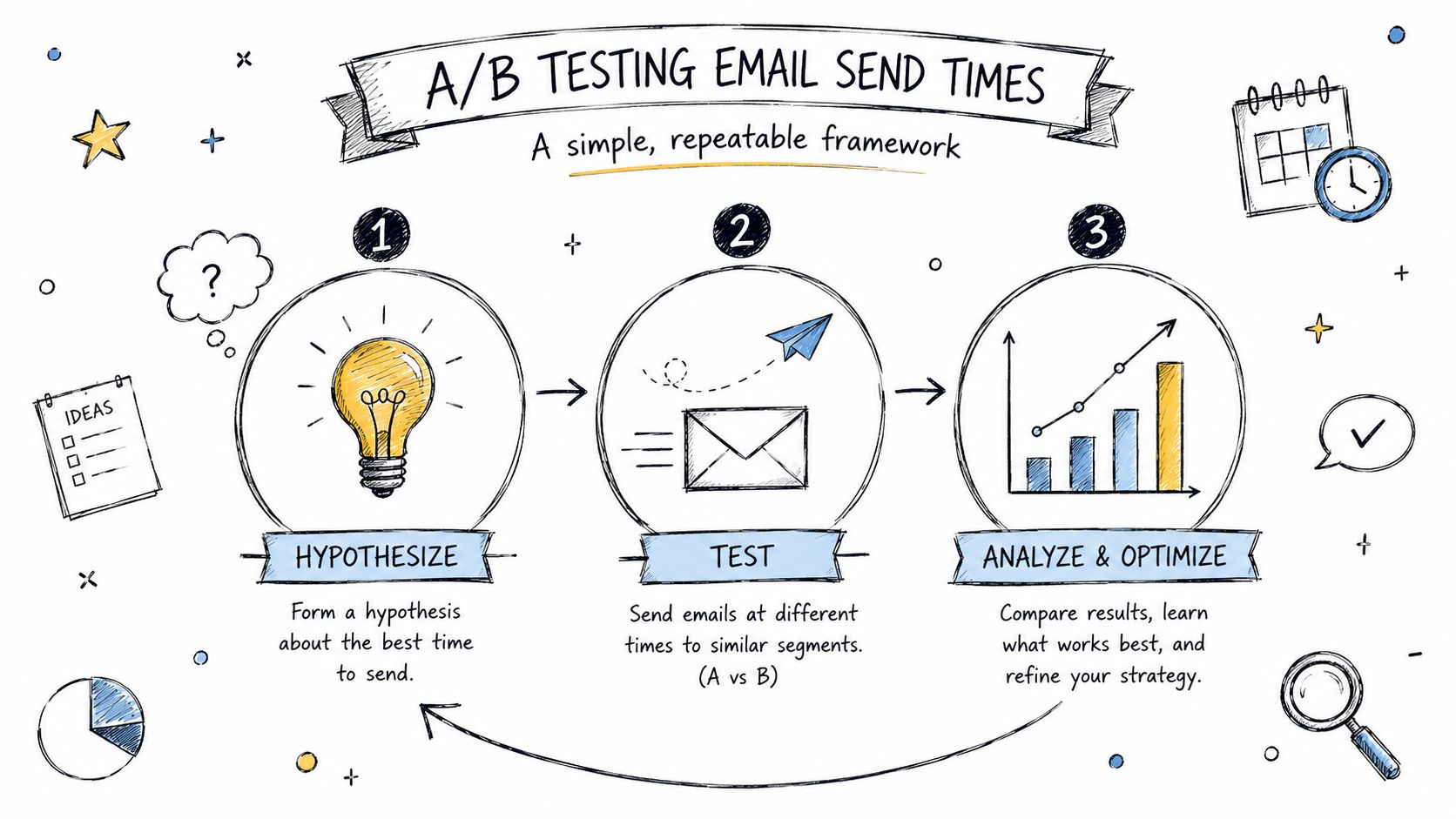
A hand-drawn illustration showing a three-step framework for A/B testing email send times for marketing campaigns.

The cleanest way to find your own best time to send newsletter campaigns is to treat timing like any other performance test. Omnisend's 2026 analysis shows why this matters, because 9–11 AM is strongest for opens, but 7–8 AM performs better for conversions. In other words, a timing win for visibility can be the wrong win for revenue. Omnisend's 2026 timing analysis

Start with one hypothesis, not ten

Pick one primary KPI before you test. If the newsletter is for awareness, judge success by opens and secondary clicks. If the newsletter is meant to generate revenue or leads, prioritize clicks, form submissions, and conversions over opens.

A strong first hypothesis sounds like this, “Tuesday at 10 AM will maximize opens for our B2B list,” or “Thursday evening will produce more clicks for our promotional campaigns.” Keep the first test narrow enough that the result means something.

Test a small, clean split

Don't blast the whole list with multiple timing variations at once. Reserve a portion of the audience for testing and compare a few send windows against each other. The goal is to isolate timing, not to mix it with a subject line change, a sender-name change, or a completely different offer.

Use a consistent creative package across every test. Same subject line. Same content. Same call to action. Only the send time should change.

Track the right metrics

Open rate matters, but it shouldn't be the only readout. Watch clicks, conversions, and unsubscribe behavior so you can tell whether the timing improved business outcomes. If an earlier send gets more opens but fewer clicks, it's not always the winning window.

Useful rule: If opens rise and conversions fall, the schedule may be improving visibility, not business value.

Give the test enough runway

Timing trends can look noisy over one send. Compare several campaigns before making a permanent change. If you see the same window outperform across multiple sends, then you've got a schedule worth adopting.

For more on the email format side of testing, Stamina's guide on HTML vs text email is worth reading alongside timing experiments, because layout can affect how readers behave once the message arrives.

The cleanest outcome is not “we found the perfect hour forever.” It's “we found the best current hour for this list, this offer, and this KPI.” That's a schedule you can defend.

How to Automate Your Optimal Schedule in Stamina

Once you know the winning pattern, the next job is making it repeatable. Stamina's workflows give you the structure to turn a send-time test into an ongoing operating rule instead of a one-off campaign decision. The same logic applies whether you're sending a weekly newsletter or a behavior-based follow-up series.

Build the schedule around behavior, not habit

A modern email stack should let you schedule broadcasts, create A/B timing tests, and send by the recipient's local time zone. That combination matters because a fixed Tuesday-at-10 send can be fine for one segment and wrong for another. Once the data points in one direction, automation keeps the logic consistent.

If you're setting up a nurture path, don't force every contact into the same send hour. Trigger the next email from behavior instead, such as a page visit, a download, or a reply. That way the message lands when interest is highest, which often matters more than the day on the calendar.

A solid automation setup usually includes three layers.

  • Broadcast timing: Use for weekly newsletters and promotional sends.

  • Local-time delivery: Use for mixed or international lists.

  • Behavior-triggered flows: Use when a subscriber's action should decide the next step.

Mailadept's email automation guide is a good companion reference if you want to compare timing logic across different automation models.

Keep the winning window visible inside the platform

If your test says the list prefers morning visibility but evening action, document that inside your campaign process. Your team shouldn't have to rediscover the same answer every month. Put the default in the campaign notes, naming convention, or workflow logic so the schedule is easy to repeat and easy to challenge later.

The point of automation isn't to stop testing. It's to make sure the best-known timing wins are used consistently while the next test runs in the background. That's the difference between ad hoc sending and an actual operating system.

Practical Starting Schedules and Case Studies

If you need a safe default today, use the benchmark that matches the business goal. For most newsletter programs, Tuesday around 10:00 AM local time is a strong visibility choice, while Thursday or Friday between 5:00 PM and 8:00 PM is a better starting point when the priority is click-through or downstream action. That split matches the broader timing pattern in the data. Nutshell's newsletter timing guidance

Three practical defaults

B2B visibility schedule. Use Tuesday or Wednesday at about 10 AM local time when the goal is to get the newsletter read early in the workday.

B2C action schedule. Use Thursday evening when the offer needs more consideration time and the click matters more than the open.

Mixed-audience schedule. Use local-time delivery and compare a morning send against a later weekday send so you can see which segment responds to which window.

Two short case patterns

A consulting firm with a small but valuable list might start with a mid-morning newsletter because its buyers are reading for insight, not impulse. If the newsletter drives demo requests, the team should watch whether the click and form-submit curve improves when the send moves later in the week.

An ecommerce brand usually has a different problem. Its audience may open in the morning but buy later, so the better schedule often focuses on the action window instead of the early open window. If the offer is time-sensitive, the test should prioritize clicks and revenue signals rather than headline opens.

The best newsletter time is the one your list proves it prefers. Start with the benchmark, test one variable at a time, and build the winner into your workflow so the schedule becomes part of your operating rhythm.

If you want a system that helps your team test, automate, and repeat the right send time without rebuilding the process every week, start with Stamina today.

The popular advice says to send your newsletter on Tuesday at 10 AM and call it a day. That shortcut is useful as a starting point, but it's incomplete, because the right send time depends on what you want the newsletter to do, who you're sending to, and how your audience behaves.

A newsletter that needs opens doesn't always need the same timing as one that needs clicks or conversions. If your real goal is demo requests, purchases, or downloads, then a benchmark that only optimizes visibility can leave money on the table. For a broader playbook on lifting inbox performance, strategies to improve email opens are useful, but timing is only one lever.

The practical question isn't “What's the single best time to send a newsletter?” It's “What's the best time for this list, this offer, and this KPI?” If you already know the mechanics of scheduling, Stamina's guide on how to schedule an email is a handy reference for the execution side.

Why Sending at Tuesday 10 AM Is Incomplete Advice

Tuesday at 10 AM is a decent default, not a universal answer. It works because weekday mornings often match inbox-checking habits, and send-time optimization still matters most when it reflects the recipient's local time zone. But that only gets you to a starting point. A schedule that fits one list can miss the mark for another, especially when the campaign has a specific business goal.

If you already know how to handle the execution side, Stamina's guide on how to schedule an email covers the mechanics. The harder question is deciding which time deserves to be scheduled in the first place.

Opens are not the same as outcomes

A strong open rate can hide a weak campaign. A newsletter may get read in the morning and still fail to produce clicks, demo requests, purchases, or downloads if the audience is not ready to act. That is why timing should follow the outcome you care about, not only the metric that is easiest to celebrate.

A practical rule helps here.

Practical rule: If the newsletter's job is visibility, favor the inbox-checking habit. If the job is action, look harder at the time when readers actually have mental space to respond.

That distinction matters for growing SMBs, where one send may need to educate, nurture, and convert at the same time. A welcome issue, a product announcement, and a lead-gen newsletter can all go to the same list, but they do not need the same send hour. For broader support on inbox performance, strategies to improve email opens can help, but timing still has to match the job of the email.

Generic timing advice breaks down fast

Once your list includes different roles, devices, and time zones, one fixed send time starts to blur the results. A B2B services firm with buyers reading at desks will behave differently from an ecommerce brand whose subscribers browse after work. Even inside one list, buyer intent can change the right hour.

The better move is simple. Start with the benchmark, then test your own audience until the schedule reflects real behavior. That is how you get past “industry average” and find the timing that supports actual conversions.

Newsletter Timing Benchmarks for 2026

The broad industry pattern is stable enough to use as a starting point. Weekday mornings still lead for newsletter engagement, and many current guides point to Tuesday through Thursday from about 9 AM to 12 PM local time as the safest default. Mailchimp's system summary also places the strongest overall newsletter send time at 10 AM in the recipient's own time zone. Mailchimp's send-time optimization summary

2026 Newsletter Send Time Benchmarks by Goal

Goal

Best Day(s)

Best Time Window (Local Time)

Visibility and opens

Tuesday through Thursday

9 AM to 12 PM

Broad newsletter default

Tuesday

About 10 AM

Clicks and downstream action

Thursday or Friday

5 PM to 8 PM

Use the table as a benchmark, not a rule. Morning sends match inbox-checking habits, while later weekday windows can work better when you want readers to take action after the workday has settled.

Benchmarks are strongest when you treat them as hypotheses

Use these numbers as a testable assumption. If the newsletter is meant to be read quickly and remembered, a mid-morning send is a logical first test. If the campaign needs a form fill, cart visit, or signup, a later send may line up better with the time readers are ready to act.

That same pattern shows up in other channels too. Social timing guides such as Optimal Instagram posting times make the same point, broad best-practice windows help, but audience-specific behavior still decides the final answer.

The benchmark is only useful if it narrows the test, not if it ends it.

If you want to improve early performance, Stamina's guide on how to improve email open rates fits well with timing work, because subject line quality and send time interact.

Four Factors That Influence Your Perfect Send Time

A hand-drawn clock illustration showing factors like audience, content, industry, and day for timing emails.

The best send time changes because people don't read email in a vacuum. They read at different moments, on different devices, for different reasons. MailerLite's 2026 analysis reports that open rates peak between 8 AM and 11 AM, while click rates peak between 8 PM and 9 PM; Beehiiv reports a 34.9% engagement rate for sends between 9 AM and 12 PM and 27.6% for 12 PM to 3 PM. That split is the clearest proof that timing depends on the metric you care about. MailerLite's 2026 send-time analysis

Audience behavior comes first

B2B readers often check email when the day starts, while consumer audiences are more likely to open messages during quieter personal windows. That doesn't mean every B2B list behaves the same way, or every B2C audience waits until evening. It does mean the workday rhythm of your list should influence the first hypothesis you test.

Device use changes the window

Desktop behavior and mobile behavior don't line up perfectly. Morning opens often happen in a fast scan mode, while evening sessions can be slower and more deliberate. If your list tends to read on mobile, the inbox may be opened during a commute, a break, or after dinner, which changes both attention span and click intent.

Time zones can quietly wreck a good schedule

If you send to one global list at one global hour, some readers will receive the message at the wrong local moment. That's why “send by local time” features matter. They preserve the intended experience and keep your morning message from landing in someone's late-night inbox.

Buying cycle and intent decide whether timing helps or hurts

A reader researching options is easier to reach in a morning scan. A reader ready to compare offers or buy often behaves later in the day when they have more time. That's why the same newsletter can perform differently when the goal shifts from education to action.

A key insight is this. Best send time is not a single variable. It's the intersection of who's on the list, what device they use, what time zone they're in, and whether they're ready to buy or just browse.

A Simple Framework for Testing Your Send Times

A hand-drawn illustration showing a three-step framework for A/B testing email send times for marketing campaigns.

The cleanest way to find your own best time to send newsletter campaigns is to treat timing like any other performance test. Omnisend's 2026 analysis shows why this matters, because 9–11 AM is strongest for opens, but 7–8 AM performs better for conversions. In other words, a timing win for visibility can be the wrong win for revenue. Omnisend's 2026 timing analysis

Start with one hypothesis, not ten

Pick one primary KPI before you test. If the newsletter is for awareness, judge success by opens and secondary clicks. If the newsletter is meant to generate revenue or leads, prioritize clicks, form submissions, and conversions over opens.

A strong first hypothesis sounds like this, “Tuesday at 10 AM will maximize opens for our B2B list,” or “Thursday evening will produce more clicks for our promotional campaigns.” Keep the first test narrow enough that the result means something.

Test a small, clean split

Don't blast the whole list with multiple timing variations at once. Reserve a portion of the audience for testing and compare a few send windows against each other. The goal is to isolate timing, not to mix it with a subject line change, a sender-name change, or a completely different offer.

Use a consistent creative package across every test. Same subject line. Same content. Same call to action. Only the send time should change.

Track the right metrics

Open rate matters, but it shouldn't be the only readout. Watch clicks, conversions, and unsubscribe behavior so you can tell whether the timing improved business outcomes. If an earlier send gets more opens but fewer clicks, it's not always the winning window.

Useful rule: If opens rise and conversions fall, the schedule may be improving visibility, not business value.

Give the test enough runway

Timing trends can look noisy over one send. Compare several campaigns before making a permanent change. If you see the same window outperform across multiple sends, then you've got a schedule worth adopting.

For more on the email format side of testing, Stamina's guide on HTML vs text email is worth reading alongside timing experiments, because layout can affect how readers behave once the message arrives.

The cleanest outcome is not “we found the perfect hour forever.” It's “we found the best current hour for this list, this offer, and this KPI.” That's a schedule you can defend.

How to Automate Your Optimal Schedule in Stamina

Once you know the winning pattern, the next job is making it repeatable. Stamina's workflows give you the structure to turn a send-time test into an ongoing operating rule instead of a one-off campaign decision. The same logic applies whether you're sending a weekly newsletter or a behavior-based follow-up series.

Build the schedule around behavior, not habit

A modern email stack should let you schedule broadcasts, create A/B timing tests, and send by the recipient's local time zone. That combination matters because a fixed Tuesday-at-10 send can be fine for one segment and wrong for another. Once the data points in one direction, automation keeps the logic consistent.

If you're setting up a nurture path, don't force every contact into the same send hour. Trigger the next email from behavior instead, such as a page visit, a download, or a reply. That way the message lands when interest is highest, which often matters more than the day on the calendar.

A solid automation setup usually includes three layers.

  • Broadcast timing: Use for weekly newsletters and promotional sends.

  • Local-time delivery: Use for mixed or international lists.

  • Behavior-triggered flows: Use when a subscriber's action should decide the next step.

Mailadept's email automation guide is a good companion reference if you want to compare timing logic across different automation models.

Keep the winning window visible inside the platform

If your test says the list prefers morning visibility but evening action, document that inside your campaign process. Your team shouldn't have to rediscover the same answer every month. Put the default in the campaign notes, naming convention, or workflow logic so the schedule is easy to repeat and easy to challenge later.

The point of automation isn't to stop testing. It's to make sure the best-known timing wins are used consistently while the next test runs in the background. That's the difference between ad hoc sending and an actual operating system.

Practical Starting Schedules and Case Studies

If you need a safe default today, use the benchmark that matches the business goal. For most newsletter programs, Tuesday around 10:00 AM local time is a strong visibility choice, while Thursday or Friday between 5:00 PM and 8:00 PM is a better starting point when the priority is click-through or downstream action. That split matches the broader timing pattern in the data. Nutshell's newsletter timing guidance

Three practical defaults

B2B visibility schedule. Use Tuesday or Wednesday at about 10 AM local time when the goal is to get the newsletter read early in the workday.

B2C action schedule. Use Thursday evening when the offer needs more consideration time and the click matters more than the open.

Mixed-audience schedule. Use local-time delivery and compare a morning send against a later weekday send so you can see which segment responds to which window.

Two short case patterns

A consulting firm with a small but valuable list might start with a mid-morning newsletter because its buyers are reading for insight, not impulse. If the newsletter drives demo requests, the team should watch whether the click and form-submit curve improves when the send moves later in the week.

An ecommerce brand usually has a different problem. Its audience may open in the morning but buy later, so the better schedule often focuses on the action window instead of the early open window. If the offer is time-sensitive, the test should prioritize clicks and revenue signals rather than headline opens.

The best newsletter time is the one your list proves it prefers. Start with the benchmark, test one variable at a time, and build the winner into your workflow so the schedule becomes part of your operating rhythm.

If you want a system that helps your team test, automate, and repeat the right send time without rebuilding the process every week, start with Stamina today.

Share this article

Share this article

Send a shareable link to your team or anyone who might find it useful.

Send a shareable link to your team or anyone who might find it useful.

Copy link

Copied

Share directly to

Table of contents

Give Your Business the Stamina it needs to Thrive

PRODUCT

COMPANY

RESOURCES

© 2026 Stamina Software Technologies Inc. All rights reserved.

PRODUCT

COMPANY

RESOURCES

© 2026 Stamina Software Technologies Inc. All rights reserved.

PRODUCT

COMPANY

RESOURCES

© 2026 Stamina Software Technologies Inc. All rights reserved.