
Your LinkedIn profile can look polished, your inbox can stay busy, and your pipeline can still feel oddly thin. That's the moment most sales leaders start asking the right question, not “How do I get a higher LinkedIn score?” but “What does this number tell me about the health of my selling process?”
The Social Selling Index score is useful only when it points to real behavior, real conversations, and real opportunities. Used well, it becomes a diagnostic for whether your LinkedIn activity is creating trust, targeting the right buyers, and opening the kind of replies that turn into meetings.
What the Social Selling Index Score Really Measures
A lot of reps see their SSI number and stop there. They know it's out of 100, they know it lives somewhere inside LinkedIn, but they're not sure whether it means they're building a real sales motion or just maintaining a decent-looking profile.
The Social Selling Index score was introduced by LinkedIn in 2014 as part of Sales Navigator, and it's available to every LinkedIn member for free. It's built from four equally weighted pillars, establishing your professional brand, finding the right people, engaging with insights, and building relationships, each worth up to 25 points (LinkedIn's SSI overview). That structure matters because it turns social selling into a measurable set of behaviors, not a fuzzy reputation score.
Think of it as a sales health gauge for your LinkedIn activity. If the score rises, it can mean you're doing more of the right things. If it stalls, the platform is usually telling you that one part of your process is underpowered.
For a deeper view of how sales data, signals, and buyer intent fit together, see sales intelligence fundamentals.
What the score does not tell you is just as important. It doesn't prove revenue, and it doesn't replace your CRM, pipeline reviews, or outbound metrics. It's a diagnostic, not a finish line.
Decoding the Four Pillars of Your SSI Score
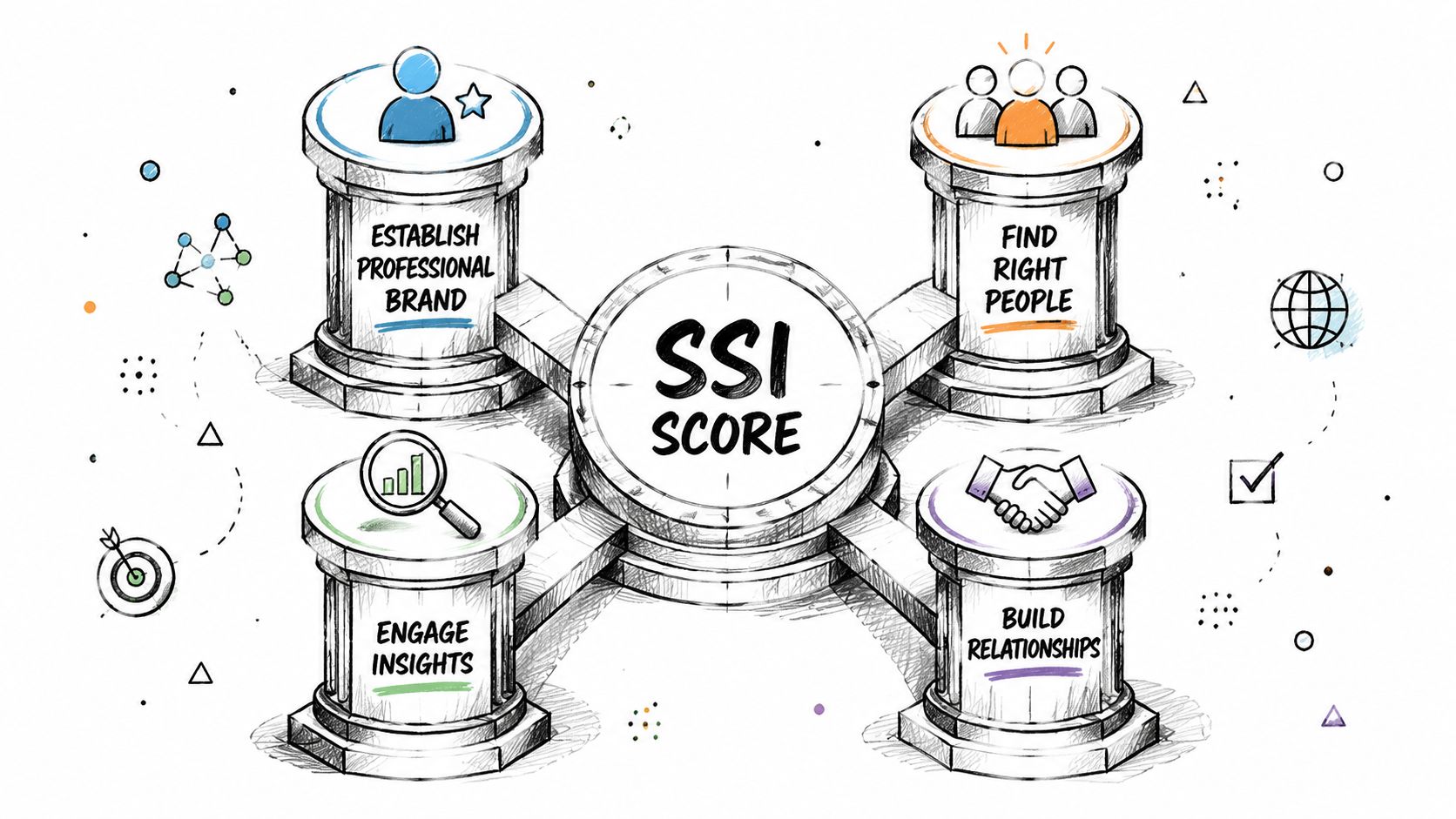
The easiest way to read SSI is as a 4-part report card. Each pillar points to a different part of your LinkedIn selling motion, and together they show whether you are building visibility, targeting the right people, and staying relevant to buyers.
Establishing your professional brand
This pillar reflects how complete and credible your profile looks. In practice, it covers the profile elements a buyer checks before deciding whether to trust a message, a comment, or a connection request.
According to Jill Konrath's SSI breakdown (Jill Konrath's SSI breakdown), a typical salesperson scores 10.4 points here. That suggests many profiles are present, but not strong enough to create real confidence. Managers see the same pattern often, a profile can look fine on the surface and still fail to answer the buyer's first question, “Why should I pay attention?”
Finding the right people
This pillar is about prospecting quality, not raw volume. LinkedIn is looking at whether you are identifying the right accounts and the right decision-makers instead of scrolling without a clear ICP or connecting without a reason.
The same practitioner breakdown puts this pillar at 5.0 points on average. That is low enough to show that targeting is often less disciplined than sellers assume. If this score is weak, your outreach may be broad, but it is not sharp enough to support a focused pipeline.
Engaging with insights
This pillar shows whether you are participating in the market or just watching it. It covers sharing useful content, commenting with perspective, and staying present in conversations that matter to your buyers.
The practitioner benchmark places this area at only 1.6 points, the weakest of the four. Most users do not underperform because they never post. They underperform because they do not engage thoroughly enough or consistently enough to stay visible where buyers are paying attention.
Building relationships
This pillar looks at how well you turn visibility into a durable network. It rewards connection quality and the habit of nurturing relationships over time.
A typical breakdown shows 5.8 points here. That makes sense, because relationship-building is the part most reps say they value and the part they often execute least systematically. If you want a sharper message framework for this pillar, keep writing a message for LinkedIn connection requests nearby.
The Four Pillars of the Social Selling Index | What It Measures | Key Action to Improve |
|---|---|---|
Establish your professional brand | Profile credibility and visible expertise | Tighten the headline, summary, and featured proof |
Find the right people | Prospecting precision and decision-maker targeting | Use focused searches and save relevant accounts |
Engage with insights | Meaningful participation around relevant content | Comment with substance, not just reactions |
Build relationships | Network quality and ongoing connection strength | Personalize outreach and follow up with relevance |
What Is a Good Social Selling Index Score
A “good” SSI score is the one that helps a sales leader make a decision. If the number does not tell you whether buyer-facing behavior is healthy, consistent, and tied to pipeline, it is just a number on a profile.
Published practitioner guides commonly place the typical SSI cluster around 40 to 50, while 75+ is often treated as top-tier performance. Breakcold's SSI guide also notes that the score updates daily, which makes it useful as a short feedback loop for testing whether new posting, commenting, or connection habits result in changed behavior. That gives teams a practical way to sort the score into bands instead of treating every point as equally meaningful.
A simple working interpretation looks like this:
Below 40: Your LinkedIn motion needs attention. The score usually points to weak habits in one or more pillars, especially targeting, engagement, or profile quality.
40 to 50: You're in the common range. Activity exists, but it may not be disciplined enough to produce consistent buyer conversations.
75 and above: You're in the top tier of platform behavior. That does not guarantee pipeline, but it usually means your LinkedIn habits are strong enough to support it.
Practical rule: judge SSI against your own trend line first, then against your peer set. A rising score is more useful than a static “good” score.
The score is most helpful when you use it as a diagnostic tool, not a trophy. If a rep's SSI is improving, but connection acceptance, reply rate, booked meetings, or qualified opportunities are flat, the issue is likely somewhere else in the selling motion, such as message quality, offer relevance, or list quality. If the score is low but replies are strong, the gap may be LinkedIn discipline rather than market fit.
That difference matters for day-to-day selling. A founder-led team may need a different activity mix than an SDR or account executive, and mastering X engagement can matter more or less depending on where the rep spends time and which channels drive conversations. The same score can mean different things across roles, so the essential benchmark is whether the behavior behind it supports pipeline. For reps who are sourcing contacts, a resource like how to find someone's email on LinkedIn can be part of that workflow when social selling needs to turn into direct outreach.
Why Your SSI Score Matters for Sales Performance
The biggest mistake is treating SSI as a vanity badge. A high score can look impressive, but the score only matters if it helps you understand whether your selling behaviors are healthy enough to generate pipeline.
Independent guidance recommends comparing SSI movement against connection acceptance, reply rate, booked meetings, and qualified opportunities instead of treating SSI itself as the goal (Knowzilla's SSI diagnostic guide). That's the right mental model for sales leaders, because those are the outcomes that matter.
A rising SSI score can be a leading indicator, but only when it reflects the right actions. If engagement improves, you'd expect more useful replies. If relationship-building gets stronger, you'd expect more meetings from warm contacts. If the score rises but those metrics don't move, then the activity is probably performative rather than productive.
The practical value is in diagnosis. If one rep's SSI is climbing while booked meetings stay flat, the issue may be message quality or offer relevance. If another rep's score is low but reply rate is healthy, the problem might be LinkedIn discipline rather than market fit.
SSI is not the goal, pipeline is. The score only earns its place when it helps you spot which buyer-facing behavior needs work.
This is why sales managers should review the number in the same cadence as other leading indicators. Used that way, SSI stops being a vanity metric and becomes a simple way to inspect whether the team's LinkedIn habits are supporting revenue.
Actionable Strategies to Improve Your SSI Score
The fastest way to improve SSI is to stop trying to “do more LinkedIn” and start improving the specific pillar that's dragging you down. That usually means being more selective with your time, not merely being more active.
For time-constrained SMB teams, meaningful comments, personalized connection requests, and engaging with prospects' content can be more efficient than broad content production when the goal is to move SSI and build buyer relationships (Cleverly's SSI guidance). That trade-off matters. Posting is visible, but it's not always the highest-yield use of time.
Start with the easiest credibility gains
If your profile is thin, fix that before you worry about daily activity. The professional brand pillar responds to visible completeness, so the work is straightforward, even if it takes focus.
Tighten the headline so it says who you help and what problem you solve. Then review the summary, featured section, and recent experience so a prospect can understand your relevance in a few seconds. If someone lands on your profile and still has to guess what you do, the brand pillar is doing too little work.
Narrow your targeting
The “find the right people” pillar improves when your prospecting is specific. That means searching for the right titles, industries, and account types instead of building a large but unfocused network.
Use LinkedIn search with intent. Save the accounts you want to sell into, review the people who matter inside them, and treat every connection as a targeting decision, not a numbers game.
Engage like a buyer, not a broadcaster
The weak spot for many teams is the engagement pillar. They read posts, maybe click like, and then move on without adding anything useful.
A better pattern is to comment on posts from buyers, partners, and relevant operators with a point of view, a question, or a concrete observation. If you want a useful outside reference for what real engagement looks like in another channel, the framework in mastering X engagement is a helpful parallel, especially because it treats engagement as a relationship signal, not a vanity signal.
Make relationship-building more deliberate
Here, connection requests, follow-ups, and light nurturing come together. If a prospect accepts your invite and then hears nothing useful, the relationship pillar won't strengthen for long.
For a simple workflow, pair every strong connection with a follow-up that reflects something specific about their role, content, or recent activity. If you need a practical reference point for finding contact details after LinkedIn research, use how to find someone's email on LinkedIn as a companion step rather than treating LinkedIn as the entire workflow.
A useful operating rule is this, don't optimize for output volume until your message quality and targeting are already consistent. That sequence usually produces cleaner SSI gains and better conversations.
Turning a Higher SSI Score into Qualified Pipeline
A higher SSI score is only valuable when it helps create a cleaner path to meetings. The best teams use it as a monthly diagnostic, then compare the results with reply rate, booked meetings, and qualified opportunities so they know whether the behavior change mattered.
The workflow is simple. Review the pillar that's lagging, pick one behavior to improve, and watch whether the sales outcome changes in the same direction. If engagement improves but replies don't, the message may still be off. If relationship-building improves and meetings rise, the score is pointing to a real pipeline lever.
That's also where process matters more than motivation. For a repeatable operating model, see sales pipeline management best practices and use SSI as one input inside that wider system, not as a standalone goal.
The practical win is consistency. Teams that connect LinkedIn behavior to pipeline review stop chasing the score for its own sake and start using it to identify what's producing conversations.
A CTA for Stamina.

