
Your team is probably doing a lot of work that looks productive and produces very little. Reps are sending sequences, updating the CRM, chasing follow-ups, and sitting through pipeline reviews. Meanwhile, the best-fit buyers slip past you because nobody caught the signals early enough.
That isn't a hustle problem. It's an information problem.
Most SMBs don't need more activity. They need better judgment about who to contact, what to say, and when to say it. That's what sales intelligence fixes. It turns scattered prospect data into usable context for outreach, prioritization, and timing.
If you've been asking what is sales intelligence, start here: it's not just a contact database and it's not another dashboard your team ignores. It's the operating layer that helps revenue teams stop guessing. If you want a useful companion read on adjacent concepts, Orbit AI insights on lead intelligence are worth reviewing because they connect data quality to better targeting. And if you're trying to make this operational with automation, using AI in sales workflows is where many teams start.
Selling Smarter Not Just Harder
A familiar pattern shows up in almost every SMB sales org. Marketing hands over a batch of leads. SDRs work them in order. AEs cherry-pick the ones with recognizable company names. Everyone says they need more pipeline.
They usually don't. They need better signal quality.
Sales intelligence means using data to understand target markets and potential customers well enough to increase revenue. It has become a major software category because teams are done relying on stale CRM records and vague assumptions. The global sales intelligence market was valued at USD 3.31 billion in 2024 and is projected to reach approximately USD 9.02 billion by 2034, expanding at a 10.54% CAGR, according to Precedence Research's sales intelligence market analysis.
Sales teams don't fail because they lack effort. They fail because they aim effort at the wrong accounts.
That matters because sales intelligence isn't just “more data.” It's a shift from broad prospecting to informed prospecting. You stop treating every account the same. You stop writing generic cold emails. You stop calling people who have no reason to care right now.
What changes when you use it properly
Three things happen fast:
Prioritization gets sharper because reps can focus on accounts that match your ideal customer profile and show actual buying motion.
Messaging gets tighter because outreach reflects company context, role context, and recent activity.
Timing improves because you can act on signals instead of waiting for a form fill.
SMBs need this more than enterprise teams do. Large companies can waste budget on bloated stacks and still survive. Small teams can't. If you have five reps, every dead-end sequence hurts.
The practical definition that matters
If you want the plain-English answer to what is sales intelligence, here it is:
It's the system you use to decide where your team should spend attention.
That's the only definition worth caring about.
How Sales Intelligence Actually Works
Traditional CRM data gives you a flat picture. Name, title, company, email. That's useful, but it's thin. It tells you who someone is. It doesn't tell you whether they're likely to care, whether they're active in-market, or why your rep should reach out now.
Sales intelligence builds depth. Think of it as turning a 2D contact record into a 3D account model.

The layers that make a record useful
Sales intelligence software collects and analyzes data about prospects and markets to help sellers formulate effective strategies. It creates structured signals from CRM activity, firmographics, technographics, and buyer intent data. The category is forecasted to grow from USD 4.99 billion in 2026 to USD 9.15 billion by 2031, according to Mordor Intelligence's sales intelligence market report.
Here's the stack that matters most.
Layer | What it tells you | Example use |
|---|---|---|
Firmographics | What the company looks like | Segment by industry, company size, region, or business model |
Technographics | What systems they use | Target teams using tools your product integrates with or replaces |
Intent data | What they may be researching | Prioritize accounts showing interest in relevant topics |
Behavioral signals | What they're doing with your brand | Trigger outreach after pricing-page visits, webinar attendance, or repeat site activity |
This is why a generic list from a data vendor isn't enough. A list gives you names. Intelligence gives you context plus timing.
Why disconnected data fails
Most SMBs already have pieces of this data. The problem is that those pieces sit in different places. HubSpot has form fills. LinkedIn has role changes. Google Analytics shows traffic patterns. Your inbox has the replies. Your reps have notes in spreadsheets they'll never clean up.
That setup kills usability.
If your team has to jump between tools to understand one account, they won't do it consistently. They'll default to shortcuts. They'll sort by recency, not relevance. They'll contact whoever looks easiest.
Practical rule: if a rep needs five tabs open to decide whether to send one email, your sales intelligence process is broken.
The output should be a decision
Good sales intelligence doesn't dump more information on reps. It narrows the choice set. It should help answer:
Is this account a fit?
Is something happening now?
Who should we contact first?
What message has the best chance of landing?
That's also why articles on uncovering intelligent customer data are useful. They show how raw inputs become usable customer context. For teams applying this in practice, lead scoring automation for SMB workflows is where this stops being theory and starts affecting rep behavior.
Key Data Sources and Buying Signals
Sales intelligence runs on two inputs. First, the data you already own. Second, the external signals that tell you what's changing around an account.
Many teams ignore the second part. That's why they react late.
Where the data comes from
Internal sources are easier to access and usually underused. External sources add market awareness and timing. You need both.
Data Type | Example Source | What It Signals |
|---|---|---|
CRM activity | Opportunity history, call notes, stage changes | Prior engagement, objections, and account momentum |
Website behavior | Pricing page visits, demo page views, repeat sessions | Rising interest, evaluation behavior, content fit |
Email engagement | Opens, replies, clicks, sequence progression | Message resonance and possible readiness to continue |
Product usage | Trial activity, feature exploration, login frequency | Expansion potential or buying readiness |
LinkedIn activity | Job changes, company posts, new hires | Org change, team growth, shifting priorities |
Company news | Funding, product launches, leadership announcements | Budget shifts, urgency, strategic initiatives |
Tech stack data | Installed tools, integrations, category overlap | Compatibility, displacement opportunity, maturity |
Social and community signals | Public complaints, tool comparisons, peer discussions | Dissatisfaction, urgency, competitor weakness |
If your team is still manually hunting contacts after spotting a good account, it helps to tighten that workflow. A guide on finding someone's email efficiently becomes useful once the signal is there and the next step is action.
What a buying signal actually looks like
A buying signal isn't magic. It's just evidence that an account may be more ready, more relevant, or more reachable than it was yesterday.
Good examples include:
A leadership change such as a new VP of Sales or Head of Marketing. New leaders often reevaluate tools, process, and vendors.
A sudden spike in high-intent page views from one account. If multiple people from the same company are checking pricing or integration pages, don't wait for a form fill.
New hiring activity in functions your product supports. Hiring usually points to investment, growth, or process pressure.
Public pain expression in social posts, review sites, or communities. If someone is frustrated with a competitor, timing matters.
How to read signals without overcomplicating them
A single signal can be noise. A cluster of signals is useful.
If one person opens an email, don't celebrate. If the account recently hired a relevant leader, visited product pages, and is using a tool you replace, that's different. Now you have a reason to prioritize and a reason to personalize.
Watch for signal combinations, not isolated events. Reps waste time when they treat weak activity like real demand.
The discipline here is simple. Don't ask, “Did anything happen?” Ask, “Did enough happen to justify attention now?”
The Benefits for Modern Sales and Marketing Teams
The payoff from sales intelligence isn't abstract. It shows up in how fast teams move, how well they coordinate, and how often they spend time on accounts that can close.
That matters even more for SMBs because wasted effort compounds quickly. One weak list can consume a week. One bad handoff between marketing and sales can stall pipeline that should have advanced.

Shorter cycles come from better fit and better routing
When teams integrate firmographic, technographic, and intent data, they cut waste at the top of the funnel. Technical evidence shows this reduces sales cycle duration by 28% and increases win rates by 15% by automatically aligning high-potential prospects with the right reps, according to ZoomInfo's overview of sales intelligence.
That doesn't happen because dashboards look prettier. It happens because the wrong rep stops chasing the wrong account at the wrong time.
If a healthcare prospect lands with a rep who knows healthcare workflows, uses relevant proof points, and reaches out when the account is showing intent, conversations move faster. If that same prospect gets a generic sequence from a rep who doesn't understand the space, the deal drags or dies.
Marketing stops throwing leads over the wall
Sales intelligence helps marketing do more than fill forms. It helps marketing qualify attention.
A team with unified signals can build tighter segments, trigger better nurture paths, and pass leads with context instead of just contact details. Sales gets more than “someone downloaded a guide.” Sales gets “this director from a fit account returned to the pricing page after engaging with content tied to a current initiative.”
That's why sales and marketing alignment best practices matter so much here. Better intelligence gives both teams a shared definition of what deserves follow-up.
Personalization becomes practical instead of performative
Most “personalized” outreach isn't personalized. It's mail merge with a company name inserted.
Real personalization uses relevance. It reflects what the account does, what tools it uses, what role the buyer holds, and what triggered the conversation. That makes messages sharper and follow-ups easier because the rep has a reason for the outreach beyond “checking in.”
Teams don't need more templates. They need better context before the first touch.
Leadership gets cleaner decisions
This is the underrated benefit. Better sales intelligence improves planning, not just outreach.
Leaders can see which segments show traction, which channels produce fit accounts, and where reps are burning time. That leads to better territory choices, cleaner pipeline reviews, and fewer debates built on opinion.
For SMBs, that's a serious advantage. When headcount is limited, strategic clarity matters as much as rep productivity.
Sales Intelligence in Action with Practical Use Cases
Definitions don't change behavior. Workflows do. The easiest way to understand what is sales intelligence is to look at what your team does differently on a normal Tuesday.
Prospecting that starts with relevance
A rep opens the day and sees an account that just became interesting. The company added leadership in a function your product serves. Their site traffic shows deeper activity around solution pages. Their tech stack suggests your offer fits naturally.
Without sales intelligence, that rep would never know. The account would sit untouched until somebody downloaded a form, if they ever did.
With sales intelligence, the outreach can start with a clear angle: acknowledgment of the team change, relevance to their likely priorities, and a message tied to the tools they already use. That's not clever copywriting. That's context doing the heavy lifting.
Prioritization based on today, not last month
Most SMB teams still work lead queues in the order records entered the system. That's lazy process design.
A better approach ranks accounts by current buying motion. One lead may have entered the CRM two weeks ago and done nothing since. Another may have joined yesterday but already shown stronger engagement across site visits, email clicks, and account-level activity.
The second account deserves the rep's attention first.
That's where lead qualification becomes operational, not philosophical. If you want another perspective on tightening that process, Recepta.ai's lead qualification insights help clarify how teams decide what deserves active follow-up.
Personalized engagement that changes with behavior
Marketing can use the same signals to stop blasting static nurture tracks.
Say a prospect from a target account spends time on an integration page, then returns to pricing. A generic nurture campaign would still send the next scheduled educational email. A smarter system changes course. It pushes content about implementation, ROI framing, or use cases tied to that buyer's role.
The difference is subtle but important. The campaign responds to the account's behavior instead of forcing the account through a fixed sequence.
Competitive displacement at the right moment
One of the most useful applications is competitor monitoring.
Let's say prospects in your category are voicing frustration in communities, comments, or public posts. Maybe they're complaining about support delays, pricing changes, or missing functionality. Many organizations notice that too late. By the time they build a campaign, the moment is gone.
A team using sales intelligence can flag those accounts early, identify decision-makers, and launch outreach when dissatisfaction is active rather than historical.
The best time to approach a competitor's customer is when the pain is current and visible, not three months later in a recycled campaign.
Daily execution gets less chaotic
The actual win is boring, and that's why it matters. Reps spend less time researching from scratch. Managers spend less time arguing over priority. Marketers spend less time guessing which segment needs what message.
The work gets cleaner.
That's the practical answer to what is sales intelligence. It's the system behind better daily choices across prospecting, qualification, outreach, and timing.
Your Implementation Checklist for SMBs
SMBs usually break this by trying to assemble a “modern stack” one tool at a time. First a CRM. Then a sequencing tool. Then a data provider. Then a chatbot. Then a scoring app. Then an AI writer. Six months later, nobody trusts the data and half the fields are wrong.
That's not a stack. It's a maintenance burden.
Start with one source of truth
Recent data shows 78% of sales leaders struggle to move from static data to predictive next best action insights, but integrating behavioral signals with generative AI can accelerate deal closures by 22% compared to traditional data-only approaches, according to Outreach's discussion of sales intelligence.
That gap is exactly where SMBs get stuck. They collect data but can't turn it into action because their systems don't share context cleanly.
Use this checklist instead:
Define your minimum useful data set
Don't begin with everything. Begin with the fields and signals that affect action. Company type, role, recent engagement, tech fit, and account activity usually matter more than a giant database full of trivia.Clean the systems you already have
If your CRM is full of duplicates, bad ownership, and dead records, fix that first. Dirty inputs create bad prioritization.Pick signal categories before tools
Decide which signals should trigger attention. Website activity, job changes, email replies, trial behavior, and competitor dissatisfaction are common starting points.Tie every signal to a next step
A signal is worthless without an action. If someone returns to pricing, who follows up? If a target account hires a new leader, what sequence starts? Write that down.
Keep the workflow simple enough to survive adoption
A workable sales intelligence process should fit into the habits your team already has. Reps won't maintain something fragile.
Use a simple operating model:
One place to view account context
One clear owner for follow-up
One set of trigger-based plays
One feedback loop into CRM and marketing
If your team can't explain the workflow in a few sentences, it's too complex.
Here's a closer look at what a unified workflow can look like in practice:
Use a unified platform instead of stitching tools forever
Most SMBs should be more opinionated. Stop buying point solutions that create more sync problems.
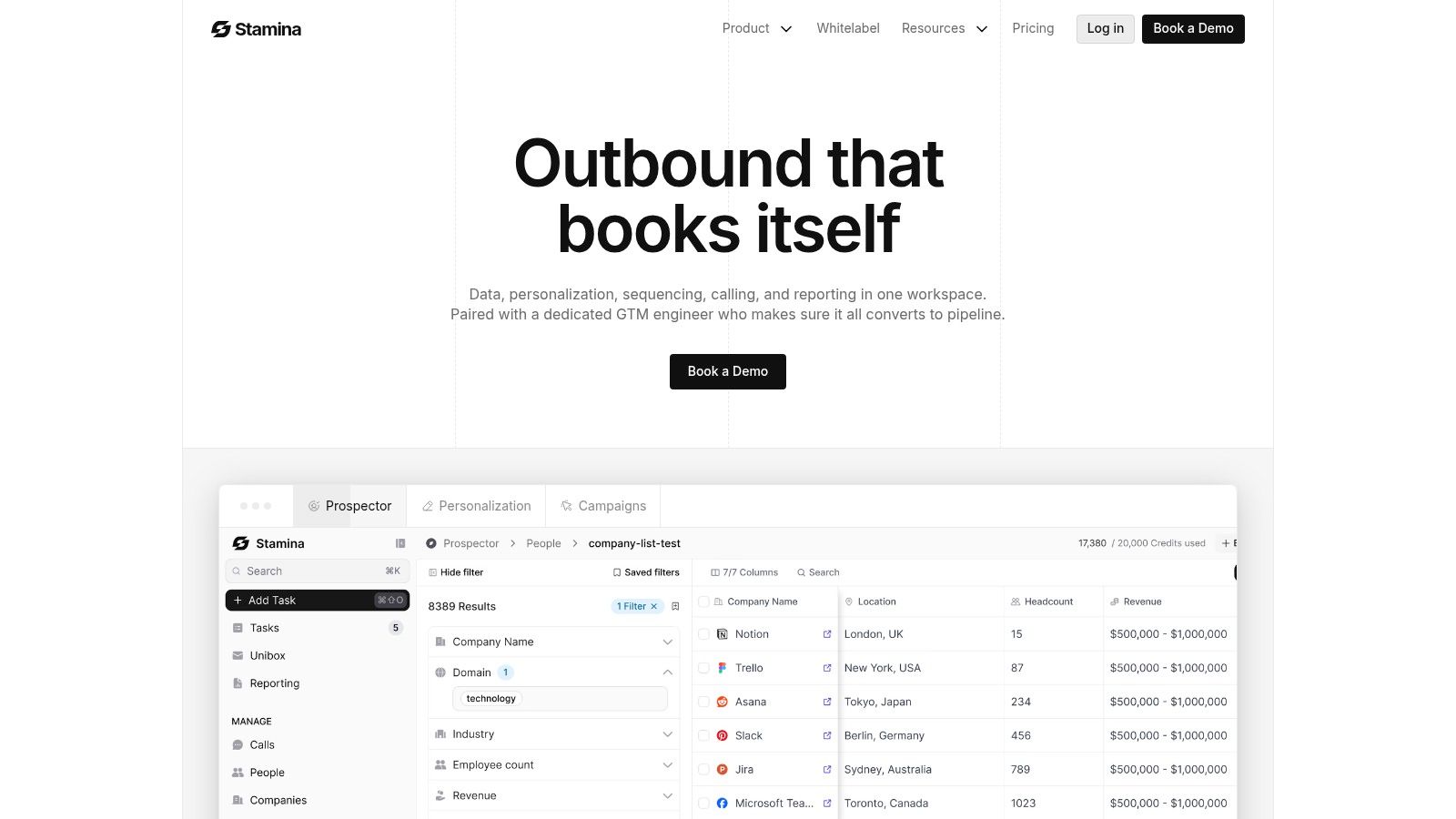
A unified platform works better because the CRM, sales engagement, marketing workflows, and AI layer operate from the same record. That gives your team a real single source of truth. It also makes next-best-action guidance usable because the behavioral signals, contact history, and outreach tools live together instead of across disconnected apps.
That's the practical advantage of a platform like Stamina for growing teams. You're not asking SMB operators to build enterprise-grade infrastructure. You're giving them one connected environment with CRM, engagement, and AI SDR capabilities in the same place. That's how smaller teams adopt sales intelligence without hiring RevOps specialists just to keep integrations alive.
Bottom line: if your tools fragment the customer record, your team will fragment the customer experience.
Sales intelligence should reduce complexity. If your setup adds it, rebuild the setup.
If you're done juggling disconnected tools and want one place to run outreach, manage pipeline, unify customer data, and activate AI-driven sales workflows, take a look at Stamina. It gives SMB teams a practical way to use sales intelligence without stitching together a bloated stack.

