What is Demand Generation in Marketing? An SMB Guide

Learn what is demand generation in marketing and how it differs from lead gen. Get a practical framework for SMBs to build pipeline and drive real revenue.

0 - Minute Read

Most advice about demand generation is backwards. It tells SMBs to crank out more leads, tighten the form, buy more traffic, and hand a bigger list to sales.

That sounds efficient. It often does the opposite.

You can hit your MQL target and still miss revenue. Sales gets a pile of names, most aren't ready, follow-up quality drops, and marketing ends up defending activity instead of proving business impact. That's the trap. If you're asking what is demand generation in marketing, start there. It isn't a prettier label for lead gen. It's the discipline of creating market interest before buyers raise their hands, then turning that interest into pipeline you can trace to revenue.

For an SMB, this matters even more. You don't have room for disconnected campaigns, fuzzy attribution, or a sales team wasting time on contacts who downloaded one asset and disappeared. You need a system that builds trust with future buyers, captures intent when it appears, and helps sales focus on accounts with real buying potential.

Why "Generating Leads" Is Costing You Revenue

A lot of B2B teams still run marketing like a call center scoreboard. More leads means better performance. More form fills means more momentum. More MQLs means marketing is doing its job.

That logic breaks fast when revenue stalls.

The core problem with many traditional programs is that they fail to translate marketing activity into measurable business growth and instead measure success through MQLs rather than revenue, as noted in Pedowitz Group's discussion of revenue marketing versus demand generation. SMBs feel this harder than larger companies because every campaign has to justify itself. If spend goes up and closed revenue doesn't follow, leadership stops trusting the function.

The MQL trap

This is typically what happens:

  • Marketing optimizes for volume: Teams choose channels and offers that generate names quickly.

  • Sales inherits weak intent: Reps chase contacts who showed curiosity, not buying readiness.

  • Reporting gets distorted: Dashboards look busy, but pipeline quality stays soft.

  • Budget gets harder to defend: Leadership asks a simple question. Which campaigns produced revenue?

This is the revenue attribution disconnect. Marketing can show clicks, downloads, opens, and lead counts. Leadership wants to know what those activities produced in pipeline and closed business.

Practical rule: If a marketing metric can't help you explain pipeline or revenue, it belongs in an operational dashboard, not the executive summary.

Demand generation changes the unit of measurement

Demand generation starts with a different assumption. The job isn't to collect as many contacts as possible. The job is to increase the number of qualified buyers who know, trust, and consider your company, then move that market awareness into opportunities sales can convert.

That shifts how you work.

Instead of asking, "How do we get more leads this month?" ask:

Old question

Better question

How many leads did we get?

Which programs influenced qualified pipeline?

Which asset converted best?

Which content changed buyer consideration?

How fast can we capture contact details?

How early can we identify intent and guide the account?

When founders make this shift, marketing stops behaving like a list factory. It starts acting like a revenue engine.

Demand Generation vs Lead Generation Explained

Lead generation and demand generation overlap, but they are not the same thing. Confusing them is one of the fastest ways to build a funnel that looks active and performs badly.

Lead generation is like fishing with a net in water where a few fish are already near the surface. Demand generation is building the lake. You make the environment attractive, visible, and trusted long before you try to catch anything.

According to The Insight Collective's B2B demand generation data, successful demand generation focuses on creating awareness among the 95% of potential customers not actively buying, while lead generation targets the 5% who are. The same source notes that content marketing is used by 83% of organizations for demand gen because it builds brand visibility and trust before a purchase decision.

Demand Generation vs. Lead Generation At a Glance

Dimension

Demand Generation

Lead Generation

Primary focus

Build awareness, trust, and category understanding

Capture contact details and sales interest

Audience

Future buyers, in-market accounts, and people still defining the problem

Buyers already showing direct intent

Typical content

Educational articles, webinars, thought leadership, expert newsletters, ungated resources

Demo forms, trial offers, gated assets, contact requests

Main channels

Content, SEO, social, email nurturing, paid distribution, brand programs

Landing pages, paid capture campaigns, retargeting, outbound follow-up

Time horizon

Longer-term and compounding

Shorter-term and transactional

Success measure

Market awareness, engagement quality, account progression, influenced pipeline

Hand-raisers, qualified leads, demos, meetings

Where teams get confused

A blog post can be demand generation. So can a webinar, newsletter, or paid promotion. But the same asset can also support lead generation if you use it to capture intent at the right moment.

The difference isn't just the channel. It's the purpose.

If you publish a strong article answering a painful buyer question, that's demand generation. If a reader later requests a demo after consuming three related resources, that's lead generation doing its job inside a larger demand strategy.

Demand generation creates the conditions for conversion. Lead generation captures that conversion when the buyer is ready.

Why the distinction matters operationally

This distinction affects budget, content format, and sales coordination. Teams that over-index on lead generation tend to gate too much, pressure buyers too early, and mistake activity for readiness. Teams that only do awareness work without a capture plan create interest but fail to convert it.

Most SMBs need both. They just need them in the right order.

If your sales and marketing teams still blur these responsibilities, it's worth tightening the handoff and role clarity around the difference between sales and marketing. That alignment becomes critical once you start measuring impact beyond raw lead counts.

The Core Components of a Demand Generation Engine

Demand generation works when it behaves like a system, not a stack of random tactics. SEO without content doesn't carry enough weight. Content without distribution goes unread. Nurturing without sales alignment keeps leads warm but stranded.

The engine has a few core parts. Miss one and the whole thing starts leaking efficiency.
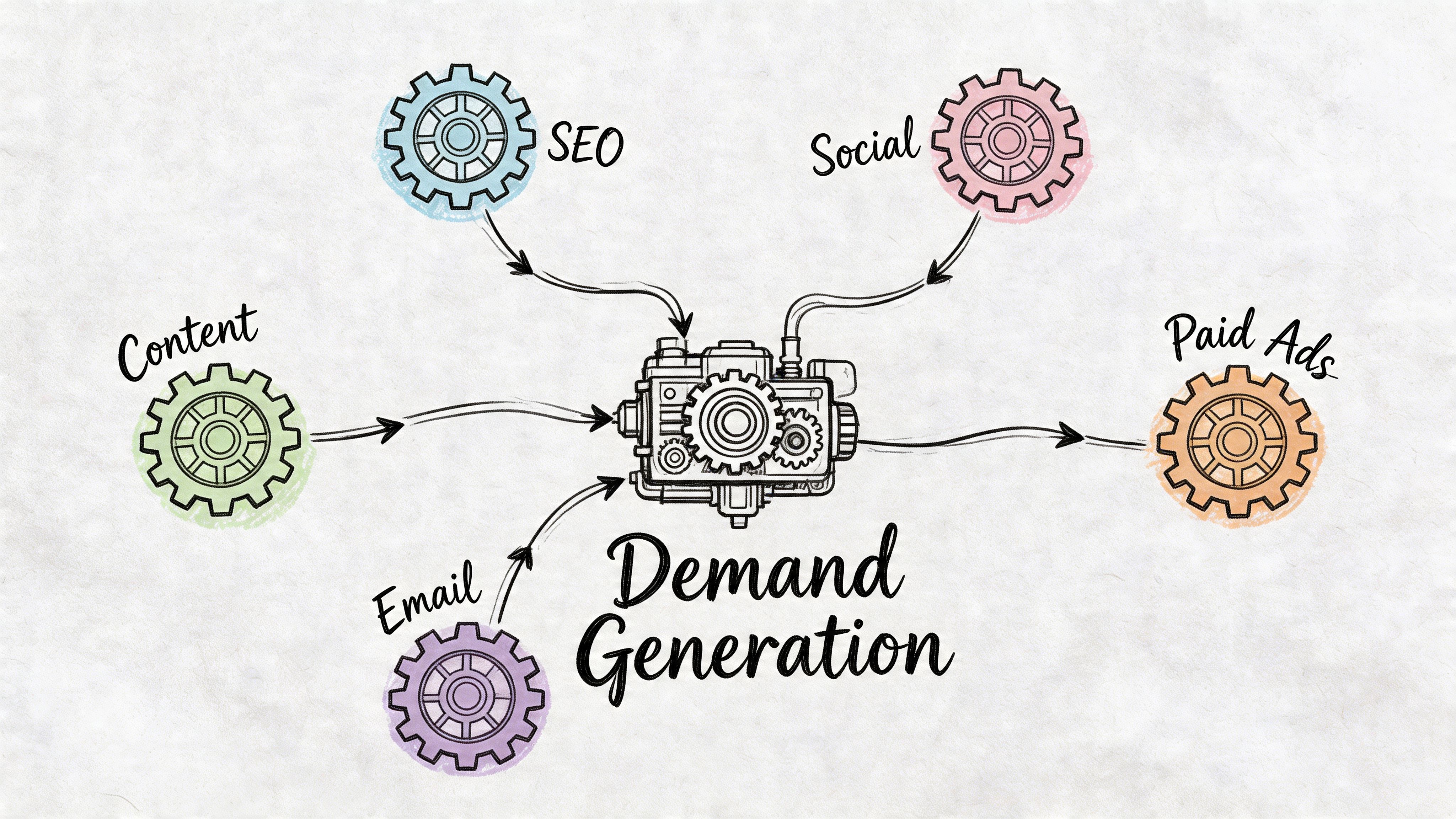
A diagram illustrating demand generation showing various marketing channels like SEO, social, content, email, and paid ads.

Brand awareness and thought leadership

Demand starts. Not with a form. With a point of view.

Most buyers aren't searching for your product name. They're trying to understand a problem, compare approaches, or make sense of competing advice. If your company shows up with useful explanations, strong framing, and practical guidance, you earn attention before the buying window opens.

Awareness work usually includes:

  • Problem-led content: Articles, webinars, and short explainers that help buyers name the issue.

  • Category education: Clear content that teaches buyers how to evaluate options.

  • Opinionated expertise: Strong positions grounded in operating experience, not generic summaries.

Multi-channel distribution

Publishing isn't distribution. A good article on a neglected blog is like opening a store in an alley with no sign.

Effective demand gen pushes content through the channels your buyers already use. For many SMBs, that means some mix of organic search, newsletters, LinkedIn, partner promotion, paid social, and targeted retargeting. The winning mix depends on where your ideal buyers pay attention.

A simple operating rule helps here:

If you're trying to do this

Use channels like this

Create new awareness

SEO, social, paid reach, partnerships

Deepen consideration

Webinars, email, comparison content, case-style explainers

Re-activate interest

Retargeting, sales follow-up, behavior-triggered outreach

Smart capture and nurturing

This is the part teams often mishandle. They either gate everything and kill momentum, or they gate nothing and fail to identify who is warming up.

You need a middle path. Let buyers learn without friction, then introduce capture points when intent is clear. A pricing page visit, repeat return to key pages, webinar attendance, and product-focused engagement usually tell you more than a cold ebook download.

Once you see intent, nurture should feel relevant, not relentless. A practical way to set that up is with automated workflow design for marketing and sales handoffs, so behavior triggers the next step instead of someone remembering to send a manual follow-up.

Buyers don't wake up wanting your nurture sequence. They want help making a decision. Good nurturing respects that.

Sales and marketing alignment

A demand generation engine breaks when marketing and sales use different definitions of progress. Marketing says a lead is qualified. Sales says it's early. Marketing celebrates campaign engagement. Sales says no serious conversations came from it.

Alignment doesn't require a giant RevOps team. It requires discipline.

Use shared definitions for:

  1. What counts as meaningful intent

  2. When an account deserves sales outreach

  3. What feedback sales must return to marketing

  4. Which messages are moving deals forward

If marketing is responsible for awareness and sales is responsible for closing, both teams are still responsible for pipeline quality. That's the operating principle that keeps demand generation connected to revenue.

Practical Demand Generation Strategies for SMBs

SMBs don't need a bloated playbook. They need a few moves that compound.

The best demand generation strategies for smaller teams do three things well. They teach the market, identify intent, and focus effort on accounts with real potential. That means less random content, fewer broad campaigns, and more deliberate use of signals.
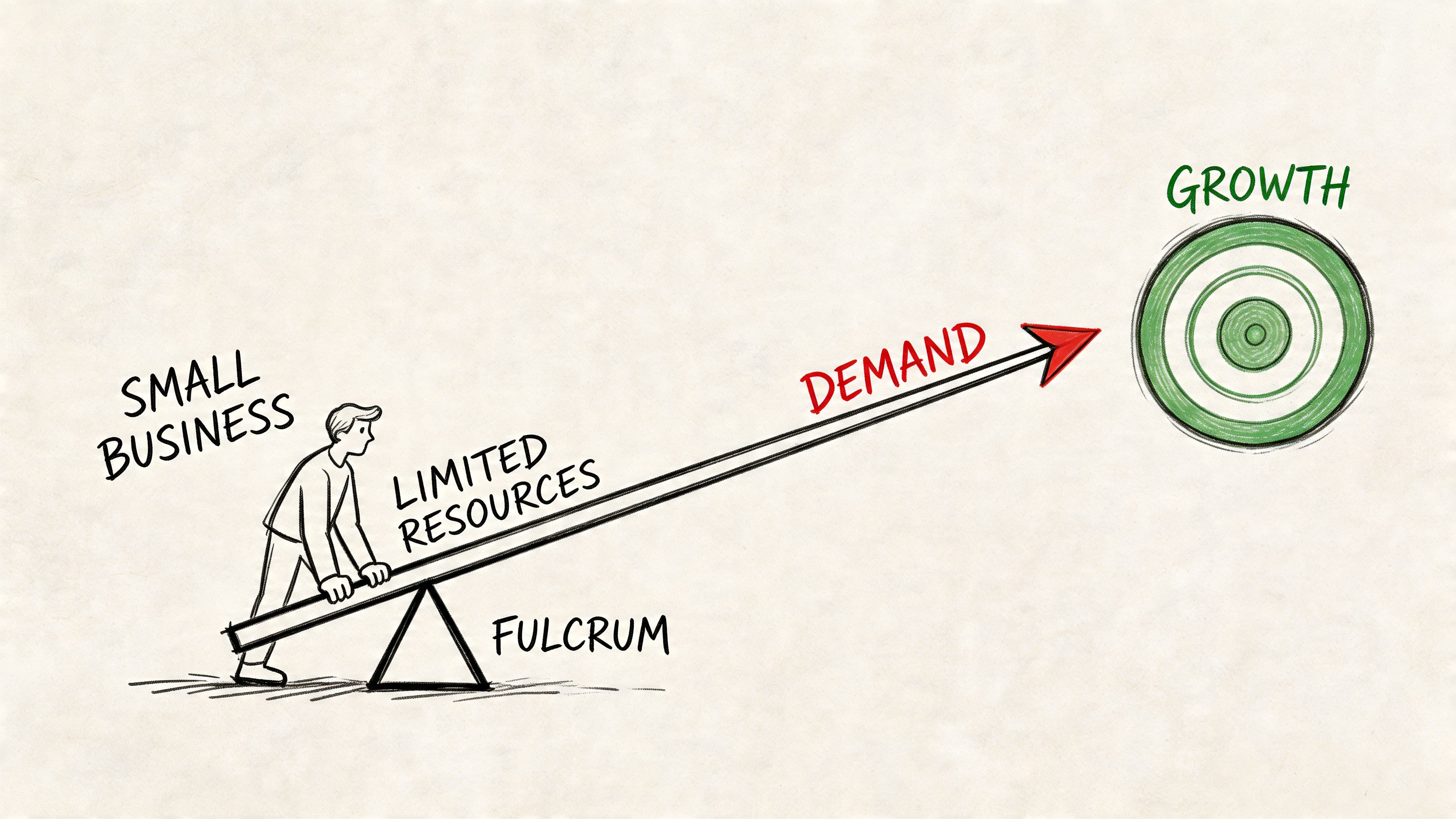
A conceptual illustration of a small business using limited resources as a lever to reach growth.

Build one strong content pillar first

A lot of SMBs lose months producing scattered posts around whatever topic feels urgent that week. That creates noise, not demand.

Start with one pillar topic tightly tied to your buyer's problem and your revenue motion. If you sell to operations leaders, write the definitive guide to the workflow bottleneck they live with. If you sell to sales teams, build practical content around outbound efficiency, handoff friction, or pipeline hygiene.

The format matters less than the utility. A strong pillar can become:

  • Search content: In-depth pages that rank for high-intent questions

  • Sales collateral: Articles reps can send after discovery

  • Newsletter material: Shorter versions that keep your audience warm

  • Social cutdowns: Sharp insights pulled into posts and carousels

Distribute harder than you publish

Many teams under-distribute by a wide margin. They spend days making a piece, post it once, and move on.

Don't do that. One useful article should show up in several places and in several formats. Pull out a strong chart or opinion for LinkedIn. Turn one section into an email. Use the same point in outbound follow-up. Package a cluster of related posts into a webinar or newsletter series.

If you're building nurture around that distribution, a simple drip campaign strategy for B2B follow-up keeps the content working after the first touch instead of letting it die on publish day.

Use first-party intent before you buy more reach

Traffic matters less than behavior. Who came matters. What they did matters more.

According to UnboundB2B's overview of data-driven demand generation, 32% of marketing executives cite analytical insights as the top factor for lead generation. The same source says that using first-party intent data from website behavior can lift engagement by 25-35%, and combining that with third-party data for ABM can generate 50% more qualified pipeline.

That means you should pay attention to signals like:

Intent signal

What it usually means

Repeated visits to product or solution pages

The account is moving from curiosity to evaluation

Engagement across multiple content topics

The buyer is mapping the problem, not just browsing

Return visits from the same company

Interest may be spreading inside the account

Pricing or demo-page activity

A commercial conversation may be near

Run ABM-lite instead of pretending you're an enterprise team

Account-based marketing gets overcomplicated fast. SMBs don't need a giant orchestration layer to use the basic idea well.

Pick a small set of target accounts that fit your ICP. Then build coordinated outreach around the likely buying group. That can include role-based messaging, content addressing known pain points, and simple sequencing across email, paid retargeting, and sales follow-up.

Buying decisions are rarely made by one person. In practice, one champion can like your product and still lose momentum if finance, ops, or a manager upstream doesn't understand the case.

A practical SMB version of ABM is simple. Fewer accounts, better research, tighter messaging, and more than one contact inside each target company.

Keep the handoff tight

Don't wait until a lead hits a generic score threshold and then toss it over the wall. Watch for clusters of activity that suggest account movement. When those appear, sales should have context. What content was consumed, which pages were visited, which pain points likely matter, and who else inside the account may influence the decision.

That context is what turns demand generation from "marketing did some awareness" into "sales walked into the call already informed."

Measuring What Matters Demand Generation KPIs

If you can't connect demand generation to revenue, you don't have a strategy. You have activity.

The mistake isn't tracking too little. It's tracking the wrong things in the wrong order. Clicks, opens, and raw lead counts can help you diagnose campaign health, but they don't tell leadership whether marketing is building pipeline efficiently.
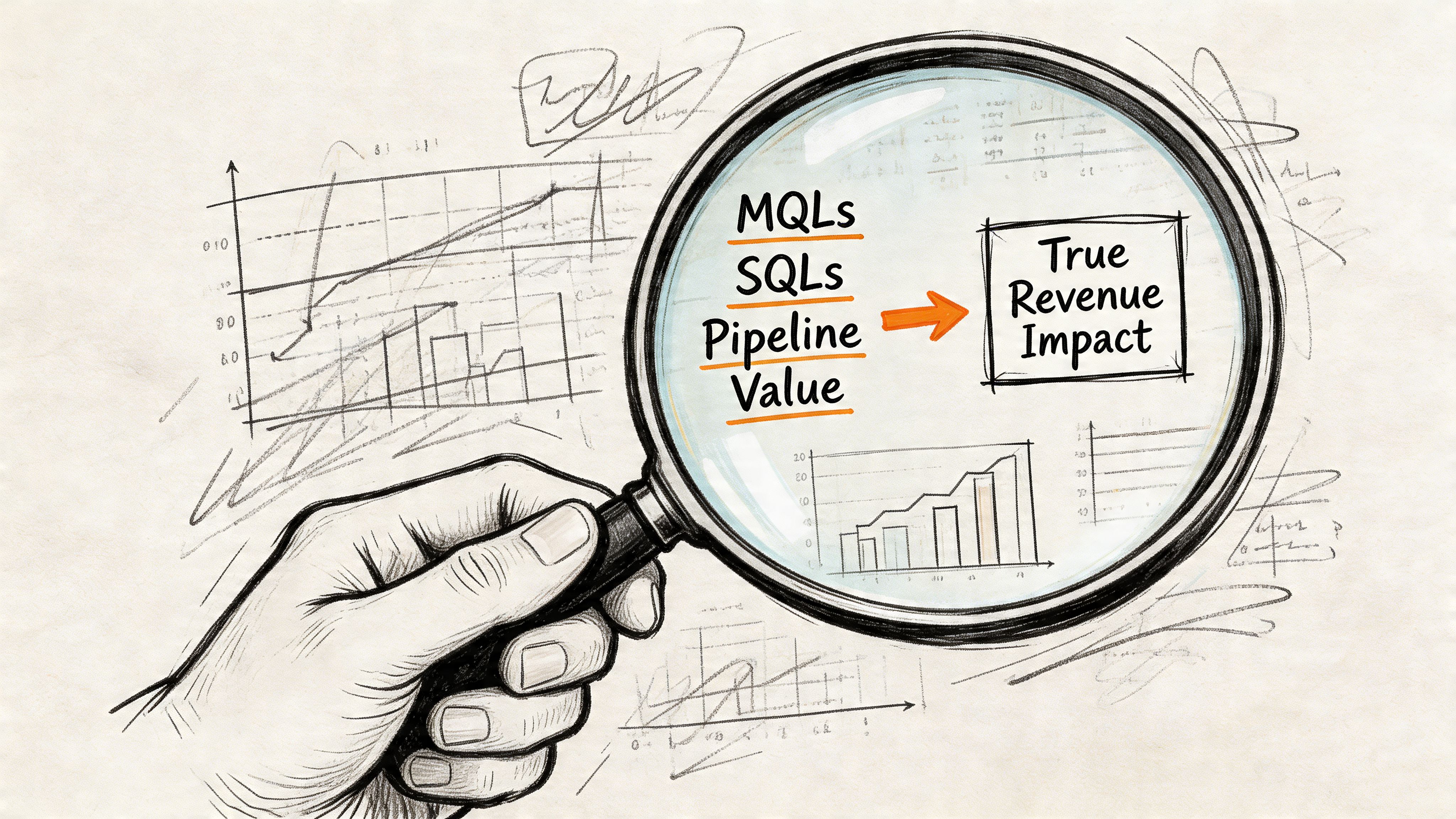
A magnifying glass focusing on business metrics like MQLs, SQLs, and pipeline value leading to true revenue impact.

Start with signal tiers

A useful way to measure demand gen is to organize metrics by what they tell you.

Tier one signals

These are early indicators that your market education is landing. Think content engagement quality, return visitors, direct traffic growth, branded search movement, and repeat company visits. They don't prove revenue, but they show whether attention is building in the right places.

Tier two pipeline indicators

These connect interest to sales motion. SQL creation, demo bookings, sales acceptance, and account progression matter here. These metrics tell you whether awareness is turning into real conversations.

A team using ad hoc reporting in a CRM and revenue stack can usually spot patterns faster here than in static monthly dashboards because the questions change as campaigns evolve.

The three KPIs executives care about

The most important measures are the ones tied directly to revenue outcomes. According to The B2B Playbook's framework for measuring demand generation, mature programs track website-sourced pipeline, Customer Acquisition Cost (CAC), and pipeline velocity. The same source notes that high-performing SMB SaaS programs can attribute 20-30% of total pipeline to marketing sources and use lead scoring to accelerate pipeline velocity by 10-20% by focusing sales on the most engaged leads.

Here's what each KPI tells you:

KPI

What it answers

Why it matters

Website-sourced pipeline

How much pipeline originated from web and marketing activity

It ties demand gen to opportunity creation

CAC

What you spent to acquire each customer

It shows efficiency, not just output

Pipeline velocity

How quickly opportunities move toward close

It reveals whether your programs help sales move faster

How to use them in practice

Website-sourced pipeline is the cleanest starting point for most SMBs. If someone discovers you through content, search, webinars, or paid campaigns and that journey results in an opportunity, you want that value visible in the CRM.

CAC keeps the team honest. Some campaigns look productive until you compare spend to customer acquisition. A channel that creates a lot of names can still be a bad investment if it eats time and closes poorly.

Pipeline velocity is where demand generation often proves its value. Strong content, better qualification, and cleaner handoffs don't just create opportunities. They help sales work the right deals earlier.

Don't ask marketing to prove revenue with last-click reporting alone. B2B demand is built through multiple touches, repeated exposure, and coordinated follow-up.

What not to center your reporting on

Avoid running the whole engine off vanity metrics. That includes:

  • Raw MQL totals: Easy to inflate, hard to trust

  • Clicks without downstream context: Useful for optimization, weak for strategy

  • Open rates in isolation: A health signal, not a business outcome

  • Traffic spikes with no account progression: Attention without conversion isn't growth

Good demand generation reporting answers one question clearly. Did this work create more qualified pipeline and revenue, more efficiently, than the alternatives?

How Stamina Unifies and Scales Your Demand Generation

Most SMB demand generation breaks in the handoffs. Marketing has campaign data. Sales has call notes and outreach history. CRM data is incomplete. Website intent sits in another tool. Reporting gets stitched together in spreadsheets, and nobody fully trusts the picture.

That's not a channel problem. It's a systems problem.

Stamina is built to solve that by unifying marketing, sales, and CRM in one operating layer. Instead of exporting data across point tools and trying to reconstruct the buyer journey after the fact, teams can work from a single source of truth that connects awareness, outreach, nurturing, pipeline, and customer context.
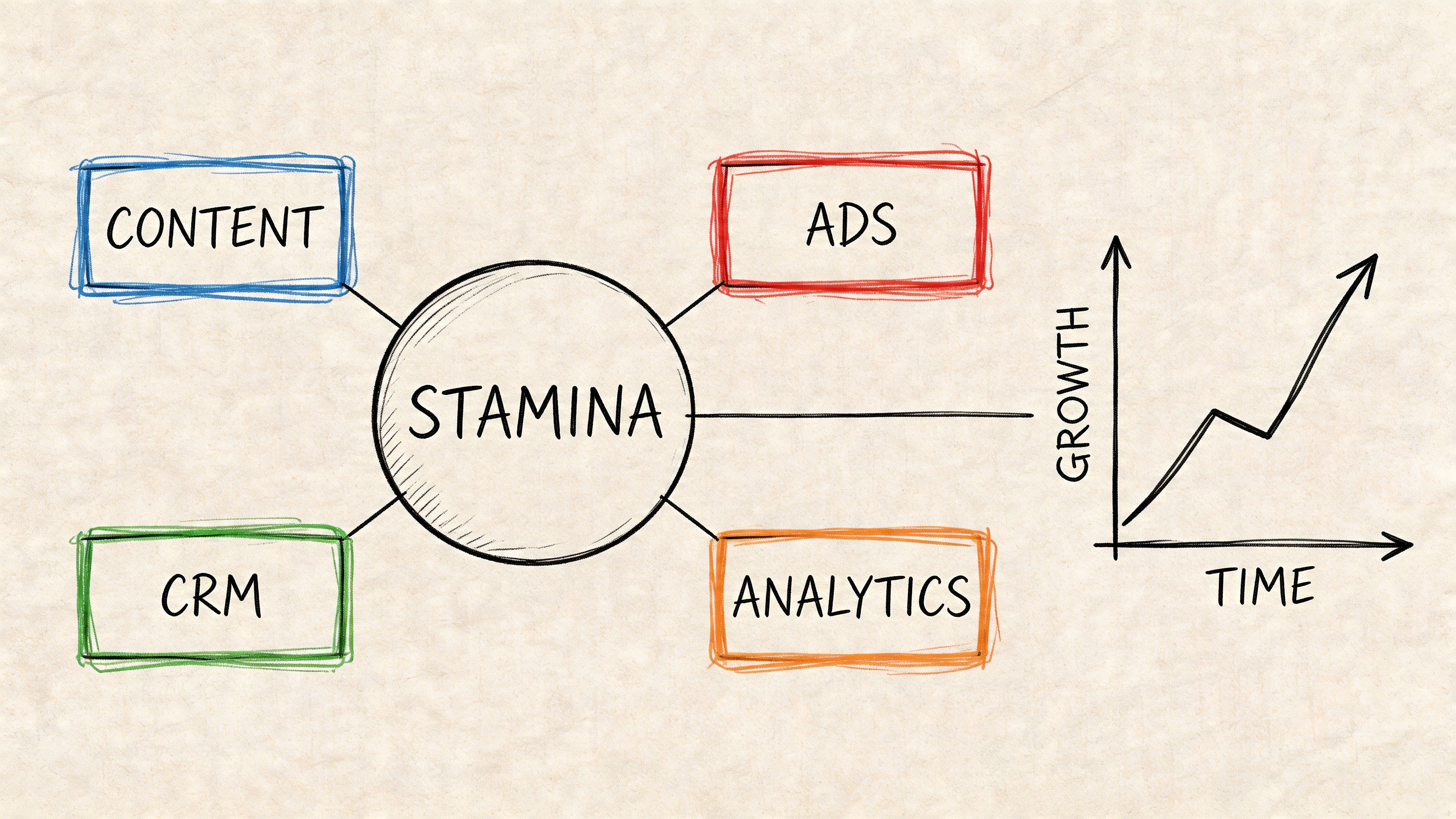
A hand-drawn diagram illustrating stamina as the central core for growth in content, ads, CRM, and analytics.

One platform instead of a stitched stack

In a typical SMB setup, marketing automation, CRM, outbound sequencing, and reporting live in separate systems. That creates lag and ambiguity. Sales doesn't know which campaigns shaped the account. Marketing can't easily see which touches influenced progression. Founders get conflicting numbers.

A unified platform changes the rhythm of execution:

  • Marketing sees account behavior and engagement in context

  • Sales sees what content and signals preceded outreach

  • Leadership sees pipeline and revenue without patchwork reporting

  • Operations teams reduce manual syncing and duplicate data work

That matters because demand generation only works when teams can act on the same information at the same time.

Zara helps SMBs engage buying groups, not just leads

One of the hardest parts of modern B2B demand generation is account complexity. SMB teams often know they need to reach more than one person inside an account, but they don't have the bandwidth to research stakeholders and personalize outreach for each one.

According to Infuse's discussion of why demand generation strategies underperform, SMBs often need to influence 4-7 decision-makers per account with limited resources. That same source notes that an AI SDR integrated into a unified platform can solve this by automating the research and personalized multi-stakeholder outreach required to warm entire accounts.

That's where Zara, Stamina's built-in AI SDR, becomes practical instead of theoretical.

Zara can help teams:

Problem

What Zara helps do

Too many target accounts, not enough SDR capacity

Research and prioritize ideal customers at scale

Generic outbound that gets ignored

Generate personalized emails, sequences, and variants

Single-threaded outreach inside accounts

Expand outreach across multiple stakeholders

Weak coordination between intent and action

Trigger warm prospecting from website and social signals

Execution gets easier when workflows live in one place

Demand generation isn't just top-of-funnel content. It's the chain reaction after someone engages.

A visitor hits a high-intent page. Sales should know. A contact engages with a nurture sequence. The account score should update. A buying group starts showing coordinated activity. The team should launch the next play, not discover it three weeks later.

Stamina's workflows, sales engagement tools, CRM, and nurture capabilities make those transitions easier to operationalize. You can run broadcasts, build automated flows, manage pipelines, and coordinate outbound without forcing people to jump across disconnected software.

The hidden cost in most SMB go-to-market stacks isn't the subscription bill. It's the delay between a signal appearing and someone acting on it.

Reporting becomes useful when the data model is shared

A lot of platforms promise reporting. True value lies in whether sales, marketing, and leadership are looking at the same underlying records.

Because Stamina brings CRM, engagement, and demand activity together, teams can evaluate the metrics that matter most in one environment. That includes website-sourced pipeline, sales activity tied to account movement, and the impact of nurture and outbound on progression toward revenue.

For founders, that means less time mediating dashboard disputes. For marketers, it means fewer arguments about attribution. For sales leaders, it means better timing and better context.

Your Demand Generation Starter Checklist

Demand generation doesn't need to start with a full replatform or a giant team. It starts with a tighter operating model.

If you're an SMB founder or marketing leader trying to build a more predictable pipeline, use this checklist to clean up the basics first.

What to do first

  • Define your ICP clearly: Write down the industries, company traits, pain points, and buyer roles that fit your best customers.

  • Choose one core problem to own: Build your first content pillar around a painful issue your buyers already struggle to explain internally.

  • Map your buying group: Identify the roles likely to influence a deal so your outreach doesn't rely on a single champion.

  • Set a capture strategy: Decide where you'll let buyers learn freely and where you'll ask for a next step such as a demo or consultation.

What to build next

  • Create a distribution routine: Publish less, promote more. Reuse strong content across search, email, social, and sales follow-up.

  • Track first-party intent: Watch repeat visits, key page activity, and account-level engagement instead of obsessing over lead volume.

  • Align sales and marketing definitions: Agree on what counts as meaningful intent, when sales should engage, and how feedback returns to marketing.

  • Install revenue-focused reporting: Make website-sourced pipeline, CAC, and pipeline velocity visible in your CRM and leadership reviews.

What to avoid

  • Don't gate everything: Early education should be easy to consume.

  • Don't chase MQL volume: More names won't fix weak fit or weak timing.

  • Don't single-thread accounts: B2B deals rarely survive on one contact alone.

  • Don't separate strategy from systems: If your stack can't connect signal to action, execution will lag.

Demand generation is the foundation for predictable growth because it builds future demand and captures current intent in one motion. That's what turns marketing from a cost center into a pipeline function.

If you're ready to run demand generation from one system instead of a patchwork stack, Stamina gives growing SMBs a practical way to unify marketing, sales, and CRM. You can capture intent, automate nurturing, coordinate outbound with Zara, and measure pipeline impact without stitching together separate tools.

Most advice about demand generation is backwards. It tells SMBs to crank out more leads, tighten the form, buy more traffic, and hand a bigger list to sales.

That sounds efficient. It often does the opposite.

You can hit your MQL target and still miss revenue. Sales gets a pile of names, most aren't ready, follow-up quality drops, and marketing ends up defending activity instead of proving business impact. That's the trap. If you're asking what is demand generation in marketing, start there. It isn't a prettier label for lead gen. It's the discipline of creating market interest before buyers raise their hands, then turning that interest into pipeline you can trace to revenue.

For an SMB, this matters even more. You don't have room for disconnected campaigns, fuzzy attribution, or a sales team wasting time on contacts who downloaded one asset and disappeared. You need a system that builds trust with future buyers, captures intent when it appears, and helps sales focus on accounts with real buying potential.

Why "Generating Leads" Is Costing You Revenue

A lot of B2B teams still run marketing like a call center scoreboard. More leads means better performance. More form fills means more momentum. More MQLs means marketing is doing its job.

That logic breaks fast when revenue stalls.

The core problem with many traditional programs is that they fail to translate marketing activity into measurable business growth and instead measure success through MQLs rather than revenue, as noted in Pedowitz Group's discussion of revenue marketing versus demand generation. SMBs feel this harder than larger companies because every campaign has to justify itself. If spend goes up and closed revenue doesn't follow, leadership stops trusting the function.

The MQL trap

This is typically what happens:

  • Marketing optimizes for volume: Teams choose channels and offers that generate names quickly.

  • Sales inherits weak intent: Reps chase contacts who showed curiosity, not buying readiness.

  • Reporting gets distorted: Dashboards look busy, but pipeline quality stays soft.

  • Budget gets harder to defend: Leadership asks a simple question. Which campaigns produced revenue?

This is the revenue attribution disconnect. Marketing can show clicks, downloads, opens, and lead counts. Leadership wants to know what those activities produced in pipeline and closed business.

Practical rule: If a marketing metric can't help you explain pipeline or revenue, it belongs in an operational dashboard, not the executive summary.

Demand generation changes the unit of measurement

Demand generation starts with a different assumption. The job isn't to collect as many contacts as possible. The job is to increase the number of qualified buyers who know, trust, and consider your company, then move that market awareness into opportunities sales can convert.

That shifts how you work.

Instead of asking, "How do we get more leads this month?" ask:

Old question

Better question

How many leads did we get?

Which programs influenced qualified pipeline?

Which asset converted best?

Which content changed buyer consideration?

How fast can we capture contact details?

How early can we identify intent and guide the account?

When founders make this shift, marketing stops behaving like a list factory. It starts acting like a revenue engine.

Demand Generation vs Lead Generation Explained

Lead generation and demand generation overlap, but they are not the same thing. Confusing them is one of the fastest ways to build a funnel that looks active and performs badly.

Lead generation is like fishing with a net in water where a few fish are already near the surface. Demand generation is building the lake. You make the environment attractive, visible, and trusted long before you try to catch anything.

According to The Insight Collective's B2B demand generation data, successful demand generation focuses on creating awareness among the 95% of potential customers not actively buying, while lead generation targets the 5% who are. The same source notes that content marketing is used by 83% of organizations for demand gen because it builds brand visibility and trust before a purchase decision.

Demand Generation vs. Lead Generation At a Glance

Dimension

Demand Generation

Lead Generation

Primary focus

Build awareness, trust, and category understanding

Capture contact details and sales interest

Audience

Future buyers, in-market accounts, and people still defining the problem

Buyers already showing direct intent

Typical content

Educational articles, webinars, thought leadership, expert newsletters, ungated resources

Demo forms, trial offers, gated assets, contact requests

Main channels

Content, SEO, social, email nurturing, paid distribution, brand programs

Landing pages, paid capture campaigns, retargeting, outbound follow-up

Time horizon

Longer-term and compounding

Shorter-term and transactional

Success measure

Market awareness, engagement quality, account progression, influenced pipeline

Hand-raisers, qualified leads, demos, meetings

Where teams get confused

A blog post can be demand generation. So can a webinar, newsletter, or paid promotion. But the same asset can also support lead generation if you use it to capture intent at the right moment.

The difference isn't just the channel. It's the purpose.

If you publish a strong article answering a painful buyer question, that's demand generation. If a reader later requests a demo after consuming three related resources, that's lead generation doing its job inside a larger demand strategy.

Demand generation creates the conditions for conversion. Lead generation captures that conversion when the buyer is ready.

Why the distinction matters operationally

This distinction affects budget, content format, and sales coordination. Teams that over-index on lead generation tend to gate too much, pressure buyers too early, and mistake activity for readiness. Teams that only do awareness work without a capture plan create interest but fail to convert it.

Most SMBs need both. They just need them in the right order.

If your sales and marketing teams still blur these responsibilities, it's worth tightening the handoff and role clarity around the difference between sales and marketing. That alignment becomes critical once you start measuring impact beyond raw lead counts.

The Core Components of a Demand Generation Engine

Demand generation works when it behaves like a system, not a stack of random tactics. SEO without content doesn't carry enough weight. Content without distribution goes unread. Nurturing without sales alignment keeps leads warm but stranded.

The engine has a few core parts. Miss one and the whole thing starts leaking efficiency.

A diagram illustrating demand generation showing various marketing channels like SEO, social, content, email, and paid ads.

Brand awareness and thought leadership

Demand starts. Not with a form. With a point of view.

Most buyers aren't searching for your product name. They're trying to understand a problem, compare approaches, or make sense of competing advice. If your company shows up with useful explanations, strong framing, and practical guidance, you earn attention before the buying window opens.

Awareness work usually includes:

  • Problem-led content: Articles, webinars, and short explainers that help buyers name the issue.

  • Category education: Clear content that teaches buyers how to evaluate options.

  • Opinionated expertise: Strong positions grounded in operating experience, not generic summaries.

Multi-channel distribution

Publishing isn't distribution. A good article on a neglected blog is like opening a store in an alley with no sign.

Effective demand gen pushes content through the channels your buyers already use. For many SMBs, that means some mix of organic search, newsletters, LinkedIn, partner promotion, paid social, and targeted retargeting. The winning mix depends on where your ideal buyers pay attention.

A simple operating rule helps here:

If you're trying to do this

Use channels like this

Create new awareness

SEO, social, paid reach, partnerships

Deepen consideration

Webinars, email, comparison content, case-style explainers

Re-activate interest

Retargeting, sales follow-up, behavior-triggered outreach

Smart capture and nurturing

This is the part teams often mishandle. They either gate everything and kill momentum, or they gate nothing and fail to identify who is warming up.

You need a middle path. Let buyers learn without friction, then introduce capture points when intent is clear. A pricing page visit, repeat return to key pages, webinar attendance, and product-focused engagement usually tell you more than a cold ebook download.

Once you see intent, nurture should feel relevant, not relentless. A practical way to set that up is with automated workflow design for marketing and sales handoffs, so behavior triggers the next step instead of someone remembering to send a manual follow-up.

Buyers don't wake up wanting your nurture sequence. They want help making a decision. Good nurturing respects that.

Sales and marketing alignment

A demand generation engine breaks when marketing and sales use different definitions of progress. Marketing says a lead is qualified. Sales says it's early. Marketing celebrates campaign engagement. Sales says no serious conversations came from it.

Alignment doesn't require a giant RevOps team. It requires discipline.

Use shared definitions for:

  1. What counts as meaningful intent

  2. When an account deserves sales outreach

  3. What feedback sales must return to marketing

  4. Which messages are moving deals forward

If marketing is responsible for awareness and sales is responsible for closing, both teams are still responsible for pipeline quality. That's the operating principle that keeps demand generation connected to revenue.

Practical Demand Generation Strategies for SMBs

SMBs don't need a bloated playbook. They need a few moves that compound.

The best demand generation strategies for smaller teams do three things well. They teach the market, identify intent, and focus effort on accounts with real potential. That means less random content, fewer broad campaigns, and more deliberate use of signals.

A conceptual illustration of a small business using limited resources as a lever to reach growth.

Build one strong content pillar first

A lot of SMBs lose months producing scattered posts around whatever topic feels urgent that week. That creates noise, not demand.

Start with one pillar topic tightly tied to your buyer's problem and your revenue motion. If you sell to operations leaders, write the definitive guide to the workflow bottleneck they live with. If you sell to sales teams, build practical content around outbound efficiency, handoff friction, or pipeline hygiene.

The format matters less than the utility. A strong pillar can become:

  • Search content: In-depth pages that rank for high-intent questions

  • Sales collateral: Articles reps can send after discovery

  • Newsletter material: Shorter versions that keep your audience warm

  • Social cutdowns: Sharp insights pulled into posts and carousels

Distribute harder than you publish

Many teams under-distribute by a wide margin. They spend days making a piece, post it once, and move on.

Don't do that. One useful article should show up in several places and in several formats. Pull out a strong chart or opinion for LinkedIn. Turn one section into an email. Use the same point in outbound follow-up. Package a cluster of related posts into a webinar or newsletter series.

If you're building nurture around that distribution, a simple drip campaign strategy for B2B follow-up keeps the content working after the first touch instead of letting it die on publish day.

Use first-party intent before you buy more reach

Traffic matters less than behavior. Who came matters. What they did matters more.

According to UnboundB2B's overview of data-driven demand generation, 32% of marketing executives cite analytical insights as the top factor for lead generation. The same source says that using first-party intent data from website behavior can lift engagement by 25-35%, and combining that with third-party data for ABM can generate 50% more qualified pipeline.

That means you should pay attention to signals like:

Intent signal

What it usually means

Repeated visits to product or solution pages

The account is moving from curiosity to evaluation

Engagement across multiple content topics

The buyer is mapping the problem, not just browsing

Return visits from the same company

Interest may be spreading inside the account

Pricing or demo-page activity

A commercial conversation may be near

Run ABM-lite instead of pretending you're an enterprise team

Account-based marketing gets overcomplicated fast. SMBs don't need a giant orchestration layer to use the basic idea well.

Pick a small set of target accounts that fit your ICP. Then build coordinated outreach around the likely buying group. That can include role-based messaging, content addressing known pain points, and simple sequencing across email, paid retargeting, and sales follow-up.

Buying decisions are rarely made by one person. In practice, one champion can like your product and still lose momentum if finance, ops, or a manager upstream doesn't understand the case.

A practical SMB version of ABM is simple. Fewer accounts, better research, tighter messaging, and more than one contact inside each target company.

Keep the handoff tight

Don't wait until a lead hits a generic score threshold and then toss it over the wall. Watch for clusters of activity that suggest account movement. When those appear, sales should have context. What content was consumed, which pages were visited, which pain points likely matter, and who else inside the account may influence the decision.

That context is what turns demand generation from "marketing did some awareness" into "sales walked into the call already informed."

Measuring What Matters Demand Generation KPIs

If you can't connect demand generation to revenue, you don't have a strategy. You have activity.

The mistake isn't tracking too little. It's tracking the wrong things in the wrong order. Clicks, opens, and raw lead counts can help you diagnose campaign health, but they don't tell leadership whether marketing is building pipeline efficiently.

A magnifying glass focusing on business metrics like MQLs, SQLs, and pipeline value leading to true revenue impact.

Start with signal tiers

A useful way to measure demand gen is to organize metrics by what they tell you.

Tier one signals

These are early indicators that your market education is landing. Think content engagement quality, return visitors, direct traffic growth, branded search movement, and repeat company visits. They don't prove revenue, but they show whether attention is building in the right places.

Tier two pipeline indicators

These connect interest to sales motion. SQL creation, demo bookings, sales acceptance, and account progression matter here. These metrics tell you whether awareness is turning into real conversations.

A team using ad hoc reporting in a CRM and revenue stack can usually spot patterns faster here than in static monthly dashboards because the questions change as campaigns evolve.

The three KPIs executives care about

The most important measures are the ones tied directly to revenue outcomes. According to The B2B Playbook's framework for measuring demand generation, mature programs track website-sourced pipeline, Customer Acquisition Cost (CAC), and pipeline velocity. The same source notes that high-performing SMB SaaS programs can attribute 20-30% of total pipeline to marketing sources and use lead scoring to accelerate pipeline velocity by 10-20% by focusing sales on the most engaged leads.

Here's what each KPI tells you:

KPI

What it answers

Why it matters

Website-sourced pipeline

How much pipeline originated from web and marketing activity

It ties demand gen to opportunity creation

CAC

What you spent to acquire each customer

It shows efficiency, not just output

Pipeline velocity

How quickly opportunities move toward close

It reveals whether your programs help sales move faster

How to use them in practice

Website-sourced pipeline is the cleanest starting point for most SMBs. If someone discovers you through content, search, webinars, or paid campaigns and that journey results in an opportunity, you want that value visible in the CRM.

CAC keeps the team honest. Some campaigns look productive until you compare spend to customer acquisition. A channel that creates a lot of names can still be a bad investment if it eats time and closes poorly.

Pipeline velocity is where demand generation often proves its value. Strong content, better qualification, and cleaner handoffs don't just create opportunities. They help sales work the right deals earlier.

Don't ask marketing to prove revenue with last-click reporting alone. B2B demand is built through multiple touches, repeated exposure, and coordinated follow-up.

What not to center your reporting on

Avoid running the whole engine off vanity metrics. That includes:

  • Raw MQL totals: Easy to inflate, hard to trust

  • Clicks without downstream context: Useful for optimization, weak for strategy

  • Open rates in isolation: A health signal, not a business outcome

  • Traffic spikes with no account progression: Attention without conversion isn't growth

Good demand generation reporting answers one question clearly. Did this work create more qualified pipeline and revenue, more efficiently, than the alternatives?

How Stamina Unifies and Scales Your Demand Generation

Most SMB demand generation breaks in the handoffs. Marketing has campaign data. Sales has call notes and outreach history. CRM data is incomplete. Website intent sits in another tool. Reporting gets stitched together in spreadsheets, and nobody fully trusts the picture.

That's not a channel problem. It's a systems problem.

Stamina is built to solve that by unifying marketing, sales, and CRM in one operating layer. Instead of exporting data across point tools and trying to reconstruct the buyer journey after the fact, teams can work from a single source of truth that connects awareness, outreach, nurturing, pipeline, and customer context.

A hand-drawn diagram illustrating stamina as the central core for growth in content, ads, CRM, and analytics.

One platform instead of a stitched stack

In a typical SMB setup, marketing automation, CRM, outbound sequencing, and reporting live in separate systems. That creates lag and ambiguity. Sales doesn't know which campaigns shaped the account. Marketing can't easily see which touches influenced progression. Founders get conflicting numbers.

A unified platform changes the rhythm of execution:

  • Marketing sees account behavior and engagement in context

  • Sales sees what content and signals preceded outreach

  • Leadership sees pipeline and revenue without patchwork reporting

  • Operations teams reduce manual syncing and duplicate data work

That matters because demand generation only works when teams can act on the same information at the same time.

Zara helps SMBs engage buying groups, not just leads

One of the hardest parts of modern B2B demand generation is account complexity. SMB teams often know they need to reach more than one person inside an account, but they don't have the bandwidth to research stakeholders and personalize outreach for each one.

According to Infuse's discussion of why demand generation strategies underperform, SMBs often need to influence 4-7 decision-makers per account with limited resources. That same source notes that an AI SDR integrated into a unified platform can solve this by automating the research and personalized multi-stakeholder outreach required to warm entire accounts.

That's where Zara, Stamina's built-in AI SDR, becomes practical instead of theoretical.

Zara can help teams:

Problem

What Zara helps do

Too many target accounts, not enough SDR capacity

Research and prioritize ideal customers at scale

Generic outbound that gets ignored

Generate personalized emails, sequences, and variants

Single-threaded outreach inside accounts

Expand outreach across multiple stakeholders

Weak coordination between intent and action

Trigger warm prospecting from website and social signals

Execution gets easier when workflows live in one place

Demand generation isn't just top-of-funnel content. It's the chain reaction after someone engages.

A visitor hits a high-intent page. Sales should know. A contact engages with a nurture sequence. The account score should update. A buying group starts showing coordinated activity. The team should launch the next play, not discover it three weeks later.

Stamina's workflows, sales engagement tools, CRM, and nurture capabilities make those transitions easier to operationalize. You can run broadcasts, build automated flows, manage pipelines, and coordinate outbound without forcing people to jump across disconnected software.

The hidden cost in most SMB go-to-market stacks isn't the subscription bill. It's the delay between a signal appearing and someone acting on it.

Reporting becomes useful when the data model is shared

A lot of platforms promise reporting. True value lies in whether sales, marketing, and leadership are looking at the same underlying records.

Because Stamina brings CRM, engagement, and demand activity together, teams can evaluate the metrics that matter most in one environment. That includes website-sourced pipeline, sales activity tied to account movement, and the impact of nurture and outbound on progression toward revenue.

For founders, that means less time mediating dashboard disputes. For marketers, it means fewer arguments about attribution. For sales leaders, it means better timing and better context.

Your Demand Generation Starter Checklist

Demand generation doesn't need to start with a full replatform or a giant team. It starts with a tighter operating model.

If you're an SMB founder or marketing leader trying to build a more predictable pipeline, use this checklist to clean up the basics first.

What to do first

  • Define your ICP clearly: Write down the industries, company traits, pain points, and buyer roles that fit your best customers.

  • Choose one core problem to own: Build your first content pillar around a painful issue your buyers already struggle to explain internally.

  • Map your buying group: Identify the roles likely to influence a deal so your outreach doesn't rely on a single champion.

  • Set a capture strategy: Decide where you'll let buyers learn freely and where you'll ask for a next step such as a demo or consultation.

What to build next

  • Create a distribution routine: Publish less, promote more. Reuse strong content across search, email, social, and sales follow-up.

  • Track first-party intent: Watch repeat visits, key page activity, and account-level engagement instead of obsessing over lead volume.

  • Align sales and marketing definitions: Agree on what counts as meaningful intent, when sales should engage, and how feedback returns to marketing.

  • Install revenue-focused reporting: Make website-sourced pipeline, CAC, and pipeline velocity visible in your CRM and leadership reviews.

What to avoid

  • Don't gate everything: Early education should be easy to consume.

  • Don't chase MQL volume: More names won't fix weak fit or weak timing.

  • Don't single-thread accounts: B2B deals rarely survive on one contact alone.

  • Don't separate strategy from systems: If your stack can't connect signal to action, execution will lag.

Demand generation is the foundation for predictable growth because it builds future demand and captures current intent in one motion. That's what turns marketing from a cost center into a pipeline function.

If you're ready to run demand generation from one system instead of a patchwork stack, Stamina gives growing SMBs a practical way to unify marketing, sales, and CRM. You can capture intent, automate nurturing, coordinate outbound with Zara, and measure pipeline impact without stitching together separate tools.

Share this article

Share this article

Send a shareable link to your team or anyone who might find it useful.

Send a shareable link to your team or anyone who might find it useful.

Copy link

Copied

Share directly to

Table of contents

Give Your Business the Stamina it needs to Thrive