
Your reps are active all day. They build lists, look up companies, rewrite follow-up emails, update the CRM, chase no-shows, and try to personalize outreach at volume. The problem isn't effort. The problem is that too much of their day gets consumed by work that feels productive but doesn't reliably create pipeline.
That's where interest in AI sales agent software has moved from curiosity to operating priority. SMB leaders aren't looking for another novelty tool. They're looking for a practical way to get more qualified conversations without hiring a larger outbound team or stitching together five disconnected tools.
The urgency is real. The global AI in sales market is projected to grow from USD 50.8 billion in 2026 to USD 383.1 billion by 2034, at a 28.7% CAGR, driven by task automation and shorter sales cycles, according to GM Insights research on the AI in sales market. That doesn't mean every vendor delivers. It does mean your competitors are actively testing ways to automate the repetitive parts of selling.
Your Sales Team Is Busy But Are They Productive
A busy sales floor can hide a weak sales system.
When I review outbound motions for SMBs, I usually find the same pattern. Reps are spending real energy on prospect research, list cleanup, sequence writing, and manual follow-ups. Those tasks matter, but they don't all need a human to perform them from scratch every day.
Activity isn't the same as output
If one rep spends the morning finding contacts, another is rewriting an email for the same persona, and a manager is trying to figure out which leads are worth attention, the team has a throughput problem. They're producing motion, not true impact.
The practical use of AI sales agent software starts here. It takes repetitive top-of-funnel work and turns it into a repeatable system. Instead of every rep rebuilding the process daily, the software researches, drafts, sequences, and routes work consistently.
A lot of teams also create useful content that never reaches prospects in the right format. If your reps record demos, discovery recaps, or customer explainers on Zoom, turning those into short clips can help sales and marketing reuse the same material across channels. A useful workflow reference is ProdShort for social video clips, especially if you're trying to get more mileage from existing customer-facing content.
The hidden drag on pipeline
Most SMB teams don't have a pure closing problem. They have a capacity problem upstream.
Common symptoms show up fast:
Research bottlenecks: Reps spend too much time figuring out who to contact and why.
Inconsistent personalization: Good messages get written, but only when someone has the time.
CRM drift: Notes, stages, and contact records go stale because selling takes priority over data entry.
Manager guesswork: Leaders can't easily see whether low output comes from bad targeting, weak messaging, or poor follow-up discipline.
That's why productivity needs to be measured beyond call counts and email volume. A sharper framework for that is this guide to sales rep productivity metrics, because output quality matters more than raw activity.
Practical rule: If your best reps are buried in admin and your average reps can't sustain personalized outreach, your process needs system support, not just more coaching.
The strongest argument for AI sales agent software isn't futuristic automation. It's operational relief. Good systems create more selling time for humans and more consistency for the business.
What Is an AI Sales Agent
An SMB sales manager usually sees the same pattern. Reps spend the morning researching accounts, rewriting follow-ups, logging notes, and chasing replies that never turn into meetings. An AI sales agent is software built to take over much of that repetitive execution so human reps can spend more time in live selling conversations. If you want a practical view of where AI fits in a sales process, this guide on how to use AI in sales is a useful reference.
It sits between simple automation and full autonomy. A chatbot waits for an inbound question. A sequencer sends fixed steps on a schedule. An AI sales agent works across tasks. It can pull account context, draft outreach, react to replies, update records, and push qualified leads toward a booked meeting or a rep handoff.
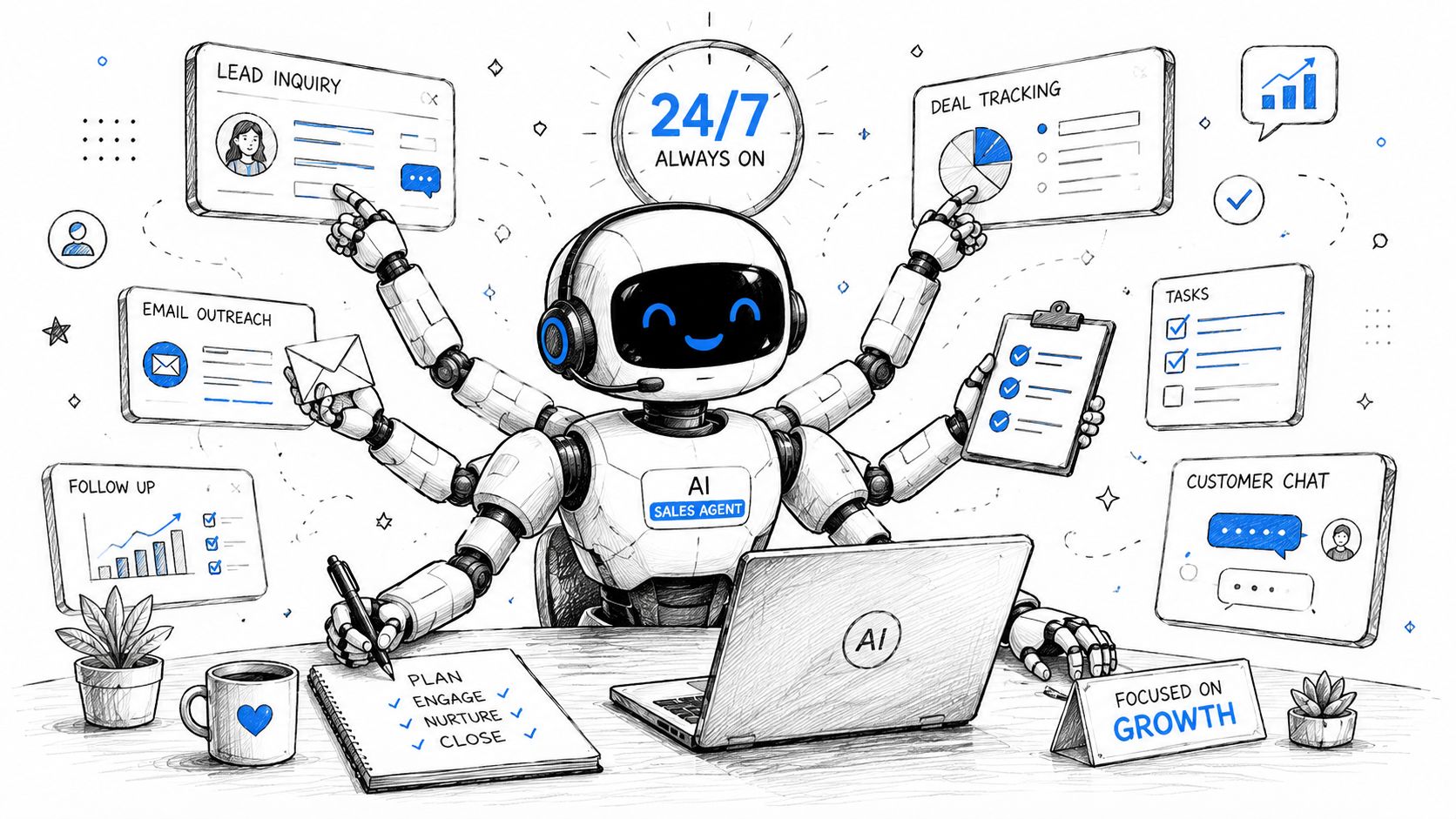
Closer to an SDR assistant than a replacement rep
The useful comparison is a junior SDR with very high output and very uneven judgment. It can process far more account data than a person can hold in mind, and it will follow process consistently. It still needs rules, review points, and clear handoff conditions.
Used well, it can:
Research accounts: Gather firmographic details, buying signals, and relevant company context before outreach
Write personalized messages: Draft emails or LinkedIn touches based on role, industry, and likely pain points
Handle early replies: Respond to common questions and keep a conversation moving
Qualify interest: Check fit based on your criteria before a rep spends time on the account
Book next steps: Route qualified leads into a calendar, queue, or CRM workflow
That distinction matters. Vendors often market these tools as if they can run outbound end to end without supervision. In practice, the best SMB results usually come from an assistive model. AI handles the repetitive first 60 to 80 percent of the workflow, and reps step in where context, timing, and judgment affect conversion.
What it isn't
A real AI sales agent is not just a text generator connected to your inbox. It needs workflow logic, access to prospect and customer data, guardrails around messaging, and rules for when a human should take over. Without those pieces, the software can produce fluent copy but still make bad sales decisions.
That gap between impressive demos and reliable production use is where many teams get burned. The right question is not whether the tool can write an email. The right question is whether it can improve coverage, response handling, qualification, and handoff quality without creating cleanup work for the team.
For agency teams or service businesses that also manage inbound calls, lead intake, and appointment flow, adjacent tools can fill parts of that process. One example is this look at AI solutions for marketing agencies, which is relevant when your pipeline starts before a rep ever sends an email.
Good AI sales agent software reduces admin load and increases qualified conversations. Human reps still carry the moments that decide revenue.
Core Features of Modern AI Sales Platforms
The best AI sales platforms don't win because they have one clever prompt. They win because several parts work together. Research, message generation, routing, CRM updates, and workflow automation all need to reinforce each other.
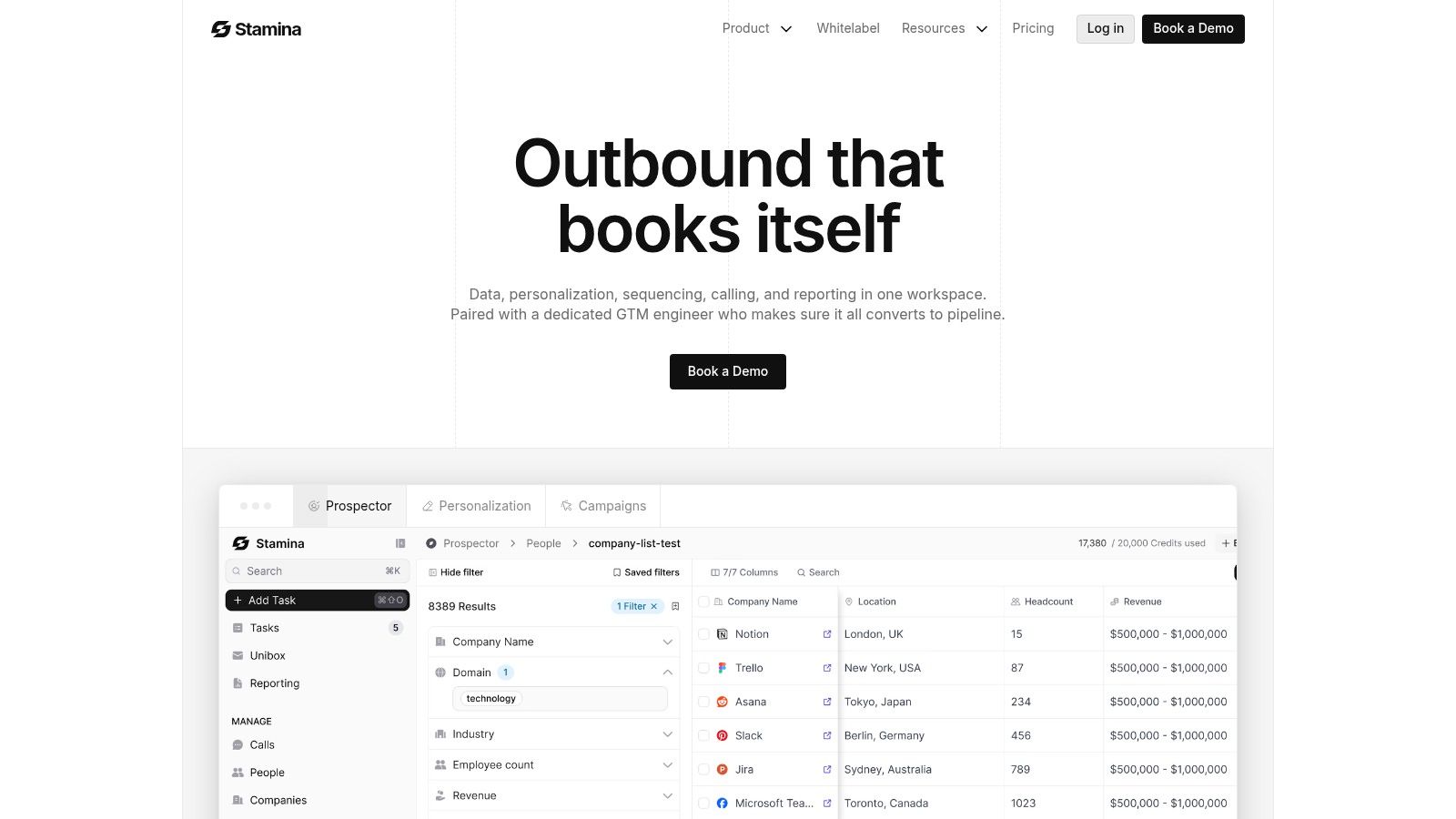
A specialized qualification engine
Qualification is where many generic tools fall apart. It's one thing to generate a nice email. It's another to identify whether a company is relevant, what problem signal matters, and what question should be asked next.
That's why purpose-built qualification matters. Microsoft reported that enterprise-grade AI Sales Qualification Agents achieved a 20% improvement in personalized outreach timeliness and 16% higher scores in precise engagement than standard LLMs when evaluated on real leads in its Sales Qualification Agent benchmark write-up.
What that means in practice is simple. Specialized systems are better at deciding what to say, when to say it, and how to move a lead toward a credible handoff.
Outbound automation with real orchestration
Modern platforms need more than sequences. They need decision-making.
A useful system should be able to trigger different actions based on replies, silence, account attributes, or CRM state. If a prospect opens but doesn't reply, the next action may differ from someone who asks a product question or someone whose company matches your ideal profile but isn't ready yet.
Core capabilities usually include:
Multi-step outreach logic: Not just send-step timing, but branching based on signals and replies
Persona-aware messaging: Different outreach paths for founders, operators, finance leaders, and technical buyers
Task routing: Qualified conversations go to the right rep, queue, or pipeline stage
Feedback loops: The system should improve from accepted, rejected, and edited outputs
A platform should help the team run the process, not just generate copy.
Here's a walkthrough format that illustrates what a more connected workflow can look like inside a sales platform:
CRM and workflow depth
Often, many buyers underestimate the difference between a demo and a durable system.
If the AI agent can't read account history, campaign engagement, previous conversations, owner assignments, and stage movement, it won't have enough context to act well. You'll get superficial personalization and brittle automation.
Operator's view: The more your AI agent knows about actual pipeline history, the less likely it is to send tone-deaf outreach or qualify the wrong account.
Strong platforms tie together:
Capability | Immediate job |
|---|---|
CRM sync | Keeps contact, company, and deal records current |
Engagement history | Prevents duplicate or misaligned outreach |
Workflow automation | Connects sales and marketing actions without manual handoffs |
Governance controls | Keeps humans in control of messaging, routing, and approvals |
The feature list matters less than the coordination. Good AI sales agent software acts like a system of execution, not a collection of isolated tricks.
The Business and Technical Benefits for SMBs
For SMBs, the benefit isn't “using AI.” The benefit is building a sales motion that scales without becoming chaotic.
When the repetitive top-of-funnel work gets systematized, senior reps spend more time in live selling situations. Managers spend less time chasing data. Marketing and sales stop arguing about whether a lead was followed up properly because the process leaves a clearer trail.
Business gains that actually matter
The most immediate upside shows up in workflow capacity.
More meetings from the same team: Reps can spend more of the week on conversations instead of prep work.
Faster lead response: Prospects get timely, relevant touchpoints while interest is still fresh.
Better rep utilization: Closers stop doing entry-level prospecting tasks that don't require their judgment.
Cleaner handoffs: Leads arrive with richer context, which improves discovery quality.
These improvements matter most in smaller teams because every wasted hour has a larger effect on pipeline coverage.
Technical gains that remove friction
A lot of SMB pain is technical, even when it looks like a people problem.
One system has lead data. Another has campaign history. Reps keep notes in inboxes. Someone exports a CSV to patch the gaps. Then leadership asks why reporting is inconsistent. The answer is usually that the stack was assembled tool by tool, not designed as a revenue workflow.
AI sales platforms can help when they create one operating layer across outreach, CRM, and follow-up.
That usually delivers:
A single working record: Teams see the same contact and company context.
Better data hygiene: The system updates fields and activity trails as work happens.
Scalable process control: New reps can plug into an existing workflow faster.
Cross-team visibility: Marketing, SDRs, and account executives stop working from separate versions of reality.
A good platform doesn't just automate outreach. It reduces the number of places your team has to remember, update, and reconcile information.
That's especially valuable for SMBs that can't afford a full revenue operations function but still need discipline in how leads move from attention to opportunity.
Your Buyer Checklist for AI Sales Agent Software
Buyers get into trouble when they judge AI sales agent software by demos alone. Most demos show polished message generation. Very few reveal how the product behaves when data is incomplete, a lead replies unexpectedly, or the CRM contains messy history.
The reliability gap is real. In benchmark testing summarized in this analysis of AI sales agent performance, top-tier AI sales agents can exceed 90% accuracy on realistic B2B tasks, while out-of-the-box LLMs often score around 45%. Broader testing showed even GPT-4o had a success rate under 50% across dynamic interactions, with qualification as the biggest failure point.
That should change how you buy.
What to evaluate before you sign
A strong buying process needs to test how the software handles real selling conditions, not just clean prompts in a vendor-controlled environment.
Evaluation Area | What to Ask | Why It Matters |
|---|---|---|
Qualification quality | How does the agent decide whether an account is a fit, and can we inspect that logic? | Qualification errors create wasted meetings and bad pipeline data. |
Personalization source | What data does the system use to personalize outreach beyond CRM merge fields? | Superficial personalization sounds automated and gets ignored. |
CRM depth | Does it write back activities, notes, statuses, and handoff context into the CRM? | If data stays trapped in the AI tool, your team loses visibility fast. |
Human control | Can reps approve, edit, pause, or override agent actions at key steps? | You need guardrails for brand tone, edge cases, and sensitive accounts. |
Learning loop | Does the platform learn from accepted edits, rejected outputs, and booked outcomes? | Static systems don't improve with your team's actual market feedback. |
Workflow flexibility | Can it branch actions by persona, lead source, reply type, or pipeline stage? | Real sales processes are conditional, not linear. |
Analytics | Can we see which messages, segments, and handoff patterns produce quality conversations? | You can't improve what the tool hides. |
Failure handling | What happens when the agent lacks enough context or receives an unusual reply? | Safe fallback behavior matters more than flashy first-touch output. |
Red flags that deserve skepticism
Some warning signs show up quickly in vendor conversations:
Generic LLM positioning: If the product sounds like a prompt wrapper, ask harder questions.
Weak qualification explanations: If the vendor can't explain how the agent reasons about fit, expect messy pipeline.
Little operational transparency: If you can't inspect decisions, your team won't trust the system.
No meaningful handoff design: If everything points toward full autonomy, the product may break at exactly the point where your brand is most exposed.
Buy for reliability under imperfect conditions, not for how polished the demo looked in a perfect one.
Implementing Your AI Sales Agent for Measured ROI
The fastest way to waste money on AI sales agent software is to hand it an entire sales cycle and hope for magic.
That approach fails because complex selling depends on context that usually lives in customer calls, objection handling, deal reviews, and hard-won pattern recognition from the team. Research highlighted by Strama on AI agent failures in sales tasks says AI agents have a 70% failure rate on complex sales tasks and that an assistive model yields the highest productivity gains.
Start with one narrow job
Pick a high-volume task that is repetitive, rule-based, and easy to inspect.
Good starting points include:
Initial lead qualification for inbound or outbound responses
First-pass research on target accounts before rep outreach
Follow-up drafting after demos, webinars, or form fills
Don't start with negotiation, pricing conversations, or nuanced deal rescue.
Build around human review
The highest-ROI rollout usually looks hybrid. The agent does the preparation and repetitive execution. Human reps handle interpretation, relationship management, and high-stakes moments.
That means designing explicit handoff points:
Agent owns: Data gathering, early outreach, routine follow-up, FAQ handling
Rep owns: Discovery depth, objection handling, commercial judgment, closing conversations
Manager owns: Review criteria, escalation rules, and quality control
A good reference for thinking through that orchestration is this guide to an AI agent workflow.
Feed the system real context
The agent needs more than a prospect list. It needs your positioning, account history, common objections, lost-deal reasons, and examples of strong sales conversations.
If you don't provide those inputs, the system will default to generic language. That's where many deployments disappoint. The software isn't failing because AI is useless. It's failing because the company gave it shallow context and too much autonomy.
Treat the agent like a new rep. Give it territory, rules, examples, and supervision. Don't expect judgment before training.
Measure outcomes, not novelty
Track whether the implementation improves actual selling flow. Look at meeting quality, handoff quality, response quality, and rep time recovered for live selling. If those move in the right direction, the rollout is working.
If all you can point to is “the AI sent a lot of emails,” you don't have ROI yet. You have activity.
Unify Your Stack with an All-in-One Platform
Most SMBs don't need more sales tools. They need fewer disconnected ones.
That's the hard lesson behind many AI rollouts. A generic model writes decent text, a sequencing tool sends it, the CRM holds partial history, marketing automation runs separately, and no one fully trusts the data. The result is more software but not a better revenue system.
The safer path is a platform that brings outreach, qualification, CRM context, and workflow orchestration into one place. That structure matters because assistive AI works best when it can operate from a complete record of the account and hand work off cleanly between teams.
An all-in-one setup also reduces the hidden cost of AI adoption. Your team doesn't have to maintain brittle integrations, duplicate data across systems, or decide which tool owns the customer timeline. Everyone works from the same source of truth, and the AI has better context for every action it takes.
If you're comparing architectures, this perspective on an all-in-one business platform is worth reviewing. The core idea is simple. Better AI outcomes usually come from better system design, not just better prompts.
The realistic takeaway is this. AI sales agent software can absolutely improve pipeline generation for SMBs, but the win rarely comes from full autonomy. It comes from a unified, assistive model that automates repetitive work, preserves human judgment, and keeps revenue data in one operating system.
If you want to see what that looks like in practice, Stamina brings AI-powered sales engagement, CRM, marketing automation, and cross-team workflows into one platform. It's built for SMBs that want more qualified pipeline without adding stack complexity.

