
79% of leads never convert when they're not nurtured, and only 3% of website visitors convert on a first visit, so most funnel problems start long before a landing page gets blamed. The practical answer to how to build sales funnels is not “make more pages.” It's to build a staged system that matches how people buy, then measure where they stall and fix that leak first, because the average B2B sales cycle lasts 84 days and 63% of buyers need at least three touchpoints before deciding, according to sales funnel statistics.
Why Most Sales Funnels Fail Before They Start
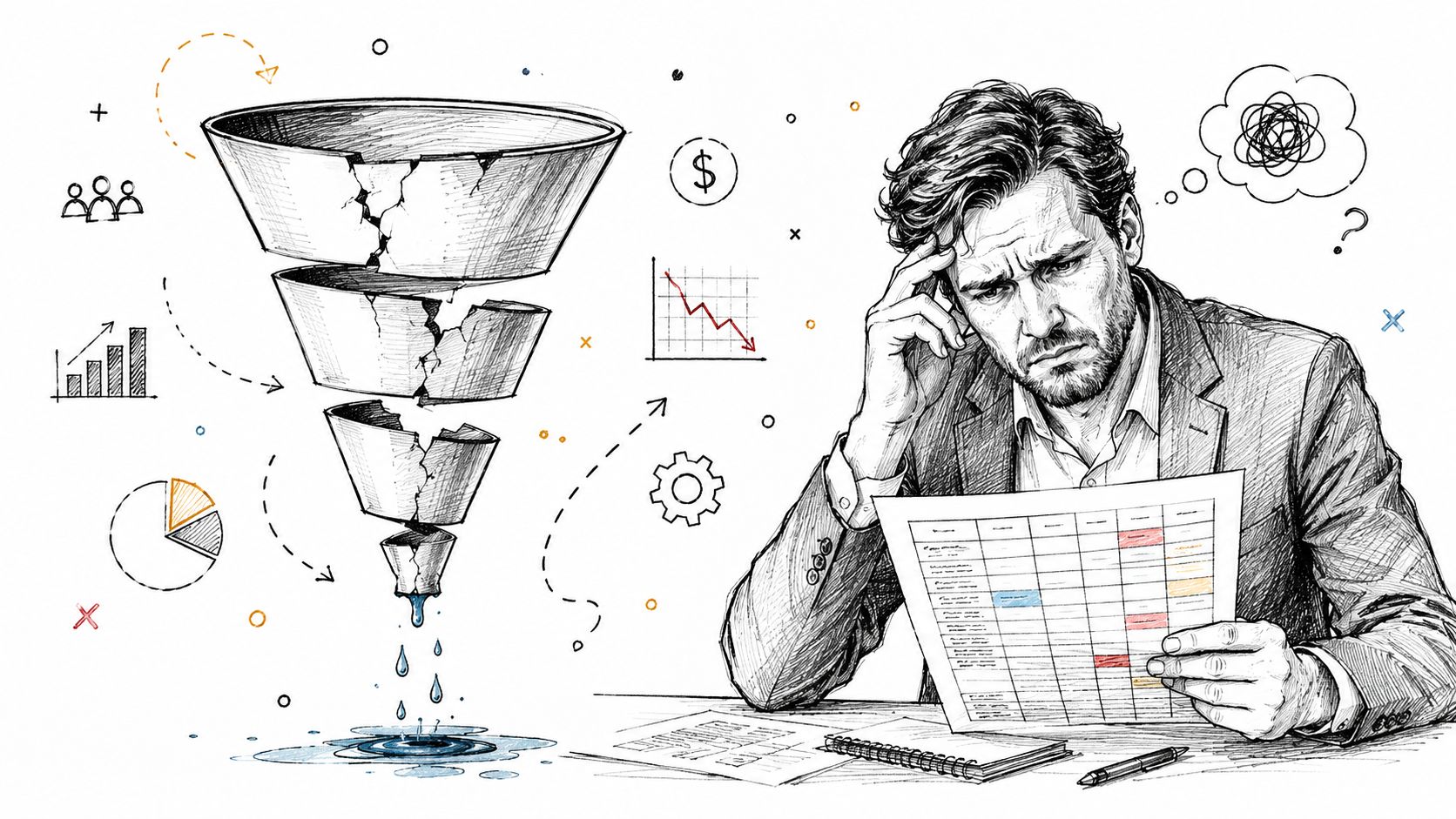
A lot of teams build a funnel like they're assembling a brochure. They start with a lead magnet, add an opt-in page, write five emails, and call it strategy. That usually fails because the problem isn't the assets, it's the lack of a real transition system between stages.
The data makes that obvious. If 79% of leads never convert because they're not nurtured and only 3% of visitors convert on the first visit, then a single message won't carry the deal across the line, especially when buyers need repeated exposure before they commit. The same benchmark set says the average B2B sales cycle is 84 days, which means your funnel has to survive time, objections, and distraction, not just initial interest. For a useful adjacent framework on pipeline hygiene, build a sales pipeline in 2026 is worth reading alongside this topic.
Practical rule: If you can't name the exact event that moves a lead from one stage to the next, you don't have a funnel yet. You have a content sequence.
A documented funnel does more than organize work. Businesses with a documented sales funnel generate 2.3x more ROI than those without one, and structured CRO programs deliver an average 223% ROI, which means the discipline is in the measurement, not the decoration. The practical takeaway is simple, and it shows up in sales process optimization work all the time. Define stage entry criteria, measure drop-off, and then improve the weakest transition one step at a time.
Defining Funnel Stages From Real Customer Data
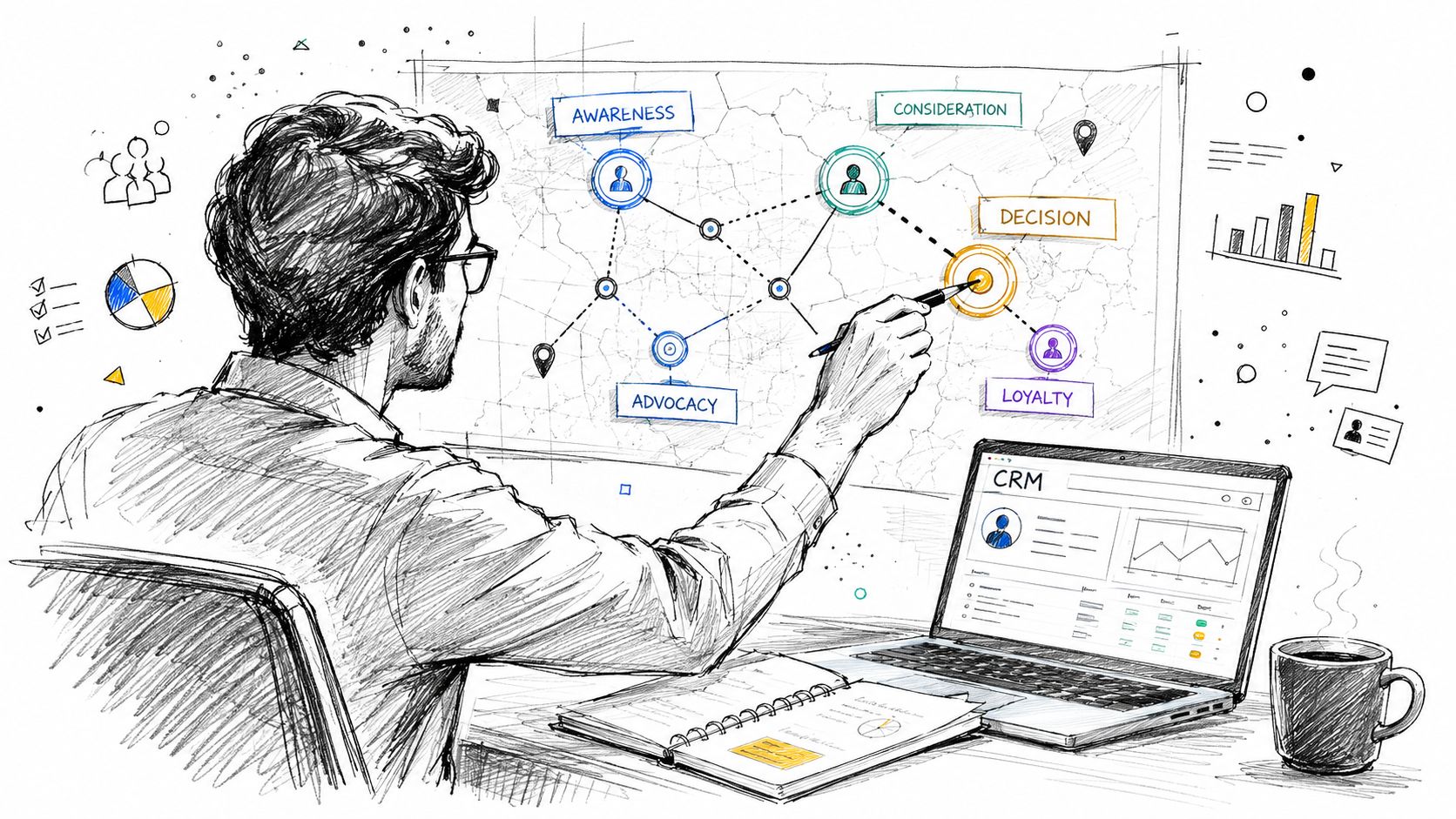
Generic AIDA models are tidy, but they often don't match how your buyers move. The cleaner approach is to build the funnel from your CRM history, win/loss notes, and customer interviews, then trim away every stage that doesn't reflect a real buying event. That's where a minimum viable funnel starts, one offer, one audience, one path from first click to purchase.
Start with the customers who already proved the model
Pull your best closed-won deals from the CRM and look for repeated patterns in company type, buying trigger, and stall points. Then compare those patterns with your loss reasons and the questions that came up in sales calls. A useful difference shows up fast, some prospects need education, others need reassurance, and a third group needs procurement help long before they're ready to sign.
That's why the ideal customer profile matters more than an abstract persona deck. When the ICP is clear, you can assign stage-specific content with a purpose, awareness content for the problem-aware buyer, decision content for the buyer comparing vendors, and action content for the one who's waiting on approval. A guide like Salesmotion B2B sales insights is helpful here because it keeps the focus on B2B motion, not generic consumer-style pathing.
Map the journey you actually sell through
A practical build usually runs from traffic source to opt-in, then email sequence, sales page, checkout or demo booking, and finally the thank-you step. The point isn't to force every customer through the same motions, it's to make each transition visible enough that you can spot the leak. If prospects go from awareness to quote request but disappear before a demo, that's a stage problem, not a traffic problem.
Define the qualification rules in writing. If a lead moves from interest to decision only after a demo request, pricing page visit, or response from a stakeholder, that transition needs to be explicit in your CRM and understood by sales and marketing.
One of the best operational habits is to create a stage only if you can answer two questions, what event proves the lead got here, and what content or follow-up should happen next. Anything else is noise.
A deeper, more technical version of this process is covered in customer data integration, because without shared data definitions, the funnel will drift back into opinion. And if you want a broader reference point on B2B structure, dashly's B2B sales funnel strategy shows why committee-stage thinking matters so much in longer deals.
Building Lead Capture and Nurture Sequences
A lead magnet only works if it moves the buyer forward. If it's a generic checklist, a recycled ebook, or a vague “ultimate guide,” you'll collect email addresses and very little intent. The better pattern is one offer, one problem, one conversion path.
Build the capture page around a single promise
The opt-in page should make one promise and one call to action. That means a focused headline, a short explanation of the outcome, and a form that asks only for what you need. Anything that distracts from that single decision lowers the chance that the visitor acts.
The lead magnet itself should solve a specific problem your ICP already feels. In practice, that might be a buying guide for first-time evaluators, a template for internal approval, or a comparison sheet for a late-stage shortlist. Don't build content to “look valuable,” build it to remove friction in the next buying step.
Use nurture to answer the next real objection
Short automated sequences work best when they deliver the resource immediately, then keep moving toward the offer. A simple pattern is resource delivery, problem framing, proof, and a direct next step. That sequence should feel like a guided follow-up from a rep, not a newsletter campaign pretending to be personal.
Practical rule: If the email can be sent to every lead without changing a word, it's probably too generic.
AI makes personalization scale here, but only if you feed it useful inputs. Use what the buyer clicked, what page they visited, what segment they belong to, and what language they used in forms or replies. That's how you generate email variants that sound specific without hand-writing every version.
Warm prospecting matters too. Website visitor signals and social engagement should trigger different branches than a cold list import, because someone who revisited pricing twice needs a different sequence than someone who just downloaded an ebook. That's why lead nurturing and marketing automation works best when the automation reacts to behavior, not just a timer.
If you're using human support to supplement the sequence, Hire SDRs can be part of the model for teams that want outbound coverage alongside automated nurture. The key is to keep the handoff clean, because a rep who ignores the prospect's recent behavior breaks the flow immediately.
Integrating CRM and Tracking Across the Funnel
A funnel without instrumentation is just a set of guesses. If sales and marketing can't see the same source, stage, and activity history, then every debate becomes anecdotal. The fix is to make the CRM the single source of truth for transition events, follow-up, and ownership.
Track stage movement, not just lead volume
Every stage needs a clear entry condition and a measurable exit condition. That lets you track conversion rate per stage and isolate where prospects stall instead of assuming the whole funnel is weak. If one stage leaks badly while the others are healthy, the fix is usually specific, not broad.
Shared qualification criteria matter here. Marketing should know what sales considers ready, and sales should know what behavior makes a lead nurture-worthy instead of disqualified. Once that agreement exists, automation can enforce the process instead of relying on memory.
Use automation to standardize the parts that should never vary
Automation is useful when it removes repetitive handoffs, not when it flattens every buyer into the same sequence. Trigger follow-up tasks when deals hit a stage, route leads by fit, and log engagement automatically so no rep has to rebuild context from scratch. The goal is consistency in execution, not sameness in messaging.
A clean integration also makes campaign audits easier. You can see which sequence produced the lead, what happened after the handoff, and whether the stage criteria matched buyer behavior. That's where marketing automation and CRM integration becomes operational, not theoretical.
A good dashboard doesn't tell you everything. It tells you where to look next.
For teams using more than one channel, the central question is whether all those actions land in one system with one reporting layer. If the answer is no, you'll end up optimizing isolated campaigns while the actual buyer journey stays hidden.
Measuring KPIs and Iterating for Growth
Many chase top-of-funnel volume because it's easy to count. The better operators watch where revenue accumulates or disappears, then adjust the stage with the weakest conversion. That habit matters because average funnel performance and top performance aren't close.
Metric | Average Performance | Top Performers |
|---|---|---|
Sales funnel conversion rate | About 2.35% to 7% across industries, according to sales funnel benchmarks | Above 5.31%, and in some benchmark sets 11% |
ROI from documented funnels | 2.3x more ROI than businesses without one, from sales funnel statistics | Stronger than undocumented systems because the process is measured |
CRO return | Average 223% ROI, or more than $3 back for every $1 invested, from sales funnel benchmarks | Better when testing is continuous and focused |
Automated funnel workflows | 53% more leads converted, from sales funnel benchmarks | Strongest when triggered by behavior, not only time |
Quarterly optimization | 10% to 30% revenue growth, from sales funnel benchmarks | Better when one variable is changed at a time |
The useful KPIs are the ones that change action. Stage-by-stage conversion rate tells you where the leak is. Time in stage shows whether the team is stuck on objections or slow to respond. Lead velocity reveals whether deals are moving, and revenue attribution tells you whether the right channels are attracting the right buyers.
The biggest measurement mistake is overreacting to a single metric. More traffic with worse downstream conversion is not progress. More demos with lower close rates is not progress either. If you changed messaging, channel mix, or lead qualification, document the change, wait for enough signal, and then compare the new results with the old path.
One clean iteration loop works well in SMB environments. Pick one bottleneck, test one change, review the outcome, and keep the winner if it improves the stage that mattered. That's slower than throwing ideas at the funnel, but it produces far cleaner learning.
Designing Funnels for Complex B2B Buying Committees
Simple funnels assume a single buyer. Real B2B deals often include a champion, a technical evaluator, an economic buyer, legal, procurement, and sometimes an executive sponsor who appears late and changes the deal shape. That's why a single lead status can hide the underlying risk in the account.
Build micro-stages around committee reality
Pre-demo qualification should check more than interest. You need to know whether the account has budget ownership, who will challenge the technical fit, and whether the buying motion is internal approval or vendor comparison. If you skip that, the deal looks healthy until it suddenly doesn't.
The content strategy changes too. One stakeholder wants proof of implementation speed, another cares about security posture, and another wants to understand commercial risk. Sending all of them the same nurture stream creates friction because their questions are different even when they share the same account.
Treat silence as a process event, not a dead end
Committee deals go quiet for reasons that have nothing to do with your offer. People are waiting on legal review, budget sign-off, or another stakeholder to return from leave. The best re-engagement sequences acknowledge that reality instead of pretending every silence means disinterest.
Practical rule: Re-engagement works better when it reflects the stage the account was in, not the last email you sent.
That's also where your CRM needs account-level visibility, not just contact-level updates. If one champion engaged heavily and then vanished, the account may still be active through another stakeholder. You need to see the committee, not just the latest responder.
The common mistake is to compress everything into one linear path because it looks simpler in a dashboard. In regulated industries and larger SMB deals, the path is rarely linear, and the funnel has to respect that complexity if you want reliable forecast and cleaner handoffs.
If you want a system that centralizes pipeline stages, automates follow-up, and gives you the visibility to build funnels from real buyer data instead of assumptions, visit Stamina and see how it connects marketing, sales, and CRM in one workflow. It's built for teams that need better qualification, smarter nurturing, and cleaner stage tracking without stitching together a pile of point tools.

