How to Improve Team Communication in 2026

Learn how to improve team communication with step-by-step processes, templates, and metrics built for SMBs, sales, and marketing teams in 2026.

0 - Minute Read

Your team doesn't have a communication problem because people are lazy. It has a communication problem because the system is broken.

The pattern is familiar. An SDR books a meeting, the AE walks in cold, the prospect repeats the same context twice, and marketing never hears why the deal stalled. Then someone asks for “better communication,” which usually means more Slack messages, more meetings, and more noise. That doesn't fix handoffs. It just buries them.

If you want to know how to improve team communication, stop treating it like a personality issue. Treat it like a revenue system. The right answer is clearer ownership, cleaner records, tighter handoffs, and channel rules that stop important information from scattering across tools. Google's Project Aristotle made the deeper point years ago, psychological safety matters more than who's on the team, because people need to speak up, ask questions, and surface risks early for communication to work at all. That's the foundation. The operating model still has to be designed.

A frustrated professional sitting at a desk with a laptop, reflecting on a lost business sales lead.

The Handoff That Cost a Deal

The deal looked fine from the SDR's side. The meeting was booked, the prospect had engaged, and the notes were in the CRM somewhere. Then the AE joined late, asked questions the prospect had already answered, and spent half the call trying to reconstruct what the SDR had heard. The prospect got impatient. Marketing never learned which objection killed momentum. That's not a people problem. That's a bad communication system.

The failure starts small. A qualification note gets buried in a thread. A promised next step lives in a Slack message instead of the record. A follow-up task depends on memory instead of ownership. By the time the pipeline review happens, the team is debating versions of the truth instead of moving a deal forward.

Practical rule: if a handoff can be lost in a chat thread, it will be lost in a chat thread.

The fix is not “communicate more.” It's “communicate in a way that survives context switching.” That means a single record for the deal, a written recap after the call, and a defined owner for the next move. It also means getting serious about what belongs in a live conversation versus what belongs in a durable system. If your sales process is already messy, the operational fix starts with the handoff logic, not with another meeting. See the broader operating model in sales process optimization.

For teams comparing how different workspaces support shared context, it's also worth reading SupportGPT integration tips as a reminder that information only helps when it's easy to find, reuse, and update.

Run a Communication Audit Before You Change Anything

Many teams reach for a new tool the moment communication gets painful. That's backwards. If you don't know whether the problem is unclear expectations, weak ownership, or people not feeling heard, you'll buy software to amplify the wrong behavior.

Start with an anonymous survey. Keep it blunt. Ask three questions, whether people feel heard, whether expectations are clear, and whether decision-making authority is understood. Those three answers tell you more than a dozen opinionated retrospectives. Then convert the results into SMART goals and a review cadence so the team knows exactly what should improve and when.

Use a one-page baseline

Build the audit on one page, not a sprawling initiative doc. Include the survey questions, the current channel mix, and a short list of operational metrics like response-time expectations, meeting action-item closure, and perceived clarity. The point is to create a starting line you can measure against.

A useful internal check is whether the team can answer these questions without debating terminology:

  • Who owns decisions?

  • Where do requests go?

  • How fast should responses happen?

  • What counts as done?

If those answers are fuzzy, the issue isn't attitude. It's design.

The cleanest way to tie the audit to action is to turn each complaint into a measurable operating rule. If people say they're not sure who approves what, define the approver. If people say updates get lost, define the channel. If people say follow-ups disappear, define the closure standard and review it on a regular timeline. That's why what is cross-team collaboration matters here. Cross-team friction usually shows up first as unclear ownership, not as open conflict.

Use the audit to stop guessing. If you can't measure the starting point, you can't prove the fix worked.

Meeting Routines and Written Records That Stick

Meetings fail when they produce conversation but not memory. Strong teams do the opposite. They use meetings to make decisions, then they write those decisions down in a place everyone can find later. That's the key difference between productive communication and expensive noise.

A simple meeting rhythm that works

Use a daily standup for status and blockers, not brainstorming. Keep it short and structured. Each person should cover what moved, what's stuck, and what needs help. For a weekly cross-functional sync, use the same skeleton every time, priorities, risks, decisions, owners, and deadlines. If a topic needs nuance, use a call. If it's routine, use async. If it's sensitive, use a direct conversation before you put it in writing.

The active listening part matters more than most leaders admit. Don't interrupt. Paraphrase the key point before you respond. Ask one clarifying question when something is ambiguous. Then capture the outcome in writing before the meeting ends. That combination prevents the classic “I thought we agreed” argument that burns time and trust.

Here's the meeting record I'd paste into any SMB team's workflow:

  • Decision made: what was approved or rejected.

  • Owner assigned: who is responsible.

  • Deadline set: when it's due.

  • Open question: what still needs resolution.

  • Follow-up sent: the written recap goes out fast.

If you're comparing tools, compare leading collaboration platforms with one question in mind, can this stack make decisions visible and reusable, or is it just another place to lose context?

A top-down sketch of a brainstorming team sitting around a circular table with notebooks and sticky notes.

SDR to AE Handoffs and Campaign Briefs That Actually Work

This is where communication stops being abstract. If you run sales and marketing in an SMB, the handoff script and the campaign brief are the difference between momentum and rework. Both should live in the same CRM record so the SDR, AE, and marketer are looking at the same facts, not three different versions of them. One place to keep that shared record is Stamina, which centralizes CRM, workflows, and AI-assisted outreach in one workspace.

Use the same handoff fields every time

The SDR-to-AE handoff should be copyable, not improvised. Here's the sequence I'd standardize:

  1. Lead context. Who is the account, what's their role, and why did they engage?

  2. Trigger event. What caused the interest, inbound form fill, reply, webinar attendance, site visit, or referral?

  3. Qualification notes. What pain, priority, or timeline was confirmed?

  4. What was promised. What did the SDR tell the prospect the AE would cover?

  5. Risks or objections. What hesitation showed up, even lightly?

  6. Next step owner. Who owns the next action, and by when?

That format matters because it removes guesswork. The AE doesn't need a recap call. The SDR doesn't need to restate the same context in Slack. The prospect doesn't have to repeat themselves.

Write the campaign brief like a contract

Marketing and sales need the same brief structure for every campaign. Don't start with creative. Start with alignment.

  • Offer: what is being promoted?

  • Audience: who is it for, and who is it not for?

  • Pain point: what problem is this meant to solve?

  • Proof: what evidence can be used in messaging?

  • Follow-up sequence: what happens after the first response?

  • Feedback loop: what objections should sales report back?

When that brief is clean, closed-lost notes become fuel instead of dead ends. If buyers keep pushing back on the same issue, the next campaign should acknowledge it directly. That loop belongs in the record, not in someone's memory. For a deeper operating view on lead qualification alignment, use marketing qualified leads as a reference point.

Don't let the AE become the first person to discover the buyer's real objection. By then, the message is already too late.

Design the Communication System, Not Just the Behavior

Telling people to “be clearer” rarely solves anything. Clearer language helps, but it doesn't fix channel chaos, unclear escalation paths, or duplicated tools. A communication charter does.

Build a charter with rules, not slogans

Write down which channel is used for what. Keep it simple. Use one channel for urgent issues, another for routine updates, and another for documentation. Set response windows so people know what's expected. Define who can escalate, and when. If a topic is sensitive, use synchronous conversation first. If it's a status update, keep it asynchronous. If it requires a decision, capture the owner in writing.

That's the part many teams skip. They add chat, project tools, and email, then assume discipline will emerge. It won't. You need explicit rules for message type, response timing, and decision capture. The charter should also cover meeting-prep expectations, who takes notes, and where the final record lives.

Remove duplicate paths on purpose

Audit redundant channels. If the same update appears in Slack, email, a project tool, and a spreadsheet, you don't have a communication system. You have four competing systems. Assign one tool per use case and make the team stick to it. Rotate note-takers so one person isn't always the bottleneck for documentation.

For teams looking at message discipline, read messaging strategy tips and compare them against your own escalation rules. The useful question isn't whether your team talks a lot. It's whether the right people see the right information fast enough to act.

Stamina fits this operating model when you want sales, marketing, CRM, and automation to live in the same workspace instead of in disconnected point tools. That's the exact kind of system that reduces handoff drift and makes ownership visible. The point is not the brand. The point is the single source of truth.
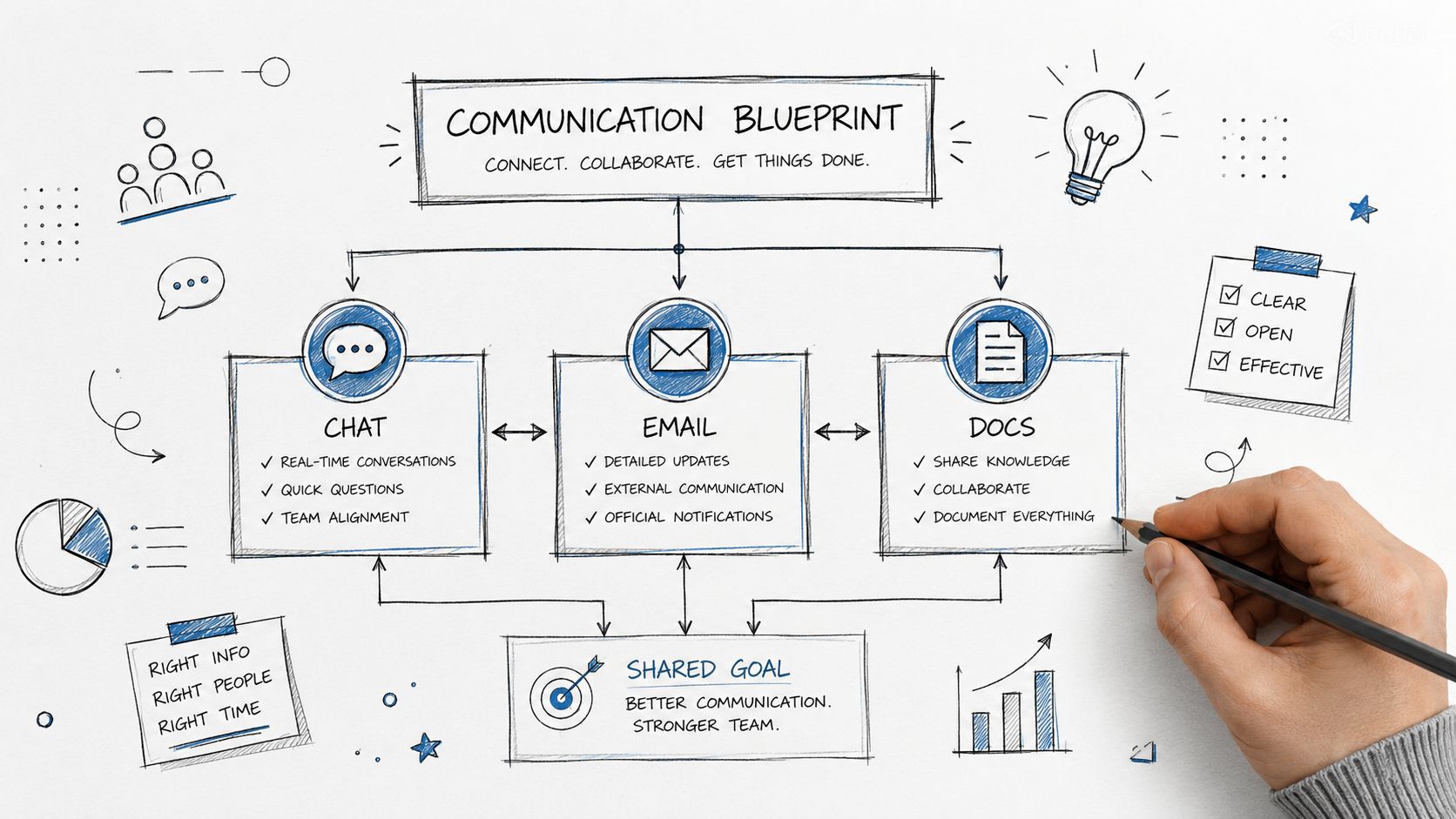
A hand drawn diagram illustrating a communication blueprint with chat, email, and documentation strategies for teams.

Metrics That Prove Communication Is Improving

If you're not measuring communication, you're guessing. The scorecard should be small enough to review in one meeting and concrete enough to tell you where the breakdown lives. Don't track vanity activity. Track the points where communication either creates momentum or creates rework.

Metric

What it measures

How to calculate

Starting benchmark

Response time within channel

Whether people are answering in the channel they're supposed to use

Measure the time from request to first useful reply

Set a clear expectation by channel and review it regularly

Meeting action-item closure rate

Whether meetings produce completed work

Count action items closed on time versus opened in the period

Start by tracking every action item from a single recurring meeting

Clarification rework rate

How often people have to restate or reinterpret the same request

Count repeated clarifications on the same topic

Baseline the current level before changing tools or formats

Lead-to-opportunity conversion after handoff

Whether SDR-to-AE transfer quality is holding up

Compare handoffs that turn into opportunities against total handoffs

Use the current handoff process as the starting point

Clarity score

Whether people feel expectations and ownership are clear

Repeat the audit survey and average the clarity responses

Use the first anonymous audit as the baseline

Review the scorecard on a steady cadence, not every time someone gets annoyed. Response time is useful only if replies are useful. A fast empty response is still a failure. Meeting closure matters because it tells you whether the room is producing decisions or just discussion. Clarification rework matters because it exposes ambiguity that keeps coming back.

The most important part is consistency. Run the same scorecard long enough to see whether the system is improving or just changing shape.

Your 30-Day Communication Rollout

Don't try to fix everything at once. Run the rollout in four weeks and keep the sequence tight.

Week 1, audit. Send the anonymous survey, review the current channels, and identify the top three breakdowns. Write them down in plain language. No buzzwords, no abstract diagnoses.

Week 2, charter. Publish the channel rules, response windows, and escalation path. Decide what belongs in a call, what belongs in Slack, and what must be written into the record. Make ownership explicit.

Week 3, templates. Roll out the meeting summary format, the SDR-to-AE handoff structure, and the campaign brief. Put them where people already work, not in some dusty folder nobody opens.

Week 4, review. Look at the scorecard, compare it against the baseline, and remove whatever is creating friction. If a rule isn't being followed, the rule is either unclear or unrealistic.

The three mistakes to avoid are obvious. Don't skip the baseline. Don't add tools before fixing the process. Don't measure activity and call it progress. Communication scales when the system carries the load, not when everyone tries harder in the moment.

If your team keeps losing context between sales, marketing, and CRM, start by tightening the record, not by asking people to be more careful. Build the charter, enforce the handoff, and make the workflow visible. That's how SMB teams stop leaking deals and start moving in sync.

A CTA for Stamina.

Your team doesn't have a communication problem because people are lazy. It has a communication problem because the system is broken.

The pattern is familiar. An SDR books a meeting, the AE walks in cold, the prospect repeats the same context twice, and marketing never hears why the deal stalled. Then someone asks for “better communication,” which usually means more Slack messages, more meetings, and more noise. That doesn't fix handoffs. It just buries them.

If you want to know how to improve team communication, stop treating it like a personality issue. Treat it like a revenue system. The right answer is clearer ownership, cleaner records, tighter handoffs, and channel rules that stop important information from scattering across tools. Google's Project Aristotle made the deeper point years ago, psychological safety matters more than who's on the team, because people need to speak up, ask questions, and surface risks early for communication to work at all. That's the foundation. The operating model still has to be designed.

A frustrated professional sitting at a desk with a laptop, reflecting on a lost business sales lead.

The Handoff That Cost a Deal

The deal looked fine from the SDR's side. The meeting was booked, the prospect had engaged, and the notes were in the CRM somewhere. Then the AE joined late, asked questions the prospect had already answered, and spent half the call trying to reconstruct what the SDR had heard. The prospect got impatient. Marketing never learned which objection killed momentum. That's not a people problem. That's a bad communication system.

The failure starts small. A qualification note gets buried in a thread. A promised next step lives in a Slack message instead of the record. A follow-up task depends on memory instead of ownership. By the time the pipeline review happens, the team is debating versions of the truth instead of moving a deal forward.

Practical rule: if a handoff can be lost in a chat thread, it will be lost in a chat thread.

The fix is not “communicate more.” It's “communicate in a way that survives context switching.” That means a single record for the deal, a written recap after the call, and a defined owner for the next move. It also means getting serious about what belongs in a live conversation versus what belongs in a durable system. If your sales process is already messy, the operational fix starts with the handoff logic, not with another meeting. See the broader operating model in sales process optimization.

For teams comparing how different workspaces support shared context, it's also worth reading SupportGPT integration tips as a reminder that information only helps when it's easy to find, reuse, and update.

Run a Communication Audit Before You Change Anything

Many teams reach for a new tool the moment communication gets painful. That's backwards. If you don't know whether the problem is unclear expectations, weak ownership, or people not feeling heard, you'll buy software to amplify the wrong behavior.

Start with an anonymous survey. Keep it blunt. Ask three questions, whether people feel heard, whether expectations are clear, and whether decision-making authority is understood. Those three answers tell you more than a dozen opinionated retrospectives. Then convert the results into SMART goals and a review cadence so the team knows exactly what should improve and when.

Use a one-page baseline

Build the audit on one page, not a sprawling initiative doc. Include the survey questions, the current channel mix, and a short list of operational metrics like response-time expectations, meeting action-item closure, and perceived clarity. The point is to create a starting line you can measure against.

A useful internal check is whether the team can answer these questions without debating terminology:

  • Who owns decisions?

  • Where do requests go?

  • How fast should responses happen?

  • What counts as done?

If those answers are fuzzy, the issue isn't attitude. It's design.

The cleanest way to tie the audit to action is to turn each complaint into a measurable operating rule. If people say they're not sure who approves what, define the approver. If people say updates get lost, define the channel. If people say follow-ups disappear, define the closure standard and review it on a regular timeline. That's why what is cross-team collaboration matters here. Cross-team friction usually shows up first as unclear ownership, not as open conflict.

Use the audit to stop guessing. If you can't measure the starting point, you can't prove the fix worked.

Meeting Routines and Written Records That Stick

Meetings fail when they produce conversation but not memory. Strong teams do the opposite. They use meetings to make decisions, then they write those decisions down in a place everyone can find later. That's the key difference between productive communication and expensive noise.

A simple meeting rhythm that works

Use a daily standup for status and blockers, not brainstorming. Keep it short and structured. Each person should cover what moved, what's stuck, and what needs help. For a weekly cross-functional sync, use the same skeleton every time, priorities, risks, decisions, owners, and deadlines. If a topic needs nuance, use a call. If it's routine, use async. If it's sensitive, use a direct conversation before you put it in writing.

The active listening part matters more than most leaders admit. Don't interrupt. Paraphrase the key point before you respond. Ask one clarifying question when something is ambiguous. Then capture the outcome in writing before the meeting ends. That combination prevents the classic “I thought we agreed” argument that burns time and trust.

Here's the meeting record I'd paste into any SMB team's workflow:

  • Decision made: what was approved or rejected.

  • Owner assigned: who is responsible.

  • Deadline set: when it's due.

  • Open question: what still needs resolution.

  • Follow-up sent: the written recap goes out fast.

If you're comparing tools, compare leading collaboration platforms with one question in mind, can this stack make decisions visible and reusable, or is it just another place to lose context?

A top-down sketch of a brainstorming team sitting around a circular table with notebooks and sticky notes.

SDR to AE Handoffs and Campaign Briefs That Actually Work

This is where communication stops being abstract. If you run sales and marketing in an SMB, the handoff script and the campaign brief are the difference between momentum and rework. Both should live in the same CRM record so the SDR, AE, and marketer are looking at the same facts, not three different versions of them. One place to keep that shared record is Stamina, which centralizes CRM, workflows, and AI-assisted outreach in one workspace.

Use the same handoff fields every time

The SDR-to-AE handoff should be copyable, not improvised. Here's the sequence I'd standardize:

  1. Lead context. Who is the account, what's their role, and why did they engage?

  2. Trigger event. What caused the interest, inbound form fill, reply, webinar attendance, site visit, or referral?

  3. Qualification notes. What pain, priority, or timeline was confirmed?

  4. What was promised. What did the SDR tell the prospect the AE would cover?

  5. Risks or objections. What hesitation showed up, even lightly?

  6. Next step owner. Who owns the next action, and by when?

That format matters because it removes guesswork. The AE doesn't need a recap call. The SDR doesn't need to restate the same context in Slack. The prospect doesn't have to repeat themselves.

Write the campaign brief like a contract

Marketing and sales need the same brief structure for every campaign. Don't start with creative. Start with alignment.

  • Offer: what is being promoted?

  • Audience: who is it for, and who is it not for?

  • Pain point: what problem is this meant to solve?

  • Proof: what evidence can be used in messaging?

  • Follow-up sequence: what happens after the first response?

  • Feedback loop: what objections should sales report back?

When that brief is clean, closed-lost notes become fuel instead of dead ends. If buyers keep pushing back on the same issue, the next campaign should acknowledge it directly. That loop belongs in the record, not in someone's memory. For a deeper operating view on lead qualification alignment, use marketing qualified leads as a reference point.

Don't let the AE become the first person to discover the buyer's real objection. By then, the message is already too late.

Design the Communication System, Not Just the Behavior

Telling people to “be clearer” rarely solves anything. Clearer language helps, but it doesn't fix channel chaos, unclear escalation paths, or duplicated tools. A communication charter does.

Build a charter with rules, not slogans

Write down which channel is used for what. Keep it simple. Use one channel for urgent issues, another for routine updates, and another for documentation. Set response windows so people know what's expected. Define who can escalate, and when. If a topic is sensitive, use synchronous conversation first. If it's a status update, keep it asynchronous. If it requires a decision, capture the owner in writing.

That's the part many teams skip. They add chat, project tools, and email, then assume discipline will emerge. It won't. You need explicit rules for message type, response timing, and decision capture. The charter should also cover meeting-prep expectations, who takes notes, and where the final record lives.

Remove duplicate paths on purpose

Audit redundant channels. If the same update appears in Slack, email, a project tool, and a spreadsheet, you don't have a communication system. You have four competing systems. Assign one tool per use case and make the team stick to it. Rotate note-takers so one person isn't always the bottleneck for documentation.

For teams looking at message discipline, read messaging strategy tips and compare them against your own escalation rules. The useful question isn't whether your team talks a lot. It's whether the right people see the right information fast enough to act.

Stamina fits this operating model when you want sales, marketing, CRM, and automation to live in the same workspace instead of in disconnected point tools. That's the exact kind of system that reduces handoff drift and makes ownership visible. The point is not the brand. The point is the single source of truth.

A hand drawn diagram illustrating a communication blueprint with chat, email, and documentation strategies for teams.

Metrics That Prove Communication Is Improving

If you're not measuring communication, you're guessing. The scorecard should be small enough to review in one meeting and concrete enough to tell you where the breakdown lives. Don't track vanity activity. Track the points where communication either creates momentum or creates rework.

Metric

What it measures

How to calculate

Starting benchmark

Response time within channel

Whether people are answering in the channel they're supposed to use

Measure the time from request to first useful reply

Set a clear expectation by channel and review it regularly

Meeting action-item closure rate

Whether meetings produce completed work

Count action items closed on time versus opened in the period

Start by tracking every action item from a single recurring meeting

Clarification rework rate

How often people have to restate or reinterpret the same request

Count repeated clarifications on the same topic

Baseline the current level before changing tools or formats

Lead-to-opportunity conversion after handoff

Whether SDR-to-AE transfer quality is holding up

Compare handoffs that turn into opportunities against total handoffs

Use the current handoff process as the starting point

Clarity score

Whether people feel expectations and ownership are clear

Repeat the audit survey and average the clarity responses

Use the first anonymous audit as the baseline

Review the scorecard on a steady cadence, not every time someone gets annoyed. Response time is useful only if replies are useful. A fast empty response is still a failure. Meeting closure matters because it tells you whether the room is producing decisions or just discussion. Clarification rework matters because it exposes ambiguity that keeps coming back.

The most important part is consistency. Run the same scorecard long enough to see whether the system is improving or just changing shape.

Your 30-Day Communication Rollout

Don't try to fix everything at once. Run the rollout in four weeks and keep the sequence tight.

Week 1, audit. Send the anonymous survey, review the current channels, and identify the top three breakdowns. Write them down in plain language. No buzzwords, no abstract diagnoses.

Week 2, charter. Publish the channel rules, response windows, and escalation path. Decide what belongs in a call, what belongs in Slack, and what must be written into the record. Make ownership explicit.

Week 3, templates. Roll out the meeting summary format, the SDR-to-AE handoff structure, and the campaign brief. Put them where people already work, not in some dusty folder nobody opens.

Week 4, review. Look at the scorecard, compare it against the baseline, and remove whatever is creating friction. If a rule isn't being followed, the rule is either unclear or unrealistic.

The three mistakes to avoid are obvious. Don't skip the baseline. Don't add tools before fixing the process. Don't measure activity and call it progress. Communication scales when the system carries the load, not when everyone tries harder in the moment.

If your team keeps losing context between sales, marketing, and CRM, start by tightening the record, not by asking people to be more careful. Build the charter, enforce the handoff, and make the workflow visible. That's how SMB teams stop leaking deals and start moving in sync.

A CTA for Stamina.

Share this article

Share this article

Send a shareable link to your team or anyone who might find it useful.

Send a shareable link to your team or anyone who might find it useful.

Copy link

Copied

Share directly to

Table of contents

Give Your Business the Stamina it needs to Thrive

PRODUCT

COMPANY

RESOURCES

© 2026 Stamina Software Technologies Inc. All rights reserved.

PRODUCT

COMPANY

RESOURCES

© 2026 Stamina Software Technologies Inc. All rights reserved.

PRODUCT

COMPANY

RESOURCES

© 2026 Stamina Software Technologies Inc. All rights reserved.