
Here's the short answer: lead generation for consultants is a hybrid system built on trust signals, a clear offer, and repeatable sequences that turn credibility into conversations. The goal isn't more outreach—it's engineering trust at scale.
How Consulting Pipelines Actually Form
Most consulting deals start with a human moment, not a cold list. A former colleague mentions your name. A prospect reads your article and thinks, "This person gets it." Someone in their network vouches for your work. That's where the real pipeline begins.
Understanding where opportunities actually come from helps you stop guessing and start building a system that compounds. Here's the breakdown:
Where Consulting Pipeline Actually Comes From
Channel | Share of Consulting Opportunities | Role in the Funnel |
|---|---|---|
Referrals and Partner Intros | 45% | Validation and warm entry to decision makers |
Content and Social Proof | 30% | Discovery and credibility building |
Outbound and Paid | 25% | Targeted sourcing and fill-in demand |
Referrals convert highest because they carry built-in trust. Content multiplies your credibility by working while you sleep. Outbound fills predictable gaps when you need to keep the pipeline moving. The smartest consultants don't pick one—they build all three, with referrals as the foundation.
Mindset Shift: From Chasing Leads to Engineering Trust
Here's where most consultants get it wrong. They treat lead generation as a numbers game—more emails, more calls, more pitches. But buyers aren't responding to volume. They're responding to evidence that you understand their problem and can solve it.
Start by auditing one recent win. Map how that client found you, who introduced you, and what content reassured them before they ever booked a call. I worked with a fractional HR consultant who discovered 60% of her closed deals referenced a single LinkedIn thread where she explained a diagnostic framework. That thread did more selling than any outreach campaign ever could.
She turned that thread into a short benchmark and a two-email nurture sequence. Three diagnostics booked in six weeks. No cold lists, no spammy follow-ups—just credibility doing the heavy lifting.
The playbook looks like this:
Define a single, repeatable diagnostic you offer
Create one short case study with real numbers
Build a 4-touch sequence: connection, value note, social proof, soft ask
Focus on sequences that feel like human follow-up and respect buyer judgment
Quick Action Checklist
If you're ready to put this into practice, here's where to start:
List your top three referral sources and double down with partner outreach.
Turn one client conversation into a LinkedIn post, an article, and an email.
Draft a three-message outreach sequence that cites a specific problem and outcome.
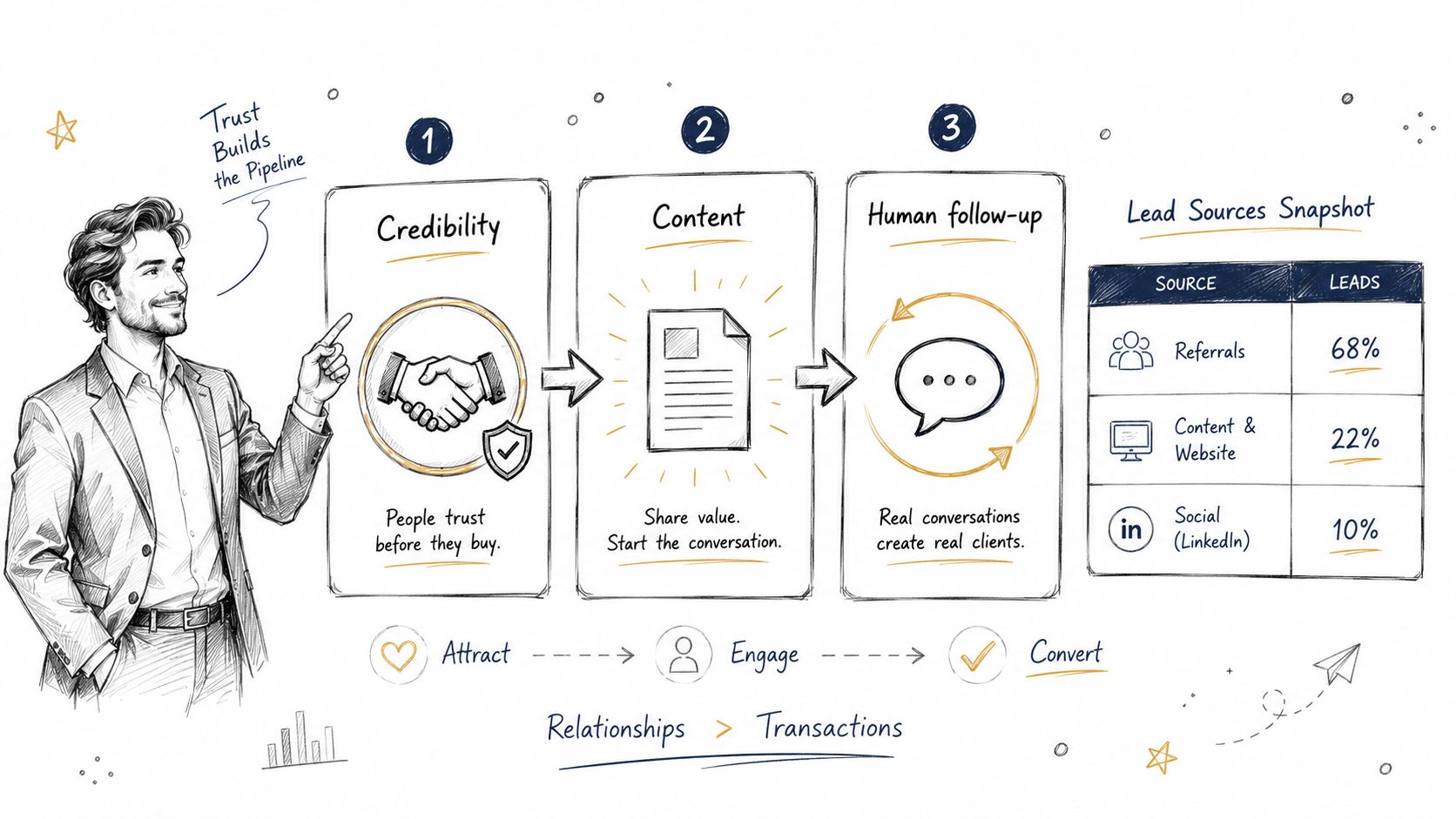
If your current motion relies on single-touch outreach, reallocate effort to credibility-first content and a small, predictable outbound cadence that supports your referrals. The consultants who win in 2026 aren't the loudest—they're the most trusted.
Defining Your Ideal Client Profile And Core Offer
Most consultants skip the quiet work that powers every channel: getting precise about who you sell to and what you promise them.
Layer firmographics with psychographics and trigger events so the ICP reads like one real person, not a generic SMB bucket. This clarity makes messaging easy to write and outreach much more efficient, which directly improves lead generation for consultants.
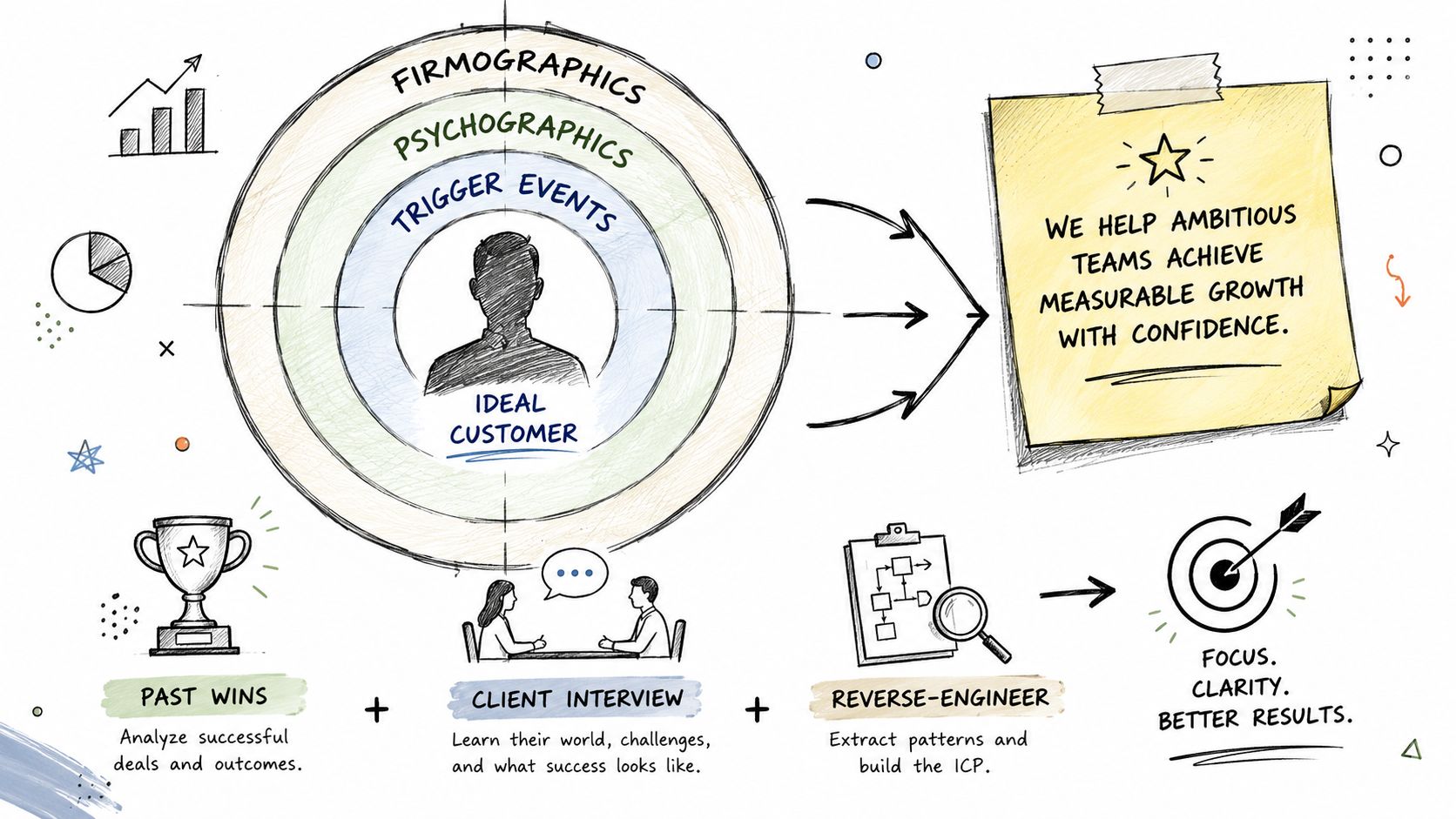
Start by reverse-engineering past wins. List five closed engagements, note the buyer title, company size, trigger event, decision timeline, and the one outcome you delivered. This reveals patterns you can use to draft a focused ICP that's defensible in a room.
Practical Exercises To Define ICP
Interview three recent clients with a 10-minute guide that asks why they chose you and what made the decision easy.
Map trigger events such as funding rounds, leadership changes, or regulatory shifts that preceded engagements.
Create a one-paragraph buyer persona that includes day-in-the-life pain points and a quote you could use in outreach.
Narrowing your ICP is the single change that reduces wasted outreach and raises reply rates.
Translate expertise into a single, repeatable offer that's outcome-driven. Don't sell capabilities; sell an immediately understandable result someone can explain to their boss on a flight home.
For example: "We design a 90-day hiring plan that reduces churn by 30% for early-stage SaaS GTM teams."
Writing Your One-Sentence Value Proposition
Identify the buyer and environment (who and context).
State the problem and the measurable outcome.
Add timeframe or scope to make it tangible.
Numbered examples help:
For Series A SaaS VP People who face rapid hiring, I deliver a 90-day hiring plan that cuts first-year churn by 30%.
For mid-market retail CFOs handling inventory waste, I deliver a 6-week margin recovery audit that uncovers $120k in avoidable losses.
Use your ICP and value sentence to craft targeted outreach and content. You'll write to one person, create case studies that resonate, and design outreach sequences that cite relevant trigger events.
Real-World Scenario
A consultant moved from "SMB HR" to "Series A SaaS VP People" and replaced broad messages with a single diagnostic offer. Reply rates jumped from 4% to 18% in four weeks without increasing send volume, proving clarity trumps volume.
Read also: Learn more about defining an Ideal Customer Profile in our guide (https://stamina.io/blog/what-is-an-ideal-customer-profile)
Building a Content Engine That Validates Expertise
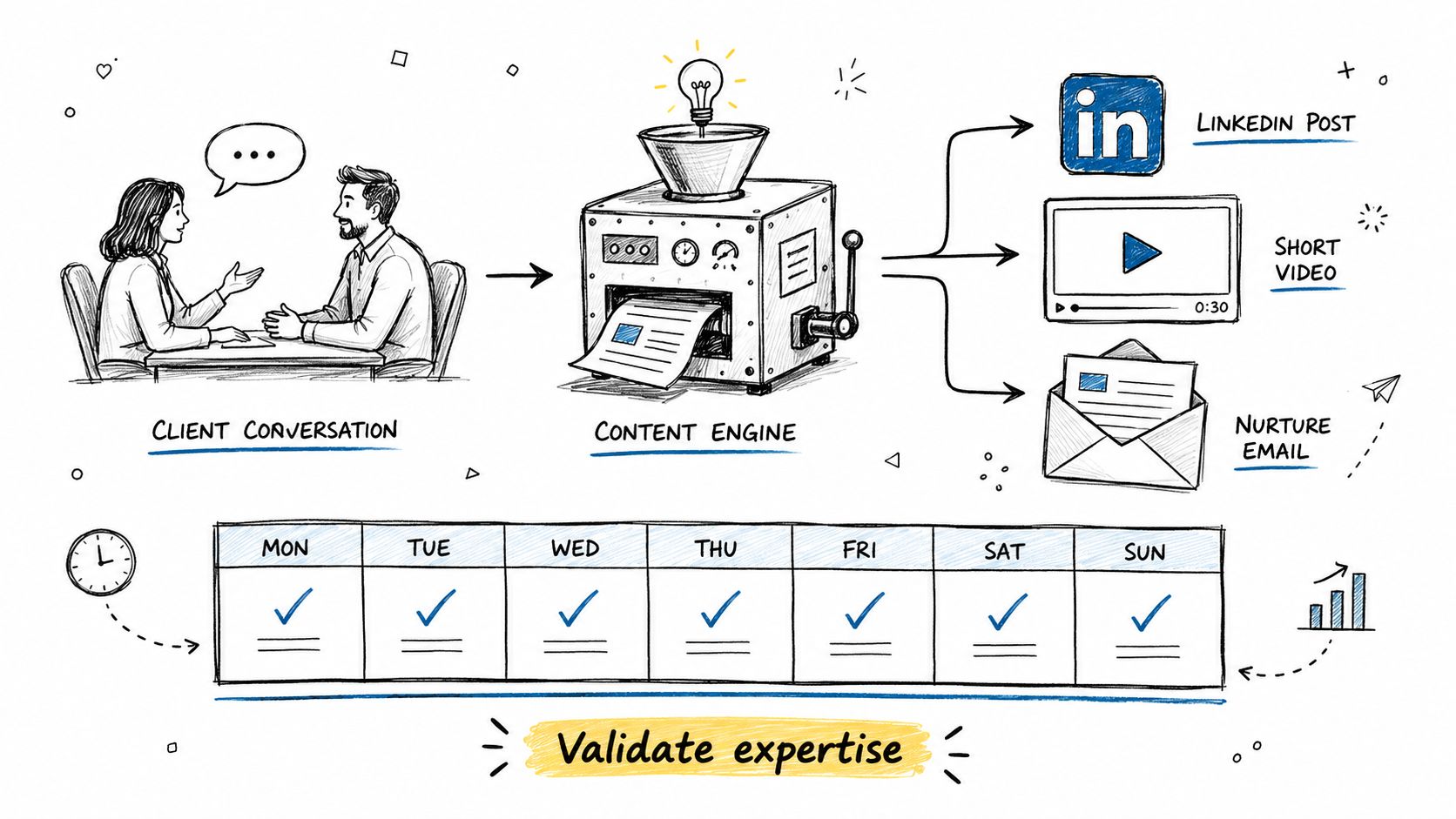
Trust sells consulting, and content is how you build that trust before the first call even happens.
Pick three formats that prove your thinking rather than just bragging about results: diagnostic frameworks, anonymized case studies, and short video breakdowns. These map directly to buyer pain points and work across channels, especially LinkedIn where 80% of social B2B discovery still happens.
Plan a weekly cadence that a solo consultant can actually sustain. One pillar post, two short LinkedIn threads, and one repurposed video clip. This rhythm compounds over time: pillar posts become reference assets, threads spark discovery, and clips feed your nurture sequences.
Weekly Cadence Example
Monday – Publish a 900–1,200 word pillar article that teaches a diagnostic step.
Wednesday – Post a two-thread LinkedIn sequence that excerpts the framework with a clear client outcome.
Friday – Share a 60–90 second video or carousel showing the method applied to an anonymized client.
Publish steadily rather than chasing virality; a consistent habit outperforms spikes.
Repurposing multiplies your output without eating into client time. Take one client call and create:
A 300-word LinkedIn post highlighting a single insight
A short article that expands the diagnostic
A two-email nurture sequence delivering the article and a related checklist
Practical Repurposing Template
Capture – Record a 15-minute debrief after the call.
Extract – Pull 3 concrete metrics or decisions from the discussion.
Craft – Write one LinkedIn thread, one article, and one nurture email referencing those metrics.
Distribution Tactics
Post the LinkedIn thread with a CTA to download the article.
Use the article as a gated summary in nurture emails.
Promote the video clip in a follow-up LinkedIn message to warm prospects.
Include real examples so readers see the method in action. One HR consultant turned a single diagnostic into a LinkedIn thread and a one-page benchmark, then booked three diagnostics in six weeks.
Measure content by qualified leads sourced, engagement on LinkedIn, and demo show rate.
Publishing Rule of Thumb One repeatable diagnostic, published weekly, repurposed across three formats — do that for eight weeks and you'll have both credibility and a steady pipeline to act on Monday morning.
Read more about marketing an ebook in our guide.
Running Multi-Channel Outreach Without Burning Trust

Outreach works best when it supports your referrals and content, not when it tries to do everything on its own. Start by tracking where each prospect first encountered you—maybe it was a LinkedIn post, a blog article, or a partner recommendation. That context shapes every follow-up, so your message feels like a conversation continuation rather than cold noise.
Research should drive the process. Personalization that reflects actual judgment about a prospect's situation lands far better than a mail-merge with their first name.
Break your outreach into four coordinated channels, each with a clear job:
LinkedIn warm sequences for connection and visibility, fueled by your posts and profile credibility
Email cadences for deeper value delivery—think one-pager benchmarks or case summaries
Partnership intros that bring in highly qualified warm leads without ad spend
A small paid retargeting layer to nudge people who already visited your site or engaged with content
Example Outreach Sequence With Realistic Timing
A sequence that respects how advisory buyers actually make decisions might look like this:
Connection request referencing something specific they shared or accomplished recently
Two days later, a short value note linking a relevant case study
One week after that, a benchmark or anonymized client outcome in their space
Ten days later, a soft ask for a 20-minute diagnostic call
This pacing mirrors real buying cycles. Watch for behavioral signals—profile views, post engagement, email opens—to decide when to switch channels or adjust timing.
Personalization grounded in research beats vanity tokens every time
An AI SDR can help you draft first-touch variants quickly, but the final call should always be yours. Take the three subject lines and two opening hooks it produces, pick the one that matches your voice, and cut anything that sounds generic.
Partnership Playbook
Identify complementary firms—fractional CFOs are natural partners for HR consultants, for example
Offer reciprocal value through co-hosted diagnostics or referral fees
Track every introduction in your CRM so nothing falls through the cracks
Messaging Crafting Tips
Open with a trigger event or measurable outcome
Anchor the offer with a specific metric or time boundary
Close with a low-friction ask that's genuinely easy to say yes to
Tactical Execution
Segment lists by trigger event rather than broad industry labels
Cap daily LinkedIn connection requests to avoid spam signals
Use short, case-based attachments in emails to prove credibility fast
Track the numbers that actually tell you something: reply rate, qualified demos booked, show rate, and referrals generated from outreach efforts. Keep your channels balanced so outreach fills gaps in demand generation without undermining the trust your content has built.
For practical ways to sharpen your email sequences, check out Sales Email Templates at Stamina with real examples and structures you can adapt.
Designing Nurture and Qualification Workflows
Most consulting leads go cold because follow-up is either generic or nonexistent. The fix? Build a compact nurture flow that mixes short broadcasts with behavior-triggered sequences — every touch should add value and gently push prospects toward readiness.
Start by mapping the behavior signals that actually matter beyond email opens: content downloads, benchmark clicks, repeated page views, LinkedIn profile visits, and replies. Score each action on a simple scale so you know exactly when to shift from broadcasting to a personalized touch.
Lead Readiness Scoring for Consulting Pipelines
Not every lead deserves the same attention. Use this four-criteria framework to score inbound and outbound prospects so you prioritize the ones closest to booking a diagnostic call.
Criterion | What to Look For | Score 1 to 3 |
|---|---|---|
Timing | Prospect cites an upcoming project, deadline, or active initiative | 1 = vague interest, 2 = mentioned timeline, 3 = specific deadline within 90 days |
Fit | Company size and buyer title match your ICP | 1 = partial match, 2 = close match, 3 = exact match on size, industry, and role |
Budget Authority | Decision maker engaged or budget range disclosed | 1 = influencer only, 2 = manager involved, 3 = decision maker active or budget confirmed |
Immediate Problem | Prospect describes a specific pain they want solved now | 1 = general curiosity, 2 = acknowledged problem, 3 = urgent pain with defined impact |
A focused nurture is short, evidence-first, and prioritized by readiness — not by opens or vanity metrics.
Turning Scores Into Workflows
Use that framework to build paths that protect your senior billable hours. Low-score contacts go into a light monthly broadcast with a one-page benchmarking insight. Mid-score contacts get a triggered three-email mini-course that ends with a soft diagnostic invite. High-score contacts move to a human outreach path where a senior consultant reviews the profile before booking.
Each path should include three tactical elements:
Quick value asset — one-page benchmarks or anonymized outcomes mapped to the buyer's role.
Behavioral trigger — a click or profile view that escalates cadence.
Qualification micro-survey — three questions in one email to confirm timing, budget, and decision owner.
Real-World Scenario
One consultant had a slow nurture stream running for nine weeks with little movement. After noticing a pattern of repeat article clicks from one prospect, they sent a short, industry-specific benchmark comparing the prospect's metrics to peers. The prospect replied, booked a diagnostic, and eventually closed a project — all because the benchmark made the problem tangible.
Practical Sequence Example
Broadcast week 0 — short benchmark summary
Triggered week 1 — case study if benchmark clicked
Micro-survey week 2 — one question about timeframe
Human review week 3 — senior consultant schedules diagnostic if score ≥9
To design these effectively, mastering lead nurturing automation is key for streamlining communication and engagement. You can nurture leads with ReachLabs.ai for automation patterns that fit consulting rhythms.
Read also: Learn more about designing nurture flows in our detailed guide on lead nurturing and marketing automation.
Measuring What Matters
Track success by qualified demos per week, cost per qualified lead, and senior hours saved. Fewer, better-filtered leads lower the cost of each closed engagement — and that's the whole point.
Measuring KPIs and Scaling with Automation
Here's where most consultants get lost — they track everything and learn nothing. The fix is tying your lead generation playbook to a handful of metrics that actually predict revenue. Not vanity numbers. Not "impressions" or "engagement rate." Just four KPIs that tell you whether your pipeline is healthy or quietly bleeding: qualified leads per week, cost per qualified lead, show rate on diagnostic calls, and proposal-to-close rate.
The real power comes from reading these together. A spike in qualified leads paired with a dropping show rate? That's a scheduling problem or a message mismatch somewhere upstream. Low lead volume but strong close rates? Your targeting or content reach probably needs work. Once you start connecting the dots, you'll know exactly where to focus your energy instead of guessing.
Key Metrics and How to Interpret Them
Qualified leads per week — this is your top-of-funnel pulse. It tells you whether your outreach and content are reaching the right people, and it's the number you'll use for capacity planning.
Cost per qualified lead — factor in ad spend, agency fees, and the actual time cost of your outreach. Most consultants forget to include their own hours here, which makes the number look better than it is.
Show rate on diagnostic calls — this one reveals how compelling your invite is and whether your reminder sequence actually works. If people book but don't show, the problem isn't your offer.
Proposal-to-close rate — this exposes pricing fit and how effective your sales process really is. A low rate here usually means misalignment on expectations before the proposal even goes out.
Track these three ratios to spot where things break down:
Qualified leads → Showed ratio
Showed → Proposal ratio
Proposal → Closed ratio
"If one link in the chain weakens, the whole forecast bends" — treat the funnel as connected pieces, not isolated stages.
Quick Tactical Checks
When something slips, here's where to look first:
Show rate below 60% — tighten your calendar prompts, send a confirmation resource before the call, and test two different reminder timings. Small changes here often produce outsized results.
Proposal-to-close below 25% — review your proposal clarity, anchor the outcomes more concretely, and run a debrief after every lost deal. One lost deal debrief is worth ten guesses.
Cost per qualified lead jumps 20% month-over-month — pause your paid channels and inspect whether your messaging still aligns with your ICP. Drift happens faster than you'd think.
Where Automation and AI Actually Help
The goal isn't to replace your judgment — it's to free up billable time and cut out the repetitive friction. Use AI for research and first-draft messaging, then humanize everything before it goes out. Automate follow-up reminders, qualification scoring inside your CRM, and simple nurture broadcasts that escalate based on behavior.
Here's what that looks like in practice:
Auto-generate three prospect message variants with Stamina and pick the one that sounds most like you.
Trigger a benchmark email when a visitor reads two or more content pages — they're raising their hand, just quietly.
Auto-score leads and route anyone with a score of 9 or above to a senior consultant for personal outreach.
One SMB consulting firm put this into play — they automated their top-of-funnel research and first-touch drafts, set up simple scoring rules, and got back 10 hours a week they'd been burning on list building. Their qualified leads climbed 35%, and senior consultants finally returned to client work instead of prospecting.
Dashboard Routine and Review
Build a dashboard that shows all four KPIs alongside the three ratios. If it doesn't fit on one screen, it's too complicated.
Review monthly, not daily. Daily reviews lead to overreacting to noise. Monthly reviews reveal actual trends.
Run two-week experiments, measure the impact, then iterate. Small, measured changes beat overhauls every time.
Measurement Rule: Focus on a small set of predictive KPIs, read them in context, and review monthly to prioritize changes that actually grow revenue.
If you want an integrated system that ties outreach, scoring, and automation together without duct-taping five tools, try Stamina.

