Marketing an Ebook: The Complete Playbook for 2026

Master marketing an ebook with this step-by-step playbook. Learn positioning, launch sequencing, funnel design, and optimization tactics for real results.

0 - Minute Read

Most ebook advice is stuck in the wrong mental model. It treats the ebook like a one-night launch and then acts surprised when attention dies two weeks later. That's backwards. Marketing an ebook works when you build a funnel that captures intent, warms it, and keeps converting long after the announcement post gets buried.

If you don't already have a large audience, the launch-event fantasy is expensive and fragile. An ebook should behave like a lead engine, not a vanity asset. Email remains one of the highest-converting channels for distribution and nurturing, with an average return on investment of about $36 for every $1 spent across studies, which is why strong ebook funnels lean on email capture, teaser sequences, and launch-day broadcasts as the core of the mix. That logic lines up with a practical go-to-market foundation and, for teams using AI to speed up promotion work, use AI to market your book can be a useful companion resource.

Stop Treating the Ebook Like a Book Launch

The fastest way to waste an ebook is to treat it like a product drop and stop there. A real ebook funnel has to do four jobs, capture, nurture, qualify, and convert. If your asset only creates a few social likes and a temporary spike in traffic, it isn't a funnel asset, it's a one-off announcement.

Think in funnel terms, not event terms

A launch event assumes people are already paying attention. Most SMBs don't have that luxury. A funnel-first approach uses the ebook as a reason to collect a lead, send a sequence, and move that person toward a next step, whether that's a demo, a consultation, a paid product, or another offer. That's why modern ebook campaigns usually pair a landing page with a waiting list, a preview chapter, and reminder emails rather than a single blast post, as outlined in the ebook marketing strategy guide.

The other reason to think this way is simple. Launching once is easy. Building a system that keeps working is what makes the effort worth it. When the ebook sits inside your broader demand-generation system, every channel has a job, and every click can be measured against downstream revenue.

Practical rule: if a channel can't send people to a page with one clear next step, it's decoration, not promotion.

Use a quick diagnostic before you choose your mode

Ask three questions. Do you already have a responsive list? Do you have at least one channel where you can reach strangers consistently? Can you support follow-up after the download? If the answer to two or more of those is no, you need an evergreen funnel with a narrow offer, a clear CTA, and simple nurture. If the answer is yes, you can afford a launch-led push on top of the evergreen base.

The point is not to choose one forever. The point is to stop building campaigns that depend on one loud day. When you think like a funnel architect, the ebook becomes a durable entry point that can capture attention today and convert it next month, which is exactly how SMBs get more out of limited content budgets. The ebook marketing approach from Automateed reinforces the same practical idea, route every channel back to one page and let the follow-up do the heavy lifting.

Find Your Reader and Sharpen the Positioning

Broad positioning kills ebook performance. If the reader can't tell, in a few seconds, whether this is for them, they bounce. That's true whether you're selling to founders, managers, freelancers, or operators, and it's why your ideal customer profile matters before you touch the landing page.

Build a reader snapshot you can actually use

Start with a narrow frame, job title, company size, pain point, and current workaround. Don't write “for marketers” if you mean “for marketing managers at 20 to 100 person SaaS companies who need to generate qualified leads without hiring another person.” That's a reader. The first version is vague. The second version tells you exactly what to say and what to leave out.

Turn that into a one-sentence promise. Good positioning sounds specific and outcome-focused. Weak positioning sounds like a category label.

  • Weak: “A guide to better ebook marketing.”

  • Sharper: “A funnel-first ebook playbook for SMB teams that need leads from scratch, not a launch-day vanity spike.”

  • Weak: “Learn how to promote your ebook.”

  • Sharper: “Use one ebook to capture leads, warm them by email, and route them into a repeatable sales path.”

You don't need a giant research project to validate this. Scan niche communities, read the wording people use in forums and comments, and talk to a handful of real prospects. You're looking for repeated phrases, repeated objections, and repeated workarounds. Those three things should shape your promise.

Positioning should survive across every asset

The landing page, email sequence, outreach message, and social post should all repeat the same core promise in different forms. If the promise changes every time, the funnel feels fragmented. If the promise stays tight, the reader recognizes the same value wherever they encounter it.

Narrow targeting beats broad targeting when you have no audience, because broad targeting gives people no reason to care.

That's the hard truth many marketers dodge. A niche doesn't shrink your opportunity, it sharpens your relevance. If you're writing for SMBs, your reader snapshot should be blunt enough to guide your copy, your examples, and your channel choices. The more precise the snapshot, the less you'll waste time rewriting assets that never had a clear buyer in the first place.

Design the Landing Page and Lead Capture Flow

Your landing page is where every channel has to agree on one thing. If the ad, social post, community mention, or partner email promises one outcome and the page promises another, conversion drops. The page needs one job, get the opt-in, then hand the lead to a sequence that continues the conversation.

Screenshot from https://stamina.io

Keep the page brutally simple

Use one CTA. Put the promise in the hero. Show the cover mock or preview asset. Add three bullets that spell out what the reader gets, not what the ebook “is about.” Keep the form short enough that nobody has to think. Then add trust cues, such as a relevant logo, testimonial, or proof of expertise, if you already have them.

Many teams get clever and lose the sale. They add too many links, too many exit ramps, and too much copy. Don't. Readers coming from cold traffic need a clear path, not a content maze. For practical inspiration on page structure and testing, boosting Divi landing page conversions is a decent reference point for thinking about hierarchy and friction.

A good checklist looks like this.

  • Headline: state the outcome clearly.

  • Subhead: explain who it's for.

  • Cover or preview: show the asset fast.

  • Three bullets: list the concrete payoff.

  • Form: keep it short.

  • Trust signal: remove doubt.

If you want to understand how people interact with the page after they land, creating a heat map is useful because it shows where attention pools and where it dies.

Warm the lead the moment they opt in

The triggered welcome sequence matters as much as the page. The first email should deliver the asset and set expectations. The second should give a useful insight tied to the ebook topic. The third should connect the problem to a real business situation and invite the next step. That's a simple flow, but it's enough to move a curious lead from passive download to active reader.

Here's the mistake to avoid. Don't use one generic newsletter blast after opt-in and call it nurture. Triggered follow-up is the point. A good setup routes every channel back to the same landing page, with matching headline, CTA, and promise, so the whole system reinforces one message instead of scattering attention. If you need the mechanics behind that structure, the drip campaign explanation is a useful internal reference.

Run the 14-Day Pre-Launch Sequence

A weak launch usually isn't weak because the ebook is bad. It's weak because the two weeks before launch were empty. If nobody is warmed up, no one shows up ready to buy, review, or share. The answer is a short, disciplined sequence that a single operator can run without burning out.
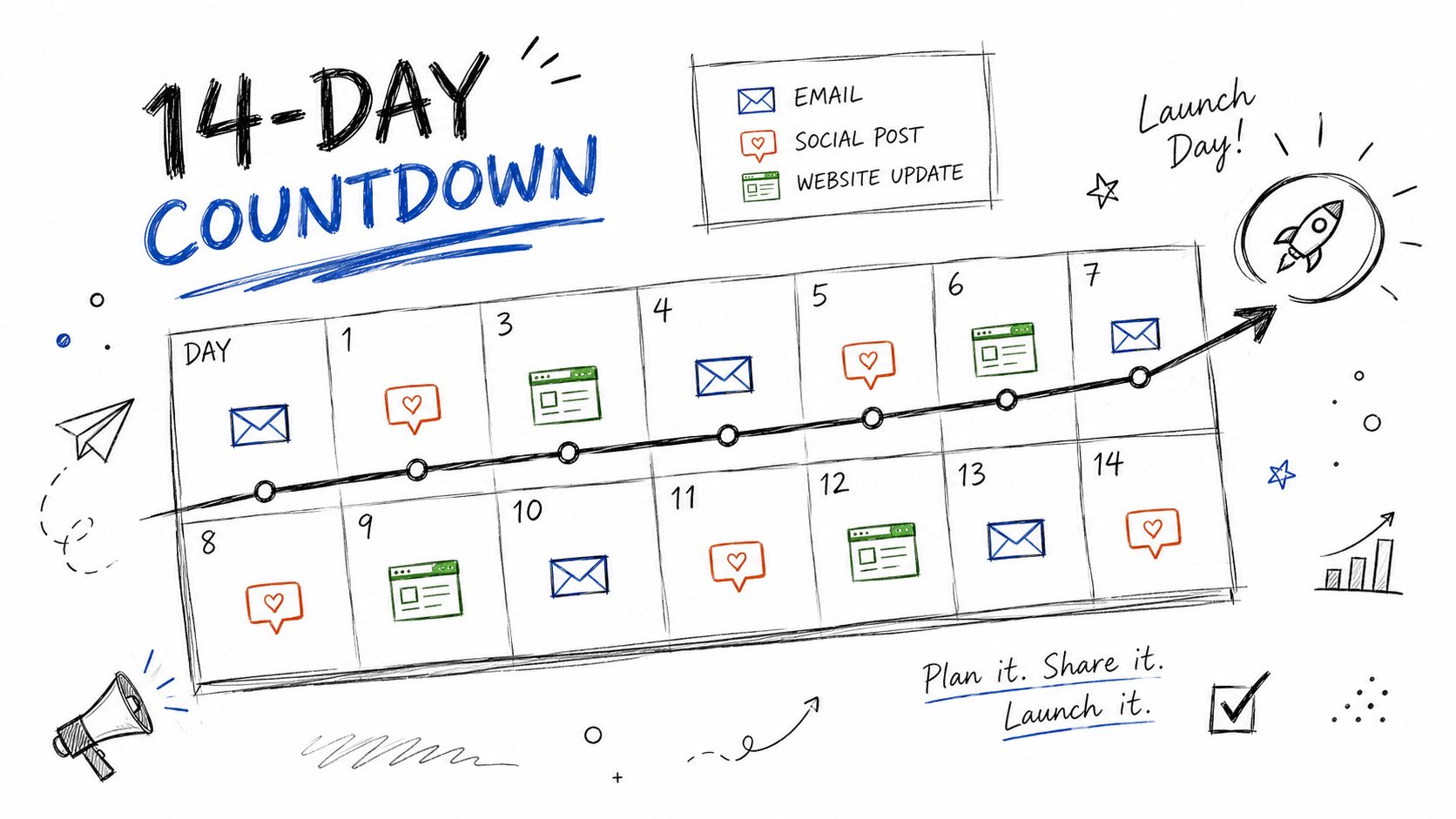
A hand-drawn 14-day marketing countdown calendar with icons representing email, social media posts, and website updates.

Start with the waitlist and proof

Day minus 14 through day minus 10 should be about setup, not noise. Finalize the landing page first, then add a lead magnet, usually a free chapter, checklist, or companion worksheet. As people opt in, route them into a short email sequence that previews the problem, the promise, and the payoff. That matches the pre-launch + proof model many launch guides recommend, build the page, grow the list, then seed credibility with early readers and reviews.

Next, identify a small group of reviewers and partners. You do not need a giant street team. You need a few people who will read the thing and respond with genuine feedback. Reach out to niche creators, customers, newsletter owners, and community moderators who already speak to your reader.

Use the final days for controlled momentum

By the second week, shift from preparation to pressure. Send the preview to your waitlist. Publish a few social posts that pull out one useful idea at a time. Ask your reviewer group for early feedback. Then line up launch-day mentions so they're ready to go the moment the ebook is live.

  • Day minus 9 to 7: send the preview and collect replies.

  • Day minus 6 to 4: confirm reviewers and partner posts.

  • Day minus 3 to 2: post teaser excerpts and a clear reminder of the launch date.

  • Day minus 1: send the final reminder and make the CTA obvious.

The launch should feel like a consequence of the prior two weeks, not a random announcement. If you do this right, launch day becomes a coordinated hit across email, community, and partner channels. If you skip the pre-launch work, you're asking strangers to care without any context, and that's a bad bet.

A useful mindset here is restraint. Don't try to invent urgency out of nowhere. Give people a real reason to pay attention, early access, a bonus, a discount, or a chance to read first and review without reservation. That's enough.

Pick the Right Channel Mix for Launch Week

Launch week is where many teams blow their attention budget. They try to be everywhere, and end up doing everything badly. The right mix depends on where your audience already lives, how much list you've built, and whether you can support paid amplification without leaking the funnel.

A hand-drawn diagram illustrating various digital marketing strategies surrounding a central brand hub.

Spend your first 10 hours where conversion is likeliest

If you have a list, start with email. It's the most direct path to people who already showed intent. If your list is tiny, lean on partner mentions, niche communities, and your own social channels, then route all of them to the same landing page. Paid ads only make sense if the page already converts and the offer is clear, otherwise you're paying to find out where the funnel is broken.

The practical split is simple. Email should carry the strongest CTA. Organic social should do one thing, create enough interest to click. Communities should add credibility through relevance, not volume. Paid should amplify what already works, not rescue a weak page.

Audience Size

Primary Channels

Secondary Channels

Paid Amplification

Near zero

Partner emails, niche communities, direct outreach

Organic social, founder posts, reviewer shares

Skip until the page converts cleanly

Small but active list

Email broadcast, social posts, community mentions

Guest appearances, partner swaps

Light test budget if the funnel is proven

Established list

Email, retargeting, partner launches

Podcasts, LinkedIn, newsletter swaps

Use paid to extend winners, not invent them

Match the channel to the job

Email is for conversion. Social is for awareness. Communities are for trust. PR and podcasts are useful when they reach your exact reader, but they're not magic by default. And affiliates only work if the offer is clean enough that other people want to share it without hand-holding.

If you've got no budget, do not pretend that paid is your default answer. Spend your time on the channels that let you earn attention. If you do have budget, spend it only after the page and email flow are already doing their job. The ebook marketing guidance from MailerLite points to the same operational truth, test the page, build the list, then let proof carry the launch.

The smartest teams treat launch week as a distribution test. They watch which channels move clicks, which ones drive opt-ins, and which ones produce actual buyers. That's how you avoid feeding money into a leaky system.

Repurpose the Ebook for Long-Term Discovery

The ebook isn't finished when launch week ends. That's when the compounding starts. A good ebook should become a content source, not a dead PDF on a sales page. The job is to turn one strong asset into multiple smaller assets that keep sending people back to the same offer.

A conceptual diagram showing an ebook being repurposed into social posts, articles, carousels, and podcast content.

Map chapters to channels

Pull out the strongest ideas from the ebook and assign them to different formats. One chapter becomes a LinkedIn carousel. Another becomes a blog post. A third becomes a short newsletter column. A customer story can become a mini case study, and a framework can become a visual post or short video script.

Don't overcomplicate the batching. Sit down once, list the core chapters, and identify which pieces can stand alone. Then build the assets in one afternoon. That way repurposing doesn't turn into a second full-time job. The aim is to create a steady stream of touchpoints that all point back to the same landing page and CTA.

  • LinkedIn carousels: use frameworks and checklists.

  • SEO articles: use chapter themes and long-tail questions.

  • Short video scripts: use one insight per clip.

  • Newsletter columns: use practical lessons and examples.

  • Podcast talking points: use the ebook's strongest argument.

Keep the promise identical everywhere

The content can change format. The promise should not change. If the landing page says the ebook helps SMBs turn one asset into a lead engine, every repurposed post should reinforce that. The point is to create recognition, not novelty for its own sake.

Smart marketers stop chasing random reach. They make one asset work across multiple surfaces, then keep pushing the same reader path. If you've already built the positioning and landing page correctly, repurposing becomes a multiplier, not a distraction.

Measure, Optimize, and Run It Again

An ebook funnel is never really done. It just gets cleaner. The teams that win keep a simple dashboard, look at the same metrics every time, and fix the bottleneck instead of blaming the topic. If the page underperforms, the page is the problem. If email doesn't convert, the sequence is the problem. If paid ads are expensive, the page or offer is the problem.

Track the metrics that actually matter

You don't need a giant analytics stack. You need enough visibility to know where the drop-off happens.

  • Landing page conversion rate: tells you whether the promise and page are aligned.

  • Opt-in to first purchase: tells you whether the email flow is warming leads.

  • Email engagement: tells you whether the sequence is relevant.

  • CAC by channel: tells you where acquisition is efficient.

  • Review velocity: tells you whether proof is building or stalling.

Set up one dashboard and look at it weekly. When a metric dips, change one variable at a time. Test a new headline, shorten the form, adjust the lead magnet, rewrite the first email, or change the CTA placement. Don't rewrite everything at once and then guess what worked.

If the funnel is broken, don't ask for more traffic. Fix the weakest step first.

Use the same checklist every time

A repeatable launch checklist keeps you from reinventing the wheel.

  1. Positioning locked.

  2. Landing page live.

  3. Lead magnet and welcome sequence ready.

  4. Reviewer list confirmed.

  5. Partner and community posts scheduled.

  6. Repurposed content mapped.

  7. Dashboard set.

That's enough to run the next launch faster and cleaner than the last one. The most useful insight isn't that one ebook did well. It's that the next one can borrow the same structure, the same process, and the same measurement loop. The best ebook marketers don't wait for one perfect asset, they ship multiple useful ones and let the funnel do its job again and again.

If you want a stack that helps you build the list, send the sequence, and keep the follow-up organized in one place, visit Stamina. It's built for SMB teams that need marketing, sales, and CRM to work as one system instead of three disconnected tools. That's exactly the kind of setup that makes marketing an ebook feel less like a launch scramble and more like a repeatable revenue process.

Most ebook advice is stuck in the wrong mental model. It treats the ebook like a one-night launch and then acts surprised when attention dies two weeks later. That's backwards. Marketing an ebook works when you build a funnel that captures intent, warms it, and keeps converting long after the announcement post gets buried.

If you don't already have a large audience, the launch-event fantasy is expensive and fragile. An ebook should behave like a lead engine, not a vanity asset. Email remains one of the highest-converting channels for distribution and nurturing, with an average return on investment of about $36 for every $1 spent across studies, which is why strong ebook funnels lean on email capture, teaser sequences, and launch-day broadcasts as the core of the mix. That logic lines up with a practical go-to-market foundation and, for teams using AI to speed up promotion work, use AI to market your book can be a useful companion resource.

Stop Treating the Ebook Like a Book Launch

The fastest way to waste an ebook is to treat it like a product drop and stop there. A real ebook funnel has to do four jobs, capture, nurture, qualify, and convert. If your asset only creates a few social likes and a temporary spike in traffic, it isn't a funnel asset, it's a one-off announcement.

Think in funnel terms, not event terms

A launch event assumes people are already paying attention. Most SMBs don't have that luxury. A funnel-first approach uses the ebook as a reason to collect a lead, send a sequence, and move that person toward a next step, whether that's a demo, a consultation, a paid product, or another offer. That's why modern ebook campaigns usually pair a landing page with a waiting list, a preview chapter, and reminder emails rather than a single blast post, as outlined in the ebook marketing strategy guide.

The other reason to think this way is simple. Launching once is easy. Building a system that keeps working is what makes the effort worth it. When the ebook sits inside your broader demand-generation system, every channel has a job, and every click can be measured against downstream revenue.

Practical rule: if a channel can't send people to a page with one clear next step, it's decoration, not promotion.

Use a quick diagnostic before you choose your mode

Ask three questions. Do you already have a responsive list? Do you have at least one channel where you can reach strangers consistently? Can you support follow-up after the download? If the answer to two or more of those is no, you need an evergreen funnel with a narrow offer, a clear CTA, and simple nurture. If the answer is yes, you can afford a launch-led push on top of the evergreen base.

The point is not to choose one forever. The point is to stop building campaigns that depend on one loud day. When you think like a funnel architect, the ebook becomes a durable entry point that can capture attention today and convert it next month, which is exactly how SMBs get more out of limited content budgets. The ebook marketing approach from Automateed reinforces the same practical idea, route every channel back to one page and let the follow-up do the heavy lifting.

Find Your Reader and Sharpen the Positioning

Broad positioning kills ebook performance. If the reader can't tell, in a few seconds, whether this is for them, they bounce. That's true whether you're selling to founders, managers, freelancers, or operators, and it's why your ideal customer profile matters before you touch the landing page.

Build a reader snapshot you can actually use

Start with a narrow frame, job title, company size, pain point, and current workaround. Don't write “for marketers” if you mean “for marketing managers at 20 to 100 person SaaS companies who need to generate qualified leads without hiring another person.” That's a reader. The first version is vague. The second version tells you exactly what to say and what to leave out.

Turn that into a one-sentence promise. Good positioning sounds specific and outcome-focused. Weak positioning sounds like a category label.

  • Weak: “A guide to better ebook marketing.”

  • Sharper: “A funnel-first ebook playbook for SMB teams that need leads from scratch, not a launch-day vanity spike.”

  • Weak: “Learn how to promote your ebook.”

  • Sharper: “Use one ebook to capture leads, warm them by email, and route them into a repeatable sales path.”

You don't need a giant research project to validate this. Scan niche communities, read the wording people use in forums and comments, and talk to a handful of real prospects. You're looking for repeated phrases, repeated objections, and repeated workarounds. Those three things should shape your promise.

Positioning should survive across every asset

The landing page, email sequence, outreach message, and social post should all repeat the same core promise in different forms. If the promise changes every time, the funnel feels fragmented. If the promise stays tight, the reader recognizes the same value wherever they encounter it.

Narrow targeting beats broad targeting when you have no audience, because broad targeting gives people no reason to care.

That's the hard truth many marketers dodge. A niche doesn't shrink your opportunity, it sharpens your relevance. If you're writing for SMBs, your reader snapshot should be blunt enough to guide your copy, your examples, and your channel choices. The more precise the snapshot, the less you'll waste time rewriting assets that never had a clear buyer in the first place.

Design the Landing Page and Lead Capture Flow

Your landing page is where every channel has to agree on one thing. If the ad, social post, community mention, or partner email promises one outcome and the page promises another, conversion drops. The page needs one job, get the opt-in, then hand the lead to a sequence that continues the conversation.

Screenshot from https://stamina.io

Keep the page brutally simple

Use one CTA. Put the promise in the hero. Show the cover mock or preview asset. Add three bullets that spell out what the reader gets, not what the ebook “is about.” Keep the form short enough that nobody has to think. Then add trust cues, such as a relevant logo, testimonial, or proof of expertise, if you already have them.

Many teams get clever and lose the sale. They add too many links, too many exit ramps, and too much copy. Don't. Readers coming from cold traffic need a clear path, not a content maze. For practical inspiration on page structure and testing, boosting Divi landing page conversions is a decent reference point for thinking about hierarchy and friction.

A good checklist looks like this.

  • Headline: state the outcome clearly.

  • Subhead: explain who it's for.

  • Cover or preview: show the asset fast.

  • Three bullets: list the concrete payoff.

  • Form: keep it short.

  • Trust signal: remove doubt.

If you want to understand how people interact with the page after they land, creating a heat map is useful because it shows where attention pools and where it dies.

Warm the lead the moment they opt in

The triggered welcome sequence matters as much as the page. The first email should deliver the asset and set expectations. The second should give a useful insight tied to the ebook topic. The third should connect the problem to a real business situation and invite the next step. That's a simple flow, but it's enough to move a curious lead from passive download to active reader.

Here's the mistake to avoid. Don't use one generic newsletter blast after opt-in and call it nurture. Triggered follow-up is the point. A good setup routes every channel back to the same landing page, with matching headline, CTA, and promise, so the whole system reinforces one message instead of scattering attention. If you need the mechanics behind that structure, the drip campaign explanation is a useful internal reference.

Run the 14-Day Pre-Launch Sequence

A weak launch usually isn't weak because the ebook is bad. It's weak because the two weeks before launch were empty. If nobody is warmed up, no one shows up ready to buy, review, or share. The answer is a short, disciplined sequence that a single operator can run without burning out.

A hand-drawn 14-day marketing countdown calendar with icons representing email, social media posts, and website updates.

Start with the waitlist and proof

Day minus 14 through day minus 10 should be about setup, not noise. Finalize the landing page first, then add a lead magnet, usually a free chapter, checklist, or companion worksheet. As people opt in, route them into a short email sequence that previews the problem, the promise, and the payoff. That matches the pre-launch + proof model many launch guides recommend, build the page, grow the list, then seed credibility with early readers and reviews.

Next, identify a small group of reviewers and partners. You do not need a giant street team. You need a few people who will read the thing and respond with genuine feedback. Reach out to niche creators, customers, newsletter owners, and community moderators who already speak to your reader.

Use the final days for controlled momentum

By the second week, shift from preparation to pressure. Send the preview to your waitlist. Publish a few social posts that pull out one useful idea at a time. Ask your reviewer group for early feedback. Then line up launch-day mentions so they're ready to go the moment the ebook is live.

  • Day minus 9 to 7: send the preview and collect replies.

  • Day minus 6 to 4: confirm reviewers and partner posts.

  • Day minus 3 to 2: post teaser excerpts and a clear reminder of the launch date.

  • Day minus 1: send the final reminder and make the CTA obvious.

The launch should feel like a consequence of the prior two weeks, not a random announcement. If you do this right, launch day becomes a coordinated hit across email, community, and partner channels. If you skip the pre-launch work, you're asking strangers to care without any context, and that's a bad bet.

A useful mindset here is restraint. Don't try to invent urgency out of nowhere. Give people a real reason to pay attention, early access, a bonus, a discount, or a chance to read first and review without reservation. That's enough.

Pick the Right Channel Mix for Launch Week

Launch week is where many teams blow their attention budget. They try to be everywhere, and end up doing everything badly. The right mix depends on where your audience already lives, how much list you've built, and whether you can support paid amplification without leaking the funnel.

A hand-drawn diagram illustrating various digital marketing strategies surrounding a central brand hub.

Spend your first 10 hours where conversion is likeliest

If you have a list, start with email. It's the most direct path to people who already showed intent. If your list is tiny, lean on partner mentions, niche communities, and your own social channels, then route all of them to the same landing page. Paid ads only make sense if the page already converts and the offer is clear, otherwise you're paying to find out where the funnel is broken.

The practical split is simple. Email should carry the strongest CTA. Organic social should do one thing, create enough interest to click. Communities should add credibility through relevance, not volume. Paid should amplify what already works, not rescue a weak page.

Audience Size

Primary Channels

Secondary Channels

Paid Amplification

Near zero

Partner emails, niche communities, direct outreach

Organic social, founder posts, reviewer shares

Skip until the page converts cleanly

Small but active list

Email broadcast, social posts, community mentions

Guest appearances, partner swaps

Light test budget if the funnel is proven

Established list

Email, retargeting, partner launches

Podcasts, LinkedIn, newsletter swaps

Use paid to extend winners, not invent them

Match the channel to the job

Email is for conversion. Social is for awareness. Communities are for trust. PR and podcasts are useful when they reach your exact reader, but they're not magic by default. And affiliates only work if the offer is clean enough that other people want to share it without hand-holding.

If you've got no budget, do not pretend that paid is your default answer. Spend your time on the channels that let you earn attention. If you do have budget, spend it only after the page and email flow are already doing their job. The ebook marketing guidance from MailerLite points to the same operational truth, test the page, build the list, then let proof carry the launch.

The smartest teams treat launch week as a distribution test. They watch which channels move clicks, which ones drive opt-ins, and which ones produce actual buyers. That's how you avoid feeding money into a leaky system.

Repurpose the Ebook for Long-Term Discovery

The ebook isn't finished when launch week ends. That's when the compounding starts. A good ebook should become a content source, not a dead PDF on a sales page. The job is to turn one strong asset into multiple smaller assets that keep sending people back to the same offer.

A conceptual diagram showing an ebook being repurposed into social posts, articles, carousels, and podcast content.

Map chapters to channels

Pull out the strongest ideas from the ebook and assign them to different formats. One chapter becomes a LinkedIn carousel. Another becomes a blog post. A third becomes a short newsletter column. A customer story can become a mini case study, and a framework can become a visual post or short video script.

Don't overcomplicate the batching. Sit down once, list the core chapters, and identify which pieces can stand alone. Then build the assets in one afternoon. That way repurposing doesn't turn into a second full-time job. The aim is to create a steady stream of touchpoints that all point back to the same landing page and CTA.

  • LinkedIn carousels: use frameworks and checklists.

  • SEO articles: use chapter themes and long-tail questions.

  • Short video scripts: use one insight per clip.

  • Newsletter columns: use practical lessons and examples.

  • Podcast talking points: use the ebook's strongest argument.

Keep the promise identical everywhere

The content can change format. The promise should not change. If the landing page says the ebook helps SMBs turn one asset into a lead engine, every repurposed post should reinforce that. The point is to create recognition, not novelty for its own sake.

Smart marketers stop chasing random reach. They make one asset work across multiple surfaces, then keep pushing the same reader path. If you've already built the positioning and landing page correctly, repurposing becomes a multiplier, not a distraction.

Measure, Optimize, and Run It Again

An ebook funnel is never really done. It just gets cleaner. The teams that win keep a simple dashboard, look at the same metrics every time, and fix the bottleneck instead of blaming the topic. If the page underperforms, the page is the problem. If email doesn't convert, the sequence is the problem. If paid ads are expensive, the page or offer is the problem.

Track the metrics that actually matter

You don't need a giant analytics stack. You need enough visibility to know where the drop-off happens.

  • Landing page conversion rate: tells you whether the promise and page are aligned.

  • Opt-in to first purchase: tells you whether the email flow is warming leads.

  • Email engagement: tells you whether the sequence is relevant.

  • CAC by channel: tells you where acquisition is efficient.

  • Review velocity: tells you whether proof is building or stalling.

Set up one dashboard and look at it weekly. When a metric dips, change one variable at a time. Test a new headline, shorten the form, adjust the lead magnet, rewrite the first email, or change the CTA placement. Don't rewrite everything at once and then guess what worked.

If the funnel is broken, don't ask for more traffic. Fix the weakest step first.

Use the same checklist every time

A repeatable launch checklist keeps you from reinventing the wheel.

  1. Positioning locked.

  2. Landing page live.

  3. Lead magnet and welcome sequence ready.

  4. Reviewer list confirmed.

  5. Partner and community posts scheduled.

  6. Repurposed content mapped.

  7. Dashboard set.

That's enough to run the next launch faster and cleaner than the last one. The most useful insight isn't that one ebook did well. It's that the next one can borrow the same structure, the same process, and the same measurement loop. The best ebook marketers don't wait for one perfect asset, they ship multiple useful ones and let the funnel do its job again and again.

If you want a stack that helps you build the list, send the sequence, and keep the follow-up organized in one place, visit Stamina. It's built for SMB teams that need marketing, sales, and CRM to work as one system instead of three disconnected tools. That's exactly the kind of setup that makes marketing an ebook feel less like a launch scramble and more like a repeatable revenue process.

Share this article

Share this article

Send a shareable link to your team or anyone who might find it useful.

Send a shareable link to your team or anyone who might find it useful.

Copy link

Copied

Share directly to

Table of contents

Give Your Business the Stamina it needs to Thrive

PRODUCT

COMPANY

RESOURCES

© 2026 Stamina Software Technologies Inc. All rights reserved.

PRODUCT

COMPANY

RESOURCES

© 2026 Stamina Software Technologies Inc. All rights reserved.

PRODUCT

COMPANY

RESOURCES

© 2026 Stamina Software Technologies Inc. All rights reserved.