What Is an Ideal Customer Profile: Your 2026 Guide to B2B

Discover what is an ideal customer profile and why it's crucial for B2B success. Get a step-by-step guide with examples, templates, and tools to build your ICP

0 - Minute Read

An ideal customer profile is a data-driven description of the perfect company to sell to, built from the attributes of your best existing customers rather than guesswork. It usually combines firmographics such as industry, company size, revenue, location, and technology stack with buying behavior and pain points so your team knows who is most likely to get real value from what you sell.

If you're reading this, there's a good chance your pipeline looks busy but not healthy. Sales is booking calls with accounts that never had budget. Marketing is driving leads that look good in a dashboard but stall in follow-up. Customer success can already tell which new logos will expand and which ones will churn, but nobody has turned that pattern into a targeting rule.

A common error in ICP work is treating it like a one-time positioning exercise or a slide in a go-to-market deck. In practice, a strong ICP is an operating system for revenue. It tells your team who to pursue, who to disqualify, how to prioritize lists, and what signals matter enough to act on now.

Why Your Sales Strategy Needs an Ideal Customer Profile

Unfocused sales teams don't usually fail because they aren't working hard. They fail because they're spending that effort on the wrong accounts.

One rep is chasing companies that are too small to support your price point. Another is working large enterprises that need security and procurement requirements your product can't support yet. Marketing keeps handing over names, but sales doesn't trust the handoff. The result is familiar: activity without momentum.
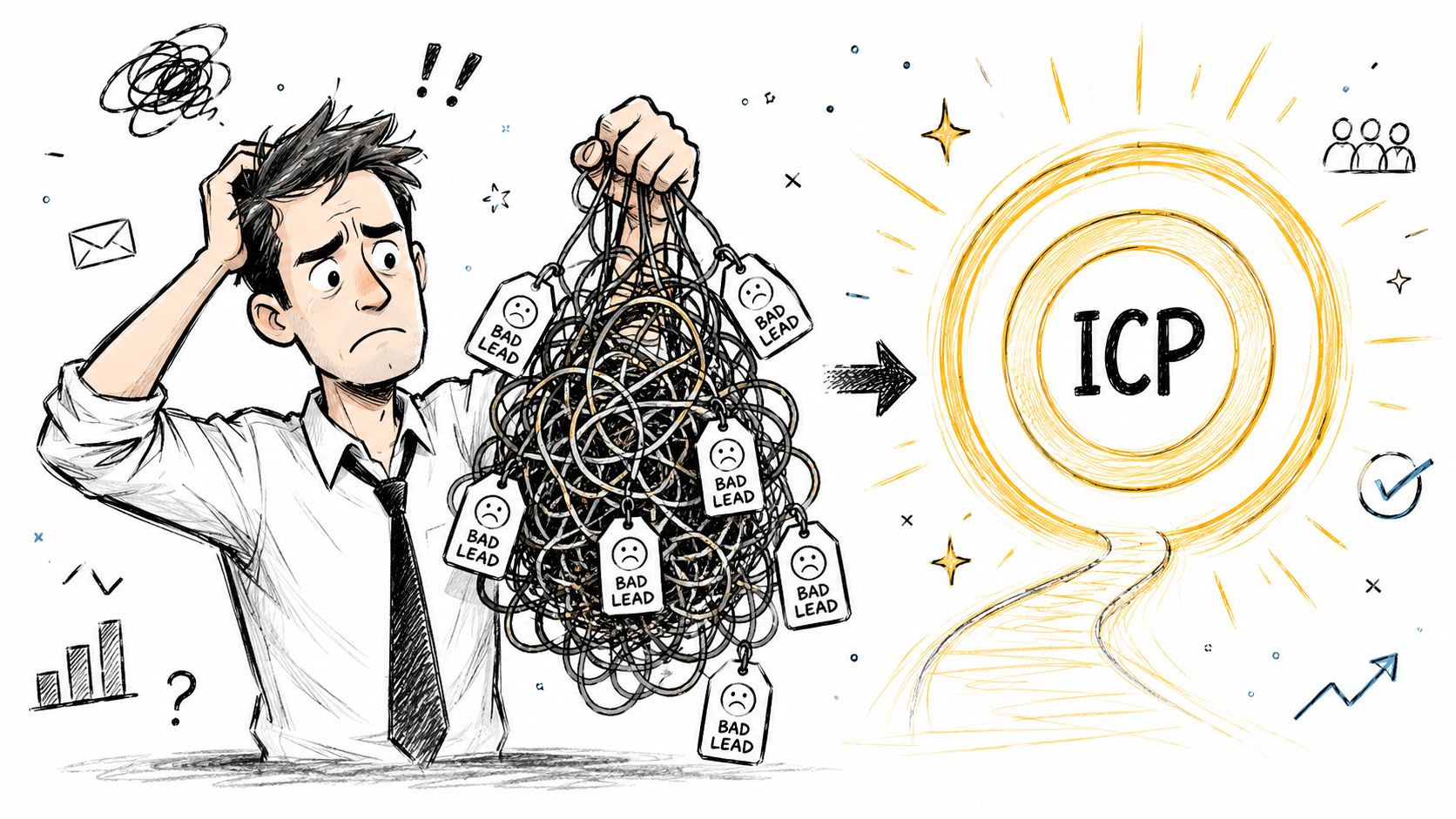
A confused businessman tangled in a mess of bad leads moving towards an Ideal Customer Profile target.

What an ICP actually does

A useful answer to "what is an ideal customer profile" isn't academic. It is a clear description of the company or buyer most likely to get strong value from your product, based on patterns in your best customers. Salesforce defines the idea in that practical direction and emphasizes firmographics, buying behavior, pain points, and an actionable view of fit in its guide to the ideal customer profile.

That matters because strategy gets sharper when fit is explicit. Your ICP helps answer questions like:

  • Who should sales contact first so reps spend time on accounts with a higher chance of becoming real customers.

  • Which leads should marketing nurture instead of forcing every inquiry into an immediate handoff.

  • What product gaps matter most because repeated deal friction often shows up first in ICP misalignment.

  • Where you should stop wasting effort on segments that look attractive on paper but don't convert cleanly.

Practical rule: If your team can't explain why a company is a fit in one sentence, your targeting is too loose.

For a second perspective, Breaker's ICP guide is a helpful reference because it shows how teams translate targeting logic into actual outbound decisions.

A good ICP also strengthens execution upstream. If you're refining campaign targeting or list-building discipline, these B2B lead generation best practices pair well with ICP work because they force the same question: are we attracting companies that can buy and succeed?

ICP vs Buyer Persona Understanding the Critical Difference

The most common GTM mistake is using ICP and buyer persona as if they're the same thing. They aren't.

Your ICP is the company you want to sell to. Your buyer persona is the person inside that company who evaluates, influences, or approves the purchase. One describes the account. The other describes the human.
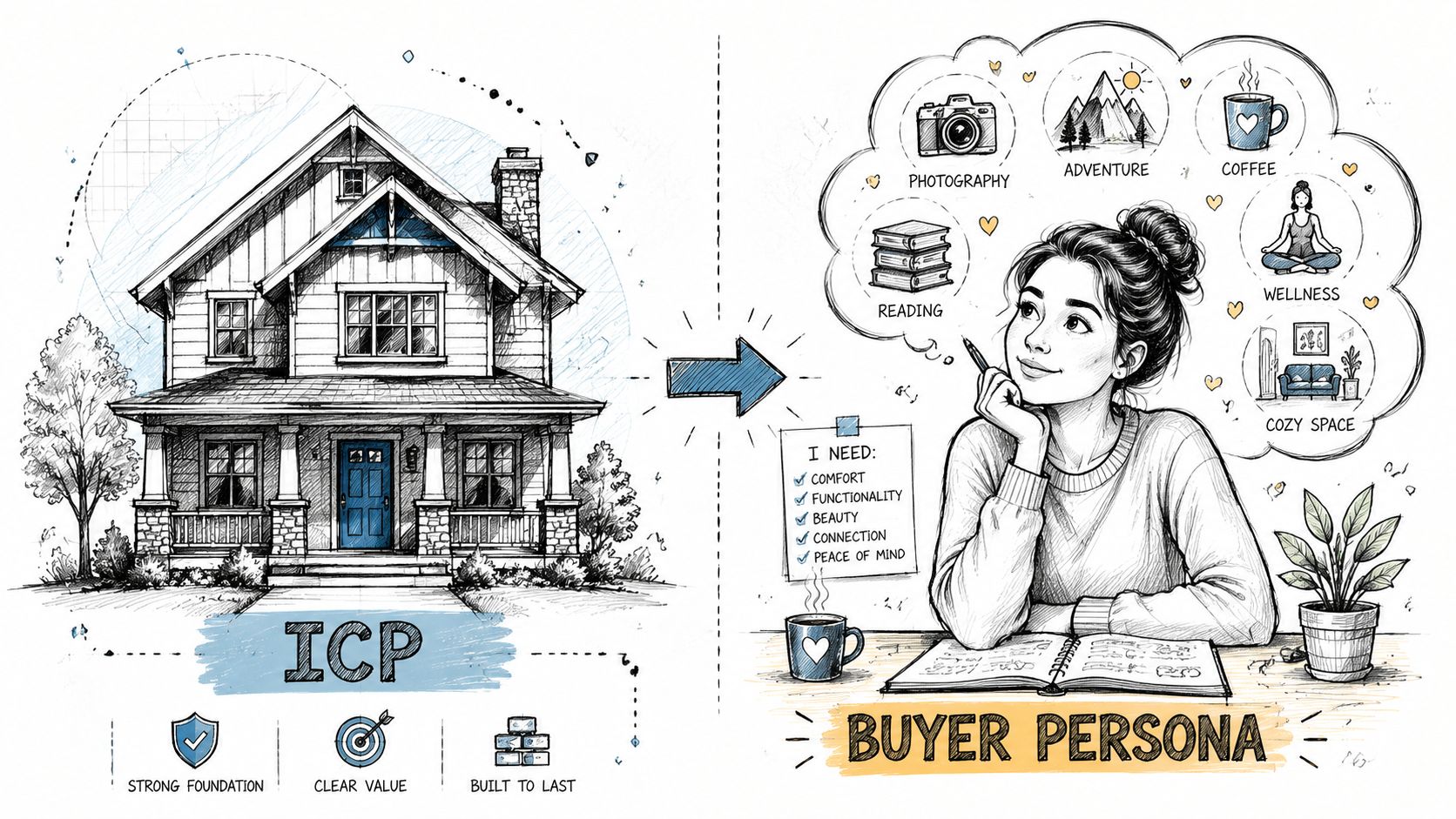
A hand-drawn illustration comparing an Ideal Customer Profile as a house foundation to a Buyer Persona profile.

Think of it as the address and the person at the door

If you're selling B2B software, the ICP tells you which buildings to walk into. The buyer persona tells you who to ask for once you're inside.

Without an ICP, your team may personalize beautifully for the wrong company. Without buyer personas, your team may target the right account but message the wrong stakeholder. Both problems hurt pipeline, but they happen at different levels.

Here's the cleanest way to separate them:

Aspect

ICP

Buyer persona

Focus

Company-level fit

Individual-level role

Core inputs

Industry, size, location, revenue, tech stack, budget constraints

Goals, objections, responsibilities, decision criteria

Primary use

Account selection and prioritization

Messaging, outreach, demos, and content

Question answered

"Should we sell to this company?"

"How do we persuade this person?"

What teams get wrong in practice

A lot of teams build a persona first because it's easier to imagine a human than a market segment. They write profiles about "Marketing Mary" or "Ops Omar," then discover those people exist in companies that will never buy.

That's backward. Start with company fit. Then layer in the people.

Sell to the right account first. Then tailor the message to the right stakeholder.

There's also an operational reason to keep the distinction clean. ICPs guide list building, routing, scoring, and account selection. Personas shape copy, talk tracks, objection handling, and nurture content. If you merge them into one bloated document, nobody uses it.

If your lead process still mixes fit and interest into one blurry stage, tightening the line between ICP and persona usually improves qualification discipline. A clear marketing qualified lead framework helps here, as it separates "belongs in our market" from "ready for a sales conversation."

The Anatomy of a Powerful ICP Key Attributes to Track

Weak ICPs are vague. Powerful ICPs are built from observable patterns in your best customers.

The signal isn't "companies that looked promising." It's the accounts that delivered the strongest business outcome for you. HG Insights recommends building the profile from your best customers by clustering firmographics, technographics, and behavioral triggers that point to conversion and long-term value in its article on how to create an ideal customer profile.

Firmographics tell you who they are

Firmographics are the starting layer. They define the shape of the company.

This includes the basics people usually know, such as industry, company size, geography, and revenue. It also includes less glamorous but highly practical filters like whether the company structure matches your sales model, whether it has enough operational maturity to deploy your product, and whether the location creates service or compliance constraints.

Firmographics help you avoid category errors. If your best customers cluster in one band of company maturity, selling outside that band usually creates friction fast.

Technographics reveal compatibility and timing

Technographics tell you what systems the account already uses and how mature its environment is.

Many teams leave money on the table by neglecting this consideration. The existing stack can reveal integration opportunities, migration opportunities, or reasons the account will be hard to win. If your product works best alongside a specific CRM, data warehouse, ecommerce platform, or communications tool, that belongs in the ICP. If your product is painful to deploy in a fragmented environment, that belongs there too.

Technographics also sharpen prioritization. Two accounts can look similar on size and industry while being totally different in readiness.

Behavioral signals show whether fit is active right now

Behavioral signals answer a different question. Not "could they buy?" but "is there evidence they might buy now?"

That can include engagement patterns, purchasing habits, product research behavior, or signs that the account is already moving toward a solution category. In practice, these signals help reps stop treating every matched account as equally urgent.

A good ICP doesn't just identify fit. It helps your team rank fit plus readiness.

ICP Attribute Checklist

Category

Attribute

Example Question to Ask

Firmographic

Industry

Which industries show up repeatedly in our strongest customer accounts?

Firmographic

Company size

What employee range tends to succeed with our onboarding and pricing model?

Firmographic

Geography

Do our best customers cluster in regions where our team can support them well?

Firmographic

Revenue or budget fit

Can this type of company realistically afford our solution and expansion path?

Technographic

Core stack

What tools are already in place when implementation goes smoothly?

Technographic

Cloud or systems maturity

Does this account have the internal capability to adopt our product without heavy hand-holding?

Technographic

Integration environment

Will our product plug into how they already operate, or are we asking them to rebuild process?

Behavioral

Buying behavior

Do they show patterns that suggest they invest in this category proactively?

Behavioral

Engagement

Are they interacting in ways that indicate research, urgency, or internal discussion?

Behavioral

Trigger events

What changes inside the account usually happen before they become a serious opportunity?

If you want to turn this checklist into something operational, pair it with a scoring system. A practical starting point is mapping these attributes into a lead scoring automation model so your team can rank accounts consistently instead of relying on rep intuition.

How to Build Your Ideal Customer Profile Step-by-Step

Most ICP projects break because they start with brainstorming. The better move is to start with evidence.

Qualtrics frames ICP creation as a cross-functional, metrics-based process that brings together sales, marketing, and customer success, then validates assumptions with quantitative signals such as NPS and CSAT alongside qualitative feedback in its guide to the ideal customer profile. That's the right approach because no single team sees the full picture.

Step 1 Pick the customers worth modeling

Don't build your ICP from all customers. Build it from the customers you'd choose again.

That usually includes accounts that close with less friction, adopt successfully, renew cleanly, expand naturally, and generate referrals or strong internal champions. Revenue matters, but it shouldn't be the only screen. Some big logos are expensive to serve and never become healthy accounts.

Use a simple review set:

  • Commercial fit means the deal size, sales motion, and margin make sense for your business.

  • Operational fit means implementation, support, and handoff didn't strain the team.

  • Outcome fit means the customer got enough value to stick, grow, or advocate.

If an account is large but painful, don't let it distort the model.

Step 2 Collect frontline insight before you touch the final draft

Once you've identified your best-fit accounts, talk to the people who know why those deals worked.

Sales can explain what made the opportunity easy or hard to progress. Customer success can tell you whether the customer had the right expectations, internal owner, and use case. Marketing can show which channels and messages attracted the right accounts in the first place.

A few prompts work well in internal sessions:

  1. What patterns show up in our cleanest wins

  2. Which accounts looked promising but failed later, and why

  3. What constraints disqualify an account even when interest is high

  4. Which signals usually appear before a strong customer engages seriously

This is also a good point to widen your market lens. If you need more context on adjacent segments or whitespace, tools that help uncover market opportunities can be useful for pressure-testing where your current wins fit in the broader market.

The point of the interview stage isn't consensus. It's surfacing tension between what teams believe and what customer evidence supports.

Step 3 Add the hard filters

The profile becomes usable.

Qualtrics emphasizes that an ICP should include measurable constraints such as employee count, annual revenue, annual budget, and legal or contractual limits. Those details matter because they turn a nice description into qualification logic.

Capture the constraints that influence buying and deployment:

  • Employee count if your onboarding or pricing only works above a certain level of complexity.

  • Annual revenue or budget reality if affordability is a recurring issue.

  • Legal or contractual limits if procurement, security, or compliance blocks deals.

  • Technology requirements if successful customers rely on certain tools or infrastructure.

A lot of teams avoid hard filters because they fear narrowing the market. In practice, refusing to narrow usually creates a bloated pipeline full of avoidable no-fit work.

Step 4 Write the ICP as a working document, not a manifesto

Your final ICP should be short enough for a rep to use, precise enough for ops to encode, and concrete enough for marketing to build against.

A solid version usually includes:

Section

What to include

Core description

The type of company you sell to best

Positive fit traits

Industry, size band, geography, stack, buying context

Negative fit traits

Accounts that often stall, churn, or drain resources

Required constraints

Budget, employee scale, legal limits, implementation needs

Trigger signals

Behaviors or changes that increase current buying likelihood

Notes for teams

Sales guidance, marketing angles, customer success considerations

Keep it to one page if you can. The more narrative you add, the less likely the team is to use it.

Step 5 Put the ICP where decisions happen

An ICP hidden in Notion or a slide deck won't change revenue behavior. It needs to show up in the systems your team already uses.

That means list criteria for outbound, routing rules for inbound, account tiers in CRM, and qualification standards in pipeline reviews. If the profile doesn't affect who gets targeted, scored, nurtured, and worked, then it's still theory.

Activating Your ICP with AI and Automation

The biggest shift in modern go-to-market isn't the definition of an ICP. It's what you can do with one once it's structured clearly.

A well-built ICP can act like a targeting instruction set for AI systems. Instead of handing reps a static document and hoping they internalize it, you can turn those rules into automated account discovery, prioritization, and outreach logic.
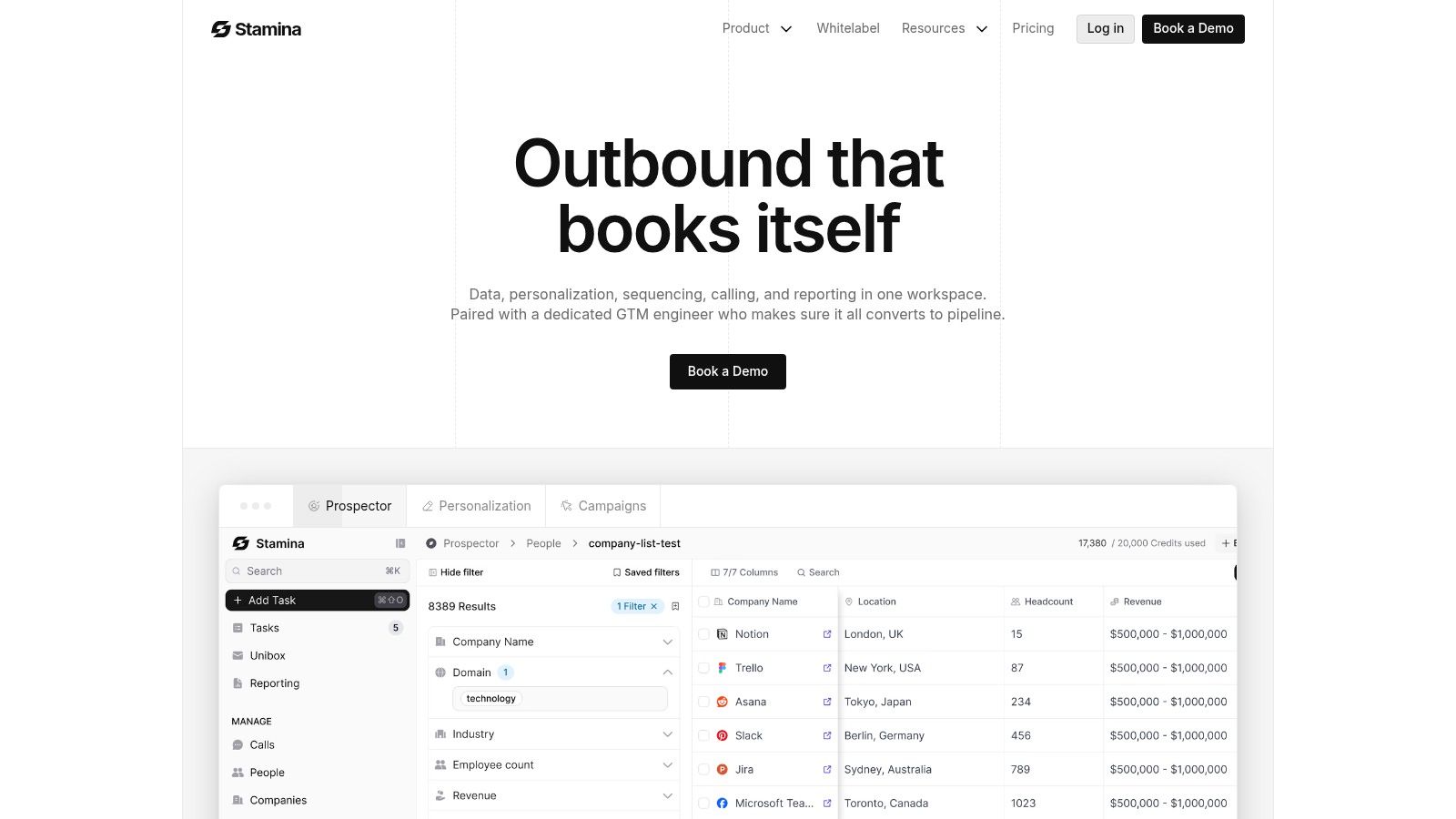
Screenshot from https://stamina.io

Turn profile criteria into machine-readable rules

ICPs are often written in prose. AI works better when the profile is translated into fields, constraints, and signal weights.

For example, instead of saying "mid-market SaaS companies with complex handoffs," define the observable markers behind that statement. Industry. company size band. geographic preference. required tools in the stack. signs of active evaluation. exclusion criteria. Once those inputs are structured, automation can sort through large pools of accounts much faster than a human SDR can.

That changes the role of the team. Reps spend less time guessing where to look and more time working the accounts that already match the shape of a good opportunity.

Use automation for research, not just outreach

This is the mistake I see most often. Teams buy AI tools and jump straight to email generation.

The better use case starts earlier. Let automation identify lookalike accounts, surface current context, and flag contact roles likely to matter inside matched companies. Then use AI to help with personalization based on the account's reality, not generic prompts.

If you're thinking through that workflow in more detail, this guide on using AI for lead generation covers the practical difference between spraying messages and automating qualified prospecting.

AI doesn't fix a bad ICP. It scales whatever targeting logic you give it.

Here's a short walkthrough that shows how this kind of workflow looks in practice:

Keep the ICP dynamic as signals change

Here, activation becomes more than list building.

A live ICP should respond to what your team is learning. If certain stacks correlate with easier adoption, increase their weight. If a segment keeps generating demos but not durable customers, tighten the filters. If new intent or engagement patterns show up before strong opportunities, incorporate them.

The static-document version of ICP work was always too slow for modern GTM. AI and automation make the profile usable day to day, but only if the rules are updated as your market changes.

Common ICP Mistakes and How to Avoid Them

Most ICP mistakes aren't subtle. Teams usually know something feels off. They just keep operating with it because changing targeting is uncomfortable.

Revenue.io notes that ICPs should be reviewed and iterated regularly, and that modern teams increasingly include technographics, buying behavior, and intent signals alongside firmographics in its explanation of ideal customer profile updates. That shift matters because static profiles age fast.

The avoidable mistakes

  • Don't make it too broad. "Any growing company" isn't an ICP. It's a refusal to choose.

  • Don't build it from opinion. If the profile comes from the loudest rep in the room, you'll encode anecdotes as strategy.

  • Don't confuse account fit with contact messaging. That's how teams end up with detailed personas for companies they should never pursue.

  • Don't stop at firmographics. Two companies can match on size and industry while having completely different buying readiness.

  • Don't freeze the document. Your market, buyer committees, and tool stacks move. The profile has to move with them.

The practical fix

Run ICP reviews on a regular cadence tied to what your GTM team is seeing in wins, losses, and customer health. Keep an eye on the mismatch between who enters pipeline and who becomes a customer you want more of.

This matters beyond targeting. Teams working on customized messaging, nurture, or account-specific campaigns often hit the same issue. Personalization only works when the underlying audience definition is sound. That's why guides on AI tools for content personalization are useful in context. Good personalization starts with accurate segmentation.

If your best reps constantly override the official targeting rules, your ICP probably needs work.

Conclusion From Profile to Predictable Pipeline

An ICP isn't a branding exercise. It's a revenue control system.

When you answer "what is an ideal customer profile" the right way, you stop talking about abstract audience definitions and start making better commercial decisions. You choose accounts with stronger fit. You give sales a cleaner target. You give marketing a sharper segment. You give customer success a better starting point for retention and expansion.

The teams that get the most out of ICP work do four things well. They build it from real customer evidence, keep it cross-functional, encode it into operational rules, and update it as the market shifts.

That's the bigger opportunity with modern AI and automation. Human judgment still defines what good fit looks like. Technology makes that judgment scalable. When those two pieces work together, the ICP stops being a document and starts behaving like a pipeline engine.

If you want to turn your ICP into a working system for prospecting, outreach, and pipeline management, Stamina gives growing teams one place to unify CRM, marketing, sales engagement, and AI-powered prospecting. It's a practical way to move from defining ideal customers to finding, prioritizing, and contacting them at scale.

An ideal customer profile is a data-driven description of the perfect company to sell to, built from the attributes of your best existing customers rather than guesswork. It usually combines firmographics such as industry, company size, revenue, location, and technology stack with buying behavior and pain points so your team knows who is most likely to get real value from what you sell.

If you're reading this, there's a good chance your pipeline looks busy but not healthy. Sales is booking calls with accounts that never had budget. Marketing is driving leads that look good in a dashboard but stall in follow-up. Customer success can already tell which new logos will expand and which ones will churn, but nobody has turned that pattern into a targeting rule.

A common error in ICP work is treating it like a one-time positioning exercise or a slide in a go-to-market deck. In practice, a strong ICP is an operating system for revenue. It tells your team who to pursue, who to disqualify, how to prioritize lists, and what signals matter enough to act on now.

Why Your Sales Strategy Needs an Ideal Customer Profile

Unfocused sales teams don't usually fail because they aren't working hard. They fail because they're spending that effort on the wrong accounts.

One rep is chasing companies that are too small to support your price point. Another is working large enterprises that need security and procurement requirements your product can't support yet. Marketing keeps handing over names, but sales doesn't trust the handoff. The result is familiar: activity without momentum.

A confused businessman tangled in a mess of bad leads moving towards an Ideal Customer Profile target.

What an ICP actually does

A useful answer to "what is an ideal customer profile" isn't academic. It is a clear description of the company or buyer most likely to get strong value from your product, based on patterns in your best customers. Salesforce defines the idea in that practical direction and emphasizes firmographics, buying behavior, pain points, and an actionable view of fit in its guide to the ideal customer profile.

That matters because strategy gets sharper when fit is explicit. Your ICP helps answer questions like:

  • Who should sales contact first so reps spend time on accounts with a higher chance of becoming real customers.

  • Which leads should marketing nurture instead of forcing every inquiry into an immediate handoff.

  • What product gaps matter most because repeated deal friction often shows up first in ICP misalignment.

  • Where you should stop wasting effort on segments that look attractive on paper but don't convert cleanly.

Practical rule: If your team can't explain why a company is a fit in one sentence, your targeting is too loose.

For a second perspective, Breaker's ICP guide is a helpful reference because it shows how teams translate targeting logic into actual outbound decisions.

A good ICP also strengthens execution upstream. If you're refining campaign targeting or list-building discipline, these B2B lead generation best practices pair well with ICP work because they force the same question: are we attracting companies that can buy and succeed?

ICP vs Buyer Persona Understanding the Critical Difference

The most common GTM mistake is using ICP and buyer persona as if they're the same thing. They aren't.

Your ICP is the company you want to sell to. Your buyer persona is the person inside that company who evaluates, influences, or approves the purchase. One describes the account. The other describes the human.

A hand-drawn illustration comparing an Ideal Customer Profile as a house foundation to a Buyer Persona profile.

Think of it as the address and the person at the door

If you're selling B2B software, the ICP tells you which buildings to walk into. The buyer persona tells you who to ask for once you're inside.

Without an ICP, your team may personalize beautifully for the wrong company. Without buyer personas, your team may target the right account but message the wrong stakeholder. Both problems hurt pipeline, but they happen at different levels.

Here's the cleanest way to separate them:

Aspect

ICP

Buyer persona

Focus

Company-level fit

Individual-level role

Core inputs

Industry, size, location, revenue, tech stack, budget constraints

Goals, objections, responsibilities, decision criteria

Primary use

Account selection and prioritization

Messaging, outreach, demos, and content

Question answered

"Should we sell to this company?"

"How do we persuade this person?"

What teams get wrong in practice

A lot of teams build a persona first because it's easier to imagine a human than a market segment. They write profiles about "Marketing Mary" or "Ops Omar," then discover those people exist in companies that will never buy.

That's backward. Start with company fit. Then layer in the people.

Sell to the right account first. Then tailor the message to the right stakeholder.

There's also an operational reason to keep the distinction clean. ICPs guide list building, routing, scoring, and account selection. Personas shape copy, talk tracks, objection handling, and nurture content. If you merge them into one bloated document, nobody uses it.

If your lead process still mixes fit and interest into one blurry stage, tightening the line between ICP and persona usually improves qualification discipline. A clear marketing qualified lead framework helps here, as it separates "belongs in our market" from "ready for a sales conversation."

The Anatomy of a Powerful ICP Key Attributes to Track

Weak ICPs are vague. Powerful ICPs are built from observable patterns in your best customers.

The signal isn't "companies that looked promising." It's the accounts that delivered the strongest business outcome for you. HG Insights recommends building the profile from your best customers by clustering firmographics, technographics, and behavioral triggers that point to conversion and long-term value in its article on how to create an ideal customer profile.

Firmographics tell you who they are

Firmographics are the starting layer. They define the shape of the company.

This includes the basics people usually know, such as industry, company size, geography, and revenue. It also includes less glamorous but highly practical filters like whether the company structure matches your sales model, whether it has enough operational maturity to deploy your product, and whether the location creates service or compliance constraints.

Firmographics help you avoid category errors. If your best customers cluster in one band of company maturity, selling outside that band usually creates friction fast.

Technographics reveal compatibility and timing

Technographics tell you what systems the account already uses and how mature its environment is.

Many teams leave money on the table by neglecting this consideration. The existing stack can reveal integration opportunities, migration opportunities, or reasons the account will be hard to win. If your product works best alongside a specific CRM, data warehouse, ecommerce platform, or communications tool, that belongs in the ICP. If your product is painful to deploy in a fragmented environment, that belongs there too.

Technographics also sharpen prioritization. Two accounts can look similar on size and industry while being totally different in readiness.

Behavioral signals show whether fit is active right now

Behavioral signals answer a different question. Not "could they buy?" but "is there evidence they might buy now?"

That can include engagement patterns, purchasing habits, product research behavior, or signs that the account is already moving toward a solution category. In practice, these signals help reps stop treating every matched account as equally urgent.

A good ICP doesn't just identify fit. It helps your team rank fit plus readiness.

ICP Attribute Checklist

Category

Attribute

Example Question to Ask

Firmographic

Industry

Which industries show up repeatedly in our strongest customer accounts?

Firmographic

Company size

What employee range tends to succeed with our onboarding and pricing model?

Firmographic

Geography

Do our best customers cluster in regions where our team can support them well?

Firmographic

Revenue or budget fit

Can this type of company realistically afford our solution and expansion path?

Technographic

Core stack

What tools are already in place when implementation goes smoothly?

Technographic

Cloud or systems maturity

Does this account have the internal capability to adopt our product without heavy hand-holding?

Technographic

Integration environment

Will our product plug into how they already operate, or are we asking them to rebuild process?

Behavioral

Buying behavior

Do they show patterns that suggest they invest in this category proactively?

Behavioral

Engagement

Are they interacting in ways that indicate research, urgency, or internal discussion?

Behavioral

Trigger events

What changes inside the account usually happen before they become a serious opportunity?

If you want to turn this checklist into something operational, pair it with a scoring system. A practical starting point is mapping these attributes into a lead scoring automation model so your team can rank accounts consistently instead of relying on rep intuition.

How to Build Your Ideal Customer Profile Step-by-Step

Most ICP projects break because they start with brainstorming. The better move is to start with evidence.

Qualtrics frames ICP creation as a cross-functional, metrics-based process that brings together sales, marketing, and customer success, then validates assumptions with quantitative signals such as NPS and CSAT alongside qualitative feedback in its guide to the ideal customer profile. That's the right approach because no single team sees the full picture.

Step 1 Pick the customers worth modeling

Don't build your ICP from all customers. Build it from the customers you'd choose again.

That usually includes accounts that close with less friction, adopt successfully, renew cleanly, expand naturally, and generate referrals or strong internal champions. Revenue matters, but it shouldn't be the only screen. Some big logos are expensive to serve and never become healthy accounts.

Use a simple review set:

  • Commercial fit means the deal size, sales motion, and margin make sense for your business.

  • Operational fit means implementation, support, and handoff didn't strain the team.

  • Outcome fit means the customer got enough value to stick, grow, or advocate.

If an account is large but painful, don't let it distort the model.

Step 2 Collect frontline insight before you touch the final draft

Once you've identified your best-fit accounts, talk to the people who know why those deals worked.

Sales can explain what made the opportunity easy or hard to progress. Customer success can tell you whether the customer had the right expectations, internal owner, and use case. Marketing can show which channels and messages attracted the right accounts in the first place.

A few prompts work well in internal sessions:

  1. What patterns show up in our cleanest wins

  2. Which accounts looked promising but failed later, and why

  3. What constraints disqualify an account even when interest is high

  4. Which signals usually appear before a strong customer engages seriously

This is also a good point to widen your market lens. If you need more context on adjacent segments or whitespace, tools that help uncover market opportunities can be useful for pressure-testing where your current wins fit in the broader market.

The point of the interview stage isn't consensus. It's surfacing tension between what teams believe and what customer evidence supports.

Step 3 Add the hard filters

The profile becomes usable.

Qualtrics emphasizes that an ICP should include measurable constraints such as employee count, annual revenue, annual budget, and legal or contractual limits. Those details matter because they turn a nice description into qualification logic.

Capture the constraints that influence buying and deployment:

  • Employee count if your onboarding or pricing only works above a certain level of complexity.

  • Annual revenue or budget reality if affordability is a recurring issue.

  • Legal or contractual limits if procurement, security, or compliance blocks deals.

  • Technology requirements if successful customers rely on certain tools or infrastructure.

A lot of teams avoid hard filters because they fear narrowing the market. In practice, refusing to narrow usually creates a bloated pipeline full of avoidable no-fit work.

Step 4 Write the ICP as a working document, not a manifesto

Your final ICP should be short enough for a rep to use, precise enough for ops to encode, and concrete enough for marketing to build against.

A solid version usually includes:

Section

What to include

Core description

The type of company you sell to best

Positive fit traits

Industry, size band, geography, stack, buying context

Negative fit traits

Accounts that often stall, churn, or drain resources

Required constraints

Budget, employee scale, legal limits, implementation needs

Trigger signals

Behaviors or changes that increase current buying likelihood

Notes for teams

Sales guidance, marketing angles, customer success considerations

Keep it to one page if you can. The more narrative you add, the less likely the team is to use it.

Step 5 Put the ICP where decisions happen

An ICP hidden in Notion or a slide deck won't change revenue behavior. It needs to show up in the systems your team already uses.

That means list criteria for outbound, routing rules for inbound, account tiers in CRM, and qualification standards in pipeline reviews. If the profile doesn't affect who gets targeted, scored, nurtured, and worked, then it's still theory.

Activating Your ICP with AI and Automation

The biggest shift in modern go-to-market isn't the definition of an ICP. It's what you can do with one once it's structured clearly.

A well-built ICP can act like a targeting instruction set for AI systems. Instead of handing reps a static document and hoping they internalize it, you can turn those rules into automated account discovery, prioritization, and outreach logic.

Screenshot from https://stamina.io

Turn profile criteria into machine-readable rules

ICPs are often written in prose. AI works better when the profile is translated into fields, constraints, and signal weights.

For example, instead of saying "mid-market SaaS companies with complex handoffs," define the observable markers behind that statement. Industry. company size band. geographic preference. required tools in the stack. signs of active evaluation. exclusion criteria. Once those inputs are structured, automation can sort through large pools of accounts much faster than a human SDR can.

That changes the role of the team. Reps spend less time guessing where to look and more time working the accounts that already match the shape of a good opportunity.

Use automation for research, not just outreach

This is the mistake I see most often. Teams buy AI tools and jump straight to email generation.

The better use case starts earlier. Let automation identify lookalike accounts, surface current context, and flag contact roles likely to matter inside matched companies. Then use AI to help with personalization based on the account's reality, not generic prompts.

If you're thinking through that workflow in more detail, this guide on using AI for lead generation covers the practical difference between spraying messages and automating qualified prospecting.

AI doesn't fix a bad ICP. It scales whatever targeting logic you give it.

Here's a short walkthrough that shows how this kind of workflow looks in practice:

Keep the ICP dynamic as signals change

Here, activation becomes more than list building.

A live ICP should respond to what your team is learning. If certain stacks correlate with easier adoption, increase their weight. If a segment keeps generating demos but not durable customers, tighten the filters. If new intent or engagement patterns show up before strong opportunities, incorporate them.

The static-document version of ICP work was always too slow for modern GTM. AI and automation make the profile usable day to day, but only if the rules are updated as your market changes.

Common ICP Mistakes and How to Avoid Them

Most ICP mistakes aren't subtle. Teams usually know something feels off. They just keep operating with it because changing targeting is uncomfortable.

Revenue.io notes that ICPs should be reviewed and iterated regularly, and that modern teams increasingly include technographics, buying behavior, and intent signals alongside firmographics in its explanation of ideal customer profile updates. That shift matters because static profiles age fast.

The avoidable mistakes

  • Don't make it too broad. "Any growing company" isn't an ICP. It's a refusal to choose.

  • Don't build it from opinion. If the profile comes from the loudest rep in the room, you'll encode anecdotes as strategy.

  • Don't confuse account fit with contact messaging. That's how teams end up with detailed personas for companies they should never pursue.

  • Don't stop at firmographics. Two companies can match on size and industry while having completely different buying readiness.

  • Don't freeze the document. Your market, buyer committees, and tool stacks move. The profile has to move with them.

The practical fix

Run ICP reviews on a regular cadence tied to what your GTM team is seeing in wins, losses, and customer health. Keep an eye on the mismatch between who enters pipeline and who becomes a customer you want more of.

This matters beyond targeting. Teams working on customized messaging, nurture, or account-specific campaigns often hit the same issue. Personalization only works when the underlying audience definition is sound. That's why guides on AI tools for content personalization are useful in context. Good personalization starts with accurate segmentation.

If your best reps constantly override the official targeting rules, your ICP probably needs work.

Conclusion From Profile to Predictable Pipeline

An ICP isn't a branding exercise. It's a revenue control system.

When you answer "what is an ideal customer profile" the right way, you stop talking about abstract audience definitions and start making better commercial decisions. You choose accounts with stronger fit. You give sales a cleaner target. You give marketing a sharper segment. You give customer success a better starting point for retention and expansion.

The teams that get the most out of ICP work do four things well. They build it from real customer evidence, keep it cross-functional, encode it into operational rules, and update it as the market shifts.

That's the bigger opportunity with modern AI and automation. Human judgment still defines what good fit looks like. Technology makes that judgment scalable. When those two pieces work together, the ICP stops being a document and starts behaving like a pipeline engine.

If you want to turn your ICP into a working system for prospecting, outreach, and pipeline management, Stamina gives growing teams one place to unify CRM, marketing, sales engagement, and AI-powered prospecting. It's a practical way to move from defining ideal customers to finding, prioritizing, and contacting them at scale.

Share this article

Share this article

Send a shareable link to your team or anyone who might find it useful.

Send a shareable link to your team or anyone who might find it useful.

Copy link

Copied

Share directly to

Table of contents

Give Your Business the Stamina it needs to Thrive

PRODUCT

COMPANY

RESOURCES

© 2026 Stamina Software Technologies Inc. All rights reserved.

PRODUCT

COMPANY

RESOURCES

© 2026 Stamina Software Technologies Inc. All rights reserved.

PRODUCT

COMPANY

RESOURCES

© 2026 Stamina Software Technologies Inc. All rights reserved.