
Sales vs Business Development: Align for Growth

Unpack sales vs business development. Our guide details key differences in goals, metrics, roles for SMBs, and how to align them for strategic growth.

0 - Minute Read

You’re probably dealing with this right now. Pipeline is thin, revenue targets are close, and every hire feels expensive. One person on the team says you need a closer yesterday. Another says you need someone opening doors with partners, new segments, and bigger accounts. Both are right, and that’s where most SMBs get stuck.

The problem with the sales vs business development debate is that founders often treat it like a naming question. It isn’t. It’s an operating model decision. If you hire for short-term closing and ignore long-term opportunity creation, you can hit a quarter and miss a year. If you hire for partnerships and strategic outreach without a clean path to revenue, you create activity that feels important but doesn’t convert.

I’ve seen this go wrong in the same predictable ways. A founder hires a “BD lead” who is really just doing prospecting with a fancier title. Or they ask an account executive to build partnerships, open new markets, qualify inbound, run demos, and close deals. That usually creates confusion, not an advantage.

What matters is understanding where sales ends, where business development begins, and how the two functions share data, ownership, and timing. Get that right and growth becomes more repeatable. Get it wrong and your team spends months arguing over lead quality, handoffs, and whether pipeline is real.

The Growth Dilemma Hunter or Farmer

Most SMB founders start with the same instinct. They hire the person who can help fastest. Usually that means someone who can book calls, run demos, and close business now. That instinct makes sense. Payroll is real, runway is finite, and waiting for a long strategic payoff can feel irresponsible.

But growth has two clocks running at the same time.

One clock is immediate. It asks who will follow up with interested buyers, move deals through the pipeline, handle objections, and get contracts signed. That’s the sales clock. It’s measured in active opportunities, next steps, and near-term revenue.

The second clock runs slower. It asks who is finding new markets, building referral channels, opening strategic accounts, and creating access you don’t yet have. That’s the business development clock. It’s measured in future opportunity, not just this month’s bookings.

Sales protects the present. Business development creates the next version of the company.

Founders get into trouble when they force one function to carry both burdens without saying so. The result is familiar. Reps chase easy deals and neglect strategic accounts. Or they spend time networking and researching while current opportunities stall. Neither failure looks dramatic at first. Both show up later in inconsistent pipeline and missed hiring plans.

A practical way to frame the choice is this:

  • If your issue is conversion: You likely need stronger sales discipline, not a vaguely defined BD role.

  • If your issue is access: You likely need business development work, not another closer working the same accounts.

  • If your issue is coordination: You don’t just have a talent problem. You have a process problem between the two.

For SMBs, that last point matters most. You rarely have the luxury of a fully staffed revenue org. You’re usually blending roles, stretching tools, and asking one system to support several jobs. That’s why definitions alone don’t solve the issue. You need a clear split in responsibility and a practical way to keep the functions connected.

Defining the Roles Sales vs Business Development at a Glance

The fastest way to clean up confusion is to stop using the titles interchangeably.

Sales is the closer. It turns qualified opportunities into revenue through discovery, demos, proposals, negotiation, and commitment.

Business development is the opener. It creates access to future revenue through market research, outbound prospecting, strategic partnerships, channel relationships, and entry into new accounts or markets.

Both functions contribute to growth. They just work at different points in the motion and optimize for different outcomes.

Why founders blur them together

In early-stage companies, one person often does both jobs. That’s normal. What hurts growth isn’t role overlap by itself. The core problem is unmanaged overlap. When nobody defines which activities matter most, people drift toward whatever feels urgent or familiar.

A strong closer often defaults to deal work because that’s where the feedback is immediate. A strong BD operator often stays upstream because research, networking, and relationship building can expand over time. Without clear boundaries, one side of the funnel gets overbuilt and the other gets neglected.

For a simple explanation of the prospecting layer that often sits between these functions, Stamina’s guide on what an SDR does in sales is useful context.

Sales vs. Business Development Key Differences

Attribute

Sales (The Closer)

Business Development (The Opener)

Primary goal

Convert qualified opportunities into paying customers

Create new opportunities, channels, and strategic relationships

Time horizon

Near term. Usually tied to the current pipeline and active deals

Longer term. Often tied to future pipeline and market access

Core activities

Discovery calls, demos, proposals, negotiation, closing, follow-up

Market research, outbound outreach, partnership building, account mapping, new market exploration

Typical counterpart

Buyers already in a buying process or close to it

Prospects, partners, referrals, ecosystem contacts, strategic accounts

Main question

“How do we win this deal?”

“Where should new growth come from?”

Success signal

Revenue booked and deals advanced

New doors opened, relationships built, opportunities created

Risk when misused

Becomes reactive and works weak leads

Becomes vague and produces activity without conversion

The practical distinction

Sales is usually strongest when the customer already has a problem, budget pressure, internal urgency, or at least a defined evaluation process. The work is about clarity, trust, process control, and moving the buyer toward a decision.

Business development operates earlier. Sometimes much earlier. The contact may not be in-market. The company may need education. The opportunity might be indirect, such as a referral partner, integration partner, reseller, or expansion path into a vertical you haven’t cracked yet.

That’s why the compensation logic should differ. Sales roles can carry more direct revenue accountability because they influence close outcomes in a tight window. BD roles need room to build value before a contract is even possible.

Where SMBs usually get this wrong

Three mistakes show up constantly:

  • Title inflation: A prospecting role gets labeled “business development” even though the work is outbound meeting generation.

  • Quota mismatch: A BD hire gets measured only on closed revenue, so they abandon strategic work and behave like a short-cycle rep.

  • Tool sprawl: Sales uses one system, marketing uses another, and BD tracks relationships in spreadsheets or inboxes.

If your team can’t answer who owns the relationship before the opportunity exists, you don’t have role clarity yet.

The sales vs business development distinction matters because each function asks for a different manager, a different cadence, and a different operating rhythm. Once that’s clear, hiring and measurement become much easier.

Core Goals and Activities A Day in the Life

A founder usually sees the problem when pipeline looks full but revenue still feels fragile. The team is busy. Meetings are happening. Yet one part of the motion is trying to create future demand while another is trying to close this quarter, and both are working from different systems, different definitions, and different priorities.

That is why a day in the life matters. Titles blur these roles. Daily work does not.
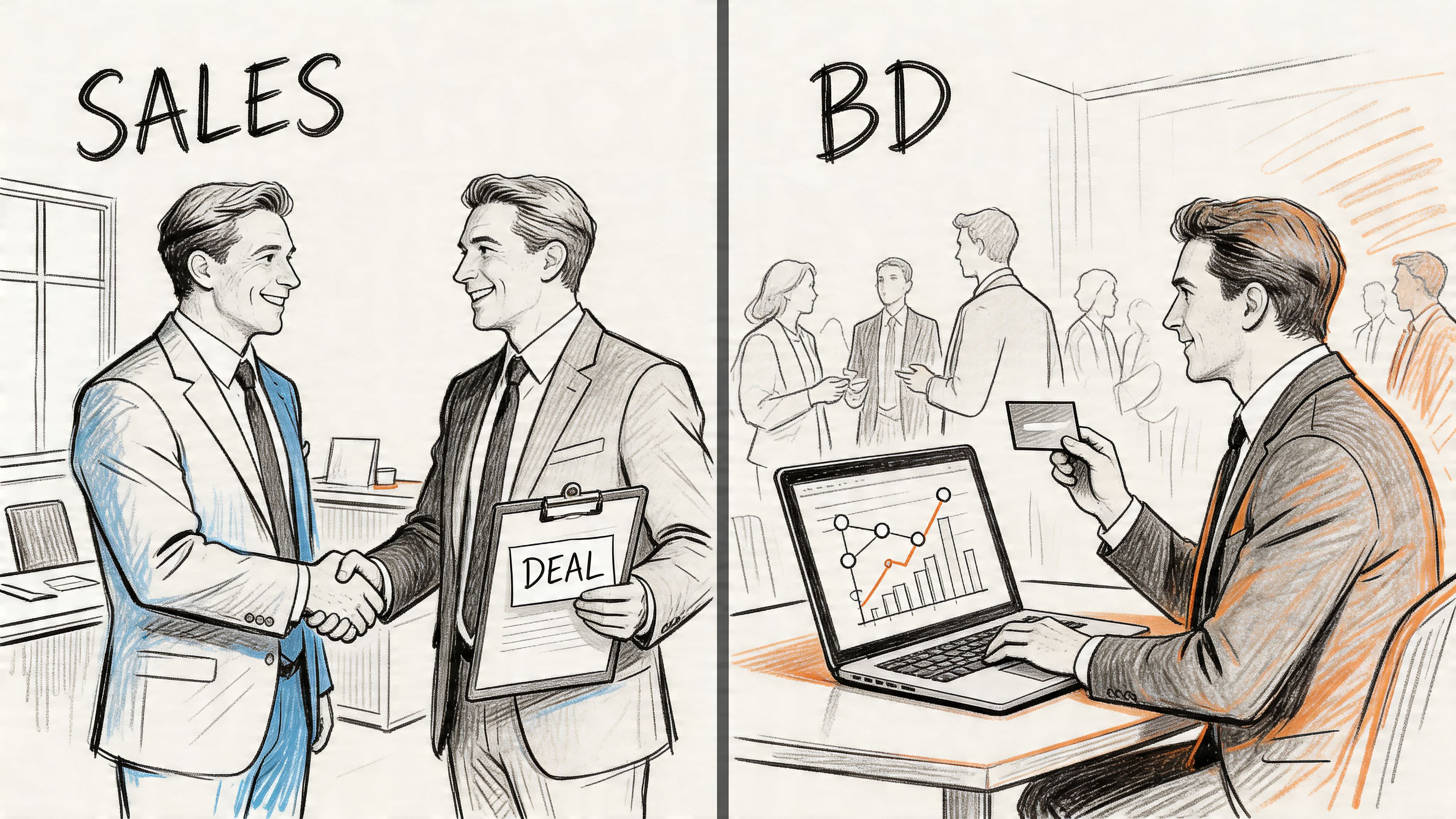
A split illustration comparing a sales handshake with a business development professional working on analytical data.

What business development actually does all week

Business development spends more time creating the conditions for revenue than closing it. The work starts with questions sales usually cannot afford to spend all week on. Which segment is warming up. Which partner can open distribution. Which target accounts matter strategically even if they are two quarters away from buying.

For SMBs, this role often becomes the unofficial connector between market learning and pipeline creation. A good BD hire is not just booking conversations. They are testing new angles, building partner channels, and giving the rest of the go-to-market team cleaner inputs.

A typical BD week may include:

  • Market mapping: Reviewing segments, geographies, and account profiles that show early signs of fit.

  • Partner outreach: Starting conversations with agencies, consultants, technology partners, or resellers that can expand reach.

  • Strategic prospecting: Opening senior-level conversations at accounts that are too important for generic outbound.

  • Relationship nurture: Staying in contact with future buyers, champions, and referral sources before a live deal exists.

  • Internal feedback: Reporting what they hear so leadership, product, and marketing can adjust faster.

The operational challenge is simple. BD often produces value before it produces revenue. If that work lives in spreadsheets, inboxes, and disconnected notes, sales inherits weak context and has to restart the conversation from scratch. That is one reason SMBs benefit from a shared system like Stamina. It keeps early relationship data, account history, and active opportunity work in one place instead of splitting them across tools.

A directional example often cited in this debate is that companies with dedicated BD teams can see better market entry outcomes than companies asking sales to do both jobs. A commonly referenced version of that claim appears in SalesMotion’s analysis of business development and sales roles. The exact number matters less than the operating truth. Strategic opportunity creation needs its own time horizon and process.

What sales actually does all week

Sales works inside active buying motion. The day is built around decisions, blockers, and timing. Which deal advanced. Which one stalled in procurement. Which stakeholder needs alignment before a proposal can move.

The work is narrower than BD, but it is not easier. Good sales reps protect focus. They qualify hard, run discovery with discipline, and spend time where buyer intent is real. In small teams, founders often make an expensive mistake by asking closers to prospect broadly, build partnerships, and manage every live deal at once. Pipeline may look healthy for a month. Conversion quality usually drops after that.

A typical sales week may include:

  • Discovery calls: Testing fit, urgency, and decision process.

  • Product demos: Framing the product around the buyer’s actual use case.

  • Proposal management: Confirming scope, pricing, and next steps.

  • Stakeholder navigation: Identifying champions, blockers, and approvers.

  • Pipeline review: Re-ranking deals based on evidence, not rep optimism.

Sales also depends on process discipline more than many founders expect. Stage definitions, exit criteria, and handoff rules shape rep behavior every day. If your team is cleaning that up, this guide to sales process optimization is a useful reference.

The handoff is where SMBs either gain speed or lose it

The handoff from BD to sales is usually where role confusion becomes a revenue problem.

In strong teams, BD passes over account context, relationship history, trigger events, and a clear reason the conversation should continue now. Sales can pick up momentum without re-asking basic questions. In weak teams, BD logs a contact, sales sees no real buying signal, and both sides argue about lead quality.

A lead is qualified when the next seller can move the conversation forward with context, not restart discovery from zero.

This has practical implications for your tech stack. If BD works from spreadsheets, sales works from a CRM, and marketing owns engagement data somewhere else, your handoff depends on people remembering to update three systems. That breaks fast in an SMB. A unified platform matters because it connects long-cycle relationship building to short-cycle revenue execution without losing the history in between.

The difference in mindset

BD is trying to create future advantage. Sales is trying to convert present advantage into revenue.

Both roles talk to prospects. Both can do outreach. Both influence growth. But their calendars, decisions, and success windows are different. Founders who understand that hire better, set cleaner goals, and choose systems that support one revenue motion instead of two disconnected ones.

Measuring Success KPIs for Sales and Business Development

A founder hires one person to "own growth," then wonders why the pipeline looks busy but revenue stays flat. In almost every case, the problem starts with the scorecard. If sales and business development are measured the same way, both roles start optimizing for the wrong outcome.

Sales should be measured on conversion. BD should be measured on opportunity creation that sales can use. That sounds obvious, but SMBs blur the line all the time, especially when one person covers both functions or the handoff lives across email, spreadsheets, and a CRM.

Sales KPIs should track movement toward revenue

Sales exists to turn qualified demand into closed business. The metrics need to reflect that job directly.

Useful sales KPIs include:

  • Revenue closed: Booked business, not just late-stage activity

  • Pipeline progression: Movement from one stage to the next with clear exit criteria

  • Win rate by segment or source: Which opportunities convert

  • Sales cycle length: How efficiently reps move buyers through the process

  • Early retention or churn signals: Whether closed deals were good deals

These metrics help founders separate effort from execution. A rep can log calls all week and still miss the job if deals stall, discounting gets sloppy, or new customers churn in the first 90 days.

If your pipeline stages are still vague, tighten those definitions before you judge rep performance. This guide to sales process optimization gives a practical framework for cleaning that up.

BD KPIs should track future revenue creation

BD is not measured well by raw activity alone. Meetings booked, emails sent, and contacts added are useful inputs, but they do not tell you whether the role is opening real paths to growth.

A better BD scorecard looks at whether the work creates commercial options the company did not have before.

Common BD KPIs include:

  • Strategic accounts opened: Target accounts where your team now has traction

  • Qualified introductions secured: Conversations with context, relevance, and a reason to continue

  • Partnership progress: Movement from initial discussion to a defined go-to-market or referral motion

  • New segment validation: Evidence that a market, vertical, or channel is worth further investment

  • Sales-accepted opportunities from BD: Opportunities that pass handoff and keep moving

This is the key trade-off. If you measure BD only on volume, you get calendars full of weak meetings. If you measure BD only on closed revenue, you force a long-horizon role into short-term behavior and lose the strategic work that creates next quarter's pipeline.

Practical rule: BD should earn credit for creating openings that survive contact with the sales process.

Shared KPIs are what keep the system honest

Separate scorecards are necessary. Shared KPIs are what prevent finger-pointing.

For SMBs, the best shared metrics usually sit at the point where BD-generated opportunity meets sales execution:

  • Handoff acceptance rate

  • Time to first follow-up after handoff

  • Opportunity progression after handoff

  • Reasons opportunities were rejected, stalled, or advanced

  • Sourced pipeline versus converted pipeline

Those metrics matter because they expose operating problems, not just individual performance. If BD creates opportunities that sales never accepts, the issue may be qualification. If sales accepts them but they die in discovery, the issue may be positioning, timing, or weak account context. If both teams are working from disconnected systems, the problem is often visibility.

That is where SMBs feel the gap between sales and BD most sharply. One team is trying to build future demand. The other is trying to capture current demand. Without a shared platform, those efforts split into separate workflows, separate definitions, and separate versions of the truth.

A unified system like Stamina helps fix the measurement problem at the source. It keeps relationship history, outreach activity, pipeline status, and handoff context in one place, so founders can judge whether BD is creating real advantage for sales and whether sales is converting the opportunities worth pursuing.

Good KPI design changes hiring decisions, compensation plans, and software choices. It tells you whether you need a closer, a relationship builder, or one hybrid operator with a very clear mandate.

Structuring Your Team Org Charts and Handoffs for SMBs

Org design for SMBs isn’t about copying enterprise charts. It’s about assigning ownership clearly enough that work moves without drama.
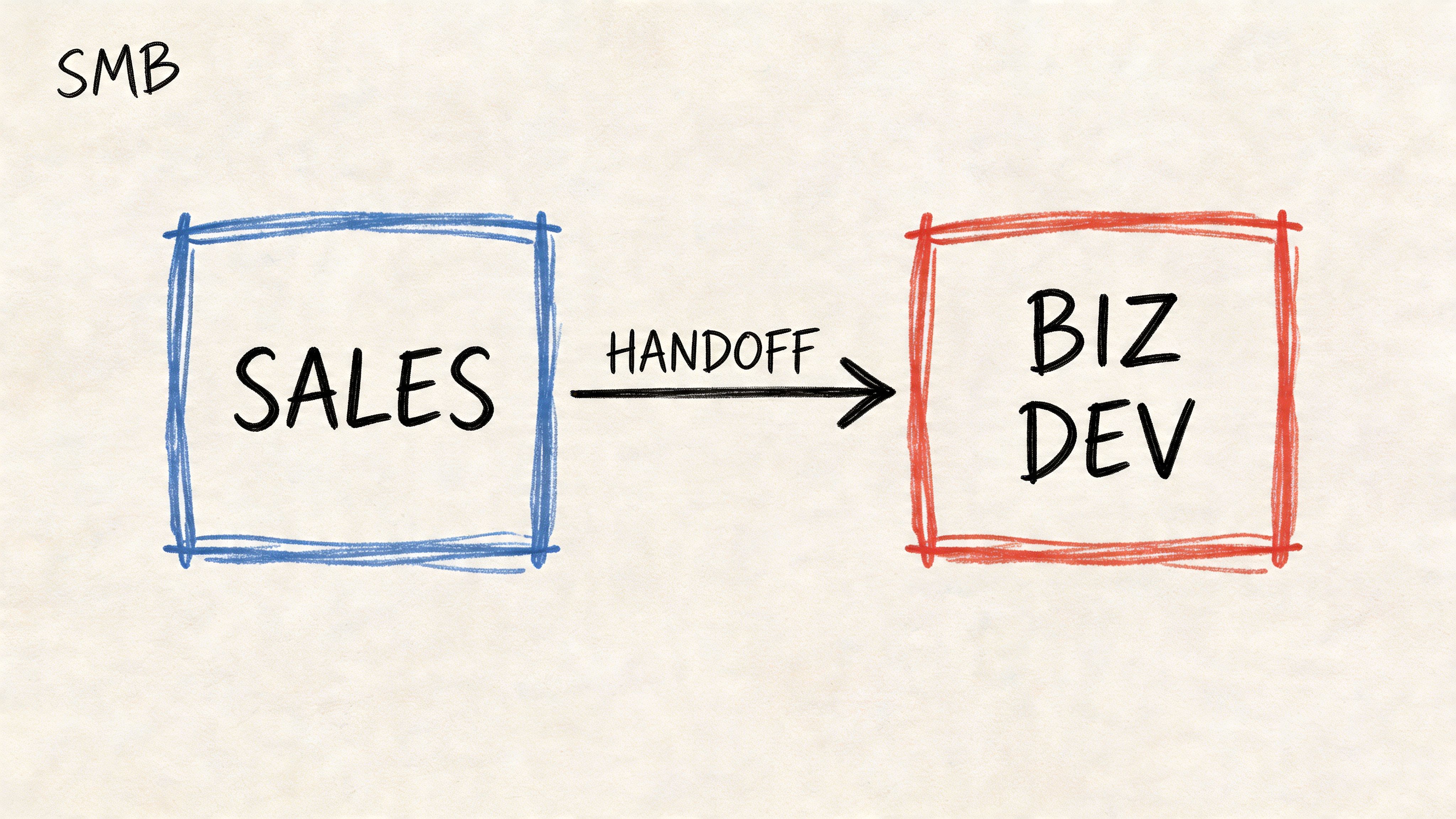
A diagram showing a sales team handing off work to the business development team for SMB companies.

Model one founder-led with selective support

At the earliest stage, the founder often acts as head of sales and head of business development at the same time. That’s workable for a while because the founder usually holds the market context, the product story, and the strongest relationships.

The risk is that everything stays in the founder’s head. Notes live in email. Partnership conversations happen informally. Active deals get attention, while strategic prospecting slips when the week gets crowded.

In this model, support should be narrow and explicit. One person might help with outbound research, scheduling, CRM cleanup, and follow-up prep. Another might support proposals or onboarding. Don’t call this a full sales team. It’s founder-led selling with delegated tasks.

Model two hybrid first hire

This is the most common SMB setup. You hire one person who can prospect, qualify, and close smaller deals while the founder still handles larger accounts and strategic relationships.

This model works only if you define the split early:

  • Founder owns: Strategic partnerships, complex enterprise-style deals, and major account relationships.

  • Hybrid hire owns: Outbound to defined segments, qualification, smaller deal cycles, and CRM discipline.

  • Shared ownership: Feedback on market response and qualification criteria.

This is also where a CRM stops being optional. If the founder is still running relationships through memory and inbox search, the hybrid hire can’t inherit context cleanly. Teams that want a practical foundation should follow strong CRM best practices before adding more headcount.

Model three split opener and closer

Once volume increases, the cleanest structure is to separate opening from closing. A BDR or SDR handles prospecting and qualification. An AE handles discovery, demos, negotiation, and close. If you have a true BD motion, that function may sit alongside this structure and focus on partnerships, strategic accounts, or new markets rather than routine top-of-funnel activity.

The point isn’t bureaucracy. It’s specialization. Each role gets better when the core job is narrow enough to master.

A useful walkthrough of how teams think about process handoffs is below.

Define the handoff before you add another rep

Most SMB revenue problems show up at the transfer point between opportunity creation and opportunity conversion. You can prevent a lot of friction with a short, essential checklist.

A sales-accepted opportunity should usually include:

  • Clear problem signal: Why this account is worth pursuing now.

  • Relevant contact context: Who engaged, what they care about, and how they fit the buying group.

  • Source detail: Whether the lead came from outbound, partner referral, inbound, or strategic outreach.

  • Confirmed next step: A meeting, intro, evaluation call, or concrete action already agreed.

  • Disqualification notes: Any reason the opportunity may stall, so sales doesn’t waste cycles rediscovering risk.

If your team can’t document those basics consistently, more hiring won’t solve the issue. You’ll just add more people to the same messy motion.

Unifying Sales and BD for Maximum Growth with Stamina

Separation of roles is healthy. Separation of systems usually isn’t.

When sales, business development, and marketing work from different tools, each team builds its own version of reality. BD logs relationship notes in spreadsheets. Sales updates only active opportunities in the CRM. Marketing sees engagement but not account context. That fragmentation is what turns a smart org chart into a sloppy operating model.
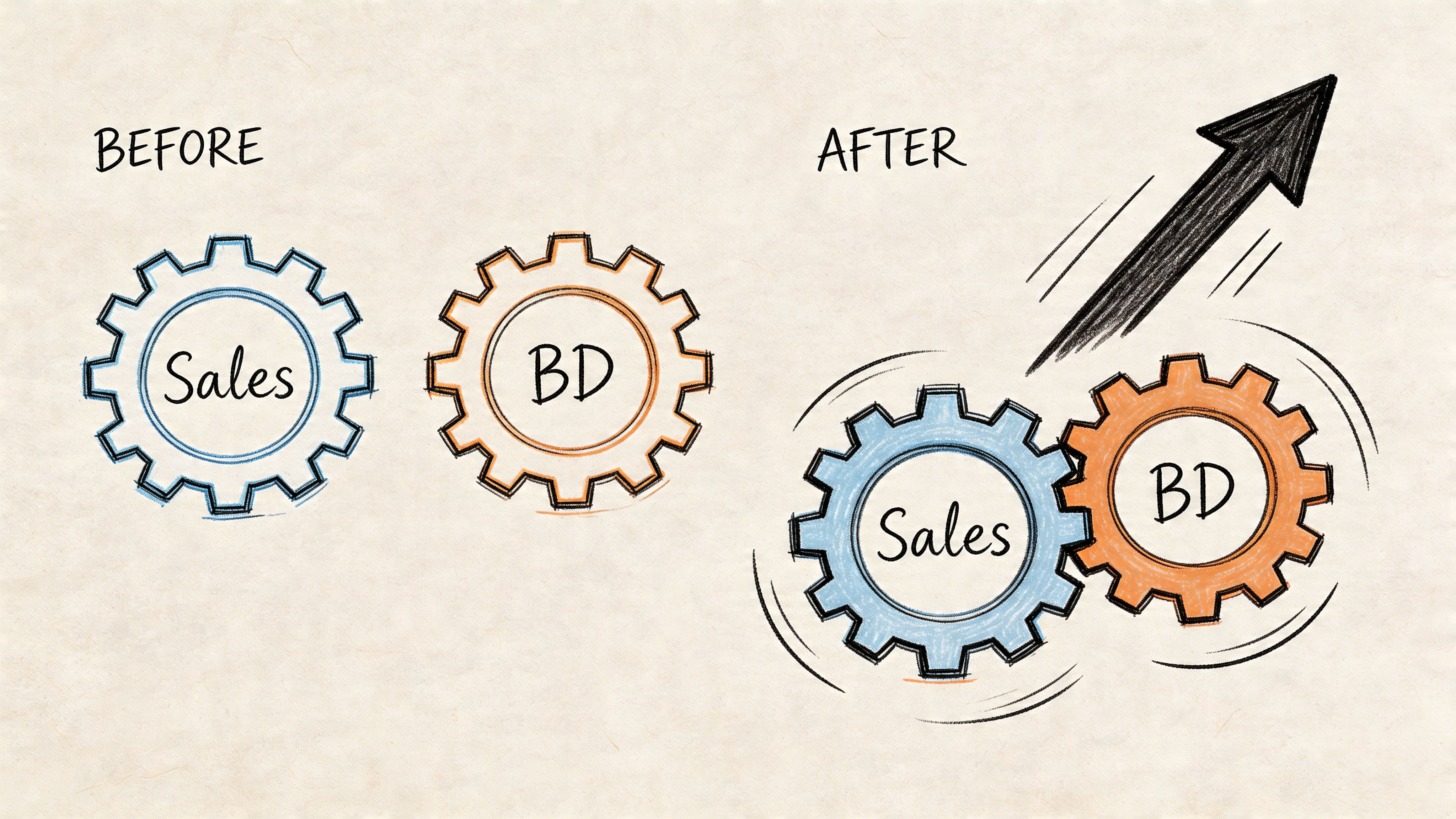
A hand-drawn illustration showing the transformation of disconnected Sales and BD gears into a synchronized, upward-moving process.

Alignment is an operating advantage

When these functions stay aligned, growth gets easier to manage. Companies achieving tight alignment across sales, business development, and marketing report 15–20% higher growth rates, according to Martal’s analysis of business development vs sales.

That result makes sense at the ground level. Better alignment means fewer dead handoffs, cleaner qualification, and less rework. Buyers don’t have to repeat themselves. Reps don’t chase stale context. Managers can see where the funnel is breaking.

The goal isn’t to merge sales and BD into one role. The goal is to give both functions one shared system of record.

What a unified platform has to solve

A useful stack for sales vs business development needs to do more than send emails or store contacts. It has to connect the full motion from first signal to closed deal.

That usually means four capabilities in one environment:

  • Shared contact and account history: Everyone sees prior outreach, meetings, replies, and ownership.

  • Prospecting support: Teams can identify and research target accounts without exporting lists across tools.

  • Workflow orchestration: A handoff can trigger the next action automatically instead of relying on memory.

  • Nurture and follow-up: Contacts who aren’t ready for sales can stay warm without disappearing.

For teams evaluating AI in that workflow, Stamina’s overview of AI sales assistants explains where automation helps and where human judgment still matters.

Where Stamina fits

Stamina is one option for SMBs that want those functions connected in a single system. It combines CRM, sales engagement, marketing automation, and workflows in one platform, with Zara as a built-in AI SDR for prospect research, personalized outreach, and follow-up. In practice, that setup helps teams keep BD-style opportunity creation and sales execution tied to the same records, sequences, and pipeline logic instead of splitting work across separate tools.

That matters most in three situations:

  • Hybrid teams: One person is still wearing multiple hats and needs context in one place.

  • Growing teams: Handoffs are becoming frequent enough that manual coordination starts failing.

  • Agency or outsourced motions: Multiple operators need visibility into the same account history without constant status meetings.

The bigger point is operational, not cosmetic. SMBs don’t usually lose growth because they can’t define sales and BD on paper. They lose it because the functions drift apart in execution. Unified data, shared workflows, and visible ownership are what prevent that drift.

Common Questions About Sales and Business Development

Can one person do both sales and business development

Yes. Early-stage startups do this all the time, and founders are usually the first example.

The mistake is treating it like one job with one scoreboard. Closing deals rewards speed, follow-up, and objection handling. Business development rewards research, relationship building, and patience. Put both under the same weekly target and the urgent work wins every time.

A combined role can work if you split time intentionally, set separate goals, and review both motions on purpose. If you do not, BD becomes the task people promise to get to after the quarter ends.

When should I split the roles

Split them when either side starts losing because of context switching.

That usually shows up in one of two ways. Reps are carrying enough active pipeline that deal progression slows because they are still sourcing and qualifying from scratch. Or the company has real expansion opportunities, such as partnerships, channels, or new market segments, but nobody has time to develop them because this month’s quota keeps taking priority.

Headcount is not the trigger. Operational complexity is.

Is SDR work the same as business development

Sometimes in title, rarely in scope.

In many SMBs, SDR and BD get lumped together because both sit near the top of the funnel. In practice, SDR work is usually a repeatable outbound motion tied to qualification and meetings. Business development often includes less structured work, such as partner sourcing, channel conversations, strategic account mapping, and early market validation.

The cleanest approach is to define the work, not argue about the label.

What’s the biggest mistake SMBs make

They build overlapping roles on disconnected systems.

I see this often. One person owns outbound. Another owns partnerships. A founder still jumps into late-stage deals. Marketing runs campaigns in a separate tool. Everyone is active, but account history is split across inboxes, CRM records, spreadsheets, and Slack threads. That is how leads get worked twice, promising partner conversations never reach sales, and reps walk into calls without context.

The practical problem is not effort. It is coordination. If ownership, stage definitions, and handoff rules are fuzzy, pipeline quality drops fast.

Should BD report to sales

It depends on the kind of BD you are running.

If BD is mostly outbound prospecting and top-of-funnel qualification, reporting into sales is usually fine. The goals, cadence, and management rhythm are close enough. If BD includes partnerships, channel development, or new market entry, a pure sales reporting line can create blind spots because those programs affect product, pricing, onboarding, and marketing as much as pipeline.

For SMBs, the reporting line matters less than shared visibility and decision rights. Someone still needs to own trade-offs across both functions.

What should I fix first if my team is already misaligned

Start with the operating model before you start hiring.

  • Role definition: Document who sources, who qualifies, who advances, and who closes.

  • Handoff criteria: Define the minimum information required before an opportunity changes hands.

  • Shared system of record: Keep outreach history, account notes, and pipeline status in one place.

  • Compensation logic: Make sure incentives do not reward one team for creating work the other team will reject.

Those four changes usually expose the primary bottleneck within a week or two.

If your team is juggling prospecting, outreach, CRM updates, and handoffs across disconnected tools, Stamina gives you one place to run the motion. You can use it to keep sales, business development, and marketing working from the same records, with AI-assisted outreach, shared workflows, and CRM visibility that reduce dropped context as you grow.

You’re probably dealing with this right now. Pipeline is thin, revenue targets are close, and every hire feels expensive. One person on the team says you need a closer yesterday. Another says you need someone opening doors with partners, new segments, and bigger accounts. Both are right, and that’s where most SMBs get stuck.

The problem with the sales vs business development debate is that founders often treat it like a naming question. It isn’t. It’s an operating model decision. If you hire for short-term closing and ignore long-term opportunity creation, you can hit a quarter and miss a year. If you hire for partnerships and strategic outreach without a clean path to revenue, you create activity that feels important but doesn’t convert.

I’ve seen this go wrong in the same predictable ways. A founder hires a “BD lead” who is really just doing prospecting with a fancier title. Or they ask an account executive to build partnerships, open new markets, qualify inbound, run demos, and close deals. That usually creates confusion, not an advantage.

What matters is understanding where sales ends, where business development begins, and how the two functions share data, ownership, and timing. Get that right and growth becomes more repeatable. Get it wrong and your team spends months arguing over lead quality, handoffs, and whether pipeline is real.

The Growth Dilemma Hunter or Farmer

Most SMB founders start with the same instinct. They hire the person who can help fastest. Usually that means someone who can book calls, run demos, and close business now. That instinct makes sense. Payroll is real, runway is finite, and waiting for a long strategic payoff can feel irresponsible.

But growth has two clocks running at the same time.

One clock is immediate. It asks who will follow up with interested buyers, move deals through the pipeline, handle objections, and get contracts signed. That’s the sales clock. It’s measured in active opportunities, next steps, and near-term revenue.

The second clock runs slower. It asks who is finding new markets, building referral channels, opening strategic accounts, and creating access you don’t yet have. That’s the business development clock. It’s measured in future opportunity, not just this month’s bookings.

Sales protects the present. Business development creates the next version of the company.

Founders get into trouble when they force one function to carry both burdens without saying so. The result is familiar. Reps chase easy deals and neglect strategic accounts. Or they spend time networking and researching while current opportunities stall. Neither failure looks dramatic at first. Both show up later in inconsistent pipeline and missed hiring plans.

A practical way to frame the choice is this:

  • If your issue is conversion: You likely need stronger sales discipline, not a vaguely defined BD role.

  • If your issue is access: You likely need business development work, not another closer working the same accounts.

  • If your issue is coordination: You don’t just have a talent problem. You have a process problem between the two.

For SMBs, that last point matters most. You rarely have the luxury of a fully staffed revenue org. You’re usually blending roles, stretching tools, and asking one system to support several jobs. That’s why definitions alone don’t solve the issue. You need a clear split in responsibility and a practical way to keep the functions connected.

Defining the Roles Sales vs Business Development at a Glance

The fastest way to clean up confusion is to stop using the titles interchangeably.

Sales is the closer. It turns qualified opportunities into revenue through discovery, demos, proposals, negotiation, and commitment.

Business development is the opener. It creates access to future revenue through market research, outbound prospecting, strategic partnerships, channel relationships, and entry into new accounts or markets.

Both functions contribute to growth. They just work at different points in the motion and optimize for different outcomes.

Why founders blur them together

In early-stage companies, one person often does both jobs. That’s normal. What hurts growth isn’t role overlap by itself. The core problem is unmanaged overlap. When nobody defines which activities matter most, people drift toward whatever feels urgent or familiar.

A strong closer often defaults to deal work because that’s where the feedback is immediate. A strong BD operator often stays upstream because research, networking, and relationship building can expand over time. Without clear boundaries, one side of the funnel gets overbuilt and the other gets neglected.

For a simple explanation of the prospecting layer that often sits between these functions, Stamina’s guide on what an SDR does in sales is useful context.

Sales vs. Business Development Key Differences

Attribute

Sales (The Closer)

Business Development (The Opener)

Primary goal

Convert qualified opportunities into paying customers

Create new opportunities, channels, and strategic relationships

Time horizon

Near term. Usually tied to the current pipeline and active deals

Longer term. Often tied to future pipeline and market access

Core activities

Discovery calls, demos, proposals, negotiation, closing, follow-up

Market research, outbound outreach, partnership building, account mapping, new market exploration

Typical counterpart

Buyers already in a buying process or close to it

Prospects, partners, referrals, ecosystem contacts, strategic accounts

Main question

“How do we win this deal?”

“Where should new growth come from?”

Success signal

Revenue booked and deals advanced

New doors opened, relationships built, opportunities created

Risk when misused

Becomes reactive and works weak leads

Becomes vague and produces activity without conversion

The practical distinction

Sales is usually strongest when the customer already has a problem, budget pressure, internal urgency, or at least a defined evaluation process. The work is about clarity, trust, process control, and moving the buyer toward a decision.

Business development operates earlier. Sometimes much earlier. The contact may not be in-market. The company may need education. The opportunity might be indirect, such as a referral partner, integration partner, reseller, or expansion path into a vertical you haven’t cracked yet.

That’s why the compensation logic should differ. Sales roles can carry more direct revenue accountability because they influence close outcomes in a tight window. BD roles need room to build value before a contract is even possible.

Where SMBs usually get this wrong

Three mistakes show up constantly:

  • Title inflation: A prospecting role gets labeled “business development” even though the work is outbound meeting generation.

  • Quota mismatch: A BD hire gets measured only on closed revenue, so they abandon strategic work and behave like a short-cycle rep.

  • Tool sprawl: Sales uses one system, marketing uses another, and BD tracks relationships in spreadsheets or inboxes.

If your team can’t answer who owns the relationship before the opportunity exists, you don’t have role clarity yet.

The sales vs business development distinction matters because each function asks for a different manager, a different cadence, and a different operating rhythm. Once that’s clear, hiring and measurement become much easier.

Core Goals and Activities A Day in the Life

A founder usually sees the problem when pipeline looks full but revenue still feels fragile. The team is busy. Meetings are happening. Yet one part of the motion is trying to create future demand while another is trying to close this quarter, and both are working from different systems, different definitions, and different priorities.

That is why a day in the life matters. Titles blur these roles. Daily work does not.

A split illustration comparing a sales handshake with a business development professional working on analytical data.

What business development actually does all week

Business development spends more time creating the conditions for revenue than closing it. The work starts with questions sales usually cannot afford to spend all week on. Which segment is warming up. Which partner can open distribution. Which target accounts matter strategically even if they are two quarters away from buying.

For SMBs, this role often becomes the unofficial connector between market learning and pipeline creation. A good BD hire is not just booking conversations. They are testing new angles, building partner channels, and giving the rest of the go-to-market team cleaner inputs.

A typical BD week may include:

  • Market mapping: Reviewing segments, geographies, and account profiles that show early signs of fit.

  • Partner outreach: Starting conversations with agencies, consultants, technology partners, or resellers that can expand reach.

  • Strategic prospecting: Opening senior-level conversations at accounts that are too important for generic outbound.

  • Relationship nurture: Staying in contact with future buyers, champions, and referral sources before a live deal exists.

  • Internal feedback: Reporting what they hear so leadership, product, and marketing can adjust faster.

The operational challenge is simple. BD often produces value before it produces revenue. If that work lives in spreadsheets, inboxes, and disconnected notes, sales inherits weak context and has to restart the conversation from scratch. That is one reason SMBs benefit from a shared system like Stamina. It keeps early relationship data, account history, and active opportunity work in one place instead of splitting them across tools.

A directional example often cited in this debate is that companies with dedicated BD teams can see better market entry outcomes than companies asking sales to do both jobs. A commonly referenced version of that claim appears in SalesMotion’s analysis of business development and sales roles. The exact number matters less than the operating truth. Strategic opportunity creation needs its own time horizon and process.

What sales actually does all week

Sales works inside active buying motion. The day is built around decisions, blockers, and timing. Which deal advanced. Which one stalled in procurement. Which stakeholder needs alignment before a proposal can move.

The work is narrower than BD, but it is not easier. Good sales reps protect focus. They qualify hard, run discovery with discipline, and spend time where buyer intent is real. In small teams, founders often make an expensive mistake by asking closers to prospect broadly, build partnerships, and manage every live deal at once. Pipeline may look healthy for a month. Conversion quality usually drops after that.

A typical sales week may include:

  • Discovery calls: Testing fit, urgency, and decision process.

  • Product demos: Framing the product around the buyer’s actual use case.

  • Proposal management: Confirming scope, pricing, and next steps.

  • Stakeholder navigation: Identifying champions, blockers, and approvers.

  • Pipeline review: Re-ranking deals based on evidence, not rep optimism.

Sales also depends on process discipline more than many founders expect. Stage definitions, exit criteria, and handoff rules shape rep behavior every day. If your team is cleaning that up, this guide to sales process optimization is a useful reference.

The handoff is where SMBs either gain speed or lose it

The handoff from BD to sales is usually where role confusion becomes a revenue problem.

In strong teams, BD passes over account context, relationship history, trigger events, and a clear reason the conversation should continue now. Sales can pick up momentum without re-asking basic questions. In weak teams, BD logs a contact, sales sees no real buying signal, and both sides argue about lead quality.

A lead is qualified when the next seller can move the conversation forward with context, not restart discovery from zero.

This has practical implications for your tech stack. If BD works from spreadsheets, sales works from a CRM, and marketing owns engagement data somewhere else, your handoff depends on people remembering to update three systems. That breaks fast in an SMB. A unified platform matters because it connects long-cycle relationship building to short-cycle revenue execution without losing the history in between.

The difference in mindset

BD is trying to create future advantage. Sales is trying to convert present advantage into revenue.

Both roles talk to prospects. Both can do outreach. Both influence growth. But their calendars, decisions, and success windows are different. Founders who understand that hire better, set cleaner goals, and choose systems that support one revenue motion instead of two disconnected ones.

Measuring Success KPIs for Sales and Business Development

A founder hires one person to "own growth," then wonders why the pipeline looks busy but revenue stays flat. In almost every case, the problem starts with the scorecard. If sales and business development are measured the same way, both roles start optimizing for the wrong outcome.

Sales should be measured on conversion. BD should be measured on opportunity creation that sales can use. That sounds obvious, but SMBs blur the line all the time, especially when one person covers both functions or the handoff lives across email, spreadsheets, and a CRM.

Sales KPIs should track movement toward revenue

Sales exists to turn qualified demand into closed business. The metrics need to reflect that job directly.

Useful sales KPIs include:

  • Revenue closed: Booked business, not just late-stage activity

  • Pipeline progression: Movement from one stage to the next with clear exit criteria

  • Win rate by segment or source: Which opportunities convert

  • Sales cycle length: How efficiently reps move buyers through the process

  • Early retention or churn signals: Whether closed deals were good deals

These metrics help founders separate effort from execution. A rep can log calls all week and still miss the job if deals stall, discounting gets sloppy, or new customers churn in the first 90 days.

If your pipeline stages are still vague, tighten those definitions before you judge rep performance. This guide to sales process optimization gives a practical framework for cleaning that up.

BD KPIs should track future revenue creation

BD is not measured well by raw activity alone. Meetings booked, emails sent, and contacts added are useful inputs, but they do not tell you whether the role is opening real paths to growth.

A better BD scorecard looks at whether the work creates commercial options the company did not have before.

Common BD KPIs include:

  • Strategic accounts opened: Target accounts where your team now has traction

  • Qualified introductions secured: Conversations with context, relevance, and a reason to continue

  • Partnership progress: Movement from initial discussion to a defined go-to-market or referral motion

  • New segment validation: Evidence that a market, vertical, or channel is worth further investment

  • Sales-accepted opportunities from BD: Opportunities that pass handoff and keep moving

This is the key trade-off. If you measure BD only on volume, you get calendars full of weak meetings. If you measure BD only on closed revenue, you force a long-horizon role into short-term behavior and lose the strategic work that creates next quarter's pipeline.

Practical rule: BD should earn credit for creating openings that survive contact with the sales process.

Shared KPIs are what keep the system honest

Separate scorecards are necessary. Shared KPIs are what prevent finger-pointing.

For SMBs, the best shared metrics usually sit at the point where BD-generated opportunity meets sales execution:

  • Handoff acceptance rate

  • Time to first follow-up after handoff

  • Opportunity progression after handoff

  • Reasons opportunities were rejected, stalled, or advanced

  • Sourced pipeline versus converted pipeline

Those metrics matter because they expose operating problems, not just individual performance. If BD creates opportunities that sales never accepts, the issue may be qualification. If sales accepts them but they die in discovery, the issue may be positioning, timing, or weak account context. If both teams are working from disconnected systems, the problem is often visibility.

That is where SMBs feel the gap between sales and BD most sharply. One team is trying to build future demand. The other is trying to capture current demand. Without a shared platform, those efforts split into separate workflows, separate definitions, and separate versions of the truth.

A unified system like Stamina helps fix the measurement problem at the source. It keeps relationship history, outreach activity, pipeline status, and handoff context in one place, so founders can judge whether BD is creating real advantage for sales and whether sales is converting the opportunities worth pursuing.

Good KPI design changes hiring decisions, compensation plans, and software choices. It tells you whether you need a closer, a relationship builder, or one hybrid operator with a very clear mandate.

Structuring Your Team Org Charts and Handoffs for SMBs

Org design for SMBs isn’t about copying enterprise charts. It’s about assigning ownership clearly enough that work moves without drama.

A diagram showing a sales team handing off work to the business development team for SMB companies.

Model one founder-led with selective support

At the earliest stage, the founder often acts as head of sales and head of business development at the same time. That’s workable for a while because the founder usually holds the market context, the product story, and the strongest relationships.

The risk is that everything stays in the founder’s head. Notes live in email. Partnership conversations happen informally. Active deals get attention, while strategic prospecting slips when the week gets crowded.

In this model, support should be narrow and explicit. One person might help with outbound research, scheduling, CRM cleanup, and follow-up prep. Another might support proposals or onboarding. Don’t call this a full sales team. It’s founder-led selling with delegated tasks.

Model two hybrid first hire

This is the most common SMB setup. You hire one person who can prospect, qualify, and close smaller deals while the founder still handles larger accounts and strategic relationships.

This model works only if you define the split early:

  • Founder owns: Strategic partnerships, complex enterprise-style deals, and major account relationships.

  • Hybrid hire owns: Outbound to defined segments, qualification, smaller deal cycles, and CRM discipline.

  • Shared ownership: Feedback on market response and qualification criteria.

This is also where a CRM stops being optional. If the founder is still running relationships through memory and inbox search, the hybrid hire can’t inherit context cleanly. Teams that want a practical foundation should follow strong CRM best practices before adding more headcount.

Model three split opener and closer

Once volume increases, the cleanest structure is to separate opening from closing. A BDR or SDR handles prospecting and qualification. An AE handles discovery, demos, negotiation, and close. If you have a true BD motion, that function may sit alongside this structure and focus on partnerships, strategic accounts, or new markets rather than routine top-of-funnel activity.

The point isn’t bureaucracy. It’s specialization. Each role gets better when the core job is narrow enough to master.

A useful walkthrough of how teams think about process handoffs is below.

Define the handoff before you add another rep

Most SMB revenue problems show up at the transfer point between opportunity creation and opportunity conversion. You can prevent a lot of friction with a short, essential checklist.

A sales-accepted opportunity should usually include:

  • Clear problem signal: Why this account is worth pursuing now.

  • Relevant contact context: Who engaged, what they care about, and how they fit the buying group.

  • Source detail: Whether the lead came from outbound, partner referral, inbound, or strategic outreach.

  • Confirmed next step: A meeting, intro, evaluation call, or concrete action already agreed.

  • Disqualification notes: Any reason the opportunity may stall, so sales doesn’t waste cycles rediscovering risk.

If your team can’t document those basics consistently, more hiring won’t solve the issue. You’ll just add more people to the same messy motion.

Unifying Sales and BD for Maximum Growth with Stamina

Separation of roles is healthy. Separation of systems usually isn’t.

When sales, business development, and marketing work from different tools, each team builds its own version of reality. BD logs relationship notes in spreadsheets. Sales updates only active opportunities in the CRM. Marketing sees engagement but not account context. That fragmentation is what turns a smart org chart into a sloppy operating model.

A hand-drawn illustration showing the transformation of disconnected Sales and BD gears into a synchronized, upward-moving process.

Alignment is an operating advantage

When these functions stay aligned, growth gets easier to manage. Companies achieving tight alignment across sales, business development, and marketing report 15–20% higher growth rates, according to Martal’s analysis of business development vs sales.

That result makes sense at the ground level. Better alignment means fewer dead handoffs, cleaner qualification, and less rework. Buyers don’t have to repeat themselves. Reps don’t chase stale context. Managers can see where the funnel is breaking.

The goal isn’t to merge sales and BD into one role. The goal is to give both functions one shared system of record.

What a unified platform has to solve

A useful stack for sales vs business development needs to do more than send emails or store contacts. It has to connect the full motion from first signal to closed deal.

That usually means four capabilities in one environment:

  • Shared contact and account history: Everyone sees prior outreach, meetings, replies, and ownership.

  • Prospecting support: Teams can identify and research target accounts without exporting lists across tools.

  • Workflow orchestration: A handoff can trigger the next action automatically instead of relying on memory.

  • Nurture and follow-up: Contacts who aren’t ready for sales can stay warm without disappearing.

For teams evaluating AI in that workflow, Stamina’s overview of AI sales assistants explains where automation helps and where human judgment still matters.

Where Stamina fits

Stamina is one option for SMBs that want those functions connected in a single system. It combines CRM, sales engagement, marketing automation, and workflows in one platform, with Zara as a built-in AI SDR for prospect research, personalized outreach, and follow-up. In practice, that setup helps teams keep BD-style opportunity creation and sales execution tied to the same records, sequences, and pipeline logic instead of splitting work across separate tools.

That matters most in three situations:

  • Hybrid teams: One person is still wearing multiple hats and needs context in one place.

  • Growing teams: Handoffs are becoming frequent enough that manual coordination starts failing.

  • Agency or outsourced motions: Multiple operators need visibility into the same account history without constant status meetings.

The bigger point is operational, not cosmetic. SMBs don’t usually lose growth because they can’t define sales and BD on paper. They lose it because the functions drift apart in execution. Unified data, shared workflows, and visible ownership are what prevent that drift.

Common Questions About Sales and Business Development

Can one person do both sales and business development

Yes. Early-stage startups do this all the time, and founders are usually the first example.

The mistake is treating it like one job with one scoreboard. Closing deals rewards speed, follow-up, and objection handling. Business development rewards research, relationship building, and patience. Put both under the same weekly target and the urgent work wins every time.

A combined role can work if you split time intentionally, set separate goals, and review both motions on purpose. If you do not, BD becomes the task people promise to get to after the quarter ends.

When should I split the roles

Split them when either side starts losing because of context switching.

That usually shows up in one of two ways. Reps are carrying enough active pipeline that deal progression slows because they are still sourcing and qualifying from scratch. Or the company has real expansion opportunities, such as partnerships, channels, or new market segments, but nobody has time to develop them because this month’s quota keeps taking priority.

Headcount is not the trigger. Operational complexity is.

Is SDR work the same as business development

Sometimes in title, rarely in scope.

In many SMBs, SDR and BD get lumped together because both sit near the top of the funnel. In practice, SDR work is usually a repeatable outbound motion tied to qualification and meetings. Business development often includes less structured work, such as partner sourcing, channel conversations, strategic account mapping, and early market validation.

The cleanest approach is to define the work, not argue about the label.

What’s the biggest mistake SMBs make

They build overlapping roles on disconnected systems.

I see this often. One person owns outbound. Another owns partnerships. A founder still jumps into late-stage deals. Marketing runs campaigns in a separate tool. Everyone is active, but account history is split across inboxes, CRM records, spreadsheets, and Slack threads. That is how leads get worked twice, promising partner conversations never reach sales, and reps walk into calls without context.

The practical problem is not effort. It is coordination. If ownership, stage definitions, and handoff rules are fuzzy, pipeline quality drops fast.

Should BD report to sales

It depends on the kind of BD you are running.

If BD is mostly outbound prospecting and top-of-funnel qualification, reporting into sales is usually fine. The goals, cadence, and management rhythm are close enough. If BD includes partnerships, channel development, or new market entry, a pure sales reporting line can create blind spots because those programs affect product, pricing, onboarding, and marketing as much as pipeline.

For SMBs, the reporting line matters less than shared visibility and decision rights. Someone still needs to own trade-offs across both functions.

What should I fix first if my team is already misaligned

Start with the operating model before you start hiring.

  • Role definition: Document who sources, who qualifies, who advances, and who closes.

  • Handoff criteria: Define the minimum information required before an opportunity changes hands.

  • Shared system of record: Keep outreach history, account notes, and pipeline status in one place.

  • Compensation logic: Make sure incentives do not reward one team for creating work the other team will reject.

Those four changes usually expose the primary bottleneck within a week or two.

If your team is juggling prospecting, outreach, CRM updates, and handoffs across disconnected tools, Stamina gives you one place to run the motion. You can use it to keep sales, business development, and marketing working from the same records, with AI-assisted outreach, shared workflows, and CRM visibility that reduce dropped context as you grow.

Share this article

Share this article

Send a shareable link to your team or anyone who might find it useful.

Send a shareable link to your team or anyone who might find it useful.

Copy link

Copied

Share directly to

Table of contents

Give Your Business the Stamina it needs to Thrive