
Sales forecasting is a financial weather report for your business. At a practical level, it means estimating future revenue, and it matters because about 93% of sales leaders still can't forecast within a 5% margin even with only two weeks left in the quarter, while companies with disciplined forecasting are over 7% more likely to hit quota.
If you're running a growing SMB, you've probably felt the problem already. One week the pipeline looks healthy, so you think about hiring. The next week two “sure thing” deals stall, cash gets tight, and suddenly every decision feels reactive. That's usually the moment leaders start asking, “What is sales forecasting, really, and how do we make it useful instead of ceremonial?”
The short answer is simple. A sales forecast is your best estimate of what revenue is likely to close in a defined period based on real signals, not wishful thinking.
The harder part is building a forecast you can trust when your business is changing fast, your CRM is messy, or you're selling something new and don't have much history yet. That's where most guides stop being helpful. They assume you've got years of clean data. Many SMBs don't. Some are launching a new offer. Others are filling pipeline with AI-generated outbound and website intent signals, not old-school rep prospecting.
This guide is for that reality.
Flying Blind Without a Forecast
A new sales manager joins an SMB and inherits a familiar mess. Reps have deals marked “closing this month” because no one wants to look pessimistic. Marketing is asking how many demos to generate next quarter. Finance wants a hiring plan. The founder wants to know whether they can afford another account executive. Nobody has one answer everyone trusts.
So decisions get made on instinct.
The team orders inventory a little too aggressively. Hiring happens a little too early, or too late. Cash planning gets tighter than expected because revenue lands later than the leadership team assumed. None of this feels dramatic in the moment. Then the quarter ends, and everyone realizes they were steering from the rearview mirror.
That's not a rare failure. According to Argano's analysis of common sales forecasting challenges, approximately 93% of sales leaders are unable to forecast revenue within a 5% margin of accuracy, even when only two weeks remain in the quarter.
Sales forecasting isn't about predicting the future perfectly. It's about reducing surprise enough that you can make better decisions today.
What a forecast actually does
A good forecast gives you a working answer to a simple question: how much revenue is likely to close, and when?
That answer affects more than sales.
Finance uses it to manage cash, spending, and collections expectations.
Operations uses it to prepare for fulfillment and delivery.
HR uses it to decide when hiring is safe.
Marketing uses it to judge whether pipeline creation is keeping pace.
If your pipeline itself is weak, forecasting won't magically fix it. You still need a system for building opportunities consistently, and that usually starts with a clear pipeline structure like the one outlined in this guide to building a sales pipeline.
A plain-English definition
If you want the simplest version of what is sales forecasting, here it is: it's the process of estimating future sales revenue based on the deals, behaviors, and patterns you can observe right now.
A weak forecast says, “We think we'll be fine.”
A useful forecast says, “Here's what's likely, here's what's at risk, and here's what would need to happen to beat plan.”
That difference is why mature teams treat forecasting as an operating discipline, not a spreadsheet chore.
Why Forecasting Is Your Business's North Star
A forecast doesn't just tell you what might happen. It gives the whole company one reference point for decisions. Without it, every team uses its own assumptions. Sales thinks growth is coming. Finance plans conservatively. Marketing pushes for more spend. Operations braces for volatility. Everyone works hard, but not in the same direction.

Why disciplined forecasting changes outcomes
The strongest argument for forecasting is that it changes behavior. Teams that forecast well inspect pipeline quality earlier, spot gaps sooner, and course-correct before the quarter is gone.
That's why the result isn't just “better reporting.” According to Salesloft's sales forecasting guide, companies adhering to rigorous sales forecasting processes are over 7% more likely to hit their revenue and sales quotas.
That number matters because quota attainment doesn't improve by accident. Better forecasting usually forces better management habits:
Earlier deal inspection instead of end-of-quarter scrambling
Stronger qualification so weak opportunities don't inflate confidence
Clearer stage definitions so pipeline means the same thing across the team
More realistic resource planning across the business
Practical rule: If your forecast doesn't change what your team does this week, it's probably just a report.
Forecasting aligns the whole company
Think of a forecast as your company's North Star. Not because it's mystical, but because it gives everyone the same directional signal.
Finance wants to know what cash is likely to arrive. Marketing wants to know whether top-of-funnel needs to accelerate. Sales leadership wants to know whether pipeline coverage is healthy enough to support the target. Founders want to know whether they can invest without getting ahead of revenue reality.
When those decisions come from the same forecast, the company operates with less friction.
It also builds management credibility
New managers often miss this point. Forecasting is one of the fastest ways to build trust upward and downward.
If you can say, “Here's the likely number, here are the assumptions, and here are the deals creating risk,” executives take you seriously. Reps also take you more seriously because you're not just asking for optimism. You're asking for evidence.
A reliable forecast won't eliminate uncertainty. It will make uncertainty visible. For an SMB, that's often the difference between controlled growth and expensive guessing.
A Breakdown of Common Sales Forecasting Methods
Not every forecast is built the same way. The right method depends on your stage, your data quality, and how complex your sales motion is. A founder-led team selling a new service won't forecast the same way as a mature SaaS team with a full CRM history.
The easiest way to understand the options is to split them into three buckets: judgment-based methods, history-based methods, and pipeline-based methods.
Qualitative methods
These rely on human judgment more than hard data.
A common example is manager or rep opinion. You ask the team what they think will close and when. This can be useful when a business is new, when you're entering a new market, or when there isn't enough history to model patterns yet.
The upside is speed and context. A rep may know that legal approval is stuck or that a buyer went quiet after a pricing change.
The downside is obvious. People are biased. Some reps are optimistic. Some sandbag. Teams often also define “likely” differently unless leadership sets a standard.
Quantitative methods
These use historical performance to project future results.
A simple version is trend-based forecasting. If sales have followed a stable pattern, you use past periods as a guide for future ones. More advanced approaches use regression or time-series analysis. If you want a useful technical primer, DataTeams' expert forecasting advice is a solid resource for understanding when pattern-based methods make sense.
These models work best when you have consistent data, a relatively stable market, and enough history to trust the signal.
They break down when conditions change fast, when you launch a new product, or when your go-to-market motion has changed so much that the past no longer predicts the next quarter well.
Pipeline and CRM-driven methods
This is the method most growing SMBs should understand first.
You look at open opportunities in your CRM, assign a probability based on deal stage, and build a weighted forecast from the pipeline you have now. This approach is more grounded than pure intuition and more responsive than pure historical modeling.
A basic example looks like this:
A deal in discovery gets a lower probability
A deal in proposal gets a higher probability
A contract in final review gets the highest probability
This method gets stronger when you stop treating stages as labels and start checking real deal movement, activity, and age.
Sales Forecasting Methods Compared
Method | Basis | Best For | Potential Downside |
|---|---|---|---|
Expert opinion | Rep and manager judgment | New teams, new markets, sparse data | Bias and inconsistent assumptions |
Historical trend | Past sales patterns | Stable businesses with reliable history | Weak when market conditions shift |
Regression or time series | Statistical relationships over time | Data-mature teams with analytical support | Harder to maintain, not ideal for zero-history launches |
Opportunity stage forecasting | Current deals and close probability | SMBs using a CRM with defined stages | Can be misleading if stage definitions are sloppy |
Multivariable forecasting | Stage plus deal attributes and activity signals | Teams with stronger CRM discipline | Requires cleaner data and tighter process |
The best forecast usually isn't one method. It's a combination of pipeline math and manager judgment, with each correcting the other.
For most SMBs, the practical move is to start simple. Use a stage-weighted pipeline forecast. Then improve it by adding better stage definitions, deal age, and activity signals. That's where forecasting starts becoming dependable instead of performative.
The Essential Data and Metrics for a Reliable Forecast
A forecast is only as good as the inputs behind it. If your CRM is incomplete, your stages are vague, or your reps update deals at the end of the month, your forecast will look precise and still be wrong.
Think of the data as ingredients. You don't need everything on day one. But you do need the right basics.
Start with the core ingredients
Most SMBs should begin with a handful of metrics they can pull from the CRM without building a complex model.
Average deal size tells you how much a typical win contributes to revenue.
Win rate shows what share of qualified opportunities close.
Sales cycle length helps you judge whether current pipeline can realistically close in the period you're forecasting.
Pipeline by stage shows where opportunities sit today.
Expected close date gives timing, though only if your team keeps it honest.
These metrics give you the first version of a usable forecast. They won't make it perfect, but they'll stop you from counting every open opportunity as if it were guaranteed revenue.
Add the signals that improve accuracy
As your process matures, your forecast should move beyond static stage labels.
A stronger B2B model calculates revenue as the sum of Deal Value × Stage Probability × Activity Velocity Score for each pipeline item. In these models, including stage duration and activity recency can reduce forecast error rates by 35% to 40% compared to traditional methods.
That matters because two deals in the same stage are rarely equal. One might have fresh buyer engagement and steady progress. The other might have sat untouched for weeks.
A deal that hasn't moved isn't “still alive” by default. In forecasting, stale usually means weaker than the stage label suggests.
The six metrics advanced teams watch closely
Once the fundamentals are in place, these metrics tend to separate decent forecasts from reliable ones:
Forecast accuracy percentage tracks how close prior forecasts were to actual results.
Win rate by segment shows whether different customer types convert differently.
Average deal age versus baseline tells you when an opportunity is aging past normal.
Pipeline coverage ratio helps you judge whether pipeline volume supports quota.
Slipped deals percentage reveals how often expected closes move out.
Model confidence score gives leaders a quick read on how trustworthy the forecast is.
If you manage a recurring revenue business, you also need to connect forecasting to retention and expansion. New sales revenue is only part of the picture. Broader revenue planning gets stronger when sales leaders understand concepts like SaaS retention strategies, especially when account growth and renewals affect the revenue plan.
For teams that want cleaner operational inputs, these sales rep productivity metrics are often the first place to look. Productivity data won't replace forecasting logic, but it does reveal whether pipeline progress is driven by real execution or by hope.
The practical takeaway
If you only track amount and close date, your forecast is fragile.
If you track amount, stage probability, deal age, and recent activity, your forecast starts to reflect what's happening in the pipeline. That's the shift from static reporting to live revenue management.
How SMBs Can Build Their First Sales Forecast
If you're building your first serious forecast, keep it simple enough to repeat. Most SMBs don't need a complex data science project. They need a method the team can run every week without turning it into a fire drill.
Pick one forecast window
Start with a period that matches how your business operates.
Monthly works well for shorter sales cycles and tighter cash management. Quarterly works better if your deals take longer and close less frequently. The key is consistency. Don't switch windows every time leadership gets nervous.
Define your stages clearly
A forecast collapses when stage names are vague.
“Proposal sent” should mean the same thing for every rep. “Commit” should require concrete evidence, not good vibes. If one rep moves deals forward based on optimism and another waits for a verbal yes, your stage probabilities won't mean much.
Write a one-line exit criterion for each stage. Keep it visible. Enforce it in deal reviews.
Build the first weighted forecast
Now do the math on open opportunities.
Take each deal in the forecast period and apply a probability based on stage. Multiply deal value by that probability. Add the weighted values together. That gives you a baseline revenue forecast.
For example, if you have three open deals, you might calculate them like this in principle:
Deal one sits early and gets a lower probability
Deal two is in a mature stage and gets a higher probability
Deal three is near signature and gets the highest probability
When you total those weighted amounts, you get a more credible number than adding all open pipeline.
Adjust for deal quality, not just stage
Under these circumstances, many new managers improve quickly.
Look at whether deals are moving. Has the buyer responded recently? Has the stage changed? Is the close date realistic based on the sales cycle? A healthy forecast doesn't treat every stage peer as equal.
A few simple questions help:
Is the opportunity fresh? If activity has gone quiet, lower confidence.
Is the timeline believable? If the deal entered late and your normal cycle is longer, don't force it into the month.
Is there buyer commitment? Verbal enthusiasm is not the same as procurement movement.
Good forecasting means challenging the date, the stage, and the evidence. Not just recording what the CRM says.
Review with the team and apply judgment
After the baseline math, hold a forecast review. At this point, qualitative context earns its keep.
Ask reps what changed, what could slip, and which deals depend on one stakeholder. Ask managers where risk is concentrated. Don't use the meeting to pressure people into confidence. Use it to pressure the data into honesty.
Turn it into a weekly operating rhythm
The first forecast matters less than the rhythm you build around it.
Run it on the same day each week. Compare forecast versus actual after the period ends. Notice which stages were overstated. Notice where close dates slipped. Then tighten the process.
A clean CRM workflow makes this much easier, especially if your team is still updating deals manually. If that's the bottleneck, this guide to CRM workflow design is a practical place to improve consistency before layering on more forecasting sophistication.
For most SMBs, the best first forecast is not complex. It's repeatable, transparent, and honest enough that leadership can act on it.
The Future of Forecasting with AI Platforms
Traditional forecasting assumes you have a past to analyze. Many modern SMBs don't.
You might be launching a new product, entering a new market, or building pipeline through AI-generated outbound instead of established rep behavior. In those situations, historical sales data is thin, misleading, or completely unavailable. That's where classic forecasting advice starts to fail.
The zero-history problem is real
A projection from Gartner in 2025 found that 35% of new product forecasts fail because they over-rely on historical proxies when none exist, and only 12% of AI-native sales teams have validated non-historical forecasting methods.
Those numbers matter because they expose a blind spot. Many teams still try to force a historical model onto a motion that doesn't have historical shape yet.
What replaces history when you don't have it
When there's no prior sales record to lean on, your forecast has to use leading indicators instead.
That can include:
Website engagement from high-intent visitors
Email interaction patterns such as replies and meeting acceptance
Social and intent signals that suggest account readiness
Early pipeline conversion behavior from first-touch to meeting booked
Activity density across newly created opportunities
This is especially relevant for teams using AI-driven outbound and orchestration tools. Pipeline may appear faster, wider, and less stable than older outbound motions. If your pipeline is being generated from live signals, your forecast has to adapt to live signals too.
AI changes the operating model
The actual shift isn't just better prediction. It's a different way of building the forecast in the first place.
Instead of asking, “What happened in the last four quarters?” AI-enabled forecasting can ask, “What are buyers doing right now, and how similar is that pattern to opportunities that progress?” That's a much better fit for new offers and AI-generated pipeline creation.
For leaders deciding whether to assemble custom forecasting logic or adopt existing AI infrastructure, this breakdown of AI tool acquisition versus building is useful context. The implementation choice affects how quickly you can get to a working forecasting system.
If your team is already experimenting with AI-led prospecting, it also helps to understand the broader workflow of using AI in sales. Forecasting gets better when outbound signals, CRM activity, and pipeline management live in the same operating loop.
When history is missing, behavior becomes the dataset.
That's the modern answer to what is sales forecasting for AI-native SMBs. It's still revenue estimation. But the inputs have changed.
Common Forecasting Pitfalls to Avoid
Most forecasting problems aren't caused by math. They're caused by habits.
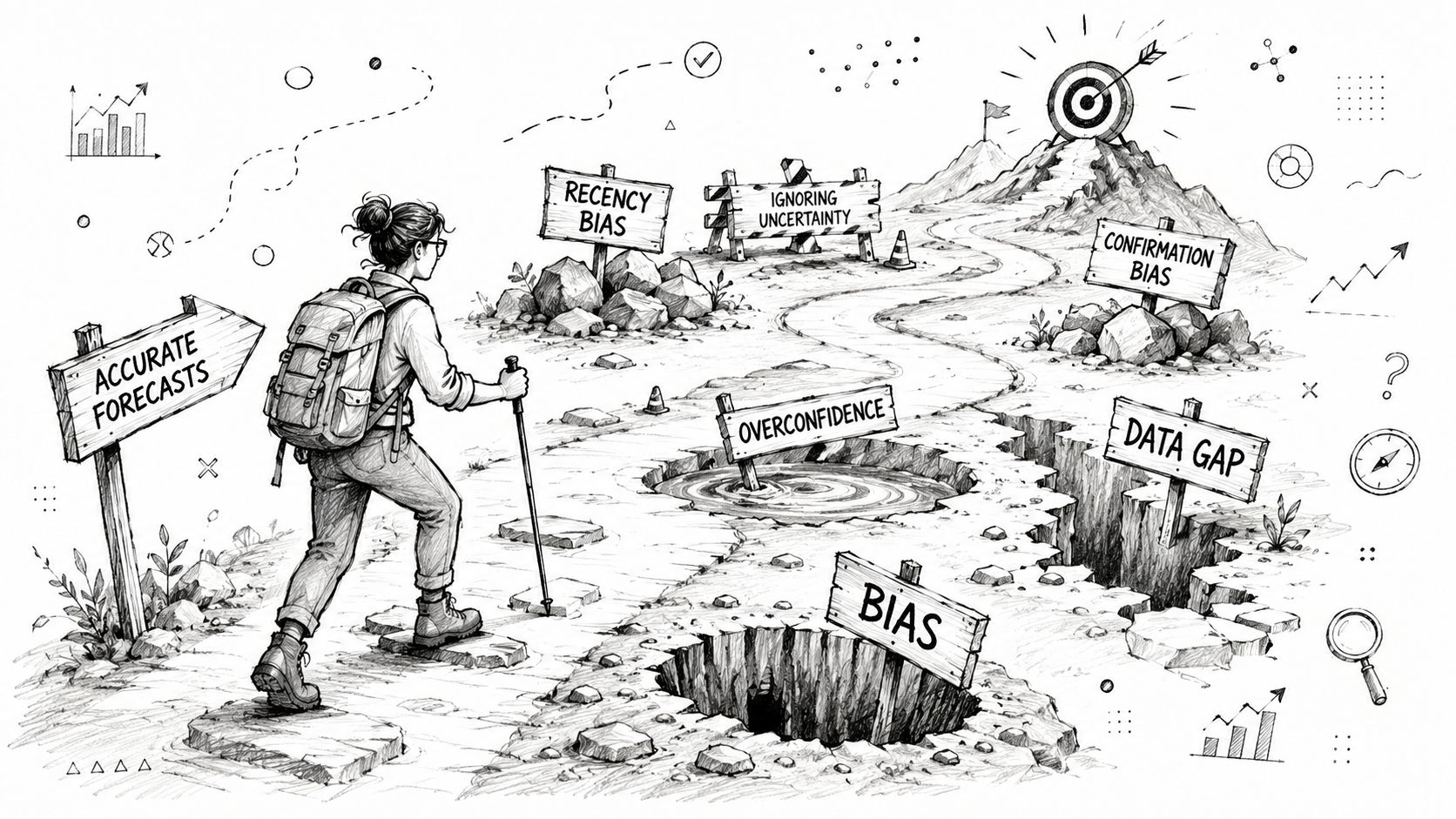
A common mistake is treating the CRM like a diary instead of a decision tool. If close dates aren't updated, stages are inflated, or reps leave dead deals open, the forecast is compromised before the meeting starts.
Another mistake is over-trusting one input. Historical trends alone can mislead. Rep judgment alone can mislead. Stage weighting alone can mislead. Good forecasts work because they combine evidence, not because they worship one model.
Watch for forecast lag
A newer problem is forecast lag. Teams still run forecasting as if pipeline changes slowly, but AI-driven outbound can make pipeline much more volatile. A 2024 Harvard Business Review study found that teams using AI for outbound have 3.5x more volatile pipelines than traditional teams, yet most guidance still doesn't show leaders how to adjust forecasts for that volatility.
That means a monthly or quarterly snapshot can become stale fast.
Here's a useful walkthrough on the topic:
Keep this checklist in front of you
Clean the data first so stage, amount, and close date mean something.
Challenge optimism consistently instead of only near quarter end.
Inspect deal movement because stale opportunities distort confidence.
Update forecasts regularly when pipeline changes quickly.
Compare forecast to actuals so the process improves, not just repeats.
A forecast should help you act earlier, not explain later why the number missed.
If you want a simpler way to connect pipeline, outbound activity, CRM data, and revenue planning in one place, take a look at Stamina. It's built for growing SMBs that need clearer visibility into what's moving, what's slipping, and what revenue is likely to land.

